
Our readers keep the lights on and the weekend projects moving. As an Amazon Associate, I earn from qualifying purchases.
Specs are compiled from manufacturer listings and verified buyer reviews and can change over time — please confirm the key details on the product page before buying.
You buy a bench plane to make boards flat and smooth without sanding. But most new planes need hours of setup before they can take a proper shaving — and some never get there. The difference between a plane that frustrates you and one that glides across a board, peeling off 0.001-inch curls, depends on three things: how flat the sole (the bottom that slides on the wood) is from the start, how long you will spend tuning it, and whether the blade steel holds an edge.
I’m Rikta — the founder and writer behind FitlyFast. This guide is built by comparing the manufacturers’ published specifications and the patterns across verified customer reviews, so you get each pick’s real strengths and trade-offs instead of marketing spin.
After looking at the specs and real owner experiences across six models, here is the reality of what separates a keeper from a time-sink in the bench plane category — and which ones are genuinely worth your money.
Quick Picks
- Woodriver #4 Bench Plane, V3 — Best Overall
- Stanley 1-12-137 62-Low Angle Sweetheart Jack Plane — Premium Pick
- Woodriver #5 Bench Plane, V3 — Heavy Stock
- Taytools 469614 Smoothing Bench Hand Plane #4 — Ductile Iron Value
- Groz 39702 JP/5 Jack Plane No. 5 — Budget Jack
- STANLEY Hand Planer, No.4 — Entry Level
How To Choose The Best Bench Plane
The first thing to understand is that almost every bench plane under about needs some amount of setup — flattening the sole, honing the blade, and cleaning up machined surfaces. The difference is whether that takes 20 minutes or an entire weekend. Your choice depends on how much of that work you are willing to do.
Sole Flatness Is Everything
A bench plane’s sole is the reference surface. If it is not flat, the plane will rock and never take an even shaving. The critical spec here is the flatness tolerance — you want a sole ground to within about 0.003 inches (the British Standard). Some premium models deliver this from the start; budget models often require you to lap the sole yourself using sandpaper on a flat surface.
Blade Steel and Setup Time
The cutter (blade) material determines how long it stays sharp. Tougher steel holds an edge longer but takes more effort to sharpen. Softer steel sharpens quickly but needs more frequent honing. The real catch is the back of the blade — it must be lapped perfectly flat before the cutting edge can be sharpened. Several buyers report spending 4-plus hours lapping the concave back of a blade flat.
Number 4 vs Number 5
A #4 plane (about 9.75-inch sole) is a smoother — used for final finishing passes. A #5 plane (about 14-inch sole) is a jack plane — used for heavier stock removal and flattening. A #4 is lighter and more maneuverable; a #5 is more versatile for dimensioning rough lumber. Most beginners benefit from starting with a #4, then adding a #5 later.
Quick Comparison
| Model | Best For | Sole Length | Weight | Setup Time | Amazon |
|---|---|---|---|---|---|
| Woodriver #4 Bench Plane, V3 | Minimal-prep premium smoother | 9-7/8 in | 5.35 lb | ~20 min | Amazon |
| Stanley Sweetheart Jack Plane | Out-of-box performance | 15.94 in | 6.29 lb | Minimal | Amazon |
| Woodriver #5 Bench Plane, V3 | Heavy stock removal jack | 13-7/8 in | 6.8 lb | ~20 min | Amazon |
| Taytools #4 Smoothing Plane | Ductile-iron value | 9-3/4 in | 4.11 lb | 4+ hours | Amazon |
| Groz #5 Jack Plane | Budget dimensioning | 14 in | — | ~40 min | Amazon |
| Stanley #4 Hand Planer (12-404) | Entry-level price | — | 2.75 lb | 6+ hours | Amazon |
In‑Depth Reviews
1. Woodriver #4 Bench Plane, V3
The smoother that lands ready to work, not ready to fight.
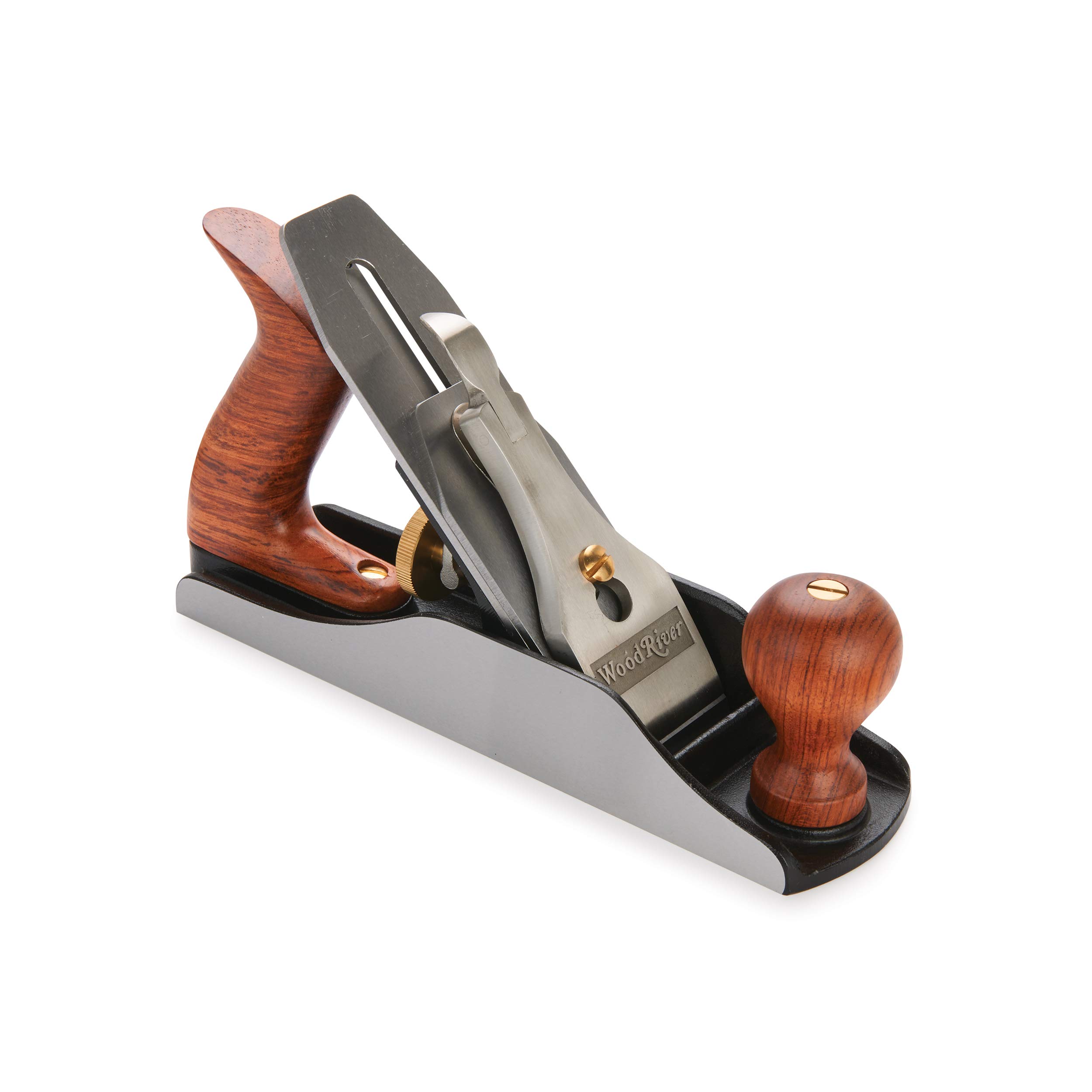
You get finish-ready shavings from this Woodriver #4 within about 20 minutes of opening the box, which is dramatically faster than most other planes in this price range. It is modeled after the classic Stanley Bedrock design and uses a fully machined frog (the adjustable ramp that supports the blade) so the blade seats solidly. The sole and sides come machined flat and square within tight tolerances — this means you skip the hours of lapping (sanding the sole flat) that cheaper planes demand. One reviewer noted they only wiped off the rust-proofing oil, tightened a few screws, and honed the blade through a 1000-16000 grit progression. Then it was slicing 0.001-inch (0.025 mm) ribbons off hard maple — thin enough that sanding is unnecessary.
At 5.35 pounds and a 9-7/8 inch sole length, it is heavy enough to carry momentum through a cut without tiring your arms over a long session. The lightly finished Bubinga handles (a dense African hardwood) give a comfortable grip — one reviewer standing 6-foot-3 said the handles fit his hands well. The 2-inch wide blade (made of tool steel in the V3 upgrade) is thick, which nearly eliminates blade chatter (vibration that causes a rough surface). However, the enlarged adjustment wheel on the V3 blocks access to the frog screws, so you set the frog once and leave it. A few owners also noted a slight amount of slop (looseness) in the lever cap and yoke (parts that hold the blade), which creates backlash (play) in the depth adjuster — about a quarter turn of the knob before the blade actually moves.
Compared to the Stanley Sweetheart jack plane, one reviewer directly said this Woodriver requires far less tuning and gives comparable or better results at a similar price. Unlike the Taytools #4 (which has owners spending over 4 hours lapping the blade back), the Woodriver’s blade back came flat on every review examined — only a quick hone and it was ready.
Straight to Work
- Minimal setup (about 20 minutes) — sole dead flat from the start
- Thick V3 iron eliminates blade chatter on end grain
- Comfortable Bubinga handles with brass hardware
Two Quirks
- Enlarged adjustment wheel blocks frog screws after initial setup
- Some backlash in lever cap and yoke (depth adjuster play)
Your best first plane: If you want a premium-quality smoother that works on day one with just a blade hone, this is the pick — minimal frustration, top-tier feel, and no 4-hour lapping sessions.
skip it if: You need a jack plane (longer sole for stock removal) rather than a #4 smoother, or you are on a tight budget that forces you toward entry-level prices.
2. Stanley 1-12-137 62-Low Angle Sweetheart Jack Plane

The jack plane that actually works right from the start.
Among all the planes in this roundup, this Stanley Sweetheart is the one most reviewers agree needed almost no setup. Multiple owners said the sole (the bottom that slides on the wood) was “dead flat” and the blade “sharp from the start” — they only needed a quick strop (a light polish on leather) before it produced thin curls on oak and poplar. The low-angle design beds the blade at 12 degrees instead of the standard 45 degrees. This makes it especially good at cutting end grain (the cut ends of a board) and reducing tearout (ragged fibers) on figured wood (wood with wavy or irregular grain patterns). That is a major advantage over a standard-angle jack plane when you work on tricky grain.
The one-piece base and frog casting (the part that holds the blade) is a standout feature. It eliminates the joint between the frog and the body that can introduce vibration and chatter on traditional two-piece designs. The patented lateral adjustment locking feature keeps the blade locked in place side-to-side, so it does not drift mid-cut. At 6.29 pounds, it is noticeably heavier than the Woodriver #4 (5.35 lb) and compared to the entry-level Stanley #4 at 2.75 pounds. That mass gives it serious momentum for hogging off material quickly. The cutter width is 2 inches, matching the other planes here, but the blade is a thick 0.187 inches — thicker than standard blades on most #4 smoothers, which contributes to chatter-free cuts.
The honest trade-off is that not every unit arrives perfect. One buyer mentioned that their plane, still marked “made in Mexico,” was not as flat as they expected and required about an hour of flattening with sandpaper on a reference surface. Another noted the handle was slightly loose on arrival. But the majority of reviews — five out of five — describe it as “good right from the start,” which is a far better batting average than the Groz or entry-level Stanley.
Out-of-Box Ready
- Low-angle design cuts end grain cleanly and reduces tearout
- One-piece base/frog eliminates chatter vs two-piece designs
- Thick 0.187-inch blade holds edge well and resists chatter
Watch For
- Some units may need an hour of sole flattening (varies by batch)
- Heavier than a #4 smoother — less nimble for final finishing
Best for low-friction setup: If you want a premium jack plane that is ready to cut with minimal fuss — and you work with end grain or figured boards regularly — this is the one to reach for.
Look elsewhere if: You need a dedicated smoother (#4 size) for final finishing passes; the 15.94-inch sole of this jack plane makes it less precise for that task.
3. Woodriver #5 Bench Plane, V3

The jack plane that chews through rough lumber with heft to spare.
Where the Woodriver #4 is a smoother for final finishing, this #5 jack plane is its bigger, heavier sibling — built for the first job of dimensioning rough-sawn timber (cutting lumber to size and making it flat). At 13-7/8 inches long and 6.8 pounds, it has the mass and the longer sole to ride across high spots on a board and take heavy passes without bogging down. The body is made from stress-relieved ductile iron castings (a tougher, less brittle type of iron than standard grey cast iron). Reviewers describe the painted and machined surfaces as “flawless and dead flat.”
Setup time mirrors the Woodriver #4 — about 20 minutes of wiping off shipping oil, tightening screws, and honing the 2-inch wide blade. One reviewer, who also owned a Stanley Sweetheart, said this Woodriver #5 required “far less tuning” and outperformed the Sweetheart in his shop. The blade is thicker on the V3, which eliminates the blade chatter that plagued earlier versions. A buyer noted it “slices 0.001-inch ribbons off hard maple” after a proper hone. The Bubinga handles are the same comfortable design as the #4, with brass screws and an oiled finish.
The two consistent complaints mirror the #4: the enlarged depth adjustment wheel blocks access to the frog screws (so set the frog once and leave it), and there is some slop in the lever cap and yoke that creates backlash in the depth adjuster — you turn the knob a small amount before the blade actually responds. A few owners also noted the lateral adjuster (which moves the blade side-to-side) feels stiff initially, though it loosens with use.
Built for Heavy Work
- 6.8-pound mass and 13-7/8 inch sole excel at stock removal and flattening
- Dead-flat sole and square sides from the start — minimal lapping needed
- Thicker V3 iron stops chatter even on hard maple
Setup Quirks
- Adjustment wheel blocks frog screws after initial setup — set once
- Backlash in depth and lateral adjusters; not a dealbreaker but noticeable
Best for heavy dimensioning: If you work with rough lumber regularly and need a jack plane that takes heavy passes without chatter — and you want minimal setup — this Woodriver #5 is the tool.
pass on it if: You only need a smoother for final finishing (the #4 Woodriver above is lighter and more maneuverable for that job), or you are on a tight budget.
4. Taytools 469614 Smoothing Bench Hand Plane #4

The smooth operator that demands elbow grease before it delivers.
This Taytools #4 has a body and frog made from ductile cast iron — a tougher alloy than the grey cast iron used on the Groz and entry-level Stanley. Ductile iron is less prone to cracking and holds machined surfaces better over time. The sole is precision ground to within 0.003 inches (the British Standard for flatness), and the sides come lapped square. The oiled and hand-rubbed Sapele (a dense African hardwood) tote and knob give it an appearance that punches above its price. The blade is 0.120-inch thick tool steel, hardened to 55-60 on the Rockwell C scale (a hardness measure for steel — higher numbers mean harder steel that holds an edge longer).
But here is the real story: the setup time on this plane is significant — and multiple buyers have documented it. One reviewer wrote, “it actually took me just over 4 hours (I’m not exaggerating) of diamond stone lapping to get it flat across the back of the cutting edge and far enough back from that to assure good clamping.” Another buyer reported that the first unit they received had excess casting material under the frog that prevented proper blade advancement; they had to exchange it for a second that was properly machined. A third noted a burr (a sharp raised edge) in the throat (the opening in the sole where the blade protrudes) that scratched the work surface. The pattern is clear: when you get a good unit, it is “every bit as described and equal to the one I saw reviewed on YouTube.” But quality control is inconsistent.
Compared to the Woodriver #4 (which costs more), the Taytools requires dramatically more setup — hours vs minutes. That said, buyers who got a good one report that after flattening and honing, it takes shavings as thin as 0.0003 inches and as thick as 0.15 inches, and that it is “easily as nice as a tool at twice its price.” At 4.11 pounds, it is the second-heaviest #4 in this roundup (behind the Woodriver at 5.35 lb), giving it good mass for a smoother.
The Upside
- Ductile cast iron body is tougher and more durable than grey cast iron
- Beautiful Sapele handles with hand-rubbed oil finish
- Precision ground sole to 0.003-inch tolerance (on a good unit)
The Real Cost
- Inconsistent QC — some units have casting defects, concave blade backs, or burrs
- Setup can take 4+ hours of lapping (blade back and sole)
Great if you have the patience: If you enjoy tuning a tool as a project in itself and want ductile-iron durability at a lower entry cost — and you are willing to risk a return if the first unit is bad — this can reward you with a fine-performing smoother.
Not for beginners: If you want a plane that works with minimal fuss, the setup time here will frustrate you; the Woodriver #4 is the better choice for your first or only smoother.
5. Groz 39702 JP/5 Jack Plane No. 5

The jack plane that works decently after a quick tune-up.
If you need a #5 jack plane for heavy stock removal and you are trying to keep costs down, this Groz is the most affordable option that still has a real chance of performing well after a reasonable setup. The grey cast iron base is precision machined with a flatness tolerance up to 0.003 inches (0.075 mm) — the same spec as the premium planes. The 14-inch sole is well suited for riding across high spots on rough boards, and the 50 mm (1.97 inch) cutter width is nearly identical to the 2-inch standard — imperceptible in use. The hardwood handle and knob (with brass detailing) feel better in hand than the all-plastic handles on the entry-level Stanley.
The setup time is the moderate story here. One owner reported: “Requires 40 min fettling (flatten back, lap chip breaker/sole)” — and they called it a great deal for the price. Another said the sole arrived flat, the sides were out of square, and the blade (about 2 mm thick at a 25-degree grind) sharpened quickly thanks to the soft steel. That softness is a trade-off: it sharpens fast on stones, but it also loses its edge faster than the harder steel on the Woodriver or Sweetheart. Several reviewers noted the depth adjustment knob has noticeable backlash — you turn it some distance before the blade moves — and the lever cap can slip if overtightened.
A few owners had worse luck. One called it the “worst plane bought,” saying the sole had burrs and was not flat, requiring days of sanding. Another noted that although the plane has “nice balance,” the warped sole defeated the purpose of flattening. The pattern with the Groz is the same as the Taytools and entry-level Stanley: quality varies unit to unit. But if you get a good casting, a 40-minute setup is realistic — which is far less than the 4+ hours needed for the Taytools.
Affordable Heavy Lifter
- 14-inch sole and 1.97-inch cutter are capable for stock removal
- Precision machined base with 0.003-inch flatness spec (varies by unit)
- Soft steel sharpens quickly; good for a budget sharpening setup
Unit-to-Unit Risk
- Some soles arrive with burrs or out of flat — quality control is inconsistent
- Soft blade steel dulls faster; needs more frequent honing
- Backlash in depth adjuster and potential lever cap slipping
Best for the patient budget shopper: If you need a jack plane for dimensioning rough lumber, you have sharpening stones and about an hour for setup, and you are willing to take the QC gamble — the Groz delivers for its price.
Buy from a generous return policy: Given the QC risk, order from a retailer that makes returns easy; the first unit may need exchanging for a good one.
6. STANLEY Hand Planer, No.4, Adjustable, 2-Inch Cutter (12-404)

The classic starter plane that asks for more work than it saves.
Let’s be honest about what this plane is: it is the most affordable way to get a Stanley-branded cast iron #4 smoother into your shop. The cast-iron base has an epoxy coating for corrosion resistance, the cutter is hardened and tempered steel, and the high-impact polymer handles are contoured. The cutting width is the standard 2 inches. It is also the lightest plane in this roundup at 2.75 pounds — compared to the Taytools #4 at 4.11 pounds and the Woodriver #4 at 5.35 pounds. That lightness means less mass to carry a cut through dense wood.
The reviews tell a tough story. The most detailed buyer report reads: “Requires 6+ hours to flatten sole and sharpen blade.” Another owner described it as “cheap plane nearly worthless after opening” and said that even after hours of lapping he could not get the sole flat enough for fine work — adding that he spent + in supplies trying. A third called it a “good budget option if you have sharpening tools and time.” A positive note: those who put in the work said that after tuning, the plane “works well” and “cuts better than untuned Stanley.”
The honest verdict: this plane is a project in itself. It is for someone who already owns sharpening stones, a reference flat surface, and sandpaper or diamond plates — and who wants to learn how to tune a plane from the ground up. For anyone who just wants to take a shaving off a board, the higher cost of the Woodriver #4 or the Stanley Sweetheart is money saved in frustration.
The Upside
- Cheapest cast-iron bench plane you will find from a trusted brand name
- With extensive tuning, it can perform decently for the price paid
The Real Trade-off
- 6+ hours of setup work (sole flattening and blade lapping) is common
- At 2.75 lb, it lacks the mass for smooth, chatter-free cuts on hard woods
- Handle reported as too small for larger hands; rough polymer may need sanding
Only for the dedicated tinkerer: If you want to learn plane tuning from scratch and have the tools and patience for a long setup project, this is your canvas.
Skip it for actual woodworking: If you want a plane that makes furniture, not a hobby project out of itself, spend the extra money on a Woodriver #4 or a Stanley Sweetheart.
Understanding the Specs
Ductile Iron vs Grey Cast Iron
The material of the plane body determines how well the sole stays flat over years of use. Ductile cast iron (used by the Taytools and Woodriver planes) has a nodular microstructure that makes it tougher and less brittle than traditional grey cast iron (used by the Groz and entry-level Stanley). The practical difference: ductile iron resists cracking if you drop the plane and maintains its machined flatness better over time — an important consideration since the sole is the entire reference surface.
Frog and Blade Bedding
The frog is the angled casting inside the plane body that the blade rests against. A fully machined frog (metal-to-metal contact) reduces blade chatter and makes adjustments more consistent. Some budget planes leave the frog surface as-cast (rough and unpainted), which can cause the blade to shift during a cut. On premium planes, the frog is machined flat and the blade seats precisely — this is one of the main specs separating a plane from a plane in terms of actual performance.
FAQ
What does “fettling” mean for a new bench plane?
Should I buy a No 4 smoother or a No 5 jack plane as my first bench plane?
How do I check if a bench plane sole is flat?
Why does the blade need to be lapped flat on the back?
Can I use a bench plane as a shooting board plane?
What does the “two inches” cutter width mean in practice?
How long should a bench plane last?
What is backlash in the depth adjustment, and does it matter?
Why do some planes need lapping even though they claim a 0.003-inch flatness tolerance?
Can I flatten a concave plane sole without a surface plate?
Final Thoughts: The Verdict
Across the board, the bench plane winner is the Woodriver #4 Bench Plane, V3 because it delivers premium-level machining and a dead-flat sole without requiring hours of setup — you can sharpen the blade and start cutting in about 20 minutes. If you want a low-angle jack plane that works even better from the start for end-grain and figured wood, grab the Stanley Sweetheart Low Angle Jack Plane. And for heavy stock removal on a budget with moderate setup, the Groz #5 Jack Plane gives you a 14-inch sole at a price that leaves room in your budget for sharpening stones.
How We Picked
We do not accept paid placement. Every pick is matched to a real buyer and a real use-case; we do not hands-on test units.
Sources & Methodology
Specifications: manufacturer listings and product documentation. Review insights: verified customer reviews, as of July 2026. Pricing: not shown on this page (it changes often); check the current price via the retailer link.
As an Amazon Associate, FitlyFast earns from qualifying purchases. This does not affect which products we feature.