
Our readers keep the lights on and the weekend projects moving. As an Amazon Associate, I earn from qualifying purchases.
Specs are compiled from manufacturer listings and verified buyer reviews and can change over time — please confirm the key details on the product page before buying.
You finish a hike and your feet ache more than your legs. The stock insoles that came with your boots are thin and flat. They leave your arches unsupported, your heel sliding, and every sharp rock on the trail jabbing up through the sole. A good aftermarket insert changes that. It locks your foot in place, absorbs shock, and supports your arch so your energy goes forward into the trail, not into sore joints.
I’m Rikta — the writer behind FitlyFast. This guide compares manufacturers’ published specs and patterns from verified customer reviews. You get each pick’s real strengths and trade-offs, not marketing claims.
This breakdown of the best boot inserts for hiking helps you find the pair your feet need, if you want rigid carbon-fiber support for rocky ground or plush cushion for multi-day treks.
Quick Picks
- PowerStep Pinnacle Hiker Orthotic Insoles — Best Overall
- Superfeet Hike Cushion Insoles — Cushion King
- SOLE Performance Thick Insoles — Custom Fit
- CURREX HikePro Insoles — Stability Specialist
- Superfeet Hike Women’s Support Insoles — Women’s Fit
- Kinergy Hiking Boot Insoles — Balanced Pick
- Welnove Carbon Fiber Insoles — Rigid Protection
How To Choose The Best Boot Inserts For Hiking
Picking the right insole depends on three things: your arch shape, where you feel pain, and how much room your boots have. Here is what to focus on.
Arch Height and Support
Your arch type determines how much support you need. Low arches or flat feet generally need a high-support, semi-rigid insole that prevents overpronation (your foot rolling inward when you step), while high arches need cushioning to absorb the shock your foot cannot naturally soften. Many premium inserts offer low, medium, and high arch profiles so you match your foot exactly.
Heel Cup Depth
A deep heel cup wraps around your heel bone to lock it in place, reducing friction that causes blisters and giving you a stable platform on side slopes or downhill descents. Shallow cups allow heel slip, which makes your feet work harder to stay stable.
Cushioning vs. Rigidity
Softer insoles feel great on flat trails but compress too quickly on rocky terrain where you need protection from sharp stones. Rigid carbon-fiber or firm cork models sacrifice a bit of initial plushness but stop rocks from poking through and provide better energy return for long miles.
Quick Comparison
| Model | Best For | Weight | Arch Type | Thickness | Amazon |
|---|---|---|---|---|---|
| PowerStep Pinnacle Hiker | Flat feet & high arches | — | Medium-High | Thicker | Amazon |
| Superfeet Hike Cushion | Heavy rucking & cushion | 4.97 oz | Medium-High | Thick (quarter-inch) | Amazon |
| SOLE Performance Thick | Custom moldable support | 4.8 oz | All (heat-moldable) | 4.8 mm | Amazon |
| CURREX HikePro | Low arches & stability | 4.59 oz | Low, Med, High options | Medium | Amazon |
| Superfeet Hike Women’s | Women’s-specific fit | 4.66 oz | Medium-High | Medium | Amazon |
| Kinergy Hiking Insoles | Value & balance | 3.53 oz | Medium | 1.1 in | Amazon |
| Welnove Carbon Fiber | Rigid injury prevention | 7.83 oz | High | Thick | Amazon |
In‑Depth Reviews
1. PowerStep Pinnacle Hiker Orthotic Insoles

Flat-footed hikers call this arch-dominant insole a standout.
Podiatrists often recommend this insert first for flat feet or serious arch support needs. The PowerStep Pinnacle Hiker’s podiatrist-designed arch relieves plantar fasciitis and overpronation. One buyer with very flat feet wrote that “the Pinnacle Hiker Arch Support Hiking Boot Insole is hands down one of the best insoles I’ve ever used.” The support feels firm at first, but reviewers report it handles 16-mile days without foot pain. One hiker said they nearly turned around for another loop after finishing.
Unlike softer insoles that compress over time, the Pinnacle Hiker holds its shape after many trail miles. Buyers report it provides the most sturdy arch support they have found among hiking insoles. But the thickness is a trade-off: these are on the thicker side, so if your boots fit snug already, your toes may feel cramped. Buyers also mention they feel hard at first and need a short break-in period.
A 2021 customer survey found 90% of PowerStep users report less foot, knee, or back pain within two weeks.
What keeps you hiking
- Podiatrist-designed arch that flat feet users call class-leading
- Semi-rigid support holds up through many miles without compressing
- Made in the USA
What to watch for
- Thicker build may crowd toes in snug boots
- Firm feel right from the start; needs a short break-in
Reach for this if: You have flat feet, plantar fasciitis, or pronation and want the most supportive insole on the list.
Look elsewhere if: Your boots fit tightly with zero extra room — the thickness here could pinch.
2. Superfeet Hike Cushion Insoles

Plushy enough for heavy packs, stable enough for sharp rocks.
This insole — formerly sold as Superfeet ADAPT Hike Max — uses Adaptive Comfort Technology that flexes with your foot for efficient heel-to-toe movement. Buyers specifically recommend it for heavy rucking (carrying 30-60 pounds for 3-10 miles), saying it cured knee pain from collapsed military boot insoles within five days. A reviewer who tested them on a 3-mile walk reported no soreness, and another called them the perfect replacement for the thin insoles in Salomon X Ultra 360 boots, noting the midfoot cushion protects from sharp rocks.
There is a catch: at roughly a quarter-inch thick, these are among the thickest insoles here. One reviewer noted they caused heel rubbing and toe squishing in snug shoes like Merrell Jungle Mocs, so they work best in lace-up, over-the-ankle boots with extra interior depth. The moisture-wicking top cover helps keep odors down on multi-day trips.
At 4.97 ounces (Hike Cushion) and 3.53 ounces (Kinergy), the Hike Cushion delivers noticeably more plushness underfoot for those carrying heavy loads.
Trail-tested strength
- Heavy ruckers (30-60 lbs) report cured knee pain within days
- Thick midfoot cushion protects feet from sharp rocks
- Moisture-wicking top cover reduces odor
Fit caveat
- Quarter-inch thickness can cause heel rubbing in snug boots
- One buyer mentioned the orange center circle detached after months
Pick these for: Long treks with a heavy pack where you need maximum cushion and arch support together.
Skip them if: Your boots fit like a second skin with no room for a thick insole.
3. SOLE Performance Thick Insoles

The oven-bake insole that molds to your exact foot shape.
What sets SOLE apart is the heat-moldable ReCORK base: you warm these in the oven, then step into them so they form to your specific arch height — low, medium, or high. The Thick profile measures 4.8mm total with 3.2mm of cushioning on a firm cork base, built for boots with extra interior space. Owners mention they last years in military boots and work boots without flattening or peeling, with one calling them “probably the best inserts I have ever purchased” after twelve-to-fourteen-hour days in boots over several months.
Unlike the Superfeet above which are trim-to-fit only, SOLE offers three thickness levels (Thin, Medium, and Thick), so you pick based on your boot’s depth. A podiatrist recommended these to one reviewer for heel stabbing pain, and they helped. The cork surface is firmer than foam, so if you prefer squishy cushion, this will not feel the same as the Superfeet Hike Cushion.
Molded advantage
- Heat-moldable cork conforms to any arch type for personalized fit
- Extremely durable: customers note no flattening after months of daily wear
- Three thickness options let you match your boot’s interior volume
Before you buy
- Firm cork feel is less plush than foam-based insoles
- Heating process adds a step before first use
Best for: Anyone whose arch does not match standard shapes — the heat molding gives a truly custom feel.
Not for: People who want instant, squishy softness without any break-in or prep.
4. CURREX HikePro Insoles

The low-arch hero that locks your heel in place on steep descents.
CURREX’s HikePro uses a deep decoupled heel cup (a cup that is separated from the arch to move independently) with a SuperGrip anti-slip surface that wraps and holds your heel in place. This is critical for stability on uneven ground and downhill sections. Buyers with low arches specifically mention it solved arch pressure issues that stock insoles caused. One reviewer completed a 3-day trek with a 30-pound backpack and said the HikePro helped support their arch the whole way. The insoles come in low, medium, and high arch profiles so you pick your exact match.
At 4.59 ounces (CURREX) and 7.83 ounces (Welnove), these are lightweight. Some reviewers question the long-term durability given the price, but the immediate comfort and blister prevention they report makes this a strong pick for low-arch hikers who want a locked-in feel. The recycled EVA (ethylene-vinyl acetate, a flexible foam) base with air vent technology keeps feet drier than solid foam models.
Locked-in feel
- Deep heel cup with anti-slip surface prevents heel lift on descents
- Available in low, medium, and high arch profiles for a precise fit
- Lightweight at 4.59 oz; breathable recycled EVA base
Value trade-off
- Price feels high relative to materials used
- Some users worry about long-term durability after months of use
Reach for these if: You have low arches and want the most secure heel lock for steep, technical terrain.
Consider the Superfeet instead if: You need a thicker cushion for heavy pack loads.
5. Superfeet Hike Women’s Support Insoles
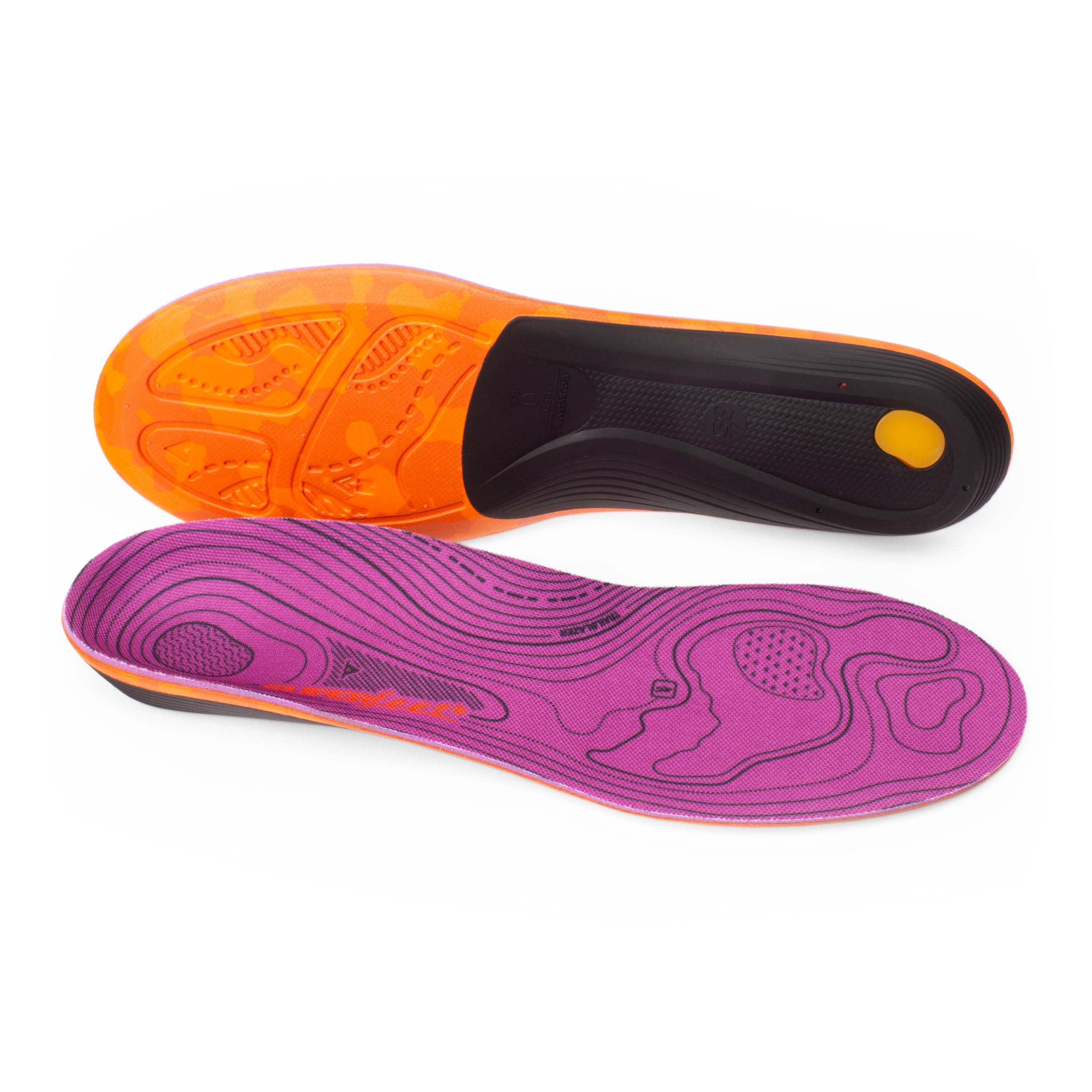
Built for women’s feet on rough terrain, with a carbon stabilizer for responsive support.
This women’s-specific insole — previously sold as the Women’s Trailblazer Comfort — uses a proprietary EVOLyte carbon fiber and polymer blend. This blend provides responsive, weight-defying support without adding bulk. The medium-thickness design and dual-layer cushioning fit well in lace-up hiking boots. Buyers with psoriatic arthritis report no foot soreness after long hikes. One noted it is her fourth pair, saying “I have them in all my boots now” because they keep her heel from sliding forward on steep inclines.
The 4.66-ounce weight is comparable to the CURREX HikePro above, but the women’s-specific shape addresses how women’s feet differ — a narrower heel and different arch placement. Unlike the men’s/unisex Superfeet Hike Cushion, this one focuses on stability rather than plush cushion. It works best for hikers who want a supportive, medium-profile insole that fits well in boots without adding bulk.
Female-focused design
- Women’s-specific shape with medium-high arch and narrower heel fit
- EVOLyte carbon fiber stabilizer provides lightweight, responsive support
- Keeps heel from sliding forward on steep inclines
Consider before buying
- Arch placement may feel off for some flat-footed women
- Minimal sole cushion compared to thicker models
Ideal for: Women with medium-to-high arches who want a slim, supportive insole that does not crowd the boot.
Not for: Those with flat feet who need a more aggressive arch or thick cushioning.
6. Kinergy Hiking Boot Insoles
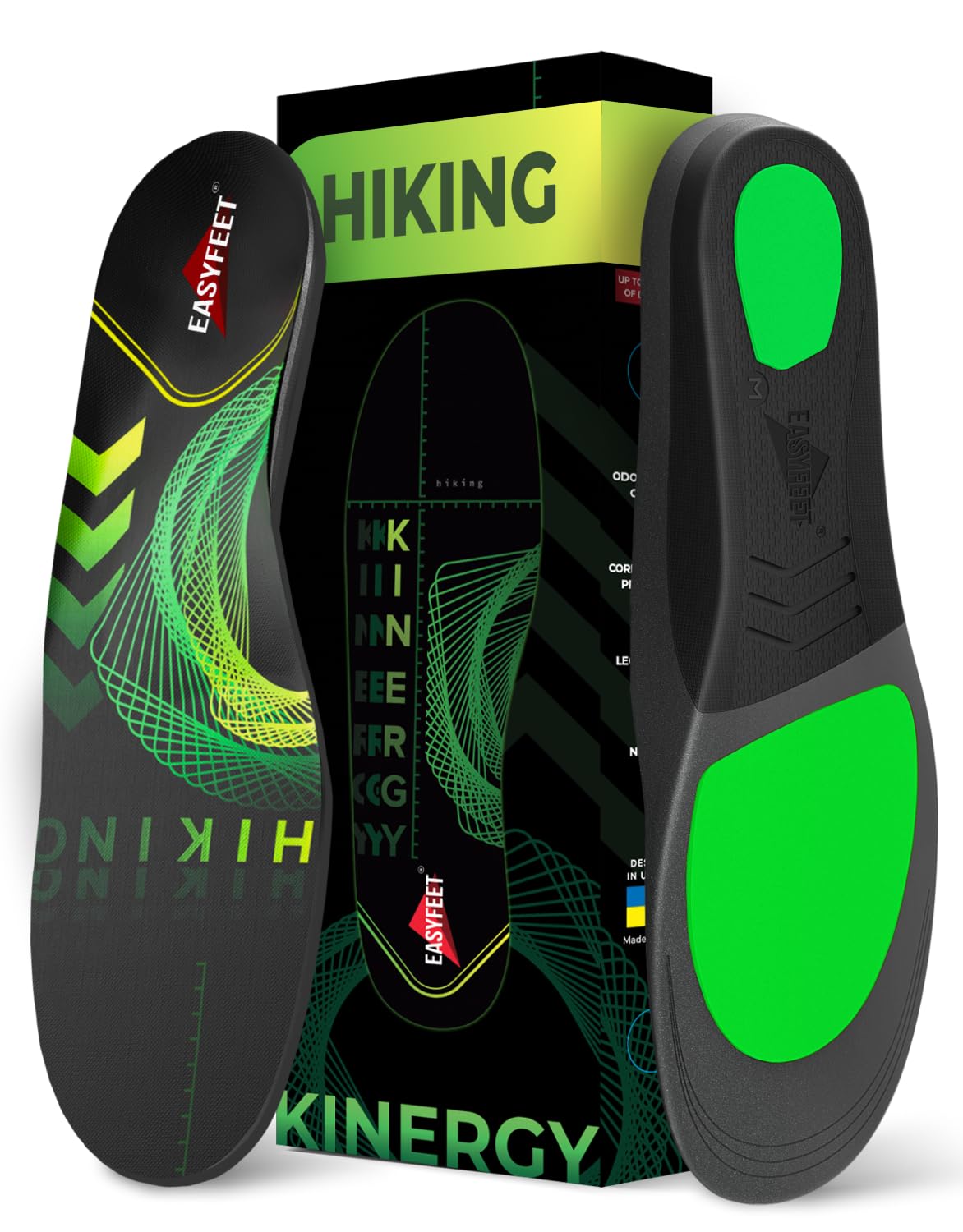
The lightweight entry that feels cushioned from the first step.
At 3.53 ounces (Kinergy) and 7.83 ounces (Welnove), the Kinergy insoles are lightweight. They use EnerBoost Tech for energy return and Joint Protect Tech designed to help prevent impact stress on joints. Reviewers point out they fit perfectly in Merrill hiking boots straight from the start without trimming, calling them “cushioned” with “perfect arch support.”
These are a mid-range option that balances price and performance well. Shoppers say they are softer than rigid carbon insoles but still provide good arch support without feeling like “wooden shoes,” as one buyer put it. The breathable cover and non-sweat layer help keep feet dry on long hikes. If you are replacing worn-out insoles and want something that works immediately with zero break-in, this is a solid choice.
Why they work
- Ultra-light at 3.53 oz; barely adds any weight to your boots
- Comfortable right from the start with no break-in needed
- Breathable cover keeps feet drier than solid foam insoles
Trade-offs
- May not fully alleviate existing foot pain for some users
- Less rigid support than carbon-fiber options for rocky terrain
Best for: Hikers who want a lightweight, comfortable upgrade that works from day one without a break-in period.
Look to the PowerStep if: You have serious arch or flat-foot issues that need maximum support.
7. Welnove Carbon Fiber Insoles

The stiff carbon plate that shields feet from rocks but demands a patience period.
If your main concern is protection from sharp rocks and uneven ground rather than plush cushioning, the Welnove Carbon Fiber insole is the most rigid option here. Made from aerospace-grade carbon fiber, it minimizes foot bending and provides stability for injuries like Hallux Rigidus (stiff big toe joint), Turf Toe (sprained big toe), and foot fractures. Buyers with these conditions call it “unbelievable,” noting it has softness on top for comfort but the stiffness underneath they need. One reviewer’s orthopedist recommended it for plantar fasciitis after a foot rupture, noting it prevents toe extension and reduces stress on the plantar fascia.
At 7.83 ounces (Welnove) and 3.53 ounces (Kinergy), this is a heavy insole. The heel cup sits higher, and some buyers report painful blisters because of it. One wrote, “My heels blistered badly as the height of the heel cup must be higher than my past insoles.” The manufacturer also warns these take up noticeable space and recommends limiting initial wear to three hours per day as your feet adjust.
Rock-solid build
- Rigid carbon fiber provides maximum protection from sharp rocks and uneven terrain
- Doctor-recommended for Hallux Rigidus, Turf Toe, and fracture recovery.
- Energy return technology gives a spring-like feel during movement
Heel cup warning
- High heel cup causes blistering for some buyers
- At 7.83 oz, it’s the heaviest insole here
- Tight fit; needs a break-in period of 3 hours per day
Who needs this: Hikers with specific foot injuries who need rigid, non-bending support and rock protection.
Avoid it if: You have normal feet and just want more cushion — the stiff cup and weight will not suit you.
Understanding the Specs
Arch Support Profile
This tells you whether the insole is shaped for low, medium, or high arches. If you have flat feet, a high-arch insole can cause pain by pressing into the wrong spot. Many insoles offer multiple profiles so you pick the one matching your foot. The PowerStep and Superfeet models target medium-to-high arches, while CURREX also offers a low-arch option.
Heel Cup Depth
A deeper heel cup wraps around your heel bone to hold it steady, which prevents it from slipping sideways on uneven ground and reduces friction that causes blisters. The CURREX HikePro’s SuperGrip anti-slip surface is a standout example. Shallow cups let your heel move around, making your foot work harder to stay stable.
FAQ
Will these insoles fit my hiking boots?
How do I know what arch height I have?
Can I use these insoles in shoes other than hiking boots?
How long do hiking insoles typically last?
What is the difference between carbon fiber and foam insoles?
How do I clean my hiking insoles?
Will thick insoles make my boots too tight?
Do these insoles help with plantar fasciitis?
Are women’s-specific insoles really different from unisex ones?
How do I break in a new pair of rigid insoles?
Final Thoughts: The Verdict
For the majority of shoppers, the best boot inserts for hiking is the PowerStep Pinnacle Hiker because it delivers podiatrist-level arch support that flat-footed and high-arched hikers alike call class-leading, and it holds its shape mile after mile. If you want the thickest cushion for heavy pack loads, grab the Superfeet Hike Cushion. And for a custom-molded fit that adapts to any arch, the SOLE Performance Thick is the one to beat.
How We Picked
We do not accept paid placement. Every pick is matched to a real buyer and a real use-case; we do not hands-on test units.
Sources & Methodology
Specifications: manufacturer listings and product documentation. Review insights: verified customer reviews, as of July 2026. Pricing: not shown on this page (it changes often); check the current price via the retailer link.
As an Amazon Associate, FitlyFast earns from qualifying purchases. This does not affect which products we feature.