
Our readers keep the lights on and the weekend projects moving. As an Amazon Associate, I earn from qualifying purchases.
Specs are compiled from manufacturer listings and verified buyer reviews and can change over time — please confirm the key details on the product page before buying.
You are pulling a heavy deadlift, holding a guitar chord, or just tired of jars winning the fight. Your grip strength is what limits you. A good grip strengthener builds the muscles in your fingers, thumbs, wrists, and forearms so your hands can actually do the work without aching or quitting.
I’m Rikta — the founder and writer behind FitlyFast. This guide is built by comparing the manufacturers’ published specifications and the patterns across verified customer reviews, so you get each pick’s real strengths and trade-offs instead of marketing spin.
Here are the hand trainers that earned their spot after weighing resistance range, build material, and how real buyers actually use them. You get a clear look at the best grip strengtheners for different goals and budgets.
Quick Picks
- GD IRON GRIP 70 Hand Grip Strengthener — Top Performer
- JTHEW Grip Strength Tester Trainer — Smart System
- Hiyoga Grip Strength Trainer — Best Value
- Vive Finger Strengthener (3 Pack) — Rehab Ready
- YPCBYNBS Hand Exerciser — Budget Champion
- DILIMI Finger Strengthener — Musician’s Pick
- GM2 Grip Exerciser — Compact Sport
How To Choose The Best Grip Strengtheners
You pick the right hand trainer by matching the tool to your specific hand task—crushing, pinching, finger extension, or recovery. Here are the three decisions that matter most.
Resistance Range and How It Grows With You
If the resistance does not increase in small steps, you will either outgrow it in a week or get stuck at a plateau. Look for a model with at least 5-6 adjustment levels or interchangeable bands. A span from very light (around 5 pounds) to at least 150 pounds covers most people from rehab to heavy deadlifter.
Build Material: Plastic vs Metal vs Stainless Steel
Plastic is fine for light rehab use, but if you squeeze hard daily, look for a stainless steel spring or a copper core. A metal frame also resists the warping that happens when you leave a gripper in a gym bag or car. Check for “pure copper core” or “high-strength stainless steel” in the specs if you plan to use it for years.
Finger Isolation vs Full-Hand Crush
A standard V-shaped gripper works your whole hand at once, which is great for deadlifts and general strength. A 5-finger button or piston design lets you train each finger individually, which is critical if you are a guitarist, rock climber, or recovering from a finger injury. Decide if you need targeted finger work or overall hand power before picking a style.
Quick Comparison
| Model | Best For | Resistance Range | Finger Isolation | Material | Amazon |
|---|---|---|---|---|---|
| GD IRON GRIP 70 | Serious lifters & long-term use | 44–150 lbs (6 steps) | No (standard V-grip) | 4T iron, aluminum handles | Amazon |
| JTHEW Grip Strength Tester Trainer | Measuring & tracking progress | 11–132 lbs (trainer) + 400 lbs (tester) | No (standard grip) | Plastic, stainless steel | Amazon |
| Hiyoga Grip Strength Trainer | Balanced daily training | 11–220 lbs (adjustable) | No (cylinder grip) | Polypropylene, stainless steel spring | Amazon |
| Vive Finger Strengthener (3 Pack) | Rehab & targeted finger work | 1.5 / 3 / 5 lbs (3 levels, per finger) | Yes (4 individual pistons) | TPR rubber, plastic | Amazon |
| YPCBYNBS Hand Exerciser | Arthritis relief & rehab | 5–50 lbs (8 rubber bands) | Yes (sliding clip for thumb isolation) | Plastic, rubber | Amazon |
| DILIMI Finger Strengthener | Guitarists & musicians | Adjustable (copper core design) | Yes (5-finger button design) | Copper core, silicone top | Amazon |
| GM2 Grip Exerciser | Sports-specific quick training | 5 / 7 / 9 lbs (3 color-coded levels) | Yes (individual finger setup) | ABS plastic, SWPC springs | Amazon |
In‑Depth Reviews
1. GD IRON GRIP 70 Hand Grip Strengthener

The tank of hand grippers that refuses to quit, built for serious lifters who need a wide resistance curve.
Your grip strength progresses fast, so you need a trainer that grows with you instead of ending up in a drawer. The GD IRON GRIP 70 covers a massive span from 44 to 150 pounds, split into 6 distinct steps. That lets you inch up in small loads rather than jumping from easy to impossible. Three handle-width settings also change your range of motion when you close the gripper, so you can work on either a deep stretch or a short powerful squeeze.
The brand builds it from what it calls “4T iron” with aluminum handles and strong compression springs. Buyers generally agree it is “sturdy as a tank” and feels like it could outlast you. The trade-off is that sturdy build comes with rough metal knurling (the textured grip) on the handles. Some owners find it “hard on the hands,” and a few mention it can pinch the skin between your thumb and forefinger—though flipping the grip 180 degrees often fixes that. Unlike the Hiyoga grip trainer, which offers a wider 11–220 lb range but in a standard cylinder shape, the GD IRON GRIP gives you more control over handle width. Buyers report that the 70 kg version is “better than the 80 or 90 kg version for average strength” because the feel is more refined. It is made and patented (US 9,415,262 B2) in South Korea, and runs quietly without any annoying squeaks.
If you are a deadlifter, powerlifter, or anyone who wants one gripper to serve you for years, this is the pick that keeps pace.
What Stands Out
- 6 resistance steps from 44 to 150 lbs lets you progress steadily without buying multiple grippers
- 3 handle-width settings change your range of motion for varied training
- Patented South Korean design with 4T iron and aluminum build—owners mention it “may outlast” them
Honest Trade-offs
- Rough metal knurling can be uncomfortable; some owners flip the grip 180 degrees to soften it
- Old design can pinch the skin between thumb and forefinger if you are not careful with hand positioning
- Priced at a premium level, so not the best entry point for casual or rehab use
Built for the regular: This is the gripper for anyone who trains heavy and wants one tool that spans beginner to advanced without needing to buy a new one every few months.
Not your pick if: You have small hands, sensitive palms, or need individual finger isolation for rehab or guitar work—the handles are wide and rough, and it works your whole hand as one unit.
2. JTHEW Grip Strength Tester Trainer
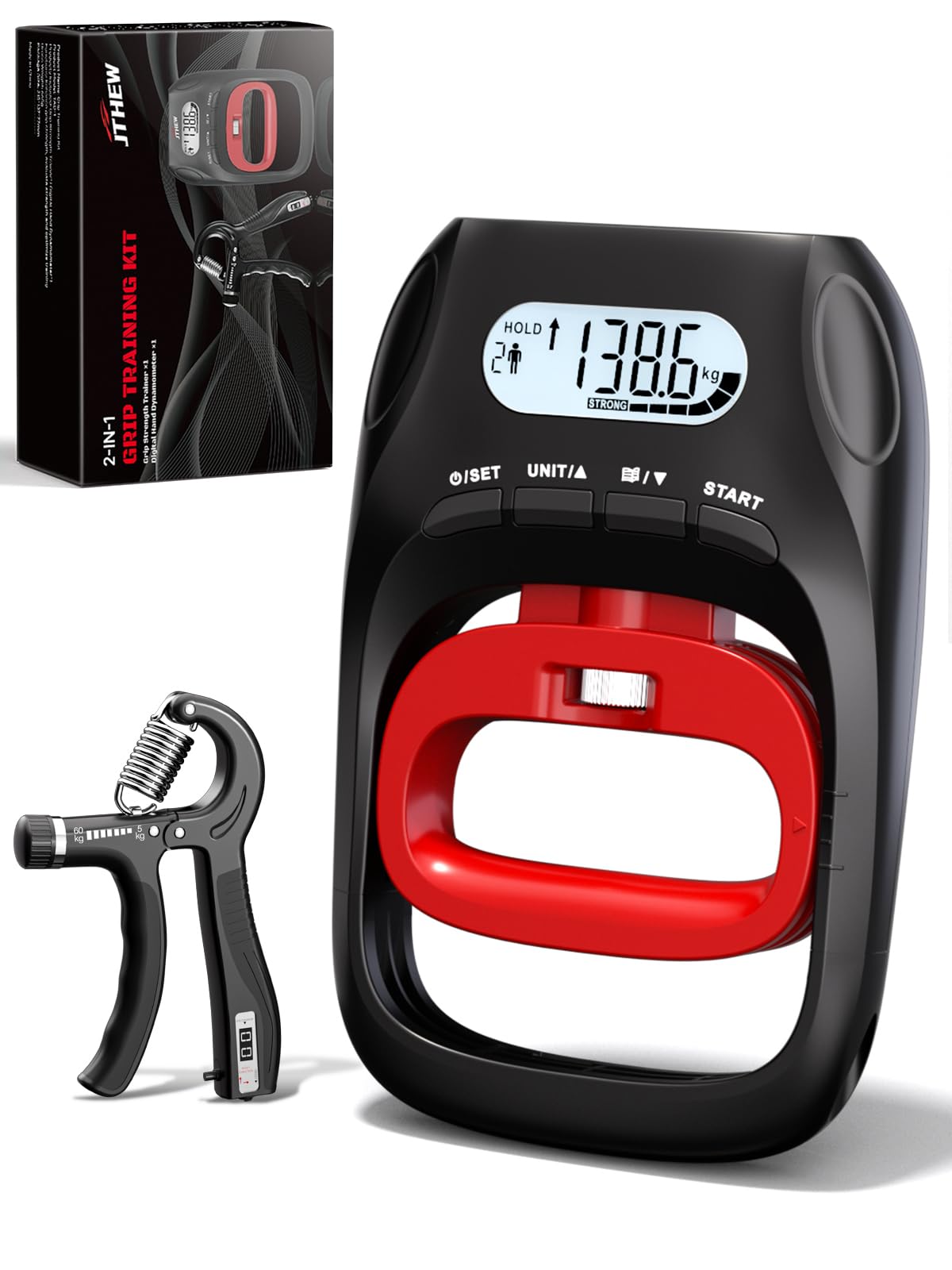
Two tools in one: measure your current grip in numbers, then train exactly where you are weak.
Most grip strengtheners leave you guessing—am I getting stronger or is the spring just looser? This set solves that by pairing a high-precision strain gauge sensor (a device that measures tiny changes in force) dynamometer with an adjustable resistance trainer. You first test your grip strength up to 400 pounds on the tester and see an exact number, then set the trainer’s resistance anywhere from 11 to 132 pounds based on that data. It stores up to 19 user profiles with age, gender, and grip status, so multiple people in a household can track their own progress on the LCD display (liquid crystal display screen).
One reviewer noted that after 8 weeks of training, their grip climbed from 55 to 85 lbs, and their deadlift went from 315 to 365 lbs. They call the dynamometer “more accurate than cheaper alternatives” with a ±2% accuracy versus ±15% on budget models. The ergonomic handles on both units have adjustable knobs, and the trainer includes a smart counter that shows each squeeze. At 1.45 pounds, this set is heavier than a single gripper, but it replaces two separate devices. Compared to the YPCBYNBS hand exerciser, which offers 5–50 lbs via rubber bands and is far better for rehab, the JTHEW is built for people who want to quantify their strength and target a specific number. One buyer mentioned it is “a bit tricky to set up” initially, but the learning curve is short. This is ideal for lifters tracking recovery from a wrist fracture, athletes wanting to see a specific kg score, or anyone who likes seeing proof of their progress in digits.
The Data Advantage
- Dual-function set: one device measures grip up to 400 lbs, the other trains from 11–132 lbs
- Stores 19 user profiles with age, gender, and grip status for multiple family members
- Customers note ±2% accuracy, which is notably better than many budget dynamometers
Where It Falls Short
- Heavier and bulkier than a single gripper—not as pocket-portable as a simple V-shaped trainer
- Initial setup can be a bit tricky, according to some reviewers
- Cannot isolate individual fingers—it is a full-hand crush tool only
Numbers-driven training: If you want to see your grip strength as a precise score and track improvement week over week, this two-piece system is the most actionable option here.
Skip it when: You just want a simple, silent gripper for light daily use or rehab that slips into a pocket—the JTHEW is larger and requires some setup before each session.
3. Hiyoga Grip Strength Trainer
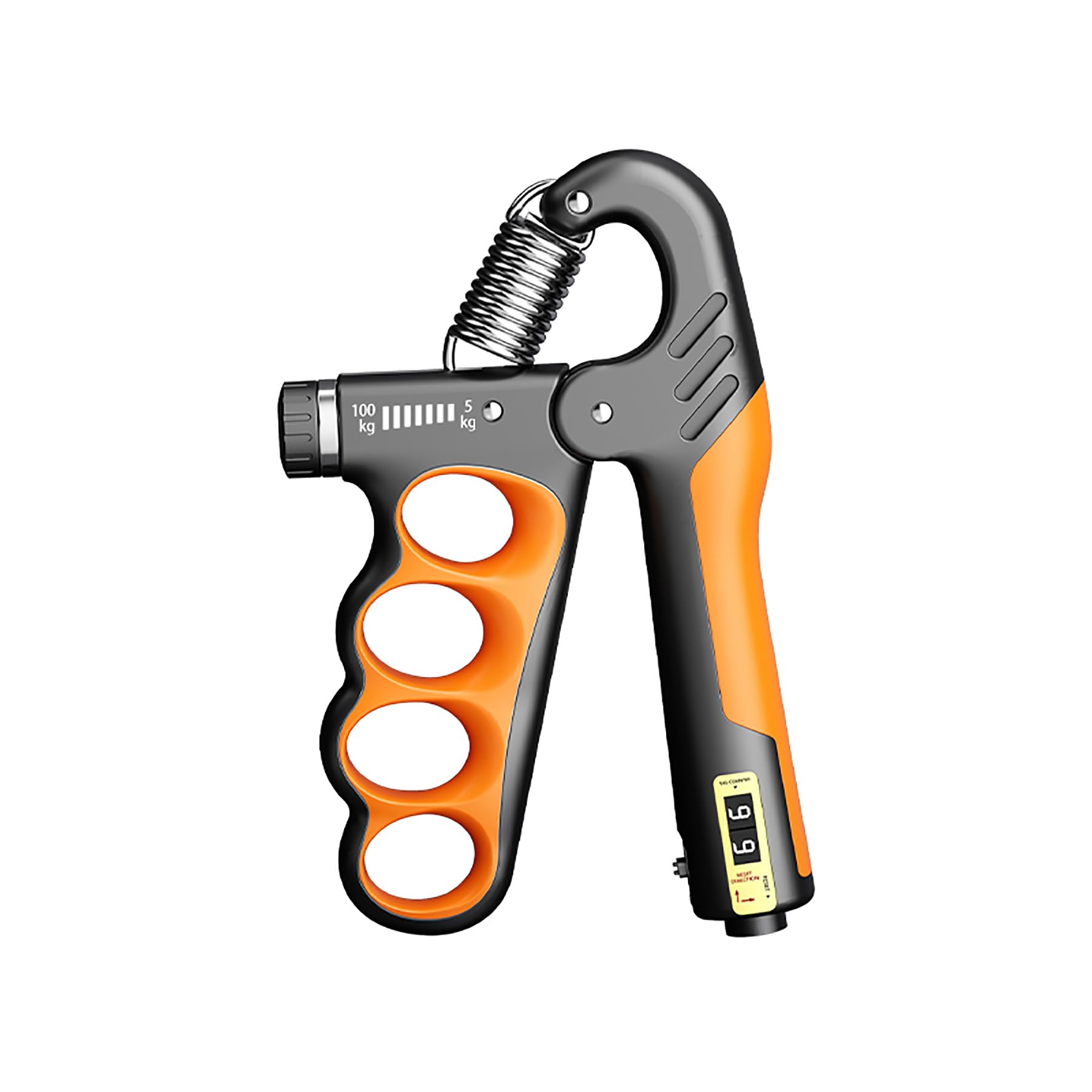
A huge resistance span with a built-in counter, all for a price that is tough to top.
The most surprising thing about this trainer is that it covers 11 to 220 pounds—a wider range than the GD IRON GRIP 70‘s 44–150 lbs—yet it costs roughly half as much. That makes it equally useful for a beginner who only needs light resistance and for an advanced lifter who needs real weight. The high-strength stainless steel spring is thickened for stability, and the TPR handle (thermoplastic rubber, a soft anti-slip material) is designed for comfort, so you can use it for longer sets without your palm slipping. It also has an automatic counter that records each rep, which you reset by twisting the orange button.
Reviewers point out the ergonomic design “fits really well in my hand” and feels “comfortable and secure even when using it for a while.” One intermediate lifter who can do 405 lbs x 4 conventional deadlifts noted that this gripper is “probably one of the best I’ve tried in this price range” and praised its “creative features that I’d love to see in more premium grippers.” The honest caveat: the manual rep counter requires a push-and-twist motion to reset, which some find a bit inconvenient between sets. Also, the cylinder shape (6.2″L x 4.3″W) is wider than a traditional V-gripper, so it may feel different in smaller hands. This is the pick for anyone who wants the widest resistance band possible without spending premium money.
Why It Works
- 11–220 lbs resistance range is one of the widest available—great for beginners and advanced users alike
- Built-in automatic counter tracks reps so you can focus on the squeeze
- Stainless steel spring and TPR anti-slip handle feel solid and comfortable during longer sessions
The Catch
- Rep counter is a push-and-twist reset that is slightly fiddly between sets
- Cylinder shape may feel bulky for people with smaller hands compared to V-shaped grippers
- No individual finger isolation—this is strictly a full-hand trainer
Wide-range value: This is the trainer for anyone who wants the broadest possible resistance range on a budget—from very light rehab level all the way to serious crush grip, all in one device.
Consider the trade-off: If you need finger-by-finger training (for guitar or specific rehab) or a more traditional V-grip feel, the Hiyoga’s cylinder shape and full-hand squeeze may not target what you need.
4. Vive Finger Strengthener (3 Pack)
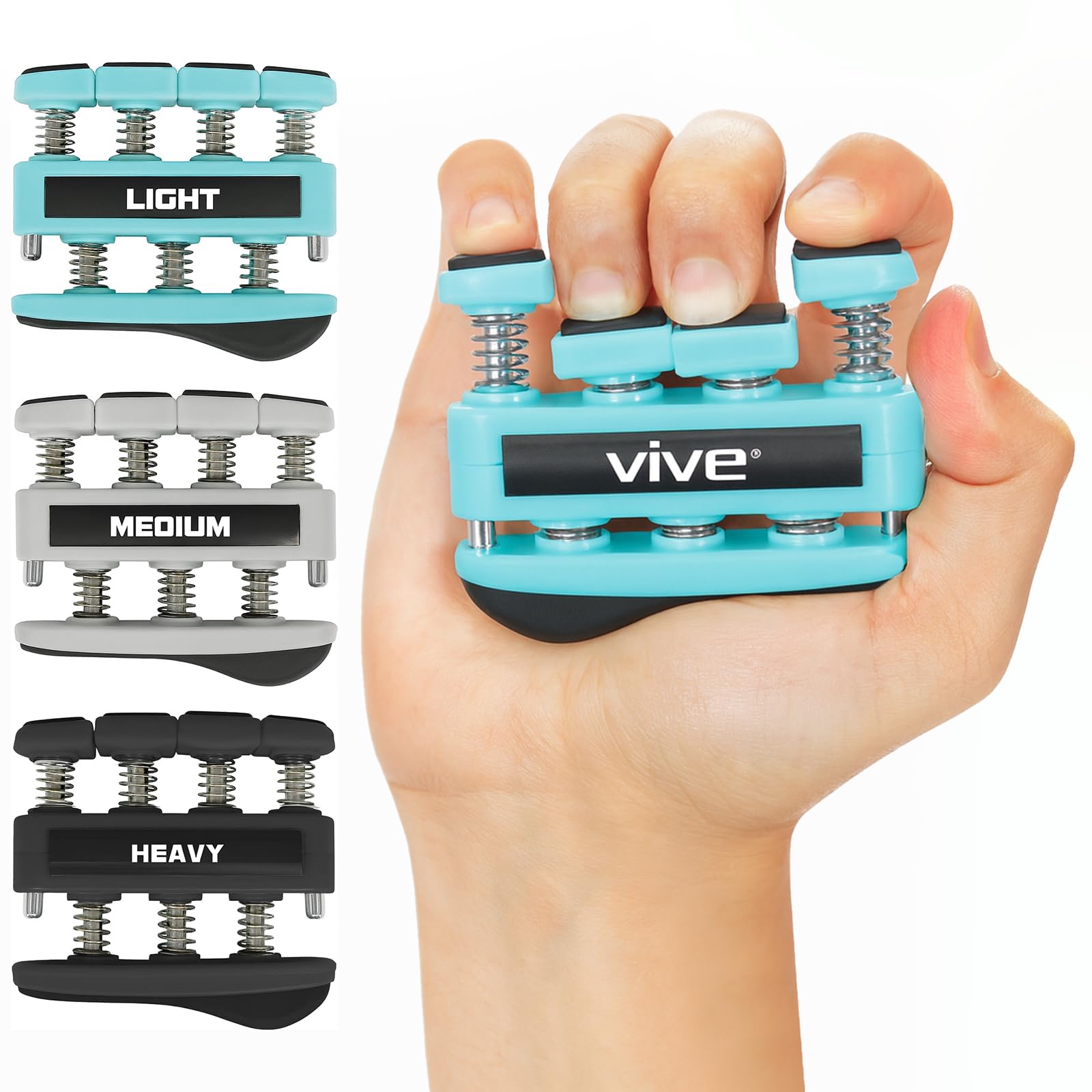
Three resistance levels in one box, each isolating your fingers individually for therapy or targeted strength.
If your goal is to rebuild control in each finger rather than just crush your whole hand, this 3-pack gives you a Light (1.5 lbs), Medium (3 lbs), and Heavy (5 lbs) unit so you can start gentle and progress. Each unit has four spring-loaded pistons (small plungers that push back) that let you work a single finger at a time. That is exactly what a physical therapist would prescribe for recovering from carpal tunnel (a nerve compression condition in the wrist), a finger fracture, or post-surgery stiffness. The handles are made of TPR rubber (thermoplastic rubber) with a contoured shape that works in either hand, and the device is quiet enough to use at your desk without bothering anyone.
Shoppers say that these are “great for rock climbing” as well as rehab. One reviewer recovering from a broken right ring finger (with tendon issues) said they “work as intended and are very well made.” That said, several people mention the units feel “a little big” if you have smaller hands, and one climber noted that the Light unit was basically a “paperweight” for anyone with decent hand strength, so the real starting point for most is the Medium or Heavy. The set is also HSA/FSA approved (Health Savings Account/Flexible Spending Account eligible) and comes with a 60-day guarantee from Vive, a well-known rehab brand. Unlike the YPCBYNBS hand exerciser at 5–50 lbs of band resistance, this set tops out much lower at 5 lbs, so it is best suited for therapy rather than heavy training.
Targeted Isolation
- Individual spring-loaded pistons for each finger let you train a single digit or a specific combination
- Three distinct tension levels (1.5 / 3 / 5 lbs) give a logical rehab progression
- HSA/FSA approved with a 60-day guarantee from a brand trusted in therapy circles
Size and Strength Limits
- Largest resistance is only 5 lbs—too light for anyone beyond beginner-level grip strength
- Overall frame feels large in smaller hands, especially for the Light unit
- Plastic construction may not survive heavy or aggressive use over years
Purpose-made for recovery: If you are in physical therapy, recovering from carpal tunnel, or building back finger strength after an injury, this 3-pack gives you the precise low-resistance isolation that a whole-hand gripper cannot provide.
Not the right tool for: Anyone who already has average or above-average hand strength—the 5 lb top-end is simply not enough stimulus for training progress once you pass rehab level.
5. YPCBYNBS Hand Exerciser

The sliding clip design that blocks movement so you can isolate your thumb or a single finger during rehab exercises.
Most hand trainers make you squeeze all fingers at once, but this V-shaped plastic frame uses a sliding clip that can stop flexion (bending) or extension (straightening) on specific fingers. That turns it into a thumb isolator or a targeted finger strengthener. It comes with 8 rubber bands (ranging from 5 to 50 pounds total) that you swap in and out depending on how much resistance you want—no complex mechanisms, just slide a band in and go. The latex-free material is good for people with sensitivities, and the whole unit weighs just 4.8 ounces, so it is easy to toss in a bag.
Buyers rave about this for arthritis (inflammation of the joints causing pain and stiffness). One reviewer who has it in both hands said, “I have arthritis in both my hands so this helps with grip and finger strength” and that they have “definitely noticed improvement” with regular use. Another mentioned it was recommended by their physical therapist. The honest limit is that the plastic frame may not hold up under improper use or aggressive squeezing—one buyer warned it could break if you are too rough. Also, switching bands takes a moment and you have to keep track of all 8 pieces. This is the best entry-level pick for someone with arthritic hands or post-surgery needs who values adjustability over brute strength.
The Rehab Edge
- Sliding clip isolates individual fingers and thumb—rare at this price point
- 8 rubber bands offer a wide 5–50 lb adjustment range without mechanical springs
- Very light at 4.8 oz and latex-free; buyers with arthritis report noticeable improvement
Fragility Concerns
- Plastic frame may crack under heavy or aggressive use—buyers caution it is not for power training
- Rubber bands can be fiddly to swap and keep organized
- Does not provide the solid “click” feedback that metal grippers give
Best for arthritic hands and rehab beginners: If you have arthritis, carpal tunnel, or are starting recovery after hand surgery, this exerciser’s band system and finger isolation make it the most adaptable low-cost option.
Pass on this one: If you are a strong lifter looking for heavy resistance or want a metal trainer that can survive daily hard squeezing—the plastic frame and band system are not built for that use.
6. DILIMI Finger Strengthener

The compact 5-button trainer that guitarists and pianists use to build individual finger independence and endurance.
This trainer is tiny at 2.6″L x 4.13″W compared to the YPCBYNBS exerciser at 6.2″L x 4.3″W—a 2.4x length gap—and it fits entirely in your palm. It has five separate silicone buttons that you press individually, and a pure copper core that lets you adjust the resistance per finger with two buckles so you can lock any two buttons and isolate the other fingers. The slim shape and soft button caps make it comfortable for repetitive use, and the non-slip silicone base keeps it steady on a desk or in your hand.
Reviewers who play guitar call it “the best hand and finger exerciser on the market,” and one owner reported that the “pinky button aids stretched position strength for difficult chords.” Another reviewer said it “helps regain hand strength after injury” and that the factory settings work well from the start. The honest issues: some units ship missing the two piston locks (the buckles that hold buttons in place), and the ergonomic shape is more of a “training tool than a stress ball,” so you have to be intentional about using it. If your goal is dexterity, finger speed, and chord stamina rather than sheer crushing power, this is the specialist choice.
Finger Independence
- 5-button design lets you work each finger individually—perfect for guitar chords and piano scales
- Copper core is adjustable per finger, and 2 buckles let you lock specific buttons for isolation
- Buyers report it is the “best among several brands” for musicians
The Drawbacks
- Some units ship without the piston locks, which limits isolation if missing
- Shape is not designed for mindless squeezing—you have to actively use it as an exercise tool
- Not suitable for heavy hand strength training; tops out at medium tension
Built for musicians and dexterity training: If you play guitar, piano, or any instrument that demands finger independence and endurance, this 5-button trainer is the most targeted choice for building that skill.
Not for you if: You want a heavy-duty gripper to boost your deadlift or general hand crush strength—this is a dexterity tool, not a power tool.
7. GM2 Grip Exerciser

Three fixed-resistance levels in a tiny oval frame that tennis and climbing athletes stash in their bag for quick sets.
The GM2 is almost pocket-sized at 3.3″L x 0.6″W and weighs practically nothing at 0.07 kg (about 2.5 ounces), but it offers something unusual: individual finger setup inside a standard grip exerciser. You can work each finger separately rather than just clenching your whole hand. It comes in three color-coded weight levels: Blue at 5 lbs, Red at 7 lbs, and Black at 9 lbs, so you can pick the right tension for each hand or each finger and progress between them.
Buyers in sports say it is ideal for sport-specific training. One tennis player reported: “I play tennis, and it is a must!” and recommends buying both the Black (9 lb) and Red (7 lb) versions to have a warm-up and working weight. Others use it while watching TV or as a quick desk break. The materials are ABS plastic with SWPC (Spring Wire Precision Coiled) high-quality springs, so the build is solid for the price. The limitation is the low max resistance: 9 lbs is fine for endurance and warm-ups but not enough for serious strength progression—the Hiyoga trainer goes up to 220 lbs in comparison. If you want a no-fuss, ultra-portable trainer that fits in your palm and works single fingers, this fills that slot neatly.
Simplicity Wins
- Three clear resistance levels (5/7/9 lbs) mean no guessing—pick your color and squeeze
- Individual finger setup inside a tiny oval frame is rare at this size and price
- Sports players (tennis, climbing) specifically call it a “must” for quick hand conditioning
Strength Ceiling
- 9 lb max is too low for anyone beyond intermediate training; you will outgrow it quickly
- Small size (3.3″L) may feel cramped in larger hands
- No adjustability—once you master Black (9 lb), you need a different product entirely
For the on-the-go athlete: If you play tennis, climb, or just want to add a few quick finger sets between meetings, this miniature trainer is the most portable option that still isolates individual fingers.
Do not buy if: You are chasing serious grip strength gains—9 lbs is a warm-up at best for most adults; you will need a heavier, adjustable trainer within weeks.
Understanding the Specs
Resistance Range and Adjustment
This is the single most important number because it determines whether the trainer will still be useful a month from now. Look for the range in pounds or kilograms (e.g., 11–220 lbs). A wider range means you can start light and gradually increase without buying a new device. Adjustable systems use a dial, spring steps, or interchangeable bands; fixed-resistance trainers (like the GM2’s single color) are simpler but you outgrow them faster.
Finger Isolation vs Full-Hand Crush
A standard gripper squeezes all fingers together, which builds overall hand strength and is best for deadlifts or general power. A finger-isolation trainer has separate buttons or pistons for each digit—essential for guitarists needing chord stamina, pianists, and anyone in physical therapy recovering from a specific finger injury or surgery. If your goal is precision, you want isolation; if it is raw strength, a full-hand trainer is fine.
FAQ
What resistance level should I start with as a beginner?
Can a grip strengthener help with arthritis pain?
How many reps should I do per day with a hand gripper?
What is the difference between a finger strengthener and a grip strengthener?
Can I use a grip strengthener every day?
Will a grip strengthener help me do more pull-ups or deadlifts?
Are metal grip strengtheners better than plastic ones?
What does it mean when a grip trainer has “100 kg” resistance?
Can I use a finger strengthener to recover from carpal tunnel surgery?
Which grip strengthener is best for guitarists specifically?
Final Thoughts: The Verdict
For most people, the grip strengtheners winner is the GD IRON GRIP 70 because its 44–150 lb range, 6-step adjustability, and iron build cover everyone from a beginner to an advanced lifter in a single device. If you want to measure your progress with hard numbers and track recovery or gains, grab the JTHEW Grip Strength Tester Trainer. And for targeted finger isolation—whether for rehab, arthritis, or guitar—the standout is the versatility of the YPCBYNBS Hand Exerciser with its sliding clip and rubber band system.
How We Picked
We do not accept paid placement. Every pick is matched to a real buyer and a real use-case; we do not hands-on test units.
Sources & Methodology
Specifications: manufacturer listings and product documentation. Review insights: verified customer reviews, as of July 2026. Pricing: not shown on this page (it changes often); check the current price via the retailer link.
As an Amazon Associate, FitlyFast earns from qualifying purchases. This does not affect which products we feature.