
Our readers keep the lights on and the weekend projects moving. As an Amazon Associate, I earn from qualifying purchases.
Specs are compiled from manufacturer listings and verified buyer reviews and can change over time — please confirm the key details on the product page before buying.
That is the real trick with a budget pitching machine — the cheap ones on Amazon are either flimsy, inaccurate, or made for tiny foam balls that teach your hitter nothing. This guide sorts through the real options so you know which one survives a season of backyard practice and which one is just a waste of shelf space.
I’m Rikta — the founder and writer behind FitlyFast. This guide is built by comparing the manufacturers’ published specifications and the patterns across verified customer reviews, so you get each pick’s real strengths and trade-offs instead of marketing spin.
Whether you are a coach looking for a team-friendly drill tool or a parent trying to get your kid more reps without wrecking your own shoulder, these recommendations focus on the actual performance and durability you can expect from a budget pitching machine.
Quick Picks
- Louisville Slugger Blue Flame Pitching Machine — Best Overall
- Franklin Sports Total Pitcher Baseball + — Versatile Pick
- Furlihong 691BH Baseball Softball Toss Machine — Smart Value
- Heater Crusher Pitching Machine W/ 8-Hour — Electric Option
- Heater Sports Crusher Portable Mini Lite-Ball — Compact Pick
- Heater Sports Junior Baseball Pitching Machine — High Speed
- SKLZ Pitching Machine | Improve Your Swing — Budget Champion
How To Choose The Best Budget Pitching Machine
Most people looking for a budget pitching machine make the same mistake: they buy based on the lowest sticker price and end up with a machine that only works with a specific type of tiny foam ball that feels nothing like a real baseball or softball. Before you click buy, there are a few things you need to check first.
What Balls Does It Actually Throw?
This is the single biggest filter. Some budget machines only accept lightweight plastic or poly balls, while others handle standard hardballs, dimpled balls, and even softballs. If your kid is facing live pitching in games, practice with a 30 mph foam ball does very little. Check the “About this item” section carefully — if it only mentions “light flight” or “mini-balls,” that machine is a training toy, not a practice tool. For real development, you want a machine that accepts standard 9-inch or 11-inch balls.
Power Source: Manual vs Electric vs Battery
A spring-loaded manual machine (like the Louisville Slugger Blue Flame) needs no electricity or batteries — you load the ball and release a tension arm. These are usually the most durable on a budget because there is no motor to fail. An electric machine (like the Heater Crusher) plugs into an AC outlet (a standard wall socket) and uses a battery for portability. The catch is that the batteries on budget electric machines often stop accepting a charge after a season, and some motors lose power between pitches. If you want zero-hassle reliability forever, go manual. If you want hands-off repetitive throwing, an electric machine is nicer — but be ready to run it plugged in.
Speed Consistency and Pitch Interval
Budget machines often have a reputation for “variable” spin, meaning the ball may dip or curve because the wheels wobble or the tension arms are uneven. Look at customer reviews for words like “inconsistent” and “wobble” — if multiple reviews mention it, that machine will frustrate a developing hitter. Also check the delay between pitches: a machine that takes 5 seconds to reload gives you enough time to reset, but one that takes 10 seconds can make practice drag. Some budget machines also lack a simple on/off switch, requiring you to turn dials each time, which is annoying during drills.
Build Quality and Total Weight
A pitching machine that weighs 2.8 pounds is portable, but it also vibrates and walks across the grass when throwing, which ruins accuracy. A machine that weighs 15 pounds sits more stable, but you pay for that in portability. On a budget, you are trading weight for stability — heavier machines are often less frustrating because they don’t skip around after every pitch. Also check for exposed electronics or cheap plastic feeders that jam. Customer reviews that mention “weak weld” or “cracked housing” are a hard no for a machine meant to last.
Quick Comparison
| Model | Best For | Ball Type | Max Speed | Power Type | Amazon |
|---|---|---|---|---|---|
| Louisville Slugger Blue Flame | Best Overall – Real Balls, No Power Needed | Hardballs, Softballs, Dimple, Plastic | 45 mph (hard balls) | Manual (spring) | Amazon |
| Franklin Sports Total Pitcher | Best for Fielding + Batting Drills | Baseballs, Softballs, Teeballs | — | Manual (spring) | Amazon |
| Furlihong 691BH | Best for Youth & Solo Practice | PU Baseball & PU Softball | — | Foot-operated (manual) | Amazon |
| Heater Crusher (8-Hour Battery) | Best for Electric Portability | Plastic / Dimple balls | 45 MPH | Rechargeable battery / AC | Amazon |
| Heater Crusher Mini-Lite Ball | Best for Compact Portable Training | Mini Poly & Lite-Balls | — | 4-hour Rechargeable battery | Amazon |
| Heater Sports Junior | Best for Older Kids (up to 48 MPH) | Yellow dimple balls | 48 MPH | Electric (AC) | Amazon |
| SKLZ Lightning Bolt Pro | Best for Indoor Hand-Eye Drills | Small hard foam balls | 30 mph | Rechargeable battery | Amazon |
In‑Depth Reviews
1. Louisville Slugger Blue Flame Pitching Machine

The only budget machine built to throw real hardballs, softballs, and even soccer balls with no power cord.
If you want a machine that does not tie you to a wall outlet and can survive years of weekend practices, this is it. The Louisville Slugger Blue Flame uses a completely manual spring-loaded design — no electricity, no batteries, no motors that lose power between pitches. It throws hard balls from 18 to 45 mph with easy to adjust speed controls, according to buyers, and it handles light flight or plastic balls up to 60 mph. You can also throw slowpitch softballs with an arch up to 12 inches. It weighs 11.9 pounds and measures 32 x 14 x 6 inches, making it significantly bulkier than the 3.7-inch cube SKLZ, but the stability pays off.
Buyers report that it throws a level pitch that teaches proper swing mechanics and that it is extremely accurate for strikes, fly balls, and grounders. One reviewer noted it is “the official pitching machine of both Babe Ruth League and Pony Baseball and Softball,” which backs up its field-ready reputation. The trade-off is that because it is manual, you have to load each ball and pull the arm back yourself — there is no automatic ball feeder — and some reviewers mention that putting the ball in the exact same spot each time is needed for best accuracy. Still, for a budget pitching machine that uses real balls and needs no power, this is the clear winner.
Why It Earns the Top Spot
- Throws standard hardballs, softballs, dimple balls, plastic, and even volleyballs — real game prep.
- Completely manual with zero electricity or batteries needed, so there is no motor to burn out.
- Adjustable speed from 18 mph up to 45 mph for hard balls, giving you a good range for youth to adult hitters.
The Practical Trade-Offs
- Manual loading means no automatic feeder — you reload every single pitch yourself, which breaks the rhythm.
- At 11.9 pounds, it is heavier than some electric options, though owners mention it is “no heavier than a bucket of baseballs.”
- Speed range is limited on the low end compared to motor-driven machines that can drop to 15 mph.
Your pick if: You want a single machine that throws real baseballs and softballs, will never strand you with a dead battery, and can survive a full season without a motor or plastic gear failing.
The limitation: The spring-action reload means practice is slower than with an electric feeder, so it is better for focused mechanical reps than high-volume rapid-fire drills.
2. Franklin Sports Total Pitcher Baseball + Softball Training Aid

A multi-purpose spring launcher that switches from batting practice to grounders to pop flies.
The Franklin Sports Total Pitcher is different from most budget pitching machines because it is designed as an all-in-one training aid rather than just a pitcher. It uses a spring-powered launching mechanism that works for batting practice and also lets you adjust settings to produce ground balls and pop flies, so fielders can work on forehands and backhands. It comes with a detachable basket equipped with handles for storing balls between reps — a small touch that makes a big difference when you are running a practice. One buyer mentioned that it takes less than 3 seconds to reload and throw again, which keeps the pace high.
Customers note that at first glance the materials can feel flimsy, and there have been reports of a weld breaking right off the arm during the first use. Another reviewer mentioned that after loading and launching, it feels like it takes more time than just throwing to your kid. However, satisfied customers say the machine is built to last, with good welds and quality material, and that it throws a consistent pitch 99% of the time. It measures 31.25 x 24 x 37.5 inches and weighs 12.84 kilograms, so it is a fairly substantial piece of gear for a manual machine. For a coach who wants one tool that covers hitting and fielding, this is a solid mid-range option.
The Versatility Advantage
- Can throw grounders and pop flies in addition to pitches — great for fielding drills without needing a second person.
- Basket is detachable with handles, making ball collection and transport easier between reps.
- Compatible with baseballs, softballs, and teeballs, so a single machine works for multiple sports.
What to Watch For
- Reports of weld failures on the arm after the first few uses, which is a durability concern.
- Some buyers find the reload-launch cycle slower than just throwing to a kid, which defeats the purpose.
- 90-day limited warranty is short compared to other manual machines that have none because they are simpler.
Deciding factor: If you want one tool that covers batting practice, grounders, and pop flies for a whole team without needing a power cord, this is a wise choice for the price.
The catch: The weld quality on the arm is a real gamble — check for solid construction when it arrives and avoid this if you cannot afford a possible return.
3. Furlihong 691BH Baseball Softball Toss Machine
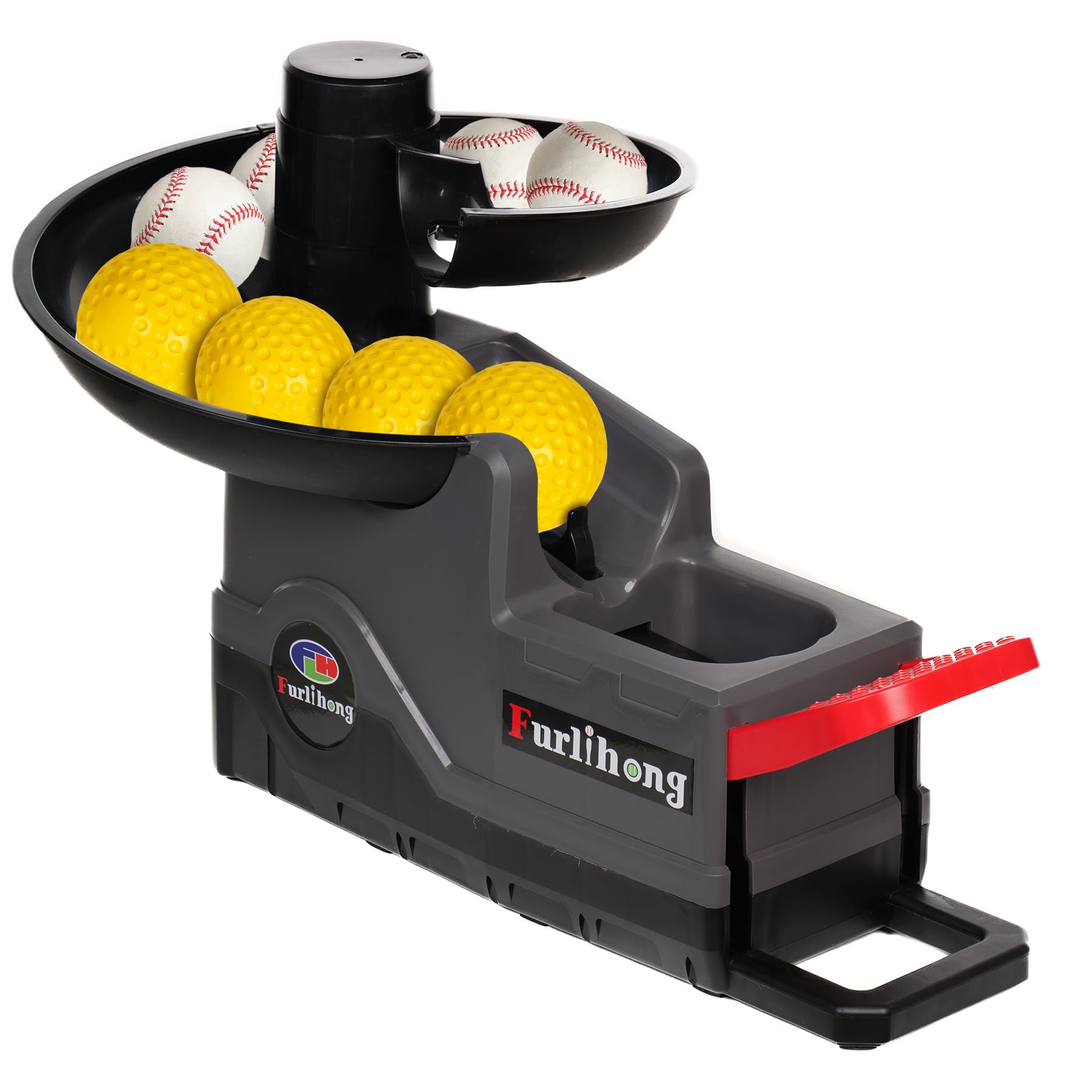
A foot-pedal tosser that launches balls after a ticking 5-second countdown — no hands needed.
The Furlihong 691BH is a unique foot-operated toss machine perfect for solo practice or youth training. You step on a red pedal, wait for an audible 5-second countdown, and then the ball launches up and forward. It has 4 adjustable speed gears: Levels 1 and 2 are geared for baseball, while Levels 3 and 4 target softball. The machine comes with two ball chutes plus one PU baseball and one PU softball, so you have everything you need from the box. Buyers describe the assembly as “intuitive—nearly simple to use” and say kids love it because it feels like a game.
However, the foot pedal does not always engage, and one owner reported that the launch height, distance, and timing are inconsistent. Another buyer pointed out that the 5-second countdown can vary from 3 to 6 seconds with no real warning of release, which makes timing the swing harder. It is made from plastic, so it is not as heavy-duty as the steel-built Louisville Slugger or Franklin models. The Furlihong also cannot throw fastballs or real-world curves — it just lobs the same pitch every time. For a parent looking for a fun, hands-off way to give a young kid extra swings in the backyard, this works. For serious team practice, it falls short.
Why It Stands Out
- Foot-operated so you keep your hands free to coach, film, or prepare the next ball.
- Includes two ball chutes plus a ball each for baseball and softball — ready to use right away.
- No batteries or electricity required, making it truly portable for any location.
The Limits
- Inconsistent launch timing (3-6 seconds) makes it hard for hitters to build a rhythm.
- Foot pedal engagement can fail, requiring multiple presses to launch.
- Plastic build feels less durable than metal competitors, and it is unstable on uneven ground.
Reach for this if: You have a younger player (8-14) who needs extra reps in the backyard and you want a machine that operates with no power and keeps your hands free to coach.
Look elsewhere if: You need consistent, predictable pitch timing for a developing hitter, or if you plan to use hard baseballs — stick with the Louisville Slugger.
4. Heater Crusher Pitching Machine W/ 8-Hour Rechargeable Battery
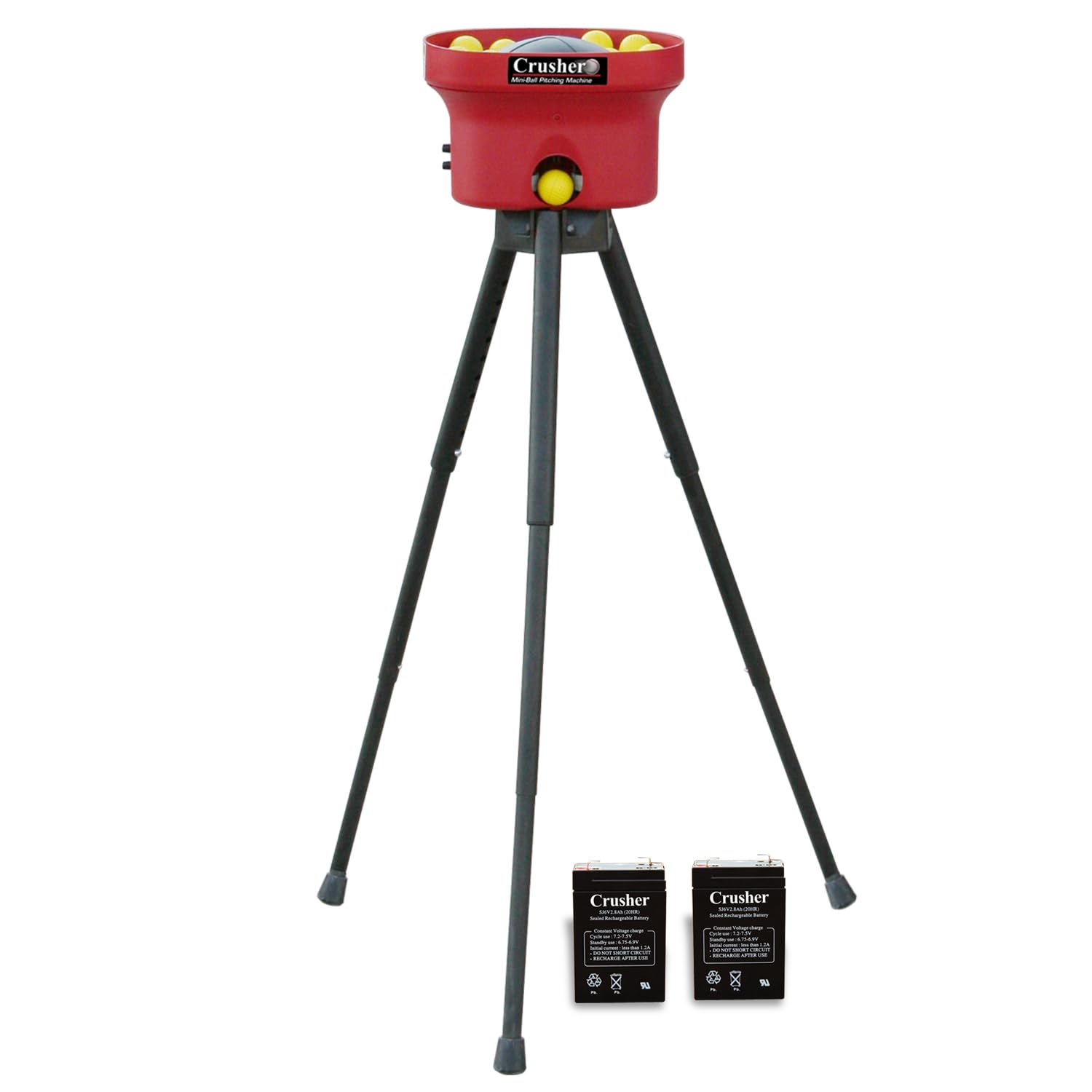
A dual-wheel electric machine that throws fastballs and curveballs up to 45 mph, but buyer feedback is rough.
The Heater Crusher is one of the more affordable electric pitching machines on the market, and it delivers both fastballs and curveballs thanks to its dual-wheel variable speed control system. It pitches up to 45 MPH, has adjustable pitch height, and includes a precision hopper ball feeder for continuous throws. At 15 pounds, it is noticeably heavier than the 2.8-pound SKLZ — a weight difference (15 pounds vs 2.8 pounds) — which helps it stay stable during use. It is made from steel and runs on an 8-hour rechargeable battery, so you can take it to the field without extension cords.
Reviewers point out mixed results. One customer observed that after 2 years the AC adapter (the power cord for a wall socket) failed, but excellent customer service replaced it. However, multiple other reviews tell a different story: batteries that do not recharge after a few uses, wheels that do not spin straight from the start, and flimsy construction that makes balls curve unpredictably. Another reviewer noted the pitch interval is too fast with no speed control on the feeder, so you have to tape slots shut to slow it down. Unless you are comfortable making modifications and handling potential returns, the Heater Crusher is a gamble at this price tier.
The Promise
- Dual wheel design lets you throw both fastballs and curveballs, giving batters variety.
- 8-hour rechargeable battery provides real portability — no extension cord needed for a full session.
- Adjustable pitch height and variable speed control give decent customization for different drills.
The Reality From Buyers
- Multiple reports of batteries failing to recharge after just 1-2 uses, making the “portable” feature useless.
- Wheels have been reported not spinning from the start, indicating poor quality control.
- Ball feeder lacks speed control, causing pitches to come too fast with no way to adjust the interval.
Consider it if: You are handy enough to make the modifications (taping feeder slots, adding a flag) and you value the dual-wheel curveball feature over reliability.
Think twice if: You want a machine that works perfectly straight from the start without tinkering — this one has a high defect rate.
5. Heater Sports Crusher Portable Mini Lite-Ball Pitching Machine

A compact tripod-based machine that throws mini lite-balls and poly balls with a 4-hour battery.
The Heater Sports Crusher Mini Lite-Ball is built specifically for training with small, lightweight balls, not full-size hardballs. It comes with a rugged tubular steel tripod stand and a 4-hour rechargeable battery, making it one of the lighter electric options at just 5 pounds. It has dual motor speed controls for professional pitch adjustment and throws both fast balls and left- or right-handed curve balls. The machine is small enough to use indoors or in tight backyard spaces.
Shoppers say a significant downside: the motors lose power after each pitch, which means the wheels have to spin back up before the next throw, leading to inconsistent velocities. One reviewer specifically said “Motors lose power after each pitch” and noted the machine lacks a simple on/off switch, requiring you to reset dial settings every time you turn it on. Another called it great for training 90+ mph reaction time because the mini-balls travel faster, but the accuracy for strikes is poor. For a coach who wants high-speed reaction drills with small balls, this can work. For a parent looking for reliable batting practice with standard balls, skip this.
What It Does Well
- Compact and lightweight at 5 pounds, easy to move from basement to field.
- Great for reaction-time training since mini-balls simulate faster pitch speeds in short distances.
- Comes with a steel tripod and 2 dozen balls, so it is ready from the start.
The Frustrations
- Motors drop power between each pitch, causing inconsistent speed and accuracy.
- No simple power switch — you have to turn dials to turn it on, which is annoying between reps.
- Only works with mini poly balls and mini lite-balls, not real baseballs or softballs.
Perfect for: A high school or college player who wants to sharpen fast-reaction skills with small balls in a small space where full-size rubber balls are not practical.
Not ideal for: A youth player who needs consistent, accurate strikes for confidence-building — the motor power drop will frustrate developing hitters.
6. Heater Sports Junior Baseball Pitching Machine

A heavy-duty electric machine with a 12-ball auto feeder that throws from 15 to 48 mph.
The Heater Sports Junior sits at the premium end of this budget roundup, offering a 1/4 horsepower DC motor (an electric motor that runs on direct current) and a 12-ball automatic ball feeder that delivers a ball every 10 seconds. This means you can set it up and let it run without reloading constantly — a major plus for teams or parents who want volume. It has adjustable speed control from 15 to 48 MPH, giving you a wide range to work with young beginners (6u) up to older kids (10u). The machine uses durable air-filled tires that are fully enclosed for safety, and a heavy-duty tripod stand keeps it stable. It measures 38 x 38 x 38 inches and weighs 23.45 pounds, making it the heaviest unit here.
Buyers report that the machine works great for kids aged 7 to 10, with one reviewer noting they have put 2,000-2,500 balls through it in 16 months before needing to order a replacement tire. However, the machine requires yellow dimpled balls — standard baseballs do not feed properly through the mechanism and can damage both the ball and the tire inside. Another reviewer mentioned the tires must be inflated to 40 psi (pounds per square inch, a measure of air pressure) to reduce vibration and noise. Customer support is reportedly excellent, with one parent noting they “spoke to a Heater support person located in the United States” who was professional and helpful. For a mid-range machine that offers auto-feeding and real speed range, this is the strongest electric option here, but you are locked into dimple balls.
Auto-Feed Advantage
- 12-ball automatic feeder delivers every 10 seconds, allowing continuous hands-free practice.
- Wide speed range from 15 to 48 mph suits everyone from beginners to older youth players.
- Durable construction with air-filled tires and heavy-duty tripod stand — designed for long-term use.
Important Limitations
- Only works well with yellow dimple balls — standard baseballs jam in the feeder and may damage the machine.
- At 23.45 pounds, it is not portable for casual trips to the field without some effort.
- Tire wear is expected after heavy use (2,000-2,500 balls), and you must keep them inflated to 40 psi for proper operation.
Best for: A team or family with kids ranging from ages 7 to 10 who want a reliable auto-feeder that provides consistent speed adjustments without needing a pitcher.
skip it if: You need a machine that throws standard hardballs or softballs — the dimple-ball requirement is a hard restriction that limits real-game prep.
7. SKLZ Pitching Machine | Improve Your Swing

The cheapest option at roughly 80 bucks, but it throws only small foam balls at 30 mph.
If you are working with a very tight budget and just need something to keep a young kid engaged with hand-eye coordination indoors, the SKLZ Pitching Machine gets that job done. It automatically pitches soft practice balls at 30 mph with a 5-second delay between pitches, and it holds up to 26 balls at a time in its hopper (a container that feeds balls into the machine). At 2.8 pounds and measuring just 3.7 x 4.25 x 3.7 inches, it is the smallest and lightest machine in this lineup — a massive dimensional difference (the SKLZ measures 3.7 x 4.25 x 3.7 inches compared to the Louisville Slugger’s 32-inch length). The angle adjusts for different pitching locations, and one user highlighted a child can use it easily with no assistance.
The catch is that this machine uses small hard foam balls only, and owners mention it “cannot pitch from 30 feet, max 20 feet,” which seriously limits realistic practice. The machine vibrates and walks across hard surfaces during use, and the included ball shagger (a device to pick up balls) is reportedly useless because balls fall out when picking up more than 4-5. There are also multiple reports of defective units straight from the start (wobbly wheels, conveyor gear always running). One reviewer praised SKLZ customer service for replacing a defective unit, while another said SKLZ deleted their negative review instead of resolving it. This is strictly a hand-eye coordination trainer for very young kids, not a practice machine for a serious player.
What It Offers
- Lightest and most portable unit at 2.8 pounds — easy to store in a closet or carry to a park.
- Holds up to 26 balls, so you get multiple reps without constant reloading.
- Simple enough for a young child to operate independently, good for indoor rainy-day drills.
Hard Limits
- Only works with small hard foam balls, providing zero real-world feel for hardball or softball players.
- Max effective range is 20 feet, not the 30 feet needed for many batting practice setups.
- Quality control is inconsistent — multiple reports of defective units with wobbly wheels and stuck conveyors.
Verdict: A decent introductory toy for a 5- or 6-year-old who is just learning to make contact, but it is not a training machine for anyone already playing in a league or facing live pitching.
The bottom line: If you are considering this, save your money for the Louisville Slugger or the Franklin — both cost more but will actually help a developing hitter improve with real balls.
Understanding the Specs
Ball Type Compatibility
This is the first number to check when looking at a budget pitching machine. A machine that only takes lightweight plastic balls or mini poly balls (like the SKLZ or the Heater Mini Lite-Ball) will not prepare your hitter for real game situations. You want a machine that accepts standard 9-inch hardballs, 11-inch or 12-inch softballs, or dimpled practice balls at minimum. The Louisville Slugger Blue Flame is the only budget machine here that can throw hardballs, fastpitch softballs, slowpitch softballs, and even volleyballs — that flexibility makes it the best long-term value even though it costs more upfront.
Power Type and Motor Consistency
There are three power flavors in this price range: manual spring (no electricity needed), electric plug-in (AC motor — motor that runs on alternating current from a wall socket), and battery-powered (rechargeable). Manual spring machines like the Louisville Slugger and Franklin are the most reliable over years because there is no motor, battery, or wiring that can fail. Electric and battery machines like the Heater Crusher and Heater Sports Junior offer automatic feeding and adjustable speed dials, but the motors on budget units often lose power between pitches or the batteries stop holding a charge after a few months. If hands-off practice is your priority, an electric machine is better, but be ready for potential motor or battery issues within the first year of use.
FAQ
Will a budget pitching machine throw real baseballs or only plastic balls?
How fast can a budget pitching machine throw?
Do I need electricity or batteries to use a pitching machine?
What does “spring-loaded” or “manual” pitching machine mean?
Can I use a budget pitching machine for softball practice?
How many balls can a budget machine hold at once?
Which budget pitching machine is best for a 6- or 7-year-old beginner?
How much does a budget pitching machine weigh?
Do budget pitching machines curve the ball or throw straight?
What is the best budget pitching machine for a travel baseball team?
Final Thoughts: The Verdict
For most families and coaches, the best budget pitching machine is the Louisville Slugger Blue Flame because it is the only one in this price range that throws real hardballs and softballs, needs no power, and has a proven reputation across Babe Ruth League and Pony Baseball. If you want a spring-powered machine that also does fielding drills, grab the Franklin Sports Total Pitcher. And if you need an electric auto-feeder for volume training with dimple balls, the Heater Sports Junior is the strongest option despite requiring specialty balls. Skip the ultra-cheap foam-ball machines — they will not prepare a developing hitter for the real competition.
How We Picked
We do not accept paid placement. Every pick is matched to a real buyer and a real use-case; we do not hands-on test units.
Sources & Methodology
Specifications: manufacturer listings and product documentation. Review insights: verified customer reviews, as of July 2026. Pricing: not shown on this page (it changes often); check the current price via the retailer link.
As an Amazon Associate, FitlyFast earns from qualifying purchases. This does not affect which products we feature.