
Our readers keep the lights on and the weekend projects moving. As an Amazon Associate, I earn from qualifying purchases.
Specs are compiled from manufacturer listings and verified buyer reviews and can change over time — please confirm the key details on the product page before buying.
You reach into deadfall for a solid arm-load and a hidden briar rakes across your knuckles. Or you are splitting rounds and an hour later your palms are buzzing numb. The right gloves turn that kind of day around — they let you grab, chop, haul, and handle hot coals without a second thought, and they stay comfortable enough that you forget you are wearing them.
I’m Rikta — the founder and writer behind FitlyFast. This guide is built by comparing the manufacturers’ published specifications and the patterns across verified customer reviews, so you get each pick’s real strengths and trade-offs instead of marketing spin.
A pair has to earn its spot at your camp — it needs real leather or a tough synthetic palm, a secure cuff that keeps debris out, and enough dexterity to tie a tarp knot. Below are the seven contenders for the title of best bushcraft gloves, ranked by how well they actually handle the raw work the woods throws at you.
Quick Picks
- Oakley Factory Pilot 2.0 Gloves — Top Performer
- FORESTER Hi-Vis Chainsaw Gloves — Best for Chainsaw Work
- Intra-FIT NFPA 1977 Wildland Fire Fighter Glove — Heat & Flame Shield
- Helikon-Tex Lumber, Ranger Winter — Rugged Brush Buster
- Intra-FIT Goatskin Climbing Gloves — Rope & Rappel Specialist
- Ironclad Ranchworx Work Gloves RWG2 — Tough Yard & Fence Glove
- Ironclad Tactical Operator Grip Gloves — Budget Tactical Pick
How To Choose The Best Bushcraft Gloves
Bushcraft means varied work — chopping, sawing, rope handling, hot coals, abrasive rock. A single glove cannot cover everything, so pick the one whose strengths match your main tasks.
Leather type and palm construction
Goatskin offers the best dexterity and heat resistance, cowhide trades some flexibility for sheer abrasion toughness, and synthetic leather (like the Ironclad Tactical Operator uses) keeps weight low and drying quick. For most camp work, a genuine leather palm is the benchmark.
Cut protection and impact padding
If you are running a chainsaw, look for a Kevlar liner and anti-vibration gel (the FORESTER gloves have both). For general axe and knife work, a thick leather layer is enough — the real value is preventing the “buzz” fatigue that sets in after a half-hour of chopping.
Cuff design and fit
An elastic or Velcro-closed cuff keeps sawdust, wood chips, and small debris out. A pull-on style is quicker to don but may let grit in during heavy brush work. Make sure the closure is snug enough that the glove stays on when you shake your hand hard.
Quick Comparison
| Model | Best For | Palm Material | Cut / Impact Protection | Cuff Type | Amazon |
|---|---|---|---|---|---|
| Oakley Factory Pilot 2.0 | All‑around dexterity + knuckle guard | Goatskin leather | Protective knuckle guard | Hook and Loop | Amazon |
| FORESTER Hi‑Vis Chainsaw Gloves | Chainsaw + vibration fatigue | 100% goatskin leather | Kevlar liner, gel padding | Neoprene + Velcro | Amazon |
| Intra‑FIT Wildland Fire Glove | Heat + flame resistance | Split cowhide | Modacrylic heat‑resistant lining | Open elastic cuff | Amazon |
| Helikon‑Tex Lumber Gloves | Briar‑heavy terrain | Cowhide leather | Reinforced cuff | Elastic cuff | Amazon |
| Intra‑FIT Goatskin Climbing Gloves | Rope work + precise grip | Premium grain goatskin | Reinforced padded palm | Adjustable Velcro cuff | Amazon |
| Ironclad Ranchworx RWG2 | Heavy digging / wire fence work | Nylon + leather palm | Kevlar reinforcements | Pull On | Amazon |
| Ironclad Tactical Operator Grip | Light bushcraft / shooting / cold day grip | Synthetic leather | Neoprene knuckle impact protection | Hook and Loop | Amazon |
In‑Depth Reviews
1. Oakley Factory Pilot 2.0 Gloves

A lightweight knuckle-guard glove that keeps you nimble enough for camp chores.
The Oakley Factory Pilot 2.0 wraps your hand in goatskin leather — a material that is softer than cowhide right from the start and gives you excellent feel for tying knots or handling a ferro rod. A protective knuckle guard sits on the back, so when you brush through thicket or knock a branch aside, your knuckles are not bloody afterward. At 0.14 kilograms these are notably lighter than the FORESTER chainsaw gloves below (0.18 kg), and you feel that difference over a full day of carrying wood.
Buyers report they stay comfortable for hours at a stretch, though the same lightness means the leather is thin — one reviewer noted that heavy brush work will wear it faster than a thicker cowhide glove would. The Unobtainium surfacing on the palm and fingers gives a very secure grip, even on a wet axe handle, and the touchscreen compatibility means you do not strip them off to check a map on your phone.
Standout Strengths
- Goatskin leather palm delivers immediate dexterity and heat resistance
- Knuckle guard protects against brush impacts without adding bulk
- Unobtainium grip pads stay secure in wet conditions
Honest Limitations
- Thin leather raises durability concerns for repeated rough use
- Sweat degrades leather over time according to reviewer accounts
- Touchscreen performance is functional but not as precise as bare fingers
The best all-rounder: If you want one pair that covers everything from morning wood processing to evening campfire tending, the Factory Pilot 2.0 is it — the goatskin palm keeps you quick, the knuckle guard covers the hard hits, and it weighs little enough to stay packed.
Look elsewhere if: Your primary work is chainsaw-heavy and you need full Kevlar cut protection instead of just thick leather.
2. FORESTER Hi-Vis Chainsaw Gloves
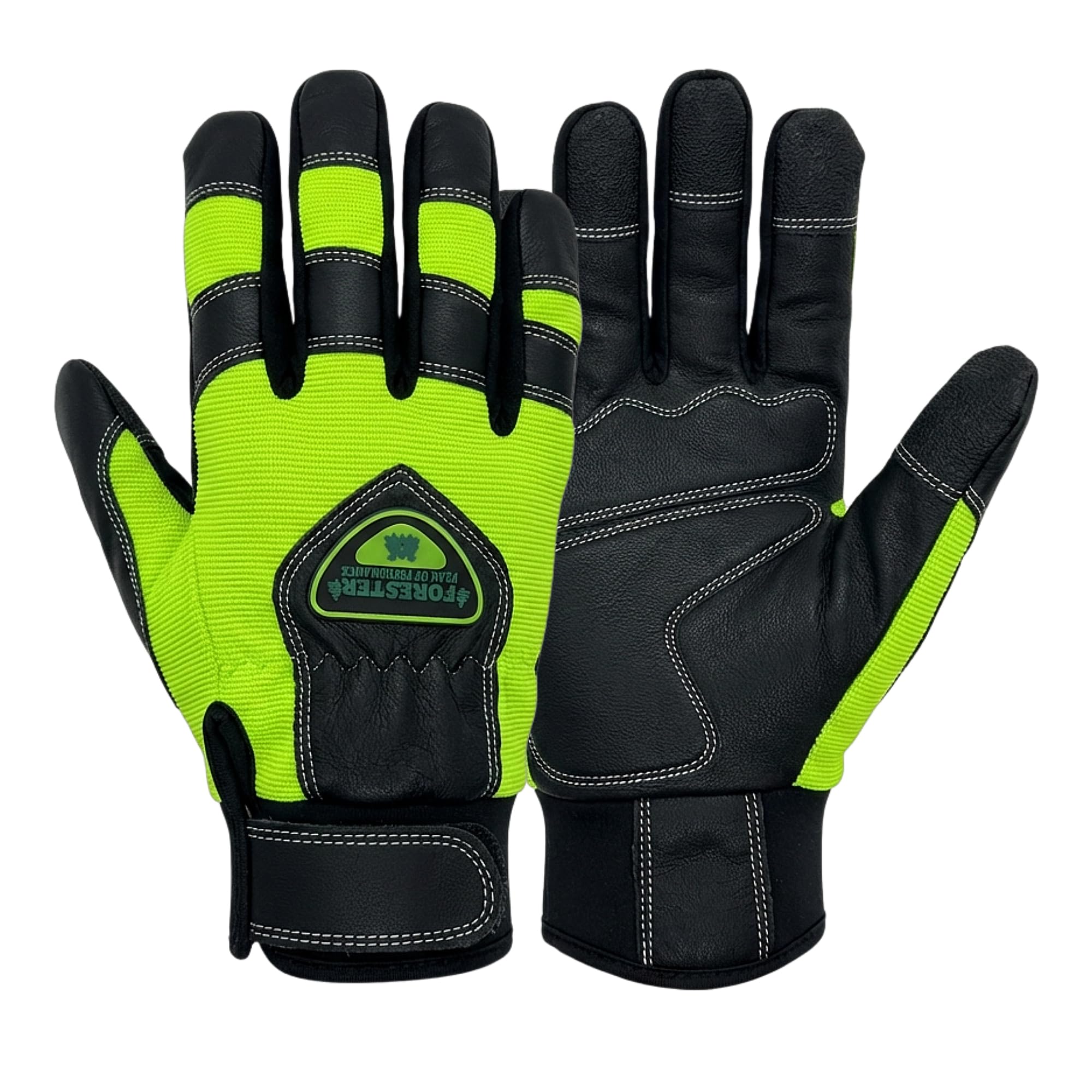
The chainsaw specialist that takes the buzz out of a long cutting session.
FORESTER lined the back of these gloves with DuPont Kevlar and added gel and foam padding in the palms. The result is a glove that dulls the vibration that makes your hands go numb after fifteen minutes of cutting, while giving you a cut-resistant layer against accidental saw contact. The 100% goatskin leather palm keeps a strong grip on the saw handle, and the green hi-vis color is a smart safety touch — you spot them instantly if you set them down in the leaves.
Owners mention that with regular fall and winter use — chainsawing, splitting, and firewood handling — these gloves last about three years before the seams go. That is a much longer lifespan than the Ironclad Ranchworx (which customers note lasts 3 months of moderate use for rough yard work). The neoprene cuff with Velcro closure does a solid job of blocking sawdust and wood chips, and the reinforced fingertips with PVC grips add bite where you need it most. One downside: the Kevlar lining and padding make these noticeably heavier than the Oakley or the Intra-FIT climbing gloves, so dexterity for fine tasks like tying a bowline knot is reduced.
Why It Shines
- Anti-vibration gel and foam padding reduces hand fatigue during long cuts
- Kevlar liner on the back of the hand adds protection against saw contact
- Goatskin leather palm with PVC grip reinforcements for secure handling
Things to Know
- Bulkier than standard leather gloves, limiting fine motor control
- Not ideal for rope-heavy tasks or rappelling due to reduced finger feel
Who should buy: Anyone who runs a chainsaw regularly in fall and winter — the Kevlar and anti-vibration padding are the exact protection you need for hours of cutting and splitting.
Skip if: Your bushcraft is mostly knife carving, fire starting, and shelter building — the extra bulk gets in the way of fine work.
3. Intra-FIT NFPA 1977 Wildland Fire Fighter Glove
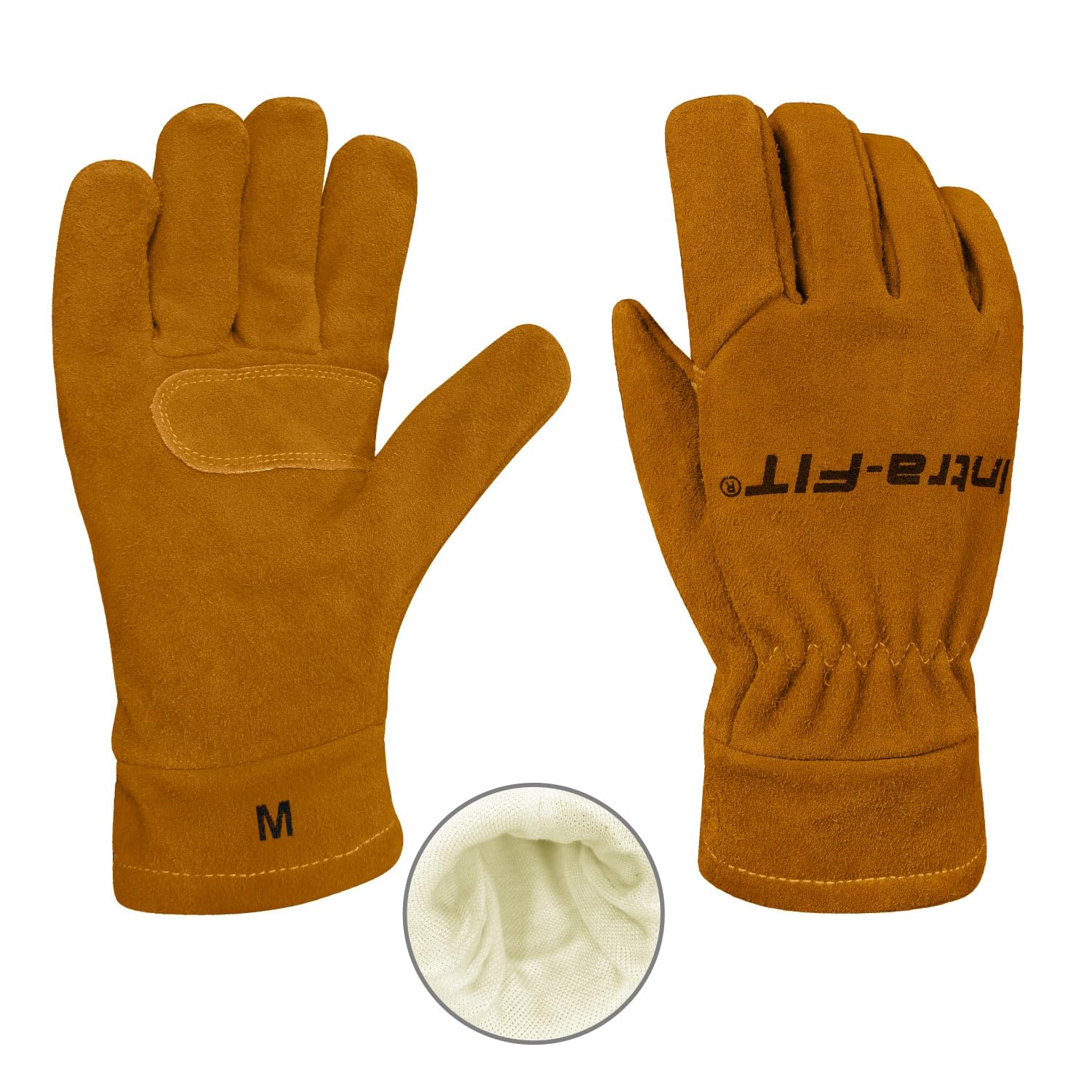
A fireline-grade glove that handles hot coals and embers as easily as axe work.
This glove is built to hold up to the heat and abrasion of wildland firefighting. The outer shell is US-tanned split cowhide — a thicker, tougher leather than goatskin — and the interior is lined with modacrylic, a flame-retardant fabric that stays stable under continuous high temperature. If you tend a campfire, pick up hot logs, or reach into ash for a half-burned coal, this glove keeps your skin safe. It is also waterproof, which matters when you are working wet brush or kneeling in damp ground.
Reviewers point out the glove has lasted over a year of daily wood-stove loading without signs of wear, and one reviewer specifically mentions it feels good when using axes and Pulaskis. The open elastic cuff lets you pull the glove on and off quickly — a feature the FORESTER gloves lack with their Velcro closure — but the trade-off is that debris can slip in more easily during heavy brush work. At a heavyweight fabric class, this is the burliest glove on the list, and you trade some dexterity for that toughness.
Key Strengths
- NFPA 1977 certified for high-temperature and flame-exposed environments
- Split cowhide outer shell with modacrylic lining for extreme heat resistance
- Waterproof construction keeps hands dry in wet conditions
Key Trade-offs
- Open elastic cuff lets sawdust and embers in during overhead work
- Heavyweight build limits finger feel for detailed tasks
Reach for this if: Your camp involves fire handling — tending hot coals, pulling embers, or working near a burn pile — and you need certified flame protection that does not quit.
Not your pick: If you mostly need a lightweight all-day glove for carving and shelter building, the cowhide bulk will feel stiff and clumsy.
4. Helikon-Tex Lumber, Ranger Winter, Woodcrafter Gloves

A thick cowhide shell that shrugs off thorns after you wade into dense brush.
Helikon-Tex built the Lumber Glove around durability for heavy undergrowth. The cowhide leather is thick and stiff at first, and it takes a little breaking in before it flexes naturally with your hand. Once it does, you get a glove that stands up to briars, blackberry vines, and sharp dead branches without tearing — one buyer mentioned using these in a class where they were constantly beating through the thickest thorns and the gloves held up perfectly. The reinforced cuff and a small hole with a carabiner let you clip them to your belt so you do not lose them on the move.
There is one sizing quirk that comes up repeatedly in reviews: the gloves run smaller than the size chart suggests. If you normally wear a medium, many shoppers say you should go up to large. After about six months of medium-to-heavy use, some users also note that the leather stretches more than expected — enough that the gloves can fall off when you lower your hands. That is unusual for cowhide, but it is worth ordering snug to give the stretch room over time. Unlike the Oakley gloves, these have no knuckle guard, so the back of your hand is more exposed to impact.
What Stands Out
- Durable cowhide leather that resists thorns and repeated brush contact
- Reinforced cuff and belt-loop carabiner hole for easy carry
- Good hand protection in extremely thick vegetation
What to Watch For
- Sizing chart runs small — order at least one size up from your normal glove size
- Leather stretches significantly over time, potentially loosening the fit
- No dedicated knuckle impact protection
Best for: Anyone pushing through heavy undergrowth — the thick cowhide is your best defense against thorns and briars.
Consider another if: You need a precise fit right from the start without a break-in period, or if you value knuckle protection during impact-heavy work.
5. Intra-FIT Goatskin Climbing Gloves, Rescue & Rock

A goatskin glove built for rope grip and heat resistance during long descents.
When you are hauling yourself up a rope or belaying a load, friction heat on the palm is the enemy. This Intra-FIT glove uses premium grain goatskin — a leather known for staying soft while handling high heat from friction — and the reinforced padded palm gives you a durable surface against rope burn.
Buyers report that after a couple of months of recreational use the gloves hold up well, and they point out the stretchable spandex panels on the back promote airflow so your hands do not soak through. The anatomically curved fingers and adjustable Velcro cuff let you handle carabiners and figure-eights without the glove shifting. One honest trade-off from reviewers: the brown fabric back is very breathable, so on cold mornings these will not keep your hands warm — they are a three-season glove at best.
Why It Works
- Goatskin palm with reinforced padding withstands rope friction heat
- Lightest leather glove on the list at 0.11 kg — 64% lighter than chainsaw gloves
- Spandex panels and curved fingers give excellent dexterity for rope work
Watch Points
- Not suitable for cold weather — the breathable fabric does not insulate
- Not designed for impact protection or heavy chopping tasks
Reach for this if: Rope handling is a core part of your bushcraft — tree climbing, rappelling, or rescue scenarios — and you need a lightweight, heat-resistant glove that lets your fingers move freely.
Not for: Cold-weather camps or sessions where you expect heavy brush contact and need knuckle or impact protection.
6. Ironclad Ranchworx Work Gloves RWG2
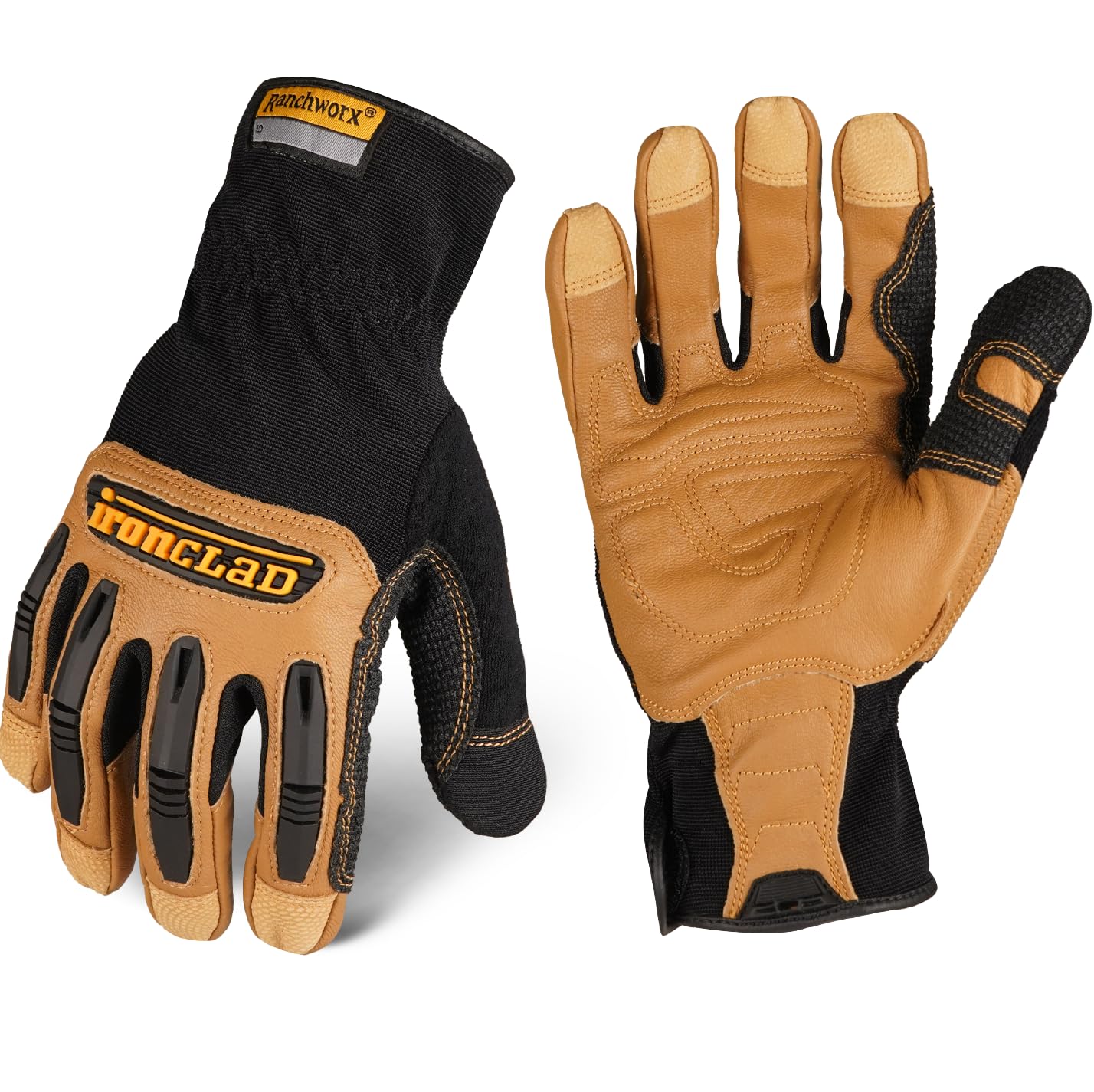
Double-layered fingertips and Kevlar patches for the jobs that chew up normal gloves.
Ironclad designed the Ranchworx for high-abrasion work like wire fencing, digging, and pulling roots. The patented Rolltop smooth Fingertips put a double layer of material on the tips without a bulky seam, so you keep more feel than a typical thick work glove. Kevlar reinforcements sit in the critical wear zones — the palm and thumb crotch — which is where most gloves blow out first. The pull-on cuff with a TPR tab lets you yank them on fast, and the terry cloth sweat wipe on the back of the thumb is a simple but useful detail for mopping your brow mid-work.
There is a hard honesty in the numbers: owners mention that with moderate use these last about three months, and with daily heavy use the lifespan drops to one to three months. That is notably shorter than the FORESTER gloves (three years of seasonal use). The Ranchworx are also stiff when new and need a break-in period before they feel natural, and the nylon construction does not resist oil — if your work involves greasy equipment, these will soak it up.
Where It Excels
- Double-layered smooth fingertips provide enhanced abrasion resistance
- Kevlar reinforcement in high-wear zones extends usable life for rough tasks
- Terry cloth sweat wipe keeps your brow dry without stopping work
Where It Falls Short
- Lifespan of 1–3 months under daily heavy use is short compared to leather options
- Pull-on cuff design lets debris in during overhead or brushy work
- Absorbs oil, making it a poor fit for lubricated equipment tasks
Who should grab these: If your bushcraft involves a lot of fence repair, digging in rocky soil, or handling abrasive materials where you expect to wear through a glove every season.
Look elsewhere for: Long-term durability in daily use — the FORESTER or Helikon-Tex options will outlast these by a wide margin for general camp work.
7. Ironclad Tactical Operator Grip Gloves

A lightweight synthetic glove that delivers a tactical grip without the leather weight.
The Tactical Operator Grip is a synthetic-leather glove that keeps your hands cooler than a full-leather build and dries fast when wet. The silicon-fused palm and index finger give you a sticky grip on a knife handle, a saw, or a firearm, and the neoprene knuckle pad adds a thin layer of impact protection for light brush work. At the budget-friendly end of the pool, it is the entry-level choice for someone who wants protection from blisters and cold mornings without spending on a premium leather pair.
Customers note that the fit runs true to size, and one reviewer measured for a Large but bought a Medium and says they fit perfectly — so if you are between sizes, sizing down may work. The durability is not in the same league as the leather gloves above, though. One reviewer who works as a merchandiser handling boxes all day found that the stitching came apart before the three-month mark. For light bushcraft duties like gathering kindling or splitting a few logs, these are fine; for heavy, repetitive woods work, the leather options above will last longer.
Good Points
- Silicon-fused palm and index finger offer excellent grip in dry conditions
- Neoprene knuckle pad gives light impact protection without adding bulk
- Performance fit good for dexterity — reviewers point out they fit like a second skin
Shortcomings
- Synthetic leather and stitching may not survive 3 months of daily hard use
- Limited ventilation leads to moisture buildup and odor over extended wear
- Not suited for heavy chainsaw, fire-handling, or thorn-brush work
Best for: The occasional bushcrafter who needs a slim, grippy glove for light camp tasks, tool handling, and cool-weather comfort without a big investment.
Not ideal for: Regular heavy work — the stitching and synthetic palm wear out faster than real leather, and the lack of heat resistance rules out fire handling.
Understanding the Specs
Goatskin vs Cowhide vs Synthetic Leather
Goatskin is the premium choice for bushcraft because it stays soft without breaking in, resists heat from rope friction and hot coals, and gives you the most finger feel. Cowhide is thicker and tougher against thorns and abrasion, but it needs a break-in period and flexes less freely. Synthetic leather is lighter and dries fast, but it does not handle heat as well and wears through quicker on rough surfaces.
Cut Resistance and Anti-Vibration Padding
A Kevlar liner (like the FORESTER uses) protects the back of your hand against accidental chainsaw contact — it stops a sudden nick from becoming a deep cut. Anti-vibration gel and foam padding sit in the palm to absorb the high-frequency buzz of a running saw, which prevents the hand numbness that sets in during prolonged cutting. For most bushcraft that does not involve a chainsaw, standard thick leather is adequate cut protection for knife and axe work.
Cuff Design and Fit
A Velcro or hook-and-loop closure (Oakley, FORESTER) creates a tight seal around your wrist that keeps sawdust, wood chips, and debris out. A pull-on cuff (Ironclad Ranchworx) is faster to put on but leaves a gap that can let grit in during overhead or brushy work. An open elastic cuff (Intra-FIT Fire Glove) also allows quick removal but provides the least debris blocking. The right choice depends on whether speed or sealing matters more for your specific tasks.
Waterproofing and Breathability
Waterproof gloves (such as the NFPA 1977 Fire Glove) keep your hands dry in wet brush and rain, but they trap moisture from sweat, making them less comfortable on warm days. Breathable gloves with spandex panels (Intra-FIT Climbing Gloves) let sweat escape and keep your hands drier during active work, but they will soak through quickly in a downpour. For general bushcraft, many users prefer breathable leather and treat it with a wax dressing for light water resistance.
FAQ
What is the best leather for bushcraft gloves?
Can I use chainsaw gloves for general bushcraft?
How do I know what size glove to order?
Do I need cut-resistant gloves for knife work?
How do I care for leather bushcraft gloves?
Can I use climbing gloves for bushcraft?
How long do leather bushcraft gloves last?
What is the difference between a tactical glove and a bushcraft glove?
Are waterproof gloves better for bushcraft?
Can I wash my bushcraft gloves in a washing machine?
Final Thoughts: The Verdict
For the majority of shoppers, the best bushcraft gloves winner is the Oakley Factory Pilot 2.0 because the goatskin leather palm delivers immediate dexterity, the knuckle guard protects against unexpected impacts, and the lightweight design makes them easy to wear all day. If you primarily run a chainsaw and need anti-vibration and cut protection, grab the FORESTER Hi-Vis Chainsaw Gloves. And for campfire-heavy work where heat resistance is non-negotiable, the Intra-FIT Wildland Fire Glove provides certified flame protection that the other picks cannot match.
How We Picked
We do not accept paid placement. Every pick is matched to a real buyer and a real use-case; we do not hands-on test units.
Sources & Methodology
Specifications: manufacturer listings and product documentation. Review insights: verified customer reviews, as of July 2026. Pricing: not shown on this page (it changes often); check the current price via the retailer link.
As an Amazon Associate, FitlyFast earns from qualifying purchases. This does not affect which products we feature.