
Our readers keep the lights on and the weekend projects moving. As an Amazon Associate, I earn from qualifying purchases.
Specs are compiled from manufacturer listings and verified buyer reviews and can change over time — please confirm the key details on the product page before buying.
You want running insoles that soften impact and support your arches, but you are on a tight budget. The short answer: the Move Game Day Performance Insole wins because its composite heel (a firm material that blends carbon fiber and foam for shock absorption) and patented arch deliver high-mileage stability that cheap EVA options cannot match. This guide lines up the proven budget-friendly contenders based on their specifications and what buyers report, so you know which insert has the firmness, fit, and foot coverage you need.
I’m Rikta — the founder and writer behind FitlyFast. This guide is built by comparing the manufacturers’ published specifications and the patterns across verified customer reviews, so you get each pick’s real strengths and trade-offs instead of marketing spin.
The key is focusing on arch height (measured in millimeters), heel cup depth (the curved pocket that holds your heel), and cushioning material. Here is the rundown on the best budget running insoles that deliver on those promises.
Our Picks at a Glance


How To Choose The Best Budget Running Insoles
Picking the right insole depends on matching your foot’s specific needs with the right materials and design. A flat arch needs different support than a high one. The padding that feels great for a short walk can be terrible for a 5-mile run. Here are the three specs you should focus on first.
Arch Height and Support Type
The arch is the bridge of your foot. Its shape determines how your weight gets distributed. A good insole will have a raised section in the middle that fills the gap under your arch. A higher arch height, like the 35 mm support you see on some insoles, gives you more lift. It can help with conditions like plantar fasciitis (pain in the tissue along the bottom of your foot). For flat feet, you want a supportive platform that prevents your foot from rolling inward, a motion known as overpronation. If the arch feels too aggressive, you could develop hip or knee pain. Look for a medium profile if you are unsure.
Heel Cup Depth and Stability
The heel cup is the curved pocket at the back of the insole that cradles your heel. A deeper cup, around 0.4 inches as found in some mid-range options, locks your heel in place so it does not slide around inside your shoe. This reduces friction that can cause blisters. It also improves your stride alignment by keeping the foot stable when it hits the ground. If you have had ankle sprains, a deeper heel cup is your top priority. It adds a layer of protection against rolling your ankle on uneven pavement.
Cushioning Material and Durability
Not all foams are the same. The cheapest insoles use a basic EVA foam (ethylene-vinyl acetate, a lightweight plastic foam). It feels soft in the store but compresses permanently after a few weeks. Better insoles use polyurethane foam (PU, a denser plastic that resists flattening). PU can recover at least 98% of its original shape after each step. Some use gel pads placed at the heel and forefoot (the ball of your foot). If you are a heavier runner or logging high mileage, look for a material that explicitly resists compression deformation, meaning it does not stay squished. A full foam insole that is too thick can also crowd your toes. Check if the product notes a break-in period of 3-7 days to let the foam settle to your foot shape.
Quick Comparison
| Model | Best For | Arch Height | Weight | Cushioning Material | Amazon |
|---|---|---|---|---|---|
| STSVZORR Plantar Fasciitis Insoles★ Best Overall | Immediate plantar fasciitis relief | 35 mm | 4.16 oz | Durable EVA foam | Amazon |
| Move Game DayAlso Great | High-mileage runners & athletes | Patented composite | 6 oz | Composite heel & reactive foam | Amazon |
| CRUVHEAL Sport Shock Absorbing | Basketball & high-impact training | Neutral arch | 5.93 oz | Strategically placed gel pads | Amazon |
| CRUVHEAL Running Gel Insoles | Runner’s knee & muscle soreness | TPE arch support | 8.78 oz | Gel & TPE | Amazon |
| Welnove Performance Arch Support | Daily runners & marathoners | Ergonomic arch | 7.83 oz | Responsive cushioning foam | Amazon |
| Welnove Metatarsal Pad Insoles | Morton’s neuroma & forefoot pain | Multi-density foam modules | 7.76 oz | Gel forefoot cushion & premium foam | Amazon |
| Bukihome Sport Insoles | Long days on feet (walking & standing) | TPU material | 7.37 oz | Polyurethane foam | Amazon |
In‑Depth Reviews
1. STSVZORR Plantar Fasciitis Relief Insoles
Lightest in the lineup at 4.16 ounces, with a 35 mm arch height aimed at immediate plantar fasciitis relief.
This is the entry-level specialist: an EVA foam insole (a lightweight plastic foam) with a pronounced 35 mm arch support that targets plantar fasciitis, flat feet, heel spurs, and Morton’s neuroma. At only 4.16 ounces, at 4.16 ounces versus the Welnove Performance (7.83 oz), which makes it an ideal swap-in for shoes where you want support without adding noticeable weight. Buyers with 30+ years of plantar fasciitis reported “immediate comfort, no pain for 5+ hours standing/walking.” One podiatrist even recommended a metatarsal insole support for ball-of-foot pain, with the buyer calling the STSVZORR a “night and day” difference.
The caveat is durability and fit. EVA foam is less dense than polyurethane, meaning it compresses faster over time. One owner reported that after a while, their feet started to slide off the insole, requiring constant adjustment. Additionally, the 35 mm arch can feel intrusive at first — the manufacturer warns new users to wear it for no more than 4 hours a day during the first week. The package dimensions (13.5 x 5.67 x 2.09 inches) also mean it is a longer insole, so it may not fit into every pair of Skechers or other slip-on styles, as one customer observed.
Why It Is a Fan Favorite
- Very lightweight at 4.16 oz — barely noticeable inside the shoe.
- 35 mm arch offers aggressive support for serious plantar fasciitis.
- Highly affordable price point for the level of relief.
Where It Compromises
- EVA foam loses cushioning faster than denser polyurethane options.
- Some users experienced foot sliding after extended wear.
Ideal For: Runners and walkers with plantar fasciitis who want a budget-friendly, lightweight insole that delivers immediate pain relief during the break-in phase.
Not For: Heavy runners or high-mileage athletes who need long-term durability — the EVA foam will flatten before the polyurethane competitors do.
2. Move Game Day Performance Insoles
Co-founded by NBA pro Damian Lillard, this insole brings pro-level support to everyday runners.
This is the premium choice. You get a patented composite heel — a firm blend of materials that soaks up shock better than plain foam — and a reactive stability platform that actively controls impact. Unlike the simpler EVA options, the Game Day targets plantar fasciitis, flat feet, and bunions, all within a single molded forefoot design that conforms to your shoe. Reviewers report it eliminated shin splints after five years of struggle, with one buyer running a mile outdoors pain-free for the first time. At 6 ounces, it is lighter than the CRUVHEAL Running Gel insole (8.78 oz), yet delivers a noticeably denser platform for hard pavement pounding.
The catch is its stiff composite heel and pronounced arch. A reviewer with past ankle sprains gave it 4 stars, noting it is better for athletes under 30 with healthy joints rather than older or injury-prone users. If you are sprinting on the court, these are the ones to buy. If you just want to pad your work shoes, look at the softer Bukihome below.
Why the Pros Choose It
- Composite heel soaks up shock better than basic foam, so your knees feel less jolt.
- Patented arch support mimics custom orthotics (prescription foot inserts).
- Durable enough for full volleyball seasons without flattening, according to buyers.
The Real Catch
- Stiff feel may be too aggressive for older feet or previous ankle injuries.
- Premium price compared to budget-tier EVA options.
Who Should Grab These: Serious runners and court-sport athletes who want a durable, high-support insole that can handle sprints and jumps without breaking down.
Who Should Pause: Anyone with very sensitive arches or a history of ankle sprains — the stiff platform can irritate if your joints are not already stable.
3. CRUVHEAL Sport Shock Absorbing Insoles

Strategically placed gel pads and a deep heel cup make this a durable pick for high-impact training.
Where the Move Game Day uses a stiff composite, the CRUVHEAL Sport relies on a neutral arch design that fits most foot shapes without forcing a corrective posture. It uses gel pads at the heel and forefoot to absorb impact, which makes it strong for basketball players and runners worried about shin splints and tendonitis. Reviewers — including a 68-year-old soccer referee — praised its “springy” feel during a 5k run, noting the deep heel cup kept the foot stable without slipping. At 5.93 ounces, it is lighter than the Welnove Performance (7.83 oz). It also requires a 3-7 day break-in period where you wear it only 2-5 hours a day to let the foam adapt.
The main trade-off is that some buyers found the mid-foot arch support slightly insufficient for severe plantar fasciitis. However, the bounce-back from the gel pads was consistently called “nicely bouncy” and “firm but not too hard.” If you play lacrosse or run on hard surfaces, the wider fit and non-slip heel pads keep everything locked in place — unlike the Bukihome, which owners mention has a slippery texture.
Standout Strengths
- Gel pads provide excellent shock absorption for high-impact sports, so your joints feel less strain.
- Deep heel cup prevents blisters and slipping during cuts.
- Lightweight at 5.93 oz — easier on the foot than heavier full-foam options.
Known Limitations
- Arch support may feel moderate, not aggressive enough for flat feet.
- Break-in period of 3-7 days requires patience.
Pick This If: You need a responsive, bouncy insole for basketball, lacrosse, or daily running without the stiff corrective feel of a high-arch orthotic.
Pass If: You have flat feet that demand a very tall arch — the neutral profile here might not give you enough lift.
4. CRUVHEAL Running Insoles Gel Insoles
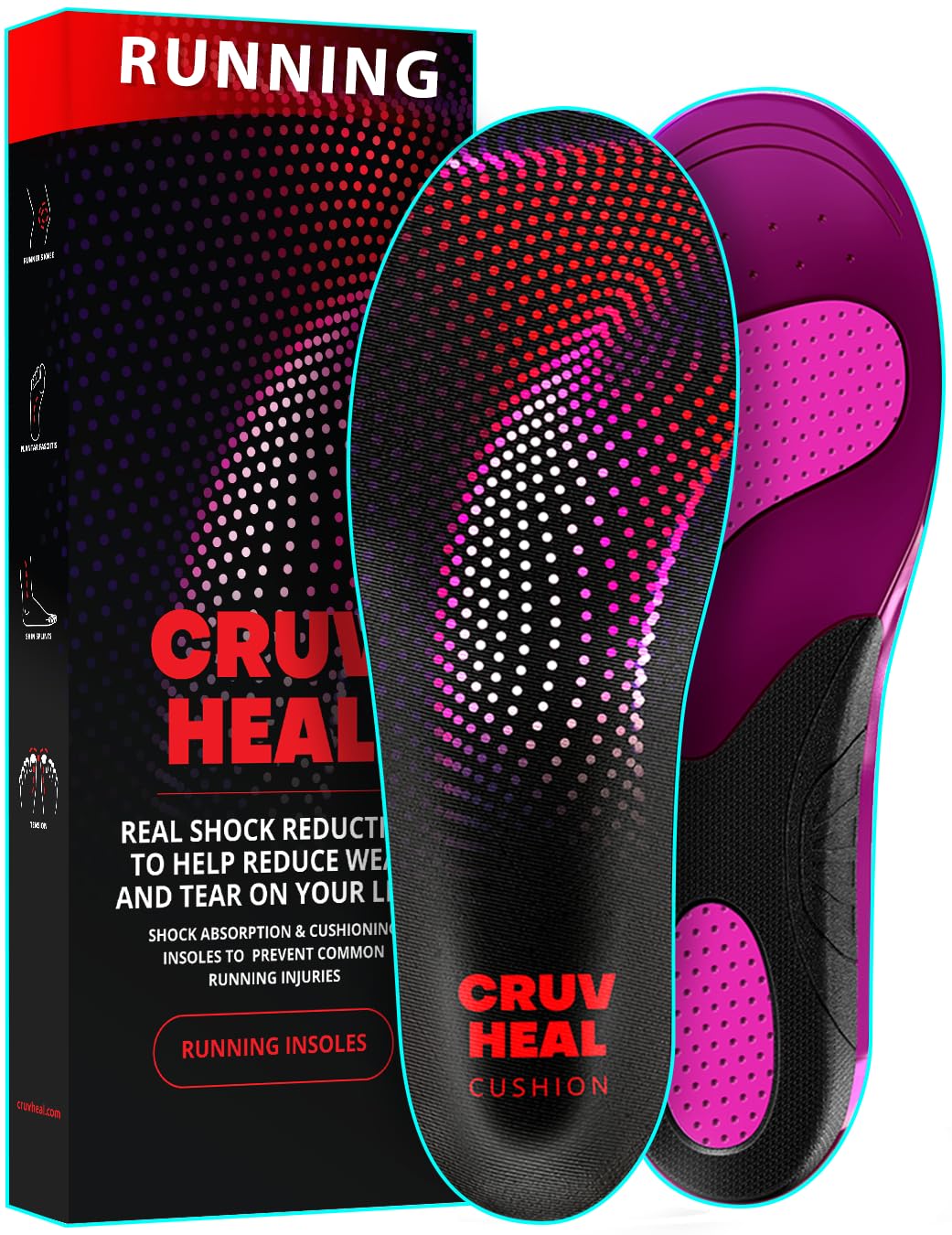
Combines a TPE arch support with a U-shaped gel heel for injury prevention at a mid-range price.
This is the second CRUVHEAL entry, but it targets a different need: runner’s knee, shin splints, and muscle soreness rather than general sports impact. The key difference is the U-shaped gel heel design paired with a TPE (thermoplastic elastomer, a springy rubber-like plastic) arch support. That gives a different feel than the neutral arch of the Sport model above. Reviewers who bought it twice say the arch support is excellent and that foot pain disappeared after one week of walking.
The gamble here is the arch height: one reviewer noted the arch was too high, causing hip pain during running, and had to discard the insoles entirely. That makes this a better fit for medium to high arches than flat feet. The skin-friendly velvet cover also helps keep odor down during sweaty sessions, though it can feel warm in the summer.
What Works
- U-shaped gel heel reduces runner’s knee and shin splint risk by cushioning impact.
- TPE arch offers durable, long-lasting support that does not flatten fast.
- Custom trim-to-fit sizing for a tailored feel.
What Could Trip You Up
- Heavy weight (8.78 oz) compared to competitors.
- High arch may cause hip pain for runners with flat feet.
Reach For These If: You have a medium to high arch and want a dense, durable insole that actively targets runner’s knee and shin pain.
Skip Them If: You have flat feet or a low arch — the TPE support might lift your foot into an uncomfortable position that shifts the strain to your hips.
5. Welnove Running Insoles – Performance Arch Support
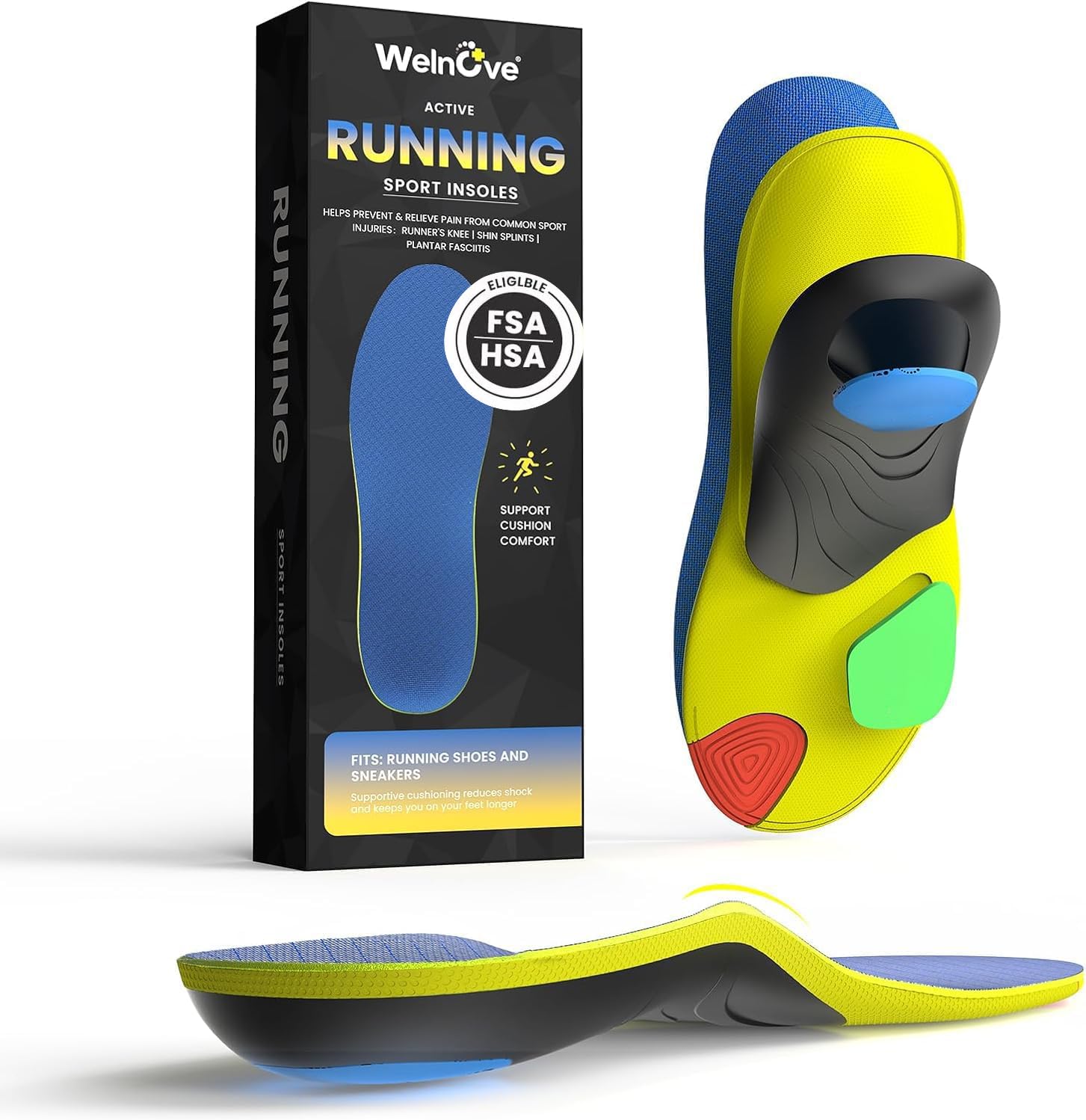
Engineered for distance runners who want responsive cushioning and breathability on long runs.
This Welnove model is for daily runners and marathoners. It uses an ergonomic arch support that stabilizes your stride and reduces joint strain. The key feature is its responsive cushioning foam, designed to absorb shock without being so soft that it bottoms out over 10+ miles. At 7.83 ounces, it sits in the middle weight range — heavier than the STSVZORR (4.16 oz) but lighter than the CRUVHEAL Gel (8.78 oz). Customers note they have purchased six pairs, calling them “excellent for running,” and one buyer mentioned the insoles make cheap sneakers feel much more comfortable.
The honest trade-off is thickness: the foam is on the thicker side, and as one buyer pointed out, it “will take up a half size if you need it.” If your running shoes are already snug, these could make your toes feel cramped. The breathable mesh fabric and moisture-wicking layer do help keep sweat under control, but expect a brief adjustment period if your current insoles are paper-thin.
Why Distance Runners Like It
- Responsive cushioning that does not flatten easily over long distances.
- Breathable mesh fabric reduces sweat and odor.
- Ergonomic arch stabilizes your stride for better alignment.
The Fit Warning
- Thick foam can crowd toes in tight-fitting shoes.
- Not recommended for prolonged standing — better for movement than static wear.
Best For: Runners who log high weekly mileage and want a breathable, supportive platform that handles the pounding of pavement and trail alike.
Not Ideal If: Your running shoes are already snug or you spend more time standing at a job than running — the thick profile steals volume from the toe box.
6. Welnove Running Insoles with Metatarsal Pad
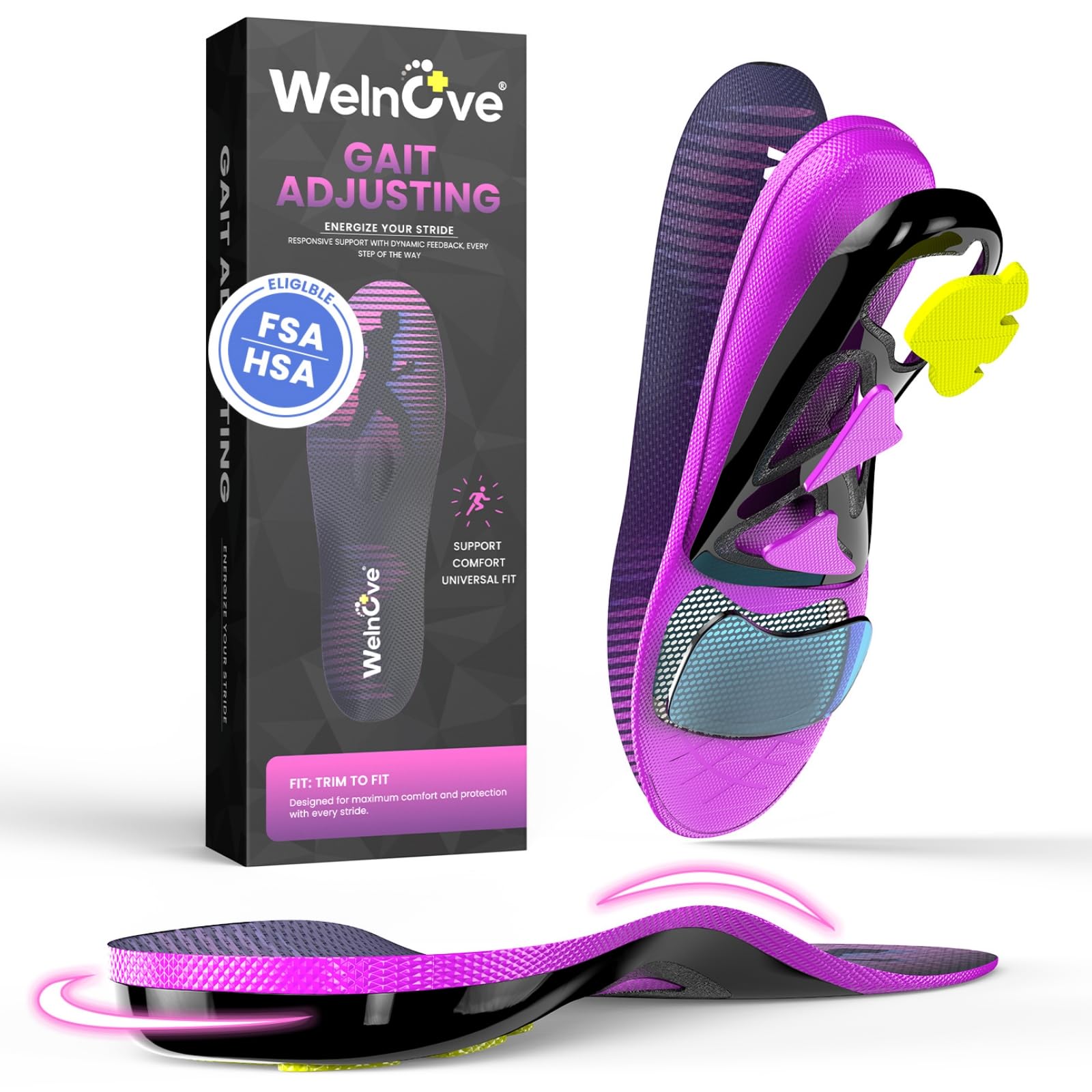
A targeted metatarsal pad and forefoot gel cushion that addresses Morton’s neuroma and ball-of-foot pain.
Unlike the standard Welnove above, this version adds a built-in metatarsal pad — a raised cushion under the forefoot that specifically offloads pressure from the ball of your foot. For runners with Morton’s neuroma (a nerve condition causing pain between the toes) or metatarsalgia (pain in the ball of the foot), this makes a huge difference. One buyer reports it allowed them to walk 100 miles in a single week without foot pain. Another with metatarsalitis said the insoles were a “life saver” for flat shoes that were previously unbearable. The multi-density foam modules dynamically adapt to your arch contour, making it suitable for both flat feet and high arches.
The downside is durability: after a few months of use, reviewers point out the insoles can become “extremely squeaky,” a common complaint for gel-based inserts when the layers start to separate. At 7.76 ounces, it is nearly identical in weight to the standard Welnove (7.83 oz). The extra metatarsal pad means it works best in shoes with a removable insole and a roomy forefoot — skip it for tight casual wear.
Pain Relief Highlights
- Metatarsal pad reduces pressure on the ball of the foot effectively.
- Multi-density foam adapts to both flat and high arches.
- Non-slip gel base keeps the insole from sliding inside the shoe.
Longevity Concern
- Can develop squeaking noises after a couple of months.
- Needs a shoe with enough forefoot room to accommodate the extra pad.
Buy This For: Runners and walkers who have a diagnosed forefoot condition like Morton’s neuroma or metatarsalgia and need direct pressure relief in the ball-of-foot area.
Think Twice If: Your pain is purely in the heel or arch — the metatarsal pad adds bulk up front that you do not need, and the standard Welnove above is a better fit.
7. Bukihome Sport Insoles
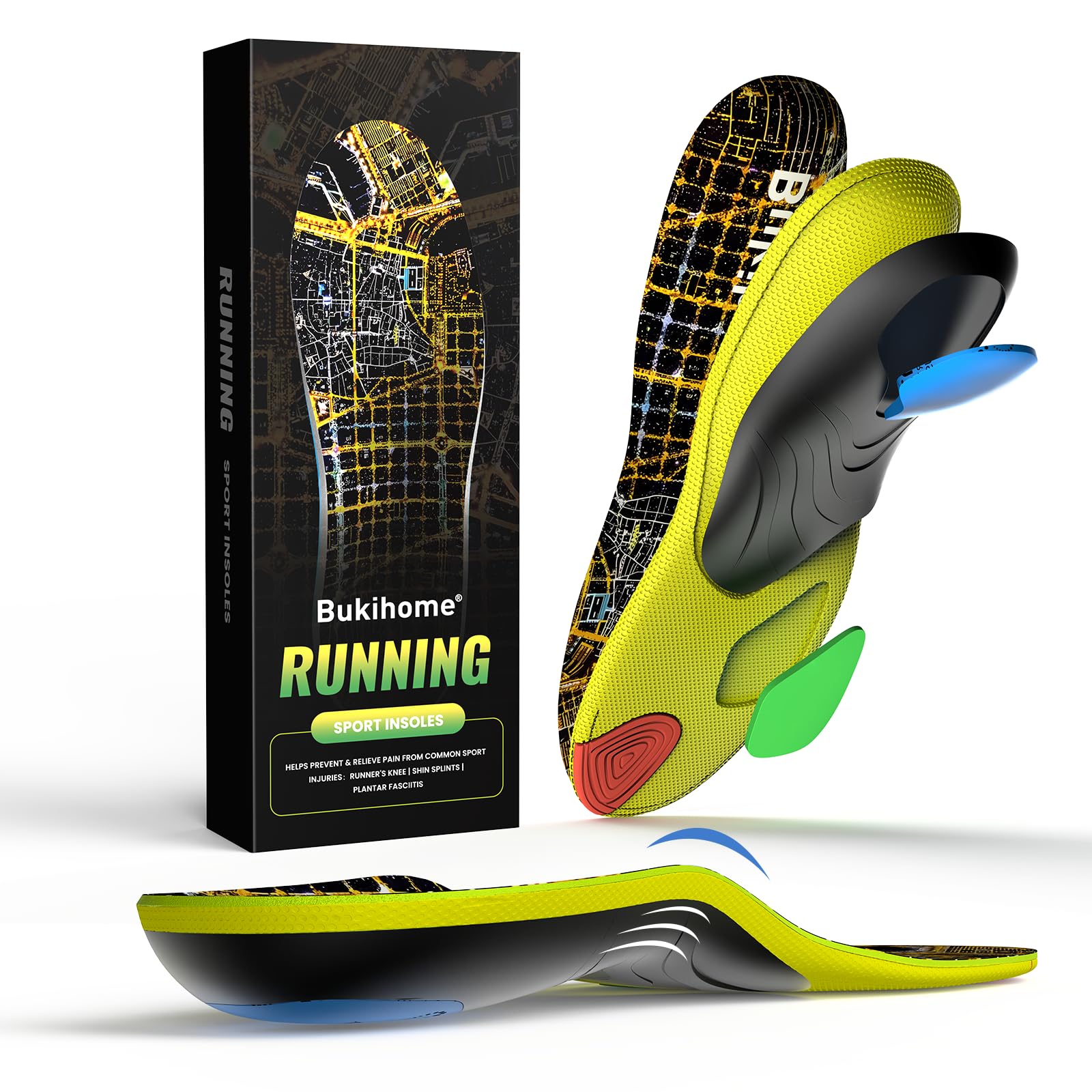
A dense polyurethane foam insole with a 0.4-inch deep heel cup designed for standing all day.
If you spend more time on your feet standing or walking than sprinting, the Bukihome brings real substance at a low cost. The polyurethane foam (PU, a dense plastic) resists permanent flattening and recovers at least 98% of its original shape after each step, unlike basic EVA. The 0.4-inch deep heel cup contours to your heel to minimize friction, which prevents blisters during long shifts. One reviewer who works on cold cement for 14-hour days reported that this insole eliminated foot and ankle pain.
The honest downsides are texture and firmness. Buyers consistently describe these as “hard insoles, no softening over time,” noting that the arch support felt insufficient and some experienced heel pain after daily use. Additionally, multiple reviewers reported that the insoles squeak and feel slippery, which can be annoying during quiet gym sessions. The manufacturer also warns that these inserts take up significant shoe space and will not work well in tight shoes.
What Holds Up
- Polyurethane foam resists compression better than standard EVA, so the cushion lasts.
- 0.4-inch deep heel cup prevents sliding and blisters.
- 180-day after-sales guarantee covers defects.
What Gets Annoying
- Firm feel with no softening over time — not plush.
- Squeaking noise and slippery surface texture reported by multiple buyers.
Choose This If: You stand for long shifts on hard floors and need a dense, durable insole that stops heel slip and resists flattening.
Avoid It If: You need a soft, plush ride or a quiet insole for the gym — the firmness and squeaking will be distracting.
Understanding the Specs
Arch Height (mm)
This is the height of the raised support under the middle of your foot. A higher number, like 35 mm, means more lift and correction for flat feet or plantar fasciitis. A lower or neutral arch is better for people whose foot shape is already stable and just needs a little padding. If the arch is too tall for your foot, you may feel pressure under the midfoot or pain in your knees and hips.
Heel Cup Depth
This is how deep the curved pocket is at the back of the insole. A deeper cup (around 0.4 inches) wraps around your heel fat pad to keep it centered during each foot strike. That prevents the heel from sliding, which reduces friction blisters and improves your overall running form by keeping the lower leg aligned with the foot.
Cushioning Material
Polyurethane (PU) foam is denser and recovers its shape better (up to 98% recovery) than EVA foam, which is softer but flattens faster. Gel pads add targeted shock absorption at specific pressure points like the heel or forefoot. TPE (thermoplastic elastomer) offers a springy, durable feeling that is stiffer than gel but less bulky than foam.
Weight (ounces)
A lighter insole puts less mass on your foot, which can feel more natural during fast running or cutting sports. However, lighter materials often mean less dense cushioning, so there is a trade-off between weight and long-term durability. For most runners, anything under 7 ounces is considered light.
FAQ
How tight should running insoles feel in my shoes?
How do I break in a new pair of budget running insoles?
Can I use running insoles for everyday walking?
Will budget insoles help with shin splints?
How long do budget running insoles last?
Do I need a metatarsal pad or just arch support?
Can I trim my insoles to fit?
Are budget insoles safe for flat feet?
Why do my insoles squeak when I walk?
What is the difference between EVA and polyurethane foam for insoles?
Final Thoughts: The Verdict
If you want one dependable pick, the best budget running insoles winner is the Move Game Day Performance Insole because its composite heel and patented arch deliver durable, high-mileage support that beats every budget EVA option on stability and rebound. If you want the best value for high-impact sports like basketball, grab the CRUVHEAL Sport Shock Absorbing Insole for its targeted gel pads and deep heel cup. And for targeted forefoot pain relief like Morton’s neuroma, the standout is the Welnove Metatarsal Pad Insole that lets you walk 100 miles in a week without discomfort.
How We Picked
We do not accept paid placement. Every pick is matched to a real buyer and a real use-case; we do not hands-on test units.
Sources & Methodology
Specifications: manufacturer listings and product documentation. Review insights: verified customer reviews, as of July 2026. Pricing: not shown on this page (it changes often); check the current price via the retailer link.
As an Amazon Associate, FitlyFast earns from qualifying purchases. This does not affect which products we feature.