
Our readers keep the lights on and the weekend projects moving. As an Amazon Associate, I earn from qualifying purchases.
Specs are compiled from manufacturer listings and verified buyer reviews and can change over time — please confirm the key details on the product page before buying.
You want the roar of a home theater without the roar of credit-card debt. A solid budget AV amp does that — it pulls dialogue out of mud, shakes the couch with a good explosion, and connects everything you own, all for a price that won’t make your spouse wince. The challenge is identifying which compromises are worth making and which will ruin the experience.
I’m Rikta — the founder and writer behind FitlyFast. This guide is built by comparing the manufacturers’ published specifications and the patterns across verified customer reviews, so you get each pick’s real strengths and trade-offs instead of marketing spin.
After digging through the real owner experiences for dozens of models, the best budget av amp we found delivers Dolby Atmos, modern HDMI specs, and genuinely clean sound without pushing past a sensible price ceiling.
Our Picks at a Glance

How To Choose The Best Budget AV Amp
A budget receiver forces you to prioritize. Invest in features that enhance your actual setup and avoid those that only look impressive on paper.
HDMI Specs Matter More Than Power Ratings
The wattage numbers on a cheap amp (often measured at 1kHz with one channel driven) are misleading. What really matters is whether the HDMI board supports what your TV does — eARC (enhanced Audio Return Channel, which sends high-quality sound from your TV’s apps back to the receiver over one cable) for sound from the TV apps, 4K/120 or 8K/60 if you game, and HDR10+ or Dolby Vision pass-through. Without these, your new receiver will feel old the day you plug it in.
Atmos or Not? It Depends on Your Ceiling
Dolby Atmos needs speakers that fire upward or sit in the ceiling. If your room has low or vaulted ceilings, or you can’t place speakers above you, Atmos processing won’t give you the helicopter-overhead effect. In that case, a simpler 5.1 receiver with great stereo sound is a smarter buy.
Room Correction Is Worth the Setup Time
You can spend an hour running the included calibration microphone, or you can leave your speakers in bad spots and blame the receiver. Budget amps that include an auto-setup mic (Audyssey on the Denon, YPAO on the Yamaha) fix timing and volume mismatches that cheap speakers alone cannot. It is the most effective free upgrade you can make.
Quick Comparison
| Model | Best For | Power (Per Ch.) | Height | Atmos | Amazon |
|---|---|---|---|---|---|
| Pyle 5.2 Channel★ Best Overall | Dorm / apartment starter kit | — | — | No | Amazon |
| Yamaha RX300AAlso Great | Entry-level Atmos + gaming | 70W | 6.13 in | Yes (Dolby Atmos) | Amazon |
| Denon AVR-S670H | Multi-room music + phono input | 75W x 5 | — | No (5.1 only) | Amazon |
| Marantz NR1510 | Compact cabinet fit + vinyl playback | 50W per ch. | 4 in | No (5.2 only) | Amazon |
| Sony STRDH590 (Renewed) | Dual-sub budget build | 145W (6 ohms) | 5.25 in | No (5.2 only) | Amazon |
In‑Depth Reviews
1. Pyle 5.2 Channel Hi-Fi Home Theater Receiver
The no-frills receiver that gets your speakers loud for the absolute lowest cash outlay.
Pyle’s 5.2-channel receiver is the lightest unit here at 11.1 pounds — a full 51% lighter than the Yamaha RX300A. It supports 4K Ultra HD pass-through, Bluetooth wireless streaming from your phone, and includes a DAC (a Digital-to-Analog Converter for connecting to a computer’s digital audio signal). The price is low enough that one owner said they “hooked up to some old infinity speakers and cranked it all the way” without fear.
What owners love is the simplicity: the receiver is “easy to use and quick to set up.” One buyer who replaced a 14-year-old Pioneer said the Pyle “has better sound than my old, more expensive, Yamaha receiver.” Another called it an “impressive machine for the price” that “performs as well as its and counterparts.” The subwoofer output lacks real adjustability — a few report it overwhelms music even at the lowest setting — but for casual movie watching and apartment living, the trade-off is small.
Sound quality gets mixed feedback overall. Some find it decent; a few call it “awful.” The consensus is that this is a “low level solid performer” — perfect for a dorm, a bedroom, or a garage setup where you just need something that works with Bluetooth and powers your speakers. If you want the overhead magic of Dolby Atmos or the precision of room correction, this is not the unit.
What works
- Lightest receiver in the group at 11.1 pounds — easy to move
- Built-in Bluetooth streams from iPhone, Android, and turntables
- Overcurrent, short circuit, and overvoltage protection
- Owners call it great value and easy to set up
What to know
- Subwoofer control is basic — lowest setting can still overwhelm
- Sound quality is mixed; some call it “awful,” others “great for the price”
- No Dolby Atmos, no room correction, no HDMI eARC
Perfect for: a first-time buyer, a small apartment, or a dedicated stereo setup where Bluetooth and low cost matter more than surround precision.
Not for: anyone building a serious home theater or needing adjustable subwoofer output — the Yamaha RX300A is worth the extra money.
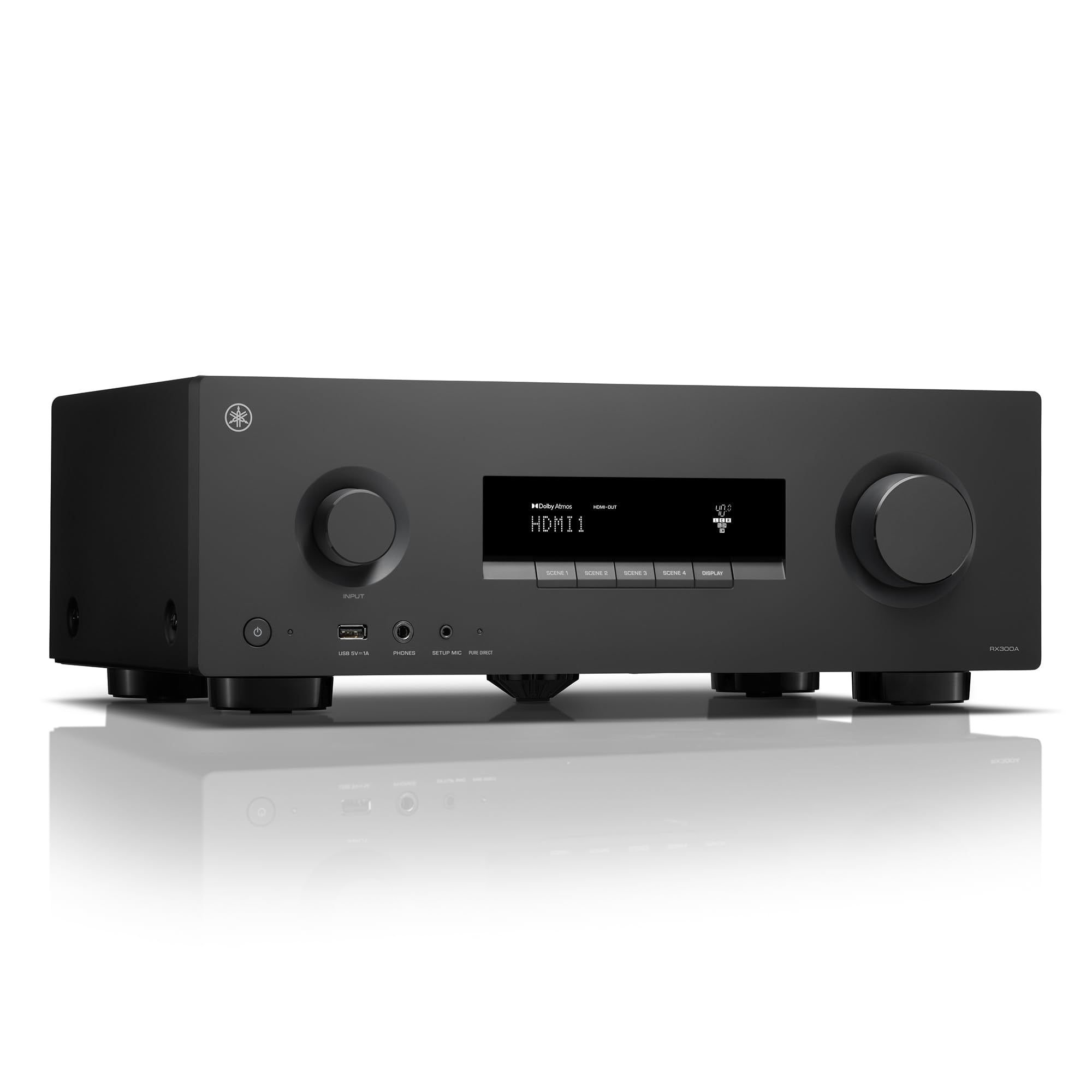
2. Yamaha RX300A 5.2-Channel AV Receiver
The entry-level receiver that brings genuine Dolby Atmos and next-gen HDMI to a sensible price.
This 5.2-channel receiver delivers 70W of power and supports speaker layouts up to 3.1.2-channels — meaning you can run two height speakers (up-firing or in-ceiling) for that overhead-object sound without a full 7.1 setup. Buyers call it an “excellent budget AV receiver with Dolby Atmos, 4K/120, eARC,” and the crowd feedback lands overwhelmingly positive: crisp dialogue, easy setup, and a sound that makes regular TV feel like a theater.
The HDMI board is where the Yamaha punches above its weight. It handles 4K/120 and 8K/60 video, plus Dolby Vision, HDR10+, ALLM, and VRR — all the gaming-friendly features you usually find on receivers that cost twice as much. An included setup microphone measures your room’s acoustics and automatically tune the sound. One owner running Klipsch RP-600M speakers reported “great 2-channel downmixing.”
The downside is its weight and depth. At 16.8 pounds and 12.5 inches deep, it is noticeably heavier and deeper than the Sony STRDH590 at 11.75 inches. Make sure your cabinet shelf can support it. Also, like many budget receivers, it lacks a phono preamp, so turntable owners will need an external box.
What steals the show
- Real Dolby Atmos support (3.1.2 layout) for a true overhead bubble
- 4K/120 and 8K/60 HDMI — future-proof for PS5 and Xbox Series X
- Bluetooth Multipoint lets you pair two phones and switch instantly
- Included room-correction mic tune sound for your living room
The fine print
- Heavier than the Sony STRDH590 at 16.8 vs 11.1 pounds
- No built-in phono preamp for vinyl playback
- Only 19 ratings so far — a newer model with less crowd data
Reach for it if: you want modern HDMI specs (4K/120, eARC, VRR) and genuine Dolby Atmos without jumping to a receiver.
Think twice if: your cabinet is shallow or you need a phono input — the Sony STRDH590 is slimmer and the Denon has a phono stage.
3. Denon AVR-S670H 5.2 Ch Home Theater Receiver

The Denon that packs a phono input, 8K HDMI, and rock-solid sound into one well-loved package.
With 75 watts across 5 channels and support for 8K/60Hz and 4K/120 pass-through, this Denon sits at the balance between price and everyday performance. Sound quality is what owners praise most — 39 call it out specifically — with one owner noting “zero hiss or static.” The built-in HEOS platform lets you stream Spotify, TIDAL, and other services to this room or others around the house, all controlled by voice via Alexa.
Unlike the Yamaha and Pyle picks, the Denon includes a phono input for turntables, which is a rare and welcome feature at this level. The included Audyssey microphone auto-calibrates speaker distances and levels. Setup is straightforward, though the on-screen menu has a learning curve that one owner described as “intimidating but learnable.” Most buyers report it works “flawlessly” after setup. Bluetooth connectivity receives mixed feedback from 17 owners — most connect fine, but a few report occasional dropouts.
Functionality ranks second in praise (34 mentions), and 21 owners single out build quality. The limitation is that this is a 5.1-channel system, not 5.2.2 — it lacks height-channel processing for Atmos. If overhead sound matters to you, the Yamaha RX300A is the better call despite having fewer HDMI inputs.
Why owners love it
- Built-in phono preamp for turntable owners — rare at this price
- HEOS multi-room streaming works with Spotify and TIDAL
- Audyssey room calibration tune sound in minutes
- 8K/60 and 4K/120 HDMI with HDR10+ and Dolby Vision
Before you buy
- No Dolby Atmos or height-channel support — 5.1 only
- Bluetooth connectivity is mixed for 17 owners, with some dropouts
- Single HDMI output limits simple setups without a TV eARC
Best for: vinyl collectors who want a clean, powerful receiver with multi-room streaming and a proven track record (237 ratings, mostly 5-star).
Not for: anyone building an Atmos system — the Yamaha RX300A is cheaper and actually does height channels.
4. Marantz NR1510 Slim 5.2 Channel Receiver

Full-size Marantz sound in a chassis that slides into the tightest AV cabinet.
The NR1510 stands just 4 inches tall — nearly two inches shorter than the Yamaha RX300A — making it the pick for anyone whose media console has limited vertical clearance. Inside that slim frame sits a discrete 5-channel amplifier rated at 50 watts per channel, plus an MM phono preamp (a built-in amplifier for a moving-magnet turntable) for connecting a turntable directly. Sound quality earns 25 positive mentions from owners, and build quality gets 24.
This receiver supports 4K Ultra HD at 60Hz with HDR, HLG, eARC, and Dolby Vision, so your picture quality matches the audio. The included setup assistant guides you through the process step-by-step. The HEOS app handles multi-room audio, and voice control works with Alexa, Google Assistant, or Siri. One owner called the sound “crisp 5.1 audio at all volumes” and praised the 0.5dB volume increments for fine-tuning.
If you have large, power-hungry speakers and a big room, you may run out of headroom. Also, the NR1510 has a known initial burn-in smell (reviewers mention it gets hot and smells for the first few hours), so plan for ventilation. It also lacks 4K/120 or 8K/60 support — this is strictly a 60Hz receiver, so next-gen gamers should look at the Yamaha.
Where it shines
- Slim 4.1-inch height fits in shallow cabinets the others won’t
- Built-in MM phono preamp — plug a turntable right in
- crisp 5.1 sound with.5dB volume increments for precision
- HEOS multi-room and voice control (Alexa, Google, Siri)
Where it gives ground
- 50W per channel is the lowest power in this lineup
- No 4K/120 or 8K/60 input — limited to 60Hz
- Runs hot initially; needs good airflow during burn-in
Reach for this if: your AV stand has a short shelf and you want Marantz-grade sound quality plus a phono input in a compact package.
Look elsewhere if: you game at 120Hz or drive large floor-standing speakers — the Yamaha RX300A gives you more power and modern HDMI.
5. Sony STRDH590 5.2 Receiver (Renewed)
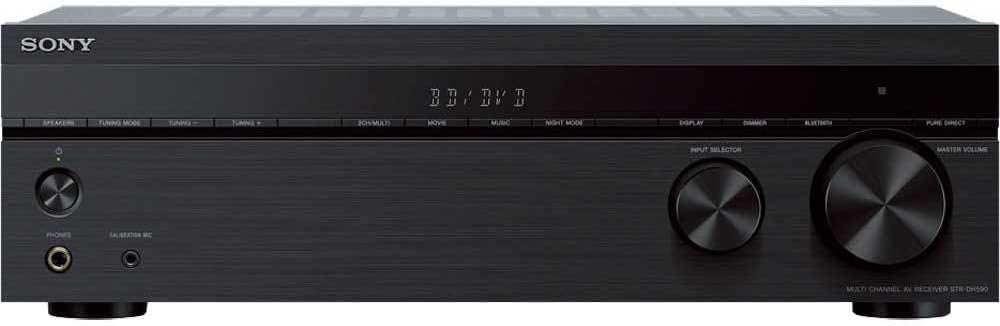
A renewed budget beast with high power and dual subwoofer outputs — if you’re okay rolling the dice.
This Sony receiver puts out a claimed 145W per channel (at 6 ohms, 1kHz, 1ch driven) and features dual subwoofer pre-outs, four HDMI inputs, and built-in Bluetooth streaming. At just 5.25 inches tall, it is slimmer than the Yamaha RX300A (6.13 inches) and lighter than both the Yamaha and the Marantz. For a budget-conscious buyer who wants headroom for bass, this Sony is a strong candidate.
Owner feedback is largely positive: owners call it “the king of the budget A/V receivers” and praise its “excellent sound” and “dual subwoofer outputs.” Multiple reviewers describe it as a perfect replacement for a dead 25-to-30-year-old unit, and one said the renewed unit was “indistinguishable from new.” It also supports Dolby Vision and HDCP 2.2, and the 4-in/1-out HDMI setup with Audio Return Channel works well for standard TV setups.
The main drawback is reliability. A smaller but real subset of owners mention a “protect” error after a few months, where the receiver shuts down internally. One owner wrote: “Failed after 6 months with internal ‘protect’ error.” Sony reportedly confirmed the issue for that buyer, and the seller was unhelpful. This is a renewed product, so the risk is slightly higher than buying new. The manual also lacks detailed setup steps for HDMI-eARC, and there is no phono input.
Why it’s tempting
- Dual subwoofer outputs give you more bass flexibility
- Slim 5.25-inch profile fits most standard cabinets
- Renewed price cuts the cost of 4K HDR surround sound
- Customers note excellent sound quality and easy HDMI ARC setup
The honest risk
- Some units fail with a “protect” error after months of use
- No phono input for turntables
- Manual lacks detailed eARC setup instructions
Go for it if: you want high watts per channel, dual subs, and a slimmer profile — and you are comfortable with the risk of buying renewed electronics.
skip it if: you need steadfast long-term reliability or a phono stage — the Denon AVR-S670H gives you both for a higher upfront cost.
Understanding the Specs
Channel Count vs. Real Surround
A “5.2” receiver means five main speaker channels plus two subwoofer outputs. That gives you front left, center, front right, two surround speakers, and two subs. “5.2.2” adds two height channels for Dolby Atmos. For most living rooms, a plain 5.2 (like the Denon or Sony) is plenty. For the overhead bubble effect, you want the “3.1.2” or “5.2.2” layouts that the Yamaha RX300A supports — which is rare at this budget tier.
HDMI Version and What It Means for You
HDMI eARC lets your TV send high-quality audio (Dolby TrueHD, DTS-HD) back to the receiver over a single cable. 4K/120 or 8K/60 support matters if you own a PS5, Xbox Series X, or a high-end TV that runs games at 120 frames per second. Without it, your receiver becomes a bottleneck. The Yamaha RX300A and Denon AVR-S670H support these features; the Marantz NR1510 and Sony STRDH590 top out at 4K/60.
Room Correction — The Free Upgrade
An included calibration microphone (Yamaha’s YPAO, Denon’s Audyssey) measures how sound bounces off your walls, furniture, and carpet, then adjusts speaker delays and volume levels automatically. This fixes the “muffled dialogue” or “boomy bass” that comes from bad speaker placement. The Pyle and Sony STRDH590 lack this feature entirely, so you will tune by ear.
Phono Input for Turntable Owners
A “phono” input has a built-in preamp that boosts the weak signal from a record player to line level. Without it, you need a separate external phono preamp box. The Denon AVR-S670H and Marantz NR1510 include a phono input. The Yamaha, Sony, and Pyle do not — factor in an extra – if you spin vinyl.
FAQ
Can a budget 5.2 receiver give me Dolby Atmos?
Do I need a 4K/120 or 8K/60 receiver for my PS5?
Is a “renewed” AV receiver worth the risk?
How much power do I really need for a living room?
What does the “2” in 5.2 mean?
Can I use a budget AV receiver with a turntable?
What is eARC and why does it matter?
How do I connect Bluetooth speakers or headphones to a receiver?
Final Thoughts: The Verdict
For most people, the budget av amp winner is the Yamaha RX300A because it brings Dolby Atmos, 4K/120 gaming HDMI, and room-correction setup to a price that undercuts rivals by a wide margin. If you want multi-room streaming and a phono input for vinyl, grab the Denon AVR-S670H — it has the most crowd-tested track record here. And for the tightest cabinet or a pure compact setup, the Marantz NR1510 delivers refined sound at just 4.1 inches tall.
How We Picked
We do not accept paid placement. Every pick is matched to a real buyer and a real use-case; we do not hands-on test units.
Sources & Methodology
Specifications: manufacturer listings and product documentation. Review insights: verified customer reviews, as of July 2026. Pricing: not shown on this page (it changes often); check the current price via the retailer link.
As an Amazon Associate, FitlyFast earns from qualifying purchases. This does not affect which products we feature.