
Our readers keep the lights on and the weekend projects moving. As an Amazon Associate, I earn from qualifying purchases.
Specs are compiled from manufacturer listings and verified buyer reviews and can change over time — please confirm the key details on the product page before buying.
Swapping your standard pedals for a load cell brake is the fastest way to shave seconds off your lap times. The catch is most serious load cell sets cost more than your whole wheelbase. But real load cell performance has finally dropped to prices that do not hurt — you just need to know which shortcuts are fine and which ruin the feel.
I am Rikta — the writer behind FitlyFast. This guide compares the makers’ published specs and patterns from verified customer reviews, so you get each pick’s real strengths and trade-offs instead of marketing spin.
If you run a Logitech G920, a Thrustmaster T300, or are building your first rig, finding the right best budget load cell pedals means picking the set that gives you the most realistic brake feel for the money without blowing your budget.
Our Picks at a Glance

How To Choose The Best Budget Load Cell Pedals
Load cell pedals measure pressure, not travel distance. That difference lets you brake the exact same way every corner — your leg muscles learn the force, not the pedal’s swing arc. Here is what separates a good budget set from a frustrating one.
The sensor itself is the whole point
A true load cell should measure at least 100 KG of foot force. That capacity gives you a wide usable range between a light tap and full braking. Anything less than 100 KG will feel vague under heavy braking and harder to modulate consistently.
Pedal construction and mounting reality
Budget load cell pedals push back with real force — they will slide across a carpet if not bolted down. Look for high-strength steel construction and check if the set comes with mounting hardware or expects you to supply your own screws. Most owners end up attaching these to a dedicated racing cockpit or a wheel stand.
Adjustability that matters
You will tune the brake feel the most. Some sets use elastomer stacks — rubber-like pucks that mimic a real brake pedal’s progressive stiffness — while others rely on metal springs. A set that lets you swap these without tools is worth a small premium. You can dial in a soft street-car feel or a stiff race-car bite.
Compatibility beyond the PC
Most budget load cell pedals connect via USB and work natively on PC. If you need console support — PS5, PS4, Xbox — you must match the pedal set to a compatible wheelbase. The Fanatec CSL Elite Pedals V2, for instance, work on PlayStation only when paired with a PlayStation-licensed Fanatec base, and on Xbox only with an Xbox-licensed Fanatec steering wheel.
Quick Comparison
| Model | Best For | Load Cell Rating | Construction | Connectivity | Amazon |
|---|---|---|---|---|---|
| MOZA SR-P★ Best Overall | Best overall value | 100 KG | High-strength steel | USB / RJ45 | Amazon |
| Fanatec CSL Elite V2 | Best adjustability | >200 KG sensor rating | All-metal | RJ12 / USB | Amazon |
| Thrustmaster T-LCM | Best console compatibility | 100 KG / 220 lb | 100% metal | USB | Amazon |
In‑Depth Reviews
1. MOZA SR-P Pedals Set
The cheapest real load cell set that does not feel cheap at all.
The MOZA SR-P gives you a genuine 100 KG load cell brake for well under two hundred dollars — a price that makes you do a double take. The bodies are machined from high-strength steel, so they have the heft of a set costing twice as much. The organ-type accelerator pedal — where your foot pivots from the heel rather than lifting the whole leg — follows the same natural arc as a real car’s throttle. That makes trail-braking transitions smoother than you expect at this price point.
Both pedals use a 16-bit magnetic encoder that delivers a 65,536 PPR (pulses per revolution) resolution. That means the pedal picks up far more tiny movements than the Hall-effect sensors (contactless magnetic sensors) in many mid-range sets, so every millimeter registers in the sim. Owners consistently say the jump in consistency over stock Logitech G920 pedals is massive. The catch: these pedals are designed for a cockpit. As buyers report, they are “for cockpit only” and need secure mounting to a racing stand or rig. The set does not come with screws for a desk or carpet setup. The stock spring is also too light for some — a swap to a firmer spring is a common first mod.
The MOZA Pit House software lets you tweak the output curves for brake and throttle independently, so you can replicate the progressive bite of a real race car. At this price there is no clutch pedal included, but the modular design means you can add one later. For someone on a budget who refuses to settle for a potentiometer brake (a wear-prone sensor that measures pedal travel), this is the set to beat.
The Real Deal
- True 100 KG load cell at an entry-level price
- 16-bit magnetic encoder beats many mid-range sets on precision
- High-strength steel construction feels premium
Smart Caveats
- Rig mounting required — not for floor or desk use
- Stock spring feels too soft for some drivers
- No clutch included in the two-pedal set
Grab these if: you are building your first cockpit on a tight budget and want genuine load cell braking that transforms your lap consistency while staying affordable.
Look past them if: you need a clutch, or you do not own a wheel stand or rig — these really need bolting down.
2. Fanatec CSL Elite Pedals V2
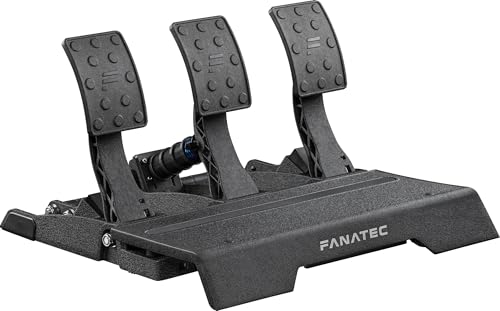
The three-pedal set that lets you tune the brake feel without touching a tool.
The Fanatec CSL Elite Pedals V2 are the most adjustable set in this lineup before you step into Heusinkveld territory. The load cell sensor is rated for over 200 KG — double the MOZA’s capacity — though you only feel the 90 KG you push into the pedal plate. What makes the brake special is the elastomer stack: three different rubber-like pucks with Shore hardness ratings (a standard measure of material softness) of 65, 75, and 85, plus an optional metal spring for extra preload. You swap them with zero tools, so you can go from a soft road-car feel to a stiff track bite in under a minute.
Buyers describe these as a “huge upgrade from the non-load cell pedals” and a clear step into mid-range sim racing. The throttle and clutch use contactless Hall-effect sensors for durability — no wiper contacts to wear out. The all-metal build and grippy rubber pedal covers give a premium, planted feel. One behavioral quirk: the brake force setting resets to 50% every time the wheelbase powers up, so you may need to re-enter your preferred percentage in the firmware. Still, owners overwhelmingly call it a worthwhile upgrade from the Logitech G920.
Connectivity is flexible — RJ12 to a compatible Fanatec base (recommended for console support) or USB as a standalone PC input. On PlayStation you need a PlayStation-licensed Fanatec base; on Xbox you need an Xbox-licensed Fanatec steering wheel. If you plan to stay on PC, the USB route is plug-and-play.
Why It Shines
- Tool-free elastomer swap for three elastomer stiffness levels plus an alternative metal spring
- 200+ KG rated load cell sensor with realistic progressive feel
- Full three-pedal set with Hall-effect throttle and clutch
The Fine Print
- Brake force randomly resets to 50% on wheelbase power-up
- Console compatibility requires specific Fanatec base or wheel
- Not an endgame set — serious racers may outgrow it
Reach for these if: you want the most adjustable brake feel in this price bracket and already own a Fanatec base or plan to run USB on PC.
Think twice if: the firmware reset bug would drive you crazy, or you are certain you will want a pro-level set next year.
3. Thrustmaster T-LCM Pedal Set
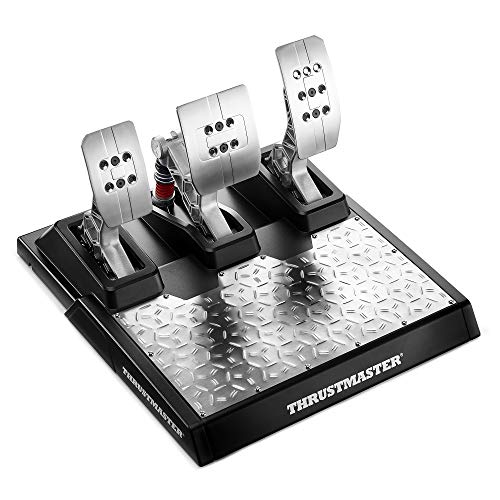
The only set here that works on every major console from the start.
The Thrustmaster T-LCM natively supports PS5, PS4, Xbox Series X|S, Xbox One, and PC via USB — no adapter or licensed base required. That makes it the default for console racers who want load cell braking without platform lock-in. The load cell measures up to 220 pounds (100 KG) of pressure, the same force capacity as the MOZA, wrapped in a 100% metal body that owners describe as “big, heavy, solid” — the opposite of plastic entry-level sets.
The brake comes with adjustable mechanical force, so you can dial in the resistance to match your preference. Buyers who jumped from a two-pedal set note it is a “good upgrade” but warn the brake is “harder than I thought” — it takes a few sessions to build leg strength for consistent modulation. Some owners do a DIY rubber bushing mod to remove the abrupt stop point from the stock springs, though many run the hardest springs right from the start. At 17.83 x 15.98 x 11.54 inches, it is a 10% larger footprint than the MOZA SR-P, so check your rig’s floor space before buying.
The three-pedal configuration includes independently adjustable pedal faces — you can shift the throttle, brake, and clutch positions side to side to match your natural leg stance. The main trade-off is that the brake adjustability is less refined than the Fanatec’s elastomer system; it relies on springs rather than progressive rubber pucks, so the feel is stiffer overall. For a console-first sim racer who wants to race on PlayStation during the day and Xbox at night without juggling hardware, the T-LCM is the obvious pick.
The Big Win
- Native support for PS5, PS4, Xbox Series X|S, Xbox One, and PC
- 100% metal construction with independently adjustable pedals
- 100 KG / 220 lb load cell at a proven, crowd-tested price point
Honest Notes
- Brake is noticeably stiffer than other budget load cells
- Larger footprint — measure your rig before buying
- Spring-based feel lacks the progressive bite of an elastomer stack
Pick this if: you race on multiple consoles and want one pedal set that works on everything without an adapter.
skip it if: you want a softer, more progressive brake feel — the Fanatec or MOZA will suit you better from the start.
Understanding the Specs
Load Cell Rating (KG)
This number tells you the maximum force the sensor can measure before hitting its ceiling. A 100 KG load cell is the entry-level balance — it gives enough range for both feather-light trail braking and full-pedal threshold stops. Higher-rated sensors (200+ KG) give you more headroom but require a stiffer elastomer or spring to feel realistic; otherwise you press hard and barely use the sensor’s range.
16-Bit vs Hall-Effect vs Potentiometer
The throttle and clutch sensors matter almost as much as the load cell brake. A potentiometer is the old standard — it wears out and gets jittery. Hall-effect sensors use magnets for contactless reading, which is more durable. A 16-bit magnetic encoder (like the MOZA SR-P’s) gives 65,536 discrete steps of resolution, so even tiny throttle inputs register cleanly. For budget pedals, any sensor technology above potentiometer is a win.
Elastomer vs Spring Brake System
Elastomers are rubber-like pucks that get progressively harder as you compress them, mimicking a real car’s brake booster and pad-kiss feel. Springs provide linear resistance — the same force all the way down. Elastomers are generally preferred for load cell pedals because they let you modulate brake pressure in the same muscle-memory zone as a track car. Most budget sets let you swap these, giving you control over the brake’s personality.
Pedal Connectivity and Console Lock-In
USB pedals work on PC natively. Console compatibility is where it gets tricky. Pedals that connect via USB to a wheelbase (like Fanatec’s RJ12) can work on PlayStation or Xbox only when paired with a licensed base or wheel from the same brand. The Thrustmaster T-LCM is the exception — it uses straight USB and works on all major consoles from the start. Always check the compatibility list before buying.
FAQ
Can I use budget load cell pedals on the floor without a cockpit?
Do I need a clutch pedal for sim racing?
Will load cell pedals make me faster?
How long do budget load cell pedals last?
Can I mix a Fanatec pedal set with a Logitech wheel?
What is the difference between a load cell and a potentiometer brake?
Do I need a special power supply for load cell pedals?
Which budget load cell pedal set is best for a Logitech G920 owner?
Can I reverse-mount load cell pedals for a Formula-style rig?
What does the 16-bit PPR rating mean for throttle precision?
Final Thoughts: The Verdict
Across the board, the best budget load cell pedals winner is the MOZA SR-P. It delivers a real 100 KG load cell in a high-strength steel body at a price that undercuts everything else by a wide margin — that is what earns it the top spot. If you want the ultimate adjustability with tool-free elastomer swaps and a third pedal, grab the Fanatec CSL Elite Pedals V2. And for console-first racers who need a single set that works on PlayStation, Xbox, and PC without an adapter, the Thrustmaster T-LCM is the one to reach for.
How We Picked
We do not accept paid placement. Every pick is matched to a real buyer and a real use-case; we do not hands-on test units.
Sources & Methodology
Specifications: manufacturer listings and product documentation. Review insights: verified customer reviews, as of July 2026. Pricing: not shown on this page (it changes often); check the current price via the retailer link.
As an Amazon Associate, FitlyFast earns from qualifying purchases. This does not affect which products we feature.