
Our readers keep the lights on and the weekend projects moving. As an Amazon Associate, I earn from qualifying purchases.
Specs are compiled from manufacturer listings and verified buyer reviews and can change over time — please confirm the key details on the product page before buying.
Picking a cable router means choosing between raw speed, how far the signal reaches, and whether the tech will still feel modern in three years. The wrong pick leaves you buffering during video calls or watching a game freeze mid-play. Here you get a breakdown of seven strong contenders, each matched to a real home setup or internet plan.
I’m Rikta — the founder and writer behind FitlyFast. This guide is built by comparing the manufacturers’ published specifications and the patterns across verified customer reviews, so you get each pick’s real strengths and trade-offs instead of marketing spin.
A home that spans 4,800 square feet needs a different router than a compact apartment. And if your internet plan hits 1 Gbps, you want a device that can actually breathe. Here is the breakdown of the best cable router picks available right now.
Our Picks at a Glance


How To Choose The Best Cable Router
Most home networks choke not on raw speed but on interference and device congestion. Here is what actually separates a confident buy from a frustrating one.
Speed Rating vs. Your Plan
A router’s speed number (like AX5400) is the theoretical max across both bands. Your real speeds live only until your internet plan’s cap — a 300 Mbps plan won’t get faster because the router says 5,400 Mbps. Match the router’s rated speed to your plan, not your dreams.
Antennas and Beamforming
External antennas and beamforming (a technique that focuses the signal toward your devices instead of blasting it everywhere) make the difference between a signal that reaches the basement and one that drops at the hallway. More antennas typically mean better range through walls.
Modem vs. Router Combo
A modem-router combo saves a power outlet and a monthly rental fee from your ISP. A separate router (your own) gives you more control, easier upgrades, and often better performance. Your choice depends on if you want simplicity or flexibility.
Quick Comparison
| Model | Best For | Speed Rating | Coverage | Wi-Fi Standard | Amazon |
|---|---|---|---|---|---|
| TP-Link Archer AX73★ Best Overall | Large home coverage | AX5400 | 4,800 sq ft* | Wi-Fi 6 | Amazon |
| TP-Link Archer AX55Best Value | Value & reliability | AX3000 | Strong | Wi-Fi 6 | Amazon |
| GL.iNet Flint 3 (BE9300) | Wi-Fi 7 & VPN performance | BE9300 | 2,000 sq ft | Wi-Fi 7 | Amazon |
| NETGEAR RAX30 | Budget Wi-Fi 6 | AX2400 | 2,000 sq ft | Wi-Fi 6 | Amazon |
| NETGEAR R6700AX | Compact & reliable | AX1800 | 1,500 sq ft | Wi-Fi 6 | Amazon |
| ARRIS SBG7400AC2 | Modem-router combo value | AC2350 | Home | Wi-Fi 5 (AC) | Amazon |
| ARRIS G34-RB | DOCSIS 3.1 combo | AX3000 | 2,500 sq ft* | Wi-Fi 6 | Amazon |
In‑Depth Reviews
1. TP-Link Archer AX73
Our pick — 4.5★ from 8,500+ verified ratings; the strongest balance of quality and price.
Its six antennas deliver the widest real-world coverage in this lineup — a proven choice for a two-story home or a basement fortress.
This is the router to pick when your home feels like a dead-zone maze. The Archer AX73 hits a 5,400 Mbps speed rating (a combination of both bands) — that is a 3.0x gap over the NETGEAR R6700AX’s 1,800 Mbps — and backs it up with six external antennas plus beamforming (a focus-beam technology that aims the signal toward your devices). Buyers report “excellent signal strength across 4,800 sq ft two-story home including basement” — the kind of coverage that eliminates the need for Wi-Fi extenders. With a 4.5-star average across 8,600+ ratings, reliability is the trait most praised, with nearly 600 owners singling it out as rock-solid.
Setup takes about ten minutes through the Tether app. Extra venting helps the unit avoid throttling (slowing down when it overheats). It handles over 20 devices without a hitch — OFDMA technology (which lets multiple devices share a channel simultaneously) and MU-MIMO (streaming data to multiple devices at once) keep gaming latency low and 4K streams smooth. A single USB 3.0 port lets you connect a drive for a private cloud or media sharing across your network.
The recurring honest note is that the “tune mode” merges the 2.4 GHz and 5 GHz bands into one network name, which can confuse older smart-home gadgets that only speak 2.4 GHz. You can separate them manually in the settings. Some buyers also note that connectivity with very unusual gear — like a 2016-era sound machine — can be mixed.
What wins people over
- Six antennas for extreme range
- Reliability is the most praised trait (595 owners mention it)
- USB 3.0 port for network storage or private cloud
- Setup via Tether app takes roughly 10 minutes
The honest trade-offs
- Smart Connect band merging can confuse older 2.4 GHz devices
- Connectivity compatibility with some unusual gear is mixed
Reach for this if: you have a large home (2,000+ sq ft), a lot of devices, or a basement that kills other signals.
Look elsewhere if: you only need a router for a small apartment and want to keep the budget lower.
2. TP-Link Archer AX55
You get VPN support plus a massive real-world speed jump for less than the price of a typical Wi-Fi 6 router — owners mention going from 130 Mbps to 500-800 Mbps after upgrading.
If you are coming from a five-year-old router, the AX55 is the upgrade that will make you wonder why you waited. It pushes up to 2,976 Mbps total (2,402 Mbps on the 5 GHz band, 574 Mbps on the 2.4 GHz band) — and customers note real-world Wi-Fi speeds jumping from 130–170 Mbps to 500–800 Mbps after swapping out an ISP gateway. With a massive 10,700+ ratings pool and a 4.4-star average, reliability is what gets the most praise. Four high-gain external antennas with beamforming deliver strong coverage — one owner with a 450 Mbps Comcast plan reports the router now delivers a full 400–425 Mbps all the way into the backyard and a metal patio room, without an extender.
The AX55 runs cool thanks to a larger heatsink (a metal component that draws heat away from the processor), so you do not have to worry about it throttling during long gaming sessions. It also includes built-in VPN server and client support — something the NETGEAR R6700AX lacks entirely — so you can protect your whole network or connect to a remote office directly from the router’s interface.
One setting to know: the band-steering feature (Smart Connect) can cause mobile devices to bounce randomly between the 2.4 GHz and 5 GHz bands. Owners advise turning it off in the settings for a stable connection. Some older printers may require the 2.4 GHz band to run on WPA2-only encryption (a simpler security mode), which is easy to set but worth planning for.
Why it’s a fan favorite
- Massive real-world speed jump — one owner saw a 285% gain
- VPN server & client built in — no extra software needed
- Runs cool, won’t slow down under heavy use
- Consistent after a year for streaming and gaming
One thing to watch
- Smart Connect band steering can be glitchy on mobile — disable it
Grab this if: you want a future-proof Wi-Fi 6 router at a reasonable price with VPN features.
Skip if: you need a modem-router combo — this is a router only.
3. GL.iNet Flint 3 (BE9300)

VPN performance here is class-leading at up to 680 Mbps — a big difference from typical consumer routers that choke at around 100-200 Mbps on OpenVPN (an encrypted tunnel protocol).
The Flint 3 is the most technically loaded router in this list. It is a tri-band Wi-Fi 7 router with a theoretical data transfer rate of 12.5 Gigabits Per Second, and all five Ethernet ports are 2.5 Gigabit (so wired connections are also screaming fast). The standout is its VPN performance: it handles both WireGuard and OpenVPN at up to 680 Mbps, which is extraordinarily fast for an encrypted tunnel — most consumer routers slow down to around 100-200 Mbps on OpenVPN.
Coverage is rated at up to 2,000 square feet. The hardware includes 1 GB of DDR4 RAM and 8 GB of eMMC storage (for installing plugins and handling over a hundred connected devices). Owners consistently praise the user interface and the AdGuard Home integration (a built-in DNS-level ad blocker that cleans up browsing). One owner, moving from closed-source routers, calls it “the best router ever” and notes the low-power ARM processor (a chip design that balances performance with energy efficiency) means it should have a long lifespan.
The honest trade-off is that Wi-Fi range is noticeably shorter than some competitors — one owner measured roughly half the range of their ISP router. It covers the rated 2,000 sq ft, but do not expect it to punch through three floors. The USB 3 port is also slow for NAS use (around 30 MB/s), so skip it if you want to stream 4K video from a connected drive.
The cutting-edge perks
- Wi-Fi 7 with MLO (Multi-Link Operation) for ultra-low latency
- WireGuard/OpenVPN up to 680 Mbps — class-leading
- All five ports are 2.5 Gigabit Ethernet
- AdGuard Home built in, plus Bark parental controls
What it trades off
- Wi-Fi range is shorter than some of the budget picks
- USB 3 port is slow for network-attached storage
Buy this for: a VPN-first home office, immediate 2.5 Gbps wired networking, or Wi-Fi 7 readiness.
Think twice if: you need a single router to cover a 2,500+ sq ft house or plan to use USB for streaming video.
4. NETGEAR RAX30 (Renewed)

Coverage here is 2,000 square feet — a 33% bigger reach than the NETGEAR R6700AX’s 1,500 sq ft — making it a stronger fit for apartments and small houses without climbing in price.
The RAX30 pushes AX2400 speeds (up to 2.4 Gbps) and comes with four 1 Gigabit Ethernet ports for wired consoles and PCs. What owners praise most is performance — 54 owners single it out as a solid, reliable workhorse. One owner coming from a provider router that “would not shake Wifi hands with my cross platform devices” says this RAX30 found them all quickly. Setup is straightforward through the Nighthawk app.
The renewed (refurbished) unit is a notable value. It comes professionally inspected and tested, and owners consistently say it looks and works like new. As a router-only model, you will need a separate modem for cable internet. Some reviewers point out compatibility issues with Spectrum cable modems — if your ISP is a major US cable company, check the RAX30’s compatibility list before buying.
Small package, big upside
- 2000 sq ft rated coverage for small to medium homes
- AX2400 speeds with 4 Gigabit LAN ports
- Performance praised — 54 owners call it solid
- Renewed units are well-tested and look brand new
One hurdle
- Some Spectrum modem compatibility issues reported
Best for: a budget upgrade to Wi-Fi 6 in a small home or apartment.
Not for: anyone who needs a built-in modem — this is a router only.
5. NETGEAR R6700AX
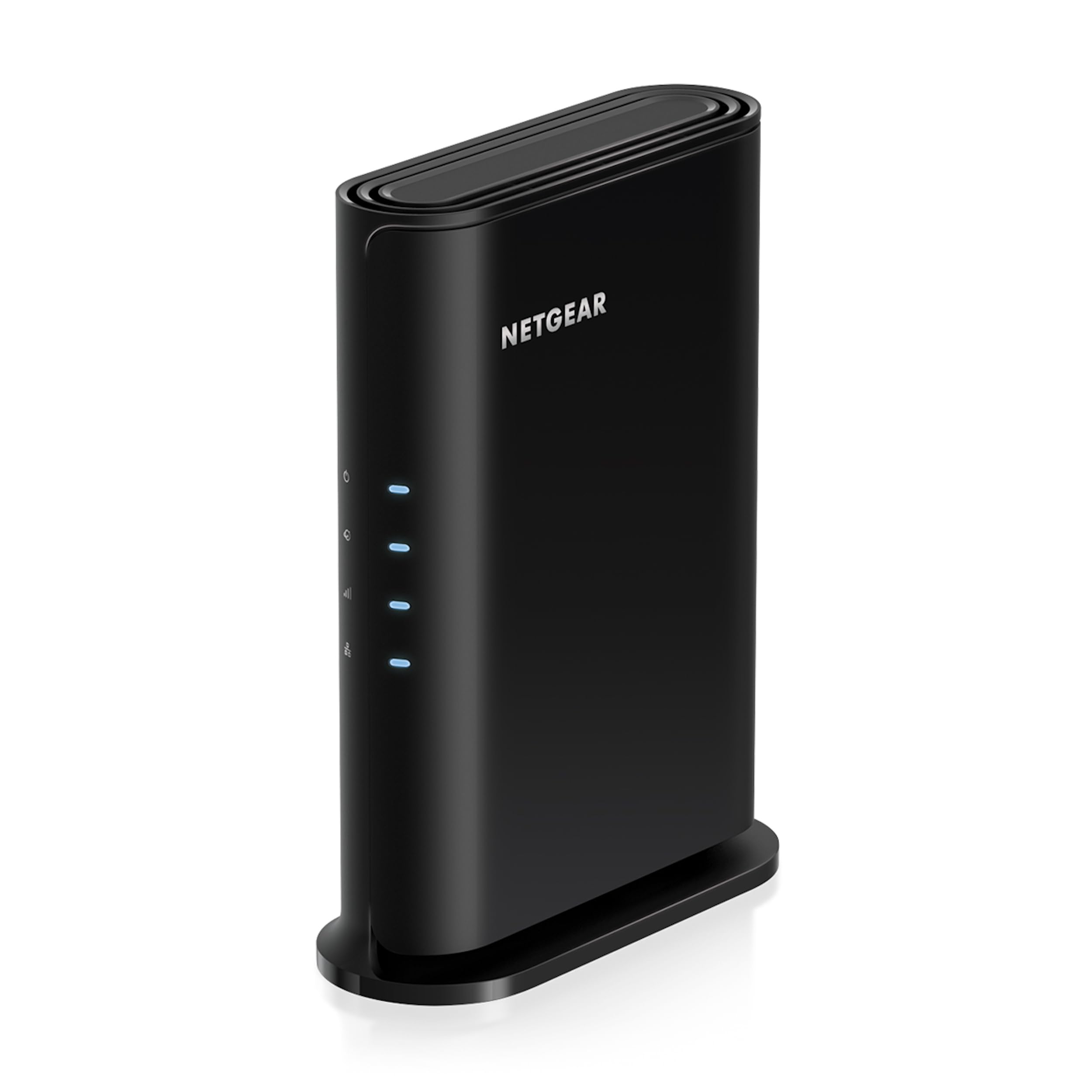
Internal antennas (no ugly prongs) make this skinny box disappear on a shelf, yet one owner measured 934.74 Mbps down on a 1 Gbps plan — nearly full wired speed.
This is the router for buyers who care about how their tech looks. The R6700AX has internal antennas, so it does not stick out like a spaceship on your media console. It delivers AX1800 speeds (up to 1.8 Gbps) and covers up to 1,500 square feet. Eleven owners specifically praise its compact size as an unobtrusive upgrade. Reliability is the most-discussed positive, with 93 owners noting rock-solid performance.
The Nighthawk app guides setup, and most shoppers say zero issues for months after. A Spectrum user swapped out their rental modem and says the R6700AX is “good value vs. renting.” The most common honest caveat is that the app-based setup can feel heavy-handed — it requires more steps than some expect, and the admin browser page offers more control. One owner also reports a unit that failed after around seven months, noting that phone support requires a paid plan after 90 days. With nearly 740 ratings at 4.2 stars, the overwhelming majority are pleased.
Clean look, solid feel
- Internal antennas for a low-profile design
- 93 owners praise its reliability
- Compact size praised as ideal for small spaces
- Nearly full gigabit wired speeds possible
Two things to note
- App setup is slow — browser admin has more options
- 3-month support window; paid plans after that
Pick this for: a clean, small-form-factor router for a 1,500 sq ft home where looks and reliability matter.
Pass it by if: you need a modem built in or have a home larger than 1,500 sq ft.
6. ARRIS Surfboard SBG7400AC2 (Renewed)

Kills your ISP rental fee — buyers report it pays for itself in about six months — but uses Wi-Fi 5 (the AC standard), so it is not the latest tech.
If paying a monthly modem rental fee to Comcast or Spectrum grinds your gears, the ARRIS Surfboard is the straightforward fix. It is a DOCSIS 3.0 cable modem (the standard connecting to your cable line) and an AC2350 dual-band Wi-Fi router in one box. It works with Xfinity, Cox, and Spectrum on plans up to 800 Mbps. Setup is simple: plug in, download the SURFboard Central App, and follow the activation steps. One owner upgraded from a Netgear CM500 and saw their speed jump from 16 Mbps to 360 Mbps — a 22.5x improvement. The build quality earns praise from 33 owners, and 32 call out the easy setup.
The honest reality is that reliability as a whole is mixed — 81 owners mention it, but Amazon marks it as a mixed aspect. Some units are flawless, while others require frequent resets. One owner reports constant daily resets (more than five times a day) that made it unusable for work. This is a renewed (refurbished) unit, so your experience depends on the specific unit’s condition. It uses Wi-Fi 5 (the 802.11ac standard), which is reliable for streaming and browsing but not the latest. For a lower-demand household where saving the rental fee matters most, it is a real value.
Why people buy this
- Modem + router in one — kills the ISP rental fee
- Easy setup via SURFboard Central App
- 32 owners praise the quick installation
- Huge speed jump possible over older modems
Something to know
- Reliability is mixed — some units need frequent resets
- Wi-Fi 5 (AC), not Wi-Fi 6; no band steering
Reach for this if: you want a single-box solution to stop paying modem rental fees.
pass on it if: you need Wi-Fi 6 speed or cannot tolerate the possibility of an intermittent unit.
7. ARRIS G34-RB (Renewed)
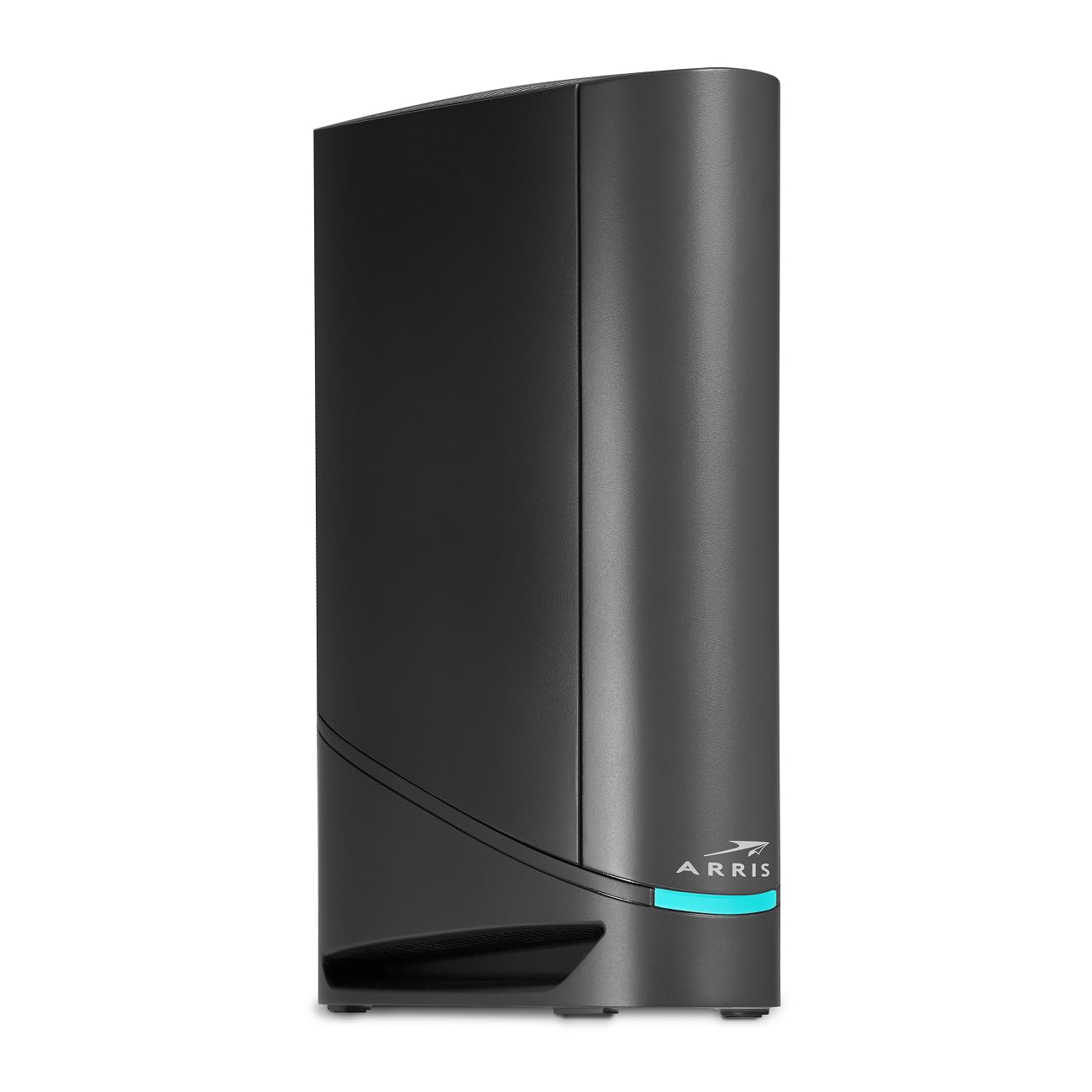
DOCSIS 3.1 — the latest cable standard supporting gigabit speeds — plus Wi-Fi 6 in a single box that replaces a separate modem and router.
The G34-RB is the modern version of a modem-router combo. It uses DOCSIS 3.1 (the latest cable standard, supporting faster speeds and lower latency than DOCSIS 3.0) and combines it with dual-band Wi-Fi 6 (AX3000) for a maximum data transfer rate of 3 Gbps. It is approved for Comcast Xfinity, Cox, and Spectrum, and its 1 Gbps maximum downstream speed matches gigabit internet plans. Owners upgrading from older hardware report serious improvements — one owner moving from a Motorola 7550 says the install took under an hour and the range covers approximately 2,500 sq ft. The integrated SURFboard Central App walks you through activation, and four Gigabit Ethernet ports handle wired consoles and PCs.
The critical trade-off with this renewed unit is that a small number of owners mention constant Wi-Fi drops that require the modem to auto-restart every 20 minutes. The 3.9-star average across 280 ratings reflects this split experience — some get a flawless unit, others get a lemon. One owner also notes a web-interface quirk: the login button is invisible until you click through an HTTPS security warning. If you buy this, test it hard in the first week.
The modern combo benefits
- DOCSIS 3.1 for gigabit cable internet plans
- Wi-Fi 6 (AX3000) with better range and efficiency
- Four Gigabit Ethernet ports
- App-based setup is quick and straightforward
What to watch for
- Small but real risk of Wi-Fi dropouts and auto-restarts
- Web interface has a hidden-login-button bug
Buy this for: a modern, single-unit solution for a gigabit cable plan if you are comfortable testing a renewed unit.
Think twice if: you cannot tolerate any interruption — a stable router-plus-modem combo may be a safer bet.
Understanding the Specs
AX Speed Ratings
The “AX” number (like AX5400) is the combined theoretical speed of both the 2.4 GHz and 5 GHz bands added together. That number is a ceiling, not a guarantee — your actual speeds will match your internet plan, not the router’s max. An AX1800 router can handle 300 Mbps cable plans perfectly fine; an AX5400 future-proofs for faster plans and more devices.
DOCSIS 3.0 vs 3.1
DOCSIS is the standard your cable modem uses to talk to your ISP. DOCSIS 3.0 handles most plans up to around 600 Mbps and is mature and cheap. DOCSIS 3.1 supports gigabit speeds (1,000+ Mbps), offers lower latency, and is better for plans over 600 Mbps. If your plan is under 400 Mbps, DOCSIS 3.0 is still fine.
Beamforming & Antennas
Beamforming is a signal-focusing technology that sends your Wi-Fi signal toward connected devices instead of broadcasting it in a sphere. More external antennas (4 or 6) plus beamforming generally mean better range and wall penetration. Internal antennas keep the router compact but often sacrifice a bit of ultimate range.
OFDMA & MU-MIMO
OFDMA (Orthogonal Frequency Division Multiple Access) lets the router talk to multiple devices at once instead of one at a time — crucial when you have 15+ devices. MU-MIMO (Multi-User, Multiple-Input, Multiple-Output) lets it send data to several Wi-Fi devices simultaneously. Together, they reduce lag and keep the network snappy during gaming or video calls.
FAQ
Do I need a separate modem if I buy a cable router?
Will a cable router work with any internet provider?
What is the difference between Wi-Fi 6 and Wi-Fi 7?
How many devices can a cable router handle?
How long do cable routers typically last?
Is it worth buying a renewed cable router?
Can I use a cable router with fiber internet?
What does beamforming do for my Wi-Fi signal?
Will a gaming VPN router slow down my connection?
Final Thoughts: The Verdict
For most people, the cable router that hits the best balance is the TP-Link Archer AX73 because its six antennas and beamforming deliver the strongest real-world coverage in the group, backed by a massive reliability consensus. If you want the highest value for the dollar with VPN support, the TP-Link AX55 is a no-brainer. And for anyone ready for Wi-Fi 7 speeds, a pro-grade VPN setup, or needing to connect over a hundred devices, the GL.iNet Flint 3 is the premium choice that future-proofs your network for years.
How We Picked
We do not accept paid placement. Every pick is matched to a real buyer and a real use-case; we do not hands-on test units.
Sources & Methodology
Specifications: manufacturer listings and product documentation. Review insights: verified customer reviews, as of July 2026. Pricing: not shown on this page (it changes often); check the current price via the retailer link.
As an Amazon Associate, FitlyFast earns from qualifying purchases. This does not affect which products we feature.