
Our readers keep the lights on and the weekend projects moving. As an Amazon Associate, I earn from qualifying purchases.
Specs are compiled from manufacturer listings and verified buyer reviews and can change over time — please confirm the key details on the product page before buying.
The real question about a budget cordless drill isn’t how much money it saves you at the register. The real question is whether it’ll still be running when you need to drive a third deck screw into a pressure-treated beam, or if it’ll start smoking halfway through the first hole. A cheap price tag hides a lot of bad motors and plastic gears. This guide cuts through the noise to show you the handful of budget-friendly drills that actually deliver real torque, last through a weekend project, and don’t force you to buy into an expensive battery system you’ll regret later.
I’m Rikta — the founder and writer behind FitlyFast. This guide is built by comparing the manufacturers’ published specifications and the patterns across verified customer reviews, so you get each pick’s real strengths and trade-offs instead of marketing spin.
if you need something for quick furniture assembly or heavier work like drilling into concrete, this breakdown of the budget cordless drill options will point you straight to the one that fits your actual workload without wasting a dime.
Our Picks at a Glance

How To Choose The Best Budget Cordless Drill
The first-time buyer usually hunts for the highest voltage number and the lowest price. Neither alone tells you if the drill can handle a 1-inch auger bit through a stud. These are the real specs you need to look at.
Motor Type: Brushless is the Priority
A brushless motor uses electronics to transfer power instead of physical carbon brushes rubbing against the rotor. This makes the motor more efficient, meaning you get more runtime from a single battery charge and the tool itself lasts a lot longer — no brushes to wear out and replace. Every single pick in this list is brushless for exactly this reason.
Clutch Settings: Your Screwdriver Replacement
The clutch is the ring with numbers behind the chuck. It disengages the motor once it reaches a set torque level, stopping the screw from sinking into the wood and stripping the head. A drill with 15 to 24 clutch settings gives you serious control over how deep a fastener goes, turning a brute-force tool into a precision instrument for delicate work like cabinet hinges or outlet covers.
Chuck Quality: The Grip You Can See
A ratcheting metal chuck is far better than a plastic one. It holds the bit tighter, it doesn’t slip under high torque, and it lasts through years of bit changes. The “3/8-inch” or “1/2-inch” number tells you the maximum shank size the chuck can accept. A 1/2-inch chuck handles the larger bits you need for spade drilling and hole saws, while a 3/8-inch is fine for standard drill bits and most driving work.
Quick Comparison
| Model | Best For | Motor Type | Max Torque | Chuck Size | Amazon |
|---|---|---|---|---|---|
| DEWALT DCD701B★ Best Overall | Everyday light work | Brushless | — | 3/8″ | Amazon |
| DEWALT DCD799BCompact Power | Compact hammer drilling | Brushless | 552 UWO | 1/2″ | Amazon |
| Makita XFD10Z | Tough job-site abuse | Brushed 4-pole | 480 in‑lbs | 1/2″ | Amazon |
| RYOBI PBLHM101B | Masonry & concrete | Brushless HP | — | 1/2″ | Amazon |
| Bosch GSR18V-400B12 | Precision & control | Brushless | 400 in‑lbs | 1/2″ | Amazon |
In‑Depth Reviews
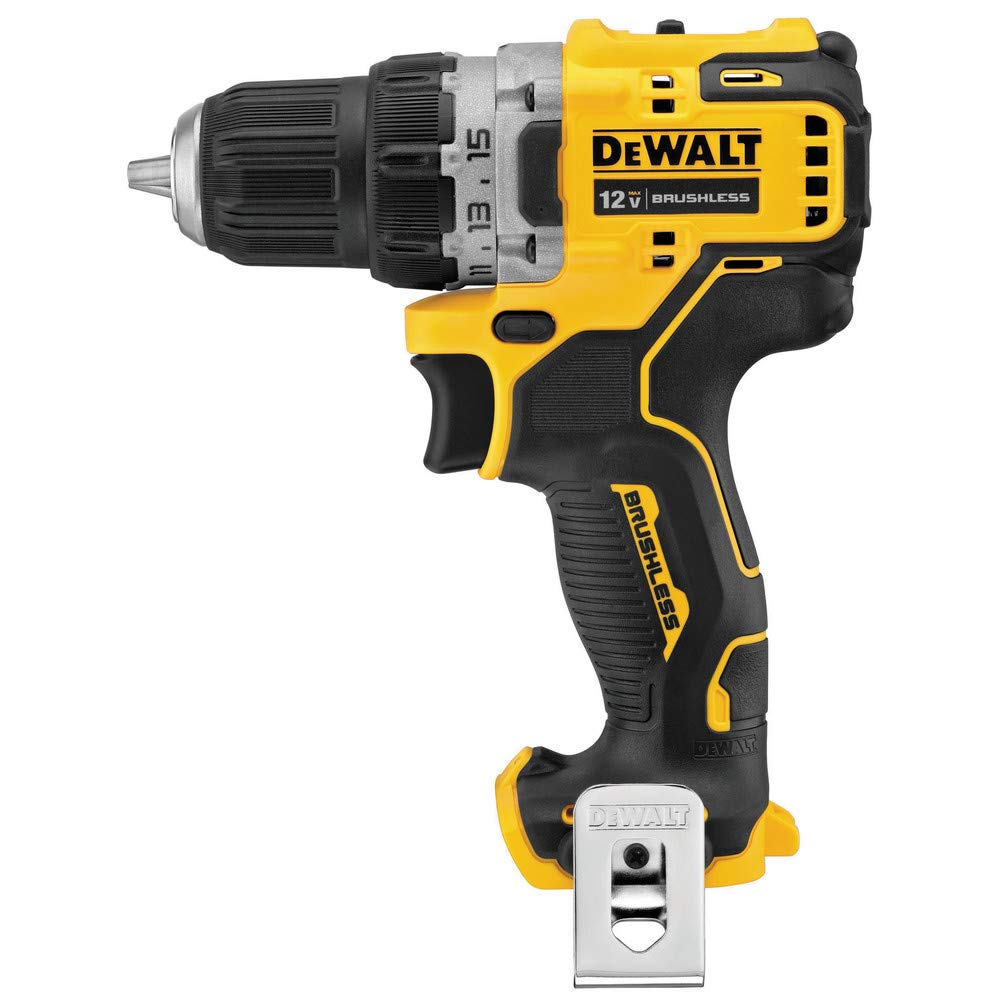
1. DEWALT Xtreme 12V MAX Cordless Drill (DCD701B)
A lightweight 12V that earns its keep by being the one you grab every day, not just the one you buy cheap.
This DEWALT is the anomaly in the budget space — it’s a 12-volt platform that beats many 18-volt drills on the spec sheet and in the hand. At just 1.9 pounds, it feels like an extension of your arm, not an anvil you have to lift. That weight advantage shows in the reviews — 41 owners single out the quality, and 24 others call the light weight the deciding factor. The 15 clutch settings (the ring with numbers behind the chuck) and the 2-speed transmission give you real control over how the power lands, so you don’t strip a screw head on a cabinet hinge.
The trade-off you feel immediately when you hold it next to the Makita XFD10Z is weight — the Makita is 2.6 pounds, while the DEWALT is 1.9 pounds, which makes the DEWALT feel like a toy until you pull the trigger and feel it drive. The 12V platform is the catch if you own a 20V or 18V system: you are buying into a separate battery family, and this is a tool-only package. Buyers report it is “light weight, high quality item” and note that its small size makes getting into tight spaces in aviation work easy. It’s not the drill for driving 6-inch lag bolts all day, but for furniture assembly, cabinet installation, and general household drilling, this is the value champion.
Why it wins
- Brushless motor at a budget-friendly price — rare
- Extremely lightweight at 1.9 pounds for all-day use
- 15 clutch settings give fine control over fasteners
The honest trade-offs
- Tool only — requires a separate DEWALT 12V Max battery and charger
- 12V platform means less raw grunt than 18V or 20V options
- Battery compatibility with other DEWALT systems is limited
Your go-to if: you want one drill for light-to-moderate tasks and you value a light tool in your hand over pure brute force.
Think twice if: you regularly drill into masonry or need maximum torque for heavy construction work — step up to a 20V or 18V model.
2. DEWALT DCD799B 20V MAX ATOMIC Compact Hammer Drill
The shortest 20V hammer drill DEWALT makes, designed to fit where nothing else will, with real concrete-busting power.
This drill fixes the biggest complaint about hammer drills: they are usually big, heavy, and impossible to use in a stud bay or a cabinet. The DCD799B has a head length of just 6.49 inches, while the DEWALT DCD701B’s 9.13-inch body, despite running on the higher-voltage 20V platform. You get that compact size without sacrificing raw power: it delivers 552 Unit Watts Out (UWO) (a DEWALT power-under-load test) and hits 1,650 RPMs. Buyers describe it as “lots of power in a compact package.” 51 owners call out the quality, and the hammer function earns high marks for making holes in concrete feel smooth. One reviewer noted “running holes in concrete is smooth, great tool and price.”
At 2.5 pounds, it is heavier than the 12V DEWALT above, but that extra heft comes with a hammer mechanism that lets you drill into brick and block without a separate SDS (Special Direct System) rotary hammer tool. The metal drilling capacity is 0.4 inches, compared to the 0.5-inch capacity of the 12V DEWALT — a surprising reversal that shows the hammer mechanism trades some drilling depth for impact force. It is also tool-only, so you need a 20V Max battery and charger. Some owners debate whether the chuck is fully metal, so check before you buy.
The key strengths
- Extremely short 6.49 in. head for tight spaces
- 552 UWO and hammer drill function for concrete
- Quality is the most-praised feature by owners
The real caveats
- Tool only — needs a 20V MAX battery and charger
- Metal drilling capacity is less than the 12V model at 0.4 in.
- Some units ship with a plastic chuck, a point of owner debate
Reach for this one if: you need to drill into concrete or masonry in tight spots like a crawlspace or wall cavity.
Look elsewhere if: you only drill wood and drywall — the hammer function is extra weight you won’t use.
3. Makita XFD10Z 18V LXT Cordless Driver-Drill

A rugged 18V workhorse that has survived Florida sun, rain, and drops from height, earning its place as the site favorite.
Makita’s XFD10Z is a different breed from the DEWALT options above. It uses a 4-pole brushed motor (which uses physical carbon brushes to transfer power, not electronic control), but the trade-off is proven durability and 480 inch-pounds of real-world torque that buyers consistently praise. 58 owners mention quality as the top talking point, followed by power at 28 mentions. One owner noted it “survived 2 years of abuse, Florida sun, and rain,” and another called it “bullet-proof.” The rubberized soft grip handle and the dual LED lights with afterglow make it comfortable to use in low-light attics and crawlspaces. The mechanical 2-speed transmission gives you a low range (0-600 RPM) for high-torque driving and a high range (0-1,900 RPM) for fast drilling.
The catch is durability, which is the most mixed aspect — 35 owners flagged it. While many report the drill lasting for years, a smaller number report the motor burning out with minimal use. The battery life is also mixed (15 mentions). The Extreme Protection Technology (XPT) is real, providing resistance to dust and moisture on job sites. At 2.6 pounds and 8.6 inches long, it is noticeably heavier and longer than the DEWALT DCD701B (1.9 pounds), which means it carries more heft in your tool bag all day. If you need maximum torque and job-site toughness over battery efficiency, this is the one.
What owners love
- Proven job-site toughness with XPT dust/water resistance
- 480 in-lbs of torque drives large screws easily
- Two-speed transmission (0-600 and 0-1,900 RPM) for versatility
The honest limitations
- Motor durability is mixed — some owners mention burnout
- Tool only — no battery or charger included
- Brushed motor is less efficient than modern brushless options
Pick this if: you work in rough conditions and need a drill that can survive bad weather and accidental drops.
skip it if: you want the longest runtime per charge — the brushed motor drains batteries faster than brushless alternatives.
4. RYOBI ONE+ HP 18V Brushless Hammer Drill (PBLHM101B)

A budget-conscious hammer drill that punches into concrete like a tool twice its price, perfect for the weekend warrior.
The Ryobi ONE+ HP lineup is the smart play if you are already invested in the Ryobi 18V ONE+ battery system, which covers everything from leaf blowers to saws. This specific hammer drill uses a brushless HP motor with a hammer mode for masonry. It has a 2-speed gearbox with a dedicated hammer mode, a 1/2-inch ratcheting metal chuck. Customers note it drills into brick and concrete “like it’s supposed to” and note that the hammer function is strong enough to loosen frozen screws.
The honest catch here is mixed durability and functionality. While 18 owners praise the quality and 9 call it good value, the “functionality” aspect is flagged as mixed by 13 owners, and “durability” is also mixed (5 mentions). This means you need to pay close attention to your unit’s quality, and treat it as a solid DIY tool, not a professional daily driver. The 24-position clutch gives you screw-stripping prevention, and the onboard LED worklight is useful in dark spaces like under sinks.
The biggest advantages
- Brushless HP motor with hammer function for concrete
- 1/2 in. ratcheting metal chuck for secure bit hold
- Part of the massive RYOBI ONE+ battery ecosystem
The honest risks
- Durability reports are mixed — some units fail early
- Tool only — battery and charger sold separately
- Not a pro-grade tool; best for moderate DIY use
Best for: homeowners who already own Ryobi ONE+ tools and need a one-off concrete drill for a weekend project.
Not ideal for: anyone who needs a drill to survive a work week of daily abuse — step up to the Makita or Bosch.
5. Bosch GSR18V-400B12 18V Compact Brushless Drill/Driver Kit

A professional-grade compact kit that feels like a precision instrument, not just a driver, and it comes with the battery.
This Bosch is the only full kit in this list — it includes a 2Ah standard battery, a charger, a belt clip, and a carrying bag, so you don’t have to hunt down a separate battery purchase. The key spec that defines this drill is the head length of only 6.3 inches, which is the shortest in this entire lineup, beating even the compact DEWALT ATOMIC. The brushless motor delivers 400 inch-pounds of torque from a tool that weighs less than 2 pounds. The “power density” is the engineering story — Bosch packs serious torque into a tiny chassis. 27 owners mention quality as the top aspect, followed by power at 13.
The mixed performance aspect (9 mentions) is the honest note here. While most owners find it powerful and easy to use, a few note it doesn’t quite have the high-end grunt of larger professional drills for heavy-duty use. The 20 clutch settings give you extremely precise control, and the all-metal chuck provides first-rate bit retention. The electronic cell and motor protection systems prevent the battery from overloading and the motor from overheating, which is a thoughtful touch for longevity. The only real downside versus the Makita above is raw torque — 400 inch-lbs vs 480 in-lbs — and the 2Ah battery is good for light work but will drain faster on heavy drilling.
Why it stands out
- Complete kit with battery, charger, and bag — no extra purchases
- Shortest head length at 6.3 in. for the best access in tight spaces
- All-metal chuck and 20 clutch settings for precision work
The trade-offs to know
- Performance is mixed for some heavy tasks
- 2Ah battery is smaller than higher-capacity options
- Less torque (400 in-lbs) than the Makita (480 in-lbs)
Choose this if: you want a ready-to-go kit with excellent ergonomics and the smallest possible tool head for working in cramped cabinets or vehicles.
pass on it if: you need maximum torque for driving large lags into dense lumber — the Makita or DEWALT ATOMIC offer more grunt.
Understanding the Specs
Voltage (12V vs 18V vs 20V)
Voltage is like the size of the gas tank — it tells you the potential energy, not the power delivery. A 12V drill like the DEWALT DCD701B is lighter and simpler, perfect for driving screws and drilling wood. An 18V or 20V platform (like the Makita or DEWALT ATOMIC) has more reserve power for heavier tasks and longer runtime, but the battery and tool are physically larger and heavier. You trade weight for capability.
Torque (in-lbs / UWO)
Torque is the twisting force the drill applies to the bit. Higher torque means the drill can turn a larger bit or drive a screw into harder material without stalling. Inch-pounds (in-lbs) is the direct measure. Unit Watts Out (UWO) is a DEWALT-specific test that measures power under load. In general, 400 in-lbs is good for most drilling, 480 is serious home-owner grunt, and 552 UWO (roughly equivalent) is powerful compact drill territory.
Chuck Size (3/8″ vs 1/2″)
The chuck is the clamp that holds the drill bit. A 3/8-inch chuck accepts bits with a shank up to 3/8 inch thick, which covers 99% of standard twist drill bits. A 1/2-inch chuck is larger, accepting spade bits, hole saws, and larger specialty bits. If you plan to drill big holes in timber or use hole saws, get a 1/2-inch chuck. If you stick to regular drilling and driving, a 3/8-inch is fine and often lighter.
Clutch Settings
The clutch is the ring with numbers or symbols behind the chuck. Each number represents a torque setting. When the drill reaches that torque, the clutch slips, stopping the rotation. This is how you drive screws to the exact depth without stripping the head or sinking it through the material. More settings (15 to 24) give you finer control, making the drill better for delicate work like assembling furniture or installing hardware.
FAQ
Can a budget cordless drill handle drilling into concrete?
What is the difference between a drill and a driver?
Is a brushless motor worth the extra money?
What is tool only mean?
How do I know which battery system to invest in?
What size chuck should I get for home use?
How long do cordless drill batteries last?
Can I use a 12V drill for furniture assembly?
What is a hammer drill and do I need one?
How important is the number of clutch settings?
Final Thoughts: The Verdict
For the majority of shoppers, the budget cordless drill winner is the DEWALT DCD701B because it delivers real brushless power in a lightweight, perfectly-balanced 1.9-pound package at a price that leaves room for a battery and charger. It has the highest owner satisfaction in this group and the reviews prove it is the go-to for everyday work. If you need to drill into concrete and want the shortest possible tool, grab the DEWALT DCD799B. And for a complete kit that works from the start with professional-grade ergonomics, the Bosch GSR18V-400B12 is the one to reach for.
How We Picked
We do not accept paid placement. Every pick is matched to a real buyer and a real use-case; we do not hands-on test units.
Sources & Methodology
Specifications: manufacturer listings and product documentation. Review insights: verified customer reviews, as of July 2026. Pricing: not shown on this page (it changes often); check the current price via the retailer link.
As an Amazon Associate, FitlyFast earns from qualifying purchases. This does not affect which products we feature.