
Our readers keep the lights on and the weekend projects moving. As an Amazon Associate, I earn from qualifying purchases.
Specs are compiled from manufacturer listings and verified buyer reviews and can change over time — please confirm the key details on the product page before buying.
The decision to bring a cable machine home is notable — and a little intimidating. You want the smooth cable feel of a commercial gym, but you need something that fits your space, your budget, and the kind of training you actually do. Do you go for a full power cage with a pulley system, a dedicated lat tower, or an all-in-one Smith machine? The right choice depends on how much room you have, how much weight you plan to move, and whether you train alone or with a partner.
I’m Rikta — the founder and writer behind FitlyFast. This guide is built by comparing the manufacturers’ published specifications and the patterns across verified customer reviews, so you get each pick’s real strengths and trade-offs instead of marketing spin.
Below, I break down eleven of the best options for a home cable machine, from compact plate-loaded towers to heavy-duty combo units with dual weight stacks, so you can match the right setup to your goals and floor plan.
Our Picks at a Glance
How To Choose The Best Cable Machine
Picking a cable machine is not just about the price tag. The best one for you depends on the kind of exercises you want to do, the space in your home, and if you need a spotter-free safety system. Start with what you actually train — if you focus on lat pulldowns and seated rows, a dedicated tower is fine. If you want full-body barbell work plus cables, a power cage or Smith machine hybrid is the smarter move.
Weight Stack vs. Plate-Loaded
A weight stack with a selector pin gives you quick weight changes — just pull the pin and slide it to the next plate. It is the easiest choice for supersets and circuit-style training. Plate-loaded machines save money and bundle well with your existing Olympic plates, but every weight change means bending down to load and unload iron. For home gyms where speed matters, a selectorized stack is worth the higher price.
Pulley Ratio and Resistance Feel
A 2:1 pulley ratio means you feel half the weight on the stack as resistance, but the cable travels twice as far. This gives you a smoother and more controlled movement, especially for cable crossovers and flyes. A 1:1 ratio delivers the full weight of the stack directly to your hands, which feels heavier and more direct for exercises like lat pulldowns and rows. Each ratio suits different exercises, so consider which movement you prioritize.
Frame Stability and Weight Capacity
A machine that wobbles when you pull heavy cable is frustrating and unsafe. Look for a frame built from at least 14-gauge steel with a wide base or reinforcing tabs. The maximum weight recommendation gives you a safety ceiling, but the real stability test is how the machine handles side-to-side force during cable crossovers — machines with a dual-triangle base or floor plates are noticeably more planted.
Quick Comparison
| Model | Best For | Weight Capacity | Pulley Ratio | Footprint (DxWxH) | Amazon |
|---|---|---|---|---|---|
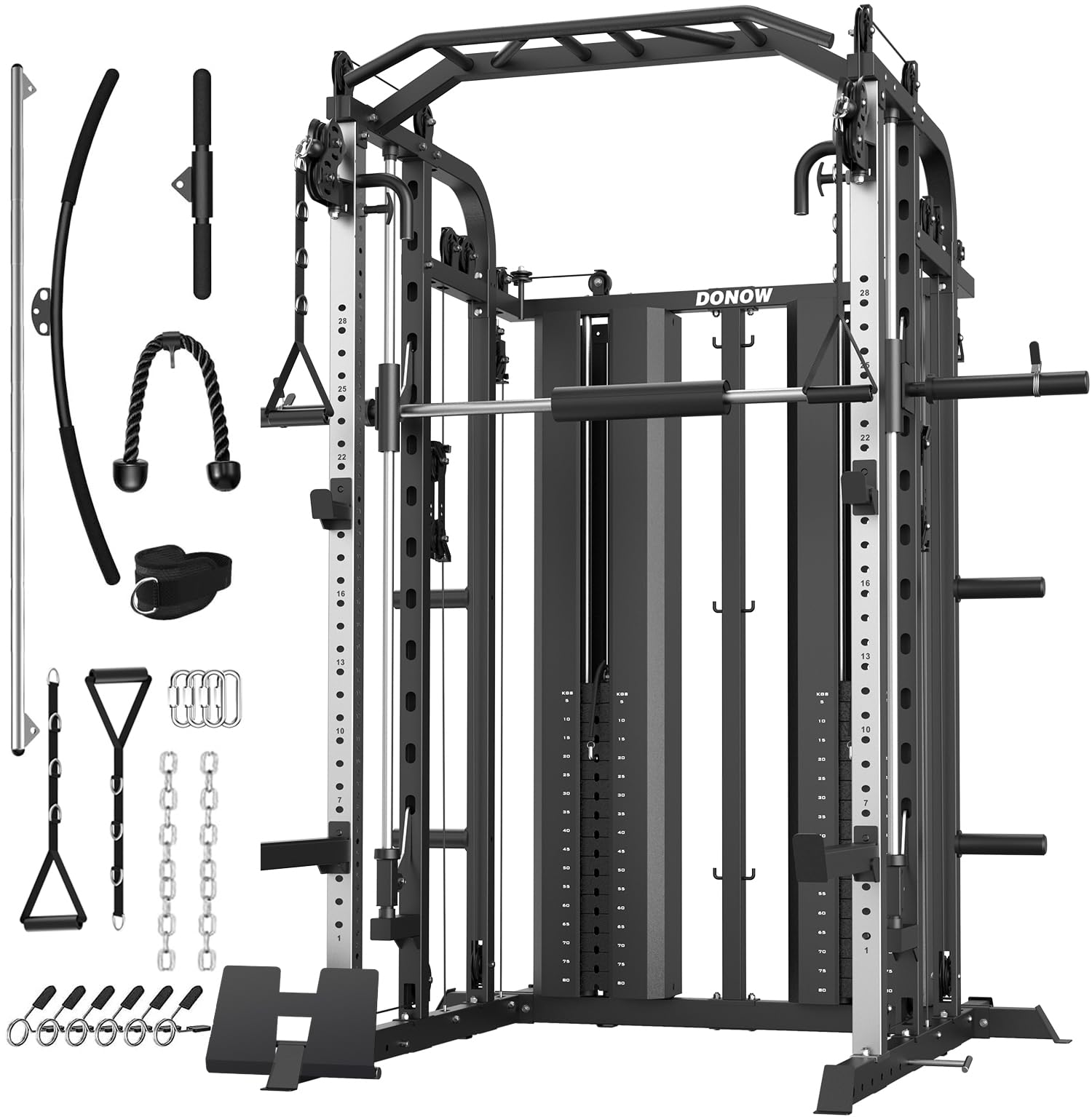
| DONOW Smith Machine★ Best Overall | Full-body heavy lifting | 2240 lbs | 2:1 | 54.7″ x 78.58″ x 88″ | Amazon |
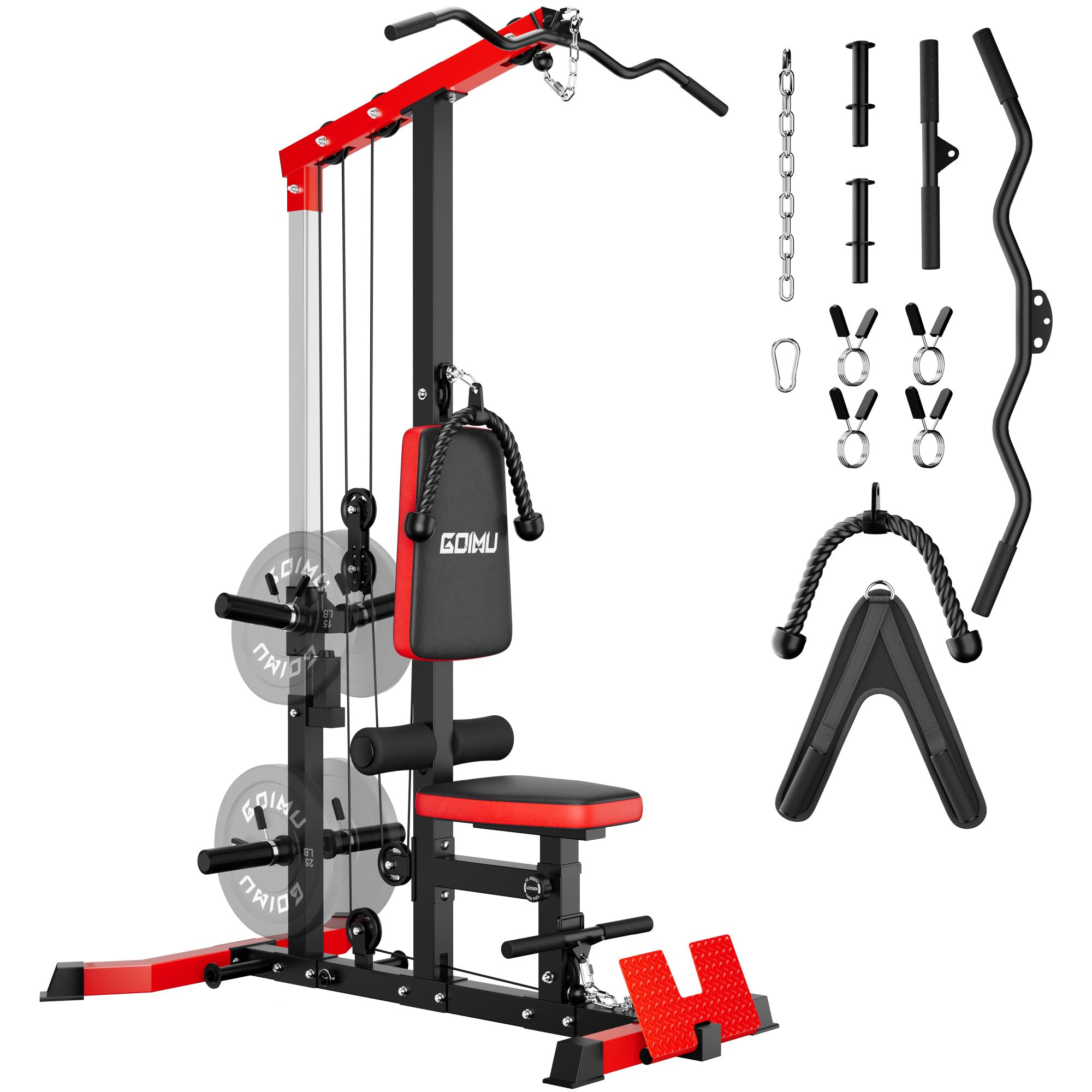
| GOIMU LS01 LAT TowerCompact Tower | Compact lat & row focus | 800 lbs | — | 59″ x 23.43″ x 83.46″ | Amazon |
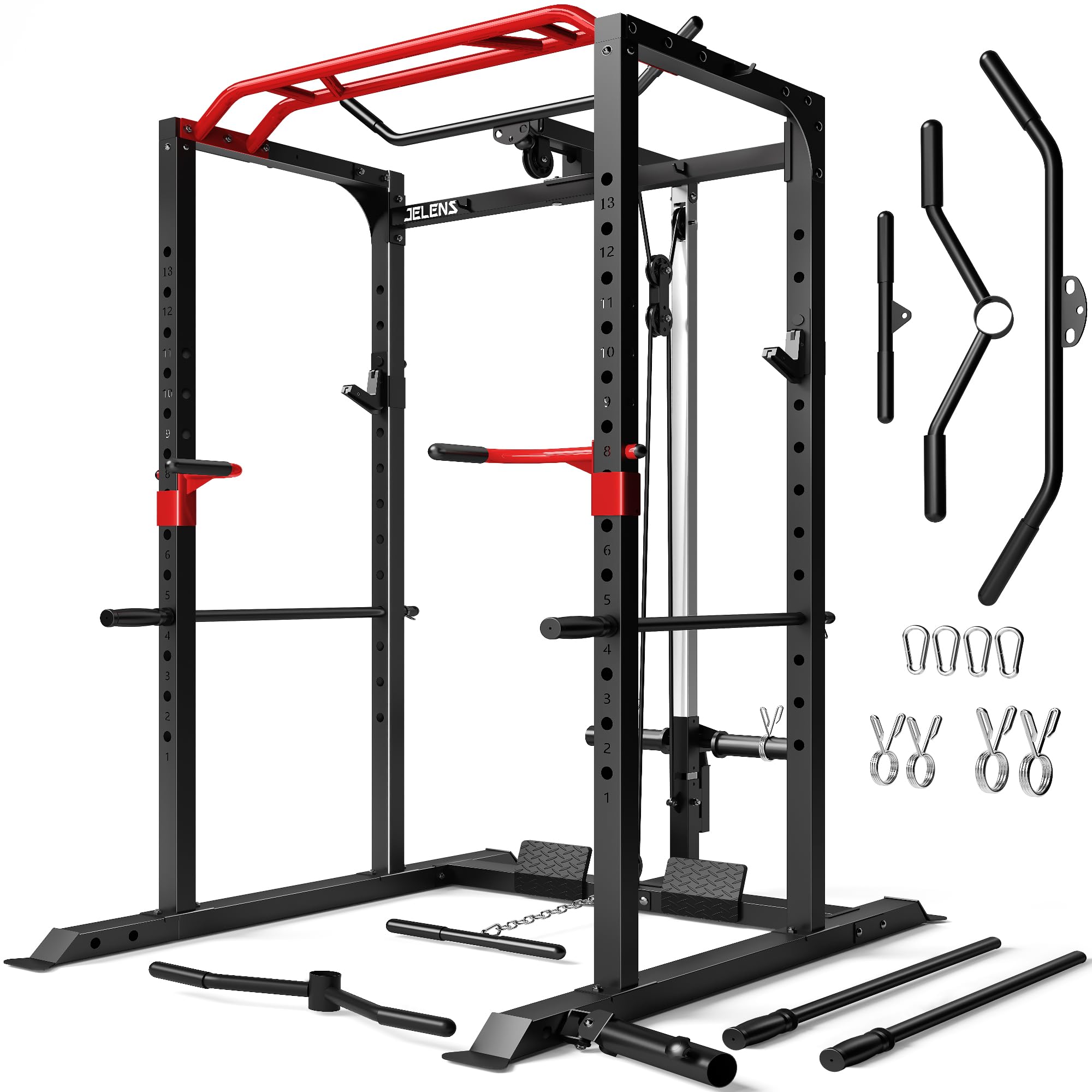
| JELENS S11 Power CageBest Value Power Cage | Budget power rack + cables | 2000 lbs | — | 57.48″ x 44.49″ x 82.6″ | Amazon |
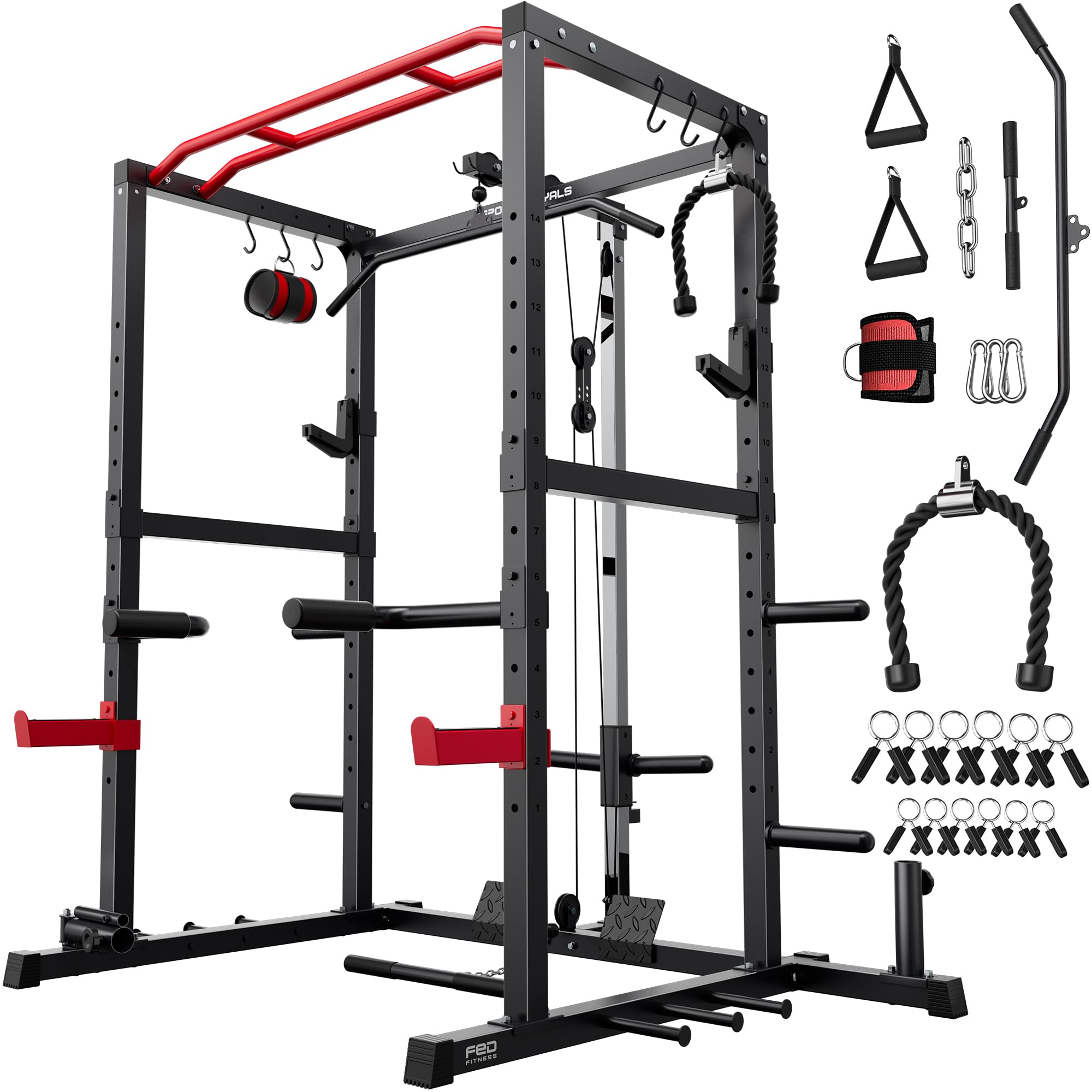
| Sportsroyals Power Rack | Versatile home gym value | 1200 lbs | — | 56″ x 61.6″ x 82.6″ | Amazon |
| Eonfit E2 Power Rack | Rotating arm versatility | 1200 lbs | 1:1 / 2:1 | 61″ x 62.5″ x 85″ | Amazon |
| SunHome Smith Machine | Smith + butterfly station | 800 lbs | — | 72″ x 60″ x 90″ | Amazon |
| Mikolo 10-in-1 ProStation | Space-saving all-in-one | 300 lbs | — | 75″ x 36.3″ x 80″ | Amazon |
| MAJOR FITNESS F22 | Dual-user cable workouts | 1600 lbs | 2:1 | 68.9″ x 55.5″ x 82.5″ | Amazon |
| SunHome Multifunction Gym | Couples training together | 138 lbs | — | 96.85″ x 55.12″ x 86.61″ | Amazon |
| pooboo P43 Power Cage | Commercial feel at home | 2000 lbs | — | 62.9″ x 43.3″ x 82.6″ | Amazon |
| Mikolo M4 2.0 Smith Machine | Heavy-duty Smith + cables | 2200 lbs | — | 71″ x 74.4″ x 87.2″ | Amazon |
In‑Depth Reviews
1. DONOW Smith Machine with Weight Stacks Home Gym System Cable Crossover
Our pick — over 4.5★ from 200+ verified ratings; the strongest balance of quality and price.
The one machine that replaces an entire gym floor without sacrificing commercial-grade weight stacks.
The DONOW is the centerpiece pick for anyone who wants a fully equipped home gym without bolting five separate machines to the floor. It combines a Smith machine, a power rack with safety arms, a dual cable crossover system, and a multi-grip pull-up station into one unit that measures 54.7″ x 78.58″ x 88″. The dual weight stacks are encased in steel covers for a clean look, and the 2:1 cable ratio means the resistance feels smooth and controlled — you move the cable twice as far as the stack travels, which is ideal for flyes and crossovers.
What wins owners over is the sheer quality — it is described as rock-solid with no rocking or wobbling during heavy lifts, and the Smith bar glides on smooth linear bearings. The maximum weight recommendation is 2240 pounds, giving you a massive safety ceiling for both barbell and cable work. Compared to the LS01 lat tower’s 800-pound capacity, the DONOW holds nearly three times the load. The trade-off is the assembly — buyers report it is a big project, with one owner noting they “built solo in ~8 hours with power tools.” The weight stacks are marked in kilograms only, and you will need at least 9 feet of width for comfortable access.
What wins owners over
- Dual weight stacks with steel enclosures for a tidy, safe setup
- 2:1 cable ratio delivers smooth, commercial-style resistance
- 2240-pound capacity handles everything from cable flyes to heavy squats
What to plan for
- Assembly is a major undertaking — expect several hours with power tools
- Weight stacks are marked in kilograms only; no pound labels
- Requires significant floor space, roughly 11 feet of width recommended
Best for the serious lifter: Anyone who wants a single machine covering Smith, cables, pull-ups, and free-weight support with no compromise on stability.
Think twice if: You have limited assembly patience, a tight budget, or a room narrower than 9 feet — the footprint is real.
2. GOIMU LS01 LAT Pulldown Machine
A dedicated lat tower that fits into a corner without forcing you to give up seated rows or ab work.
The LS01 is the right choice if barbell squats and bench presses are handled by a separate rack and you just need a compact cable station for back, arms, and core. It packs high, low, and ab crunch pulley stations into a frame that weighs only 80 pounds and sits 59″ deep by 23.43″ wide. The seat adjusts to three heights, accommodating users from 5’2″ to 6’4″, and the leg hold-down locks you in for lat pulldowns and rows. It is built from 2mm thick steel tubing, and owners consistently praise the quality and value as outstanding for the price.
Assembly is straightforward — buyers call it easy, with one completing it solo in about 1.5 hours. The included attachments cover the essentials: a lat bar, a cable bar, a tricep rope, band pegs, and an ab crunch strap. The honest limitation is that the cable travel is too short for face pulls or wood choppers, so this machine is best for traditional pulldowns, rows, bicep curls, and tricep extensions.
Who it fits: Anyone with a separate squat rack or bench who needs a space-efficient cable addition for back and arm isolation. The catch: Cable travel range is limited — avoid it if you want to do high-angle flyes or full-range chopping motions.
3. JELENS S11 Power Cage
A barbell power rack with a surprisingly smooth cable pulley system for under three hundred dollars.
The JELENS S11 proves you do not need to spend a fortune to get a stable power cage with a lat pulldown. It is built from 50mm x 50mm heavy-duty steel pipes and holds a safe weight of 2000 pounds. The cage size is 57.5″ x 44.5″ x 79.7″, covering just 12.5 square feet — compact enough for a garage corner. The upgraded pulley system uses precision steel shafts and polished steel wire rope, and buyers confirm the cable action is smooth and quiet. The included accessory set is generous: a lat pull-down bar, cable bar, T-bar, J-hooks, safety rods, a 360° landmine, and counterweight racks.
The thing everyone raves about is the build quality at this price point — owners call it the best they could find under three hundred dollars. A minor recurring note is that the paint on the safety bars and dip handles can scratch off during insertion. Assembly is manageable with clear instructions, and the rack ships in two boxes. If you want a squat rack that also handles cable exercises while staying affordable, this is the one.
The smart buy: Anyone building a first home gym on a budget who still wants a real power rack with a functional cable pulldown. Minor annoyance: Paint wear on moving parts is common — treat the finish as cosmetic, not structural.
4. Sportsroyals Power Rack
A power rack that gives you lat pulldowns, cable rows, and a dip station without demanding a second mortgage.
The Sportsroyals RK2 is among the most popular multifunction racks on the market, and the reason is simple: it packs an enormous amount of utility into a single frame. The cage measures 56″ x 61.6″ x 82.6″ and is made from 50 x 50mm commercial steel with a 1.5mm thickness. The pulley system uses precision bearing pulleys and electroplated telescopic poles for smooth movement, and the solid steel cable can hold 500 pounds. You get fourteen height adjustments, a 360° landmine, dip bars, a wide and narrow pull-up frame, and six band pegs — enough variety to keep workouts fresh for years.
Stability is the most-discussed strength here — over 170 owners praise how planted the rack feels. One honest note from buyers: the cable pulley sits close to your nose during squats, so most users squat facing away from the cage. The rack is ideal for intermediate lifters working with moderate loads, and assembly is straightforward with clear instructions. It is proof of the value that over 650 buyers have rated it highly.
The pick for whole-family training: The accessory set is so complete that everyone from a beginner to a veteran can find exercises they love. Snag: The squat area is tight inside the cage — larger users may prefer to squat outside.
5. Eonfit E2 Power Rack

The rack that lets you position the cables anywhere — overhead, in front, or out to the side — for over a hundred unique exercises.
The Eonfit E2 stands out because of its 360° rotating pivot arms. Unlike a fixed trolley system that only moves up and down a vertical upright, these arms can swing outward for a better stretch on chest flyes, move inward so the weight is directly beneath you for shrugs, or sit overhead for lat pulldowns. The cage dimensions are 61″ x 62.5″ x 85″, and the rack weighs about 220 pounds. It is built from 14-gauge 2″ x 2″ steel with 1-inch hole spacing, and the maximum weight capacity is 1200 pounds. The cable system supports a 1:1 and 2:1 ratio, giving you both direct and smooth resistance options.
Buyers describe the rack as rock-solid and say it compares favorably to more expensive systems. The assembly instructions are minimal — most owners recommend checking YouTube for a video guide. A few note that the arms are not labeled left and right, which can cause rework. At this price, the E2 is a compelling alternative to a traditional functional trainer if you have the space and want maximum exercise versatility from a single power cage.
Why trainers like it
- Rotating arms open up dozens of cable exercises a fixed pulley cannot do
- Dual ratio (1:1 and 2:1) for both heavy direct pulls and smooth crossovers
- Sturdy construction with commercial-grade steel and robotic welding
Assembly notes
- Instructions are sparse — lean on assembly videos
- Pivot arms not labeled left/right, causing potential rework
- Bottom welds on uprights can prevent a completely flush floor fit
Reach for this if: You love cable flyes, face pulls, and creative angles and want a power cage that doubles as a functional trainer. Look elsewhere if: You want a quick, frustration-free assembly — this one rewards patience.
6. SunHome Smith Machine

A Smith machine hybrid with a patented butterfly chest station that mimics a premium cable crossover.
The SunHome SH-999 does something unique: it adds a dedicated butterfly chest station alongside the Smith bar and cable pulldown system. This means you can superset Smith machine squats with flyes without walking across the room. The frame is built from 2mm thickened commercial steel, and the machine weighs 440 pounds — heavy enough to stay planted during aggressive cable crossovers. The footprint is 72″ x 60″ x 90″, and it includes six weight plate storage posts to keep the floor clear.
Owners highlight the smooth Smith bar action and the overall value, noting it competes with machines costing far more. The pulleys use a rolling bearing design, which buyers confirm is smoother and quieter than sliding alternatives. A few mention that the Smith machine safety stops do not allow for weighted hip thrusts, and some parts may need lubrication from the start. Still, for the price, this is a rare combination of Smith machine, cable pulldown, and chest fly station in one unit.
The smart move for chest-day lovers: The butterfly station is a genuine differentiator — you get a cable fly motion without buying a separate functional trainer. The trade-off: The machine’s 800-pound maximum recommendation means it works best for intermediate training loads.
7. Mikolo 10-in-1 ProStation
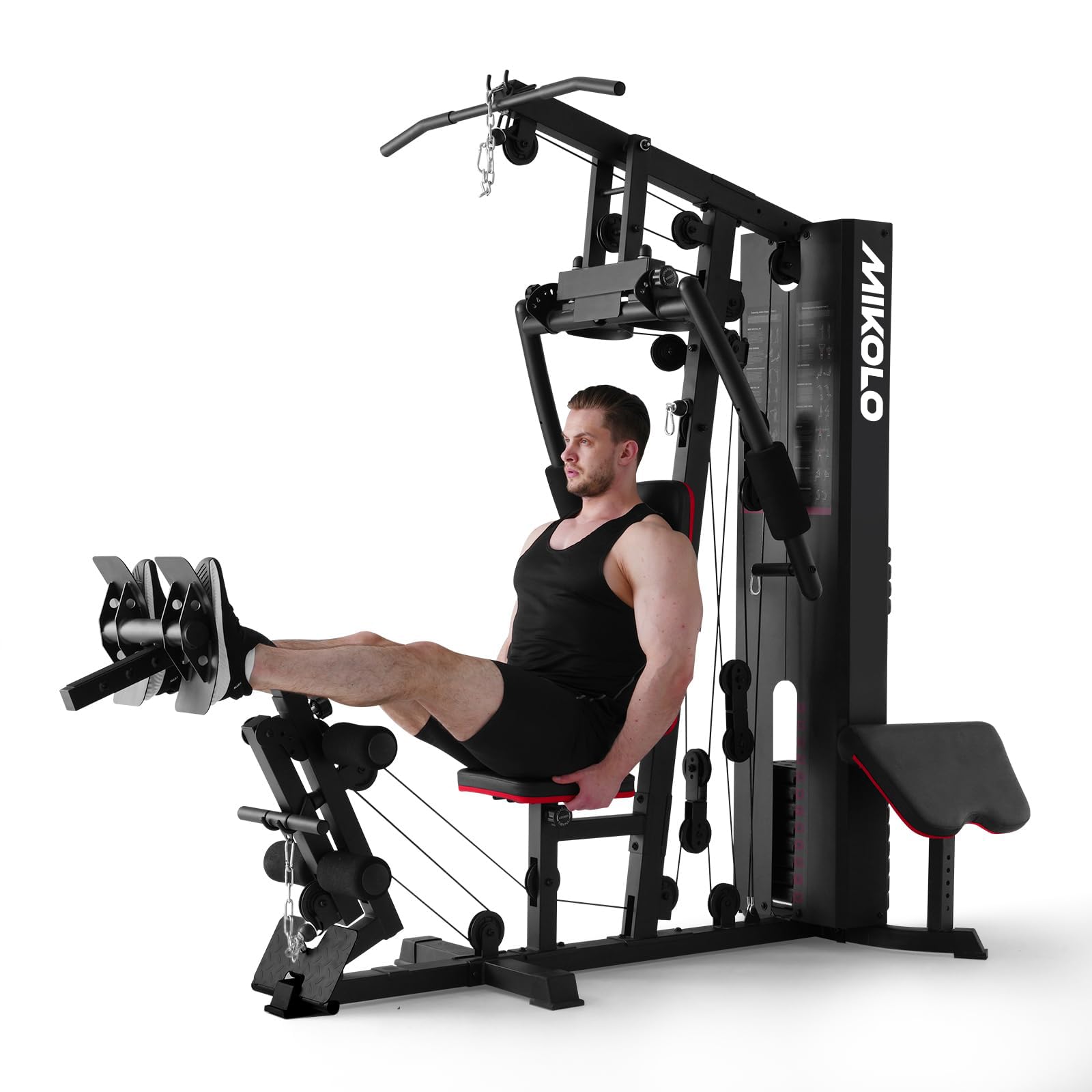
A compact all-in-one station with a real selectorized weight stack and a footprint narrower than a standard doorway.
The Mikolo ProStation is the right call when floor space is your tightest constraint. It measures 75″ deep by just 36.3″ wide — slim enough to fit in a bedroom corner or along a narrow garage wall. Instead of plate-loading, it comes with a 152-pound selectorized weight stack that adjusts in twelve levels, so you never bend down to change plates. The machine supports over 90 exercises, including PEC fly, lat pulldown, low row, chest press, leg extension, leg press, preacher curl, and core training, all from a single 300-pound station.
What buyers appreciate most is the quality — the machine is built with 14-gauge steel, and the counterweight block is protected by a steel sheet. The professional bearing on the cable bar reduces wrist stress during use. The honest limitation is height: this machine works best for users 6’1″ or shorter. Taller lifters may find the range of motion cramped for overhead movements. Assembly is mixed — some find it straightforward, others call it time-consuming, but the included video helps.
Perfect for space-limited home gyms: The narrow footprint and built-in weight stack make this the easiest full-body machine for apartments and small rooms. Check your height: If you are over 6’1″, the ProStation may feel small for seated rows and overhead presses.
8. MAJOR FITNESS F22 Power Rack
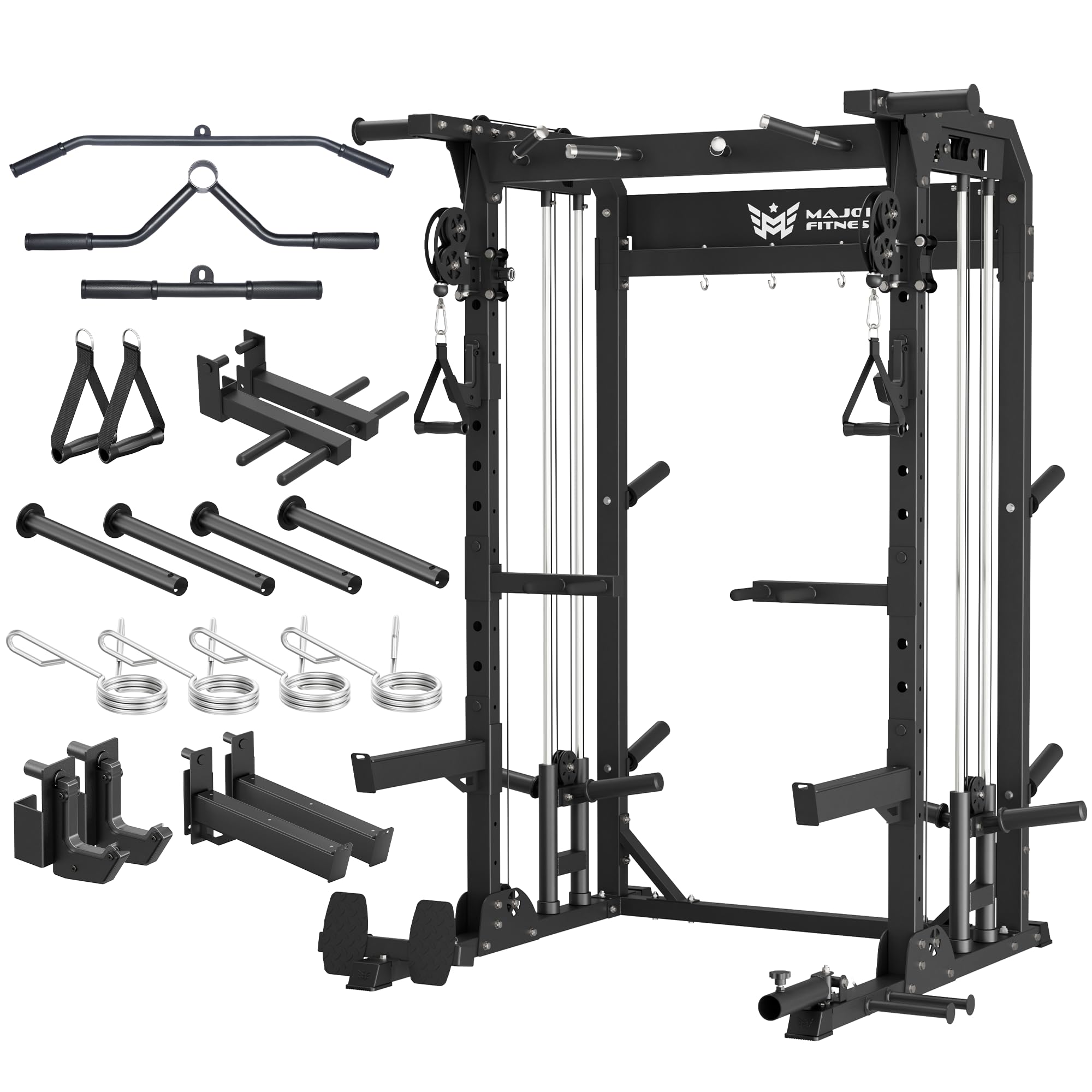
A power rack with an independent dual-pulley system that lets two people train at the same time.
The MAJOR FITNESS F22 is designed for the home gym that sees more than one lifter. Its independent dual-pulley system uses a 2:1 ratio for smooth cable travel, and the two weight trollies operate completely separately — so you can do cable crossovers while a partner does lat pulldowns with zero interference. The frame is built from 2″ x 3″ commercial-grade 14-gauge steel with a 1600-pound static capacity. The dual-triangle base design increases floor contact, eliminating the need to bolt the rack down for stability.
Buyers praise the rock-solid feel and the smooth pulley operation, with one noting it feels stable even during weighted pull-ups. The assembly process takes about three to four hours, and the included accessories cover J-hooks, safety arms, foot pedals, a landmine, dip bars, and a T-bar. A minor complaint is that the lat bar is a bit narrow and the attachments are functional rather than commercial-grade. If you train with a partner, the F22 is one of the few sub-premium racks that truly supports simultaneous use.
Why partner trainers choose it
- Independent dual weight trollies for simultaneous training
- Dual-triangle base provides floor-gripping stability
- Compact footprint at 68.9″ x 55.5″ for a dual-station rack
Minor trade-offs
- Lat bar is noticeably narrow — tall users may want a wider aftermarket bar
- Attachments are functional but not commercial-grade
- Dip bar handles are narrow (1.25″ with foam)
Best for couples or workout buddies: The independent pulley system is a rare feature at this price. Not ideal if: You expect commercial-grade attachment quality — these are solid but basic.
9. SunHome Multifunction Gym
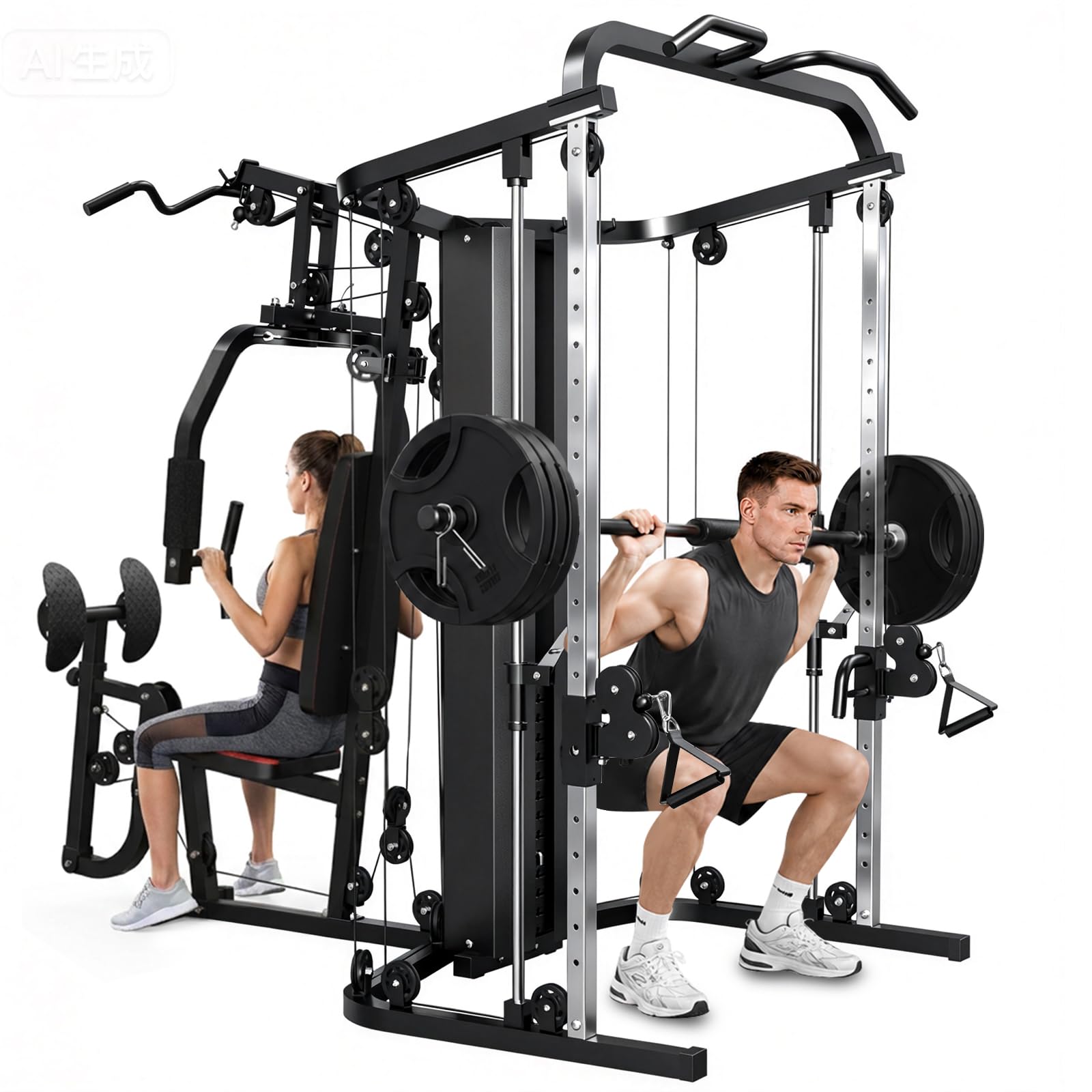
A Smith machine and cable crossover combo with independent weight stacks on each side for two-person training.
The SunHome 925 is built around the idea that home gyms should accommodate two people at once. It includes a Smith machine on one side and a cable crossover station on the other, each with a separate 138-pound selectorized weight stack. This means couples or training partners can exercise simultaneously without sharing or waiting. The frame uses commercial-grade 2″ x 2″ steel and the machine measures 96.85″ x 55.12″ x 86.61″.
Buyers consistently mention the sturdy build and smooth Smith bar action, with one noting it handles over 400 pounds easily. The pulley system is adjustable and works well for a wide variety of exercises. The honest feedback is that the instructions could be better and the seat is non-adjustable, which may limit comfort for some users. Assembly takes a few hours with two people. If you and a partner want to train together without buying two separate machines, this is the most practical all-in-one solution at this price.
The couples’ buy: Independent weight stacks on each side mean zero downtime between sets. The compromise: The seat does not adjust, and the instructions require patience — set aside an afternoon for assembly.
10. pooboo P43 Power Cage
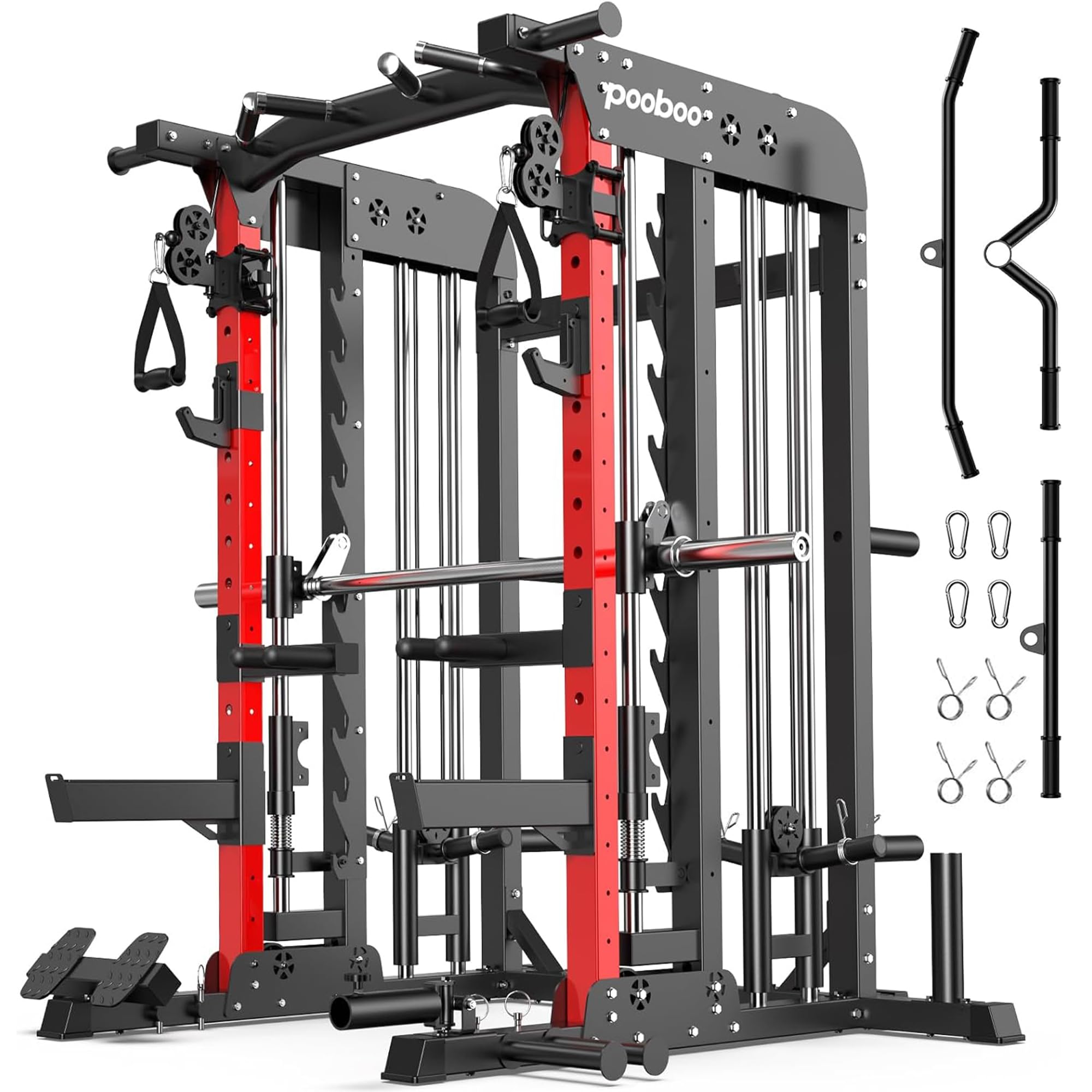
A heavy-duty power cage with over twenty attachments and a precision pulley system that feels like a commercial gym.
The pooboo P43 is the choice for lifters who want a commercial-grade experience at home without the commercial price tag. It is built from heavy-duty steel with a 2000-pound capacity, and the machine weighs 417 pounds — so it stays planted under any load. The precision pulley system uses bearing pulleys and durable PU wire rope for smooth, silent operation. The cage itself measures 62.9″ x 43.3″ x 82.6″, a relatively compact footprint for the capability it offers.
The accessory bundle is the most generous in this lineup: over twenty pieces including 2 J-hooks, 2 safety spotter arms, 2 dip bars, 2 cable grip handles, a lat pulldown bar, a row bar, a low foot board, a 360° landmine, 4 plate storage pins, and 4 band pegs. Buyers call the construction top-notch and the stability incredible, with many noting it feels solid during intense workouts. The assembly is straightforward despite the volume of parts, and the rack ships in two packages to minimize transit damage.
The closest thing to a commercial rack at home: The heavy frame, 2000-pound rating, and silent pulley system make this a long-term investment. Consider if: You want a power cage with a full set of accessories included — no extra shopping required.
11. Mikolo M4 2.0 Smith Machine
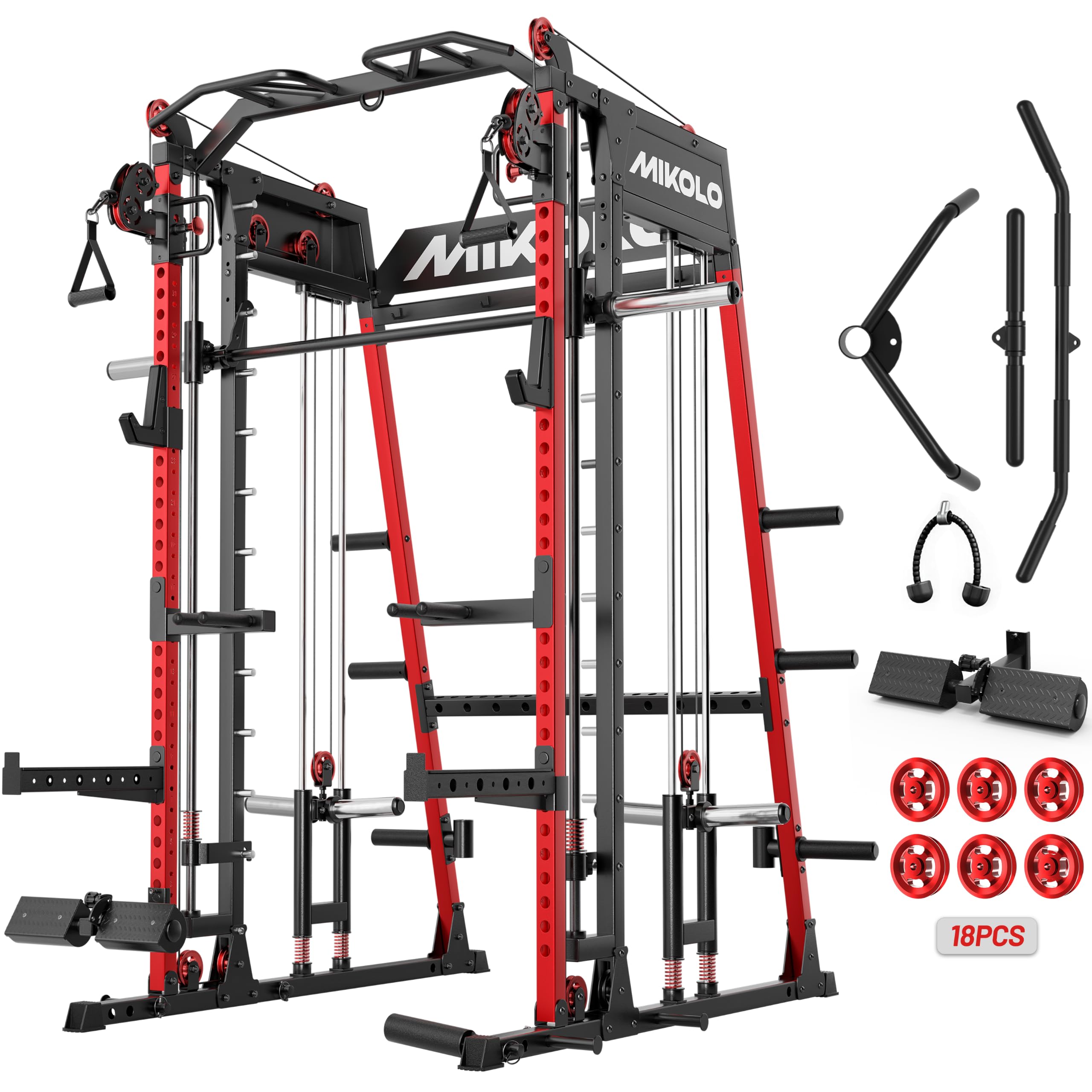
An updated classic that pairs a super-smooth linear bearing Smith bar with a dedicated cable lat pulldown station.
The Mikolo M4 2.0 is a refined version of among the most popular home gym Smith machines. It is built from 14-gauge 2″ x 2″ steel with a 2200-pound maximum recommendation, and it weighs 389 pounds for a planted feel. The all-new linear bearing Smith system provides ultra-smooth, friction-free motion — buyers call the Smith bar “super smooth with minimal wobble.” The lat pulldown attachment is switchable for seated rows from floor to bench height, and the upgraded sandwich-style J-hooks and 20″ safety catches make transitions faster and safer.
The machine measures 71″ x 74.4″ x 87.2″, so it needs a dedicated space. The new Arm-Reach Storage System keeps J-hooks, dip bars, plates, and barbells organized and within reach. There is a minor design quirk where the pulley weights can collide with storage weights during low cable exercises, so you may need to plan your plate storage layout. Assembly takes several hours, but the instructions are clear and parts are packaged by step. Overall, this is a flagship Smith machine with a genuinely smooth feel that competes with commercial units.
The standout features
- Linear bearing Smith bar delivers friction-free, wobble-free motion
- Arm-Reach Storage System solves the clutter problem of older models
- 2200-pound capacity for heavy squats, bench, and cable work
Layout quirks
- Pulley weights can collide with stored plates during low cable exercises
- Assembly is an 8-10 hour solo project — plan a weekend
- Instructions are visual-only and require focus to follow
The Smith machine for serious lifters: The smooth bar and high capacity make it a legitimate alternative to commercial gym equipment. Think twice if: You want a quick setup or have a partner who shares the machine — the storage layout needs some trial and error.
Understanding the Specs
Pulley Ratio (1:1 vs 2:1)
The pulley ratio determines how the weight feels in your hands. A 1:1 ratio means you pull the exact weight on the stack — for example, a 100-pound plate feels like 100 pounds. This is best for heavy compound pulls like lat pulldowns. A 2:1 ratio means the cable travels twice as far as the stack moves, so a 100-pound plate feels like 50 pounds of resistance, but the motion is smoother and more controlled. This suits isolation exercises like cable flyes and tricep pushdowns. Some machines let you switch between both.
Selectorized Stack vs. Plate-Loaded
A selectorized weight stack uses a pin to pick resistance instantly — just pull the pin and slide it to the next plate. It is faster and cleaner, making it ideal for circuit training and supersets. Plate-loaded machines require you to slide weight plates onto a horn or sleeve, which takes more time but lets you use the same plates you already own for your barbell. For a dedicated home gym, a selectorized stack saves minutes per workout, while plate-loaded saves money upfront.
Frame Material and Gauge
The frame’s steel thickness is measured in gauge — lower numbers mean thicker steel. A 14-gauge frame (about 2mm) is the minimum for a stable cable machine at moderate weights. Commercial machines often use 11- or 12-gauge steel. Thicker steel resists twisting during cable crossovers and keeps the machine from rocking. Look for frames with reinforcing gussets or dual-triangle base designs, which add lateral stability without adding a huge amount of weight.
Maximum Weight Recommendation
This number tells you the highest load the frame is designed to handle, including the weight of the user, the barbell, and the plates. Do not confuse it with the weight stack or cable capacity — it is the total stress the structure can take. A machine rated for 1200 pounds is more than enough for most home gym users. If you plan to do heavy squats with a loaded barbell plus cable work, look for a rating of 1600 pounds or higher.
FAQ
Can I do cable crossovers on a lat pulldown tower?
What size weight plates do I need for a plate-loaded cable machine?
How much floor space do I need for a cable machine?
Is a 2:1 pulley ratio better than a 1:1 ratio?
Can two people use a cable machine at the same time?
How long does assembly take for a cable machine?
Do I need to bolt my cable machine to the floor?
What is the difference between a Smith machine cable and a dedicated cable crossover?
Can a cable machine help with rehabilitation exercises?
What attachments come with a typical cable machine?
Final Thoughts: The Verdict
For the majority of shoppers, the cable machine winner is the DONOW Smith Machine because it combines dual weight stacks, a Smith bar, a pull-up station, and a 2240-pound capacity in one solid package that replaces nearly an entire commercial gym. If you want a lat tower that tucks into a tiny corner and assembles in 90 minutes, grab the GOIMU LS01. And for the best power cage value with a silky cable system under three hundred dollars, the JELENS S11 is the one to reach for. Every machine here was selected because it solves a real home gym problem — match the one that solves yours.
How We Picked
We do not accept paid placement. Every pick is matched to a real buyer and a real use-case; we do not hands-on test units.
Sources & Methodology
Specifications: manufacturer listings and product documentation. Review insights: verified customer reviews, as of July 2026. Pricing: not shown on this page (it changes often); check the current price via the retailer link.
As an Amazon Associate, FitlyFast earns from qualifying purchases. This does not affect which products we feature.