
Our readers keep the lights on and the weekend projects moving. As an Amazon Associate, I earn from qualifying purchases.
Specs are compiled from manufacturer listings and verified buyer reviews and can change over time — please confirm the key details on the product page before buying.
A finance calculator should make you faster, not confused. You need to find payment amounts, internal rates of return, and cash flow totals without hunting through a manual. But with so many models promising “all the functions,” the real question is which one actually works the way you do. We cut through the noise to show you the calculators that real professionals and students actually keep on their desks.
I’m Rikta — the founder and writer behind FitlyFast. This guide is built by comparing the manufacturers’ published specifications and the patterns across verified customer reviews, so you get each pick’s real strengths and trade-offs instead of marketing spin.
Whether you are a loan officer dialing up monthly payments or an MBA student working through TVM problems, this guide has narrowed the field to the strongest options. The calculator for finance that wins the top spot has a crowd of nearly a thousand owners behind it, and for good reason.
Our Picks at a Glance


How To Choose The Best Calculator For Finance
Most finance calculators look the same at a glance, but the difference between a good one and a great one is how naturally its keys match your daily workflow. Here are the few things that really matter.
Match the functions to your field
A real estate agent and a corporate finance analyst use different sets of keys every day. Mortgage-focused calculators have dedicated Loan Amt, Int, and Term buttons so you never dive into a menu. General financial models cover TVM, NPV, and IRR for broader business use. Pick the layout that matches your most common tasks.
Check for exam approval
If you are taking the CFA, CFP, or FRM exam, the calculator must be on the approved list. The Texas Instruments BA II Plus and the HP 12C are the two most widely permitted models. Do not assume a calculator is allowed just because it looks professional — verify with your exam board first.
Decide between RPN and algebraic logic
HP calculators use RPN (Reverse Polish Notation) where you enter the numbers first, then the operation — it is faster once you learn it, but it takes practice. Most other brands use standard algebraic logic (2+2=). If you are in a hurry or share a calculator with colleagues, algebraic is easier to pick up without training.
Quick Comparison
| Model | Best For | Key Functions | Display Lines | Exam Approved | Amazon |
|---|---|---|---|---|---|
| Calculated Industries 3415★ Best Overall | Mortgage & Real Estate | Buyer Qualifying, Amortization, ARMs, FHA/VA | Single | — | Amazon |
| CATIGA CF-300Best Value | Budget-Friendly All-Rounder | TVM, IRR, NPV, Cash Flow | Single | — | Amazon |
| HP 10bII+Student Favorite | MBA & Finance Students | TVM, Cash Flow, Probability, Statistics | Single with labels | SAT, PSAT/NMSQT, AP | Amazon |
| Calculated Industries 3400 | Real Estate Licensing | Amortization, Future Value, Date Math | Single | — | Amazon |
| Texas Instruments BA II Plus | CFA & Business Students | TVM, NPV, IRR, Bond, Depreciation | Single | CFA, FRM, CMA | Amazon |
| Casio FC-200V-2 | Multi-Line Viewing | Cash Flow, Amortization, Interest Conversion | 4-Line | — | Amazon |
| HP 12C | Banking & Investment Pros | TVM, NPV, IRR, Amortization, Bond | Single | — | Amazon |
| TI BA II Plus Professional | Advanced Investment Analysis | NPV, MIRR, NFV, Modified Duration | Single (10-digit) | CFA, FRM | Amazon |
| Calculated Industries 3430 | Loan Officers & Brokers | Buyer Qualifying, PITI, DTI, IRR, NPV | Single | — | Amazon |
In‑Depth Reviews
1. Calculated Industries 3415 Qualifier Plus IIIx
Our pick — over 4.5★ from 900+ verified ratings; the strongest balance of quality and price.
The industry standard that agents and brokers call genuinely useful for daily mortgage work.
This is the calculator that speaks your language if you work in residential real estate. The keys are labeled in plain mortgage terms — Loan AMT, Int, Term, PMT — so you never translate a problem into financial jargon. You can enter a client’s income, debt, and expenses to pre-qualify them on the spot, which means you stop showing properties they cannot afford. Buyers report that one unit lasted 18 years before needing a replacement, and owners consistently praise the functionality, with well over 90 people mentioning it as the standout trait.
The rubber enclosure feels solid in the hand, and the button-cell battery compartment is secured with a tool-required fastener, meeting U.S. federal safety requirements (16 CFR Part 1263). It also handles ARMs, combo loans (80:10:10, 80:15:5), and date math for listings and contracts. The trade-off is that it is very specifically a mortgage calculator — if you need general corporate finance functions like NPV and IRR for business analysis, the layout will not serve you as well.
What Owners Come Back For
- Keys are labeled in plain English — Loan Amt, Int, Term — so you never guess
- Built-in buyer pre-qualifying with income, debt, and expense entries
- Multiple owners mention 10+ years of daily use without failure
The Real Limit
- Purely a mortgage tool — no general business functions like NPV or IRR
- Not solar powered, so you need to watch the battery level
Who It Fits: Real estate agents, loan officers, and brokers who need fast, dedicated mortgage math without navigating menus.
Think Twice If: You need a general financial calculator for corporate finance, accounting, or exam prep that includes NPV and IRR.
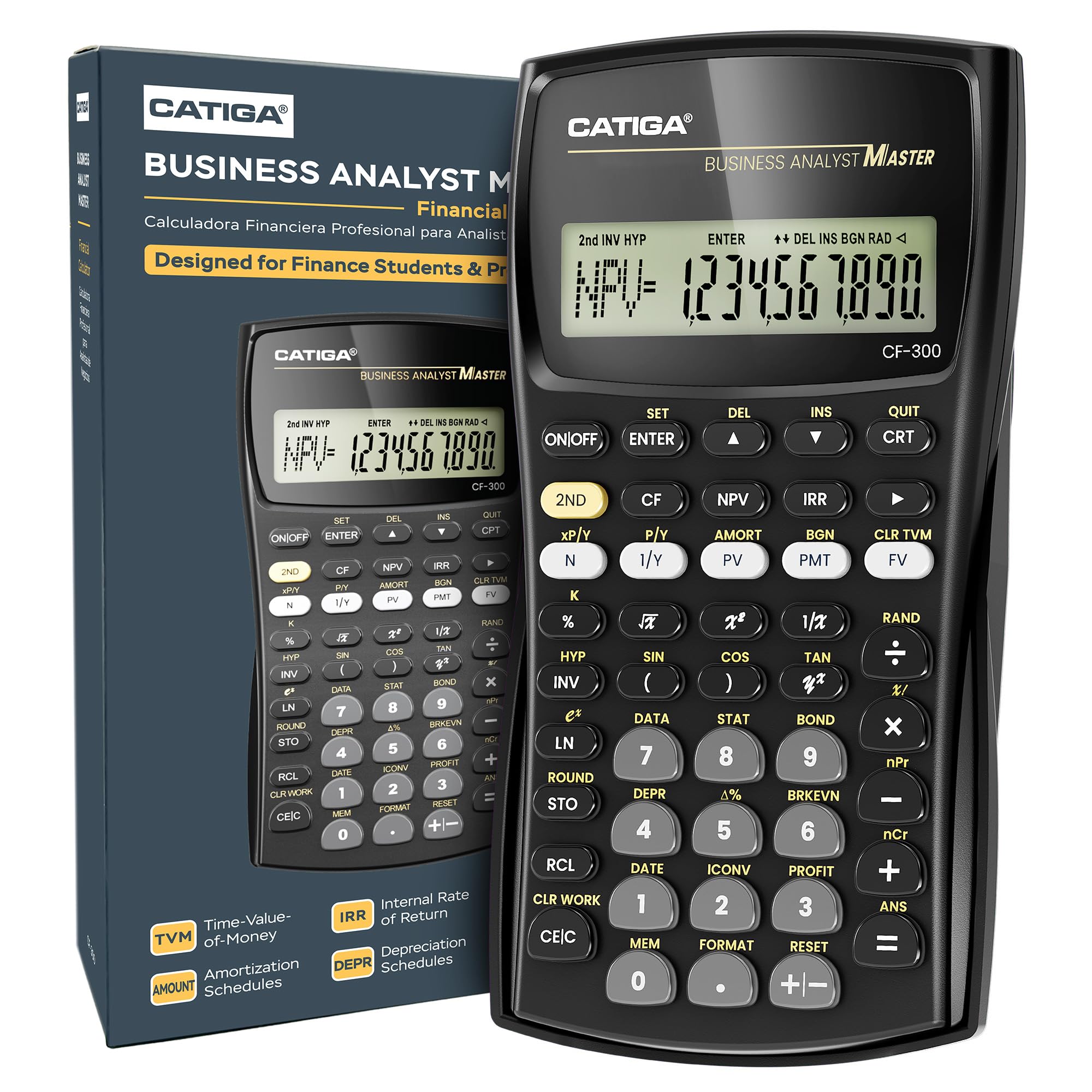
2. CATIGA Financial Calculator CF-300
Packs TVM, IRR, and NPV into a compact unit with a hard-shell cover at an entry-level price.
If you want a general business calculator without paying a premium for a brand name, this is the one to reach for. It covers TVM, IRR, NPV, cash flow analysis, amortization, break-even, depreciation schedules, and bond pricing — everything an MBA student or real estate investor needs. The offset calculation column reduces entry errors, and the tactile buttons have two different shapes so you can feel the difference between numbers and functions. As buyers put it, “this works so much better than the HP one I have that I bought off of Amazon.” The flip-open hard case snaps closed securely, making it safe to throw in a bag.
The single-line display is adequate but can feel cramped during complex cash flow entry, and it is not approved for the CFA or CIPM exams — always check with your exam board. But for coursework and daily professional use, it offers a huge feature set at a hard-to-beat value.
Real-World Edge: Comes with a printed instruction book, so you do not have to hunt for PDFs online — though a few owners wish the company also made YouTube walkthroughs.
Best For: Students and professionals who need a full suite of financial functions (TVM, NPV, IRR) without spending on a TI or HP badge.
Watch Out For: Not accepted on the CFA exam, and the single-line screen slows down heavy cash flow editing.
3. HP 10bII+ Financial Calculator
A lightweight, student-friendly workhorse with over 100 functions and exam approval for SAT, PSAT, and AP tests.
This is the calculator that MBA and finance students lean on because it covers TVM, cash flow, probability distributions, and statistics without the learning curve of an RPN machine. The keyboard layout is intuitive — most common calculations take just a few keystrokes. The adjustable contrast and on-screen labels make the 12-digit display easy to read in different lighting. Reliability is the top thing owners praise, with nearly 20 owners calling it out specifically. One owner summed it up: “I used this to pass my CFP exam and I’ve continued to use it on a daily basis for work for financial planning.”
At 3.04 ounces, it is noticeably lighter than the metal-bodied calculators, and the plastic enclosure feels durable for classroom-to-office travel. It even works on SAT, PSAT/NMSQT, and College Board AP tests. The only catch is a modest learning curve for the more advanced functions — but that is true of any capable financial model, and most owners say a quick how-to guide solves it.
Why It Wins Over the TI BA II Plus: The 10bII+ has a more forgiving keyboard layout and includes probability distributions, which the standard BA II Plus does not offer from the start.
Reach For This If: You are a student who needs a reliable, exam-approved calculator for finance classes and the CFP without wrestling with RPN.
Look Elsewhere If: You require the CFA-exam-approved status of the TI BA II Plus — the 10bII+ is not on that list.
4. Calculated Industries 3400 Pocket Real Estate Master

A no-fuss amortizing calculator with a large display and metal body that fits in a pocket.
If you only need loan amortization, remaining balances, and future values, this is the simplest and most affordable way to get there. It has a large display and bigger keys than most compact calculators, which owners over 40 particularly appreciate. One owner called it “the ideal affordable amortizing calculator.” It handles instant principal, interest, interest-only, and total payments, plus date math for contracts. The metal enclosure gives it a reassuring weight at 4 ounces, and ease of use is the thing owners mention most — nearly 30 people highlight it.
Unlike the more advanced 3415 model, the 3400 does not have buyer pre-qualifying keys or combo-loan support. It is a straightforward tool for one job: amortization. That simplicity is exactly why licensing-exam takers and new agents love it — it covers everything the state test requires without extra functions that slow you down.
Perfect For: The real estate licensing exam and day-to-day payment calculations where you do not want to wade through menus.
Grab It For: The exam or your first year in real estate — it is lightweight, simple, and reliable.
Pass It Up If: You need buyer pre-qualifying or combo-loan analysis, which requires the step-up 3415 model.
5. Texas Instruments BA II Plus Financial Calculator

The single most common calculator in CFA exam rooms, trusted by tens of thousands of finance students and professionals.
If you are studying for the Chartered Financial Analyst, Financial Risk Manager, or Certified Management Accountant exams, this is the calculator the industry expects you to use. It handles TVM, NPV, IRR, amortization, bond calculations, and depreciation, plus list-based one- and two-variable statistics with four regression options. The usability is what owners highlight — nearly 500 people mention it as a strength. As the review consensus puts it, it is essential for finance and business, handling everything from cash flow to bond math with a solid build and a clear display.
The main complaint is that the button responsiveness can feel off at first — the CPT key and IRR logic take a session or two to get used to. But once you learn the workflow, it is fast. The standard BA II Plus weighs 3.68 ounces and has a durable plastic build with a slide cover. For its approval on the CFA, FRM, and CMA exams alone, it is the default choice for anyone serious about a finance credential.
What Makes It Essential
- Approved for CFA, FRM, and CMA exams — the professional standard
- More than 1,100 owners cite functionality as the top strength
- Durable battery and sturdy cover — customers note years of reliable use
What Frustrates Some
- Double-entry can fail on the first pass; the CPT/IRR logic is confusing at first
- No bracket indicator or nesting display — complex equations require careful entry
Career Pick: The safest choice if you are pursuing CFA or FRM certification — most professors and exam prep courses assume you have this model.
Trade-Off: The learning curve for IRR and NPV entry is real — plan to spend an hour practicing before exam day.
6. Casio FC-200V-2 Financial Calculator

The only model on this list with a four-line display, so you see your inputs and results without scrolling.
If you have ever entered a long cash flow sequence only to realize you mistyped step three, this Casio solves that frustration. Its 4-line LCD shows the formula, the intermediate values, and the result all at once. It covers simple and compound interest, amortization, cash flow analysis, date calculation, nominal-to-effective interest rate conversion, and margin/cost/price calculations. The impact protection cover keeps the screen safe in a backpack, and it runs on a single included AAA battery, which lasts noticeably longer than the button cells used by other brands.
The trade-off is that it is not as widely used in U.S. finance programs as the TI or HP models, so you may have to learn the keystrokes on your own rather than following a class guide. But for anyone who does complex cash flow analysis or needs to see the whole picture at once, the 4-line display is a genuine productivity advantage.
Best Use Case: University-level finance coursework where you frequently check and re-enter cash flow data — the four lines save real time.
Choose It For: You can see four lines of calculations at once on the screen, and a single AAA battery keeps it running for a very long time.
skip it if: You need a calculator that matches the keystrokes taught in a U.S. MBA program — the Casio workflow is different.
7. HP 12C Financial Calculator

The gold calculator that has been the industry standard in banking and real estate since 1981.
If you walk onto a trading floor or into a commercial real estate office, you will see this golden rectangle on desks. It has over 120 functions including TVM, NPV, IRR, amortization, and bond calculations, and the user interface has not changed in over 40 years — which means muscle memory transfers from one unit to the next. The new ARM-chip version is extremely fast, and the battery lasts months of daily use. Owners who have had one for 20+ years say the durability is legendary. At 0.15 kg with a metal enclosure, it feels substantial without being bulky.
The catch is RPN. You push the number first, then the operator. It is faster once it clicks, but the learning curve is steep if you have used algebraic calculators your whole life. A handful of owners also note that the latest production batch has sticky keys on some units, so check the return policy. But for real — the HP 12C has earned its place through four decades of professional trust.
Why Pros Keep It On Their Desk
- Industry standard since 1981 — instantly recognizable and trusted in banking
- Over 120 functions including TVM, NPV, IRR, amortization, and bond calculations
- Metal enclosure with legendary durability — many report 20+ years of service
The Hurdle
- RPN logic requires deliberate practice to learn; it is not intuitive at first
- No printed manual is included — you have to download it
Reach For This If: You work in banking, commercial real estate, or want the same tool the most seasoned finance pros use.
Hold Off If: You need a calculator you can hand to a colleague without explanation — RPN is a solo sport.
8. Texas Instruments BA II Plus Professional

The step-up version of the standard BA II Plus, adding MIRR, NFV, and duration calculations for investment pros.
If you regularly compute modified internal rate of return, net future value, or modified duration, the standard BA II Plus does not have those functions. This Professional version adds them, along with payback and discounted payback. It also has an improved 10-digit display that is slightly sharper than the original. The metal casing and leather-like case give it a premium feel. For complex investment evaluation and loan interest calculations, owners say it excels — it “saved me in my FINA 3000 class.”
The downside is that the display image on the listing often shows a different color than the actual unit (grey, not black). A few owners also wish it came with a quick-reference card like the standard model. But if you need the advanced functions for Level II CFA or for work in fixed-income analysis, this is the logical upgrade.
At 4.64 ounces, it is heavier than the standard BA II Plus (3.68 oz) — a small trade-off for the added metal and expanded function set.
Upgrade For: MIRR, NFV, and modified duration — tools the standard BA II Plus simply does not have.
Stick With Standard If: You only need basic TVM, NPV, and IRR for introductory finance courses.
9. Calculated Industries 3430 Qualifier Plus IIIFX

The most advanced real estate calculator on this list, adding IRR, NPV, and cash flow to the mortgage toolkit.
This is the step-up model from the 3415 that loan officers and experienced brokers choose when they need both mortgage math and investment analysis. It keeps all the dedicated keys (Loan Amt, Int, Term, Pmt) and adds IRR (internal rate of return), NPV (net present value), and cash flow functions so you can evaluate rental properties and trust-deed investments on the same device. It handles PITI (principal, interest, taxes, insurance) payments, DTI (debt-to-income) ratios, and buyer pre-qualifying with tax, insurance, and mortgage insurance included. At 6.4 ounces, it is the heaviest calculator here — the metal build and sturdy keys give it a serious feel. Owners say it is “extremely easy to use” and that they use it “every day, multiple times a day” for P&I, DTI, and LTV (loan-to-value) calculations.
The screen can look dim in low light, and the buttons do wear out after 5-6 years of heavy daily use — though that is a long lifespan for a tool that lives in a pocket. If you are a mortgage professional who also analyzes investment properties, this is the one model that covers both worlds without needing a second calculator.
What Makes It a Daily Driver
- Combines mortgage pre-qualifying keys with IRR, NPV, and cash flow for investment analysis
- Flexible data entry — you can change inputs on the fly and compute both forwards and backwards
- Built to survive daily use; reviewers point out 5-6 years before button wear
Where It Stumbles
- The segment LCD screen is dim compared to newer models — hard to read in low light
- Heavier than the 3415 at 6.4 ounces — you notice it in a shirt pocket
Best For: Loan officers and real estate investors who need a single calculator for mortgage pre-qualifying AND property investment analysis.
Consider The 3415 If: You only need residential mortgage math and want a lighter, less expensive device.
Understanding the Specs
TVM (Time Value of Money)
This is the core function of any finance calculator. It lets you compute any one of five values — present value, future value, payment, interest rate, or number of periods — when you enter the other four. If you are pricing a loan, saving for retirement, or valuing a bond, TVM is where you start. A dedicated TVM key cluster (N, I/Y, PV, PMT, FV) means less menu scrolling and fewer errors.
NPV & IRR (Net Present Value & Internal Rate of Return)
These two functions evaluate whether an investment is worth the upfront cost. NPV tells you the dollar value an investment adds after accounting for the time value of money — a positive number means it beats your required return. IRR is the annualized rate the investment earns. Not all financial calculators handle uneven cash flow for NPV/IRR equally well; models with a cash flow (CF) list make entry much faster.
Amortization
This breaks a loan payment into its interest portion and principal portion for each period. A good amortization function shows you the remaining balance after each payment, which is essential for mortgage work, loan underwriting, and creating payoff schedules. Most real estate-focused calculators have a dedicated amort key; general financial models often place it inside a menu.
Exam Approval
If you are taking a professional exam like the CFA, CFP, or FRM, the calculator must be on the approved list. The Texas Instruments BA II Plus (both standard and Professional) and the HP 12C are the two most universally accepted. The HP 10bII+ is allowed on the SAT and CFP but not the CFA. Always confirm with your exam board before buying — an unapproved calculator can mean a disqualified score.
FAQ
What does TVM mean on a finance calculator?
Is the HP 12C or the TI BA II Plus better for the CFA exam?
Can I use a real estate calculator for general business finance?
How long do the batteries last in a financial calculator?
Which finance calculator do most real estate agents use?
What is RPN and should I learn it?
Do I need a financial calculator if I have Excel?
How do I know if a calculator is approved for my exam?
What is the difference between the TI BA II Plus and the TI BA II Plus Professional?
Why is the Casio FC-200V-2 not more popular in U.S. finance programs?
Final Thoughts: The Verdict
For most buyers, the calculator for finance winner is the Calculated Industries 3415 Qualifier Plus IIIx because it is the only model that pairs dedicated mortgage keys with the real-world durability that nearly a thousand owners have vouched for. If you need a general business calculator for the CFA exam or corporate finance, grab the Texas Instruments BA II Plus — it is the most universally accepted model in professional finance. And for a student on a budget who still needs TVM (time value of money), IRR, and NPV, the CATIGA CF-300 delivers an impressive feature set at a fraction of what name brands charge.
How We Picked
We do not accept paid placement. Every pick is matched to a real buyer and a real use-case; we do not hands-on test units.
Sources & Methodology
Specifications: manufacturer listings and product documentation. Review insights: verified customer reviews, as of July 2026. Pricing: not shown on this page (it changes often); check the current price via the retailer link.
As an Amazon Associate, FitlyFast earns from qualifying purchases. This does not affect which products we feature.