
Our readers keep the lights on and the weekend projects moving. As an Amazon Associate, I earn from qualifying purchases.
Specs are compiled from manufacturer listings and verified buyer reviews and can change over time — please confirm the key details on the product page before buying.
You are risking your money on a budget miter saw. Too many cheap models wobble, bind, or drift off the line the moment you touch a hardwood board. But the right one — with the right motor (15 amps for pushing through dense wood), the right blade, and the right build — makes clean, repeatable angle cuts feel almost automatic, even on a tight budget. This guide picks through nine affordable miter saws to find the ones that actually hold their settings and cut square, cut after cut.
I’m Rikta — the founder and writer behind FitlyFast. This guide is built by comparing the manufacturers’ published specifications and the patterns across verified customer reviews, so you get each pick’s real strengths and trade-offs instead of marketing spin.
Knowing which specs matter in a budget miter saw keeps you from wasting money on one that shakes itself apart after a season.
Our Picks at a Glance


How To Choose The Best Budget Miter Saw
A miter saw is a purchase you live with for years. Picking the wrong one means fighting with bad cuts every time you set up. Focus on these four things to get it right the first time.
Motor Power: Stick with 15 Amps
A 15-amp motor is the industry standard for a reason. It gives you the torque to push through dense hardwoods and pressure-treated lumber without slowing down. Anything less (like 10 or 12 amps) will bog down on a 4×4, leaving burned edges and stalled cuts. Every saw on this list runs on a 15-amp motor except for the Evolution models (1200W and 1500W), which compensate with specialized gearboxes.
Sliding vs. Compound vs. Sliding Compound
A compound miter saw tilts its head left for bevel cuts — essential for crown molding and picture frames. A sliding compound saw adds rails that let the blade move forward and back, giving you a wider crosscut without a bigger blade. If you ever cut boards wider than 6 inches, get a sliding saw; the extra reach saves you from flipping the material. If you only cut trim and 2x4s, a standard compound saw is lighter, simpler, and cheaper to maintain.
Bevel and Miter Range: Know Your Angles
For most DIY trim work, a 0-45 degree bevel range is enough. For crown molding, you want at least 45 degrees in the miter (both left and right) and a 45-degree bevel. Some budget saws go to 52 degrees on the miter, which gives you extra room when cutting nested crown. Look for positive stops — detents that click into common angles like 22.5, 30, and 45 degrees — so you don’t have to measure each time.
Laser Guide or Shadow Line
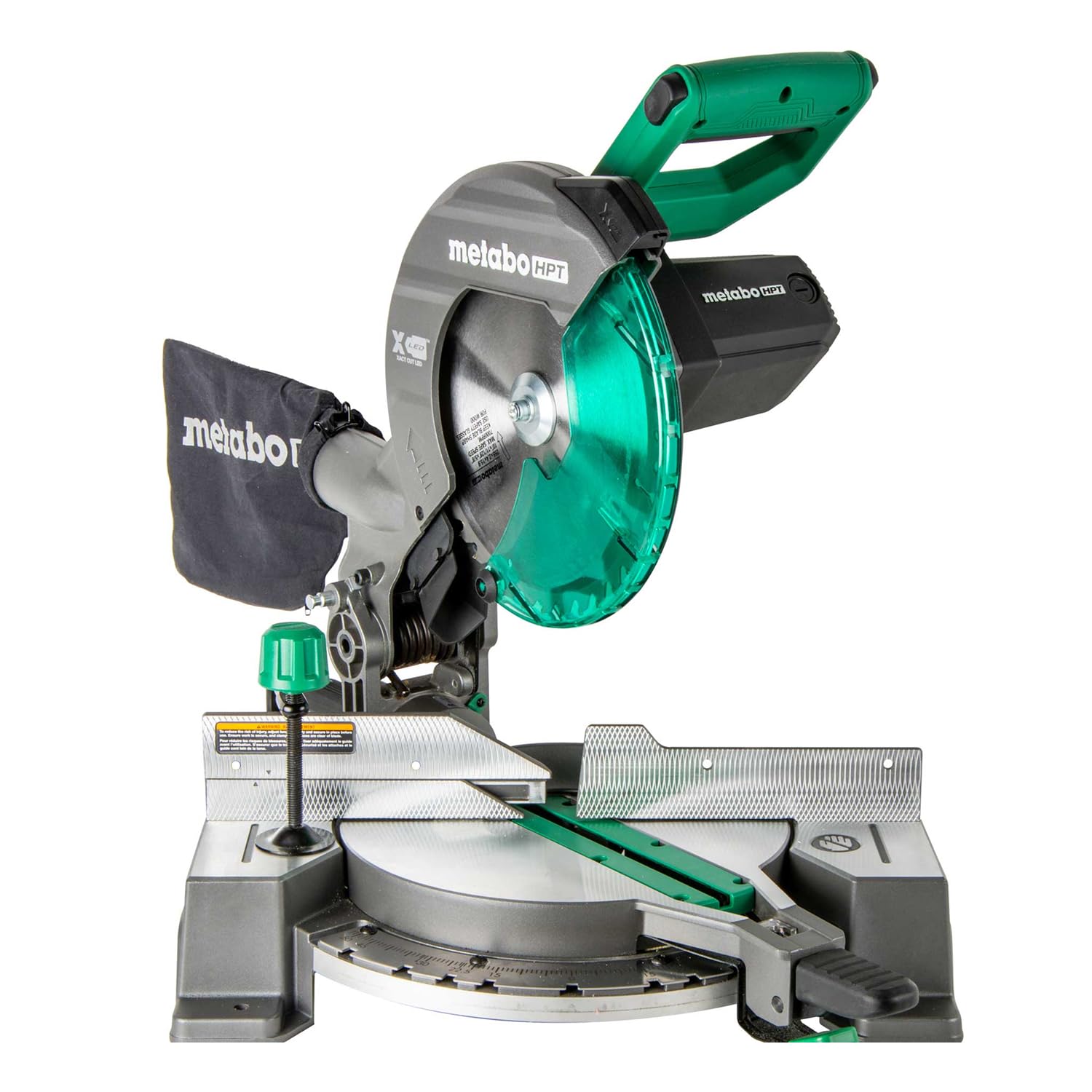
A laser guide projects a red line onto your material so you see exactly where the blade will hit. It helps beginners get accurate cuts faster. The Metabo HPT uses a shadow line (a physical shadow cast by a bright LED) instead — many owners find it more precise than a laser because it never drifts out of calibration. Either system is useful; the key is that the line actually matches the cut.
Quick Comparison
| Model | Best For | Motor | Blade Size | Weight | Amazon |
|---|---|---|---|---|---|
| Evolution R210CMS★ Best Overall | Multi-material cutting | 1200W | 8-1/4″ | 12.8 lbs | Amazon |
| Metabo HPT C10FCG2Also Great | Overall value & precision | 15 Amp | 10″ | 24.2 lbs | Amazon |
| Evolution R185SMS+Pro Value | Compact sliding saw | 1500W | 7-1/4″ | — | Amazon |
| MarvTool 10-Inch | Lightweight portability | 15 Amp | 10″ | 20.5 lbs | Amazon |
| Genesis GMS1015LC | Laser-guided trimming | 15 Amp | 10″ | — | Amazon |
| DOVAMAN 10-Inch Sliding | Multi-speed versatility | 15 Amp | 10″ | 37.5 lbs | Amazon |
| Ryobi TS1346 | Beginner DIY | 14 Amp | 10″ | — | Amazon |
| NOVORIK 10-Inch Sliding | Sliding cuts on a budget | 15 Amp | 10″ | 33.9 lbs | Amazon |
| Hoteche 10-Inch Sliding | Extended cutting capacity | 15 Amp | 10″ | 34.9 lbs | Amazon |
In‑Depth Reviews
1. Evolution Power Tools R210CMS Compound Miter Saw, 8-1/4″
A tiny footprint that cuts steel tube square and cool right from the start.
The Evolution R210CMS is the smallest and lightest saw on this list — measuring just 15 inches long, 10.2 inches wide, and weighing 12.8 pounds. It fits in a car trunk and stores on a shelf. Despite its size, the 1200W hi-torque motor and Japanese TCT blade cut through steel, aluminum, wood, and plastic without generating heat or burrs. As owners put it: “Surprised the heck out of me….cut dead square from the start….light weight and leaves a clean finish thats cool to the touch.”
The bevel tilts 0-45 degrees, and the miter swings 45 degrees left and right — enough for basic trim work and metal cuts. It includes a top hold-down clamp and a 24T multi-material TCT blade. The 3-year limited warranty is solid for a tool at this price.
The compromise is size. With a cutting angle of 45 degrees (vs. 52 on the Metabo HPT), you have less room for angled cuts. And the 8-1/4 inch blade cannot cut through a 4×4. Some owners note that metal shavings can melt into the plastic housing after heavy use, so cleaning is important.
The go-to for multi-material DIY: If you cut metal studs, aluminum, or wood with nails, this is the most portable solution.
Skip it for heavy lumber: The blade and motor are too small for framing or large dimensional wood.
2. Metabo HPT 10-Inch Single Bevel Compound Miter Saw, C10FCG2
The budget king that cuts like a premium saw — square, smooth, and repeatable.
The Metabo HPT C10FCG2 hits the balance between price and precision. Its 15-amp motor spins up to 5,000 RPM, giving you clean cuts through hardwood without bogging down at the end of the stroke. What wins people over is the Xact Cut Shadow Line — a bright LED that casts a precise shadow of the blade kerf onto the material, so you see exactly where the cut will land without a laser that drifts.
At 24.2 pounds, it is lighter than most 10-inch saws, making it easy to carry to a job site or stow in a garage cabinet. The miter range goes 0-52 degrees left and right, which beats the standard 45-degree limit — useful when cutting nested crown molding against a fence. Owners say it arrives well-packaged, square from the start, and that the stock blade cuts wood like butter with minimal tear-out. The 5-year warranty is a rare find at this price point.
The main trade-off: this is a single-bevel saw (0-45 degrees left only). If you need to cut compound angles on both sides without flipping the board, you will need a dual-bevel model that costs more. Also, the dust collector is small and functional but not shop-vac powerful.
What owners rave about
- Shadow line cut indicator is dead accurate — no laser drift to recalibrate
- Lightweight at 24.2 lbs for a 10-inch saw
- 52-degree miter range gives extra room for crown molding
- 5-year manufacturer warranty backs the tool body
The honest limitations
- Single bevel — you flip the board for opposite-side bevels
- Dust port works but needs a shop vac for serious collection
- Motor has a break-in period; initial smell and uneven run resolve after 10 minutes
The smart buy for: Anyone who wants pro-level accuracy (shadow line, 5,000 RPM, square-out-of-box) without spending pro-level money. This is the crowd favorite.
Think twice if: You need dual-bevel for production crown molding — the single-bevel limit means extra steps on compound cuts.
3. Evolution Power Tools R185SMS+ Sliding Miter Saw, 7-1/4″
A compact slider that cuts steel as cleanly as pine, with no blade change.
The Evolution R185SMS+ does something most budget saws cannot cut metal without sparks, heat, or burning the blade. Its patented multi-material technology, powered by a 1500W motor and an tune gearbox, lets you slice through steel, aluminum, wood with embedded nails, and plastic using the included TCT blade. The sliding rails give you a wider crosscut than a standard 7-1/4 inch saw would suggest — ideal for cutting metal studs or aluminum angle stock in one pass.
It is lightweight enough to carry around a jobsite, and the ergonomic carry handle makes it easy to grab. Owners praise the smooth ball-bearing slides and the accurate laser guide that shows exactly where the cut lands. The premium 3-piece clamp holds workpieces firmly. Buyers report that it cuts thick metal smoothly and that customer service is exceptional if you ever need a part. At 4.6 stars from 980 ratings, it is among the most trusted budget picks on the market.
The catch: the 7-1/4 inch blade size limits depth of cut compared to a 10-inch saw. You cannot cut a 4×4 in one pass. It is intended for finish work, light metal cutting, and smaller dimensional lumber — not framing.
Best for metalworkers and handymen: If you switch between wood and steel, this saw saves you the cost of a dedicated metal-cutting saw.
Not for framing: The 7-1/4 inch blade cannot handle large dimensional lumber — keep a 10-inch saw for that.
4. MarvTool 10-Inch Compound Miter Saw
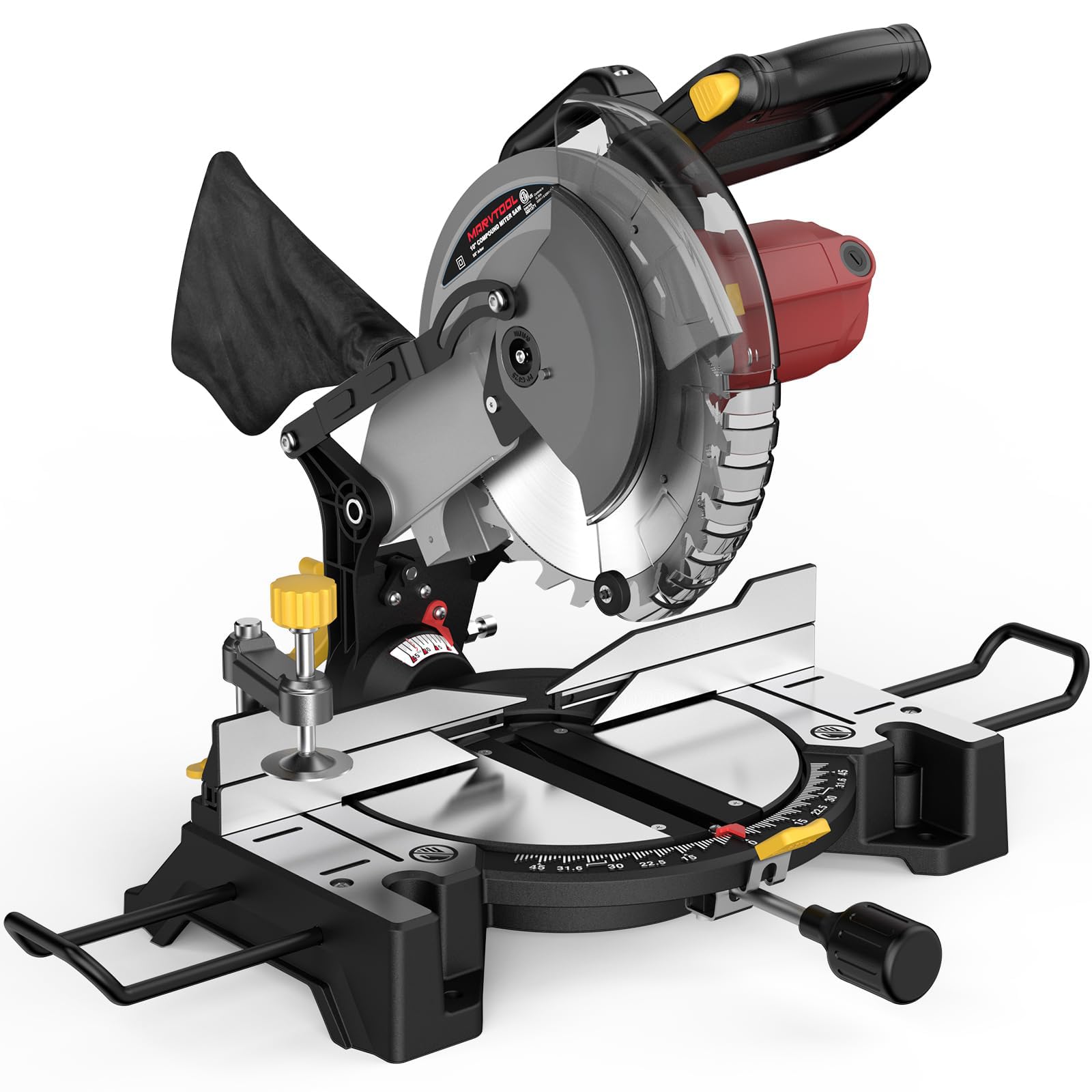
A lightweight 10-inch saw that punches through 4x4s without breaking a sweat.
The MarvTool 10-inch compound miter saw proves you do not need to spend big money for a saw that cuts straight and stays true. Weighing just 20.5 pounds, it is the lightest 10-inch saw in this lineup — easier to carry up stairs or hang on a wall hook. The 15-amp motor spins at 5,000 RPM, giving you enough power to cut through 4×4 hardwood posts smoothly. Owners mention it handles 2×4 to 4×4 stock with ease and remains durable even after hundreds of cuts and three blade changes.
Setup is straightforward, and the included 36T alloy steel blade gives decent crosscuts right from the start. The vise clamp secures material for safety, and the dust collection bag keeps the worst of the debris off the floor. It cuts at 45 degrees miter and single bevel 0-45 degrees — standard specs that cover most DIY projects like baseboards, picture frames, and shelving.
The trade-off is build quality. While owners praise the build quality as the most-mentioned positive aspect, the depth stop is slightly flimsy, and rotating to acute angles requires fully loosening the knob. It is a beginner-friendly saw, not a job-site workhorse.
Best for DIYers on a tight budget: At 20.5 pounds with a 15-amp motor, it is the lightest and cheapest way to get 10-inch cutting capacity.
Not for continuous heavy use: The plastic components and depth stop feel less sturdy than the Metabo HPT or Evolution saws.
5. DOVAMAN Updated 10-Inch Sliding Miter Saw

A sliding saw with two speeds and three blades — built for material versatility.
The DOVAMAN 10-inch sliding miter saw solves a problem most budget saws ignore: different materials need different speeds. It runs at 5,000 RPM for fast wood cuts and drops to 3,200 RPM for softer metals and plastics, reducing burn and chatter. The 15-amp pure copper motor delivers consistent torque across both speeds. With a 13-inch sliding rail and extendable side tables, you get a wide cutting range up to 4 inches by 13 inches — enough for larger stock.
It ships with three TCT blades (two 40-tooth, one 48-tooth), so you have spare options for different materials. The ambidextrous design and dual lock switches make it comfortable for left- and right-handed operators. Owners say the laser guide is accurate and the build feels solid, though heavy at 37.5 pounds.
The main concern is durability. The summary shows that some owners mention the saw failing after a few cuts. This is not a buy-and-forget tool — it needs to be treated gently. The sliding rails are a great feature for the price, but long-term reliability is not guaranteed at the same level as the Metabo HPT or Evolution saws.
Why it stands out
- Dual-speed motor (5,000 / 3,200 RPM) for wood vs. metal/plastic
- Three TCT blades included — spare options from the start
- Sliding rail with 13-inch capacity for wider boards
- Ambidextrous design works for left-handed users
Where it falls short
- Heavy at 37.5 lbs — not a portable saw
- Durability concerns reported; some units die after a few cuts
- Loud — ear protection is mandatory
Who it fits: DIYers who cut mixed materials (wood, PVC, soft metal) and need a sliding saw on a budget.
Who should pass: Anyone who needs a daily workhorse for years — the durability track record is too mixed for pro use.
6. Genesis GMS1015LC 10-Inch Compound Miter Saw with Laser

A laser-equipped saw built for trim work and crown molding on a budget.
The Genesis GMS1015LC brings two features you usually find on higher-end saws: an integrated laser guide and an electric brake that stops the blade in seconds. The 15-amp motor handles 2x4s and 4x4s easily, and the included 60-tooth carbide blade gives a finer finish than the standard 24- or 40-tooth blades found on other budget saws. Owners say it is easy to assemble as a beginner and that the laser line is genuinely effective for alignment.
The nine positive miter stops lock firmly at common angles (0, 15, 22.5, 30, 45 degrees in both directions), so you can repeat cuts without re-measuring. The die-cast aluminum base keeps it stable without being heavy. It cuts up to 45 degrees left and right for miter and 45 degrees left for bevel — full coverage for crown molding and picture frames.
The weak points: the dust bag is poorly designed (debris slides back onto the work), and the extension wings are not long enough to support lumber over 8 feet. It is also loud — ear protection is a must. And Genesis recommends this saw for wood only; cutting metal may melt plastic components.
Perfect for beginner trim carpenters: The laser guide, electric brake, and 60-tooth blade make trimming baseboards and crown molding accurate and safe.
Not for metal cutting: The plastic housing and components cannot handle the heat from metal cuts — stick to wood and wood products.
7. Ryobi 10 in. Compound Miter Saw with LED (TS1346)

A gentle learning curve with an LED cutline that makes your first cuts confident.
Ryobi built the TS1346 for the first-time buyer. The 14-amp motor reaches 5,500 RPM — slightly faster than most 15-amp saws — giving you clean cuts through pine, poplar, and plywood. Instead of a laser, it uses an LED Cutline Indicator that projects a bright shadow of the blade’s path onto the material. Owners find this more reliable than a laser because it never needs calibration; the light simply shows where the blade will land.
The 24-tooth carbide blade cuts fast but leaves a rougher edge than higher-tooth-count blades. Many owners swap it immediately for a Diablo blade for finer trim work. The 1-1/4 inch dust port hooks up to standard shop vac hoses. It includes a work clamp, dust bag, and blade wrench. Owners consistently describe it as a “bang for your buck” saw that is pleasant to use for DIY projects.
The downside: this saw only has a 45-degree miter range (not 52), which limits crown molding techniques. Also, with only 47 ratings, the track record is shorter than more established models. It is a solid entry-level tool, not a heavy-use pro saw.
Great for weekend DIY: The LED cutline is intuitive, and the 5,500 RPM motor cuts fast enough for home projects.
Consider upgrading earlier: If you plan to do serious trim work or need a wider miter range, look at the Metabo HPT or Genesis.
8. NOVORIK Single Bevel Compound Sliding Miter Saw, 10″

A sliding saw under with a 15-amp motor and laser guide — rare specs at this price.
The NOVORIK 10-inch sliding compound miter saw offers sliding rails and a 15-amp motor for less than most non-sliding saws cost. The 4,000 RPM no-load speed gives it enough torque for wood, plastic, and soft metal. The laser guide tracks the blade’s real-time position so you preview the cut before pulling the trigger. Bevel cuts go 0-45 degrees left, and the miter swivel has positive stops at 0, 15, 22.5, 30, and 45 degrees on both sides.
At 33.9 pounds, it is heavier than a standard compound saw but that weight helps with stability during sliding cuts. It ships with a 40-tooth TCT blade sufficient for general woodworking. Owners appreciate the sturdy build and affordable price, with many saying it works great from the start and that customer service is responsive if parts are missing.
The main complaint is that the degree dial uses a sticker that may wear off over time, and the dust collection is adequate but not perfect — dust still escapes. Some reviewers were disappointed to find it is not a dual-bevel saw despite the description’s phrasing. It is a good value for a sliding saw, but check the bevel direction before buying.
Who should buy: Home woodworkers who need the extra crosscut capacity of a sliding saw without the sliding-saw price tag.
Watch out for: The degree labeling is a sticker — protect it or plan to add your own markings.
9. Hoteche 10-Inch Sliding Compound Miter Saw
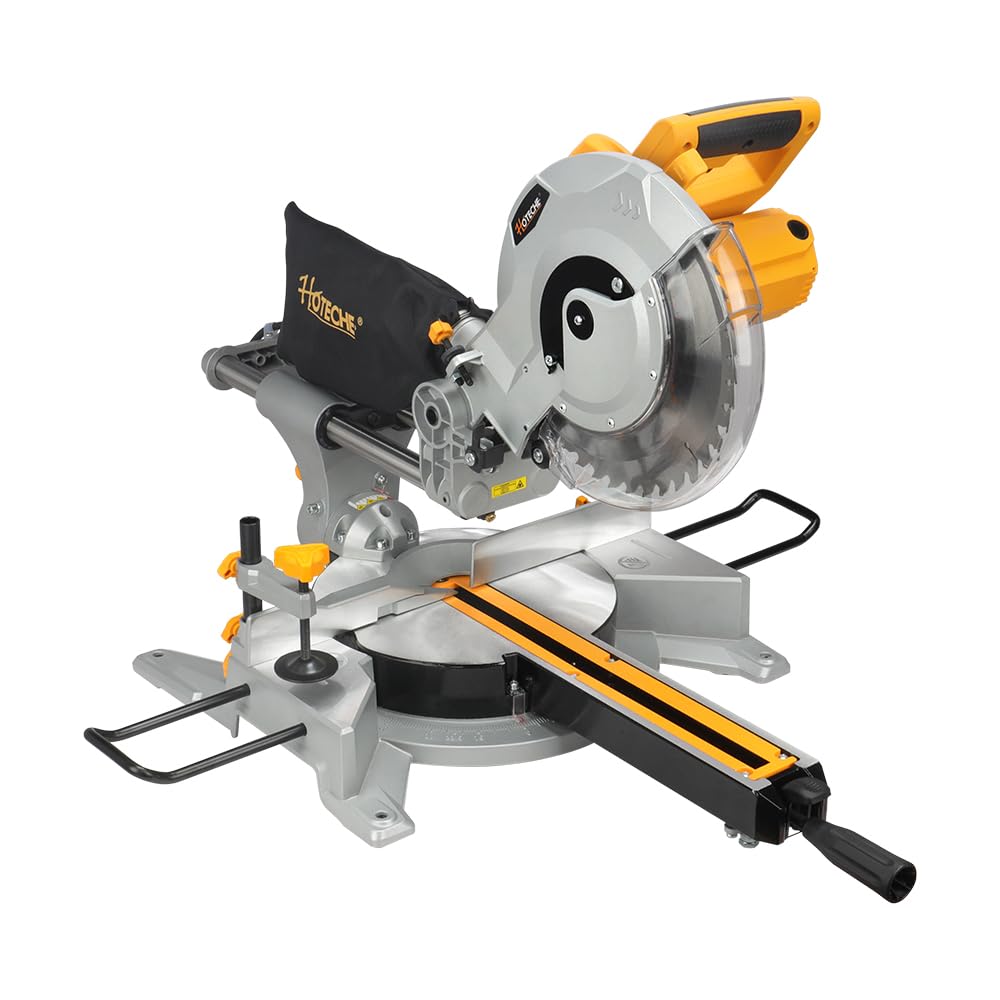
A sliding saw with extension bars for framing-sized cuts at a budget price.
The Hoteche 10-inch sliding compound miter saw gives you 340mm (13.4 inches) of cutting capacity thanks to its sliding rails and included extension bars. The 15-amp motor (1800W) spins at 4,500 RPM — fast enough to zip through dimensional lumber, trim, and sheet goods. The single-bevel design cuts up to 45 degrees left, and the 40-tooth TCT blade handles wood and plastic cleanly.
The complete accessory kit includes the blade, extension bars, two hex wrenches, a dust bag, a work clamp, and a pair of carbon brushes for future motor maintenance. Owners who installed window casing said it worked perfectly and that the laser sight was helpful for a first-time miter saw user. The saw looks and feels like a tool twice its price.
The catch is the sliding mechanism. Some owners point out that the “sliding” miter saw does not actually slide on rails — it pivots, which limits crosscut width compared to a true sliding saw. Others mention that the front mounting holes are poorly designed and difficult to bolt down. One owner reports the motor shorted after 1.5 years due to moisture exposure, so it is best kept in a dry shop.
Best for budget-conscious framers: The extension bars and sliding head let you cut wide boards that a non-sliding 10-inch saw cannot handle.
Not a true slider: The head pivots rather than sliding on rails — check the capacity against what you actually need to cut.
Understanding the Specs
Miter Range vs. Bevel Range
The miter range is the angle you turn the saw table left or right for angled crosscuts. A 45-degree miter in both directions covers most picture frames and trim. The bevel range is how far the saw head tilts for angled cuts through the board’s thickness. A 0-45 degree left bevel handles crown molding and compound miters. A 52-degree miter (like on the Metabo HPT) gives you extra room for nested crown without re-setting the saw.
Sliding vs. Non-Sliding: Cutting Capacity
A sliding miter saw has rails that let the blade move forward and back, increasing the width of board you can cut. A non-sliding 10-inch saw typically cuts a 5-6 inch wide board. A sliding 10-inch saw can cut 10-14 inches wide, depending on the rail length. If you cut lumber wider than a 2×6, a sliding saw is worth the extra cost. For trim and 2x4s, a non-sliding saw is lighter and more rigid.
FAQ
What is the difference between a compound miter saw and a sliding compound miter saw?
Can a budget miter saw cut metal?
What size blade do I need for a budget miter saw?
Do I really need a laser guide on a budget miter saw?
What is a positive stop on a miter saw?
How many teeth should the blade have on a budget miter saw?
Can I use a budget miter saw for crown molding?
Why is my miter saw burning the wood?
How often should I replace the blade on a budget miter saw?
Are budget miter saws safe for beginners?
Final Thoughts: The Verdict
For most people, the budget miter saw winner is the Metabo HPT C10FCG2 because it combines a reliable 15-amp motor, a dead-accurate shadow line, and a 52-degree miter range at a price that undercuts bigger brands while still delivering square cuts from the start. If you cut mixed materials like steel and wood regularly, the Evolution R185SMS+ is the one to reach for — it handles metal without a blade change and remains compact. And for the absolute tightest budget where every dollar counts, the MarvTool 10-inch gives you a full-size blade and 5,000 RPM for less than any other 10-inch saw on this list.
How We Picked
We do not accept paid placement. Every pick is matched to a real buyer and a real use-case; we do not hands-on test units.
Sources & Methodology
Specifications: manufacturer listings and product documentation. Review insights: verified customer reviews, as of July 2026. Pricing: not shown on this page (it changes often); check the current price via the retailer link.
As an Amazon Associate, FitlyFast earns from qualifying purchases. This does not affect which products we feature.