
Our readers keep the lights on and the weekend projects moving. As an Amazon Associate, I earn from qualifying purchases.
Specs are compiled from manufacturer listings and verified buyer reviews and can change over time — please confirm the key details on the product page before buying.
Nothing ages a boat faster than a chalky, faded gelcoat. Regular car compounds can be too harsh on marine surfaces, while some “marine” polishes simply don’t have enough bite to handle the sun and salt damage a boat collects. The right buffing compound for boats needs to cut through years of heavy oxidation without scouring the gelcoat itself — a balance that separates a great restoration from a dull, swirly mess.
I’m Rikta — the founder and writer behind FitlyFast. This guide is built by comparing the manufacturers’ published specifications and the patterns across verified customer reviews, so you get each pick’s real strengths and trade-offs instead of marketing spin.
From heavy-cut pastes that tackle severe chalk to gentle polishes that finish to a high-gloss mirror, these are the top nine contenders for the title of best buffing compound for boats in 2025.
Our Picks at a Glance

How To Choose The Best Buffing Compound For Boats
Choosing the right compound is about matching its “cut” to your gelcoat’s condition. A compound that is too aggressive can haze a clearcoat, while one that is too mild might not touch deep oxidation. Here are the most important factors to weigh.
Cut Level and Grit Rating
The grit number tells you how aggressively the compound removes material. Lower grit numbers, like 600 or 800, are heavy-cut compounds that can strip heavy oxidation and sanding marks fast. Higher grit numbers, such as 1500, are finer polishes for refining the surface after the heavy work is done. For a badly chalked hull, a heavy-cut compound with a 1000-grit equivalent or lower is your starting point.
Gelcoat Safety and Formula Type
Not all compounds are safe for marine gelcoat — some automotive compounds use large, harsh abrasives that can cut through a boat’s softer outer layer. A marine buffing compound typically uses finer, engineered abrasives (like aluminum oxide or cerium oxide) that break down during use. Water-based and silicone-free formulas are easier to clean up and leave the surface ready for waxing without staining pads or leaving a greasy film.
Ease of Use and Dust
Some compounds create a cloud of fine dust as you buff, which can be a real nuisance in a boat yard. A “dust-free” formula saves you cleanup time and keeps the work area air cleaner. Also look for compounds with a long “open time” — they stay wet longer on the surface, giving you more working time before they dry out and start gumming up your pad.
Quick Comparison
| Model | Best For | Grit Number | Item Weight | Dimensions | Amazon |
|---|---|---|---|---|---|
| Jescar Correcting Compound★ Best Overall | Precision finishing & swirl removal | 1500 | 2 lb | 3 x 3 x 9.25 in | Amazon |
| Better Boat Marine PolishBest Value | Light oxidation & UV protection | — | 1.23 lb | 8.58 x 3.46 x 1.81 in | Amazon |
| SONAX Ultimate CutTop Performer | Wet-sand scratch removal | 800 | 0.3 kg | 2.2 x 2.2 x 7.01 in | Amazon |
| Malco Super Duty Heavy Cut | Heavy oxidation on clearcoat & gelcoat | — | 2 lb | — | Amazon |
| Meguiar’s Marine/RV Power Cut | Heavy oxidation on large hulls | — | 2 lb | 2.13 x 4.5 x 9 in | Amazon |
| Shurhold Buff Magic | Restoration of severe oxidation | 800 | 1.6 lb | 4 x 18.5 x 13.5 in | Amazon |
| TotalBoat TotalBuff | Heavy oxidation on gelcoat | 1000 | — | — | Amazon |
| Wizards Turbo Cut | High-volume, multi-surface correction | 1500 | 8 lb | 9.8 x 6.9 x 4.8 in | Amazon |
| 3M Marine High Gloss Gelcoat | Professional-grade restoration | — | 10 lb | — | Amazon |
In‑Depth Reviews
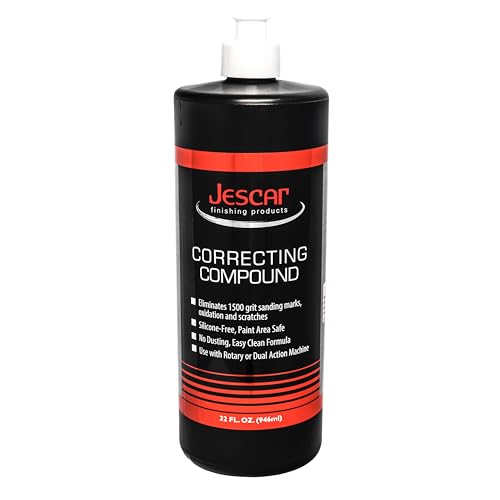
1. Jescar Correcting Compound
Our pick — over 4.5★ from 350+ verified ratings; the strongest balance of quality and price.
The precision specialist that banishes swirls without throwing dust everywhere.
What sets the Jescar apart is how cleanly it works. Its advanced formula destroys P1500 grit sanding marks — and, as buyers report, “removes swirls in the paint with ease.” But the real hero feature is the minimal dust generation. While many heavy compounds create a chalky haze you have to wipe from every crevice, this one leaves very little residue behind, making it a dream for indoor or garage work.
It is a fine 1500-grit compound, meaning it is not the first tool you reach for on a chalky, neglected hull. It thrives on the finishing and correction side — after you have knocked down the heavy stuff. Its premium blend of European abrasives is designed to work beautifully with DA (dual-action) polishers and orange foam pads, a combo that owners say produces a finish that “makes the paint look like glass.”
For a boat that is already in decent shape but has swirling from a previous wash or light oxidation, this is the compound that delivers a show-ready gloss. The only comparison point note is that the Jescar has a smaller following than the budget champion below, but it holds a higher satisfaction rating — a real crowd favorite among serious detailers.
Aggressive compound
- Virtually dust-free — keeps your work area clean and pads from loading up.
- Finishes down beautifully; owners mention it leaves paint looking like glass.
- Safe for all paint systems and fiberglass gelcoat with no silicone contamination.
Needs care
- 1500-grit rating means it is a finishing compound, not a heavy oxidation fighter.
- Pricier per ounce than some bulk options, reflecting its professional formulation.
For deep scratches: your boat’s gelcoat is already fair but marred by swirls or light marring — this refines the finish to a mirror.
For light swirls: your hull is chalky or heavily oxidized; you will need a heavier cut like the Malco or SONAX for the first pass.
2. Better Boat Marine Polish
The easy-going polish that restores a 20-year-old console without breaking a sweat.
If your boat has light oxidation or faded color, the Better Boat Marine Polish is the gentle option you want. It is made to remove those issues from gelcoat and fiberglass, and owners confirm it did a “great job on lightly oxidized flag blue hull.” Use it as the second step in a restoration — after a heavier compound has cut through the chalk — and it leaves behind UV protection that helps guard against future fading.
You spread it with a cloth or applicator pad, and owners find it “wipes clean with little effort.” At just over a pound per bottle, it is a good value for smaller boats, RVs, or touch-up jobs where you do not want to buy a gallon. It is made in the USA by a family-owned company, which adds a layer of trust for many buyers. However, some owners noted it leaves a minimal reflective shine on heavily sun-damaged paint, so it is best suited for maintenance and light restoration rather than a full cut-and-buff on a badly chalked hull.
At 1.23 pounds, it is the lightest bottle in this guide — convenient for carrying around the dock but a reminder that this is a polish more than a heavy cutting compound.
Gentle polish
- Wipes off with little effort — reduces elbow grease on a hot day.
- Includes UV protection to extend the life of your restoration.
- Affordable enough for covering a 24-foot RV or a small boat hull.
Slow work
- Not aggressive enough for heavy, deep oxidation — it is a polish, not a cutting compound.
- Some owners found the final gloss less reflective than true compounds like the SONAX.
For regular wax: your boat just has a light haze or you want to maintain a recently restored finish with UV protection.
For heavy oxidation: you are tackling a severely chalked hull that needs a heavy cut to come back.
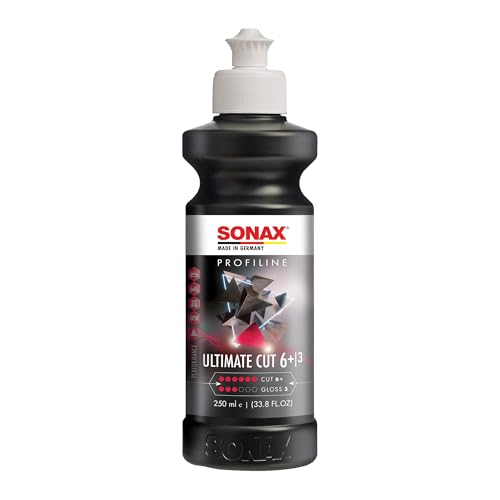
3. SONAX Ultimate Cut
The wet-sanding eraser that clears pigtails and leaves a near-mirror finish.
When you have wet-sanded a section and need to bring back the clarity, SONAX Ultimate Cut is the compound detailers turn to. Its 800-grit cerium oxide abrasive is aggressive enough to remove P1000 or finer sanding scratches, yet the water-based formula stays dust-free and does not dry out on the pad. “After wetsanding to 2k grit, Sonax 6+3 cleared pigtails and scratches, leaving near-mirror finish; outperformed Meguiars 100 and Chemical Guys V32,” one experienced buyer noted.
This is a professional-grade cutting compound that works equally well on solid paint and clear coats. It is designed primarily for use with a rotary polisher and a foam or wool pad, which gives you the speed and heat needed to activate the cerium oxide abrasives. The result is a medium-gloss OEM finish with minimal hologramming — so you can follow it with a finer polish without having to fight swirls you just put in.
At roughly 0.3 kg, the 250 ml bottle is compact, but it packs enough cut to handle a full hull restoration in several passes. It is deeper-cutting than both the Malco and the Jescar, making it the proper starting point for anyone dealing with heavy oxidation or deep scratches that need to be sanded flat first.
Strong cutter
- Effectively removes P1000 grit sanding marks, even after wet sanding.
- Dust-free formula keeps pads clean longer during multi-panel work.
- Water-based and silicone-free — no oily residue to strip before waxing.
Requires skill
- Cut level may be insufficient for very deep scratches that a heavier compound would tackle.
- Best results require a rotary polisher, not a standard dual-action orbital.
For tough jobs: you are wet-sanding and need a compound that can erase 1000–2000 grit scratches in one efficient pass.
For beginners: you are a first-time buffing user with a random orbital — SONAX rewards a steady hand and rotary power.
4. Malco Super Duty Heavy Cut Compound
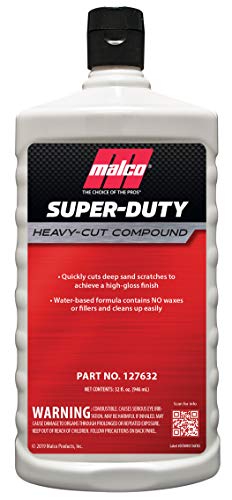
The workhorse that cuts past dead paint where other compounds just get tired.
Malco’s Super Duty is the one you pick up when your gelcoat looks like dusty chalk. Its heavy-cut formula is designed to remove P1500 grit and finer sand scratches from both clearcoat and gelcoat surfaces, and it does so with a pace that owners describe as “night and day” faster than competitor brands. The formula leaves a high-gloss finish behind, saving you a step in many cases.
This compound works best with a wool cutting pad and a rotary buffer. It is aggressive enough to strip heavily oxidized single-stage urethane and gelcoat, but it remains safe for clear coats so you do not have to worry about burning through the outer layer on a newer boat. That said, some users note that it can leave some residue if overworked — the trick is to work in smaller sections and wipe clean before moving on.
At 2 pounds, the bottle is comparable to the Meguiar’s in weight, but Malco’s formulation has a loyal following among professional detailers who appreciate its consistency and the fact that it dusts less than the ubiquitous Meguiar’s 105.
Fast removal
- Excellent cut performance — removes heavy oxidation and 1500 grit sanding marks quickly.
- Versatile: safe on clear coats, gelcoat, single-stage paint, and marine finishes.
- Leaves a high-gloss finish, reducing the number of steps in a full correction.
Watch technique
- Can leave residue if overworked; best for experienced users who manage their passes.
- Not ideal for soft clear coats or finishes that are easily marred.
For rapid correction: you are restoring a weathered boat or trailer and need a heavy compound that cuts fast on clearcoat and gelcoat.
For delicate surfaces: your boat’s gelcoat only has light haze — the Jescar or Better Boat would be a gentler starting point.
5. Meguiar’s Marine/RV Power Cut Compound

The marine-specific cutter that makes a 49-foot fifth wheel look like new again.
Meguiar’s engineered this compound specifically for marine and RV gelcoat, and it shows in how it handles heavy oxidation. Customers note that it removes “heavy oxidation from a 20-year-old boat hull without wet sanding,” which is proof of its balanced cut. It is less aggressive than a full heavy-cut compound like the Malco, but more aggressive than the Better Boat polish, making it a safe first step for a moderately chalked hull.
The fast-cutting formulation is designed to minimize swirling — a common complaint with older compounds. You can apply it with a rotary buffer, and the consistency allows for even coverage. One owner noted they used two full containers on a 26-foot boat, which gives you a sense of coverage for planning a large job. The compound is especially trusted for removing scratches and heavy oxidation without scouring the gelcoat the way some conventional compounds do.
At 2 pounds per bottle, it is almost exactly the same physical weight as the Malco, but the Meguiar’s is easier to work with for large areas due to its forgiving nature. It is a compound that almost any DIYer can pick up and get good results with on the first try.
Marine formula
- Designed for marine gelcoat — less risk of marring the surface compared to generic compounds.
- Effective at removing heavy oxidation and scratches without the need for wet sanding in most cases.
- Easy to apply and remove; relatively low dust for a cutting compound.
Not extreme
- Some stubborn areas still require wet sanding before the compound can finish the job.
- Coverage may require two bottles for larger hulls (26 feet and up), adding to the total cost.
For boat gelcoat: you want a safe, reliable first step for a moderately oxidized boat or RV, with a low learning curve.
For severe damage: you have already wet-sanded or are dealing with deep scratches — the SONAX or Malco will cut deeper.
6. Shurhold Buff Magic Compound
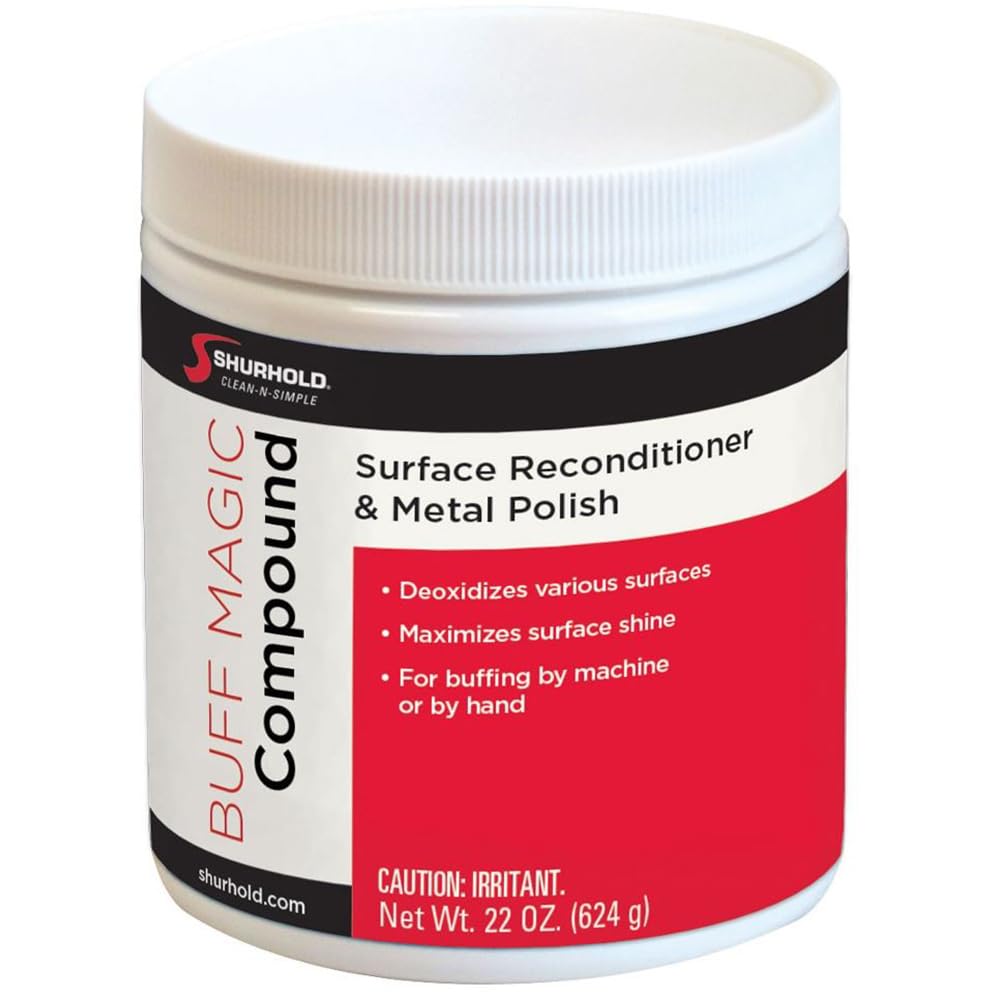
The marine veteran that cut through oxidation three other compounds could not touch.
Shurhold Buff Magic is a heavy-duty compound with a cult following among boat owners who face severely oxidized fiberglass. Its 800-grit aluminum oxide formula is aggressive enough to cut through heavy chalk and stains, yet it refines the surface for a high-gloss finish. Reviewers point out that it restored a 27-foot boat’s deep navy blue gelcoat in half a day with a Makita buffer — avoiding costly professional wet sanding.
It is not just for gelcoat. The formula also works on metal surfaces like aluminum, bronze, and copper, making it useful for cleaning up bimini top supports or hardware. The smart-abrasive formula means the compound breaks down as you work, transitioning from a heavy cut to a finer polish. This progressive refinement cuts down on the number of polishing steps you need to reach a showroom shine.
At 1.6 pounds for a 22-ounce jar, it is slightly heavier than the Better Boat bottle, but the jar format lets you dip your pad directly without pouring. The trade-off is that it requires a professional orbital polisher (not a random orbital) and some patience — owners who rushed through it found they needed multiple passes on deep oxidation.
Deep marine cut
- Handles severe oxidation that many other compounds cannot touch.
- Progressive-abrasive formula means fewer steps; cuts then refines.
- Works on multiple surfaces including gelcoat, metal, and painted surfaces.
Needs proper gear
- Best results come from a professional orbital polisher with a wool pad — not a cheap random orbital.
- Requires patience and multiple passes for deep-oxidized or neglected surfaces.
For pro detailers: you have a boat with severe chalk and have tried milder compounds that failed — this is your plan B.
For casual use: you want a simple wipe-on-wipe-off polish; this is a serious cutting tool that demands the right machine and technique.
7. TotalBoat TotalBuff Marine Rubbing Compound
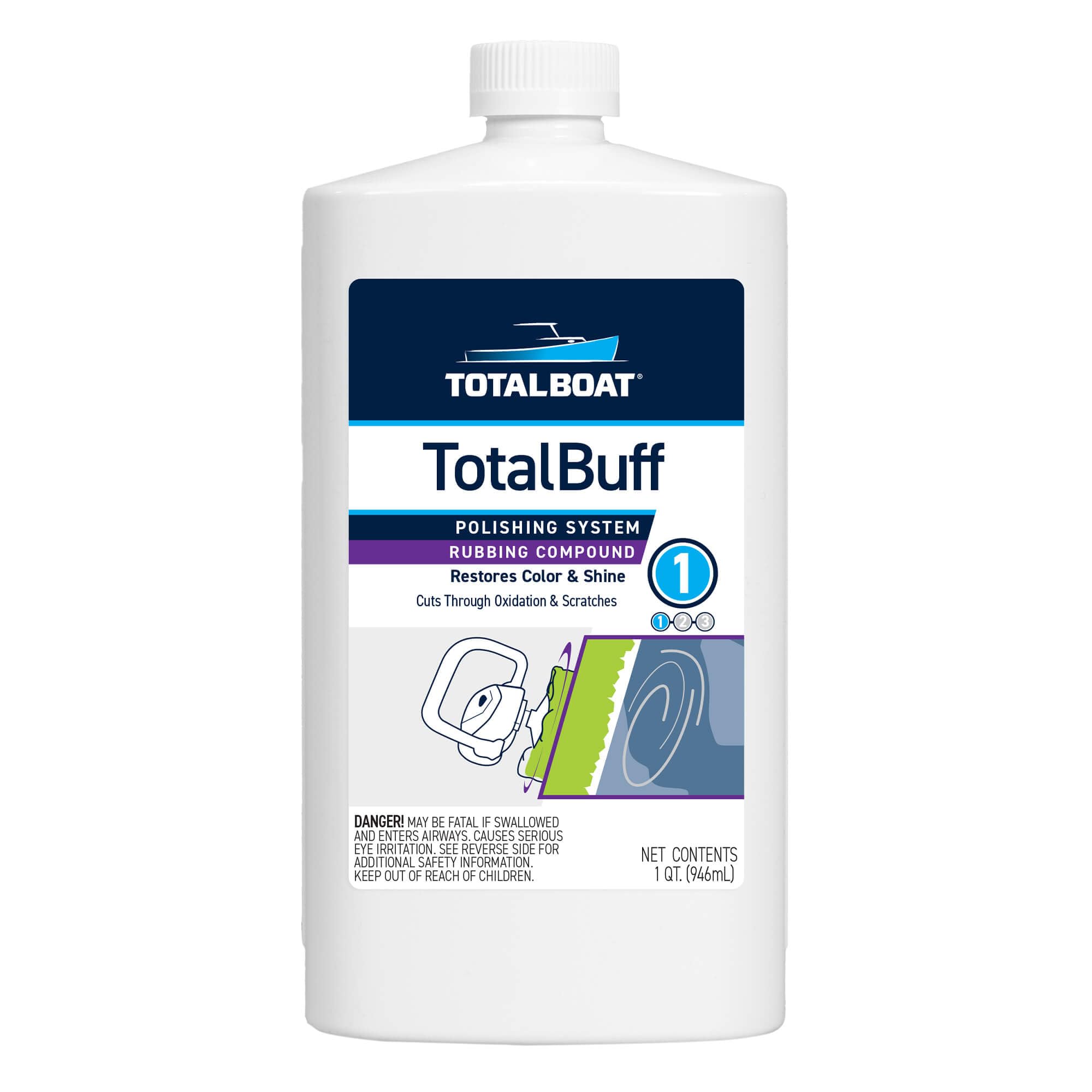
The heavy-cut compound that beat 3M and Presta on the first pass.
TotalBuff is the aggressive first step in TotalBoat’s three-step gelcoat restoration system, and it is engineered to remove heavy oxidation and 600/800 grit wet sanding scratches from chalky fiberglass. Owners confirm it “outperformed 3M Super Duty and Presta Super Cut” — removing nearly all oxidation in a single pass with a white wool pad. That is the kind of time-saver that turns a weekend project into a one-day job.
The formula has a long open time, meaning it stays wet long enough for the aluminum oxide grit to do its work without drying out prematurely. This is particularly helpful when working on a large hull in direct sunlight. The 1000-grit rating places it between the heavy-cut SONAX (800 grit) and the finishing Jescar (1500 grit), making it a true mid-level heavy compound for tough oxidation that does not yet require sanding.
One honest caveat: the consistency gets mixed reviews, with several owners describing it as watery or thin. While the thin formula helps it spread easily and prevents pad loading, it can feel unfamiliar if you are used to thick paste compounds. It works best with a wool buffing wheel and a variable-speed buffer.
Time saver
- Removes heavy oxidation in fewer passes than many competing compounds.
- Long open time — stays wet long enough for the grit to cut through chalk.
- Part of a complete three-step system: compound to polish to wax.
Runny liquid
- Very runny formula can be messy to apply; be ready for splatter on a rotary buffer.
- Some owners question its cutting ability on harder gelcoats due to the thin viscosity.
For efficient work: you have a heavily oxidized fiberglass boat and want a compound that can cut through it faster than the standard marine offerings.
For thick compounds: you prefer a thick paste compound that stays put on the pad — the thin liquid here takes some getting used to.
8. Wizards Turbo Cut Heavy Cutting Compound

The gallon-size machine that handles boats, cars, and trailers with one formula.
Wizards Turbo Cut is built for volume. This 1-gallon container weighs 8 pounds and is formulated to remove 1200-grit sand scratches from automotive and marine surfaces. The headline feature is its time-release abrasive technology: it starts with an aggressive cut to lift scratches and oxidation, then self-moderates as you work, leaving a surface that levels to a smooth 4000-grit finish. That progressive cut means you do not need to switch compounds mid-panel as often.
It is water-based and silicone-free, so it cleans up easily without staining your pads or leaving a greasy residue that could interfere with a wax or sealant application. One owner who applied it to a boat with a chip brush before buffing found it prevented pad gumming, a clever trick for anyone working on a large hull. The compound is designed to work at 1400 to 2200 RPM with a blended wool pad on a rotary buffer.
The 1-gallon size is the real story here. It is more than you need for a single touch-up, but for a marina, a fleet, or someone who regularly restores trailers and boats, it is the most economical way to buy cutting compound in bulk.
Bulk value
- 1-gallon size offers the lowest per-ounce cost for heavy users.
- Time-release abrasive starts aggressive and finishes fine — fewer tool changes.
- Water-based and silicone-free; cleans up easily and leaves a clean surface for waxing.
Large container
- At 8 pounds, the gallon jug is large and takes up storage space.
- Engineered for machine application — less ideal for hand buffing small sections.
For high volume: you have a fleet of boats, cars, or trailers to restore and want a single compound that does the job in bulk.
For small jobs: you just need a bottle for a single boat — smaller sizes from Malco or Meguiar’s are easier to store and handle.
9. 3M Marine High Gloss Gelcoat Compound

The pro’s choice that restored a 1992 Ranger’s gelcoat to an unbelievable shine.
When a detailer needs a compound that will not compromise on speed or finish, the 3M Marine High Gloss Gelcoat Compound is often the first can they reach for. This fast-cut paste is designed to remove scratches from sanding, oxidation, stains, and surface blemishes from fiberglass gelcoat. It is a gel, not a liquid, which means it stays where you put it and does not run off vertical surfaces — a huge advantage when buffing the sides of a hull.
The formula is wax and silicone free, so you do not have to worry about preventing a follow-up wax or polish from bonding. One owner who restored a 1992 Ranger bass boat with this compound said they “couldn’t believe how beautiful the boat came out” after hand sanding followed by the 3M system. The 10-pound can is the largest container in this guide, covering an estimated 12.6 to 18.9 square feet per pound — a professional-level quantity for multiple boats or large RVs.
One honest word from owners: the packaging has been an issue for some. The can has arrived dented or with a damaged lid in transit, so check your order on arrival. The product itself, however, is consistently praised as a quick-cutting paste that works well for oxidized gelcoat and dries slower than pourable compounds, giving you more working time.
Pro speed
- Fast-cut formulation reduces compounding time on large surfaces.
- Gel format stays put on vertical panels — ideal for boat sides.
- Wax and silicone free; ready for a polish or wax step immediately after.
Stubborn residue
- 10-pound can is heavy and the packaging has been prone to shipping damage.
- Contains some petroleum distillates; may leave a rust ring if left on the surface.
For quick gloss: you are a professional or a serious DIYer restoring a large boat or RV and need a fast-cutting gel in bulk.
For slow polish: you need a smaller quantity for a single touch-up — the 3M gallon is a bigger commitment than most casual users need.
Understanding the Specs
Grit Number and Cut Level
The grit number, often listed as a number like 800 or 1500, tells you how coarse the abrasive particles in the compound are. A lower number means larger, more aggressive particles that remove material faster — ideal for stripping heavy oxidation or sanding marks. A higher number means finer particles that refine the surface to a polish without cutting deep. For a badly chalked hull, start with a 800-1000 grit compound. For swirl removal and final gloss, a 1500-grit compound is your finishing step.
Water-Based vs. Solvent-Based
Water-based compounds use water as the carrier instead of petroleum solvents. They produce less dust, clean up easily with water, and are generally safer for the user and the environment. They also tend not to stain pads or leave a greasy film on the surface, which means you can go straight to waxing without an extra wipedown. Solvent-based compounds may cut slightly faster on heavy oxidation but often require a thorough cleaning before the next step and can create more airborne dust during buffing.
Dust-Free Performance
Some compounds dry into a fine powder as you buff, which can travel across the boat and settle on every surface. A dust-free or low-dust formula keeps the abrasive active longer and reduces the mess, making clean-up faster. If you are working in an enclosed space like a garage or near other vehicles, a dust-free compound like the Jescar is a practical choice that keeps the air cleaner.
Open Time
This refers to how long the compound stays wet and effective on the surface before it dries out. A long open time is valuable when working on large panels in direct sunlight or hot weather, because it gives you more passes before the compound starts to gum up and load the pad. Compounds with a short open time force you to work faster and smaller sections. The TotalBoat TotalBuff and 3M Marine compounds are both noted for having a longer open time than many pourable liquids.
FAQ
Can I use automotive buffing compound on my boat’s gelcoat?
How do I know which grit compound to start with?
What is the difference between a rubbing compound and a polishing compound?
Can I apply a marine buffing compound by hand?
How many coats of compound do I need to apply?
Will a buffing compound remove scratches from my boat’s gelcoat?
Is it safe to use these compounds on my boat’s painted surfaces?
What kind of pad should I use with a marine buffing compound?
How long does a 32-ounce bottle of compound last?
Do I need to wax my boat after using a buffing compound?
Final Thoughts: The Verdict
Across the board, the best buffing compound for boats winner is the Jescar Correcting Compound because it combines near-zero dust generation with a finish that owners describe as “like glass,” all while being safe for every paint system and gelcoat. If you want the fastest oxidation removal for a badly chalked hull, grab the SONAX Ultimate Cut — it cuts through deep scratches and sanding marks with a water-based, dust-free formula. And for a budget-friendly polish that restores light color loss and adds UV protection, the Better Boat Marine Polish is the one to reach for.
How We Picked
We do not accept paid placement. Every pick is matched to a real buyer and a real use-case; we do not hands-on test units.
Sources & Methodology
Specifications: manufacturer listings and product documentation. Review insights: verified customer reviews, as of July 2026. Pricing: not shown on this page (it changes often); check the current price via the retailer link.
As an Amazon Associate, FitlyFast earns from qualifying purchases. This does not affect which products we feature.