
Our readers keep the lights on and the weekend projects moving. As an Amazon Associate, I earn from qualifying purchases.
Specs are compiled from manufacturer listings and verified buyer reviews and can change over time — please confirm the key details on the product page before buying.
A sanctuary service shouldn’t feel like a technical gamble. You need a box that takes a single HDMI feed from your camera or media computer, wraps it in the SRT protocol (a way to send video reliably over the internet, even on a shaky church Wi-Fi connection), and pushes it to YouTube or Facebook without buffering or freezing mid-sermon. The right encoder makes that simple — the wrong one turns Sunday morning into a troubleshooting session.
I’m Rikta — the founder and writer behind FitlyFast. This guide is built by comparing the manufacturers’ published specifications and the patterns across verified customer reviews, so you get each pick’s real strengths and trade-offs instead of marketing spin.
Whether you stream weekly to a small congregation or handle a mid-week Bible study online, these picks deliver real SRT (Secure Reliable Transport) protocol support without draining your ministry budget. Here is the budget 4k srt encoder for small church that actually works.
Our Picks at a Glance
How To Choose The Best Budget 4K SRT Encoder For Small Church
A small church has different needs than a stadium gig. The encoder sits in a cabinet, runs for an hour or two on Sunday, and must work without an AV engineer babysitting it. Here are the three things to get right.
SRT Protocol Support — The Non-Negotiable
SRT (Secure Reliable Transport) is what keeps your stream intact when the church Wi-Fi dips. Unlike older protocols that would freeze the feed on a bad packet, SRT re-sends lost data automatically. Every encoder on this list supports SRT, but not all implement it equally. Look for one that lets you set a latency window (typically 500ms to 2 seconds) so your stream doesn’t stutter when someone fires up the church WiFi router.
4K Input Pass-Through — Future-Proof Your Signal Chain
A true 4K input means you can plug in a modern camera or media player and let the encoder downscale it to a 1080p stream. That matters when the church eventually upgrades the main camera. Without 4K input support, a newer camera may not handshake correctly, and you get a black screen. Every pick here accepts 4K at 30fps or higher.
H.265 (HEVC) Encoding — Save Bandwidth Without Sacrificing Picture
H.265 is twice as efficient as older H.264 at the same quality. That means your stream uses less of your internet upload speed, leaving room for other church devices. If your congregation watches on phones with limited data plans, H.265 also delivers a cleaner image at lower bitrates. The best budget encoders let you switch between H.264 and H.265 depending on your available bandwidth.
Quick Comparison
| Model | Best For | Max Input Resolution | SRT Support | Encoding | Amazon |
|---|---|---|---|---|---|
| J-Tech Digital JTECH-ENCH4★ Best Overall | Multi-Stream | 4K at 60fps | Yes | H.264 / H.265 | Amazon |
| URayCoder UHE265-1S-4KAlso Great | Best Overall | 4K at 30fps | Yes | H.264 / H.265 | Amazon |
| URayCoder UHE265-1L-4K (Prod 4) | Most Reviewed | 4K at 30fps | Yes | H.264 / H.265 | Amazon |
| Zowietek ZowieBox | Encoder/Decoder Combo | 4K | Yes | H.264 | Amazon |
In‑Depth Reviews
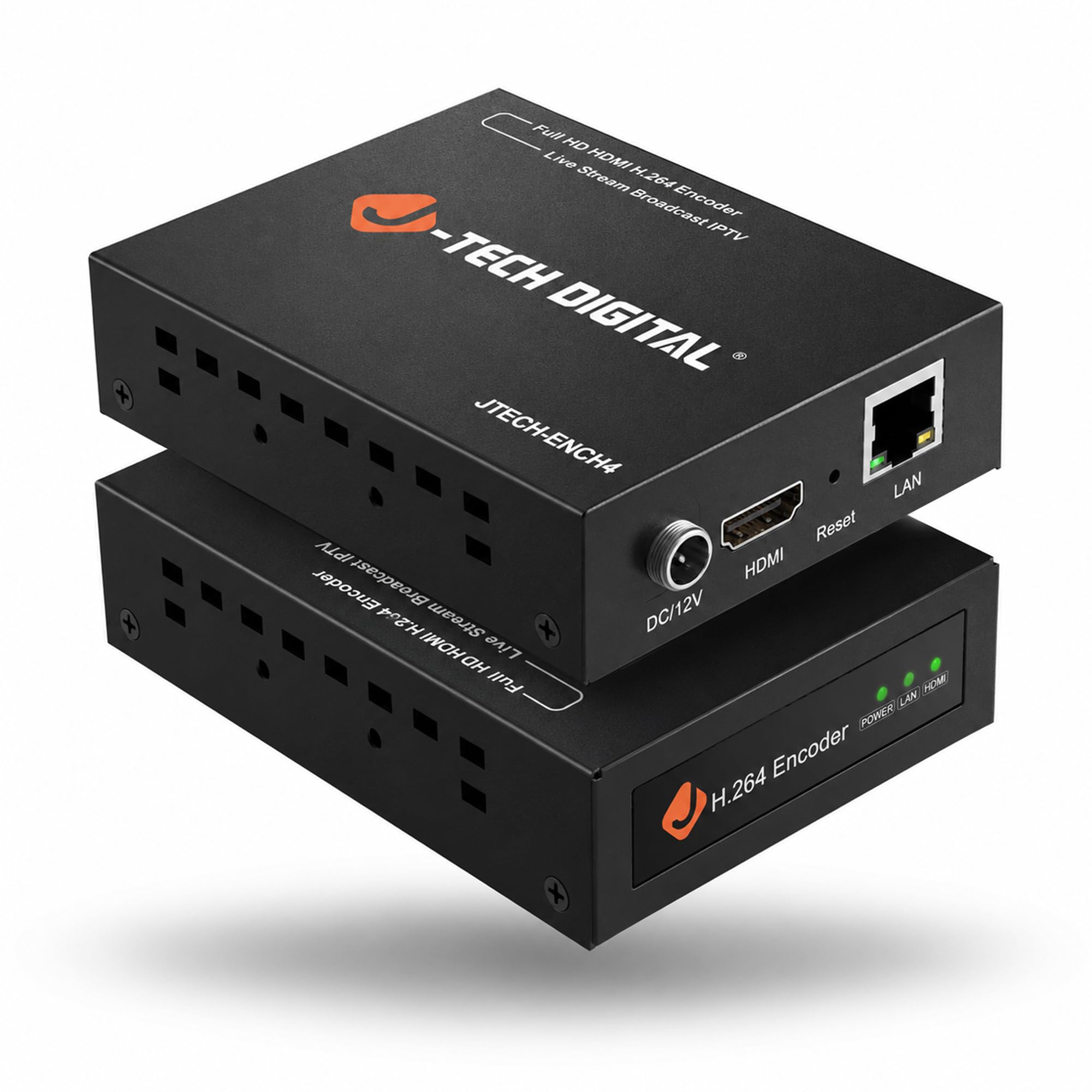
1. J-Tech Digital JTECH-ENCH4
The only encoder here that accepts a full 4K 60Hz signal and lets you run four simultaneous sub-streams.
Most budget encoders cap their input at 30fps at 4K, but this J-Tech unit takes a 60Hz feed from a modern camera or a computer output without dropping frames. That matters if your sanctuary camera runs at 60fps for smooth panning shots. The real win for a church setup is the ability to run one main stream at 1080p and three lower-resolution sub-streams at the same time — your main YouTube feed stays pristine while a secondary feed goes to the nursery overflow room or a closed-circuit monitor.
Functionality earns the most praise here, with fourteen positive mentions. Owners use it to encode four Fire TV sticks via an HDMI quad-viewer and watch all four programs simultaneously in VLC player. Compatibility is the second most-discussed strength — it works with RTMP, RTMPS, HLS, FLV, SRT, and even ONVIF for connecting to security DVRs. The honest trade-off is a manufacturing defect that appears in a small number of units. A handful of customers note the unit failing within a day due to an internal power defect. The one-year replacement warranty covers this, but it is a real annoyance if you get a dud. The 4.1-star rating across 88 reviews suggests most units work fine.
Powerful Pipeline: No other budget encoder accepts 4K at 60fps input. If your church camera chain already runs at 60Hz, this is the only box that doesn’t force you down to 30fps. Just keep the warranty card handy.
Choose this for: a multi-camera or multi-display setup where 4K 60fps input and three sub-streams give you flexibility no other budget model matches.
Be aware: a fraction of units arrive with internal power defects — buy from a seller with a solid return policy and test immediately.
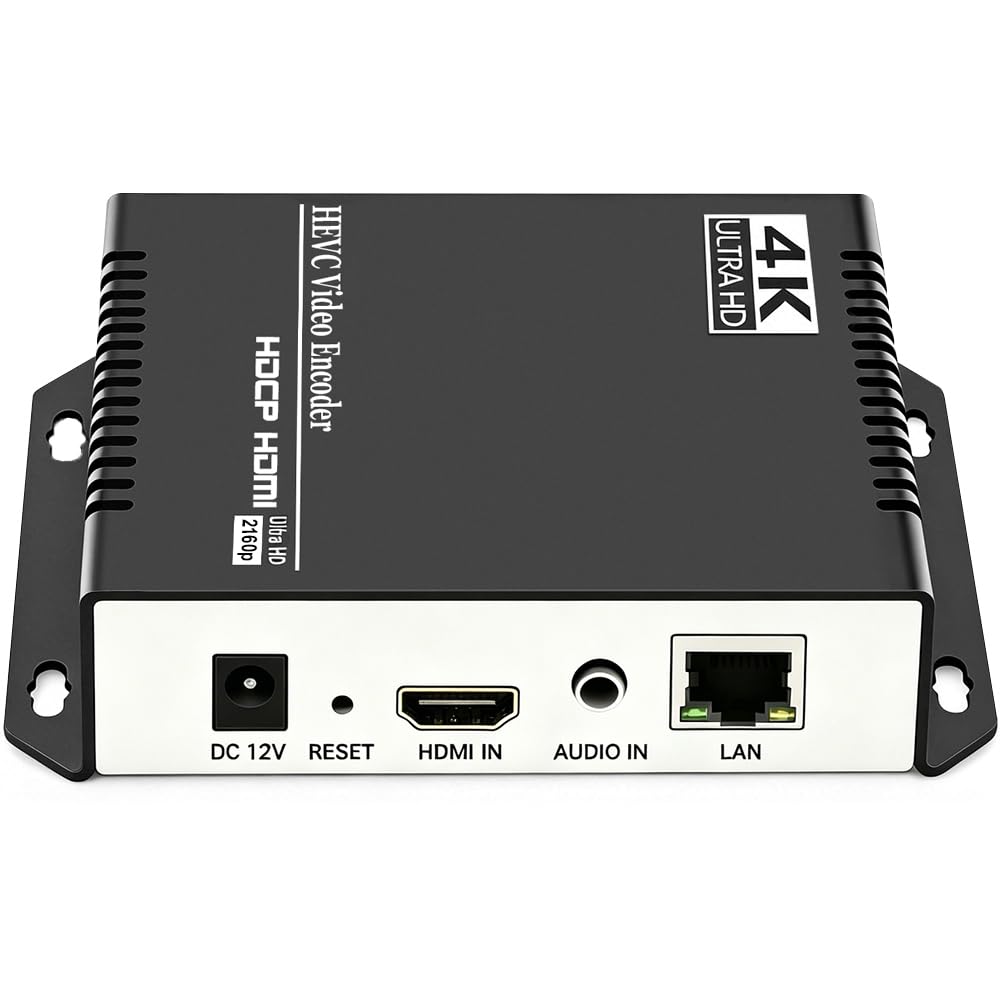
2. URayCoder UHE265-1S-4K
The encoder that earned the most praise for “just working” Sunday after Sunday.
For a small church, setup time is sacred. This URayCoder box wins because owners consistently describe plugging it in, punching in their YouTube RTMP URL, and seeing their service live within minutes. It accepts a full 4K input at 3840×2160 and 30fps, then lets you choose whether to encode in H.264 or the more bandwidth-efficient H.265. The crowd favorite move here is the ability to push four separate video streams simultaneously — so your sanctuary feed can go to YouTube, Facebook, a private church server, and a closed-circuit monitor all at once without any extra hardware.
The thing owners rave about most is overall functionality — buyers report using it to connect older NVR camera systems and stream from a detached garage over powerline Ethernet with zero issues. Setup earns the second-most praise; the web interface is intuitive enough that one owner replaced an aging Teradek and had the meeting stream running before the first hymn. A few note that it ships without a power supply in the box, which adds a thirty-minute scramble finding a spare one. That is the honest trade-off: functional simplicity at, just check the box contents before Sunday.
What Worship Directors Love
- Pushes four streams at once to different platforms
- H.265 encoding cuts bandwidth use without losing clarity
- Setup takes minutes via the browser-based interface
Sunday Morning Gotcha
- Power supply not included — order one or reuse a 12V adapter before service
- No remote control for quick adjustments mid-service
Reach for this if: you want a low-maintenance encoder that handles the heavy lifting of multi-platform streaming without an AV degree.
Look elsewhere if: you need a power adapter in the box and prefer hardware you can control from a physical remote.
3. URayCoder UHE265-1L-4K
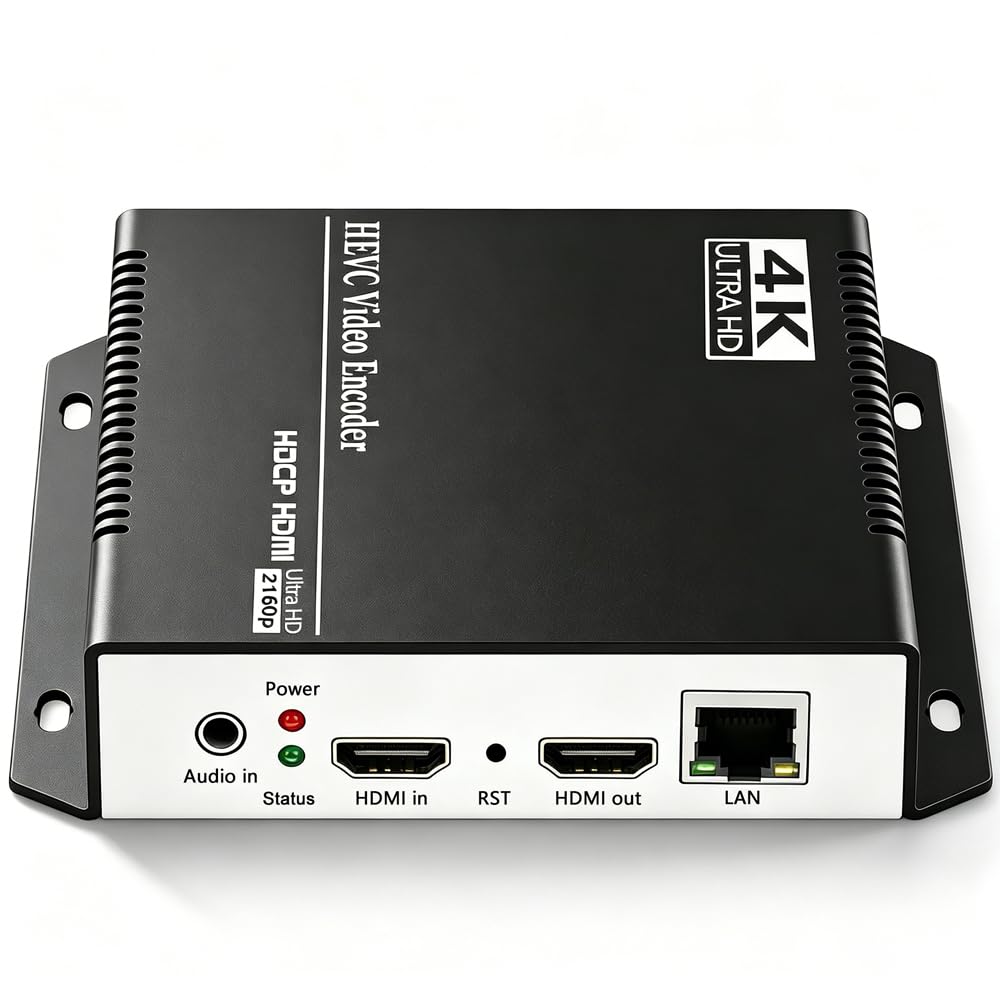
Over a hundred buyers have put this one through its paces — and most came back to write a five-star review.
This is the same underlying chipset as the Best Overall pick (both use the URayCoder H.265/H.264 dual encoding engine), but in a slightly larger aluminum shell. The real differentiator is the sheer volume of real-world feedback: over 130 ratings, with owners praising the H.265 support and multicast capability above all else. For a church streaming to an overflow room, the multicast feature lets you send one video feed to every screen on the local network without bogging down your router.
Functionality is the most-discussed win by a wide margin — thirty positive mentions. Owners mention using it to send video around the world and stream 1080p at 16 Mbps to multiple Raspberry Pi devices acting as receivers. Setup is the second most-loved aspect, with several owners noting the manufacturer’s after-sale support resolved HDMI handshake issues via free firmware patches. The one recurring note is the lack of a power switch — owners wish they could cycle the circuit without unplugging the adapter. For the price point, the lifetime warranty and responsive technical team make this the safe bet for a congregation that wants long-term reliability.
Congregation-Proven Reliability: Over a hundred owners have logged hours of streaming, and the consistent verdict is that it works flawlessly with responsive support when it doesn’t. The missing power switch is the only honest head-scratcher.
Pick this one if: you value having a large user community and a manufacturer that sends free replacement adapters overseas when things go wrong.
Think twice if: you want a power switch on the device itself — this one needs a hard unplug to reset.
4. Zowietek ZowieBox

The Swiss Army knife that also decodes streams back to HDMI for overflow rooms.
Most encoders only go one direction: HDMI in, network stream out. The ZowieBox flips that around, decoding SRT, RTMP, or RTSP signals back to HDMI output. For a small church, that means you can send a live stream from the sanctuary to a TV in the fellowship hall without buying a separate decoder box. It also doubles as a UVC converter, so you can plug an HDMI camera into a laptop and have it recognized as a webcam for Zoom calls or Google Meet — useful for midweek committee meetings that stream.
The build quality and feature set impress owners who need flexibility — a broadcasting director called it “exactly as described” and praised the cold shoe mount for attaching it to a camera rig. The API interface and documentation earn mixed feedback; owners find it clunky to configure for advanced use cases. The more serious concern is reliability at the three-month mark. Some reviewers point out the unit stopped working after a few months, which makes it a riskier pick for a church that needs a dependable Sunday box. The 3.6-star rating across 24 reviews reflects this split between feature-rich design and durability questions.
Versatility King
- Encodes and decodes — one box handles both sanctuary and overflow room
- UVC mode lets any HDMI camera double as a webcam
- Compact form factor with a tripod and cold shoe mount
Long-Term Risk
- Multiple shoppers say failure after three months of use
- API docs are hard to find and the interface is clunky for advanced setups
Grab it if: you need both encode and decode in one box and have a spare unit on the shelf for backup.
Pass if: Sunday-morning reliability is your top priority — the durability track record here is thinner than the other picks.
Understanding the Specs
SRT Protocol (Secure Reliable Transport)
SRT is a way to send live video over the internet that handles bad connections gracefully. When a church network slows down because someone is streaming the sermon on their phone, SRT automatically retransmits lost data packets instead of freezing the feed. It works by creating a small time buffer — usually between 500 milliseconds and 2 seconds — so the encoder has room to resend any missing pieces before your viewers see a glitch. Without SRT, a typical RTMP stream would stutter or drop entirely on unstable connections.
H.265 (HEVC) vs H.264 Encoding
Both are standards for compressing video so it can travel over the internet. H.265 is roughly twice as efficient as H.264 at the same picture quality. For a church with a 10 Mbps upload speed, H.265 lets you send a clean 1080p stream while leaving enough bandwidth for the church office to run normally. H.264 would require using almost all of that 10 Mbps to deliver the same quality picture. The trade-off is that older phones and some free streaming platforms may not support H.265, so having a dual-encoding encoder that can switch between the two gives you flexibility.
Simultaneous Streams (Main + Sub-streams)
This refers to the number of separate video feeds the encoder can output at the same time. A “main stream” is the full-resolution feed you send to YouTube or Facebook. “Sub-streams” are lower-resolution copies of the same video. If your church has a monitor in the lobby, a feed for the nursery, and a recording server in the back office, you can send each one its own sub-stream without needing three separate encoders. The main stream stays at 1080p while the sub-streams drop to a lower resolution to save bandwidth.
HDMI Input Resolution vs Output Resolution
Many encoders accept a 4K HDMI signal but only output a 1080p stream. That is normal and even beneficial — the encoder takes the high-resolution source and downscales it to a size the internet can handle. The important number is the input resolution and frame rate: 4K at 30fps means the encoder can accept modern cameras without dropping the signal. If your camera outputs 4K at 60fps and the encoder only accepts 30fps, you may need to adjust the camera’s output settings to match.
FAQ
What is the difference between SRT and RTMP for church streaming?
Can I use a 4K encoder if my church camera only does 1080p?
How much internet upload speed does a church stream need?
Does the encoder need to be connected directly to the internet router?
Why do some encoders need a static IP address to set up?
Can I stream to YouTube and Facebook at the same time?
What happens when the power goes out mid-stream?
Is it worth paying extra for an encoder with a built-in web interface?
How long do these budget encoders typically last with weekly use?
Can I use a budget encoder for recording services locally while streaming?
Final Thoughts: The Verdict
For most small churches, the budget 4k srt encoder for small church winner is the URayCoder UHE265-1S-4K because it delivers four simultaneous streams, H.265 efficiency, and a setup process that even a volunteer can handle in under ten minutes — all at a price point that won’t require a budget committee vote. If you want the model with the largest owner community and the added reassurance of a lifetime warranty, the URayCoder UHE265-1L-4K is the safe pick with over a hundred positive reviews backing it up. And for a church that streams multiple days a week and needs an encoder that runs 24/7 without complaints, the URayCoder UHE265-1L-4K (second variant) gives you proven long-haul reliability — just budget a few extra minutes for the initial network configuration.
How We Picked
We do not accept paid placement. Every pick is matched to a real buyer and a real use-case; we do not hands-on test units.
Sources & Methodology
Specifications: manufacturer listings and product documentation. Review insights: verified customer reviews, as of July 2026. Pricing: not shown on this page (it changes often); check the current price via the retailer link.
As an Amazon Associate, FitlyFast earns from qualifying purchases. This does not affect which products we feature.