
Our readers keep the lights on and the weekend projects moving. As an Amazon Associate, I earn from qualifying purchases.
Specs are compiled from manufacturer listings and verified buyer reviews and can change over time — please confirm the key details on the product page before buying.
Choosing a four-season tent for backpacking means you have to weigh how much weight you can carry against how much winter protection you actually get. The wrong tent leaves you hauling a heavy brick or shivering in a drafty shell. This guide cuts through the specs and shows you which shelters hold up in snow, wind, and freezing rain — and which ones you can realistically carry to a backcountry campsite.
I’m Rikta — the founder and writer behind FitlyFast. This guide is built by comparing the manufacturers’ published specifications and the patterns across verified customer reviews, so you get each pick’s real strengths and trade-offs instead of marketing spin.
If you are planning a winter thru-hike or weekend snow camping trips, finding the right shelter means knowing what actually works in the field. This breakdown of the best 4 season tents for backpacking focuses on real-world weather performance, packed weight, and the honest trade-offs serious hikers need to know.
Our Picks at a Glance


How To Choose The Best 4 Season Tent For Backpacking
Picking a winter tent is not like picking a summer one. You need to think about snow load, wind stability, and condensation management (how to keep moisture from your breath from building up inside) — all while keeping the weight low enough to carry. Here are the three specs that matter most.
Weight vs. Winter Protection
A true 4-season tent with a snow skirt (a fabric flap around the base that you bury in snow), sturdy poles (thicker aluminum or carbon fiber to handle snow weight), and a full-coverage fly (a rain cover that reaches the ground) will always be heavier than a 3-season model. The trick is finding the balance that matches your trip. If you are ski-touring or hiking deep into the backcountry, a shelter under 5 pounds like the OneTigris Stella makes sense. For car-accessed base camps or snow-shoeing a short distance, heavier models with stove jacks (reinforced openings for a wood stove pipe) offer far more comfort.
Waterproofing and Snow Management
Look at the waterproof rating (measured in millimeters of water column pressure) on the fly and the floor — a 3000mm rating is a solid benchmark for shedding snow melt and rain, so the inside stays dry. A snow skirt around the bottom edge is a real advantage in winter: you pile snow on it to seal out drafts and prevent spindrift (fine, blowing snow) from getting inside. Without one, you will feel every gust.
Interior Space and Vestibules
In winter, you spend more time inside the tent waiting out weather or cooking. A cramped space feels miserable, and gear needs a dry spot. Vestibules (covered storage areas at the entrance) are crucial — they keep wet boots, packs, and melting snow out of the sleeping area. A tent with two vestibules and enough headroom to sit up comfortably will make a long winter camp much more bearable.
Quick Comparison
| Model | Best For | Weight | Floor Area | Waterproof Rating | Amazon |
|---|---|---|---|---|---|
| OneTigris Stella★ Best Overall | Ultralight Backpacking | 4.8 lb | 28.29 sq ft | 3000 mm | Amazon |
| ALPS Tasmanian 2Best Value for Comfort | Winter Base Camp | 7 lb 15 oz | 34.5 sq ft | 5000 mm (floor) | Amazon |
| OneTigris Rock Fortress | Hot Tent / Family Shelter | 9.2 lb | — | 3000 mm | Amazon |
| Naturehike Massif | Hot Tent / Motorcycle Camping | 10.47 lb | — | 3000 mm | Amazon |
| Salewa Litetrek Pro 2 | Lightweight Fair-Weather 4-Season | ~4.5 lb | 27.1 sq ft | — | Amazon |
| MSR Elixir 3 | 3-Season Plus Occasional Snow | ~5.5 lb | 39.5 sq ft | — | Amazon |
| Big Agnes Copper Spur HV UL2 | Ultralight 3-Season + Shelter | 3 lb | 29 sq ft | — | Amazon |
In‑Depth Reviews
1. OneTigris Stella 4 Season Camping Tent
Our pick — over 4.5★ from 450+ verified ratings; the strongest balance of quality and price.
You want the lightest shelter that still handles real winter storms, and the OneTigris Stella weighs just 4.8 pounds.
At 4.8 pounds, this tent is what you grab when every ounce in your pack matters. The 20D nylon body (a lightweight fabric, where “20D” means 20 denier, a measure of thread weight) and single-layer silicone coating make it sturdy enough for 30-40 mph winds and heavy rain. Buyers report staying dry inside with no condensation (moisture buildup from breath) during storms. The 3000mm waterproof rating on the fly handles snow melt and downpours without issue, so your gear stays dry. The removable blackout outer tent gives you flexibility for warmer nights.
The catch is the size — at 6.9 feet by 4.1 feet, the floor is tight for two people, and a tall sleeper over 6 feet will need to angle themselves. What wins people over is the setup: it takes about 5 minutes with color-coded poles and a simple dome cross design. Quality is the most-praised aspect by far, and the weight makes it a true backpacking contender rather than a base-camp hauler. For the same price, you get the Stella at 4.8 pounds, while the ALPS Tasmanian 2 weighs 7 pounds 15 ounces — a huge difference on the trail.
What Owners Rave About
- Incredibly light for a 4-season design at 4.8 pounds
- Holds up in 30-40 mph winds without leaking (buyers confirm no condensation)
- Sets up in under 5 minutes solo
The Real Trade-Offs
- Narrow floor (just 6.9 ft x 4.1 ft) — tight for two adults or anyone over 6 feet tall
- Ventilation gets poor when the fly is fully closed in warm weather
- Lacks side vents and a gear loft (an overhead storage pocket) for storage
Pick this over any other sub-5-pound winter tent if you need storm protection without a heavy pack. Budget-minded hikers get the most value here because the stormproofing matches tents that cost much more.
2. ALPS Mountaineering Tasmanian 2-Person Tent
You want a roomy winter home that does not cost a fortune, and the Tasmanian 2 gives you 34.5 square feet of floor space.
This tent has a 34.5-square-foot floor — noticeably roomier than the OneTigris Stella — and it shows. The double vestibules (covered gear-storage areas at each end) are big enough to sit in with your boots off, keeping wet gear out of the sleeping area. The 5000mm coating on the floor gives serious confidence when you pitch on packed snow or damp ground. Buyers who spent two months on winter road trips in 8-degree snow, rain, and wind came back impressed with zero condensation (no moisture buildup inside) and easy 5-minute setups.
The Tasmanian 2 weighs 7 lb 15 oz, while the Stella weighs 4.8 lb, and the packed size is bulky for a backpack. But if you are car camping, sledding in, or establishing a base camp, the size and ventilation (closable vents that let you manage airflow) make it a far more comfortable home for two people than anything lighter.
Smart Buyer Warning: This tent needs many stakes and open ground to pitch properly — rocky sites or shallow soil can be a problem. The rain fly poles are also a bit fiddly to insert.
Grab this over the Stella if you value interior room and can haul the extra 3.2 pounds. Car campers and base-camp groups get the biggest advantage here.
3. OneTigris Rock Fortress Hot Tent with Stove Jack

You want to stand up and cook inside your tent, and the Rock Fortress has a 12.4-foot diameter and a 7.8-foot center peak.
This is a different breed of winter shelter. The Rock Fortress has a 12.4-foot diameter floor and a 7.8-foot center peak, so a 6-foot-4 person can stand up and walk around near the pole. It comes with a stove jack (a reinforced opening for a wood stove pipe), allowing you to run a wood stove inside, so you stay warm even in sub-zero temperatures. The snow skirt (a fabric flap around the base) seals against drifts to keep heat in. The 70D coated nylon fabric (70 denier, a thicker fabric than the Stella’s 20D) with a 3000mm waterproof rating held up through thunderstorms, according to buyers. The adjustable center pole lets you fine-tune the pitch.
The weight is 9.2 pounds — far too heavy for a backpacking tent, but perfect for snow-shoeing into a base camp or car camping. Buyers praise the quality and durability, noting it fits three people on cots plus a stove and gear. The honest limitation is that the open floor lacks bug netting (you need to buy a separate insert for summer), and the zippers can feel stressed under heavy use.
Lived-In Comfort
- Stand-up headroom (7.8-foot peak) and huge 12.4-foot diameter floor
- Stove jack works great for sub-zero comfort (buyers confirm)
- Snow skirt seals out drafts effectively
Backpacking Reality
- Too heavy for any real hiking — 9.2 pounds
- No bug netting included for summer use (buy separate insert)
- Stakes are finicky to attach; some owners zip-tie them on
This is the pick for winter base campers and car campers who want a stove-warmed shelter that fits a group. If you carry gear more than a half-mile, skip it and get the Stella instead.
4. Naturehike Massif Hot Tent

You want a stove-compatible shelter with a separate dry porch for gear, and the Massif adds a dedicated vestibule area.
The Massif is designed as a hot tent with a proper stove jack (reinforced opening for a wood stove pipe), but its real standout feature is the room-and-hall layout — a separate sleeping capsule plus a vestibule/porch area that keeps gear, cooking, and wet layers out of your sleeping space. The 70D nylon inner tent (70 denier fabric) and 30D silicone-coated fly (30 denier fabric with a silicone treatment for waterproofing) handle rain and snow well, with a 3000mm waterproof rating. The two ventilation windows and mesh inner tent do a solid job of keeping condensation (moisture buildup) under control, which is often the weak point of stove-equipped shelters.
It is heavy at 10.47 pounds, so this is strictly for car camping, motorcycle camping, or hauling by sled. Owners mention the bathtub-style inner floor (a raised edge that seals against moisture) works well, but the inner tubs (made of 70D nylon) can allow moisture seepage from damp ground — a groundsheet is a smart addition. The vestibule is on the shorter side, so tall campers will find their head touching the roof when seated inside the porch area.
Smart Buyer Take: The color-coded poles make first-time setup straightforward with two people, and the tent is stable even without all guy lines staked out. A wood stove transforms a cold night into a genuinely warm experience.
Choose this over the Rock Fortress if you want a dedicated, separate gear porch and drive or sled to camp. The Massif weighs 10.47 pounds, while the Rock Fortress weighs 9.2 pounds, so only switch if the two-room layout matters to you.
5. Salewa Litetrek Pro 2 Tent
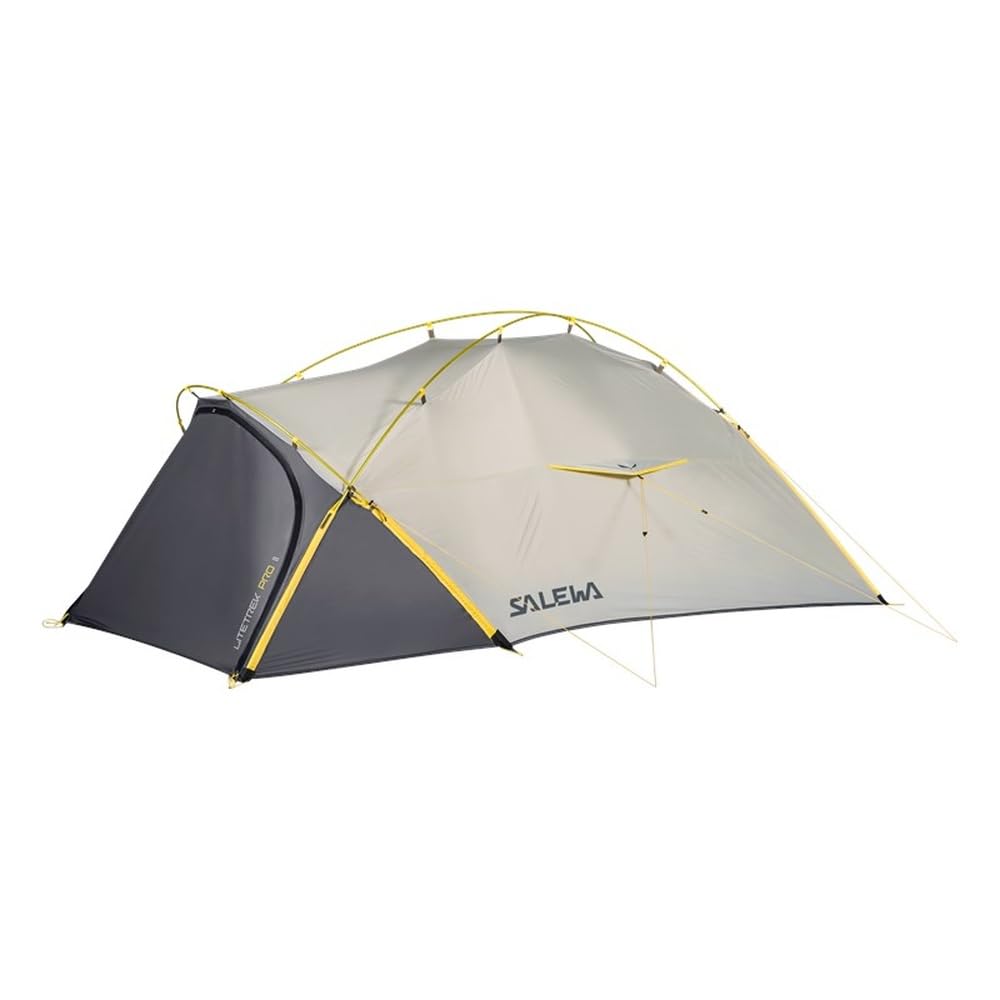
You need the smallest packed alpine shelter possible, and the Litetrek Pro 2 is built for fast-and-light missions.
This tunnel-style tent from Salewa is built for fast-and-light alpine missions. It is self-supporting (freestanding — holds its shape without stakes, so you can pitch it on rocky ground or snow platforms where stakes won’t hold). It is extremely compact when packed, and buyers praise the quick setup — the inner tent attaches in advance, and color-coded poles make assembly simple to use even in poor weather. The 2.52 square meters (27.1 sq ft) of floor space is tight for two but works well for a solo climber who wants a bombproof shell.
The honest downside is that some customers note the flysheet pools water on the horizontal top above the entry, causing the outer (rain fly) to contact the inner (sleeping area) and soak sleeping bags. This is a known design sensitivity — proper pitch angle is critical. The actual weight came in at 4.5 pounds for one verified buyer, not the claimed 3.7 pounds, which is a meaningful miss at this price point. For reference, the OneTigris Stella is 4.8 pounds but wider and more stormworthy.
Standout Features
- Very small pack size for a 4-season tent
- Fast, frustration-free setup with pre-attached inner
- Good stability in wind when properly pitched
Potential Pitfalls
- Fly can pool water and wet the inner if not tensioned perfectly
- Heavier than advertised — reported at 4.5 lb vs. 3.7 lb claim
- No mesh pockets and stuff sack lacks compression straps
Get this only for solo alpine trips where packed size and freestanding design are non-negotiable. If you want less fuss in wet weather, the Stella is a better bet for the same weight class.
6. MSR Elixir 3 Tent

You want a roomy 3-season tent that can handle an occasional snowy weekend, and the Elixir 3 gives you 39.5 square feet of space.
The MSR Elixir 3 is technically a 3-season tent (not built for deep winter), but it earns a spot here because owners consistently push it into shoulder-season and even mild winter conditions with success. The freestanding aluminum pole structure (holds shape without stakes, made of lightweight aluminum) sets up in minutes. The waterproof zipper and sealed seams keep water out during heavy rain. The 3.67 square meters (39.5 sq ft) of floor space means three people can fit, though two is the comfortable real-world limit. The two vestibules (covered gear-storage areas) and dual-entry mesh doors give excellent ventilation, which helps manage condensation (moisture from breath) in cold weather.
It is not a true 4-season tent — it lacks a snow skirt (a fabric flap to seal against snow) and the poles are not rated for heavy snow loads (thick snow build up). One reviewer noted a pole segment broke during setup from improper insertion, though it was easily and cheaply replaced. The 5.5-pound weight is reasonable for a 3-person shelter, but you will want an alpine-specific model like the OneTigris Stella if you plan to camp in deep snow.
Buyer Insight: After two years and about three months of total use including a bike trip and road trip, reviewers point out it stays dry even in heavy rain and packs down surprisingly small for its size.
Grab this over the Stella if you mostly camp in three-season weather but want the extra room for occasional early-winter trips. Anyone planning deep snow camping needs a true 4-season tent.
7. Big Agnes Copper Spur HV UL2 Tent

You want the lightest freestanding tent period, and the Copper Spur weighs just 3 pounds for the 2-person version.
At just 3 pounds for the 2-person version, the Copper Spur HV UL2 is a marvel of lightweight design. The high-volume pole architecture (a pole structure that creates steep, nearly vertical walls) gives you more usable headroom than you expect from a 3-pound tent. The two large vestibules (covered gear-storage areas) are big enough to hold full packs. The dual doors with quick-stash mesh mean you can enter and exit from either side without climbing over your partner. It is a fully freestanding design (holds its shape without stakes), so you can pitch it on sand, snow platforms, or tent pads without stress.
This is not a 4-season tent — there is no snow skirt (a fabric flap for sealing against snow), and the lightweight fabric and poles (thin, ultralight DAC aluminum) are not designed for heavy snow loads or sustained winter winds. It is at its best as an ultralight 3-season tent that can handle an occasional dusting of snow or a chilly shoulder-season night. Buyers who used it at 11,500 feet in rain and wind found it held up well, but that is not a winter blizzard. The price is steep, but for someone counting every gram, the weight-to-space ratio is tough to top. The Copper Spur weighs 3 pounds, while the Stella weighs 4.8 pounds — a huge difference for long hikes.
Why Ultralight Hikers Love It
- Remarkable 3-pound packed weight for a 2-person freestanding tent
- Spacious interior with steep walls and plenty of headroom
- Two large vestibules hold gear away from sleeping area
Real Limitations
- Not a true winter tent — no snow skirt and light poles for snow loads
- High price point for a shelter without 4-season features
- Awning setup feature is cumbersome and bag is bulky
Get this over the Stella only if you are obsessed with minimum weight and never camp in consistent snow or sub-freezing temps. If winter storms are possible, the Stella offers better protection for 1.8 pounds more.
Understanding the Specs
Waterproof Rating (mm)
This number tells you how much water pressure the fabric can handle before it leaks. A rating of 3000mm is the standard for a reliable 4-season tent — it sheds rain, snow melt, and even a bit of standing water. A 5000mm floor rating, like the ALPS Tasmanian has, is overkill for most backpackers but gives extra confidence on wet ground or packed snow.
Floor Area and Usable Space
The square footage of the floor is the starting point, but headroom and wall angle matter just as much. A tent with steep walls (like the Big Agnes Copper Spur) feels much roomier than a low-dome model with the same floor area. For two people in a winter tent, look for at least 30 square feet plus a vestibule (covered gear-storage area) for gear — otherwise you will be living on top of each other.
Freestanding vs. Non-Freestanding
A freestanding tent uses its poles to hold the shape without needing stakes — you can pick it up and move it. This is a big advantage on snow or rocky ground where stakes won’t hold. Non-freestanding designs are lighter but require proper staking to stay taut. For winter camping, freestanding is almost always the better choice.
Snow Skirt and Stove Jack
A snow skirt is a strip of fabric around the bottom edge that you pile snow on to seal out wind and spindrift (fine, blowing snow). A stove jack is a reinforced opening in the fly for a wood stove pipe. Both are heavy but transform a tent into a true winter living space. If you don’t need a stove, skip the jack and save the weight.
FAQ
Can I use a 4-season tent in the summer?
How much should I spend on a 4-season backpacking tent?
What is the difference between a 4-season and a 4-person tent?
Do I really need a stove jack for winter camping?
What does the waterproof rating number actually mean?
How do I prevent condensation inside a 4-season tent?
Can I pitch a freestanding tent on snow without stakes?
Is a heavier 4-season tent better than a lighter one?
What is a snow skirt and do I need one?
Final Thoughts: The Verdict
For most backpackers, the best 4 season tents for backpacking winner is the OneTigris Stella because it hits the balance of sub-5-pound weight (4.8 lb), genuine stormproofing (3000mm waterproof rating, 30-40 mph wind resistance), and a price that does not hurt. If you value interior room (34.5 sq ft vs. 28.29 sq ft) and can spare the weight (7 lb 15 oz), the ALPS Mountaineering Tasmanian 2 gives you a bigger floor and double vestibules for a fraction of the cost of premium brands. And for stove-warmed winter base camps, the OneTigris Rock Fortress is the one to reach for — a spacious tipi (12.4-foot diameter) that lets you stand up (7.8-foot peak), cook inside with a wood stove, and sleep warm with a group.
How We Picked
We do not accept paid placement. Every pick is matched to a real buyer and a real use-case; we do not hands-on test units.
Sources & Methodology
Specifications: manufacturer listings and product documentation. Review insights: verified customer reviews, as of July 2026. Pricing: not shown on this page (it changes often); check the current price via the retailer link.
As an Amazon Associate, FitlyFast earns from qualifying purchases. This does not affect which products we feature.