
Our readers keep the lights on and the weekend projects moving. As an Amazon Associate, I earn from qualifying purchases.
Specs are compiled from manufacturer listings and verified buyer reviews and can change over time — please confirm the key details on the product page before buying.
Picking a GPU for AI on a tight budget means wrestling with one hard truth: VRAM costs money, and most affordable cards top out at 8GB. That is barely enough to load a 7-billion-parameter language model or run a Stable Diffusion pipeline without crashing. You need every megabyte of memory you can get, plus architecture that accelerates the math behind neural networks. This guide lines up the real contenders that deliver the most compute and the most video memory for the least cash, cutting through the gaming marketing to focus on what actually matters for AI workloads.
I’m Rikta — the founder and writer behind FitlyFast. This guide is built by comparing the manufacturers’ published specifications and the patterns across verified customer reviews, so you get each pick’s real strengths and trade-offs instead of marketing spin.
The list below cuts through the noise to show you which cards handle model inference, training runs, and creative AI tools without breaking your bank. Whether you are fine-tuning a diffusion model or running local LLMs, finding the best budget gpu for ai starts with knowing how much VRAM and which tensor cores your workload actually demands.
Our Picks at a Glance


How To Choose The Best Budget GPU For AI
Most people buying a budget card for AI make the same mistake: they fixate on core clock speed or gaming frame rates. For machine learning, the priority order is VRAM capacity, then memory bandwidth, then tensor or CUDA core count. A card with 12GB of VRAM can load a larger model than what an 8GB card can handle, and that difference often decides whether your training script runs or crashes. Stick to these three filters and you will avoid wasting money on a card that looks fast on paper but chokes on real AI workloads.
VRAM Capacity Is The Single Dealbreaker
Every AI model — from Llama to Stable Diffusion to whisper — must fit entirely inside your GPU’s video memory. If the model plus its context window exceeds your VRAM, the GPU offloads to system RAM, and inference speed drops by an order of magnitude. Look for a minimum of 8GB for small models; 12GB is the balance for running 7B-parameter models at reasonable quantization levels. More VRAM directly means bigger models, longer context windows, and faster batch processing.
Tensor Cores And CUDA Cores Accelerate The Math
NVIDIA’s tensor cores are purpose-built for the matrix multiplications that power neural networks. Every RTX card includes them, and the newer the generation (Ampere, Ada Lovelace, Blackwell), the more efficient the tensor operations become. CUDA cores handle general parallel compute, so higher counts improve throughput during training. AMD’s equivalent matrix accelerators exist, but NVIDIA’s software ecosystem — CUDA, cuDNN, TensorRT — still dominates AI tooling, making NVIDIA cards the safer bet for compatibility.
Memory Bandwidth Determines How Fast Data Moves
A wide memory interface (192-bit or 128-bit) paired with fast GDDR6 or GDDR6X memory moves model weights to the compute units faster. Low bandwidth creates a bottleneck: your tensor cores sit idle waiting for data. For example, a card with a 192-bit bus and 12GB at 19 Gbps transfers data significantly quicker than a 96-bit bus card, even if both have the same VRAM capacity. Prioritize bandwidth alongside capacity when comparing cards.
Quick Comparison
| Model | Best For | VRAM | Memory Interface | Boost Clock | Amazon |
|---|---|---|---|---|---|
| MSI Ventus 2X RTX 3050 6GB★ Best Overall | Ultra-low-power AI inference | 6GB GDDR6 | 96-bit | 1492 MHz | Amazon |
| ASRock Intel Arc B580 12GBAlso Great | Best VRAM-per-dollar for AI | 12GB GDDR6 | 192-bit | 2740 MHz | Amazon |
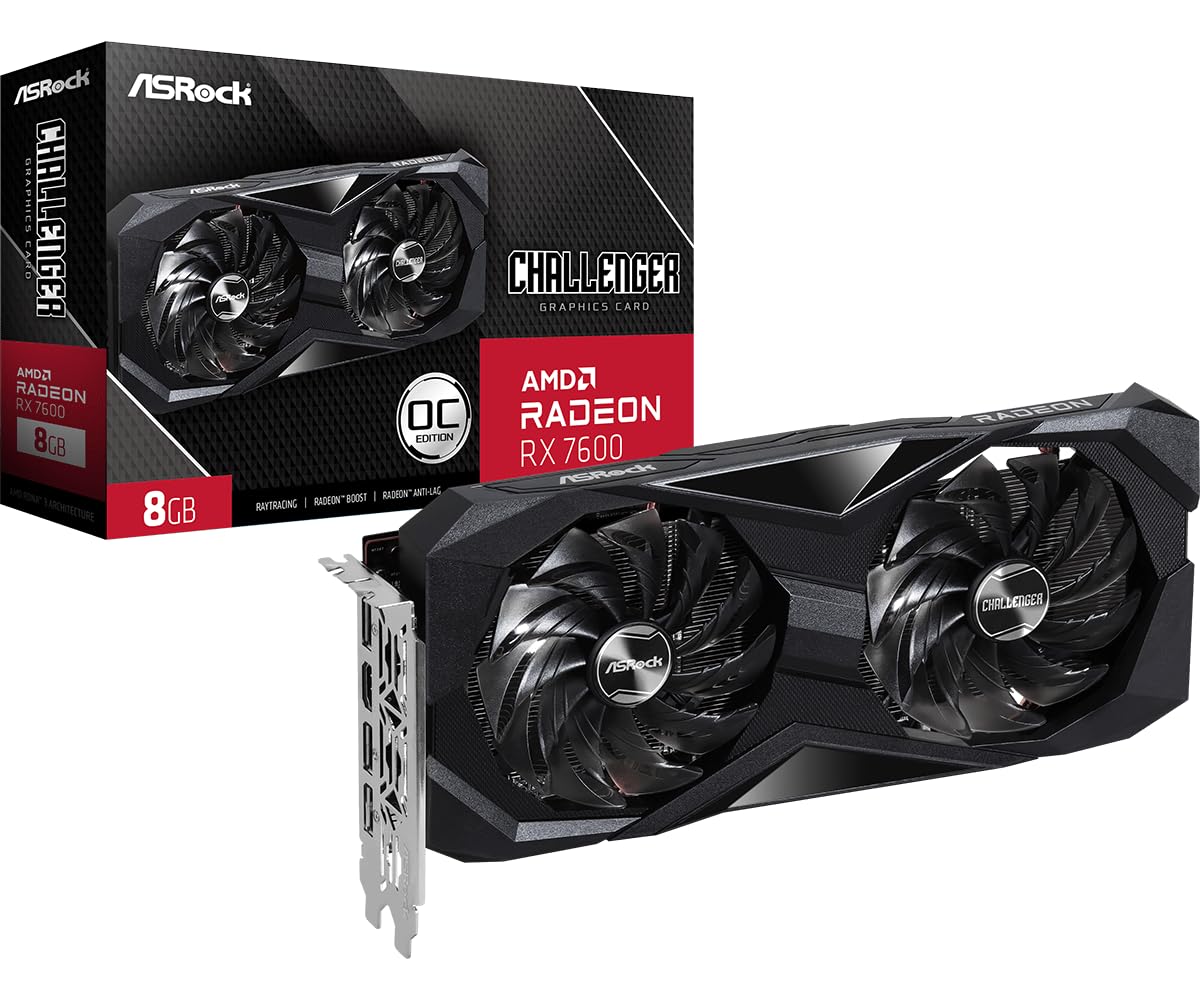
| ASRock RX 7600 Challenger 8GBPro AI Value | Linux AI workstation | 8GB GDDR6 | 128-bit | 2695 MHz | Amazon |
| Gigabyte RTX 3050 Windforce 6GB | Entry-level 1080p + light AI | 6GB GDDR6 | 96-bit | 1477 MHz | Amazon |
| ASUS Dual RTX 4060 V2 8GB | Renewed mid-range AI card | 8GB GDDR6 | 128-bit | 2 GHz (est.) | Amazon |
| Gigabyte RTX 5060 Windforce 8GB | Latest-gen Blackwell AI | 8GB GDDR7 | 128-bit | 2512 MHz | Amazon |
| ASUS Dual RTX 5060 8GB | High-efficiency AI inference | 8GB GDDR7 | 128-bit | 2535 MHz | Amazon |
| PNY RTX 5060 Epic-X 8GB | Triple-fan AI workstation | 8GB GDDR7 | 128-bit | 2280 MHz | Amazon |
| PNY RTX A2000 12GB | Professional AI & CAD | 12GB GDDR6 | 192-bit (est.) | — | Amazon |
In‑Depth Reviews
1. MSI Gaming RTX 3050 Ventus 2X 6GB OC
The lowest-power RTX card ever made — 70 watts, no external cables, and it just works.
The MSI Ventus 2X is the spiritual sibling to the Gigabyte 3050 above, but with a tiny edge in clock speed (1492 MHz vs 1477 MHz) and a slightly different cooler. For AI, that means it is perfect for a secondary inference node or a low-power server that needs GPU acceleration for whisper or small ONNX models. The 6GB GDDR6 on a 96-bit bus is the same capacity constraint as the Gigabyte version. Owners confirm it is “great for entry-level/budget GPU” and runs “Cyberpunk 2077: 50-60 FPS high, ~100 FPS medium.” On the AI side, the Ampere tensor cores are present but limited by the 6GB VRAM. The card runs Linux (RHEL 10) and Windows 11 flawlessly, with full-load temperatures below 62°C and idle power as low as 10-15W. One owner pointed out that the 6GB version fits specific wattage needs where the 8GB version would exceed the power budget. The fans are described as “extremely quiet” — a genuine advantage for a machine that runs 24/7. The 7.4-inch length is compact enough for almost any case.
Same caveat as the Gigabyte 3050: 6GB VRAM is the absolute minimum floor for AI. You will be limited to 2B-parameter models or highly quantized 7B models that barely fit. This is a card for learning, prototyping, and very specific low-power edge-AI scenarios, not for productive model work.
The efficiency king: 70W total board power with no external connectors is class-leading — perfect for a low-power AI server that runs around the clock.
Memory-limited: 6GB and a 96-bit bus mean you are in the shallow end of the AI pool. Great for learning, limiting for real work.
Grab this for: An ultra-low-power dedicated GPU node for light AI tasks, or for reviving a system with a very weak PSU.
Avoid if: You need to run serious models — the Arc B580 or a used RTX 3060 12GB is the minimum for productive AI work.
2. ASRock Intel Arc B580 Challenger 12GB OC
The VRAM king that quietly shatters the price barrier for AI workloads.
This is the card that redefines what “budget” means for AI. You get 12GB of GDDR6 running on a wide 192-bit memory bus — a combination that usually costs twice as much. That 192-bit wide interface feeds the 20 Xe cores and 160 Xe Matrix eXtension engines fast enough to handle 1440p gaming, but the real prize for AI is the VRAM. A 12GB capacity lets you load a 7-billion-parameter LLM at 4-bit quantization comfortably, or run Stable Diffusion with batch sizes that would crash an 8GB card. The 2740 MHz GPU clock and 19 Gbps memory clock keep training iterations moving. Buyers report excellent 1440p high-settings gaming performance and whisper-quiet cooling from the dual-fan setup. The 0dB Silent mode means the fans stop entirely under light load, which is perfect for an AI workstation that idles between inference jobs. A recommended 650W PSU is reasonable for this tier, and PCIe 4.0 x8 gives you enough bandwidth for most model-loading scenarios.
The catch is driver maturity and ecosystem support. Intel’s Arc software stack has improved dramatically, but NVIDIA’s CUDA and TensorRT remain the gold standard. If your AI tooling specifically requires CUDA, the B580 is not a plug-and-play choice — you will need to work with Intel’s OpenVINO or check compatibility first. For the price, though, the sheer VRAM-per-dollar ratio puts this card ahead of everything else in this roundup. What wins people over is the performance-to-value equation: the B580 leads on value for money and performance, with owners praising its 1440p capability, low power draw, and cool thermals.
It also helps that this card includes AV1 encoding hardware, which speeds up video-related AI tasks like transcoding or dataset preparation. The metal backplate reinforces the PCB for durability in a machine that may run long training sessions. One honest trade-off: the card requires a system with Resizable BAR (ReBAR) enabled, which means a 10th-gen Intel CPU or newer. Older builds may struggle.
The VRAM bargain: No other card in this budget range offers 12GB on a 192-bit bus. If your AI workload is memory-bound — and most are — this is the pick that lets you actually run models instead of hitting out-of-memory errors.
Ecosystem note: CUDA-dependent users should double-check framework support; everyone else gets the best VRAM-per-dollar deal on the market right now.
Reach for this if: You need the most VRAM possible for under and your AI stack supports OpenVINO or DirectML.
Think twice if: You rely on CUDA-specific tools like TensorRT or stable-diffusion-webui with NVIDIA-only optimizations.
3. ASRock Radeon RX 7600 Challenger 8GB OC
The Linux-first AI card that runs silently while crunching through inference.
If your AI workstation runs Ubuntu or any GNOME-based Linux distro, the RX 7600 is the smoothest plug-and-play experience in this list. The reviews are emphatic: it works on Linux from the start with no extra driver installation — the standard kernel supports it fully. The chip packs 8GB of GDDR6 on a 128-bit bus running at 18 Gbps, with a boost clock of 2695 MHz that crushes the RTX 3050’s 1492 MHz (an 82% gap in clock speed alone). That raw compute power translates to fast inference on medium-sized models. The card handles 1440p gaming and, as buyers put it, “keeps up to 180 FPS” in lighter titles. For AI, the 8GB VRAM and 128-bit bus are enough for 6B-parameter models at 4-bit and most Stable Diffusion workflows, though you will hit VRAM limits on larger LLMs.
The RDNA 3 architecture includes hardware ray tracing, but for AI the more relevant feature is the 32 Compute Units and 2048 stream processors, which handle the parallel math of neural networks well. The 0dB Silent mode is a genuine benefit for a machine that sits near you during long training runs — the fans literally stop when the GPU is under low load. The dual-fan setup with striped axial fans and a heatpipe keeps temperatures in check under full load. A single 8-pin power connector makes installation simple, and the recommended 550W PSU is easy to accommodate. What wins owners over is the performance at this price point, with 32 positive mentions for raw performance and 14 for value for money.
The trade-off is that AMD’s ROCm software stack, while improving, still trails CUDA in breadth of support. If you rely on PyTorch with CUDA extensions or NVIDIA’s TensorRT, you will want to verify ROCm compatibility first. The 8GB VRAM also means you will be quantizing models aggressively to fit within memory.
The Linux edge: No driver wrangling, no proprietary installers — this card just works on Ubuntu, and owners consistently praise that frictionless experience.
CUDA caveat: The performance is excellent, but AMD’s AI software ecosystem is not as mature. Check your framework’s AMD support before buying.
Best for: Linux-based AI setups that value driver-less plug-and-play and quiet operation.
Skip if: Your training pipeline depends on CUDA-specific libraries that lack AMD equivalents.
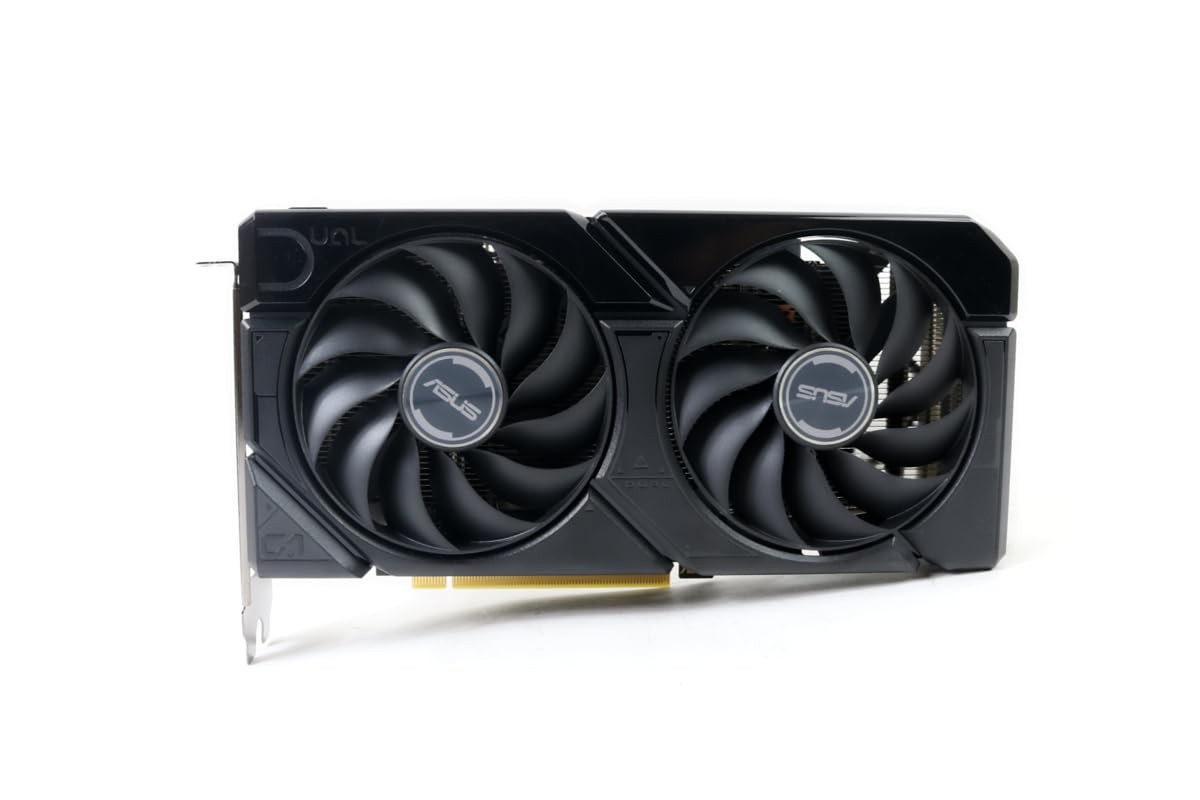
4. ASUS Dual GeForce RTX 4060 V2 OC Edition 8GB (Renewed)
Ada Lovelace architecture at a used-car price, complete with DLSS 3.
A renewed RTX 4060 is a clever way to get NVIDIA’s latest gen architecture — Ada Lovelace — without paying the full premium. The card packs 8GB of GDDR6 on a 128-bit bus with PCIe 4.0 support, but the real draw is DLSS 3 with Frame Generation. While that is a gaming feature, the underlying optical flow accelerator can be leveraged by some AI upscaling and video processing tools. More importantly, the 3rd-gen tensor cores in Ada Lovelace deliver roughly double the AI inference throughput per watt compared to Ampere. Owners mention the card arrives in pristine condition and works like new, with one buyer noting it upgraded a GTX 1660 Super with a quiet dual-fan setup that installs in about 10 minutes. The 0dB technology stops the fans under low load, and the Axial-tech fan design with a barrier ring increases downward air pressure for better cooling. Reviews highlight the condition and value for money, with 18 positive mentions for performance and 9 for graphics quality.
The 8GB VRAM is the same bottleneck you face on the 3050 and 5060 — enough for 6B-parameter models at 4-bit, but you will hit walls with 13B or 30B models. The renewed risk is that you may receive a unit that has been mined on, though the reviews suggest this seller’s stock is consistently clean. The 2-slot design fits most cases easily, and the 1.2-pound weight means it is well-supported in standard PC builds.
The gen-on-gen jump: Ada Lovelace tensor cores are significantly faster for AI inference than Ampere, making this a smart pick for lightweight model serving.
Renewed risk: The price is unbeatable, but buying renewed always carries a small lottery factor. Check the seller’s return policy.
Grab it if: You want latest-gen NVIDIA architecture on a tight budget and do not mind a pre-owned unit in excellent condition.
Pass if: You need more than 8GB of VRAM or prefer a factory-new card with a full warranty.
5. PNY RTX A2000 12GB

A professional-grade 12GB card that sips power and fits in a shoebox.
The RTX A2000 is NVIDIA’s workstation card that does something almost no other budget card can: it offers 12GB of ECC GDDR6 memory with a 192-bit memory interface, all while drawing its power entirely from the PCIe slot — no external power cables needed. This is a unique proposition for AI. ECC memory corrects single-bit errors during long training runs, which matters when a model trains for days. And the 12GB capacity is the balance for running 7B-parameter LLMs at 4-bit quantization with decent context lengths, or Stable Diffusion with multiple LoRAs loaded. The card uses NVIDIA’s Ampere architecture, so you get 2nd-gen RT cores and 3rd-gen tensor cores that are compatible with the full CUDA ecosystem — TensorRT, PyTorch with CUDA, ONNX Runtime, everything. Four Mini DisplayPort outputs support up to 8K resolution for data visualization. Owners describe it as “absolutely ideal for SFF builds” and note that it performs comparably to an RTX 4060 in many workloads thanks to the large video memory.
The catch is the price — this is the most expensive card on this list, and for that money you could get a used RTX 3060 12GB or a new Arc B580 with the same VRAM. The A2000 justifies its premium with ECC memory, professional driver support, and a low-profile form factor that fits in compact workstations. The Quadro drivers also offer better ISV certification for CAD and scientific computing, which matters if your AI pipeline runs alongside simulation or 3D modeling software. A few buyers received units that appeared used — missing the low-profile bracket or original box — so buying from a reputable seller matters here.
The professional edge: ECC memory and no external power requirement make this the card for a reliable, compact AI inference node.
The price reality: You pay a premium for the pro badge. If you do not need ECC, the Arc B580 gives you the same VRAM for significantly less.
Ideal for: SFF AI workstations where reliability and power efficiency are non-negotiable.
Not for: Budget buyers who want maximum VRAM-per-dollar — the Arc B580 and used RTX 3060 12GB beat it on price.
6. GIGABYTE GeForce RTX 5060 WINDFORCE OC 8G

NVIDIA’s newest Blackwell architecture makes AI inference faster than ever at this price.
The RTX 5060 introduces the Blackwell architecture with 4th-gen tensor cores and DLSS 4, which includes a transformer-based model that delivers a massive leap in frame generation quality. For AI, the Blackwell tensor cores are significantly more efficient at FP8 and FP4 quantization, meaning you can run quantized models with lower precision loss compared to Ampere. The 8GB of GDDR7 memory on a 128-bit bus is a step up in bandwidth over GDDR6 — GDDR7 hits 28-32 Gbps on this card, though the specs list 8GB at 128-bit. The WINDFORCE cooling system with dual fans keeps noise low during sustained loads, and customers note over 250 FPS in games like Cyberpunk, which gives you a sense of how much raw compute headroom exists. Performance is the top praise from buyers, with 42 positive mentions, alongside strong value-for-money feedback (17 mentions). The card handles 1440p gaming and creative tasks easily, and the 8GB VRAM is manageable with settings tuning. One owner recommends running DDU before installing to avoid driver conflicts — a standard precaution with any GPU swap.
The 8GB VRAM is still the limiting factor for larger models. At this price, the Arc B580 offers 50% more VRAM, which matters more for AI than the Blackwell architecture improvements. The PCIe 5.0 interface is forward-looking, but most AI workloads do not saturate PCIe 4.0 yet, so that is a nice-to-have rather than a must.
Architecture advantage: Blackwell’s tensor cores are the most efficient for FP4 and FP8 AI inference available at this price point.
VRAM ceiling: 8GB limits you to smaller models; for the same money the Arc B580 gives you 12GB.
Choose this for: The latest NVIDIA architecture and DLSS 4 support, especially if your AI pipeline benefits from the newest tensor core efficiency.
Consider alternatives if: Your workload is VRAM-bound — the B580 or a used RTX 3060 12GB will serve you better.
7. ASUS Dual NVIDIA GeForce RTX 5060 8GB GDDR7 OC Edition

An SFF-ready Blackwell card packing 623 AI TOPS into a compact, cool-running package.
The ASUS Dual RTX 5060 stands out with a headlining spec: 623 AI TOPS (trillion operations per second), a metric that directly measures matrix compute throughput for neural networks. That figure comes from the Blackwell architecture’s 4th-gen tensor cores running at 2535 MHz boost clock, paired with 8GB of GDDR7 memory. For AI inference and fine-tuning, TOPS is more useful than core clock because it quantifies the card’s ability to handle the massive matrix multiplications that define deep learning. The 8GB VRAM is still the limit for model size, but the GDDR7 memory bandwidth is noticeably higher than GDDR6, which helps with feeding the tensor cores. The card is SFF-Ready, meaning it fits in small form-factor cases — a boon for a compact AI workstation that sits on a desk. Owners praise the performance, with 39 mentions, and value for money with 12 mentions. The Axial-tech fan design with a smaller hub and longer blades increases downward air pressure for better thermal performance. One reviewer noted it runs at approximately 100W under load, making it remarkably efficient for the compute you get. The 2.5-slot design is slightly thicker but still fits most cases. The review pages sum it up: “GDDR7 and PCIe 5.0 boost memory bandwidth over 4060, rasterization near 2080 Ti/3070, TDP 150W.”
The 8GB VRAM is the same constraint as every other entry in this price tier. If you want to run models larger than 7B parameters at reasonable quantization, you will run out of memory. The ASUS card also lacks RGB, which is actually a plus for a serious AI workstation — no distracting lights.
TOPS leader: The 623 AI TOPS rating gives you a concrete measure of compute throughput for training and inference — the highest raw AI performance in this budget range.
Memory size matters more: The TOPS number is impressive, but the 8GB cap means you cannot load models that the slower but larger-VRAM cards can handle.
Best if: You prioritize raw AI compute speed over model size, and your workloads fit within 8GB of VRAM.
Skip if: You need to run larger LLMs or batch-heavy pipelines that require 12GB or more.
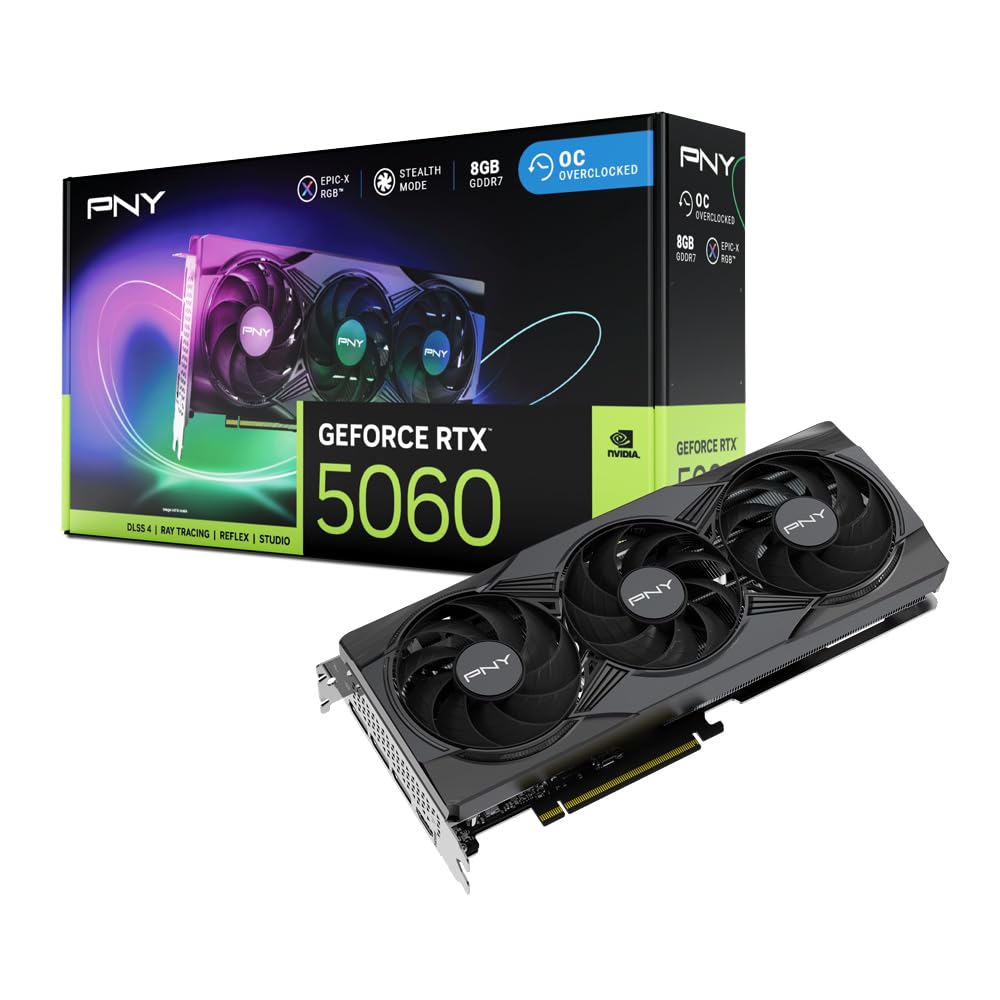
8. PNY NVIDIA GeForce RTX 5060 Epic-X ARGB OC Triple Fan
The coolest-running 5060 on the block, with ARGB that won’t distract a proper AI rig.
PNY’s take on the RTX 5060 uses a triple-fan cooling solution that keeps temperatures well in check during sustained AI training runs, which can peg the GPU at 100% utilization for hours. The 8GB of GDDR7 memory on a 128-bit bus delivers the same Blackwell architecture as the ASUS and Gigabyte 5060 cards, but the Epic-X design prioritizes thermal headroom. For AI workloads, consistent temperature means consistent clock speeds — no thermal throttling mid-epoch. The card includes 5th-gen tensor cores and 4th-gen ray tracing cores, but the real story is DLSS 4 and the NVIDIA Reflex latency reduction technology. While Reflex is game-oriented, the broader point is that PNY uses NVIDIA’s reference board design with a sturdy cooler. Owners confirm it “handles most modern games well enough,” runs cool, and ships quickly. The reviews note compatibility with AMD Ryzen 5 9600X and easy installation, with good power consumption. The card is also flagged specifically for working effectively with AI-assisted programs, which aligns perfectly with this guide’s focus. The triple-fan design makes it slightly larger, so measure your case clearance.
Like all 5060 cards, the 8GB VRAM is the limiting factor for AI. The triple-fan cooling is overbuilt for a card with a 150W TDP, but that thermal headroom means zero fan noise even under sustained load — the fans can run slower and still keep the chip cool. Great for a quiet office or lab environment.
The thermal advantage: Triple fans mean you can run long training sessions without worrying about thermal throttling or loud fan ramping.
Same VRAM constraint: All 5060 cards share the 8GB VRAM limit; the cooling is the differentiator here.
Reach for this if: You run long-duration AI training jobs and want the most sturdy, quietest cooling available at this tier.
Look elsewhere if: Your AI workload demands more than 8GB of VRAM — the cooling is irrelevant if the model does not fit.
9. GIGABYTE GeForce RTX 3050 WINDFORCE OC V2 6GB

The card that resurrects old office PCs for light AI duty with zero PSU upgrades.
If you have a Dell Optiplex or an HP ProDesk with a proprietary power supply, this is the only GPU on the list that will work without changing your PSU. The RTX 3050 Windforce draws its full 75W from the PCIe slot — no external power cables needed. Buyers confirm it “works in low-power Dell (75W board limit)” and “runs Steam games at adequate 60FPS.” For AI, the 6GB of GDDR6 on a 96-bit bus is limiting. You can run very small models — think 2B-parameter LLMs at 4-bit or lightweight whisper models — but anything larger will overflow to system RAM and slow to a crawl. The 1477 MHz boost clock is modest, and the 96-bit memory interface creates a bandwidth bottleneck. However, the card includes NVIDIA’s Tensor Cores (2nd-gen, Ampere), so you get real AI acceleration for compatible frameworks like TensorRT. The WINDFORCE dual fans keep the card quiet and cool, and the 7.5-inch length fits in almost any case. The card earns high marks for performance in its class, with 24 positive mentions, and value for money with 10 mentions.
The 6GB VRAM is the hard floor for AI. Most modern AI tooling assumes at least 8GB. Use this card for experimenting with very small models, tinkering with ONNX runtime, or as a dedicated video transcoding GPU while your main card handles inference. It will not run Stable Diffusion 1.5 at any reasonable resolution.
The slot-power miracle: No external power, no PSU upgrade — this card works in any desktop with a PCIe x16 slot and a 75W board budget.
The VRAM wall: 6GB excludes you from most serious AI model running. This is an entry-level tinkering card, not a workhorse.
Ideal for: Reviving an old office PC for light AI experimentation without spending a dime on a new power supply.
Not for: Anyone who needs to run real AI models — look at the B580 or a used 3060 12GB instead.
Understanding the Specs
VRAM (Video Memory)
This is the amount of fast, on-card memory your GPU uses to hold the model weights and intermediate calculations during inference or training. Think of it as the workspace desk: a bigger desk lets you spread out a larger blueprint (model) without constantly fetching tools from a shelf (system RAM). For AI, VRAM capacity is the single most important spec — if the model does not fit, your GPU cannot run it. Every card on this list uses GDDR6 or GDDR7 memory, with 8GB being a practical minimum and 12GB being the balance for running 7B-parameter models.
Tensor Cores vs CUDA Cores
CUDA cores are the general-purpose parallel processors that handle the billions of math operations in a neural network. Tensor cores are specialized hardware units designed specifically for the matrix multiplication that forms the backbone of deep learning — they are faster and more power-efficient for AI workloads than CUDA cores. All modern RTX cards include both, but newer generations (Ada Lovelace, Blackwell) have tensor cores that support lower-precision formats like FP8 and FP4, which are crucial for running quantized models with minimal accuracy loss.
Memory Bandwidth and Bus Width
The memory interface width (measured in bits) multiplied by the memory speed determines how much data can move between the GPU cores and the VRAM each second. A 192-bit bus moves more data per clock than a 128-bit bus at the same memory speed. For AI, high bandwidth means model weights reach the compute units faster, reducing the time the tensor cores sit idle waiting for data. This matters most during training, where the entire model and dataset must shuffle through memory repeatedly.
PCI Express Generation
The PCIe slot connects the GPU to the CPU and system memory. Modern cards use PCIe 4.0 or 5.0, which offer higher bandwidth than the older PCIe 3.0 standard. For AI inference, PCIe bandwidth rarely bottlenecks performance because the model lives entirely in VRAM. However, when loading models at startup or during data preprocessing that moves tensors between system RAM and GPU memory, a faster PCIe link can reduce wait times. Some budget cards (like the Intel Arc B580) use PCIe 4.0 x8, which is narrower than x16 but still sufficient for most AI workloads.
FAQ
How much VRAM do I need to run a 7B-parameter LLM?
Is an NVIDIA card mandatory for AI, or can I use AMD or Intel?
Will a gaming GPU work for AI training and inference?
What does “AI TOPS” mean and why should I care?
Can I run Stable Diffusion on a 6GB GPU?
Does PCIe generation (3.0 vs 4.0 vs 5.0) affect AI performance?
Is a renewed or used GPU safe for AI workloads?
What power supply do I need for a budget AI GPU?
Final Thoughts: The Verdict
Across the board, the best budget gpu for ai is the ASRock Intel Arc B580 Challenger 12GB because it delivers more VRAM for less money than any competitor, and VRAM is what determines whether your model fits or crashes. If you need CUDA ecosystem compatibility and are willing to sacrifice VRAM, grab the ASUS Dual RTX 5060 for the highest raw AI compute in the budget tier. And for a Linux-based plug-and-play AI workstation, the ASRock Radeon RX 7600 Challenger 8GB is the one to reach for. Whichever you pick, your budget AI GPU buying decision depends on one question: how much model do you need to fit in VRAM?
How We Picked
We do not accept paid placement. Every pick is matched to a real buyer and a real use-case; we do not hands-on test units.
Sources & Methodology
Specifications: manufacturer listings and product documentation. Review insights: verified customer reviews, as of July 2026. Pricing: not shown on this page (it changes often); check the current price via the retailer link.
As an Amazon Associate, FitlyFast earns from qualifying purchases. This does not affect which products we feature.