
Our readers keep the lights on and the weekend projects moving. As an Amazon Associate, I earn from qualifying purchases.
Specs are compiled from manufacturer listings and verified buyer reviews and can change over time — please confirm the key details on the product page before buying.
You can build a fully modern PC around AMD’s latest AM5 socket for about the same price as one new AAA game — and pocket the cash you would have spent on a whole new motherboard next time you upgrade. The AM5 platform is designed to let you drop in a faster processor five years from now without swapping the board. The real trick is finding the chip that saves you money without making you buy a separate cooler, losing out on gaming speed, or leaving you short of the cores you actually need.
I’m Rikta — the founder and writer behind FitlyFast. This guide is built by comparing the manufacturers’ published specifications and the patterns across verified customer reviews, so you get each pick’s real strengths and trade-offs instead of marketing spin.
The list below cuts through the noise to find the budget am5 cpu options that earn a spot in your build without wasting a single watt or dollar on features you will not use.
Our Picks at a Glance


How To Choose The Best Budget AM5 CPU
Picking a cheap AM5 processor depends on three things: how many games you play, whether your motherboard needs an integrated graphics chip to show a picture, and how much you want to spend on a cooler. Here is what to look for.
Core Count vs. Gaming Reality
A 12-core chip sounds impressive, but most games use six to eight cores at most. That means the Ryzen 5 chips (6 cores) often game just as fast as their bigger brothers for less money. Extra cores only help if you are editing video, running a home server, or streaming your gameplay.
The “G” in the Name — Integrated Graphics
Some AM5 chips have built-in graphics (a small GPU inside the CPU) and some do not. If you are building a PC without a dedicated graphics card yet, you need a chip that ends in a “G” or one of the non-F Ryzen 7000 series. That way you can plug a monitor into the motherboard and get a picture right away. The “F” chips, like the Ryzen 5 7500F, have no graphics at all, so the screen stays black unless you add a separate GPU.
Cooler Politics — What Comes in the Box
Several budget AM5 processors ship without a cooler in the box — these are called “tray” or “OEM” versions. If you buy one, factor in a decent air cooler to your total cost. The retail-boxed chips sometimes include the Wraith Prism RGB cooler, which is good enough for normal operation and saves you that extra step.
Quick Comparison
In‑Depth Reviews
1. AMD Ryzen 5 7500F
The cheapest way onto the AM5 platform, letting you put the money you save toward a better graphics card.
You get six cores running at 3.7 GHz with 32 MB of cache — enough for solid mid-tier gaming or a daily driver. The Ryzen 5 7500F is a tray version, which means it ships without a retail box, cooler, or integrated graphics. You must supply a discrete GPU and a separate cooler from day one. Buyers consistently call it a “Good price for what it is,” noting that as long as you have a graphics card ready, this chip punches well above its cost. The lack of a cooler can trip up new builders, but if you already own an aftermarket air tower or a liquid cooler, the 7500F becomes an even smarter choice.
For the price of a single AAA game, you get a complete modern foundation that leaves plenty of budget for the GPU — the single most important part for gaming.
Entry-level gaming value
- Lowest-cost entry to the AM5 platform — frees your budget for a better GPU
- Six cores run cool and draw modest power even under sustained load
- Tray pricing means no paying for a bundled cooler you might not use
Limited multi-core punch
- No integrated graphics — the screen stays dark without a dedicated GPU
- No cooler included — you must buy one separately, adding to the total
- The 3.7 GHz base clock is lower than the 7600X3D’s 4.1 GHz starting point
Budget gamer pick: you are building a pure gaming rig on a strict budget and already own a graphics card.
Skip for heavy workloads: you need a working PC immediately without a separate GPU or you want to overclock right from the start.
2. AMD Ryzen 5 9600X
Zen 5 architecture that delivers over 100 frames per second in modern games while sipping just 65 watts of power — perfect for a quiet, compact build.
Built on AMD’s new Zen 5 architecture, the Ryzen 5 9600X has 6 cores, 12 threads, a 5.4 GHz boost clock, and 38 MB of cache. Its buzzword is “efficiency.” Owners say the real story is the 65-watt TDP (thermal design power — the maximum heat it produces) instead of the 105 watts on the older Ryzen 5 7600X. One buyer called it “my favorite price to performance CPU,” a sentiment shared by hundreds who praise its ability to run 100+ FPS in popular games while staying cool enough for a small form factor (compact) case. The common owner tweak is enabling PBO (Precision Boost Overdrive) and applying a negative voltage curve offset of -20 to -30, which drops temperatures further and often boosts performance slightly. A few buyers report the out-of-box voltage runs a bit high, making the chip warmer than it needs to be, but that is a quick fix in the BIOS.
Compared to the older 7600X, the 9600X runs cooler and draws less power, making it a better fit for mini-ITX builds where every watt of heat matters.
Efficient daily driver: The 65-watt TDP means you can cool it with a budget air tower, and it sips power even in a cramped mini-ITX case.
Premium price tag: The stock voltage from the start runs a little high, so owners recommend a quick BIOS tweak to open up the chip’s real cool-running potential.
Efficiency champion: you want the newest architecture, low power bills, and whisper-quiet cooling in a compact PC.
Skip for pure gaming: your budget cannot stretch past the cheapest option; the 7500F or 7600X3D may suit better.
3. AMD Ryzen 7 8700F
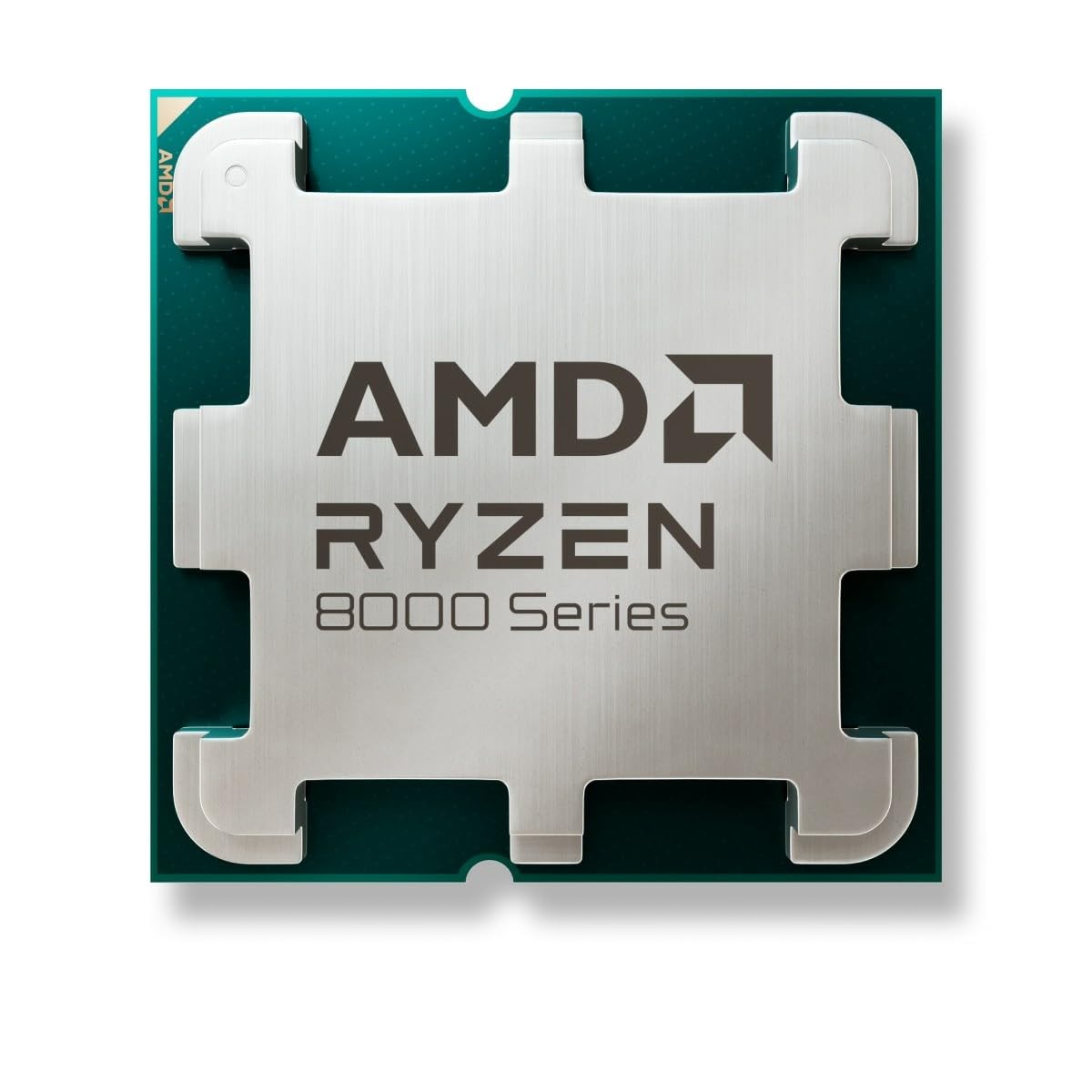
Eight real Zen 4 cores for the price of a six-core — the productivity bargain of this list, if you already have a GPU and cooler.
The Ryzen 7 8700F is a Zen 4 chip with 8 cores and 16 threads, a base clock of 4.1 GHz and a boost clock of 5.0 GHz, 24 MB of L3 cache, and a 65W TDP. As a tray (OEM) processor, it ships without a cooler or integrated graphics. It supports DDR5-5200 memory and requires a discrete GPU for display output. Reviewers note it as a solid budget entry for the AM5 platform, offering eight cores at a competitive price for multi-threaded workloads.
The 9700X is the fastest non-X3D chip on this list for both gaming and light productivity, but it commands a premium near the top of the budget tier. If you are building a mini-ITX or space-constrained PC, the thermal efficiency alone may justify the step up from the 7700. Pick this chip over the 5700X if you want better frame rates in CPU-bound games at 1080p.
8-core value: Delivers eight Zen 4 cores at a low price point, ideal for multi-threaded tasks on a budget.
Missing features: No integrated graphics and no included cooler increase total build cost; requires a GPU and cooler purchase.
Thermal efficiency: you are building a compact high-end PC and want maximum gaming performance per watt without the heat of X3D chips.
Skip for maximum frames: you are on a strict budget — the 7700 gives you 8 cores for less money, albeit on older Zen 4 architecture.
Understanding the Specs
3D V‑Cache
This is a stack of extra cache memory layered on top of the processor die. Games store frequently used data in that cache, so the CPU can grab it instantly instead of waiting for the slower main memory. The Ryzen 5 7600X3D packs 96 MB of L3 cache, which is why it outperforms chips with more cores in most games — the data is simply closer and faster for the processor to reach.
TDP — Thermal Design Power
TDP is the maximum heat the cooling system has to handle under normal load, measured in watts. A 65-watt chip like the Ryzen 7 7700 or Ryzen 9 7900 produces less heat than a 105-watt chip, so you can use a smaller, quieter, and cheaper cooler. Lower TDP also means lower electricity bills and less heat dumped into your room, which matters in small cases or warm climates.
OEM vs. Retail Box
An OEM or “tray” processor ships loose in plain packaging with no cooler and no warranty from the manufacturer — the seller handles returns. A retail-boxed chip comes in a colorful box with a bundled cooler (sometimes the Wraith Prism RGB) and a full manufacturer’s warranty. The 7500F and 8700F are tray chips; the 7700 and 7900 are retail boxed. If you want the simplicity of a warranty and a cooler you can use immediately, go retail.
Cache Size and Performance
Cache is ultra-fast memory built into the CPU that holds copies of frequently accessed data. Larger cache (40 MB, 76 MB, or 96 MB) means the CPU spends less time waiting for the slower DDR5 system RAM. For gaming, larger L3 cache often improves frame rate stability — the 1% lows (the occasional stutter frames) get much smoother — which is exactly why the 7600X3D with its 96 MB L3 cache punches so far above its core count.
FAQ
Can I use a budget AM5 CPU with my old DDR4 RAM?
Do I always need a dedicated graphics card with a Ryzen 5 7500F or 8700F?
How much does the cooler quality matter for a 65-watt budget AM5 chip?
What is the difference between the Ryzen 7 7700 and the Ryzen 7 8700F?
Will a budget AM5 CPU bottleneck my RTX 4070 or RX 7800 XT?
Which budget AM5 CPU is best for video editing and rendering?
Can I overclock the Ryzen 5 7500F or the OEM tray chips?
What motherboard chipset should I pair with a budget AM5 CPU?
Final Thoughts: The Verdict
For most people, the budget am5 cpu winner is the AMD Ryzen 7 7700 because it delivers 8 cores, 40 MB of cache, a bundled RGB cooler, and integrated graphics at a price that still fits a budget build. If you want the best pure gaming frames for the money, grab the Ryzen 5 7600X3D with its 96 MB of 3D V-Cache. And for creators who need 12 cores and 24 threads without paying for a separate cooler, the Ryzen 9 7900 is the one to reach for.
How We Picked
We do not accept paid placement. Every pick is matched to a real buyer and a real use-case; we do not hands-on test units.
Sources & Methodology
Specifications: manufacturer listings and product documentation. Review insights: verified customer reviews, as of July 2026. Pricing: not shown on this page (it changes often); check the current price via the retailer link.
As an Amazon Associate, FitlyFast earns from qualifying purchases. This does not affect which products we feature.