
Our readers keep the lights on and the weekend projects moving. As an Amazon Associate, I earn from qualifying purchases.
Specs are compiled from manufacturer listings and verified buyer reviews and can change over time — please confirm the key details on the product page before buying.
PoE security cameras rely on two things: a steady electrical supply and a clean data path through one single cable. A bad cable introduces voltage drop, intermittent disconnects, and enough packet loss to turn a 4K feed into a slideshow. This guide cuts through the categories (Cat5e, Cat6, Cat6a) and the jacket types (PVC, LLDPE, OSP) to show you exactly which copper matters and which hype to ignore.
I’m Rikta — the founder and writer behind FitlyFast. This guide is built by comparing the manufacturers’ published specifications and the patterns across verified customer reviews, so you get each pick’s real strengths and trade-offs instead of marketing spin.
The most important spec for a cable for poe cameras is the conductor gauge and material. Thick pure copper or solid CCA (copper-clad aluminum) is what actually delivers consistent power and gigabit video at distances over 50 feet.
Our Picks at a Glance


How To Choose The Best Cable For PoE Cameras
Picking the wrong cable is the fastest way to turn a weekend security-camera install into a week of troubleshooting. Here is what actually moves the needle.
Conductor Material: Pure Copper vs. CCA
Solid bare copper conducts electricity far better than CCA (copper-clad aluminum, an aluminum core with a thin copper coating). For a PoE camera 100 feet from the switch, CCA can cause a voltage drop that makes the camera reboot or fail to power on at all. Pure copper is heavier, costs more, and delivers every watt the camera needs.
AWG Gauge and Distance
AWG (American Wire Gauge) tells you the thickness of the copper. Lower numbers mean thicker wire. 24AWG or 23AWG is the balance. Thinner 26AWG or 28AWG wires increase resistance and voltage drop — a bad choice for a long, power-hungry run.
Jacket Rating for Your Environment
PVC (polyvinyl chloride) jackets are fine for a dry attic. For direct burial in soil or a run along a fence line, look for LLDPE (linear low-density polyethylene) or OSP (outside plant) jackets. These materials resist UV rays, moisture, and physical abrasion. A standard PVC jacket outdoors will crack and fail within a season.
Shielding
UTP (unshielded twisted pair) is perfectly fine for most residential PoE camera runs. Shielded cable (SFTP or STP) adds a foil or braided layer to block electrical interference. You need shielded cable if you are running your camera line parallel to high-voltage AC power lines or through an industrial shop.
Quick Comparison
| Model | Best For | Speed | Gauge | Jacket | Amazon |
|---|---|---|---|---|---|
| GWFIBER Cat6 100 ft★ Best Overall | Heavy-duty value | 1 Gbps | — | UV/Waterproof | Amazon |
| ecjtu Cat6 100 ft Direct BurialDirect Burial | Underground burial | 10 Gbps | 24 AWG | LLDPE UV | Amazon |
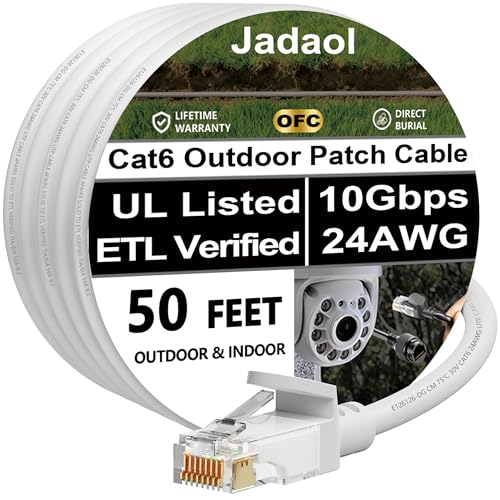
| Jadaol Cat6 50 ftFlex Run | Flexible indoor runs | 10 Gbps | 24 AWG | UV/Waterproof | Amazon |
| Veigrvy Cat6a 100 ft | Long-range PoE | 10 Gbps | 23 AWG | LLDPE | Amazon |
| Ercielook Cat6a 100 ft | Slim conduit routing | 10 Gbps | 24 AWG | LLDPE UV | Amazon |
| REOLINK Cat5 100 ft | Plug-and-play Reolink | 100 Mbps | — | PVC | Amazon |
| AvesView Cat6 Shielded 100 ft | Industrial interference | 10 Gbps | 24 AWG | SFTP Shielded | Amazon |
| Cable Matters Cat6 Bulk 300 ft | In-wall whole-home runs | 10 Gbps | 23 AWG | CMR Riser | Amazon |
| TRUE CABLE Cat6 Bulk 500 ft | Large outdoor installs | 5 Gbps | 23 AWG | OSP UV | Amazon |
In‑Depth Reviews
1. GWFIBER Cat6 100 ft Ethernet Cable
Our pick — over 4.5★ from 750+ verified ratings; the strongest balance of quality and price.
The rough-and-ready 100-footer that owners call tougher than brand-name kit cable.
This cable keeps buyers coming back. It delivers reliable performance — the most-discussed trait by a notable margin, followed closely by quality. At 1 Gbps (1 gigabit per second), it is not the fastest Cat6 on paper in this guide, but that is more than enough bandwidth for a PoE camera stream. A waterproof coupler on one end adds genuine weatherproofing for an outdoor camera without needing a separate dongle.
Buyers report it is thicker and more durable than the cable that ships with a Lorex camera kit. They describe it as easy to install and less coiled, meaning it lies flat after you unspool it. The four twisted pairs inside have a plastic separator that reduces crosstalk (signal interference between pairs), and the copper strands are thick enough to carry PoE current without a voltage drop at the full 100-foot length. A buyer who trimmed and re-terminated it for a camera said the internal wires are substantial and easy to punch down.
The main real-world trade-off is stiffness. It is a heavy-duty round cable, so bending it through sharp conduit turns takes effort. That stiff feel is the direct result of the thick copper and durable jacket that make it so reliable — a fair swap for a solid connection. It is stiffer than the lighter Jadaol Cat6 50 ft, for example, but handles weather better.
What owners love
- Heavy-duty construction outlasts OEM camera cables
- Waterproof coupler simplifies outdoor installation
- Plastic cross separator reduces signal crosstalk
- Excellent value for the 100-foot length
The honest trade-off
- Stiffer than patch cables; less forgiving in tight bends
- Rated for 1 Gbps, not the 10 Gbps of newer Cat6
Reach for this if: you need a heavy, weather-ready cable for a single outdoor PoE camera and want a proven performer that just works.
Think twice if: you plan to snake it through a series of sharp 90-degree conduit elbows; it will fight you.
2. ecjtu Cat6 100 ft Direct Burial Cable
The underground specialist that handles sun, frost, and a tree falling on it.
Reliability is what this cable is known for — it is the single most-praised aspect among owners. The 24AWG conductors and LLDPE (linear low-density polyethylene) jacket make it genuinely rugged for direct burial and above-ground outdoor use. It supports a 10 Gbps (10 gigabit per second) data transfer rate at a 550 MHz (megahertz) frequency, which is more than any PoE camera can demand and leaves room for future gigabit networks.
Owners mention that a 20-foot segment of this cable survived a tree fall undamaged, and others confirm absolutely no drop in speed over the full 100-foot length. The connector quality earns praise too, with a protective lock tab guard that stops those fragile plastic tabs from snapping off during installation. You get 25 cable ties in the box to secure the run. This cable is noticeably tougher than the GWFIBER for physical abuse like soil pressure or impact.
The honest drawback is stiffness. The heavy-duty 24AWG solid-core and thick LLDPE sheath make it resistant to kinking, but it also holds a coil memory that fights you when snaking through a wall cavity. It is a cable designed to be buried or run along a fence — not threaded through a drop ceiling.
What owners love
- Survives extreme weather and physical impact
- Full 10 Gbps throughput with zero packet loss
- Sturdy connector lock tabs that do not break
- Great value for a direct-burial-rated cable
The honest trade-off
- Very stiff; difficult to pull through interior walls
- Cable holds a coil curl that must be worked out
Grab this for: a long trench to an outbuilding or a direct burial run to a gate camera where the cable will face weather and abuse.
Skip it for: in-wall attic or crawlspace runs; it is too stiff for that.
3. Jadaol Cat6 50 ft Pure Copper Cable
The lightweight 50-footer that hides along baseboards and delivers 10 Gbps.
Not every camera needs a 100-foot run. This 50-foot Jadaol cable is built with 24AWG solid pure copper conductors, not CCA, so it carries PoE power cleanly and hits a full 10 Gbps data rate at 550 MHz. Buyers consistently describe it as durable, lightweight, and flexible — a combination that makes installation noticeably easier than a heavy round cable like the GWFIBER.
Customers note plugging it in for a PoE-powered Wi-Fi extender and getting a strong, steady signal with no dropouts. Another buyer used the same cable to feed a 3K security camera and called the video feed clear. The round structure is flexible enough to route around corners and tight spaces without kinking, and the UV-resistant jacket means it survives above-ground outdoor use along siding or under eaves.
The honest limit is the 50-foot length. At roughly half the reach of the GWFIBER (50 ft vs 100 ft), you cannot use it for a long run across a property line. If your camera is closer to the switch or the NVR (network video recorder), this is the best-handling cable in the list.
What owners love
- True 10 Gbps performance from pure copper conductors
- Flexible round cable that bends easily around corners
- UV and waterproof jacket for outdoor above-ground use
- Very good value for a pure-copper Cat6
The honest trade-off
- Only 50 feet — not enough for long property runs
- Not rated for direct burial in soil
Best for: a camera mounted on a garage wall or a soffit within 50 feet of your switch, where you want easy routing and full gigabit speed.
Not the one for: underground trench work or runs longer than 50 feet.
4. Veigrvy Cat6a 100 ft Cable
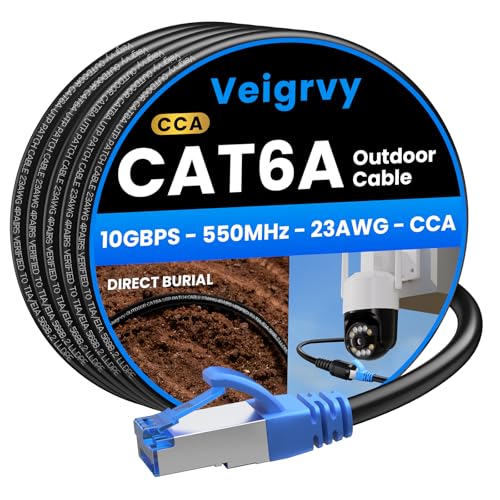
The 23AWG thick-copper choice that runs 10 Gbps to a detached garage.
Cat6a is a step above standard Cat6, and this Veigrvy cable shows exactly why. The 23AWG conductors are thicker than the typical 24AWG found in most Cat6, which means lower resistance and better voltage delivery for a PoE camera at the far end — so a camera 100 feet away powers on reliably without flickering. It supports a 10 Gbps data transfer rate with a 550 MHz bandwidth, and the LLDPE (linear low-density polyethylene) jacket handles direct burial installation and UV exposure.
Quality is the most-discussed praise from owners. They report using a 280-foot run to a detached garage and still getting excellent gigabit speeds. The connectors are snag-less with nickel-plated housings, and the cable ships with dust caps and cable ties. It also earns points for being easy to terminate. Compared to the GWFIBER, the Veigrvy carries a faster 10 Gbps rating and the thicker 23 AWG wire for less resistance on longer runs.
The catch is the 23AWG thickness combined with the LLDPE jacket makes it even stiffer than the other outdoor cables here. Owners mention it tangles on itself when pulling through a house, requiring patience to straighten out during installation.
Best for long properties: If you need to send a clean 10 Gbps signal 100 feet or more to a camera at the end of a driveway or a barn, the thicker 23AWG copper here is the right choice. Just plan for a wrestling match during the pull.
Reach for this if: you need maximum reliability at the edge of the 100-meter Ethernet limit and want the extra headroom of 23AWG conductors.
Think twice if: your run is a simple attic-to-eve path; the stiffness will frustrate you.
5. Ercielook Cat6a 100 ft Cable

The slim 5mm profile that slides into tight conduits where others get stuck.
This Ercielook cable solves a very specific problem: routing Ethernet through narrow pipes and tight channels that a standard round cable cannot fit. With a 5mm outer diameter, it is measurably slimmer than most Cat6a cables, and the LLDPE (linear low-density polyethylene) UV-resistant jacket makes it suitable for outdoor and direct burial use despite the slender build — so you can run it along a fence line without worrying about UV damage.
It carries a 10 Gbps data rate at 500 MHz frequency using 24AWG CCA (copper-clad aluminum) conductors. Reviewers point out using it for PoE-powered Ring cameras and getting a stable connection with no complaints, and one owner ran it through an attic and called the installation easy. The maker warns it may crease if bent at a sharp 90-degree angle, but states that will not affect speed or durability.
The main real-world trade-off is the conductor material. CCA is less conductive than pure copper. For a single PoE camera at 100 feet, it works perfectly. For a high-power PoE++ device (Power over Ethernet Plus Plus, supplying 60 to 100 watts) or a run approaching 150+ feet, you want pure copper. Compare this to the GWFIBER, which uses heavier conductors for more demanding power needs.
Ideal for tricky routing: If you need to feed a cable through a ½-inch conduit or along a narrow channel under a deck, the slim 5mm profile is a lifesaver. It works reliably with standard PoE cameras and the tough LLDPE jacket keeps the elements out.
Grab this for: conduit runs, tight soffits, and any path where a standard cable simply will not fit.
Skip it for: a long underground direct burial where pure copper provides a more sturdy long-term connection.
6. REOLINK Cat5 100 ft Cable

The no-brainer plug-and-play cable for anyone building a Reolink camera system.
This is the most straightforward pick on the list: a Cat5 cable built specifically for Reolink PoE cameras and NVRs. It uses T-568B wiring and RJ45 connectors, and it works instantly with the Reolink app — plug it in and you are live. Quality and functionality are the top two aspects owners praise equally. They call it a very good quality cable that turns a DIY install into a simple A-to-B route.
The obvious spec downgrade here is Cat5 versus Cat6. It is rated for 100 Mbps (100 megabits per second), which is enough bandwidth for a single 4K camera feed, but not enough for a multi-camera aggregate or future gigabit networking. If you ever upgrade to a 10 Gbps local network, this cable will be the bottleneck. The GWFIBER, by contrast, offers more bandwidth for future upgrades.
The honest reason to buy this over a generic Cat6 is compatibility assurance. It is guaranteed to work with Reolink hardware, and for the majority of home security installations, 100 Mbps is plenty of speed.
Best Reolink companion: If you are installing a Reolink camera system and want zero guesswork, this cable is the right call. It is built for the same voltage and pinout standard, and quality is consistent across the brand.
Reach for this if: you own a Reolink NVR and cameras and want a cable that you know will work on the first try.
Look elsewhere if: you plan to run multiple cameras on one cable or need more than 100 Mbps of bandwidth.
7. AvesView Cat6 Shielded 100 ft Cable

The shielded heavy that blocks electrical noise from nearby power lines.
SFTP stands for Shielded and Foiled Twisted Pair. Each pair inside this AvesView cable is wrapped in aluminum foil, and the whole bundle has an additional aluminum magnesium wire screen around it. This double layer of shielding blocks EMI (electromagnetic interference) from things like fluorescent lights, HVAC motors, and power cables running parallel to your camera line — so your video feed stays clean and free of static. Quality is the most frequently praised trait by a wide margin, followed closely by functionality.
It supports 10 Gbps at 550 MHz using 24AWG conductors, and buyers consistently report flawless performance with PoE devices, consistent gigabit speeds, and excellent build quality with thick jacket material and durable connectors. One owner described it as a reliable cable with no signal drops or interference even when running multiple devices. This cable is the best choice when you have electrical noise that would affect a standard UTP cable like the GWFIBER.
The honest trade-off is that shielded cable requires the entire system to be properly grounded to be effective. If you plug an SFTP cable into an ungrounded plastic switch on one end and a plastic-bodied camera on the other, the shield does nothing. You also need shielded RJ45 connectors if you cut and terminate it yourself.
Best for noisy environments: If your camera cable runs alongside 120V electrical wire in the same conduit or through a workshop with heavy machinery, the foil and braid shields here are worth it.
Grab this for: industrial shops, garages, or any run near high-voltage lines where interference is a real risk.
Skip it for: standard home use where a simple UTP cable is all you need.
8. Cable Matters Cat6 Bulk 300 ft
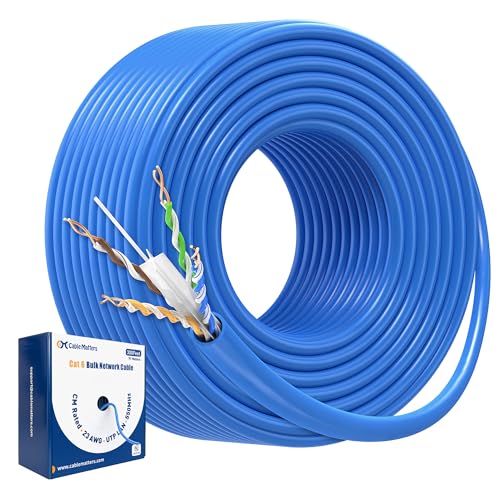
The UL-listed bulk spool for running cable through walls the professional way.
This is a bulk spool, not a pre-terminated patch cable. You get 300 feet of solid bare copper Cat6 on an easy-pull reel, designed to be cut to length and terminated with RJ45 connectors. It is CMR (communications riser) rated, meaning the jacket meets fire-safety standards for running between floors in a residential or commercial building — so you can install it safely in walls without violating building codes. Quality and ease of use are the two most-praised aspects, and owners call the cable flexible and easy to work with for a beginner.
The spec sheet is impressive: 23AWG solid bare copper (not CCA), 10 Gbps data transfer rate, 550 MHz bandwidth, and UL listed (E485863, a safety certification). Shoppers say using it for in-wall runs where it pulls cleanly without snagging, and terminated connections are stable with no drops. One owner using it for 1 Gbps networking confirmed consistent speeds and low latency. Another pushed 10 Gbps over a 30-foot terminated run without issues. The thicker 23 AWG wire here gives it an edge over a 24 AWG bulk cable for long runs.
The honest drawback is the tool investment. You need a crimping tool and RJ45 connectors to turn this spool into usable cables. For a single camera run, a pre-terminated cable like the GWFIBER is faster and cheaper. For a whole-house camera system with custom-length runs, 300 feet of bulk cable is exactly what the job demands.
Best for whole-home installs: If you are running cables to five different rooms or multiple cameras, this spool lets you cut exactly what you need with no waste and no ugly coil loops.
Reach for this if: you are tackling a multi-camera installation or wiring a new house and want proper in-wall rated cable.
Think twice if: you just need one cable for a single camera; a pre-terminated patch cable is simpler.
9. TRUE CABLE Cat6 Outdoor Bulk 500 ft
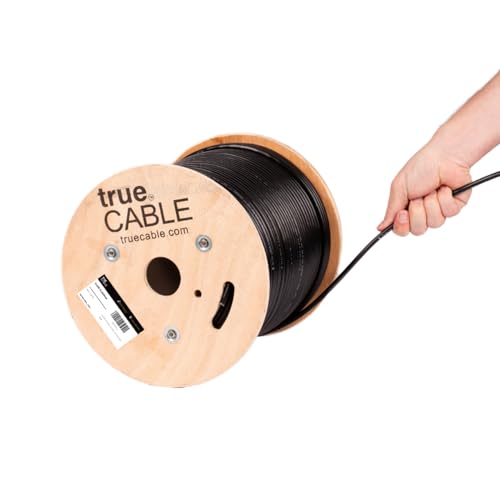
The 500-foot OSP spool for serious outdoor camera networks that must survive the sun.
TRUE CABLE builds this specifically for outdoor use. The OSP (outside plant) jacket is UV resistant and designed to withstand sunlight, snow, and ice without cracking — so it stays flexible and protects the copper inside, run after run. It uses 23AWG solid bare copper conductors, not CCA, which means it delivers consistent power for PoE devices and handles the IEEE 802.3af/at/bt standard up to 100W (PoE++, Power over Ethernet Plus Plus).
The cable supports up to 5 Gbps at 328 feet and 10 Gbps at 165 feet with a 550 MHz bandwidth. It is Fluke DSX-8000 certified (a network certification tool) and complies with ANSI/TIA 568.2-E standards. The 500-foot length arrives on a tangle-free spool that makes pulling easy. Buyers describe it as great quality with tight windings and a Cat6 plastic cross separator inside. This is the largest spool in the guide, giving you 200 feet more than the Cable Matters 300-ft option for big properties.
The honest limit: this cable is not rated for direct burial. The OSP jacket is UV-resistant for above-ground runs but does not have the gel or double-jacket construction needed for underground trenching. If you want to bury it, you need to run it through conduit.
Best for large outdoor networks: If you are wiring a property with six or eight outdoor cameras, a 500-foot spool of solid bare copper with a UV-stable jacket is the cost-effective way to do it right.
Grab this for: running cables along a roofline, across a backyard fence, or above ground between buildings.
Not for: direct burial in soil without putting it through a conduit first.
Understanding the Specs
AWG (American Wire Gauge)
AWG tells you how thick the copper wire is inside the cable. A lower number like 23AWG is thicker than 24AWG. Thicker wire has less electrical resistance, so it delivers more power and maintains a stronger signal over longer distances. For a PoE camera run over 50 feet, 24AWG is the safe minimum, 23AWG is better for runs approaching 100 feet.
Cat6 vs Cat6a vs Cat5
The category rating defines the maximum data speed and frequency the cable is tested for. Cat5 tops out at 100 Mbps — fine for a single camera but not future-proof. Cat6 handles 10 Gbps up to around 165 feet and is the current balance for PoE cameras. Cat6a pushes that 10 Gbps to the full 328-foot Ethernet limit and adds better crosstalk resistance — useful for very long runs.
Jacket Ratings (PVC, LLDPE, OSP, CMR)
The jacket is the plastic outer layer. PVC is standard indoor cable. LLDPE resists UV, water, and abrasion for above-ground outdoor use. OSP is made for outdoor exposure to sunlight and ice. CMR (riser-rated) has fire-resistant properties for running between floors inside a wall. Choose the jacket based on where the cable physically goes, not the data speed.
CCA vs Solid Bare Copper
CCA (copper-clad aluminum) uses an aluminum core with a thin copper coating. It is cheaper and lighter but has higher electrical resistance and is more brittle. Solid bare copper is pure copper throughout — it conducts power and data better, resists breakage, and handles PoE current more reliably. For a permanent camera installation, solid copper is worth the premium.