
Our readers keep the lights on and the weekend projects moving. As an Amazon Associate, I earn from qualifying purchases.
Specs are compiled from manufacturer listings and verified buyer reviews and can change over time — please confirm the key details on the product page before buying.
A power outage doesn’t announce itself, and neither should your backup plan. The real challenge with budget generators isn’t finding one that’s cheap—it’s finding one that starts on the first pull, runs your essentials all night, and doesn’t drown out every conversation in the campground. This guide cuts through the noise to hand you the quietest, most reliable picks without the premium price tag.
I’m Rikta — the founder and writer behind FitlyFast. This guide is built by comparing the manufacturers’ published specifications and the patterns across verified customer reviews, so you get each pick’s real strengths and trade-offs instead of marketing spin.
The right budget generator keeps power flowing for your home, RV, or job site while staying affordable or your back.
Our Picks at a Glance

How To Choose The Best Budget Generator
Buying a generator on a budget means you can’t afford to waste money on the wrong specs. Focus on these three things first, and you’ll land on a machine that performs well above its price.
Running Watts vs. Peak Watts
Running watts tell you what the generator can produce continuously. Peak watts (or surge watts) cover the extra kick needed to start a motor — like a refrigerator compressor or a window AC unit. Never buy based on peak watts alone. Your daily essentials (fridge, lights, furnace fan) must fall under the running wattage. As a rule of thumb, add up the running watts of everything you plan to power at once, then add 20-30% margin so the generator isn’t straining.
Clean Power (THD) for Sensitive Electronics
Total Harmonic Distortion (THD) measures how clean or “dirty” the electricity is. Less than 3% THD is considered clean power, also called pure sine wave. Modern electronics — laptops, CPAP machines, smart refrigerators, battery chargers — can be damaged by dirty power above 10% THD. Inverter generators almost always produce clean power, while some conventional open-frame models do not. If you plan to charge a phone or run a TV, look for a generator that explicitly states THD under 3%.
Portability and Noise
A generator you can’t easily lift or carry is a generator you’ll use less often. Weight and handle design matter, especially if you need to move it in and out of a car or RV. Every 10-pound reduction makes a real difference. Noise is measured in decibels (dBA) at a set distance, usually 23 feet. A comfortable conversation is about 60 dBA. Generators rated around 52-59 dBA are quiet enough for campsites and neighborhoods, while anything over 70 dBA will be loud enough for neighbors to notice.
Quick Comparison
| Model | Best For | Running Watts | Runtime | Weight | Amazon |
|---|---|---|---|---|---|
| Oxseryn 4400W Inverter★ Best Overall | Home Backup & RV | 3400W | 14 hrs (25% load) | 56 lbs | Amazon |
| AMERISUN 4500WTop Performer | Emergency Power | 3800W | 6.5 hrs (50% load) | 68 lbs | Amazon |
| AIVOLT 1600WUltralight Champion | Ultralight Camping | 1260W | 8 hrs (25% load) | 28 lbs | Amazon |
| Oxseryn 2800W Inverter | Compact Backup | 2000W | 9 hrs (25% load) | 56 lbs | Amazon |
| POXURIO 2550W | Quiet Jobsite Use | 2000W | 10 hrs (25% load) | 43.9 lbs | Amazon |
| PowerSmart 3600W | RV & Camping | 3200W | 8 hrs (25% load) | 50.7 lbs | Amazon |
| Westinghouse 2550W Dual Fuel | Gas & Propane Versatility | 1900W | 12 hrs (gas) | 42.4 lbs | Amazon |
| Pulsar PGD40ISCO | Lightweight High Power | 3200W | 4 hrs (half load) | 47.3 lbs | Amazon |
| WEN 56360i | Reliable All-Rounder | 2900W | ~4 hrs (AC load) | 46 lbs | Amazon |
In‑Depth Reviews
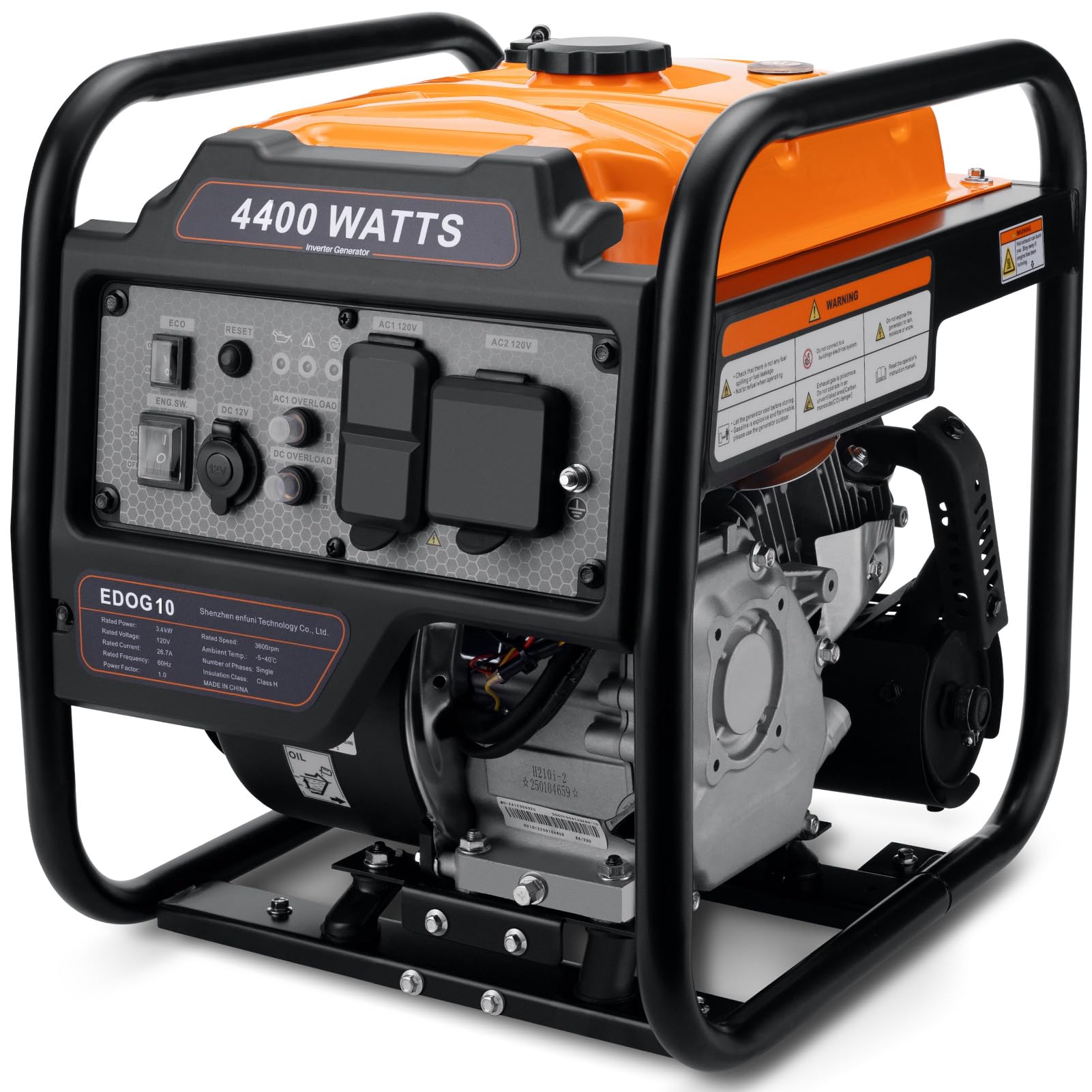
1. Oxseryn 4400W Inverter Generator
A 56-pound workhorse that outruns the competition by running 14 hours on a single tank.
The standout feature here is the runtime — up to 14 hours at 25% load with ECO mode. That is up to 14 hours at 25% load, while the AMERISUN 4500W runs 6.5 hours at 50% load, and it comes from a 2-gallon fuel tank with a built-in fuel gauge so you always know your reserves. The 3400 running watts (4400 peak) are enough to run a fridge, freezer, AC, and microwave together — buyers report it even handled a welder without skipping a beat.
At 56 pounds, it’s noticeably lighter than the 68-pound AMERISUN, and the noise level of under 72 dBA from 23 feet away is reasonable for an open-frame inverter. The two 120V AC ports, one 12V DC port, and one RV port give you the outlets you need for home backup and camping without an adapter.
The catch is that the 2-gallon tank falls just short for overnight AC use — some owners add one more gallon’s worth of range for all-night comfort. A few also mention the fuel tank brackets are tough to remove during maintenance, so treat those bolts gently.
What Owners Love Most
- 14-hour runtime with ECO mode — a full night of power without refueling
- Lighter than many 4400W competitors — buyers call it “2/3 the weight of a Champion”
- Over 200 hours logged by owners with no issues reported
- Runs fridge, freezer, AC, microwave simultaneously, even a welder
A Few Honest Trade-offs
- Fuel tank needs about 1 gallon more for all-night AC use
- Bracket design makes removal difficult during service
- No CO auto-shutoff sensor for added safety
the balance: You get a portable generator that runs all night for home backup or RV camping and has enough power for multiple appliances — that is why this pick earns its spot.
Think Twice If: You want an ultralight unit under 30 pounds for solo car camping — the 56-pound weight is manageable but not backpack-friendly.
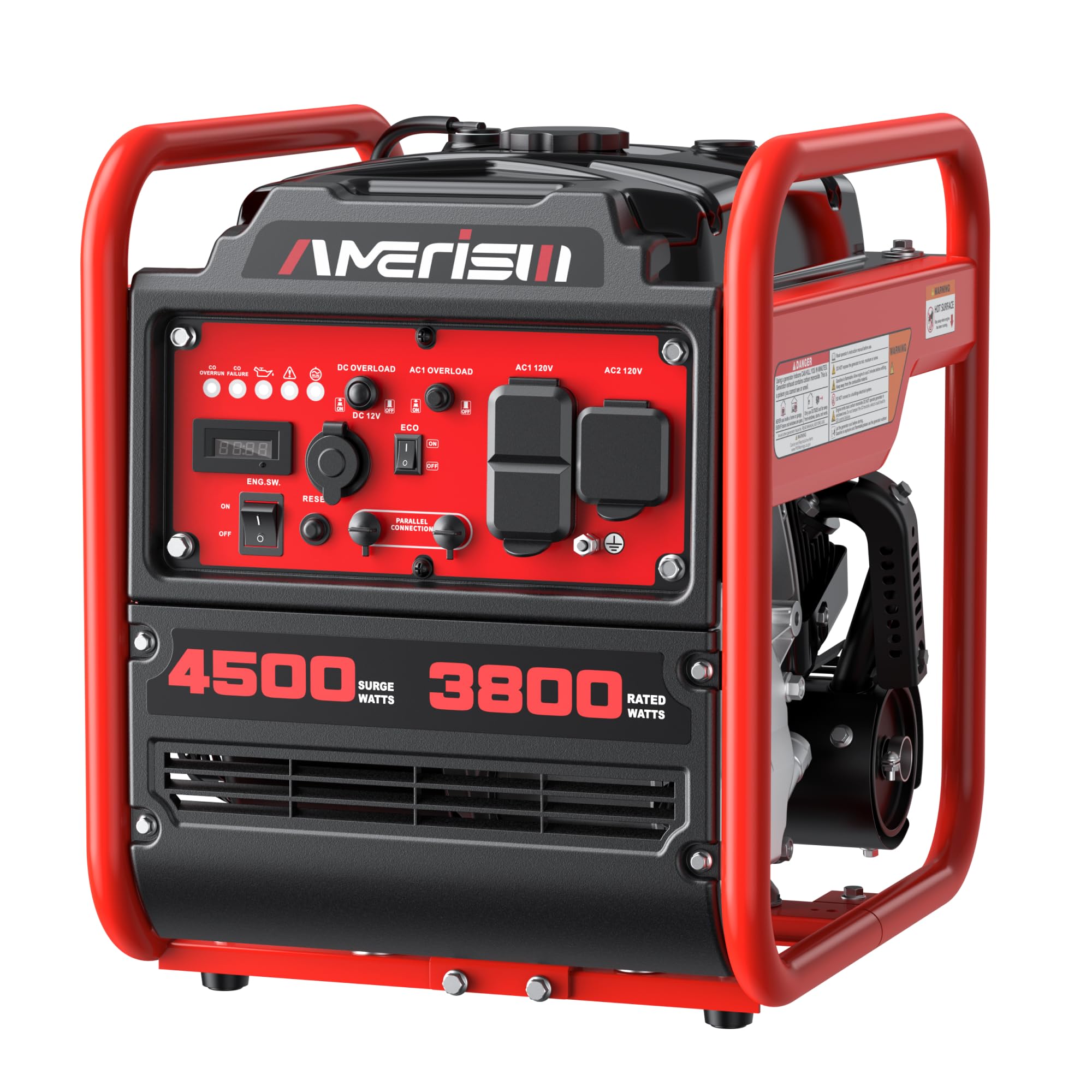
2. AMERISUN 4500W Open Frame Inverter Generator
The one with the built-in CO shutoff that powers an RV mini-split on a whisper.
You get 3800 running watts (4500 peak) — the most power among the picks here — plus a built-in carbon monoxide (CO) alert system that automatically shuts the unit down if dangerous levels are detected. That safety feature is rare at this price point, so you stay safer during emergency use. The smart ECO mode adjusts engine speed to demand, stretching runtime to 6.5 hours at 50% load.
What owners highlight most is the performance — it ran a 6000 BTU AC unit and a full house (fridge, washing machine, TV, PS5, fans, CPAP) without any power surges. Buyers also love that a 1-gallon tank can run over 11 hours under light use. The parallel-ready feature lets you connect a second unit for expanded output, and the digital display shows voltage, frequency, and runtime at a glance.
At 68 pounds, this is the heaviest unit on the list — a fair trade-off for the extra power and the built-in safety sensor. A few owners note that the CO sensor can be overly sensitive and may trigger a shutoff in windy conditions, and customer service response times have been inconsistent.
Safety-First Powerhouse: The integrated CO alert system is the defining edge here — few budget generators offer this level of protection.
Worth Knowing: Parallel-ready with two compatible units for over 9000 peak watts if you expand later.
Who This Works For: Anyone who needs high power for a house or large RV plus the built-in safety of automatic CO shutoff.
Who Should Pass: If you need a lightweight generator under 50 pounds for frequent moving, the 68-pound weight will be a strain.
3. AIVOLT 1600W Super Quiet Inverter Generator
At just 28 pounds, this 57 dBA inverter slips into a car trunk and runs all night on a whisper.
At 28 pounds, this generator weighs 28 pounds versus the Oxseryn 4400W at 56 pounds. The 1600 peak watts (1260 running watts) are modest, but paired with an 8-hour runtime at 25% load in ECO mode, it keeps a tent AC running through the night or charges phones, laptops, and a small portable fridge. The clean power output (THD under 3%) means your sensitive electronics — including camera gear and drones — get safe, stable electricity.
The pure sine wave inverter is also parallel capable, letting you connect a second AIVOLT for double the output. The control panel includes two 120V outlets plus USB-A and USB-C ports, which is convenient for modern devices. It’s EPA approved and ANSI/PGMA G300-2018 compliant, so it’s legal for use in most US states. The 2-year warranty and lifetime technical support add real value for a unit at this price.
Some owners also report the noise rating of 57 dBA is slightly optimistic and that the actual level is closer to 72-73 dB measured close up under load. A small number of units have arrived with carburetor defects, though customer service has been responsive with replacements.
Why Owners Pick This
- Ultralight 28-pound design — easily carried one-handed
- 8-hour runtime on ECO mode for overnight camping
- Pure sine wave <3% THD safe for phones, laptops, CPAP
- USB-A and USB-C ports built-in
The Practical Limits
- 1260 running watts limits you to small appliances only
- Noise is louder at close range than the 57 dBA rating suggests
- Restart delay after hot shutoff — cooling period required
Best For: Tent campers, van lifers, and anyone who needs a truly portable generator that fits in small spaces and runs sensitive electronics safely.
skip it if: You need to power a full-size fridge, sump pump, or a large AC unit — the 1260 running watts won’t cut it.
4. Oxseryn 2800W Portable Inverter Generator
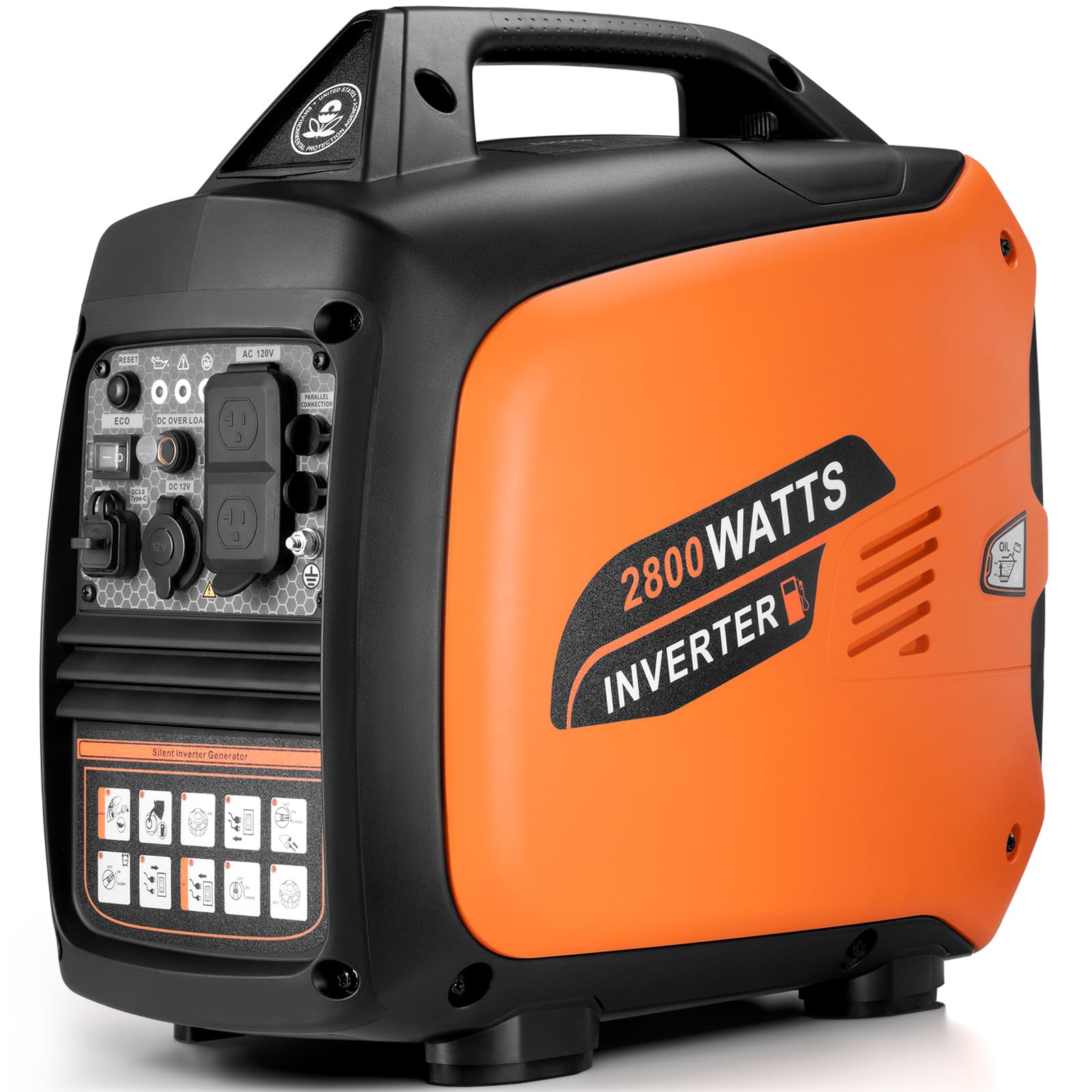
A 56-pound inverter that delivers 2800 peak watts and 9 hours of quiet runtime — a tight fit for any trunk.
The defining trait here is the balance of power and portability: 2000 running watts (2800 peak) from a 79.8cc engine that weighs just 56 pounds. That is enough juice to run a toaster oven, RV converter, and refrigerator — but not quite enough for a microwave alone, as some owners found. The 1.1-gallon fuel tank delivers up to 9 hours of runtime at 25% load, and the 58 dBA noise rating at 23 feet keeps it quiet enough for campsite use. The clean power output (under 3% THD) means it is safe for laptops, drones, and camera charging.
Where this generator really shines is its port options: two 120V AC ports, one 12V DC port, a USB-A port, and a USB-C port — all in a compact 17.9 x 11.2 x 17.35-inch frame. The parallel function lets you link a second unit for more power when needed. Owners consistently praise the first-pull start and the fuel economy, with one running it for 4 hours on just 0.5 gallons of gas.
The most common frustration is oil access — you must remove a side panel to check or fill the oil, which can be messy. A few early units showed metal grit in the initial oil change, though this seems to clear up after the break-in period.
The All-Day Camping Buddy: 9 hours of runtime with clean power and USB-C in a package that doesn’t dominate your trunk space.
One Detail to Note: Side-panel removal for oil service is awkward — keep a syringe handy for cleaner changes.
Reach for This If: You want a compact inverter that handles RV essentials and electronics for a full day without refueling.
Look Elsewhere If: You need to run a microwave alone — this one stumbles near its 2000-watt max.
5. POXURIO 2550W Portable Inverter Generator
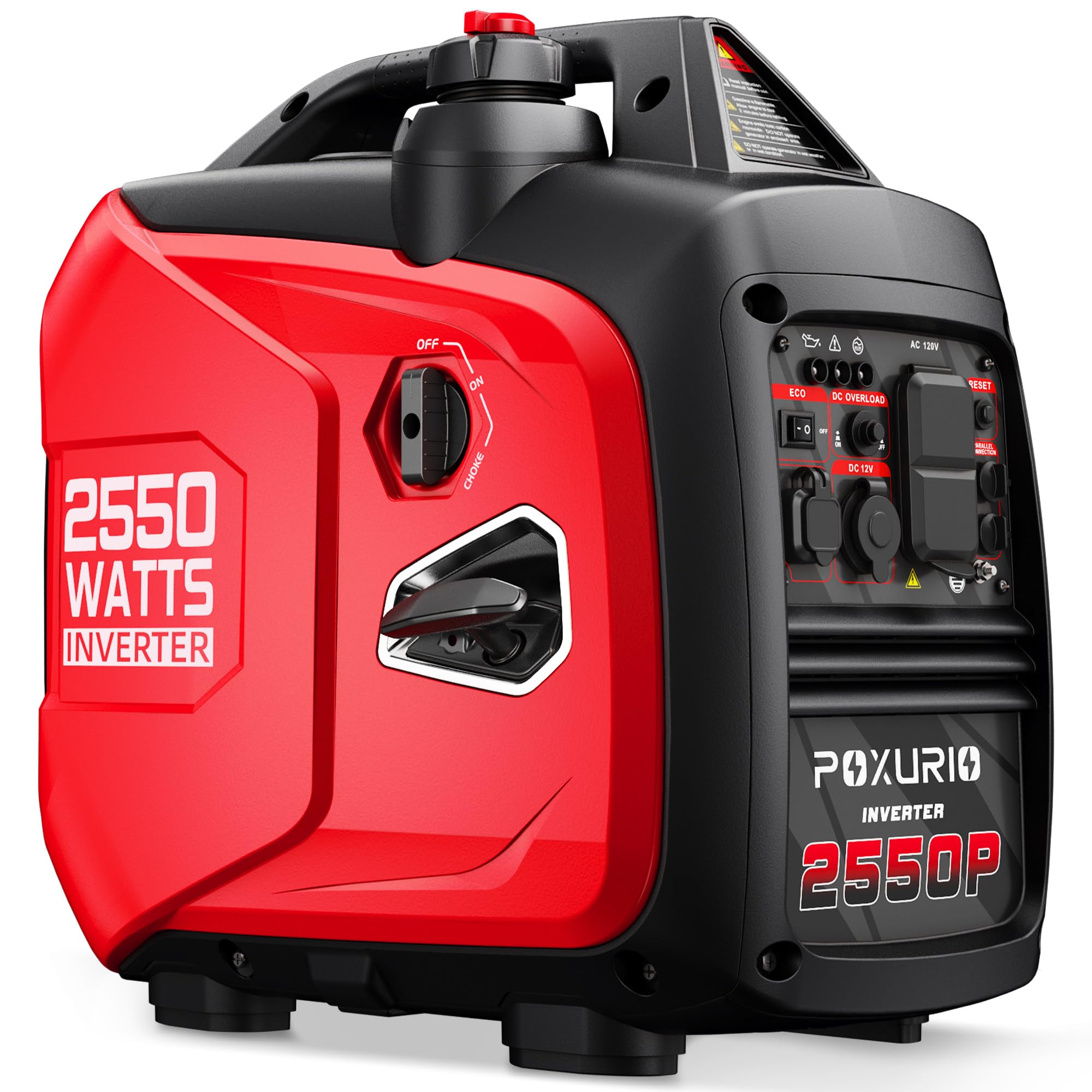
A value-focused inverter with a 4-liter tank that runs 10 hours — great for distance from outlets.
Starting with a 2550 peak watt and 2000 running watt output, this generator targets campers and homeowners who need consistent power without a big spend. The 4-liter (roughly 1 gallon) fuel tank is the draw — up to 10 hours of runtime at 25% load means you can run lights, a small refrigerator, and charge devices through the night. The 59 dBA noise rating keeps it polite for campgrounds and neighborhoods, and the low-oil and overload indicators take the guesswork out of maintenance. Owners note it starts on the first pull and powers an RV air conditioner, coffee pot, TV, and Starlink simultaneously (not all at full load).
The portability is solid at 43.9 pounds, and the 21.26-inch length includes a built-in handle. The control panel includes multiple ports for flexibility. EPA compliance means it is legal in most states.
Where opinions split is on capacity: some owners find the 1-gallon tank runs only about 3 hours under heavy AC load, rather than the advertised 10 hours at 25% load. Noise also climbs noticeably under high demand, and the instruction manual is unclear on maintenance steps. A small percentage of units have arrived defective.
Strong Points
- 10 hours runtime at 25% load stretches your fuel dollar
- 59 dBA is genuinely quiet at moderate load
- First-pull start reliability praised by many owners
- Low-oil and overload indicator lights
Areas to Watch
- ~3 hours runtime under full AC load — not the advertised 10
- Noise increases significantly at high load
- Manual is unclear on proper setup and storage
Who This Suits: Budget-conscious campers who run moderate loads (lights, fans, fridge, TV) and prioritize fuel-efficient runtime over raw power.
Who Might Be Frustrated: Anyone expecting 10 hours under heavy load — run times drop fast when you push the 2550 watts near its limit.
6. PowerSmart 3600W Portable Inverter Generator
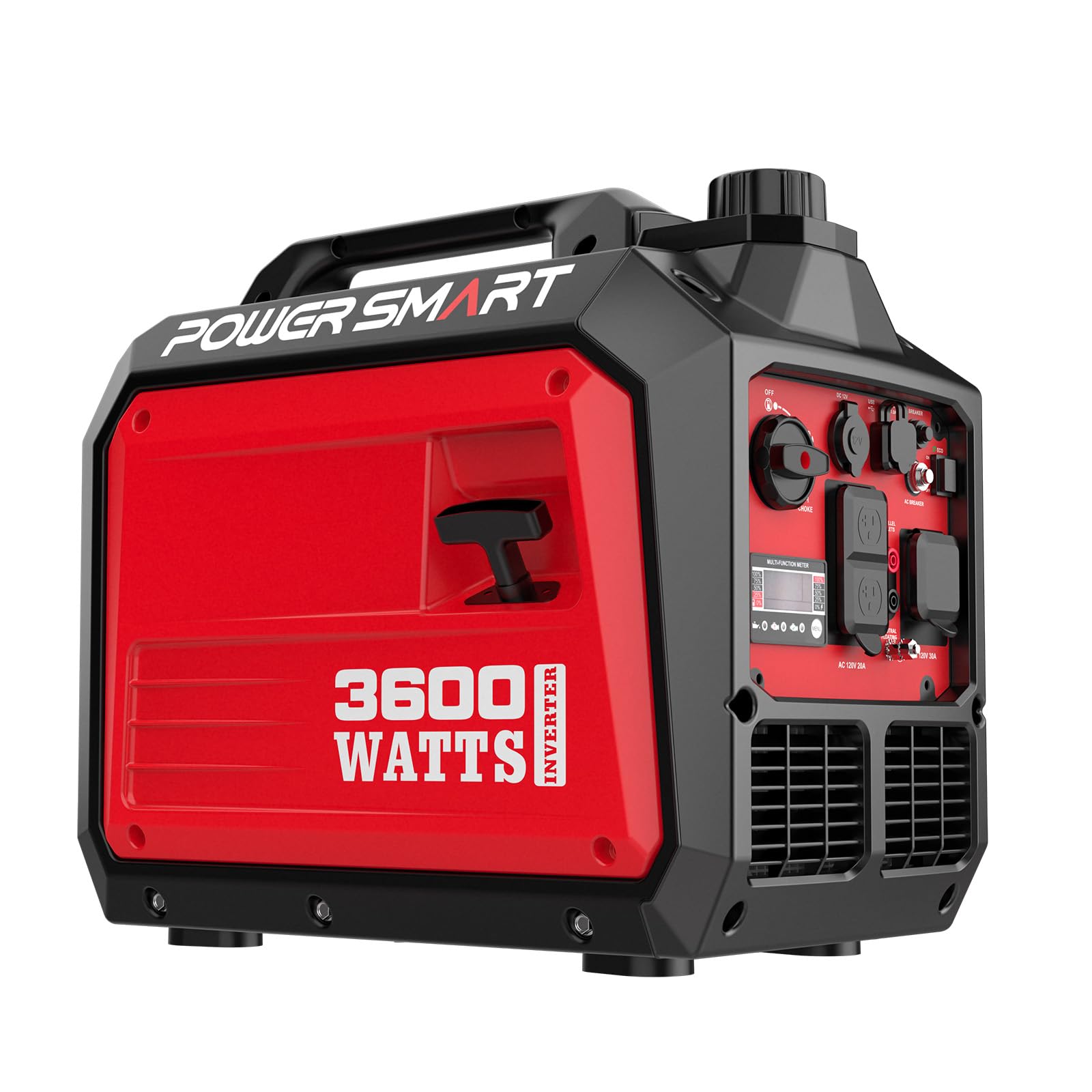
A 3600-peak-watt inverter with 59 dBA noise that owners call “half the weight of standard generators.”
This generator produces 3600 peak watts and 3200 rated watts with clean power (THD under 3%), making it safe for sensitive electronics like smartphones, laptops, and tablets. The 1.3-gallon fuel tank delivers up to 8 hours of runtime at 25% load in ECO mode, which is enough for overnight camping. At 59 dBA from 23 feet at 25% load, it is quiet enough for peaceful campsite use.
The control panel includes a 120V 30A L5-30R twist-lock outlet (use an RV adapter for RV hookup), a 120V 20A 5-20R duplex household outlet, a 12V 8A DC port, and dual 5V 2.1A USB ports — a versatile combo for both household and RV use. The parallel capability lets you connect a second PowerSmart 3600W unit to double your output. Owners praise its reliability, with one noting it runs a small freezer effectively, and its ease of start and transport for camping trips. The 2-year limited warranty and free lifetime technical support add assurance.
There is one notable complaint: some owners find the wattage rating misleading. A 3600W unit reportedly fails to run a 1600-2000W air conditioner, showing an overload. This suggests the rated wattage may be optimistic under certain conditions.
The Reliable Workhorse: 3200 clean watts and a versatile outlet panel in a 50.7-pound package that owners trust for camping and home backup.
One Caveat: The wattage rating may be generous — some 2000W AC units push it into overload. Keep your real load under 3000W to be safe.
Good For: Campers who need clean power for sensitive electronics plus the ability to run RV appliances and equipment with a trusted brand.
Not Ideal If: You need to reliably start a large AC unit near 2000W — the overload protection may trip.
7. Westinghouse 2550W Dual Fuel Inverter Generator

A dual-fuel inverter that switches between gas and propane — 2550 peak watts at 52 dBA.
The ability to run on either gasoline or LP gas is the headline feature here, giving you flexibility no other pick in this list offers below the premium tier. With 1900 running watts (2550 peak) and a low 52 dBA noise output in ECO mode, this generator is extremely quiet and efficient — up to 12 hours of run time on a 1.16-gallon gas tank. That makes it a strong choice for extended camping trips or emergency backup during power outages. It’s also lightweight for its class at 42.4 pounds, with an RV-ready TT-30R outlet.
Owners consistently praise the reliability — it powers an RV AC unit and charges a battery bank simultaneously. The propane option eliminates the hassles of stale gas and stores indefinitely, which is a major advantage for emergency preparedness. The plug-and-play package includes oil, funnel, tool kit, propane hose, and a user’s manual. The 3-year limited service warranty and nationwide customer service network add confidence.
Some units have arrived defective or failed to start on propane, and a few owners note the need for a magnetic dipstick to monitor oil levels. The support response time can be slow at 48 hours.
Why Owners Choose Westinghouse
- Dual-fuel (gas & propane) — propane stores indefinitely and burns clean
- As low as 52 dBA noise output — the quietest on this list
- 12 hours runtime on gasoline in ECO mode
- Comes with oil, funnel, propane hose, and tools
The Real Trade-offs
- 1900 running watts limits you to smaller appliances
- Some units arrive defective or won’t start on propane
- Customer support response can take up to 48 hours
Best For: Emergency preppers and campers who want the fuel flexibility of gas and propane in a very quiet, lightweight package.
Skip If: You need more than 1900 running watts for heavy appliances — the dual-fuel versatility comes with a power limit.
8. Pulsar PGD40ISCO 4000W Inverter Generator

A 47-pound inverter with 4000 peak watts that one owner calls “the best purchase ever” for a tiny home.
This inverter delivers 4000 peak watts and 3200 rated watts while weighing only 47.3 pounds — that is a strong power-to-weight ratio for a budget generator. The 1-gallon fuel tank provides about 4 hours of runtime at half load, which is shorter than many competitors but acceptable for intermittent use like running a 13,500 BTU RV air conditioner during the day. The 59 dB noise rating makes it quiet enough for campgrounds and neighborhoods.
What owners really love is the portability — one described carrying it with one hand, and another said it runs a tiny home for 4-plus hours without issue. The parallel-ready feature lets you connect a second unit, and the three-prong and RV-ready outlets cover most needs. The build quality is praised, with one owner logging 410 hours over 3 summers with no issues using ethanol-free fuel and regular oil changes.
The small fuel tank is the main limit — about 5-6 hours with AC overnight and 4 hours during the day. It is also slightly louder than some premium inverter models like the Predator 3500 or Honda EU2000. The lack of wheels can make it tricky on rough terrain.
Lightweight Heavy Hitter: At 47.3 pounds, this 4000W inverter is surprisingly easy to move and powerful enough for RV AC and home essentials.
The Fuel Factor: The 1-gallon tank limits runtime to 4 hours at half load — not a whole-night generator.
Who This Fits: RV owners who need a portable but powerful generator for daytime AC use and can refuel regularly.
Not For: Overnight campers who want to fill the tank once and sleep through — you will be up every 4-5 hours.
9. WEN 56360i 3600W Inverter Generator

A 46-pound inverter with 2900 running watts and a fuel shutoff that protects the carburetor every time.
The 149cc engine in the WEN 56360i produces 3600 surge watts and 2900 rated watts, with clean power that is safe for sensitive electronics like smartphones, tablets, and laptops. The standout design choice is the fuel shutoff valve — it lets you run the carburetor dry before shutdown, which prevents old fuel from gelling up and extends the generator’s lifespan significantly. That is a simple but effective feature for anyone who stores a generator between uses.
At just 46 pounds, it is one of the lightest 3600W-class units available, and the quiet operation — owners describe a “gentle purr” in ECO mode — makes it suitable for campgrounds and suburban neighborhoods. The control panel includes two three-prong 120V receptacles, a TT-30R RV receptacle, a 12V DC receptacle, and two USB ports. The three-year warranty is among the best on this list.
Owners consistently praise how it starts on the first pull, even in cold weather, and how it powers a 13,000 BTU air conditioner, furnace fan, lights, and battery charger without issue. The downsides are relatively minor: the oil must be changed every 25 hours (no oil filter), and a few units have arrived with dirty carburetors or gas in the oil that takes some cleaning to resolve.
What Stands Out
- Fuel shutoff valve prevents carburetor damage during storage
- 46 pounds — one of the lightest for 3600 surge watts
- 3-year warranty is the longest on this list
- Quiet operation — owners describe it as a “gentle purr”
Minor Notes
- Oil change every 25 hours required — no filter
- Some units arrive with carburetor issues needing cleaning
- Fuel consumption ~1 gallon per 4-5 hours under AC load
Best For: Homeowners and RV campers who plan to store the generator for months between uses — the fuel shutoff is a genuine longevity hack.
Consider Another If: You want a simple to use out-of-box experience with zero carburetor maintenance — a small number of units need initial cleaning.
Understanding the Specs
Running Watts and Peak Watts
Every generator has two power numbers. Running watts (also called rated watts) is what the engine can produce continuously hour after hour. Peak watts (surge watts) is a short burst for starting electric motors — think refrigerator compressor startup or an air conditioner’s initial kick. A common beginner mistake is buying based on peak watts alone, then finding the unit can’t sustain the load. Always add up the running watts of everything you plan to run at the same time (lights, fridge, furnace fan, laptop charger) and make sure that total is under the generator’s running wattage. Then check that the largest motor’s startup surge doesn’t exceed the peak watts.
Runtime and Fuel Tank Size
Runtime is always quoted at a specific load percentage — typically 25% or 50% load. At 25% load, you are using about a quarter of the generator’s maximum capacity (running a few lights and a laptop). At 50% load, you are using half (a fridge and a TV plus some lights). Runtime is always shorter at higher loads. A 14-hour runtime at 25% load can drop to 6-8 hours at half load or 3-4 hours near full load. Fuel tank size (gallons or liters) directly affects runtime: a 2-gallon tank will generally run longer than a 1-gallon tank at the same load, but generator efficiency matters too. ECO mode adjusts the engine speed to match demand, saving fuel when you are not pushing the unit hard.
FAQ
What size generator do I need for a refrigerator and freezer?
Is a 2000 watt generator enough to run an RV air conditioner?
Can I run a generator in the rain?
How often do I need to change the oil in a budget generator?
What does ECO mode do on a generator?
Is it safe to use a generator with a power strip for sensitive electronics?
How long can a generator sit before the gas goes bad?
Do I need to let the generator cool down before refueling?
Final Thoughts: The Verdict
For most buyers, the budget generator winner is the Oxseryn 4400W Inverter Generator because it pairs the longest 14-hour runtime with 3400 running watts at a weight that stays manageable for one person. If you want an ultralight option for tent camping and sensitive electronics, grab the AIVOLT 1600W at just 28 pounds with 8 hours of runtime. And for dual-fuel flexibility and propane storage, the Westinghouse 2550W is the one to reach for — it burns clean propane, stores practically forever, and runs quieter than most conversations.
How We Picked
We do not accept paid placement. Every pick is matched to a real buyer and a real use-case; we do not hands-on test units.
Sources & Methodology
Specifications: manufacturer listings and product documentation. Review insights: verified customer reviews, as of July 2026. Pricing: not shown on this page (it changes often); check the current price via the retailer link.
As an Amazon Associate, FitlyFast earns from qualifying purchases. This does not affect which products we feature.