
Our readers keep the lights on and the weekend projects moving. As an Amazon Associate, I earn from qualifying purchases.
Specs are compiled from manufacturer listings and verified buyer reviews and can change over time — please confirm the key details on the product page before buying.
You want stereo sound that makes movies feel bigger and music you actually hear — without draining your wallet. The tricky part is figuring out which cheap speakers actually deliver good sound and which ones will just frustrate you. This guide cuts through the noise by matching the best budget stereo speakers to the right buyer, using real owner feedback and hard specs to steer you straight.
I’m Rikta — the founder and writer behind FitlyFast. This guide is built by comparing the manufacturers’ published specifications and the patterns across verified customer reviews, so you get each pick’s real strengths and trade-offs instead of marketing spin.
The speakers here cover a wide range of budgets, inputs, and sizes, because the right budget stereo speakers for your desk won’t be the same as the ones that fit your living room turntable setup.
Our Picks at a Glance

How To Choose The Best Budget Stereo Speakers
Buying speakers on a budget means making smart trade-offs. You can get incredible sound for under, but only if you know what to prioritize. Here are the key decisions that will shape your listening experience.
Powered vs. Passive: What’s the real difference?
A powered speaker has its own amplifier built in — you just plug it into the wall and connect your audio source. This is the simplest option for a desk or turntable. A passive speaker needs a separate stereo receiver or amplifier to power it, which adds cost and complexity but lets you upgrade components individually. For most people on a budget, powered speakers are the smarter, easier choice.
Driver size and what it means for bass
The woofer — the larger driver that handles lower frequencies — is usually measured in inches. A 4-inch or 5.25-inch driver can deliver satisfying bass for music and movies. A 3-inch driver will still sound clear and balanced but won’t shake the room. If you love bass-heavy music or action movies, aim for at least a 4-inch woofer, or plan to add a subwoofer later.
Connectivity: Match the speakers to your gear
Check what connections your turntable, TV, or computer uses. Bluetooth is great for streaming from a phone, but it introduces a tiny delay that can bother serious gamers or videographers. RCA and AUX inputs are wired and deliver lossless audio. If you are building a studio setup, balanced TRS or XLR inputs keep noise low over longer cable runs.
Quick Comparison
| Model | Best For | Type | Woofer Size | Key Inputs | Amazon |
|---|---|---|---|---|---|
| Electrohome Huntley★ Best Overall | Compact desktop & small-space listening | Powered | 3 in | Bluetooth 5, RCA, AUX | Amazon |
| Ortizan C7Top Performer | Near-field studio & critical listening | Powered | 3.5 in | BT 5.3, USB-C, RCA, TRS | Amazon |
| Pyle PHQBS53CHBest Value | Room-filling home theater sound | Passive | 5.25 in | 5-way binding posts | Amazon |
| Rockville RockShelf 68C | High-power movie & music setups | Passive | 6.5 in | 5-way binding posts | Amazon |
| Edifier MR3 | Versatile desktop with app EQ | Powered | 3.5 in | BT 5.4, TRS, RCA, AUX | Amazon |
| Edifier R1280T | Entry-level bookshelf with remote | Powered | 4 in | Dual AUX | Amazon |
| Micca MB42X G2 | High-fidelity passive system | Passive | 4 in (Carbon Fiber) | Speaker wire | Amazon |
| PreSonus Eris Accent | Turntable and vinyl listening | Powered | 4 in | USB-C, RCA, sub out | Amazon |
In‑Depth Reviews
1. Electrohome Huntley Powered Bookshelf Speakers
Smart-sounding speakers that resist the urge to shout.
These compact bookshelf speakers produce a warm and natural sound that is easy to listen to for hours — exactly what you want for a record player or a day of TV. The 3-inch drivers won’t rattle the windows, but owners describe the sound as “great” and “big” for the size, with the audio staying balanced even when the room is filled.
Setup is a two-minute job: plug in the power cord, connect your device via Bluetooth 5, RCA, or AUX, and you are listening. The classic retro wood cabinet (a handcrafted MDF build) looks good on a console, and the rear ported design helps squeeze out a bit more low-end presence without needing a subwoofer. The main trade-off is the bass — it is present but not deep, so if you want chest-thumping lows, you will want a subwoofer.
As buyers put it, the speakers perform great for both TV (wired) and music (Bluetooth) in small spaces. Quality and value for money are the two most-praised traits here, with 44 owners specifically calling out the price-to-performance ratio.
Why Owners Love It
- Easy Bluetooth pairing and wired setup
- Natural, warm sound that doesn’t fatigue
- Attractive wood cabinet fits small spaces
The Trade-Off
- Bass is polite — a subwoofer helps for bass-heavy content
- Sound quality reviews are mixed overall, so expectations should match the price
Designed for: Anyone wanting an easy, attractive pair of powered speakers for a small apartment desk, turntable, or TV setup — no amplifier needed.
Think twice if: You need room-shaking bass for a large room or plan to use them for professional audio monitoring.
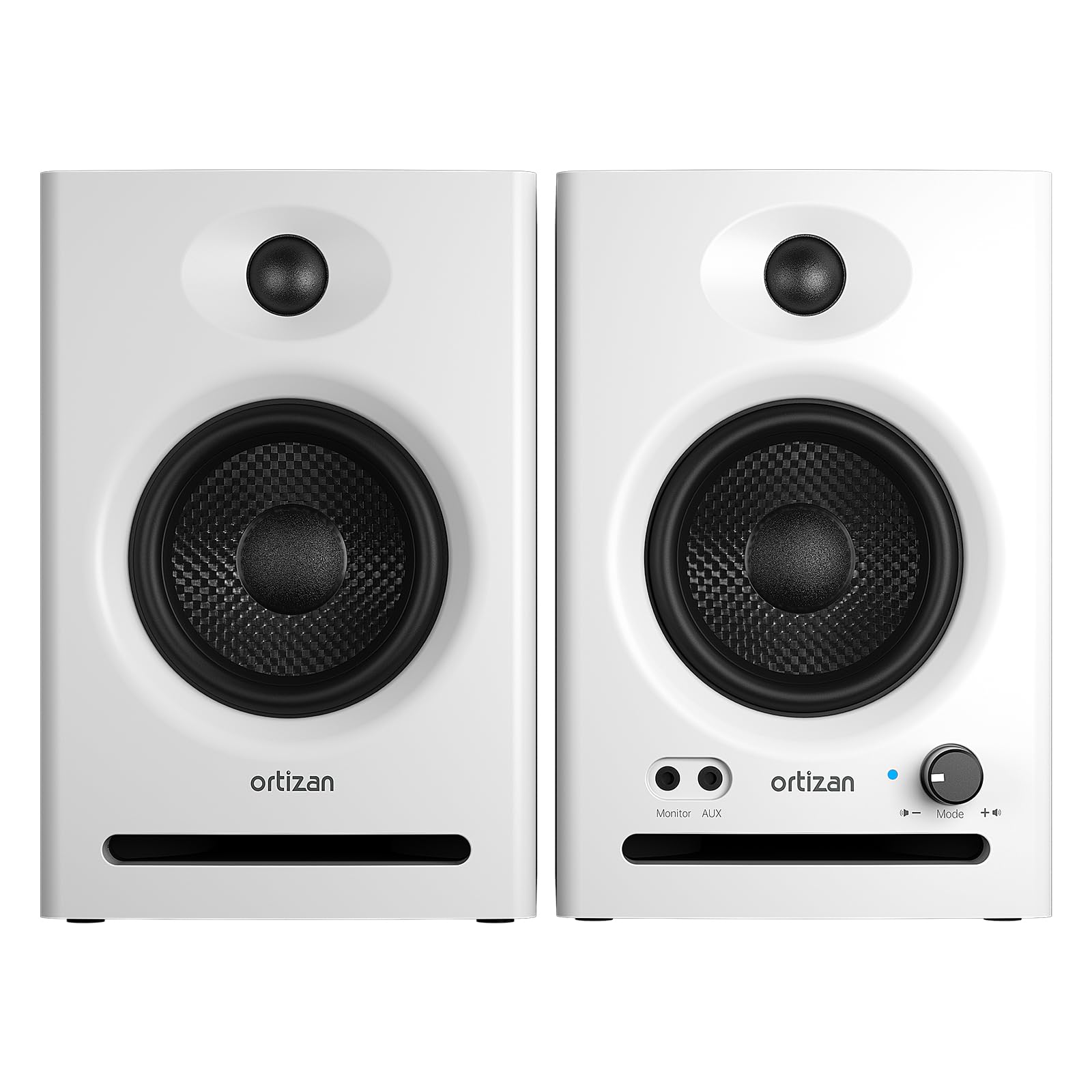
2. Ortizan C7 Dual-Mode 2.0 Studio Monitors
Studio-grade clarity that punches well above its weight class.
These active monitors are built for near-field music production, and they deliver an admirably flat frequency response that captures audio honestly — owners describe it as excellent value vs. major brands. The 3.5-inch driver and 0.75-inch silk dome tweeter, paired with an electronic 2-way crossover, produce precise mids and smooth, transparent highs with a low end that extends down to around 45Hz.
Connectivity is unusually generous for this price point: Bluetooth 5.3 pairs in seconds, plus you get a built-in 24-bit DAC over USB-C, RCA inputs, and 6.35mm TRS balanced inputs for connecting a mixing console or electric piano. Noise is low and the soundstage is detailed enough for critical listening. The honest catch is the bass — it is adequate for near-field work but noticeably weak if you expect deep low end without a subwoofer. Some owners also note a faint idle hiss and a choppy volume dial.
The sheer sound quality and build across over 800 ratings make this a standout for anyone who needs accurate monitoring on a tight budget.
The Highlights
- Near-flat frequency response — honest, accurate sound
- Multiple pro inputs (TRS, USB-C DAC, Bluetooth 5.3)
- Compact and durable build
The Caveats
- Bass extension is limited — a subwoofer fills it out
- Idle hiss is faint but present in quiet rooms
- No grille covers for the drivers
Perfect for: Bedroom producers, video editors, and anyone who wants flat, detailed sound for content creation on a desk.
skip it if: You just want casual, bass-heavy listening — these reveal imperfections more than they flatter.
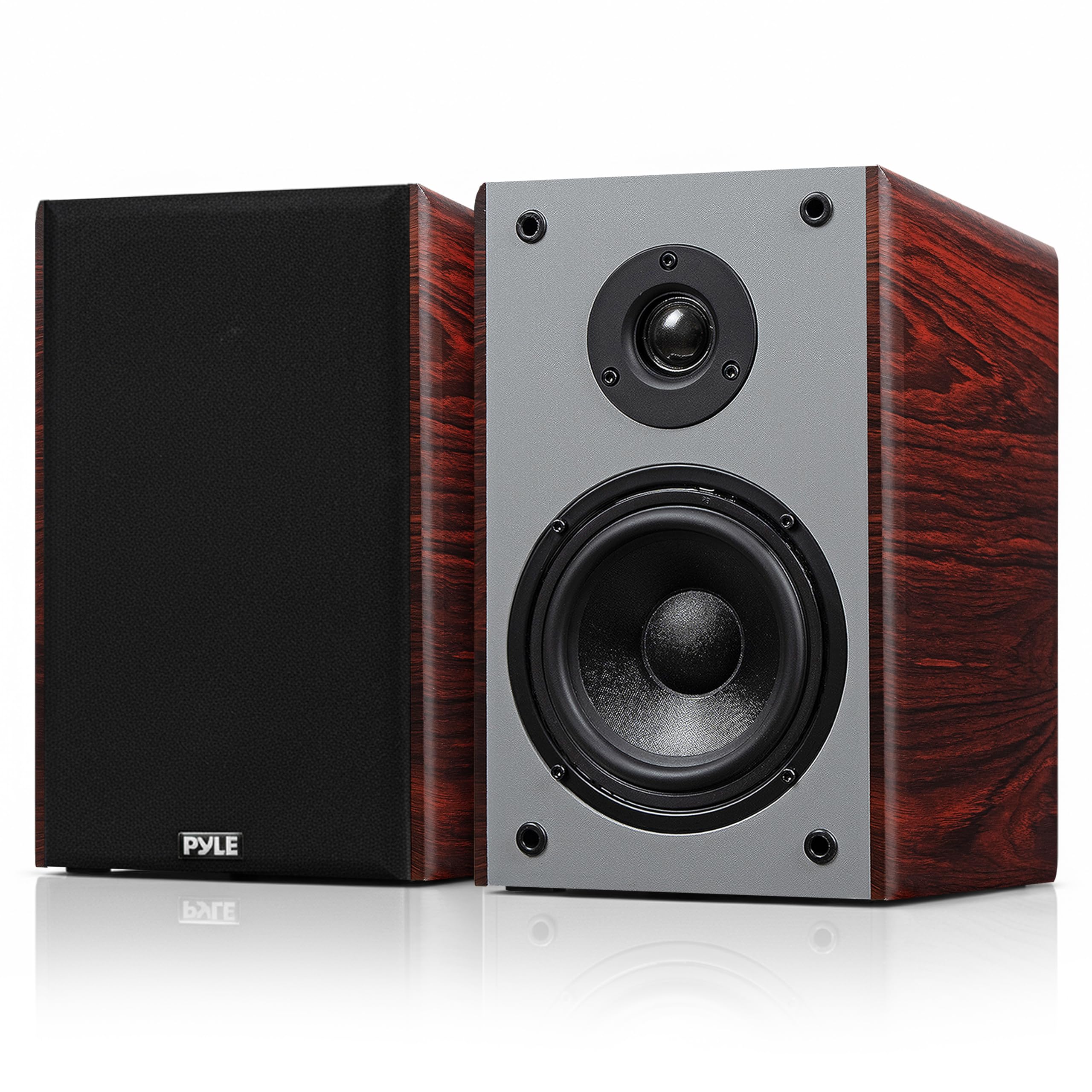
3. Pyle 5.25” Wired Bookshelf Speakers Pair
The bigger driver that fills a room without needing a sub.
These passive speakers pack a 5.25-inch woven glass fiber woofer and a 0.75-inch silk dome tweeter into a compact MDF cabinet with a cherry wood grain finish. They deliver 50W RMS each (100W per pair) and up to 200W peak, with a frequency range of 65Hz–20kHz. That means you get tight, responsive bass and crisp highs without the boxy boom of cheaper towers.
Compared to the smaller active speakers above, the Pyles need an external amplifier or receiver to work — they are passive. But owners switching from 80s-era three-way towers report being impressed by the clean, tight bass and clear treble. The gold-plated 5-way binding posts accept banana plugs or bare wire, and the built-in wall-mount brackets and magnetic grilles make setup clean. The sound quality is the most-praised feature by 81 owners, with build quality coming in second.
If you already own a stereo receiver, these speakers offer a massive jump in performance without stepping up to premium pricing.
Why It Works
- Room-filling 100W RMS power with clean bass
- High-quality MDF build and magnetic grilles
- Wall-mount brackets included
Before You Buy
- Requires a separate amplifier or receiver
- No Bluetooth or wireless connectivity
Reach for these if: You have a good amp and want budget speakers that outperform their price tag in a home theater or stereo setup.
Look elsewhere if: You need a simple, all-in-one powered solution — these need extra gear to play music.
4. Rockville RockShelf 68C V2 Bookshelf Speakers

The biggest woofers on the list, built to handle serious power.
These passive bookshelf speakers are in a different league for raw output. Each speaker uses a 6.5-inch Kevlar cone woofer and a 1-inch silk dome tweeter, handling 50W RMS per speaker (100W per pair) with peaks up to 400W per pair. The 8-ohm impedance makes them easy to pair with most home theater receivers, and the dark wood MDF cabinet is solid and resonance-free.
Buyers describe them as remarkably bright sounding with punchy lows and surprising bass for a sealed bookshelf design. The gold-plated 5-way binding posts (connectors that accept bare wire, banana plugs, or spade lugs) and detachable magnetic grilles add convenience, and the included wall-mount brackets give placement flexibility. The most-discussed trait is sound quality (54 positive mentions), and owners note they sound incredible for the price, with some calling them identical to the Pyle at a lower cost — though they lack the Pyle’s slightly lower-frequency extension (so you get less deep bass rumble).
The honest take: they are lightweight for their size, bright in the high end, and would benefit from a subwoofer if you crave deeper sub-bass.
Standout Specs
- 6.5″ Kevlar woofers deliver real low-end presence
- High 400W peak power handling
- Solid wood-grain MDF build
Consider This
- Passive — an external amp is required
- Bright tweeters may need EQ taming in some rooms
- Bass is punchy but not subwoofer-deep
Best for: Home theater setups in small-to-medium rooms where you want big, dynamic sound from a passive pair without spending premium money.
Not for: A desk setup with no receiver — these need amplification to work.
5. Edifier MR3 Powered Studio Monitor Speakers

Hi-Res certified monitors with an app that lets you dial in your sound.
The Edifier MR3 is a powered near-field monitor with Hi-Res Audio certification, meaning it reproduces sound from 52Hz up to 40kHz — far beyond what human hearing captures, ensuring the audible range is exceptionally clear. It pushes 18W per channel with a peak SPL of 92.5dB, driven by a 3.5-inch mid-low driver and a 1-inch tweeter.
What sets the MR3 apart from the Ortizan C7 above is the customizable sound experience. You can switch between Music, Monitor, and Custom modes, then fine-tune EQ through the EDIFIER ConneX app. Owners describe the sound as clean, neutral, and detailed with tight bass and sparkling highs, reporting zero hiss and no distortion even at loud volumes. Inputs include balanced TRS, RCA, AUX, and Bluetooth 5.4 with multi-point connection — plus a front headphone output.
The catch is that some owners find the Bluetooth pairing mode tricky to engage (the button is on the back), and a few note the mid-range can sound a bit flat without EQ adjustment.
What Stands Out
- Hi-Res Audio certified with 40kHz upper range
- App-based EQ for fine tuning
- Flawless Bluetooth 5.4 and multiple pro inputs
What to Know
- No deep sub-bass — needs a subwoofer for bass-heavy genres
- Bluetooth pairing button is on the back, not intuitive
Ideal for: The desktop user who wants studio-level accuracy, wireless streaming, and the ability to tweak the sound signature to their taste.
Consider alternatives if: You need a simple plug-and-play experience with no app or settings to configure.
6. Edifier R1280T Powered Bookshelf Speakers

The people’s champion of budget bookshelf speakers — for good reason.
The Edifier R1280T is a near-legendary entry-level powered speaker. It uses a 13mm silk dome tweeter and a 4-inch full-range driver to deliver 42 watts RMS with natural sound reproduction. The wood-effect MDF cabinet looks classic and blends into any room, and the side-panel controls let you tweak treble and bass to your liking.
Owners consistently praise the sound quality (90 positive mentions) and the convenience of the included remote control. Setup takes about ten minutes, and the dual AUX inputs let you connect two devices at once — no plugging and unplugging. The honest limitation is bass depth. Words like “crisp highs” and “consistent mids” come up often, and most owners recommend adding a subwoofer for a more balanced sound. It is not a studio monitor; it is a friendly, musical speaker that makes everything sound good.
Compared to the more neutral Edifier MR3, the R1280T leans warmer and more forgiving, which many listeners actually prefer for casual enjoyment.
The Appeal
- Warm, natural sound that is easy to enjoy
- Remote control and side EQ knobs
- Dual AUX inputs for two devices
The Limit
- Bass is polite — a subwoofer is a worthwhile add-on
Who it fits: The first-time buyer who wants a simple, great-sounding pair of powered speakers with remote control and adjustable EQ.
Who might want more: Bass lovers and critical listeners who need deep low-end extension or a flat studio response.
7. Micca MB42X G2 Premium 2-Way Passive Bookshelf Speakers

The updated classic that stays neutral without sounding clinical.
The Micca MB42X G2 is the successor to among the most popular budget audiophile speakers. It upgrades to a 4-inch carbon fiber woofer with a rubber surround (which helps the cone move smoothly for cleaner bass), paired with a 0.75-inch silk dome tweeter (a soft fabric dome that produces smooth high frequencies), and a precision-tuned 12dB/octave crossover (a filter that splits the audio signal between woofer and tweeter at a steep rate). The result is a neutral tonal balance with improved time alignment — music and movies sound dynamic and natural, not artificially boosted.
These are passive speakers, so they need an external amplifier — but they handle up to 80 watts each and can fill a medium room with ease. Owners say the sound is detailed, well-balanced, and far bigger than the compact cabinet suggests. The frequency response stretches from 55Hz to 20kHz, and the bass is impressively tight for the size, though a subwoofer is still recommended for bass-heavy content. The crossover gives a more relaxed, less bright sound than the first generation, which owners say reduces listening fatigue.
The honest setup note: they need around 100+ hours of break-in to reach their full potential. Without a subwoofer, the bottom octave is missing.
What’s Great
- Neutral, balanced sound with less listener fatigue
- Carbon fiber woofer for tight, articulate bass
- Compact design fits small shelves
The Fine Print
- Needs a separate amplifier or receiver
- Deep bass requires a subwoofer
- Long break-in time before sound stabilizes
Great for: The hobbyist upgrading from a cheap soundbar who wants neutral audiophile sound without spending premium money.
Not ideal for: Anyone without an existing amplifier or who wants bass-heavy, room-shaking sound from the start.
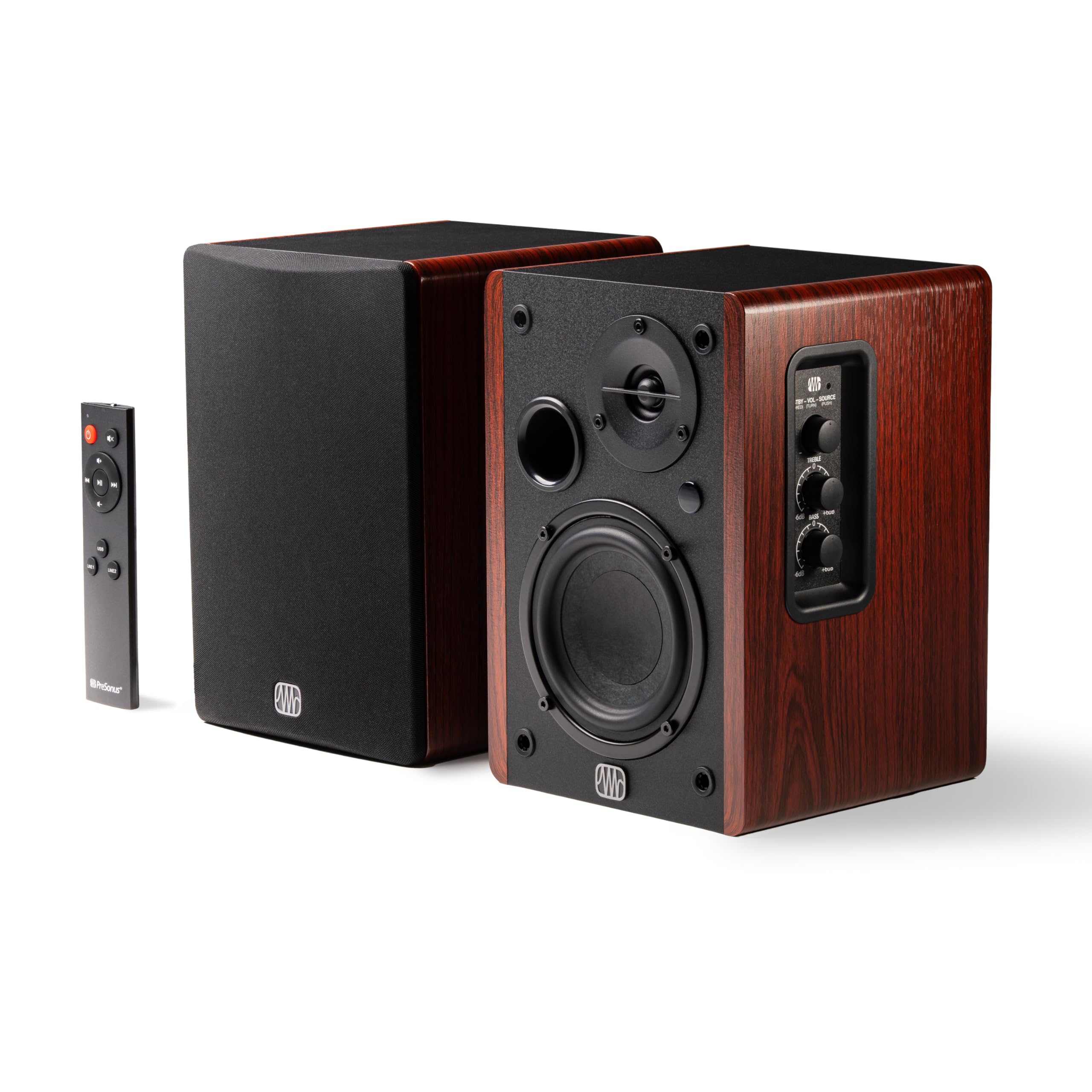
8. PreSonus Eris Accent Powered Bookshelf Speakers
Studio lineage meets vinyl warmth — with a remote control to boot.
PreSonus is a respected name in pro audio, and the Eris Accent brings that studio-quality sound to a budget-friendly powered bookshelf speaker. It delivers 50W total (25W per channel) through a 4-inch woofer and ½-inch silk dome tweeter, with a frequency range of 55Hz–20kHz (so it can reproduce deep bass notes up to high treble) and a peak SPL of 85dB (sound pressure level, meaning it can get loud enough to fill a small room). The sound is balanced and rich, with adjustable treble and bass controls on the front panel.
Unlike many budget speakers, the Eris Accent includes a remote control for volume and playback, plus a dedicated subwoofer output (RCA sub out) for easy expansion. Connectivity covers USB-C and RCA inputs, making it simple to pair with a computer or turntable. Owners describe the setup as a five-minute job: plug in via AUX or RCA, adjust the EQ to taste, and enjoy a loud, crisp, deep sound. The ability to dial back the default bass boost is a specific point of praise.
The honest drawback: the magnetic grilles slightly muffle the sound if left on, and the speakers are not completely flat for critical studio mixing — they lean a bit warm, which feels great for music listening.
Key Strengths
- Easy 5-minute setup with turntable or PC
- Remote control and subwoofer output included
- Adjustable EQ tames the default bass boost
Minor Gripes
- Grilles affect sound clarity if left on during listening
- Not perfectly flat for critical studio work
Best for: The vinyl listener or desktop user who wants a simple, good-sounding powered speaker with a remote and room to grow with a subwoofer.
Consider a different pick if: You need absolutely flat frequency response for professional audio editing.
Understanding the Specs
Power Handling (RMS vs. Peak)
RMS (Root Mean Square) is the continuous power a speaker can handle. This is the number that tells you how loud it can actually play over time. Peak power is a burst number — impressive on paper, but it rarely reflects real-world use. When choosing budget stereo speakers, compare RMS figures between models, not peak numbers. A 50W RMS speaker will generally be louder and cleaner than a 100W peak model from a different brand.
Frequency Response
This spec shows the range of sounds a speaker can produce, measured in Hertz (Hz). The first number (e.g., 55Hz) is the lowest bass note; the second (e.g., 20kHz) is the highest treble pitch. Human hearing roughly covers 20Hz–20kHz, so a speaker that hits 55Hz on the low end will miss the deepest organ notes and synth bass, but it will still sound full on most music. A subwoofer is needed below 40Hz for serious bass extension.
Woofer Size and Material
The woofer (the larger driver) determines how much air the speaker moves — bigger woofers produce deeper bass. A 4-inch woofer works for near-field desks; a 5.25-inch or 6.5-inch woofer fills a living room. Materials matter: Kevlar and carbon fiber are stiff and resist distortion; paper and polypropylene are cheaper and can sound warm but less precise. A silk dome tweeter handles high frequencies and is smoother than a metal dome, reducing listening fatigue.
Active vs. Passive
An active (or powered) speaker has the amplifier built into the cabinet. You just plug it into the wall and connect your audio. A passive speaker has no amp inside — it needs an external receiver or amplifier. Active speakers are simpler and cheaper to set up. Passive speakers let you upgrade the amplifier separately and often deliver better sound quality per dollar if you already own amplification.
FAQ
Do I need an amplifier for these budget speakers?
What is the difference between near-field and far-field listening?
Can I use these speakers with my turntable?
How much bass can I expect from a 4-inch woofer?
Is Bluetooth good enough for music listening?
What does Hi-Res Audio certification mean?
Will small speakers sound bad in a large room?
Can I use passive speakers on a computer desk?
Final Thoughts: The Verdict
Across the board, the true winner among budget stereo speakers is the Electrohome Huntley because it offers the best blend of easy setup, warm sound, and compact size at a price that leaves room for other gear. If you want flat, detailed sound for studio work, grab the Ortizan C7. And for a classic, remote-controlled bookshelf speaker that just sounds good, the Edifier R1280T is the one to reach for.
How We Picked
We do not accept paid placement. Every pick is matched to a real buyer and a real use-case; we do not hands-on test units.
Sources & Methodology
Specifications: manufacturer listings and product documentation. Review insights: verified customer reviews, as of July 2026. Pricing: not shown on this page (it changes often); check the current price via the retailer link.
As an Amazon Associate, FitlyFast earns from qualifying purchases. This does not affect which products we feature.