
Our readers keep the lights on and the weekend projects moving. As an Amazon Associate, I earn from qualifying purchases.
Specs are compiled from manufacturer listings and verified buyer reviews and can change over time — please confirm the key details on the product page before buying.
You buy an asphalt emulsion sealer because your driveway is cracking, your roof is leaking, or your foundation looks worn. You need it to stick, seal, and stay put for years — not peel off in six months. The difference between a sealer that works and one that fails depends on how it handles your specific surface, how thick it applies, and whether the manufacturer backs the warranty. This guide covers four proven options — each offering a different balance of coverage, durability, and ease of application.
I’m Rikta — the founder and writer behind FitlyFast. This guide is built by comparing the manufacturers’ published specifications and the patterns across verified customer reviews, so you get each pick’s real strengths and trade-offs instead of marketing spin.
Below, you will find everything you need to confidently choose the right asphalt emulsion sealer for your driveway, roof, or foundation project — including coverage rates, application tips, and honest owner experiences that separate the sealers that last from the ones that don’t.
Our Picks at a Glance

How To Choose The Best Asphalt Emulsion Sealer
Not all sealers are the same brew. The one that saves your shed roof will be too thin for a beaten-up driveway. The heavy-duty driveway formula might be overkill on a smooth parking pad. Here is what actually matters when you are deciding.
Match the formula to the surface
A “non-fibered” emulsion, like the Black Jack coating, is designed to flow into cracks on vertical or low-slope surfaces like roofs and foundations. A polymer-modified or rubberized formula, like the Jetcoat or Henry resurfacer, adds body and flexibility for horizontal driveways that bear vehicle weight and UV exposure. Using the wrong type means the sealer either drips off or fails to bridge a crack.
Check the coverage number — then halve it for rough surfaces
Every manufacturer lists a coverage range, usually 250–500 square feet per 5-gallon pail. That number assumes a smooth, primed surface. On a weathered, pitted, or cracked driveway, you will use closer to the bottom of that range — and you will need a second coat. Owners consistently report that coverage falls short of the optimistic number on the label, so plan for two pails if your driveway is in rough shape.
Understand the warranty — and where it does not apply
Some manufacturers offer multi-year warranties (Henry claims 7 years on some products). But multiple buyers have reported that Henry refuses to honor warranty claims when the sealer is purchased through Amazon, leaving the owner with no recourse. If warranty protection matters to you, check the manufacturer’s policy on third-party marketplace purchases before you click buy.
Quick Comparison
| Model | Best For | Volume | Coverage (sq. ft.) | Material | Amazon |
|---|---|---|---|---|---|
| Black Jack 6190★ Best Overall | Roof / Foundation | 4.75 gal | Varies by surface | Non-Fibered Asphalt Emulsion | Amazon |
| Henry HE532410 | Driveway Resurfacing | 5 gal (640 oz) | 250 – 500 | 7x Rubberized Gel | Amazon |
| Jetcoat Premium | Driveway Longevity | 5 gal (608 oz) | 250 – 350 | Polymer-Modified Emulsion | Amazon |
| E-Z Stir Henry (2 Pack) | Large Driveways | 9.5 gal (1216 oz) | Varies by surface | Asphalt Filler/Sealer | Amazon |
In‑Depth Reviews
1. Black Jack 6190 Roof and Foundation Liquid Asphalt Coating, 5-Gallon Pail
Our pick — over 4.5★ from 100+ verified ratings; the strongest balance of quality and price.
The non-fibered emulsifier that seals a leaky roof without the solvent stench.
This is the pick for any vertical or low-slope job — roof, foundation wall, wooden fence post, metal flashing. The formula is a 4.75-gallon non-fibered asphalt emulsion that is water-based, odorless, and solvent-free, meaning you can brush it on without a respirator and clean up with a garden hose. Buyers report a single 5-gallon pail covered a 10×10 roof with a quarter of the bucket left over after two coats applied a week apart — strong real-world proof against the advertised coverage.
Owners agree that effectiveness is this sealer’s standout trait. One reviewer noted it “passed foundation inspection right away,” while another described it as “much cheaper and easier than re-shingling.” The trade-off is that it dries slightly tacky — so if you stack treated boards, they will stick together. On a roof or foundation, that residual tack actually improves the waterproofing seal. At 45 pounds per pail, it is a solid lift but manageable for a single person with a dolly.
Unlike the driveway-focused sealers below, this one is not designed to bear vehicle traffic. Use it where water runs or seeps, not where tires roll.
Owners Praise Most
- Effectiveness consistently praised across reviews — stops leaks on old roofs and foundations
- Easy brush application and water cleanup without harsh fumes
- Versatile on asphalt, wood, concrete, and metal surfaces
The Honest Caveat
- Remains slightly tacky after drying, so stacked items may stick
- Not formulated for driveways or horizontal vehicle surfaces
- Shipping damage can break the pail seal — inspect on arrival
Reach for this if: you need a waterproof coating for a roof, foundation, fence posts, or metal that must seal without stinking up the neighborhood.
Look elsewhere if: your project is a driveway or you plan to stack treated lumber immediately after application.
2. Henry HE532410 5 Gallon Driveway Asphalt Resurfacer
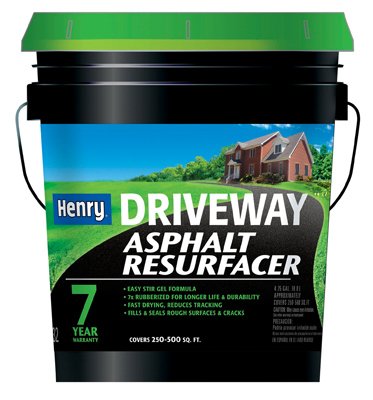
A rubberized gel that promises 7 years of life — if the warranty holds.
This Henry resurfacer is a thick, 7-times rubberized gel tailored for asphalt driveways. It comes in a 5-gallon pail that weighs 57 pounds, and the manufacturer claims coverage of 250 to 500 square feet per pail depending on how rough your surface is. The gel formula stirs easily, applies without drip, and dries to a deep black that owners describe as “nice black color.”
The rub is the warranty. More than one buyer reports that the sealer failed within six to eight months despite proper prep and no ice melt use. When those owners contacted Henry to use the 7-year warranty, the company refused because the purchase was made on Amazon. The seller also declined to help beyond the initial return window. On top of that, some owners found the product expensive relative to the end result — excellent coverage but “pricy” is how one put it. For a mid-range driveway, it works well; for a high-investment driveway, the risk of an unbacked warranty is worth knowing.
At roughly 640 fluid ounces per pail, it offers 32 ounces more than the Jetcoat below, but the quality of that extra volume is the open question.
Strengths
- Heavy rubberized formula designed for long-term durability on driveways
- Gel consistency stays put on sloping surfaces without running
- Easy stir-and-pour application with good crack-filling ability
Weaknesses
- Warranty may not be honored for Amazon purchases — a real risk
- Coverage can fall short of advertised 500 sq ft on rough pavement
- Premium price point that feels steep for the results some owners saw
Best if: you want a thick, rubberized resurfacer for a moderate driveway and can afford to gamble on the warranty.
Think twice if: you need manufacturer-backed protection for a high-value driveway or expect the sealer to last the full 7 years.
3. Jetcoat Premium Driveway Sealer, Asphalt Crack Filler and Sealant (5 Year Protection)
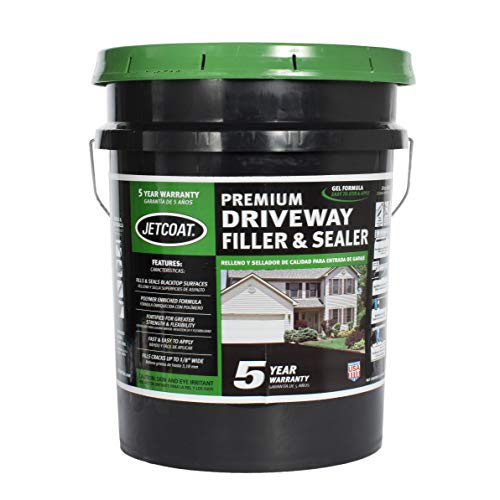
Polymer-modified with sand for grip — the smart middle ground for driveway sealing.
This Jetcoat sealer is designed for asphalt and blacktop surfaces only — not concrete. The formula is a polymer-modified emulsion (a plastic-enhanced liquid) fortified with sand, which does two things: it fills cracks with more body than a plain emulsion, and it adds slip resistance so the driveway does not turn into a skating rink when wet. The manufacturer recommends applying it on damp pavement with a rubber squeegee or brush, then a second coat within 24 hours if needed. Coverage lands between 250 and 350 square feet per pail — slightly lower than the Henry, but owners note that thickness is the trade-off for durability.
Owners mention positive results. One owner, who has used many other sealers, called it “by far the best with the best result” and was able to get two full applications from a single pail. Another reported it “did great to fill and seal driveway.” The main criticism is that the sealer is thick, which means you do not get as much coverage as you might hope — one owner put it bluntly: “It seems a little thick so you do not get much coverage.” That thickness is what gives it the filling power, so it is a trade-off, not a defect.
Against the Henry above, the Jetcoat is slightly smaller (608 fluid ounces versus 640) but carries a higher average owner satisfaction on the same kind of driveway work. The 5-year protection claim is the manufacturer’s, and early reports suggest it holds up — time will tell.
What Wins People Over
- Sand-fortified formula fills cracks visibly and adds slip resistance
- Multiple customers note it is the best sealer they have tried for smooth finish
- Two-coat application feasible from one pail for a standard driveway
The Caveat
- Thick consistency reduces coverage — plan for less square footage than label suggests
- Shipping issues reported with missing containers arriving weeks late
Choose this for: a balanced driveway sealer that fills cracks well, applies smoothly, and comes from a brand with strong owner feedback.
Pass if: your driveway is extremely large and you want full coverage from a single pail — the thick formula may not stretch that far.
4. E-Z Stir Driveway Asphalt Filler/Sealer (4.75 gal – 2 Pack)
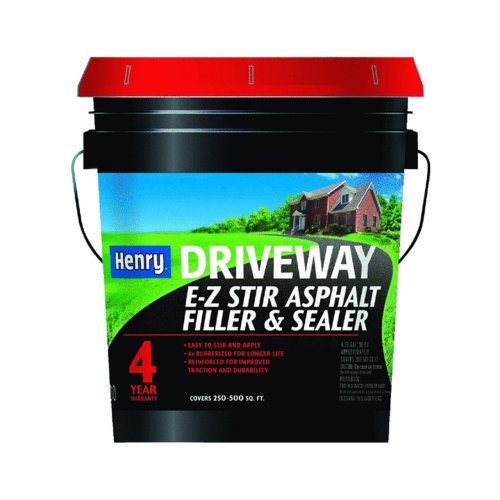
Two pails of Henry sealer for the price of one — but the quality is a coin flip.
This E-Z Stir pack is the volume play: two 4.75-gallon pails totaling 1216 fluid ounces. That is exactly twice the volume of the Premium Driveway Sealer above, at roughly the same price. For a large driveway or a multi-car parking area, the raw coverage math is hard to argue with. The formula is a straightforward asphalt filler and sealer from Henry, designed to be stirred and poured without specialty tools.
Where it gets complicated is the inconsistency. Owners say it is easy to pour and spread — the application scores well. It fills cracks effectively. But the quality gets mixed marks. Some pails arrive with significant color variation: one bucket dries light grey while another dries black, leaving a splotchy finish. A buyer who prepped their cracked driveway meticulously reported the sealer was “50% worn off in 8 months.” Another noted the buckets are extremely hard to open, and the shipping experience can be absurd — one owner found the 4 buckets delivered blocking their car for hours.
For the price, you get a lot of sealer. The question is whether you get consistent sealer. If your driveway is a weekend-warrior job and you are okay with potential variation, this is the lowest cost per fluid ounce in the list. If a uniform, long-lasting finish matters more than volume, the Jetcoat above is the safer bet.
Value Highlights
- Massive 9.5-gallon total volume — enough for very large driveways
- Easy to stir, pour, and spread with basic tools
- Effectively fills cracks when applied correctly
Watch Out For
- Inconsistent color between buckets — black can dry light grey or black
- Mixed durability reports, with some owners seeing wear within a year
- Shipping can be chaotic — very heavy at 4 buckets delivered together
Grab this if: you have a huge driveway on a budget and can accept some appearance inconsistency in exchange for double the volume.
Skip if: a uniform black finish or long-term durability is your priority — the single-pail Jetcoat is a better value there.
Understanding the Specs
Emulsion Base vs. Solvent Base
An emulsion sealer uses water as the carrier, not petroleum solvents. That means it smells less, cleans up with soap and water, and is safer for the environment around your home. The trade-off is that emulsion sealers can be less aggressive on heavily oil-stained or very old asphalt. They work best on surfaces that have been cleaned and are slightly damp during application.
Rubberized vs. Polymer-Modified
A “rubberized” formula (like the Henry) adds latex or synthetic rubber particles for flexibility — good for climates with freezing and thawing. A “polymer-modified” formula (like the Jetcoat) uses plastic polymers to increase adhesion and durability. Both are better than plain asphalt emulsion for driveways, but polymer-modified tends to be harder and more crack-resistant. Non-fibered emulsions (like the Black Jack) are best for vertical surfaces where flexibility is less important than waterproof seal.
FAQ
Can I use a roof coating on my driveway?
How many square feet does a 5-gallon pail actually cover?
Does Henry honor the warranty if I buy from Amazon?
What is the difference between a fibered and non-fibered asphalt emulsion?
Can I apply asphalt emulsion sealer in cold weather?
How long does asphalt emulsion sealer take to dry?
What is the best way to apply an asphalt emulsion sealer?
Will an asphalt emulsion sealer fill deep cracks?
Final Thoughts: The Verdict
For most people, the asphalt emulsion sealer winner is the Black Jack 6190 because it stops leaks reliably on roofs and foundations without harsh fumes and at a very competitive price per gallon. If you want a tough, sand-fortified seal for your driveway that fills cracks and adds grip, grab the Jetcoat Premium Driveway Sealer. And for covering a very large driveway on a budget, the E-Z Stir 2-Pack gives you the most volume for the dollar — just be prepared for potential color variation between buckets.
How We Picked
We do not accept paid placement. Every pick is matched to a real buyer and a real use-case; we do not hands-on test units.
Sources & Methodology
Specifications: manufacturer listings and product documentation. Review insights: verified customer reviews, as of July 2026. Pricing: not shown on this page (it changes often); check the current price via the retailer link.
As an Amazon Associate, FitlyFast earns from qualifying purchases. This does not affect which products we feature.