
Our readers keep the lights on and the weekend projects moving. As an Amazon Associate, I earn from qualifying purchases.
Specs are compiled from manufacturer listings and verified buyer reviews and can change over time — please confirm the key details on the product page before buying.
The biggest mistake in budget tower speakers is buying on wattage alone — a huge peak number means nothing if the cabinet is thin and the drivers can’t move air. What actually separates a great budget tower from a paperweight is the driver design, the cabinet build, and how honestly it delivers bass at normal listening levels. This guide breaks down the towers that genuinely fill a room without emptying your bank account.
I’m Rikta — the founder and writer behind FitlyFast. This guide is built by comparing the manufacturers’ published specifications and the patterns across verified customer reviews, so you get each pick’s real strengths and trade-offs instead of marketing spin.
Whether you’re building a first home theater or upgrading tired bookshelves, these budget floorstanding speakers deliver real, room-filling sound without forcing you into audiophile pricing.
Our Picks at a Glance


How To Choose The Best Budget Floorstanding Speakers
Floorstanding speakers are the backbone of a serious home audio setup, but the budget tier is crowded with traps. The good news is that a few clear specs tell you almost everything about how a tower will actually perform in your living room.
Start with the driver layout: 2-way vs 3-way
A 2-way speaker splits the audio between a woofer and a tweeter, while a 3-way adds a dedicated midrange driver in between. That extra midrange driver is what makes voices and instruments sound natural instead of strained. It is the single biggest reason to pay a little more for a 3-way tower.
Read the power rating correctly
Peak wattage is the marketing number — it describes a brief burst. The RMS rating is the continuous power the speaker can handle, and that is the one that predicts real-world volume and headroom. A speaker rated 125W RMS will play louder and cleaner than one rated 60W RMS before distortion sets in.
Match impedance and sensitivity to your receiver
Most budget receivers handle 8-ohm speakers comfortably, while 6-ohm models demand a bit more current. Sensitivity, measured in dB, tells you how efficiently the speaker turns power into sound — a 94dB speaker plays far louder than an 87dB one on the same amplifier. Pair a low-sensitivity speaker with a weak receiver and you will be constantly cranking the volume.
Quick Comparison
| Model | Best For | Design | Power Handling | Sensitivity | Amazon |
|---|---|---|---|---|---|
| Rockville RockTower 68B★ Best Overall | 3-way value | 3-Way | 125W RMS | — | Amazon |
| GOgroove Bluetooth TowerAll-in-One Pick | All-in-one wireless | 2.1 Powered | 60W RMS | — | Amazon |
| Polk Monitor XT60Sealed-Cabinet Pick | Sealed-cabinet clarity | Passive Radiator | — | — | Amazon |
| Yamaha NS-F210BL | Slim spaces | 2-Way Bass-Reflex | — | — | Amazon |
| Dayton Audio Classic T65 | Party volume | 2-Way + Tweeter | 150W | — | Amazon |
| Rockville RockTower 68C | 2-pack value | 3-Way | 125W RMS | 87 dB | Amazon |
| Klipsch R-620F | High-efficiency punch | Horn + 2-Way | — | — | Amazon |
| Sony SS-CS3M2 | Hi-Res detail | 3-Way, 4-Driver | — | — | Amazon |
| Klipsch Reference R-610F | Crowd favorite | Horn + 2-Way | 85W RMS | 94 dB | Amazon |
| Jamo S809 | Dolby Atmos ready | 2.5-Way | 240W | — | Amazon |
| Q Acoustics 3050i | Pure hi-fi sound | 2-Way Reflex | 50-165W | 91 dB | Amazon |
In‑Depth Reviews
1. Rockville RockTower 68B Passive Tower Speaker
The budget tower that brings a true 3-way speaker layout to a price most brands charge for a single woofer.
The Rockville 68B earns the top spot because it gives you a dedicated 6.5″ midrange driver between the dual 6.5″ woofers and the 1″ silk dome tweeter. That 3-way configuration is exactly what makes voices and instruments sound full and natural rather than thin. It handles 125W RMS and 500W peak power — a 4.2x gap between continuous and burst output that means real headroom for dynamic movie scenes and punchy music.
The cabinet is built from MDF (a dense, resonance-damping wood composite) with a vented design and a black grain finish. The detachable grille lets you show off the drivers or keep a clean front. Gold-plated 5-way binding posts accept banana plugs, spade terminals, or bare wire, and the 8-ohm impedance pairs easily with most home amplifiers.
You get clear highs and lows, easy assembly, and a solid wood-veneer look — that is what owners praise most. Buyers report that bass can initially seem weak when driven by a soundbar’s subwoofer output, but fed by a proper amp or with equalization, the towers come alive. One owner noted that on a 1970s receiver the bass was “impressively strong.” The reviews sum it up: “with EQ or amp sound great.”
What wins people over
- True 3-way design with dedicated midrange for natural vocals
- 125W RMS power handling with 500W peak headroom
- Gold-plated binding posts for flexible cable options
- Detachable grille for two distinct looks
Know before you buy
- Bass is shy until fed by a real amplifier or EQ
- Sold as single units — you need two for stereo
Best for: budget buyers who want true 3-way sound quality without stepping up to premium pricing.
Think twice if: you plan to drive them from a TV’s headphone jack — they need a real amp or receiver to shine.
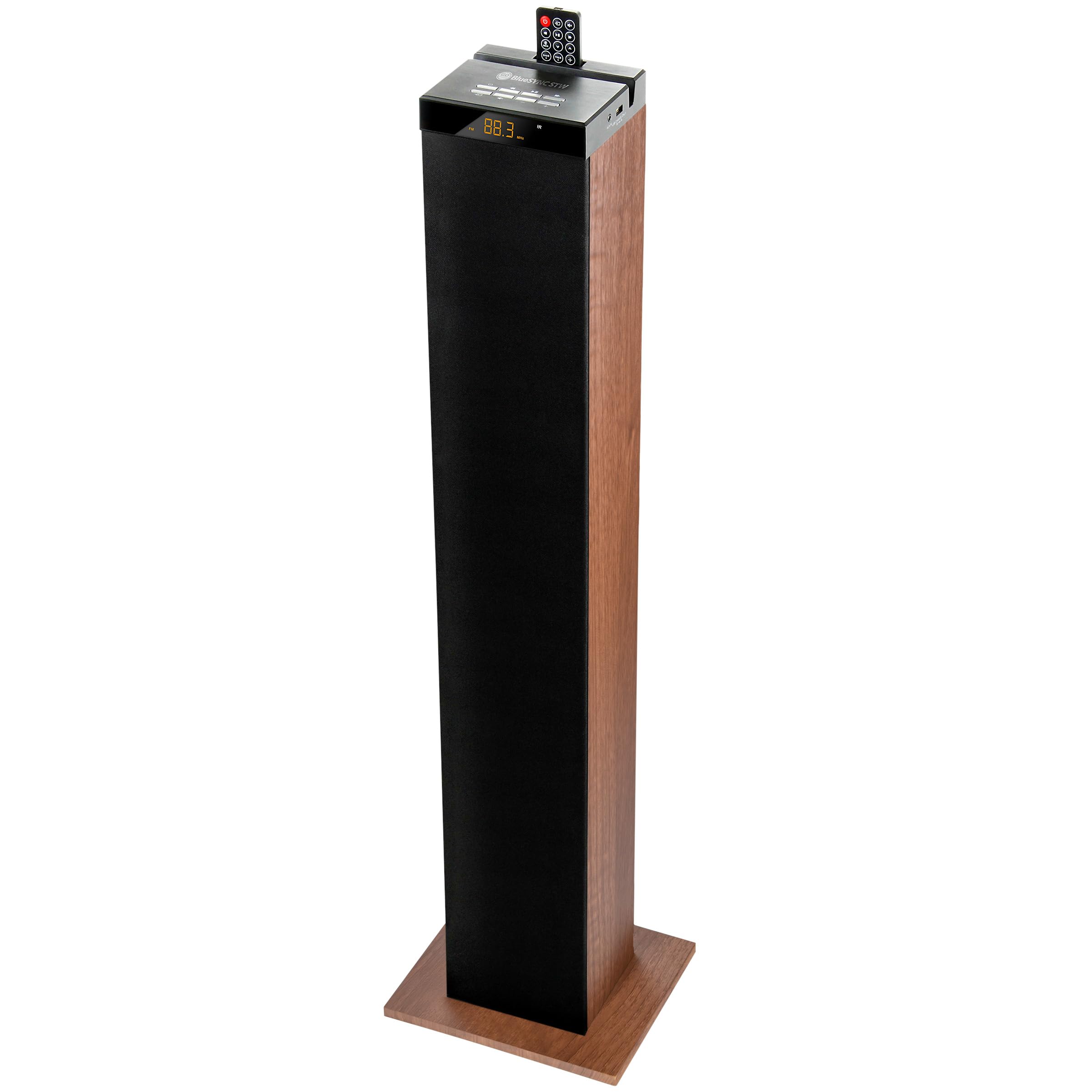
2. GOgroove Bluetooth Tower Speaker with Subwoofer
A wireless tower that skips the receiver entirely — just stream, plug in, or tune in and go.
If you don’t want to build a traditional stereo system, the GOgroove is the rare budget tower that works completely on its own. It has a powered subwoofer and dual drivers built in, delivering 60W RMS and 120W peak power — about half the continuous wattage of the Rockville above, but enough to fill a small room. The built-in sub means you get bass without buying a separate one.
At 38.25 inches tall and just 10.1 pounds, it is light enough to move around easily. The 4-in-1 audio station covers wireless Bluetooth streaming, a 3.5mm AUX input, an FM digital radio, and an MP3 player mode that reads music files from a USB flash drive. There is even a dock slot on top with a USB 1A charging port so your phone stays powered while you stream.
Quality and value are the two most-praised aspects, with buyers calling it “easy to assemble, light weight” and noting how little floor space it takes up. The smart way to think about it: “think vertical soundbar.” It is not audiophile-grade, but it beats most TV soundbars for both music and movies. The honest fit-note is that sound quality splits opinions — the majority enjoy it, but critical listeners find it acceptable rather than exceptional, and the remote is on the flimsy side.
Why it’s a great standalone
- No receiver needed — Bluetooth, FM, and USB all built in
- Powered subwoofer delivers bass without a separate box
- Top dock charges your phone while streaming
Worth noting
- 60W RMS is modest — fine for dorms and studios, not big rooms
- Sound quality is mixed; great for the price, not for purists
Reach for this if: you want one box that does everything — streaming, radio, and file playback — in a small apartment or dorm.
Look elsewhere if: you already own a good receiver and want speakers that scale to a large living room.
3. Polk Audio Monitor XT60 Tower Speaker
The tower that uses passive radiators instead of a port — meaning tighter, more controlled bass.
Most budget towers use a port (a vented hole) to boost bass. The Polk XT60 takes a different route: a 1″ tweeter and 6.5″ woofer are joined by two 6.5″ passive radiators — unpowered drivers that move air in response to the main woofer. That design delivers smooth mid-range and bass in a sealed enclosure. Owners call it a key selling point, especially when running stereo without a subwoofer.
Owners praise the sound above all else. One buyer’s take: “Great sound….replaced some ancient, higher wattage JVC standing speakers, and like most modern electronics, these are a fraction of the size with better sound.” It supports Hi-Res Audio (high-resolution audio files), Dolby Atmos (object-based surround sound), Auro 3D (a 3D audio format), and DTS:X (a competing surround format), so it fits a modern home theater without obsolescence. The rubber feet grip both carpet and hardwood, so you can place it anywhere.
Value is the clear second theme among owners. The honest physical limit: with 6.5″ drivers, these are not built to pressurize a large room at loud volumes — they shine in small-to-medium rooms at quiet-to-moderate listening. An occasional unit arrives with minor cabinet damage, so inspect the packaging carefully. This is also a single speaker, so budget for two for stereo.
Standout strengths: the sealed-cabinet design with dual passive radiators gives you controlled, non-boomy bass that works well in stereo without a subwoofer.
Real limitation: underpowered for large rooms and loud volumes due to the 6.5″ drivers — physics, not a flaw, so aim it at cozier spaces.
4. Yamaha NS-F210BL 2-Way Bass-Reflex Floorstanding Speaker

A sleek column that slips into tight spaces beside flat-panel TVs without dominating the room.
The Yamaha NS-F210BL is a 2-way bass-reflex tower with a slim design that visually matches modern flat-panel TVs. Its light aluminum cones give the woofers extra-fast response, which translates to snappy, detailed mids and highs. The heavy-duty round steel base keeps the tall, narrow cabinet stable on the floor.
Sound quality is the most-praised aspect, with owners describing superb bass and excellent highs once properly set up. The recurring theme in reviews: this is designed as a home theater main speaker (L/R in a 5.1 or 7.1 system), not a standalone full-range stereo speaker. Paired with a subwoofer and a receiver’s crossover, the detailed mids and highs shine. Run alone, the bass can sound boomy and boxy — it really wants help below about 50Hz.
The other strong note is appearance, with its low-key all-black look fitting constrained setups beautifully. Several owners mention it needs about 9 inches of clearance from the wall behind it, and it benefits from a 2-week break-in period. Because it is purpose-built as a home theater main, think of it as part of a larger system rather than a complete stereo solution.
The sharp angle: a beautifully slim column that excels as a home theater main with a subwoofer — ideal for apartments and tight media centers.
The catch: it is not a full-range standalone speaker; run it solo and the bass turns boomy, so plan on a sub and proper crossover.
5. Dayton Audio Classic T65 Floor-Standing Tower Speaker Pair

A pair of full-size towers that handle 150W and place their tweeters at ear level for easy listening.
At over 39 inches tall, the Dayton T65 is a full-size tower that positions its tweeter right at ear level for seated listening. That height, combined with a large bass-reflex cabinet, gives it ample internal volume for room-filling bass. The dual 6-1/2″ custom poly bass drivers and 1-inch silk dome tweeter deliver punchy low-end and accurate treble without harshness.
This is one of the best values for power in the budget tier — rated to handle 150W, it is built for both easy listening and party volume. The sound is the most-praised aspect, with owners noting crisp, clear highs and bass that matches subwoofer output. One buyer summed it up perfectly: “great sounding speakers absolutely worth the price.” The wood finish drew repeated compliments, and the upgraded gold-plated binding posts accept banana plugs for clean signal transfer.
Customers note the bass can actually be a touch too strong at first and needs dialing back — a good problem to have. They also mention a 30+ hour break-in period before the drivers fully loosen up. You get a pair here, which saves you from buying two singles. The one honest caveat from a few: if you are coming from very high-end vintage speakers, these will sound good but not extraordinary — they excel relative to their price.
Why it stands out: a true pair of towers with 150W handling and a silk dome tweeter that keeps treble smooth at high volume.
Balance it with: a short break-in period and possibly dialing the bass down a notch for the first week.
6. Rockville RockTower 68C Classic Tower Speakers (2-Pack)
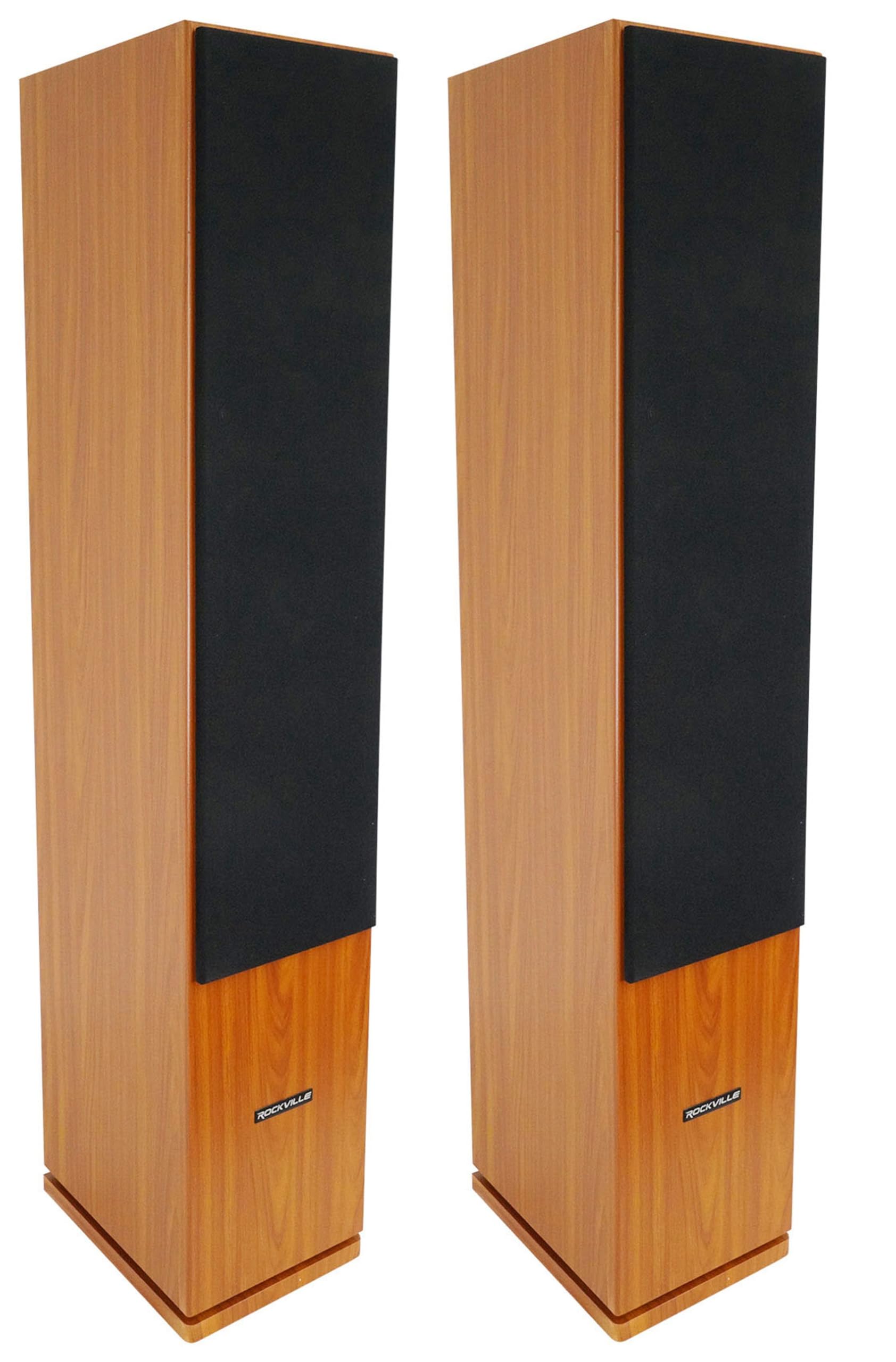
Two complete 3-way towers in one box with a classic wood-grain finish and serious power handling.
The Rockville 68C is the two-pack version of the 68B, so you get a complete stereo pair without hunting for a second unit. Each tower is a true 3-way design: a 1″ silk dome tweeter, a 6.5″ midrange with an 8 oz magnet and 1″ voice coil, and dual 6.5″ woofers with 15 oz magnets and 1.25″ voice coils. Each speaker handles 125W RMS and 500W peak power.
Owners describe these as sounding “like big dollar speakers,” and the 30Hz–20kHz frequency response with 87 dB sensitivity means accurate full-range sound on modest amplifiers. The classic wood grain vinyl finish fits both traditional and modern rooms, and the removable grilles offer a clean look with or without covers. Gold-plated 5-way binding posts accept banana plugs, spade connectors, or bare wire.
The recurring theme is honest value: these are “the best budget tower speakers if you use a good subwoofer,” per the most detailed owner take. The 8-ohm impedance means you’ll need to push your receiver a bit harder, and the MDF is not as thick as premium brands. One owner notes the look is rectangular rather than the angled photos suggest — a minor cosmetic mismatch, not a sound issue.
What makes it a 2-pack standout: full 3-way stereo sound in one box, with crisp clean sound that owners call a “great deal.”
Pair it with: a 10-inch subwoofer to cover the deepest lows and a receiver with enough power to drive 8-ohm towers.
7. Klipsch R-620F Floorstanding Speaker

The horn-loaded tower that brings a live-concert energy to your living room with easy efficiency.
The Klipsch R-620F packs the brand’s signature 90×90 Square Tractrix Horn around a 1″ Aluminum LTS tweeter — a design that directs high frequencies straight at your ears for crisp, detailed sound. Dual 6.5″ spun-copper IMG woofers handle the low end, and the bass-reflex cabinet uses rear-firing Tractrix ports to move serious air. At 40 inches tall, it is a commanding presence.
Sound quality is the clear winner here, with owners describing a “realist” quality that turns movie nights into concert experiences. The efficiency of the horn design means even modest receivers drive these to satisfying volume. It plays EDM, rock, and classical with equal confidence — one owner reports it beating custom speakers that cost 4x as much.
The most-honest advice from owners: you need a receiver that lets you manually adjust the crossover frequency to get the best results. A few note that the included screws can snap easily during assembly, an easy fix with wood screws. This is sold as a single speaker, so plan to buy two for a full stereo pair — most will want to anyway, given the praise for the sound.
The Klipsch magic
- Horn-loaded tweeter for efficient, detailed highs
- Dual spun-copper woofers for bold bass
- Efficient design plays loud on modest receivers
Setup notes
- Requires a receiver with adjustable crossover frequency
- Leg screws can be brittle — handle gently
Grab it if: you want high-efficiency, horn-loaded sound that makes movies and music feel live and immediate.
Pass if: you cannot adjust crossover on your current receiver — you’d be leaving performance on the table.
8. Sony SS-CS3M2 3-Way 4-Driver Hi-Res Floorstanding Speaker
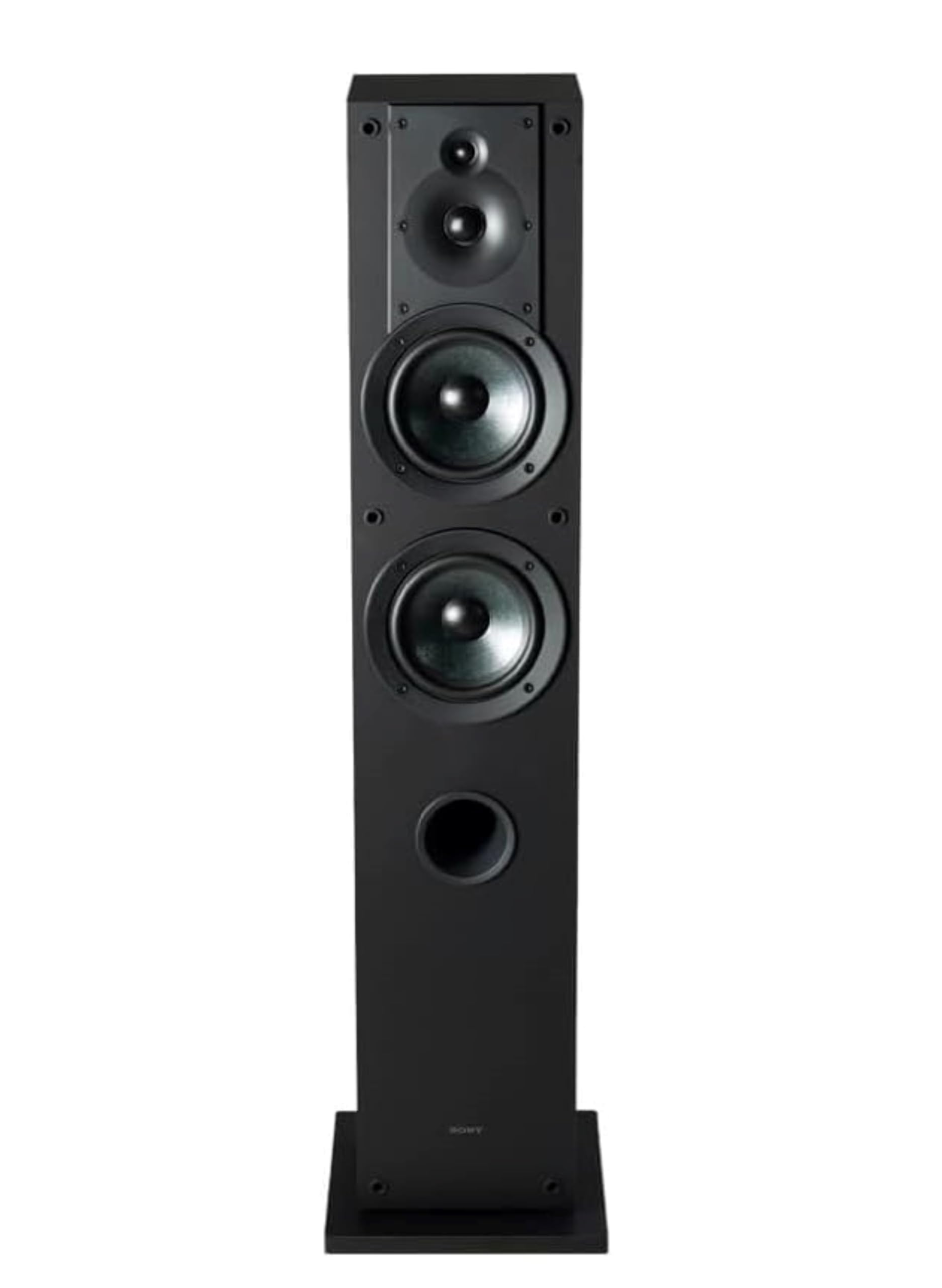
A 3-way, 4-driver tower that reaches up to 50kHz for Hi-Res audio detail most budget speakers miss.
The Sony SS-CS3M2 is built for listeners who want every last bit of detail from their music. It is a 3-way, 4-driver system with dual 5.12-inch woofers, a high-precision tweeter, and a wide-dispersion super tweeter that creates an expansive soundstage. The frequency response extends from 45Hz to 50kHz — well beyond the human hearing range, which is what Hi-Res Audio demands.
The reinforced cellular cone is designed to prevent distortion, and the bass-reflex enclosure (a ported cabinet that boosts low frequencies) delivers clean bass. At 6 ohms impedance, it pairs well with quality AV receivers, and reviewers point out smooth integration with Denon receivers in particular. If you are building a same-brand system, it matches Sony AV receivers perfectly.
Most owners are delighted, running them as a 2.1 system with a powered subwoofer and reporting great sound with no issues over months of use. The honest split: a couple of buyers found the bass lighter than expected and plan to add a subwoofer to fill it out — and one critical ear noted occasional “hollowness” on vocals with heavy midrange. At this price, it is a detail-focused speaker best paired with a sub for full-range impact.
Its defining trait: a genuine Hi-Res 3-way design with a super tweeter for an expansive, detailed soundstage.
Plan around: lighter bass response — most owners pair it with a powered subwoofer for full-range sound.
9. Klipsch Reference R-610F Floorstanding Speaker, Pair

The most-reviewed budget tower on this list — and the sound quality praise is overwhelming.
The Klipsch R-610F is the crowd favorite for a reason. It pairs a 1″ Aluminum LTS tweeter with a 90×90 Square Tractrix Horn for crisp, efficient highs, and a 6.5″ woofer handles the bass. The 94dB sensitivity is the standout spec here — it means these speakers convert amplifier power into volume very efficiently, playing loud and clear even on modest receivers.
With 85W continuous and 340W peak power handling and a frequency response of 45Hz to 21kHz, these are built to fill a room. The 8-ohm impedance works with most AV receivers for easy setup. Sound quality dominates the praise — it is by far the most-praised aspect, with owners describing dramatic improvements over older speakers and massive bass increases. One noted they work brilliantly even with a vintage 40-watt stereo, proof of the 94dB efficiency.
Owners deeply appreciate the value and the copper-look drivers and horn grilles. At 36 pounds each, they are solidly built with MDF cabinets and no unwanted resonance. The recurring gripes are minor: the leg screws are cheap and worth replacing immediately, and you’ll want a subwoofer for the deepest bass. This pair genuinely sounds “awesome with or without a subwoofer,” so it is flexible for any setup.
Why it dominates
- 94dB sensitivity plays loud on modest receivers
- 85W RMS / 340W peak power handling
- Sold as a pair — stereo ready from the start
Minor setup quirks
- Leg screws are brittle — swap in better ones
- Add a subwoofer for the deepest movie bass
For most buyers, this is it: a complete pair of high-efficiency towers with outstanding sound quality and value that scales from vintage amps to modern receivers.
Only skip it if: your room is tiny and a bookshelf pair would suffice — these towers want space to breathe.
10. Jamo Studio Series S809 Floorstanding Speaker Pair

A Scandinavian-styled pair that’s Dolby Atmos ready and praised for performing well without a subwoofer.
The Jamo S809 brings a distinctive Scandinavian design to the budget tower space, and it is Dolby Atmos ready — meaning you can later add height modules for overhead sound effects. Each tower pairs a 25mm (1″) soft dome tweeter with triple 102mm (5″) Aluminized Polyfiber Woofers, and the WaveGuide acoustic technology helps spread sound evenly across the room. The pair handles 240W of power with front-firing ports.
Sound quality and appearance are the two most-praised aspects, with owners loving the sleek walnut finish and the clear, crisp highs. The standout praise is that these perform well without a subwoofer — the triple-woofer layout generates surprising bass for music. Owners call them a “superb value” that easily outperforms their price point.
The honest notes: the treble can run hot around 10-12kHz, which a quick EQ adjustment fixes. Some found the veneer looks a bit plastic up close, like IKEA furniture rather than real wood. For a music-first listener who values style and wants Atmos-ready flexibility later, this pair is easy to recommend.
What stands out
- Dolby Atmos ready for future height-channel upgrades
- Triple woofers deliver surprising bass without a sub
- Clean Scandinavian design that fits modern decor
Honest quirks
- Treble can run hot — a little EQ fixes it
- Veneer looks more plastic than premium wood
Choose it for: a stylish pair that sounds great on music alone and leaves the door open for Dolby Atmos later.
Consider the alternative: if you strictly watch dialogue-heavy TV at low volume, the muted dialogue of these is worth testing first.
11. Q Acoustics 3050i Floorstanding Tower Speaker

The finest-built tower here, with P2P bracing and HPE resonance control for purer, cleaner sound.
The Q Acoustics 3050i is the most refined speaker on this budget list, and it shows in the engineering. The 22mm decoupled high-frequency drivers use a wide surround to create even, wide stereo dispersion, while P2P bracing reduces intrusive cabinet vibrations for a purer sound. It is a 2-way reflex design with dual 165mm (6.5″) woofers and a 22mm (0.9″) tweeter.
Q Acoustics’ HPE technology is the clever part — it equalizes air pressure inside the cabinet to eliminate the sympathetic resonance that plagues taller towers. The result is a frequency response of 44Hz to 30kHz with 91dB sensitivity, and 6 ohm average impedance (4 ohm minimum). Power handling spans 50-165W, giving you flexibility with a wide range of amplifiers. Low-profile binding posts let you place the towers close to a rear wall, even with 4mm banana plugs.
Owners consistently call the build quality outstanding, with one noting these sound “way much better” than a pair of Polk XT-70 towers they own — more alive and engaging. The included accessories are generous: magnetic grilles, foam bungs, speaker stabilizers, spikes, and handling gloves. The single-unit note is real, so order two for stereo. A minor logistics gripe: one owner was sent the wrong color three times before getting a matching set, so verify your delivery.
The signature strength: premium cabinet engineering — P2P bracing and HPE resonance control — that delivers a rich, alive sound beyond its price.
Order carefully: sold as single units, so buy two, and double-check the finish on delivery to get a matching pair.
Understanding the Specs
RMS vs Peak Power
Peak wattage is the marketing number — a brief maximum burst. The RMS (root mean square) rating is how much power a speaker can handle continuously without strain. That RMS number is the one that predicts how loud and clean your music will sound at normal listening levels. A 125W RMS tower will outperform a 60W RMS tower before hitting distortion.
Sensitivity (dB)
Sensitivity tells you how efficiently a speaker turns amplifier power into volume. A 94dB speaker produces much more sound from the same wattage than an 87dB speaker. Higher sensitivity means your receiver works less hard, which translates to cleaner sound and more headroom for dynamic peaks in movies and music.
3-Way vs 2-Way Design
A 2-way speaker splits audio between a woofer and a tweeter. A 3-way adds a dedicated midrange driver in between, which handles the critical frequencies where voices and most instruments live. That extra driver is why 3-way towers sound more natural and full in the midrange — the most important part of the audio spectrum.
Bass-Reflex Ports & Passive Radiators
A bass-reflex port (a vented hole) boosts low-end output by letting air move in and out of the cabinet. Passive radiators work similarly — an unpowered driver that vibrates with the main woofer — but deliver tighter, more controlled bass without the “chuffing” noise ports can make. Both designs aim to extend bass response in a smaller cabinet.
FAQ
Do budget floorstanding speakers need a subwoofer?
What receiver power do I need for budget tower speakers?
Are floorstanding speakers better than bookshelf speakers?
What does 3-way mean in a tower speaker?
How much space do floorstanding speakers need?
Can I use tower speakers without an amplifier?
What is speaker sensitivity and why does it matter?
Are budget towers good for music or only home theater?
Should I buy towers sold as singles or pairs?
What is a passive radiator in a speaker?
Final Thoughts: The Verdict
If you want one dependable pick, the budget floorstanding speakers winner is the Rockville RockTower 68B because its true 3-way design (separate drivers for bass, midrange, and treble) delivers the most complete sound quality for the money. If you want a wireless all-in-one without a receiver, grab the GOgroove Bluetooth Tower. And for a ready-made stereo pair with the best overall owner satisfaction, the Klipsch R-610F is the one to reach for — it holds the highest rating on this list with impressive efficiency (measured in decibels per watt) that plays loud on any receiver.
How We Picked
We do not accept paid placement. Every pick is matched to a real buyer and a real use-case; we do not hands-on test units.
Sources & Methodology
Specifications: manufacturer listings and product documentation. Review insights: verified customer reviews, as of August 2026. Pricing: not shown on this page (it changes often); check the current price via the retailer link.
As an Amazon Associate, FitlyFast earns from qualifying purchases. This does not affect which products we feature.