
Our readers keep the lights on and the weekend projects moving. As an Amazon Associate, I earn from qualifying purchases.
Specs are compiled from manufacturer listings and verified buyer reviews and can change over time — please confirm the key details on the product page before buying.
Think of a butcher steel as the quick fix that brings a dulled blade back to life between full sharpenings. The best pick for most serious cooks is the F. DICK DICKORON Classic — it pairs a sapphire corrugated surface with an oval shape and a 65 HRC rating, and it holds a 4.8-star consensus across hundreds of owners who say it puts a razor edge on any knife.
I’m Rikta — the founder and writer behind FitlyFast. This guide is built by comparing the manufacturers’ published specifications and the patterns across verified customer reviews, so you get each pick’s real strengths and trade-offs instead of marketing spin.
Matching the right steel to your blade metal and honing habits is the real secret, and you will find the full breakdown of the top butcher steel options ranked below.
Our Picks at a Glance



How To Choose The Best Butcher Steel
Choosing a butcher steel is really about matching the tool to your knife’s steel and how often you cook. A steel realigns the microscopic teeth of an existing edge, so the right texture and hardness keep your blade cutting cleanly for months between sharpenings.
Match the Hardness Rating
The Rockwell hardness scale (HRC) tells you how hard a metal is. Your steel should be noticeably harder than your knife blade — otherwise it will just bounce off instead of straightening the edge. Ceramic rods top out around HRC 68, while quality metal steels sit near 62 to 65 HRC, which covers most kitchen and butcher knives.
Pick the Surface Texture for Your Needs
Smooth and fine steels gently polish an edge with almost no metal removal, perfect for daily upkeep. Corrugated or grooved surfaces bite harder and work faster on very dull blades, while ceramic rods sit between the two, removing a little material to refresh a tired edge. If you own hard Japanese knives, a fine ceramic or smooth steel is usually the safer match.
Consider Length and Handle Grip
A 12-inch rod gives you full single-stroke coverage of most chef knives, while a shorter 9-inch steel suits casual home cooks. The handle matters more than you might think — a nonslip or textured grip keeps your hand steady through dozens of strokes, and a finger guard or bolster protects your knuckles from the blade.
Quick Comparison
| Model | Best For | Rod Length | Hardness (HRC) | Surface Type | Amazon |
|---|---|---|---|---|---|
| F. DICK DICKORON Classic★ Best Overall | Sapphire-corrugated all-rounder | 11.8″ | 65 | Sapphire Corrugation | Amazon |
| Shenzhen Knives Ceramic RodBest Value | Hard Japanese knives on a budget | 12″ | 68 | 1000 Grit Ceramic | Amazon |
| WÜSTHOF 9″ Honing SteelEveryday Essential | Everyday home kitchen upkeep | 9″ | — | Grooved Steel | Amazon |
| Victorinox Round Finecut | Long blades like scimitars | 30 cm | — | Fine Cut Round | Amazon |
| Dexter-Russell 14″ Butcher Steel | Carbon steel and pro butcher work | 14″ | — | Medium Coarse Magnetized | Amazon |
| F. DICK Orange Sharpener | High-visibility commercial kitchens | 10″ | — | Smooth Polish | Amazon |
| ZWILLING 10-inch Sharpening Steel | Broad-contact oval honing | 10″ | Approx. 62 | Extra Fine Oval | Amazon |
| ZWILLING Professional 12-inch Oval | Large carving knives | 12″ | — | Extra Fine Oval | Amazon |
| F. Dick 11-inch Multicut Steel | Heirloom finish sharpening | 11″ | — | Multicut Flat | Amazon |
In-Depth Reviews
1. F. DICK DICKORON Classic Sharpening Steel
Our pick — over 4.5★ from 850+ verified ratings; the strongest balance of quality and price.
The sapphire-corrugated German steel that makes any knife bite again with a few easy strokes.
You get a razor edge back with just a few easy strokes, thanks to a corrugated sapphire surface that smooths the blade evenly. The oval profile gives the blade a wide bearing surface to ride on, and at 65 HRC (a hardness scale for metals), it is hard enough to straighten most kitchen and butcher blades. The 11.8-inch rod length covers a full chef’s knife in one sweep, so you are not stopping mid-blade. The red nonslip synthetic handle is shaped with finger protection, so your hand stays comfortable and clear of the edge through a long session.
Owners call it the best steel they have used, with the crowd favorite aspect being the sheer sharpening performance — the thing everyone raves about is how easily it restores a razor edge. It shines brightest on harder, higher-carbon knives, where a finer steel like this really earns its keep. The honest trade-off: it is an oval, flat-ish steel rather than a round one, so if you have only ever used a classic round rod, the shape takes a moment to get used to.
A couple of buyers report rust appearing within the first month in heavy commercial use, which is a reminder that even fine German steel wants a wipe-down after a wet shift. For a home cook or dedicated enthusiast, this is the one that combines smooth action, safety-minded design, and a genuinely fine finish.
The sharpening secret: the sapphire corrugation delivers an evenly sharp, fine edge without the aggressive bite of a coarse steel, making it forgiving on premium blades.
The confident pick: this is the steel for knife lovers who want a single, versatile tool that handles daily honing and delivers a fine edge across most blade types.
Think twice if: you prefer a classic round rod feel — this oval shape is the main adjustment, and the premium price reflects its German build.
2. Shenzhen Knives Ceramic Honing Rod
A 1000-grit ceramic rod that outperforms far pricier metal steels on hard blades.
You get professional-grade realignment for hard blades without the premium price tag, because this rod is made from ceramic alumina (a type of ceramic) that ranks just below diamond at HRC 68 — harder than any steel rod on this list, including the F. DICK’s 65 HRC. The 1000 grit surface (a measure of abrasiveness) gently realigns a blade edge with each stroke, so knives stay sharper longer between full sharpenings. At 12 inches, it sweeps the full length of most chef, butcher, and hunting knives in a single heel-to-tip stroke, so you are not making multiple passes on a long blade.
What wins owners over is the sharpening performance — the top-mentioned aspect, with dozens of cooks astonished at how effective and easy it is. Owners mention it restores old santoku blades in just 5 to 10 swipes per side. The built-in zinc-alloy-reinforced rectangular guard keeps fingers safely away from the rod and stops it rolling off the counter, and the ergonomic 5-inch nylon handle gives a secure grip.
The catch is durability: ceramic is hard but breakable, and a few owners found it shattered when dropped, which is why the guidance is clear — hand wash only, never the dishwasher, and never let it fall. The plastic handle is the other frugal tell, but for the price it still delivers professional-grade realignment.
Why it wins
- HRC 68 ceramic out-hardens every metal steel here
- 12-inch rod covers full blade length in one stroke
- Safety guard builds confidence for first-time honers
The honest limits
- Ceramic shatters if dropped — handle with care
- Plastic handle feels less premium than metal rivals
Reach for this if: you own hard Japanese or carbon steel knives and want pro-level honing without the premium price tag.
Look elsewhere if: you tend to be hard on tools — a drop can end a ceramic rod, where a metal steel would just dent.
3. WÜSTHOF 9″ Honing Steel
A 9-inch German grooved steel that keeps a casual cook’s favorite knife sharp with zero fuss.
New knife owners find this easy to use because the grooved rod makes each stroke feel effective without needing heavy pressure, as buyers describe it as intuitive. The magnetic steel rod attracts loose metal fibers during sharpening, a small detail that keeps your blade and board cleaner as you work. At just 6.4 ounces, it is the lightest full steel here, which suits lighter, more frequent sessions rather than marathon butcher work.
What wins people over is the sharpening performance and quality, both top-mentioned aspects, with owners finding it returns a keen edge to carving knives and keeps them sharp between the 3-to-4-month full sharpenings. It performs especially well on carbon steel knives, and one buyer found it superior for kitchen-to-outdoor blades alike. The slip-resistant textured handle with its protective bolster keeps your hand planted and safe through dozens of strokes.
The known trade-offs: the handle is a soft plastic that can melt near heat, and the rod is made in China despite the German brand — customers note the origin, so go in knowing that. The 9-inch length also means more strokes on longer blades, but for a casual cook who likes nice things, this is a genuinely great entry point.
What it does best
- Magnetic rod pulls loose metal fibers away as you work
- Grooved surface eases sharpening for beginners
- Light 6.4-ounce weight suits frequent light use
Worth knowing
- Soft plastic handle can melt if left near heat
- 9-inch length means extra strokes on long blades
The easy entry: this is the steel for new knife owners who want a forgiving, intuitive tool that makes weekly upkeep easy.
Not the one if: you work long commercial shifts — the light build and short rod are built for the home kitchen, not the butcher line.
4. Victorinox Round Finecut Butcher Sharpening Steel

A round fine-cut steel with long grooves that reaches down a scimitar with room to spare.
Long blades like a scimitar or cimeter get full coverage because this rod runs 30 cm, which owners say is about 2 inches longer than their previous steel. Where many newer steels come with a diamond-patterned finish, this one uses long grooves instead, and reviewers point out preferring that classic cut for how it glides along the edge. The round profile keeps the familiar feel of a traditional butcher steel while the fine cut delivers a smooth, controlled hone.
What wins owners over is the sharpening quality — the top-mentioned aspect — with one buyer noting it works exceptionally well on their breaker knife, and another calling it the best sharpener they have ever owned. It is a straightforward, honest tool: fine cut, round form, and a length built for real butcher work. The included component is a single 78513 butchers sharpening steel, so there is no sheath or extra hardware to fuss with.
This is a no-frills professional tool rather than a flashy kitchen accessory, and shoppers say “worth the money” for that reason. If your knives are mostly shorter chef blades, the extra length is simply a bonus you will not use much, but for anyone breaking down larger cuts, the reach is the whole point.
The groove advantage: the long-groove fine cut gives a smooth hone that owners prefer over diamond-patterned finishes, especially on long butcher blades.
Grab this if: you regularly hone long carving or butcher knives and want a round steel with extra reach.
skip it if: you prefer a flat or oval profile — this is unapologetically a round, traditional butcher steel.
5. Dexter-Russell 14″ Butcher Steel

A 14-inch magnetized workhorse that puts a razor edge on hard carbon steel in two swipes.
You get a razor edge on hard carbon steel in just two swipes, according to an experienced butcher who calls it one of the best sharpening steels ever. The medium-coarse high-carbon steel surface is magnetized to safely collect metal shavings during honing, keeping your work area clean as you go. The extended 14-inch length provides more surface area for long blades with consistent edge alignment, and the ergonomic hardwood handle features a hanging ring for convenient storage between shifts.
What wins owners over is the performance — the top-mentioned aspect — and the stories are telling: An experienced butcher says two swipes on a hard carbon steel knife leave it razor-sharp.. It is made in the USA by Dexter-Russell, a company with over 200 years of knife-making history, and buyers confirm it is the best steel for the price after comparing four different options for maintaining blades while cutting meat.
The honest trade-off is on the surface texture: a few owners find the medium-coarse finish not as smooth as they hoped, which is the natural cost of a steel that removes metal faster. This is not a gentle polisher — it is a working tool for blades that see real abuse, and it delivers exactly what a busy butcher needs.
The pro advantages
- 14-inch length handles the longest butcher blades
- Magnetized rod collects metal shavings as you hone
- Hardwood handle with hanging ring for easy storage
Fair warnings
- Medium-coarse texture feels less smooth than fine steels
- Built for serious use, not delicate kitchen blades
The professional’s choice: this is the steel for butchers and heavy home cooks who work with hard carbon steel and want fast, aggressive edge maintenance.
Look elsewhere if: you own fine Japanese knives — the medium-coarse surface is rougher than a ceramic or fine-cut rod wants to be.
6. F. DICK Orange Knife Sharpener
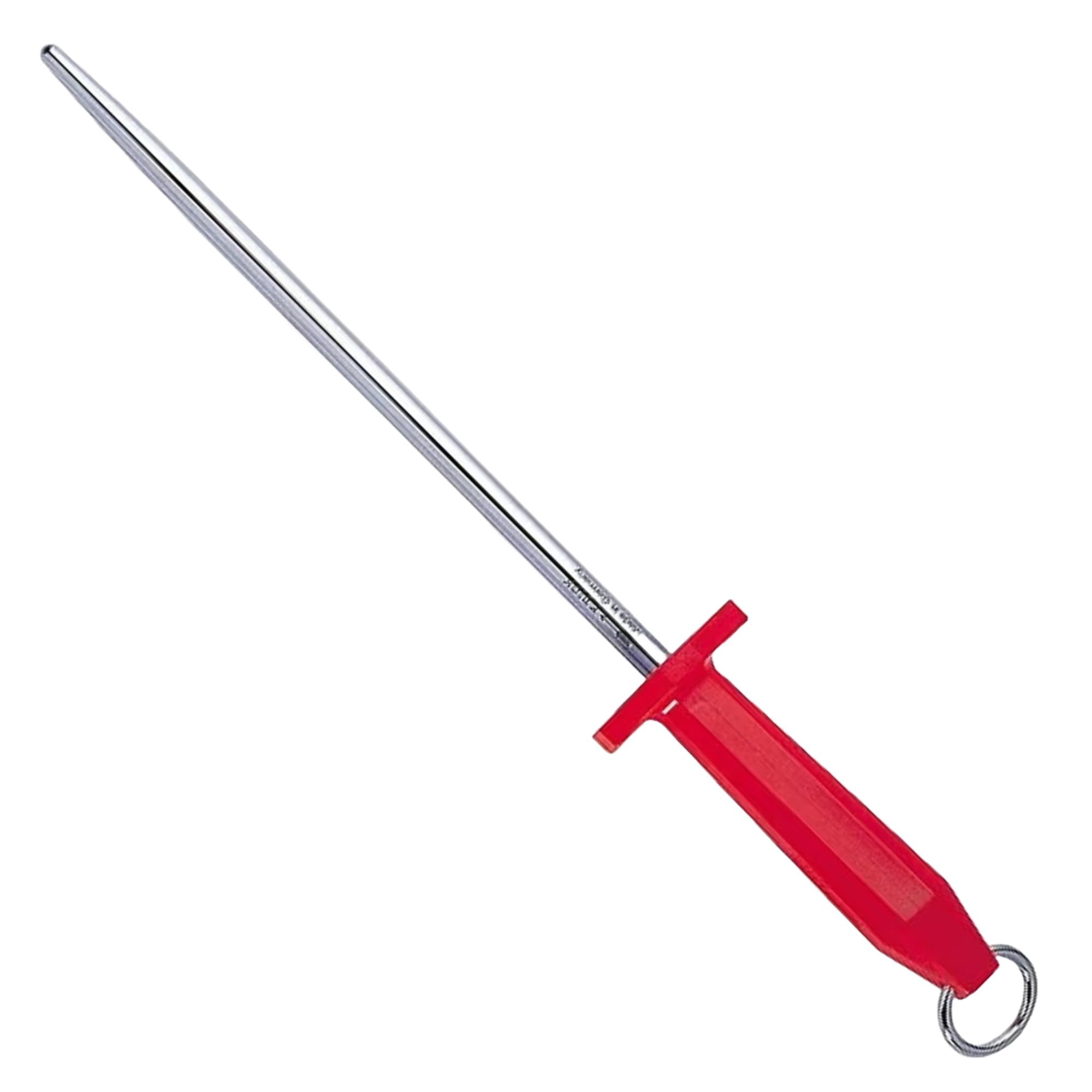
A German-made smooth steel with a bright orange handle that refuses to rust on the line.
You will not lose this steel in a busy prep station because the bright orange handle is designed for high visibility, and An owner on high-speed slaughter lines confirms it resists rust where others fail.. The smooth steel construction is what buyers love most, and the feedback is emphatic. At just 8.16 ounces, it is light enough for quick refreshes between tasks rather than heavy maintenance sessions.
What wins owners over is the sharpening quality — the top-mentioned aspect — with the effectiveness close behind, and the reviews make the case clearly: It keeps edges sharp between sharpenings, speeds up fillet work, and owners call it a quality product built to last.. The smooth surface is forgiving on blades, making it a reliable daily companion for cooks who need a fast touch-up mid-shift.
The trade-off is that a smooth steel removes less metal than a corrugated or coarse one, so it will not rescue a truly neglected blade — it maintains rather than resurrects. But for a working kitchen that keeps knives reasonably cared for, the rust resistance alone makes this a smart, low-drama choice.
The rust-proof edge: buyers report this steel stays clean where others corrode, and the smooth polish delivers a razor-sharp edge that speeds up fillet work.
Choose this if: you work in a wet, fast-paced kitchen and want a rust-resistant steel you can spot instantly on the counter.
Not ideal if: your knives go very dull between uses — the smooth surface maintains edges but does not aggressively grind them back.
7. ZWILLING 10-inch Sharpening Steel

An oval extra-fine steel that realigns a blade edge in fewer strokes, with the right weight in hand.
You save time because the oval rod provides more surface contact with the blade edge, achieving the same result as a traditional round rod but with fewer strokes — a real time-saver for cooks who hone a few times a week. The hard steel alloy rod is rated at approximately 62 Rockwell (HRC), giving it enough hardness to realign edges and remove any nick or burr on most kitchen blades. The ergonomic plastic handle includes a hanging hole, and a steel ring at the bottom lets you store it on a hook.
What wins owners over is the quality — the top-mentioned aspect — with sharpening performance close behind, and the stories back it up: One buyer maintains an amazing edge on 420J and 420HC steel for box cutting and food processing., running the knife across the rod a few times a week to keep it sharp. Buyers call it easy to grip, comfortable in the hand, and big enough to work a six-inch blade, with the weight feeling just right.
The honest caveat is that a steel like this maintains an edge but does not replace professional sharpening — an owner notes everyone should get their knives professionally sharpened, and this tool does not take the place of that. For weekly upkeep on a solid chef’s knife, it is a reliable, well-built performer.
What stands out
- Oval profile cuts strokes by increasing edge contact
- 62 HRC hardness realigns most kitchen blades
- Hanging ring and comfortable grip for easy use
Keep in mind
- Maintains edges but cannot replace professional sharpening
- Plastic handle feels less premium than metal alternatives
The weekly companion: this is the steel for home cooks who hone their chef’s knife a few times a week and want a solid, comfortable tool.
Not the one if: you expect it to revive badly neglected blades — this is a maintenance tool, not a full sharpener.
8. ZWILLING Professional 12-inch Oval Sharpening Steel

An oval high-carbon steel long enough for a 10-inch chef’s knife, praised for its 12-inch reach.
You get full sweeps on a 10-inch chef’s knife because this rod runs 12 inches, and the oval shape boost cutting surface and promotes smooth strokes — exactly what owners highlight as among the most-discussed aspects, with buyers noting it increases contact and makes honing quicker and more effective. It is made from high-carbon stainless steel with a synthetic handle, and the metal loop on the handle allows for easy wall storage.
What wins owners over is the sharpening quality — the top-mentioned aspect — with the oval shape close behind, and the reviews are glowing: One buyer calls it the best steel in 50 years., another says it is a must for a fine knife edge, and the consensus is that it works better than a finishing stone for maintaining sharpness. It fits American, German, and French knives alike, making it a versatile addition to any serious kitchen. The high-carbon steel construction and extra-fine grit deliver a smooth, controlled hone.
The recurring drawback is storage: owners mention it is huge and will not fit in a standard knife block, so you will need a wall hook or drawer space. A few also mention the handle-to-rod connection could be better, and you may eventually want a harder rod for tougher steels. But for a large-blade kitchen, this is a standout performer.
Why it impresses
- 12-inch length reaches the full sweep of a 10-inch chef’s knife
- Oval shape boost cutting surface for smooth strokes
- High-carbon steel construction is built to last
The real caveats
- Too large for a standard knife block — needs a wall hook
- Handle-to-rod connection draws occasional criticism
Pick this for: serious cooks with large carving or chef knives who want an oval steel with real reach and a premium German build.
pass on it if: drawer space is tight — this is a substantial tool that demands a proper storage spot.
9. F. Dick 11-inch Multicut Steel

A flat German steel built like seven steels in one, made to be the last you ever buy.
You get both grinding and fine honing from one tool, because the manufacturer markets this flat cutting surface as “seven steels in one.” The special handles ensure a safe grip, and the technique is simple: use strong pressure for a grinding effect, or light pressure to hone the edge. At 11 inches with a wide flat profile, it gives you more control and blade contact than a round steel, and buyers consistently call it heirloom quality — a “buy it once” tool that lasts decades with 8-plus years of professional use reported.
What wins owners over is the quality — the top-mentioned aspect — with material close behind, and the reviews read like a love letter: “exquisite quality,” “the last one you’ll ever buy,” and “finest steel made” are the recurring themes. It quickly hones even hard Japanese knives, enhances edges, and extends the time between full sharpenings, reducing how often you need professional work. Owners say it noticeably improves sharpness on everything from cheap to premium knives, and the wide surface is easier on blades than round steels.
The honest reality is the price — buyers call it extravagant for home cooks but reasonable for serious users, and the value-for-money aspect is mixed for that reason. There is also no sheath included, so you will need to store it carefully. But for someone who takes knives seriously, this is the steel that ends the search.
The heirloom case
- Wide flat profile gives superior control and blade contact
- Seven-in-one surface grinds or hones based on pressure
- Customers note 8+ years of professional use
The honest cost
- Premium price that is hard to justify for casual cooks
- No sheath included — needs careful storage
The finishing touch: this is the steel for knife enthusiasts who want a one-time purchase that delivers heirloom-grade sharpening for decades.
Pass on it if: you are a casual home cook — the price is better spent on a solid mid-range steel and professional sharpening.
Understanding the Specs
Rockwell Hardness (HRC)
The Rockwell hardness scale (HRC) measures how hard a metal is. A butcher steel should be harder than your knife blade to straighten the edge instead of bouncing off. Ceramic rods reach around HRC 68, metal steels often sit near 62 to 65 HRC, and softer blades are easier to realign with a finer steel.
Surface Texture and Grit
The surface of a steel determines how much metal it removes. Smooth and fine surfaces gently polish an edge for daily upkeep, corrugated or grooved surfaces bite harder for duller blades, and ceramic rods with a grit rating like 1000 (a measure of abrasiveness) sit between the two. Match the texture to how dull your knives get between uses.
FAQ
What is the difference between a butcher steel and a sharpening stone?
Will a ceramic honing rod work on Japanese knives?
How often should I use my butcher steel?
Is an oval or round butcher steel better?
Can a butcher steel sharpen scissors and cutters?
Why does my steel have grooves or a corrugated surface?
How do I clean and care for my butcher steel?
What length butcher steel do I need?
Why is my steel not making my knife sharp?
Is it safe to use a butcher steel on serrated knives?
Final Thoughts: The Verdict
Across the board, the butcher steel winner is the F. DICK DICKORON Classic because it pairs a sapphire-corrugated surface with an oval profile and 65 HRC hardness for a smooth, versatile finish. If you own hard Japanese knives and want budget-friendly performance, grab the Shenzhen Knives Ceramic Rod at HRC 68. And for professional butcher work on carbon steel, the Dexter-Russell 14″ is the one to reach for.{“@context”: “https://schema.org”, “@graph”: [{“@type”: “ItemList”, “name”: “9 Best Butcher Steel”, “url”: “https://fitlyfast.com/best-butcher-steel/”, “numberOfItems”: 9, “itemListElement”: [{“@type”: “ListItem”, “position”: 1, “name”: “F. DICK DICKORON Classic Sharpening Steel”, “url”: “https://fitlyfast.com/best-butcher-steel/#product-1”}, {“@type”: “ListItem”, “position”: 2, “name”: “Shenzhen Knives Ceramic Honing Rod”, “url”: “https://fitlyfast.com/best-butcher-steel/#product-2”}, {“@type”: “ListItem”, “position”: 3, “name”: “WÜSTHOF 9\” Honing Steel”, “url”: “https://fitlyfast.com/best-butcher-steel/#product-3”}, {“@type”: “ListItem”, “position”: 4, “name”: “Victorinox Round Finecut Butcher Sharpening Steel”, “url”: “https://fitlyfast.com/best-butcher-steel/#product-4”}, {“@type”: “ListItem”, “position”: 5, “name”: “Dexter-Russell 14\” Butcher Steel”, “url”: “https://fitlyfast.com/best-butcher-steel/#product-5”}, {“@type”: “ListItem”, “position”: 6, “name”: “F. DICK Orange Knife Sharpener”, “url”: “https://fitlyfast.com/best-butcher-steel/#product-6”}, {“@type”: “ListItem”, “position”: 7, “name”: “ZWILLING 10-inch Sharpening Steel”, “url”: “https://fitlyfast.com/best-butcher-steel/#product-7”}, {“@type”: “ListItem”, “position”: 8, “name”: “ZWILLING Professional 12-inch Oval Sharpening Steel”, “url”: “https://fitlyfast.com/best-butcher-steel/#product-8”}, {“@type”: “ListItem”, “position”: 9, “name”: “F. Dick 11-inch Multicut Steel”, “url”: “https://fitlyfast.com/best-butcher-steel/#product-9”}]}, {“@type”: “Product”, “position”: 1, “name”: “F. DICK DICKORON Classic Sharpening Steel”, “image”: “https://m.media-amazon.com/images/I/51r0xzeeeUL.jpg”, “brand”: {“@type”: “Brand”, “name”: “F.”}, “url”: “https://www.amazon.com/dp/B003VOSI8S/?tag=fitlyfast00-20”, “offers”: {“@type”: “Offer”, “url”: “https://www.amazon.com/dp/B003VOSI8S/?tag=fitlyfast00-20”}}, {“@type”: “Product”, “position”: 2, “name”: “Shenzhen Knives Ceramic Honing Rod”, “image”: “https://m.media-amazon.com/images/I/51lspfQrxrL.jpg”, “brand”: {“@type”: “Brand”, “name”: “Shenzhen”}, “url”: “https://www.amazon.com/dp/B07KJT8NYT/?tag=fitlyfast00-20”, “offers”: {“@type”: “Offer”, “url”: “https://www.amazon.com/dp/B07KJT8NYT/?tag=fitlyfast00-20”}}, {“@type”: “Product”, “position”: 3, “name”: “WÜSTHOF 9\” Honing Steel”, “image”: “https://m.media-amazon.com/images/I/51zCZWhbhOL.jpg”, “brand”: {“@type”: “Brand”, “name”: “WÜSTHOF”}, “url”: “https://www.amazon.com/dp/B00074PDE2/?tag=fitlyfast00-20”, “offers”: {“@type”: “Offer”, “url”: “https://www.amazon.com/dp/B00074PDE2/?tag=fitlyfast00-20”}}, {“@type”: “Product”, “position”: 4, “name”: “Victorinox Round Finecut Butcher Sharpening Steel”, “image”: “https://m.media-amazon.com/images/I/41ETsWx9QhL.jpg”, “brand”: {“@type”: “Brand”, “name”: “Victorinox”}, “url”: “https://www.amazon.com/dp/B001U555S6/?tag=fitlyfast00-20”, “offers”: {“@type”: “Offer”, “url”: “https://www.amazon.com/dp/B001U555S6/?tag=fitlyfast00-20”}}, {“@type”: “Product”, “position”: 5, “name”: “Dexter-Russell 14\” Butcher Steel”, “image”: “https://m.media-amazon.com/images/I/41Vx1KjOGJL.jpg”, “brand”: {“@type”: “Brand”, “name”: “Dexter-Russell”}, “url”: “https://www.amazon.com/dp/B001EQEILG/?tag=fitlyfast00-20”, “offers”: {“@type”: “Offer”, “url”: “https://www.amazon.com/dp/B001EQEILG/?tag=fitlyfast00-20”}}, {“@type”: “Product”, “position”: 6, “name”: “F. DICK Orange Knife Sharpener”, “image”: “https://m.media-amazon.com/images/I/51Co6CEOLRL.jpg”, “brand”: {“@type”: “Brand”, “name”: “F.”}, “url”: “https://www.amazon.com/dp/B078PQKT75/?tag=fitlyfast00-20”, “offers”: {“@type”: “Offer”, “url”: “https://www.amazon.com/dp/B078PQKT75/?tag=fitlyfast00-20”}}, {“@type”: “Product”, “position”: 7, “name”: “ZWILLING 10-inch Sharpening Steel”, “image”: “https://m.media-amazon.com/images/I/4189kfw-x2L.jpg”, “brand”: {“@type”: “Brand”, “name”: “ZWILLING”}, “url”: “https://www.amazon.com/dp/B00004RFKZ/?tag=fitlyfast00-20”, “offers”: {“@type”: “Offer”, “url”: “https://www.amazon.com/dp/B00004RFKZ/?tag=fitlyfast00-20”}}, {“@type”: “Product”, “position”: 8, “name”: “ZWILLING Professional 12-inch Oval Sharpening Steel”, “image”: “https://m.media-amazon.com/images/I/611djWO47SL.jpg”, “brand”: {“@type”: “Brand”, “name”: “ZWILLING”}, “url”: “https://www.amazon.com/dp/B00004RFM7/?tag=fitlyfast00-20”, “offers”: {“@type”: “Offer”, “url”: “https://www.amazon.com/dp/B00004RFM7/?tag=fitlyfast00-20”}}, {“@type”: “Product”, “position”: 9, “name”: “F. Dick 11-inch Multicut Steel”, “image”: “https://m.media-amazon.com/images/I/51nSbaA3-NL.jpg”, “brand”: {“@type”: “Brand”, “name”: “F.”}, “url”: “https://www.amazon.com/dp/B000YQHXU0/?tag=fitlyfast00-20”, “offers”: {“@type”: “Offer”, “url”: “https://www.amazon.com/dp/B000YQHXU0/?tag=fitlyfast00-20”}}, {“@type”: “FAQPage”, “mainEntity”: [{“@type”: “Question”, “name”: “What is the difference between a butcher steel and a sharpening stone?”, “acceptedAnswer”: {“@type”: “Answer”, “text”: “A butcher steel realigns the existing edge of a knife rather than grinding a new one. It straightens the microscopic teeth of the blade, which is why it is best used regularly between full sharpenings. A sharpening stone removes metal to create a fresh edge and is needed less often, typically every few months for a home cook.”}}, {“@type”: “Question”, “name”: “Will a ceramic honing rod work on Japanese knives?”, “acceptedAnswer”: {“@type”: “Answer”, “text”: “Yes, and it is often the safer choice. Ceramic rods around 1000 grit are hard enough at HRC 68 to realign the harder steel of Japanese knives without stripping excessive metal. Reviewers point out ceramic rods work well on Japanese blades, restoring sharpness in just a few swipes per side.”}}, {“@type”: “Question”, “name”: “How often should I use my butcher steel?”, “acceptedAnswer”: {“@type”: “Answer”, “text”: “For most home cooks, honing before each cooking session or after every 2 to 3 uses keeps a knife sharp. Regular use with a few strokes per side extends the time between full sharpenings, which is why shoppers say weekly use improves cutting and reduces how often professional sharpening is needed.”}}, {“@type”: “Question”, “name”: “Is an oval or round butcher steel better?”, “acceptedAnswer”: {“@type”: “Answer”, “text”: “An oval steel provides more surface contact with the blade edge, achieving the same result as a round steel but with fewer strokes. Buyers appreciate the oval shape for maximizing cutting surface and smooth strokes. A round steel offers a more traditional feel that some butchers prefer. Both work well — it depends on personal comfort.”}}, {“@type”: “Question”, “name”: “Can a butcher steel sharpen scissors and cutters?”, “acceptedAnswer”: {“@type”: “Answer”, “text”: “Yes, a honing steel can be used to realign the edges of scissors and cutters, not just knives. The same technique of running the edge along the steel at the correct angle applies. However, for very dull or damaged tools, a proper sharpening stone or professional service is still the better option.”}}, {“@type”: “Question”, “name”: “Why does my steel have grooves or a corrugated surface?”, “acceptedAnswer”: {“@type”: “Answer”, “text”: “Grooved or corrugated surfaces remove more metal than smooth ones, which makes them more aggressive for restoring duller blades. The F. DICK DICKORON uses a sapphire corrugation that delivers a smooth, even sharpening despite the texture. Grooved rods also improve ease of sharpening because they grip the edge more firmly.”}}, {“@type”: “Question”, “name”: “How do I clean and care for my butcher steel?”, “acceptedAnswer”: {“@type”: “Answer”, “text”: “Most metal steels should be wiped clean after use and kept dry to prevent rust. Ceramic rods are hand wash only — never put them in the dishwasher, and handle them carefully because ceramic can shatter if dropped. After honing on a ceramic rod, gray streaks of metal residue can be wiped away with mild soap and a non-scratch pad.”}}, {“@type”: “Question”, “name”: “What length butcher steel do I need?”, “acceptedAnswer”: {“@type”: “Answer”, “text”: “A 12-inch rod covers the full length of most chef knives in a single stroke, which is why longer rods are favored for larger blades. A 9-inch steel suits casual home cooks with shorter knives, while a 14-inch rod like the Dexter-Russell is built for long butcher blades and professional use. Match the length to your longest knife.”}}, {“@type”: “Question”, “name”: “Why is my steel not making my knife sharp?”, “acceptedAnswer”: {“@type”: “Answer”, “text”: “A steel realigns an edge but cannot fix a blade that is truly dull or damaged. If your knife has significant nicks or has not been sharpened in a long time, you need a sharpening stone or professional service first. The steel then maintains that fresh edge between sharpenings. Also check that your steel is harder than your blade.”}}, {“@type”: “Question”, “name”: “Is it safe to use a butcher steel on serrated knives?”, “acceptedAnswer”: {“@type”: “Answer”, “text”: “No, butcher steels are designed for straight-edge blades only. A ceramic rod like the Shenzhen Knives model explicitly states it is not suitable for serrated knives. Serrated edges require special tools or professional sharpening to maintain the scalloped cutting surface properly.”}}]}]}