
Our readers keep the lights on and the weekend projects moving. As an Amazon Associate, I earn from qualifying purchases.
Specs are compiled from manufacturer listings and verified buyer reviews and can change over time — please confirm the key details on the product page before buying.
Finding desktop speakers that don’t sound like a phone speaker turned up too loud is the real challenge of budget audio. Today’s budget models deliver genuine bass and clear vocals without studio prices. This guide ranks nine budget sets by real-world performance and desk fit.
I’m Rikta — the founder and writer behind FitlyFast. This guide is built by comparing the manufacturers’ published specifications and the patterns across verified customer reviews, so you get each pick’s real strengths and trade-offs instead of marketing spin.
You can upgrade from tinny laptop speakers without spending a fortune. This breakdown of the budget computer speakers market helps you find the right pair for clear sound, deep bass, and easy setup—if you want a simple USB-powered set or a full 2.1 system with a subwoofer.
Our Picks at a Glance


How To Choose The Best Budget Computer Speakers
Your ideal budget speaker hinges on desk space and listening habits. A compact 2.0 pair might be perfect for podcasts and calls, while a 2.1 system with a subwoofer adds the rumble needed for movies and gaming.
Power: Reality vs. Marketing
Speaker wattage is often the most confusing spec. A label like “60W peak power” sounds impressive, but peak power is a brief maximum, not continuous output. Look for RMS (Root Mean Square) ratings, which measure sustainable power, to get a realistic sense of how loud and clean the speakers can play. A set with 8W RMS can still fill a small room clearly if the drivers are well-tuned.
The Bass Equation: Radiators vs. Subwoofers
For deep bass in a small package, manufacturers use one of two tricks. Passive radiators are lightweight cones that move air to reinforce low frequencies without needing their own power, perfect for compact 2.0 speakers. A dedicated subwoofer, as found in 2.1 systems, is a powered driver that handles only the low end, allowing the satellite speakers to stay clear. This is the key choice: a small footprint with surprising bass, or a separate box that delivers room-shaking lows.
Quick Comparison
| Model | Best For | Max Power | Connectivity | Bass Type | Amazon |
|---|---|---|---|---|---|
| ROSON Compact Speaker★ Best Overall | Cable-free simplicity & headphone users | 3W x 2 | USB + 3.5mm | None (full-range) | Amazon |
| Sanyun SW102Bass Champion | Space-saving with punchy bass | 5W x 2 | USB + 3.5mm | Passive Radiator | Amazon |
| Creative Pebble V3Clean Desk Pick | Clean desks & Bluetooth streaming | 8W RMS | USB-C, BT 5.0, AUX | Enhanced drivers | Amazon |
| Sanyun SW208 | Music lovers wanting HiFi detail | 60W | BT 5.0, USB, AUX | Carbon fiber drivers | Amazon |
| Logitech Z313 | Gamers & movie fans wanting 2.1 | 25W RMS | 3.5mm + RCA | Dedicated Subwoofer | Amazon |
| Logitech Z207 | Multi-device Bluetooth users | 10W Peak | BT 4.2, 3.5mm | Passive Radiator | Amazon |
| H1 Powered Speaker | Audiophiles on a budget | 60W | BT, USB-C DAC, Optical, AUX | Bass reflex port | Amazon |
| Bluedee 2.1 System | RGB fans wanting cinematic bass | 80W Peak | BT 5.4, USB, USB-C, AUX | Dedicated Subwoofer | Amazon |
| Nylavee 2.1 Soundbar | Soundbar style with deep sub bass | 60W Peak | BT 5.4, 3.5mm, RCA | 5.25″ Subwoofer | Amazon |
In‑Depth Reviews
1. ROSON Compact Computer Speaker
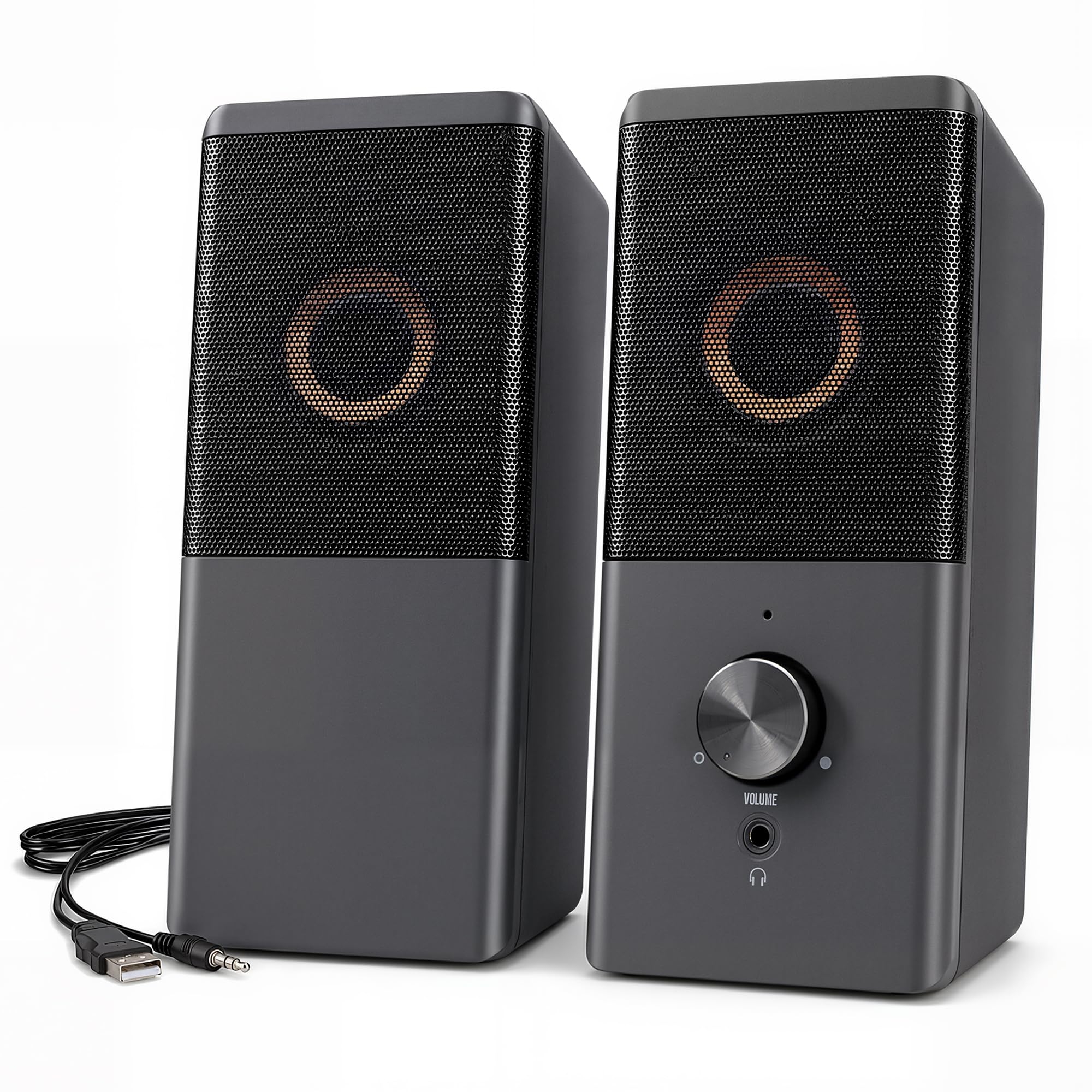
Plug-and-play pair with front volume knob and headphone jack for easy access.
The ROSON set wins the top spot because it nails the essentials of desk audio: it is a true 2.0 stereo system powered simply by a USB cable for power and a 3.5mm aux cable for sound. Just plug both in, and it works with any device that has a standard headphone jack — desktops, laptops, phones, tablets, and even gaming consoles. The best part is the front-mounted volume control and headphone jack on the right speaker, so you can adjust levels or plug in headphones without hunting under the desk.
At 3W x 2 maximum power, it is not the loudest or most bass-heavy option here — it delivers a sound that is clear, bright, and rounded rather than earth-shaking. The left-to-right speaker cable spans 31.49in (80cm), and the USB and aux cables each stretch 39.37in (100cm), giving you solid flexibility for most desk layouts. Reviewers consistently mention the sound is clear and gets surprisingly loud for the size, with some calling it a worthy replacement for a much pricier Bose system they had to bend under the desk to power on.
Ideal for wire-averse users wanting reliable sound for calls, YouTube, and casual music. The main trade-off, as buyers report, is that “they don’t handle low volume bass well” — so if you crave deep low-end thump, you will want to look at a set with a dedicated subwoofer or passive radiators.
Desk-Life Highlights
- Front volume knob and headphone jack for easy access
- Plug-and-play with any 3.5mm device
- Long 39.37in cables for flexible placement
Sound Limitations
- Light on bass at low volume levels
- 3W x 2 power won’t fill a large room
Grab it if: you want a fuss-free, compact set with convenient front controls for everyday desktop use.
Look elsewhere if: your playlist relies on deep bass, which this budget-friendly pair simply isn’t built to deliver.
2. Sanyun SW102 Computer Speakers
Compact 10W set with passive radiator delivering surprising bass depth.
If you want maximum bass from a minimal footprint, the Sanyun SW102 is the crowd favorite — a massive base of owners praise its sound quality above all else. It achieves this with a clever acoustic trick: a built-in passive bass radiator that reinforces low frequencies, giving you punchy lows that simply aren’t possible from a standard small driver. With 5W x 2 maximum power, it delivers 10W total, which is a full 67% more power than the ROSON set, making it noticeably louder and richer.
The build is a mix of metal and high-quality plastics designed to stay steady without vibrating, and the compact size (3.94×2.76×2.95 inch) fits easily under a monitor. The included speaker cable runs over 4 feet, which owners mention gives them plenty of room to position each satellite properly for that 360-degree stereo effect. Setup is true plug-and-play: just connect the USB for power and the 3.5mm jack for audio, and it works with most music players, computers, and even 5V chargers.
Owners describe the sound as “crisp” and note the passive radiator adds “notable bass depth” without distortion at normal volumes. The honesty in the marketing is refreshing — Sanyun admits the bass still can’t match a big speaker or professional subwoofer, which is the fair trade-off for a set this small. Some units have reported reliability issues where one speaker stops working, so it is worth checking for that right after setup.
Punchy Personality
- 10W total power (5W per speaker) for a small set
- Passive bass radiator delivers surprising low-end depth
- Steady metal and plastic build that doesn’t vibrate
Reality Check
- Occasional reports of a satellite speaker failing over time
- Bass still can’t rival a dedicated subwoofer
Choose this if: you’re short on desk space but refuse to compromise on bass quality.
The honest catch: a small percentage of owners hit a reliability issue, so ensure your return window covers you.
3. Creative Pebble V3
Single USB-C cable powers audio and Bluetooth, with 45° angled drivers for direct sound.
The defining feature of the Pebble V3 is its minimalist connectivity — it needs only a single USB-C cable for both power and audio, so your desk stays neat with no messy 3.5mm tangles. For older computers with only USB-A ports, Creative includes a converter, so compatibility is a non-issue. If you want to ditch wires entirely, the built-in Bluetooth 5.0 lets you stream from your phone while you’re still at your desk, which reviewers love for lazy listening moments.
You’ll hear a massive step up from laptop speakers, thanks to a larger custom-tuned 2.25″ full-range driver that Creative claims is 50% louder than the previous version. It delivers 8W RMS (continuous power) and up to 16W peak power, with a built-in gain switch for amplified audio when plugged into a 10W USB port. The signature 45° improve drivers angle the sound directly toward your ears, creating an “audio balance” that makes voices and music feel more present. The Clear Dialog processing is a standout for anyone who watches a lot of YouTube or TV — it makes spoken words intelligible without cranking the volume.
The trade-off, as some listeners note, is that there’s no real bass — the sound can get tinny at high volumes. This is a 2.0 set without a subwoofer or passive radiator, so it is best for clear, balanced listening rather than thumping music. Owners consistently call it a “great value” upgrade for a clean desk setup, with one noting the volume knob feels smooth and satisfying to use.
Single-cable mastery: One USB-C connection handles power and audio, freeing your desk from wire clutter while Bluetooth 5.0 adds wireless freedom.
Keep it moderate: At high volumes sound turns tinny, so let the 8W RMS shine at normal listening levels.
4. Sanyun SW208 Bookshelf Speakers

Step up to real HiFi with carbon-fiber drivers and a built-in DAC for studio-like detail.
This is the budget pick for people who care about the details in their music. The SW208 uses a 30W x 2 carbon fiber speaker unit with a multi-layer voice coil, a design that delivers a warm, thick midrange and clear, bright highs that you simply don’t find in plastic-cabinet speakers. The 24-bit DAC (Digital-to-Analog Converter) is the key feature here — when you connect via USB, it processes the digital audio signal directly, reducing loss and maximizing the fidelity of the original recording.
Set-up is a step up in complexity but still manageable, with volume, treble, and bass adjustment knobs located on the side of the main speaker. This gives you real control to tailor the sound to your room and your taste, which is rare at this level. The bookshelf design with a rear bass reflex port helps produce surprisingly deep and powerful lows, and reviewers call it a “big upgrade from speakers” that reveals new details in familiar music.
The honest feedback is mixed on a few fronts. The advertised tweeter is actually cosmetic — a “fake tweeter” that doesn’t produce sound, which some owners dislike. The volume might max out at what feels like two-thirds of expectations, making it better for a desk than for filling a large room. Deep voices can sound odd with heavy bass, so you’ll want to dial the bass knob down to find the balance for dialogue-heavy content.
Detail-oriented: The 24-bit DAC and carbon-fiber drivers make this the best-sounding option for music lovers who want to hear every instrument.
Know the limits: The tweeter is cosmetic only and max volume is modest, so manage expectations for room-filling sound.
5. Logitech Z313 2.1 System

The classic 2.1 setup that adds cinematic rumble with a compact subwoofer and convenient control pod.
When you want to feel your games and movies, not just hear them, the Z313 delivers with a genuine 2.1 system. It pairs two compact satellite speakers with a dedicated subwoofer, driven by 25 Watts (RMS) of total output. This is the pick for anyone who wants that deep, physical bass that a 2.0 set simply cannot produce, all controlled by a convenient control pod that sits right on your desk.
Setup is famously easy — reviewers describe it as the simplest they’ve ever done, often replacing 15-to-25-year-old speaker systems with a dramatic improvement in clarity and power. The subwoofer adds the body that makes action movies and game explosions feel rich, while the satellites keep vocals crisp and clean. The control pod puts the volume knob right at your fingertips, so there’s no reaching behind the desk to adjust levels.
Connectivity is straightforward with a 3.5mm aux input and RCA connections, making it compatible with desktops and TVs. The recurring theme from owners is “great value,” with many noting it offers better sound at half the price of their old systems. There are honest caveats: the subwoofer can sound a bit muddy compared to pricier systems, and a small number of customers note issues with the right speaker stopping working over time.
The 2.1 Advantage
- Dedicated subwoofer adds real cinematic bass
- Convenient control pod for easy volume access
- 25W RMS output fills a room well
Honest Caveats
- Subwoofer isn’t as tight as premium systems
- Long-term reliability gets a few complaints
Perfect for: gamers and movie fans who want that physical subwoofer rumble on a strict budget.
Think twice if: you need audiophile-grade accuracy — this prioritizes fun, effective sound over studio neutrality.
6. Logitech Z207 Bluetooth Speakers

The longevity champ that switches between your PC and phone with a single tap of play.
If you juggle audio sources, the Z207 is built for you. It features Logitech’s Easy-Switch technology, which lets you smoothly move between two Bluetooth devices — just pause audio on one and press play on the other. This makes it easy to take a call on your phone and then switch straight back to your computer’s music, and reviewers point out it works even with both a 3.5mm aux connection and a Bluetooth source streaming simultaneously.
Sound comes from an active driver in each speaker paired with a passive radiator that provides bass extension, delivering a balanced sound that shoppers say is not tinny — a common praise for a set this compact. The 10W peak power is enough to fill a room without distortion, though you may need to push your device volume to the max. The built-in amplifier can actually boost low laptop volume, which is a welcome feature for quieter laptops.
The durability story is the standout here, with multiple owners reporting their sets are “going 6+ years strong” with impressive Bluetooth range. The main gripe is the bass — it’s mediocre at best, a fair trade for the small footprint. Also, the black volume dot is nearly invisible against the black knob, a small design flaw that makes adjusting the level a bit of a guess.
Switching wizardry: Easy-Switch makes hopping between your PC, phone, or tablet painless, with the rare ability to mix wired and Bluetooth sources.
Built to last: Buyers report years of reliable service, though bass is weak and the volume knob’s marker is hard to see.
7. H1 Powered Computer Speakers
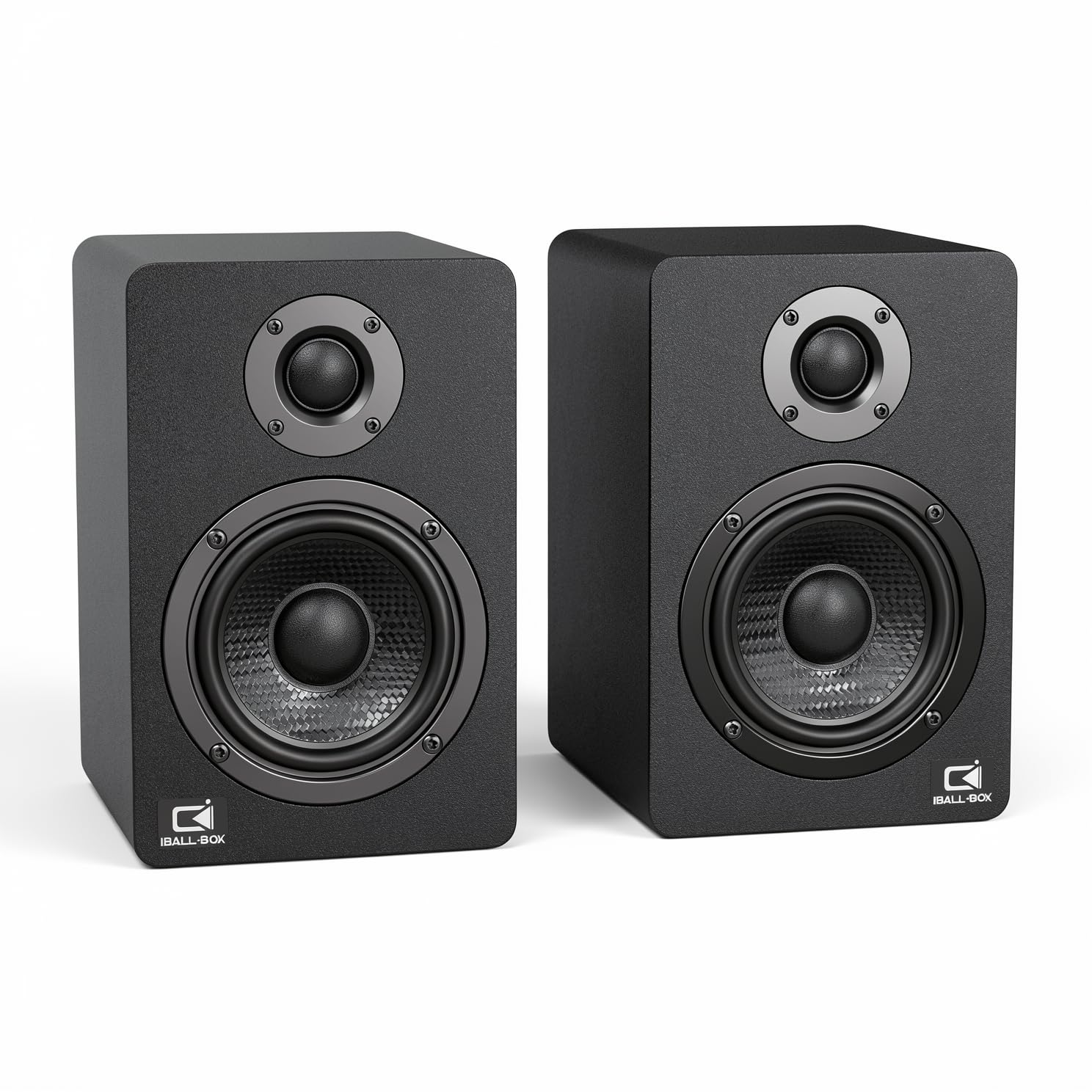
The compact system with audiophile-grade inputs, including optical and a 24-bit USB-C DAC.
This is the budget speaker that punches far above its weight class in connectivity. The H1 is powered by 60W of output in a 2.0 system, using dual 3-inch carbon-fiber woofers and dual 1-inch silk-dome tweeters to deliver a frequency response from 40Hz to 20KHz with a signal-to-noise ratio of ≥95dB. That translates to cleaner highs, fuller mids, and tighter bass than you’d expect from a desktop set.
The input selection is where this set really shines. You get a 24-bit wired playback through a USB-C DAC, an optical input (great for TVs and gaming consoles), and a standard 3.5mm AUX, plus Bluetooth for wireless convenience. Owners specifically highlight the optical connection to a PC as sounding “great for Netflix and MP3s,” and the inclusion of multiple cables in the box means you can start using it immediately. This is the “flexible stereo speakers with multiple inputs” that reviewers rave about for clean sound.
Front-panel controls let you adjust master volume, treble, and bass directly, so you can fine-tune the sound for different media without software. The compact design fits neatly on a desk while offering a “cleaner upgrade over weak built-in device audio.” The only minor complaint is the color — described as dark gray rather than the slate blue in the images — and a knob that selects inputs via audio and LED confirmation, which takes a moment to get used to.
Audiophile Features
- Optical input delivers pristine digital audio from TVs and consoles
- 24-bit USB-C DAC enhances wired playback quality
- Front bass and treble controls for easy tuning
Small Nits
- Color is dark gray, not slate blue as pictured
- Input-selection knob requires a bit of practice
Reach for this if: you want studio-quality inputs like optical and USB-C DAC without paying studio prices.
A fair note: With a lower review count than the massive Logitech base, it’s a newer contender, but the sound quality feedback is overwhelmingly positive.
8. Bluedee 2.1 RGB Speakers
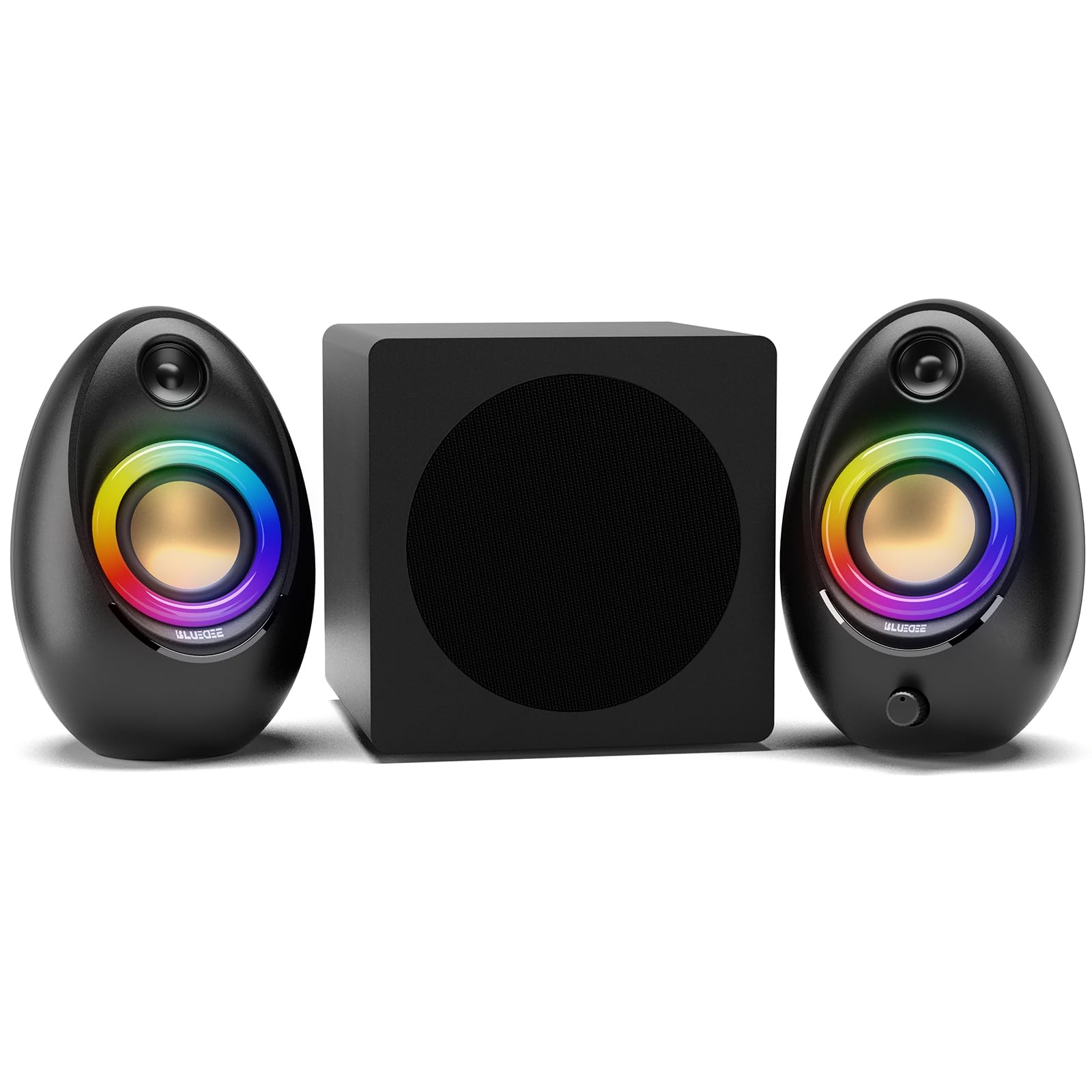
The 2.1 system that brings desk-shaking bass and customizable RGB lighting to your battlestation.
For the gamer who wants both performance and aesthetics, the Bluedee system delivers a full 2.1 setup with an independent subwoofer for deep, punchy bass that keeps satellite speakers clear of muddiness. The 80W peak power, driven by DSP tuning (Digital Signal Processing that reduces distortion), provides clear vocals and balanced audio for work-from-home calls as well as rich game soundtracks.
Connectivity is future-proof with Bluetooth 5.4 for wireless streaming, plus wired options via USB, USB-C, and 3.5mm AUX. The adapter-powered design means true plug-and-play — just connect the power and you’re ready. Owners praise the “deep punchy bass” from the subwoofer and note the setup is quick, with the speakers connecting right from the start.
The all-in-one control knob is a clever touch, letting you adjust volume, play or pause audio, change lighting effects, and switch input modes without juggling multiple buttons. The RGB lighting is described as “vibrant but not distracting,” with options for dynamic colors or a soft static glow. The fair caveat is that at very high volumes or with bass-heavy tracks, the sound can distort — the honest advice from owners is to dial the volume back a bit to find the balance.
Full-package theater: A dedicated subwoofer, 80W peak power, and subtle RGB make this the most rich budget desktop setup here.
Handle with care: Push it too hard and you’ll hit distortion, so keep the volume in its comfort zone for clean sound.
9. Nylavee 2.1 Soundbar with Subwoofer
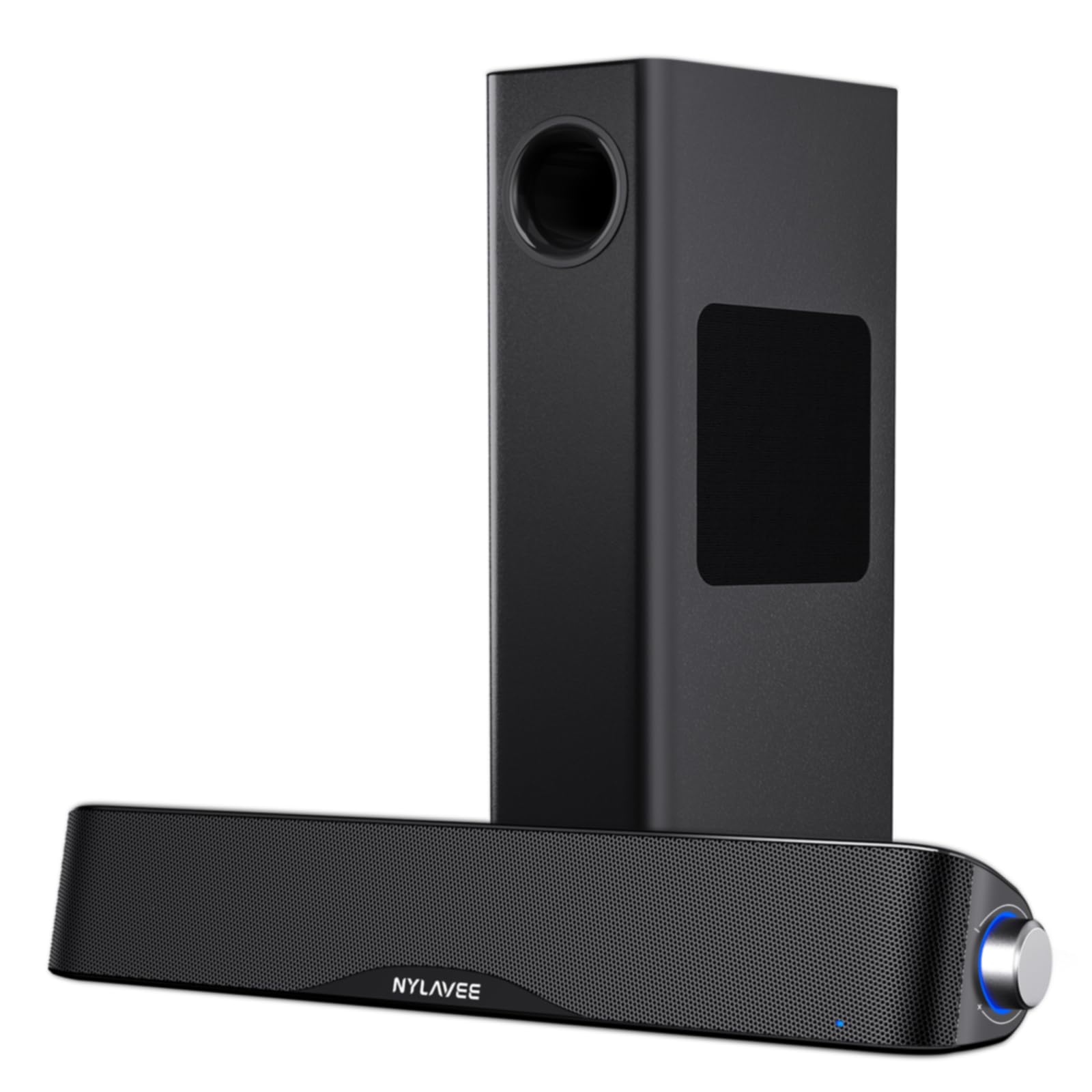
The sleek soundbar design that pairs with a 5.25-inch subwoofer for room-filling, punchy audio.
This pick combines the clean, space-saving look of a soundbar with the low-end power of a true 2.1 system. The Nylavee features dual soft-dome silk tweeters and full-range drivers in the bar, which deliver crisp highs and balanced mids, while a standalone 5.25″ bass driver with 60W peak power (30W RMS) handles the deep lows. Owners say the subwoofer “vibrates the desk at mid-high volume,” giving your games and movies real physical impact.
Setup is genuinely easy — powered by an AC adapter with no built-in battery, it’s plug-and-play with zero drivers or software needed. All controls live on a side knob for power, mode switching, volume, and reset. Bluetooth 5.4 handles wireless streaming, and the 3.5mm AUX plus included RCA cable ensure compatibility with desktops, laptops, MacBooks, iMacs, Xbox, and PS5. One owner even noted the free companion software gives you equalizer-like control with presets for voice, music, and movies.
The sound quality is the most-praised feature, described as “clear, crisp, and powerful.” The recurring feedback is that the subwoofer is great, but there’s no dedicated bass control knob on the unit, so you’re relying on your device’s EQ or the software to adjust the lows. Reviewers consistently call it “easily worth the money” and a massive upgrade over built-in monitor speakers or older budget sets.
Soundbar Benefits
- Space-saving soundbar design with a separate 5.25″ subwoofer
- 60W peak power delivers punchy, defined bass
- Works with consoles like Xbox and PS5 via 3.5mm or RCA
Control Quirks
- No on-unit bass adjustment knob
- Subwoofer output is impressive but you can’t fine-tune it directly
Best for: desks where a long soundbar feels cleaner than two separate satellites, especially for console gamers.
Keep in mind: You’ll use your computer’s EQ or the free software to manage the bass since there’s no physical sub control.
Understanding the Specs
Power Output (Wattage)
Look for the RMS value, which is the continuous power the speaker can sustain cleanly. Peak power is the brief maximum it can hit on loud bursts. For a small desk, 8W RMS is plenty; for a 2.1 system with a subwoofer, aim for 25W RMS or more to get real room-filling sound.
Passive Radiators vs. Subwoofers
A passive radiator is an unpowered cone that moves air to reinforce bass in compact 2.0 speakers. A subwoofer is a powered speaker dedicated to low frequencies. Radiators give surprising bass for the size; subwoofers deliver deeper, more physical rumble that you can feel.
Connectivity & DAC
USB-C connections often include a built-in DAC (Digital-to-Analog Converter) that processes digital audio more accurately than a standard headphone jack. Optical inputs deliver pure digital audio from TVs, while Bluetooth 5.0 or 5.4 provides stable wireless streaming with better range than older versions.
Driver Materials
Carbon-fiber and silk-dome drivers are designed to reduce distortion and produce cleaner sound. Carbon fiber is stiff and lightweight, offering punchy midrange, while silk domes are smooth and handle high frequencies without harshness. These materials are a sign of quality in budget speakers.
FAQ
Will these budget speakers work with my computer’s USB port?
What is the difference between a 2.0 and 2.1 speaker system?
How much power do I really need for a small room?
Can I connect these speakers to my TV or gaming console?
Why does my budget speaker sound tinny with no bass?
Is a USB-C speaker better than a standard 3.5mm aux speaker?
How long do budget computer speakers typically last?
What does the gain switch on the Creative Pebble V3 do?
Why is one of my budget speakers louder than the other?
Do I need special software to control these speakers?
Final Thoughts: The Verdict
For most people, the budget computer speakers winner is the ROSON Compact Speaker because it nails the core balance of plug-and-play ease, convenient front controls, and clear day-to-day sound at a very friendly price. If you want surprisingly deep bass from a tiny footprint, grab the Sanyun SW102. And for a cinematic 2.1 experience with a dedicated subwoofer, the Logitech Z313 is the one to reach for.
How We Picked
We do not accept paid placement. Every pick is matched to a real buyer and a real use-case; we do not hands-on test units.
Sources & Methodology
Specifications: manufacturer listings and product documentation. Review insights: verified customer reviews, as of August 2026. Pricing: not shown on this page (it changes often); check the current price via the retailer link.
As an Amazon Associate, FitlyFast earns from qualifying purchases. This does not affect which products we feature.