
Our readers keep the lights on and the weekend projects moving. As an Amazon Associate, I earn from qualifying purchases.
Specs are compiled from manufacturer listings and verified buyer reviews and can change over time — please confirm the key details on the product page before buying.
Living on a 110-volt household outlet used to mean settling for a weak, frustrating arc. That is no longer true. The new generation of inverter-based 110V stick welders delivers surprisingly capable welds from a standard garage socket, whether you are fixing a trailer gate, patching a farm tool, or learning on your own metal.
I’m Rikta — the founder and writer behind FitlyFast. This guide is built by comparing the manufacturers’ published specifications and the patterns across verified customer reviews, so you get each pick’s real strengths and trade-offs instead of marketing spin.
Before diving in, a quick note: the list flexibly matches 110V or 120V input machines, so a pick rated for 120V serves the same purpose as one rated for 110V. Find the best 110 volt stick welder for your garage and skill level with this research-backed lineup.
Our Picks at a Glance

How To Choose The Best 110 Volt Stick Welder
A 110V stick welder is all about matching the machine to the thickness of metal you actually work on. The physics of a standard household outlet caps how much power any plug-in unit can draw, so the honest machines rate their output accordingly.
Know the real amp output on 110V
Many machines advertise a 200-amp peak that only appears on 220V power. On a 110V outlet, that same unit often delivers far less. Buyers report the Sunstac 200A only comfortably burns 1/16 or 3/32 rods on 110V, while the DEKOPRO 160A handles light repairs on 120V. Check what the output actually is on standard household power, not the marketing headline.
Match output to rod size
The rod you can run defines the job you can do. A 3/32-inch 6013 rod needs roughly 60-80 amps, while a 1/8-inch 7018 wants 90-130 amps. A 90-amp machine like the Forney 298 is perfect for thin sheet and hobby work, but it will not burn a 1/8-inch rod all day. The smallest handheld units top out around 120 amps and suit 3/32-inch rods best.
Weigh duty cycle against your projects
Duty cycle is the percentage of a 10-minute window you can weld continuously before the machine needs to cool. A 40% duty cycle at 200A means four minutes of welding, then a cool-down. For weekend projects, even a low duty cycle is fine. For a full trailer build, you want a machine that runs long without thermal shutdown — the ESAB Rogue earned praise for welding four hours straight without tripping breakers.
Look for beginner-friendly arc features
Hot start gives an extra punch of current when the rod first touches metal, making the arc easier to strike. Arc force boosts current when the arc gets too short, preventing the rod from sticking. Anti-stick automatically cuts power if the rod fuses to the work. These three features turn a frustrating first hour into a productive one.
Quick Comparison
| Model | Best For | Max Amps | Weight | Welding Modes | Amazon |
|---|---|---|---|---|---|
| Weldpro 200A AC/DC TIG★ Best Overall | Multi-process precision | 200A | 61.8 lb | 5-in-1 TIG/Stick | Amazon |
| ESAB Rogue ES 180iPro Build | Pro-grade build quality | 180A | 18 lb | Stick + 6010 mode | Amazon |
| MTS-205 ComboMulti-Process | MIG/TIG/Stick versatility | 205A | — | MIG/Flux/Lift TIG/Stick | Amazon |
| PUWU 6-in-1 Plasma Combo | Cutting plus welding | 200A MIG / 50A CUT | 25.6 lb | MIG/HF TIG/Stick/CUT | Amazon |
| YESWELDER TIG-205P | Pulsed TIG precision | 200A | 23.7 lb | Stick/DC TIG/Pulse TIG | Amazon |
| ARCCAPTAIN TIG200 | Entry-level dual voltage | 200A | 20.8 lb | HF TIG/Stick | Amazon |
| Forney 298 Easy Weld | Beginner household repairs | 90A | 13.7 lb | Stick + TIG capable | Amazon |
| Saker Handheld | Light portable fixes | 120A | 6.82 lb | Handheld Stick | Amazon |
| Faiuot Handheld Kit | Complete starter kit | 120A | 6.67 lb | Handheld Stick | Amazon |
| DEKOPRO 160A | Budget dual voltage | 160A | 11.44 lb | ARC/Lift TIG 2-in-1 | Amazon |
| Sunstac SS-200S | Ultra-compact value | 200A | 12.18 lb | Stick/Lift TIG | Amazon |
In‑Depth Reviews
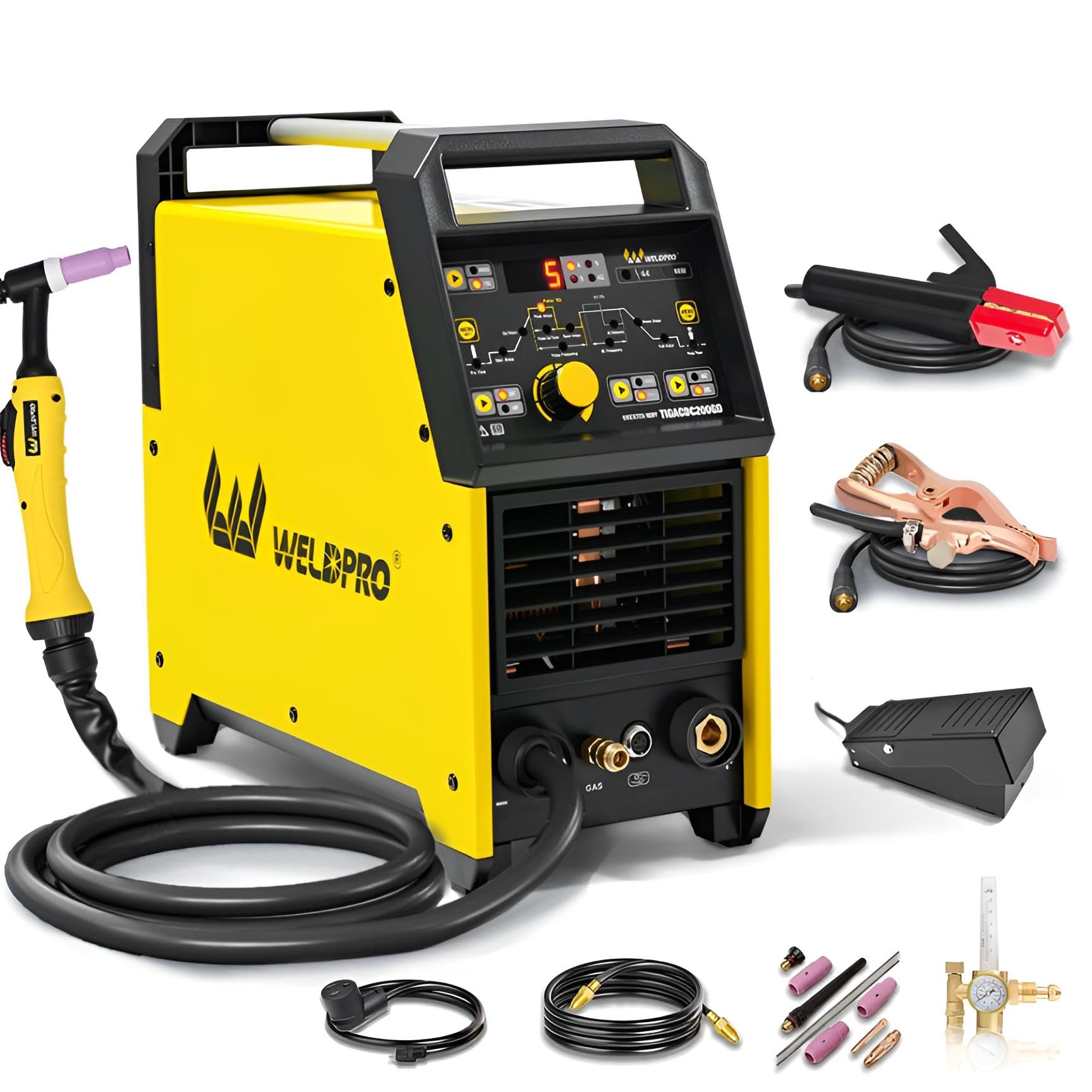
1. Weldpro 200A AC/DC TIG Welder
Our pick — over 4.5★ from 800+ verified ratings; the strongest balance of quality and price.
The heavyweight do-everything machine that graduates from garage hobbyist to professional fabricator without changing tools.
This is the machine you buy when you want one unit that does it all: High-Frequency AC TIG, DC TIG, AC Pulse TIG, DC Pulse TIG, and Stick MMA welding. That five-mode flexibility means you can lay a clean bead on thin aluminum sheet one hour, then switch to the stick electrode holder for rusted farm steel the next. It handles aluminum, magnesium, and other non-ferrous metals, which most 110V stick units cannot touch at all.
The controls reward time spent learning them. A large HD LED display shows every parameter in real time, and the fully adjustable pulse frequency spans 0.5-200HZ. The included rocker foot pedal gives you hands-free amperage control mid-weld, which is the difference between awkward stops and a continuous, professional-looking seam. Owners mention the digital amperage knob and intuitive layout make it far easier to use than the price suggests.
The trade-off is physical. At 61.8 pounds, this is roughly five times heavier than the compact Sunstac 200A (12.18 pounds) below, so it is not a grab-and-go machine. It uses dual voltage auto-detection (110V/220V), but its 40% duty cycle at full 200A output means it is built for real work sessions, not marathon production. Owners praise the premium CK17 flex torch, smooth pedal, and quality ground clamp as far above what this price point usually includes.
What wins people over
- Five welding modes cover everything from thin aluminum to thick steel
- Foot pedal gives hands-free amperage control for long seams
- Buyers rate the build quality and torch as genuinely premium
The honest trade-offs
- 61.8 pounds makes it a stationary shop tool, not a portable one
- Gas torch runs hot on long welds and tungsten dulls fast
- Learning curve for the AC balance and pulse settings
Grab this if: you want one serious machine that welds aluminum, stainless, and steel without buying three separate units later.
Think twice if: you mostly make light repairs with 3/32-inch rods on a bench — a compact stick welder will be easier to store.
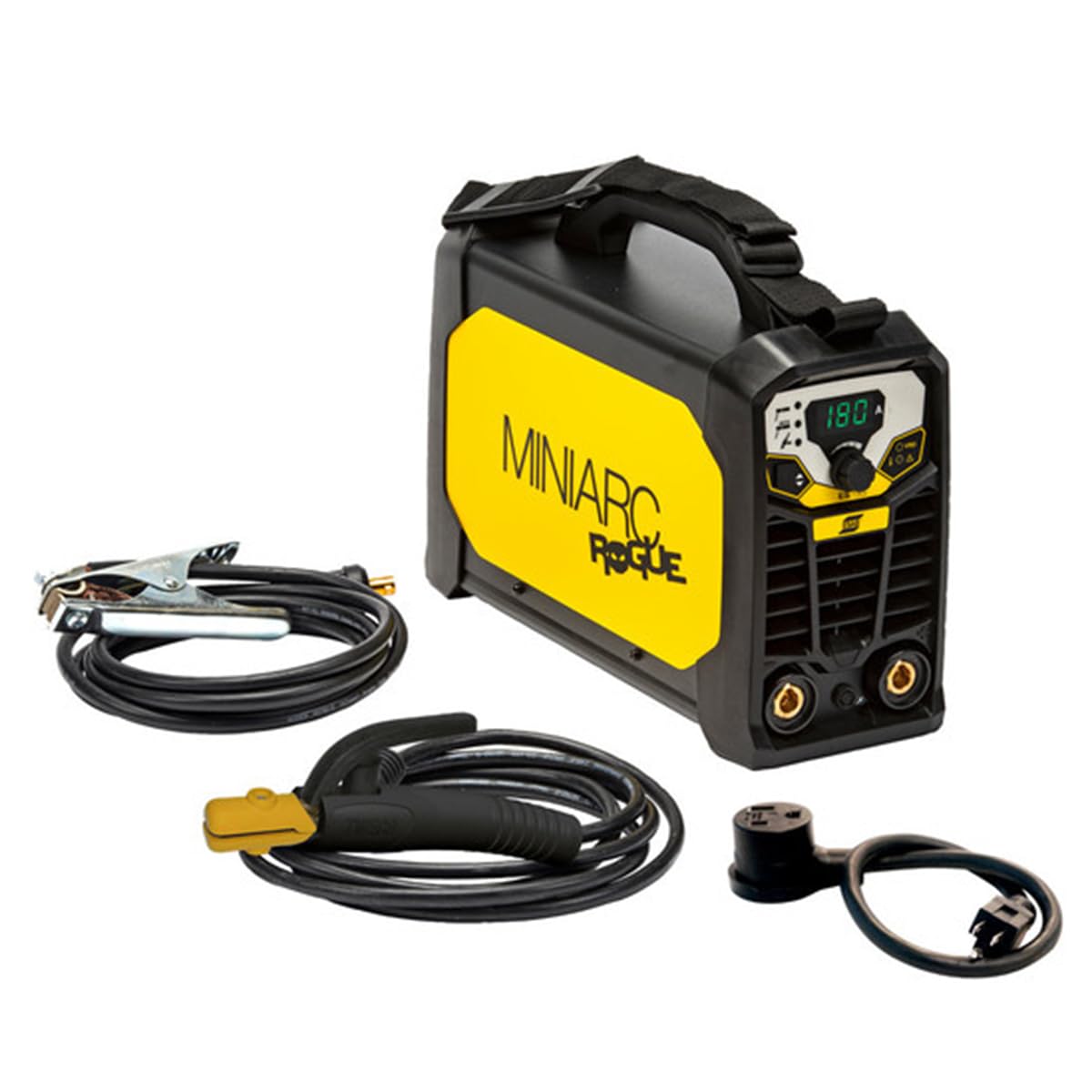
2. ESAB Rogue ES 180i
A compact powerhouse from a brand professionals trust, delivering a smooth arc that makes 1/8-inch rods feel easy.
ESAB is a name from industrial welding shops, and the Rogue ES 180i brings that pedigree down to a portable 18-pound package. It is a dedicated stick welder with a special mode tuned for 6010 electrodes — the rod known for deep penetration on dirty or rusty metal. That makes it a genuine field machine for repairs where you cannot grind the work clean first.
The adjustable hot start and arc force let you dial in how aggressive the arc strikes, which prevents the rod from sticking to the plate. Owners rave about its efficiency and accurate amperage, with one describing it as easier rod burning than Miller or Lincoln they have used professionally. Power factor control means it draws cleaner power, and it is generator-compliant with a 7kW recommendation, so it travels well to job sites without a shore outlet.
The catch is the price — it is the most expensive unit here — and the fact that a carry case is sold separately. A boat-trailer builder reported welding four continuous hours without tripping breakers at home, a level of endurance most 110V machines cannot approach. A 20-gauge steel job at just 20A with 1/16-inch 7018 rods shows how precisely the low end of the amperage range can be controlled.
Why it earns the premium
- 6010 rod mode tackles rusted, dirty metal other welders struggle with
- Four hours of continuous welding without thermal shutdown
- Efficient, accurate amperage from 20A up to 180A
What to know first
- No carry case included — budget for one separately
- Stick-only machine, so no TIG or MIG modes on this unit
- Premium-brand pricing puts it above hobby-tier budgets
Reach for it if: you want a trustworthy, built-to-last stick welder for serious repairs and are willing to pay for the brand.
Look elsewhere if: you need multiprocess flexibility or only weld a few times a year on light steel.
3. Amico Power MTS-205
A true multiprocess workhorse that welds MIG, flux core, lift TIG, stick, and even aluminum with a spool gun.
If you have ever wished one machine could handle every job in the shop, the MTS-205 is that machine. It combines MIG, MAG, flux core, lift TIG, stick, and spool gun welding — the spool gun being the key to welding aluminum. It handles all conductive metals including aluminum, stainless, cast iron, and copper, up to around 1/2 inch thick. That range makes it the most versatile single purchase on this list.
It runs on 110V (needing a 20A breaker) or 220V, with a 60% rated duty cycle at 205A. Owners upgrading from a Lincoln 140 were impressed that it pushed.035 wire through the provided gun on aluminum without a spool gun — something the bigger brand could not do. The ETL listing adds a safety-certification layer that budget imports often lack.
The honest downsides center on its complexity and build. The wire feed mechanism drew complaints from a few owners, and the settings chart is genuinely confusing — knob labels for WFS and volts are reversed, and wire-feed units are mislabeled. Durability is a genuine watch-point, as some units failed after years of storage. That said, the seller’s tech support earned high marks for diagnosing and shipping replacement parts when things went wrong.
What makes it valuable
- Four welding processes plus spool gun aluminum capability
- Welds up to 1/2 inch thick material across all conductive metals
- ETL listed with a 60% duty cycle at 205A
Where it trips up
- Wire feed mechanism is the most-reported failure point
- Confusing settings chart and reversed knob labels
- Durability concerns from a few long-term owners
Best suited to: a home or farm shop owner who welds different materials and wants MIG plus stick in one footprint.
Not ideal for: someone who wants a simple set-and-forget machine or who only ever runs 3/32-inch rods.
4. PUWU 6-in-1 Plasma Cutter Welder Combo

One box that welds and cuts, so you can fabricate a project from raw steel to finished piece without switching machines.
The headline feature here is the 50A plasma cutter bolted onto a full welding machine. That means you can cut a plate to size, then weld the pieces together with the same unit. It combines Gas MIG, Flux Core MIG, HF TIG, Stick, and plasma cutting in dual voltage 110V/220V. The spool gun compatibility (sold separately) extends it to aluminum welding.
You get stable, low-spatter welds right away because Synergic MIG mode (a one-knob setup that automatically matches voltage, current, and wire feed speed) does the tuning for you. If you prefer hands-on control, switch to manual mode and adjust every parameter yourself. At 25.6 pounds with a sturdy handle, you can carry it to any job site without strain, and the 2-year warranty covers defects for added confidence.
Owners were blown away by its endurance — one ran it 8.5 hours straight on a job site doing plasma cutting and stick welding without a shutdown. Another praised the cuts as “like butter” and ran it off 110V, 220V, and a small generator. The main complaint is the manual: getting all six functions set up correctly took real time and research.
Why it stands out
- Plasma cutting plus five welding modes in one portable unit
- Ran 8.5 hours continuous on a real job site
- Synergic MIG one-knob control suits total beginners
The learning curve
- Manual is thin — expect to research setup on your own
- Spool gun for aluminum sold separately
- Setup of all six functions takes time and patience
Perfect for: a home fabricator who cuts and welds and wants one machine under a bench instead of two.
skip it if: you only need stick welding and want the simplest possible interface.
5. YESWELDER TIG-205P
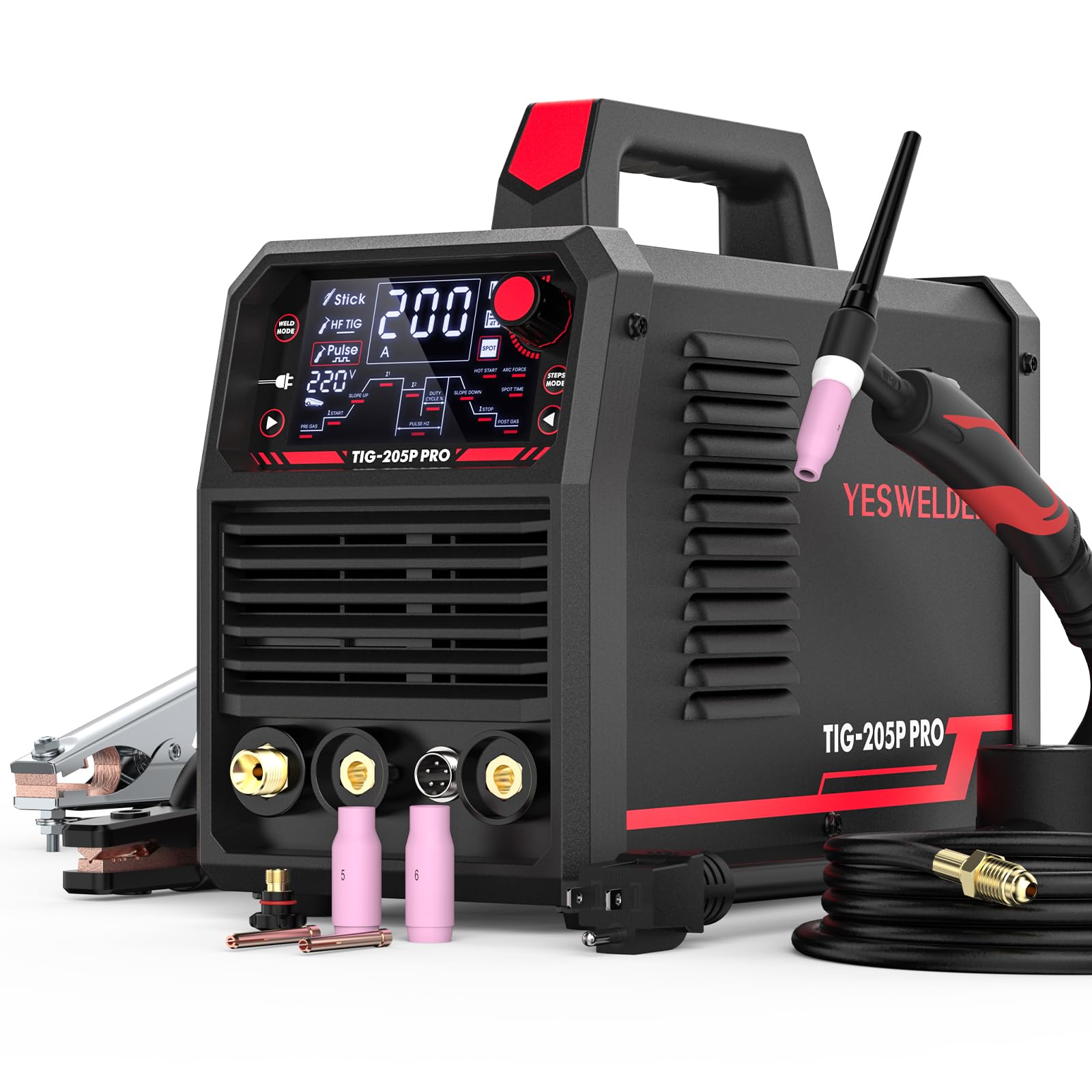
A pulse-TIG specialist that makes thin stainless exhaust work look easy, with stick mode for the rough jobs.
This 3-in-1 machine combines Stick, DC TIG, and Pulse TIG, with pulse giving you independent control over frequency, duty cycle, and current. That precision is exactly what makes thin materials like 1/16-inch tubing and 22-gauge sheet weldable without burn-through. Owners welding stainless exhaust systems called it perfect for the job.
It auto-senses dual voltage (110V/220V) with no manual switching — plug into a household outlet or a shop circuit and it figures out the power itself. The large LED display keeps all parameters visible, and high-frequency non-contact arc starting reduces tungsten consumption. The 5-pin foot pedal interface lets you add a pedal for throttle-style current control, which owners confirmed works exactly as a throttle, not just an on-off switch.
The important limitation is right in the title: this unit cannot weld aluminum. The performance and quality drew mixed feedback across reviews — some owners found the build flimsier than big brands and noted a loud constant fan. A trade welder who stopped by confirmed it welds great, especially wired for 220V, where it pushed 1/4-inch steel at 175A.
The precision edge
- Pulse control welds thin stainless and sheet without burn-through
- Auto-sensing dual voltage plugs into any outlet
- Foot pedal works as a true current throttle
Know the limits
- Cannot weld aluminum — DC-only TIG
- Build quality feels cheaper than Lincoln or Miller
- Constant fan noise and flimsy lead connections reported
Choose it for: stainless exhaust, thin sheet, and creative pulse welding where bead aesthetics matter.
Pass if: aluminum welding is on your to-do list, since this machine cannot do it.
6. ARCCAPTAIN TIG200
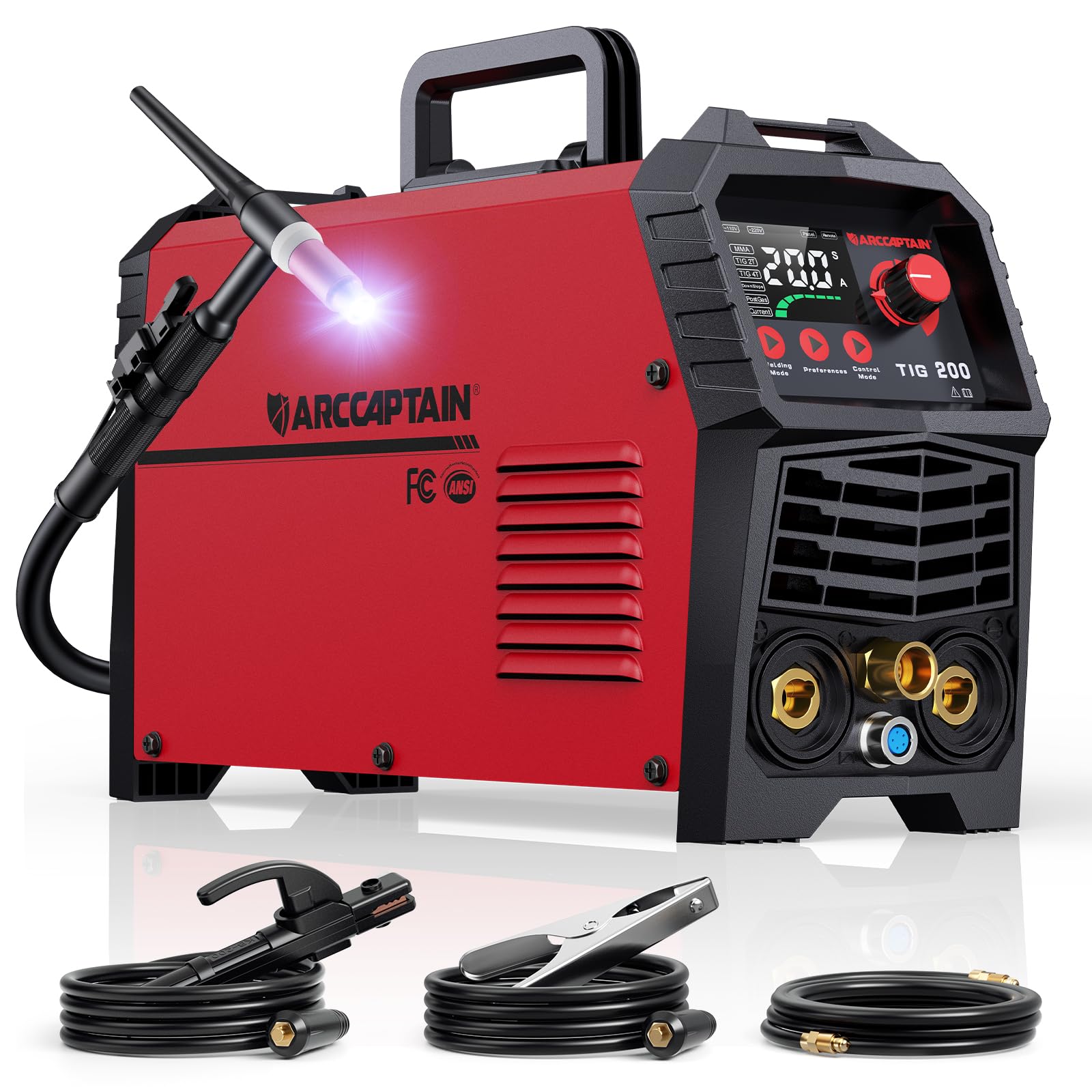
A compact dual-voltage TIG and stick machine that impressed on real job sites, with high-frequency starts for clean ignition.
At 20.8 pounds, the ARCCAPTAIN TIG200 is light enough to carry between job sites, yet it delivers up to 200 amps. High-frequency non-contact arc starting begins the arc without touching the rod to the metal, which reduces tungsten wear and makes starts feel easy. It handles stainless and mild steel with precision, plus stick mode for outdoor work on thicker material.
The 2T/4T trigger modes are the standout feature. 2T is tap-on, tap-off for short welds; 4T holds the arc for long, continuous seams without keeping your finger squeezed. Adjustable post-gas time (1-10s) protects the weld and cools the torch after you release the trigger, preventing damage to the torch head. Buyers praised the 4T mode for holding the arc on long seams without finger fatigue.
Buyers praised its compact size and easy setup, with one using it on multiple job sites for repair and small fabrication. The notable complaint is the stock leads — several owners replaced them with longer 20-foot versions, since the factory cords are too short for anything but bench work. At 150 amps the machine hits its runtime limit faster, so heavy continuous work needs a rest.
What owners appreciate
- High-frequency start gives clean, reliable ignition
- 4T mode holds the arc for long continuous seams
- Compact 20.8-pound build moves between job sites easily
What to plan for
- Stock leads are short — budget for longer 20-foot cables
- Runtime caps out when running near 150 amps
- Lightweight remote cords feel fragile
Reach for it if: you want a capable TIG/stick machine to learn on that you can toss in a truck.
Look elsewhere if: you plan long, high-amp production runs or want premium stock cables.
7. Forney 298 Easy Weld 100ST
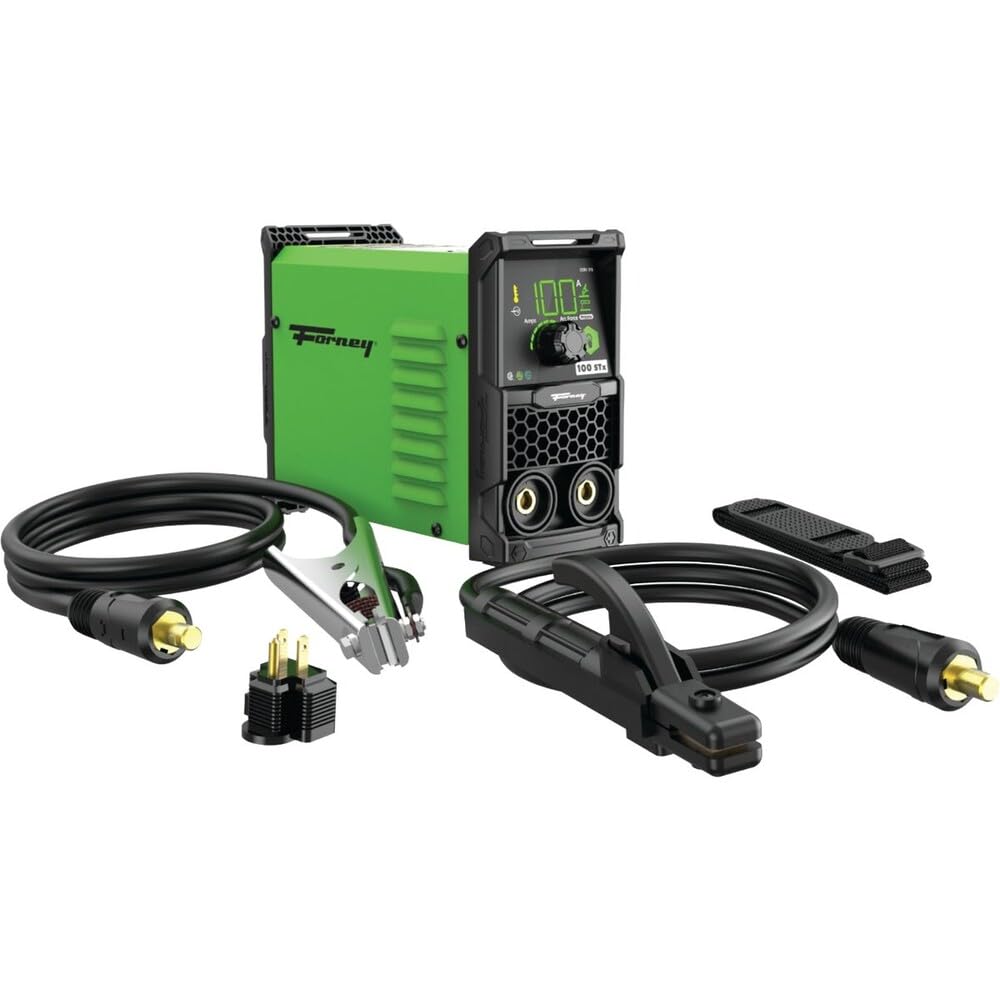
A no-nonsense American-made 90-amp stick welder that taught a generation of beginners how to weld on a regular outlet.
Forney has been making welding gear for over 70 years, and the 298 Easy Weld is their simple, honest 120-volt stick machine. At 90 amps output, it is not trying to burn 1/8-inch rods all day. It is built for exactly what most hobbyists need: light repairs on 1/16-inch to 3/16-inch steel, using 3/32-inch rods like E6013 and E7018. The all-metal case takes the bumps of garage life.
Its simplicity is the point. It plugs into any standard household outlet, comes with an 8-foot electrode holder and 8-foot ground clamp, and has a clean digital display. Retired professionals and certified welders alike praised it as an excellent learning machine that runs hot enough for single-pass welds on 3/16-inch steel with 3/32-inch 6011 or 7018 rods. The brand’s 12-month warranty against manufacturer defects adds reassurance.
The arc stability drew mixed feedback — some owners found once the arc starts it runs beautifully, but starting can be finicky with certain rods like 3/32-inch 7018. It is TIG-capable, meaning you can add a TIG torch later to expand its range. The soft spots are the on-off switch, which is hard to operate with welding gloves, and the honest limit that it is not for single-pass welds over 1/8-inch thick.
Why beginners love it
- Simple 120V plug-and-play operation, perfect for learning
- American-made with a tough all-metal case
- Light 13.7-pound build moves around the garage easily
Its honest limits
- 90A output means no single-pass welds over 1/8-inch steel
- Arc starts can be finicky with hard-to-strike rods
- On-off switch is awkward to use wearing gloves
Best for: the first-time welder who wants a reliable, no-frills machine for hobby repairs around the house.
Not for: anyone planning to weld thick structural steel or run 1/8-inch rods on a regular basis.
8. Saker Portable 110V Welder
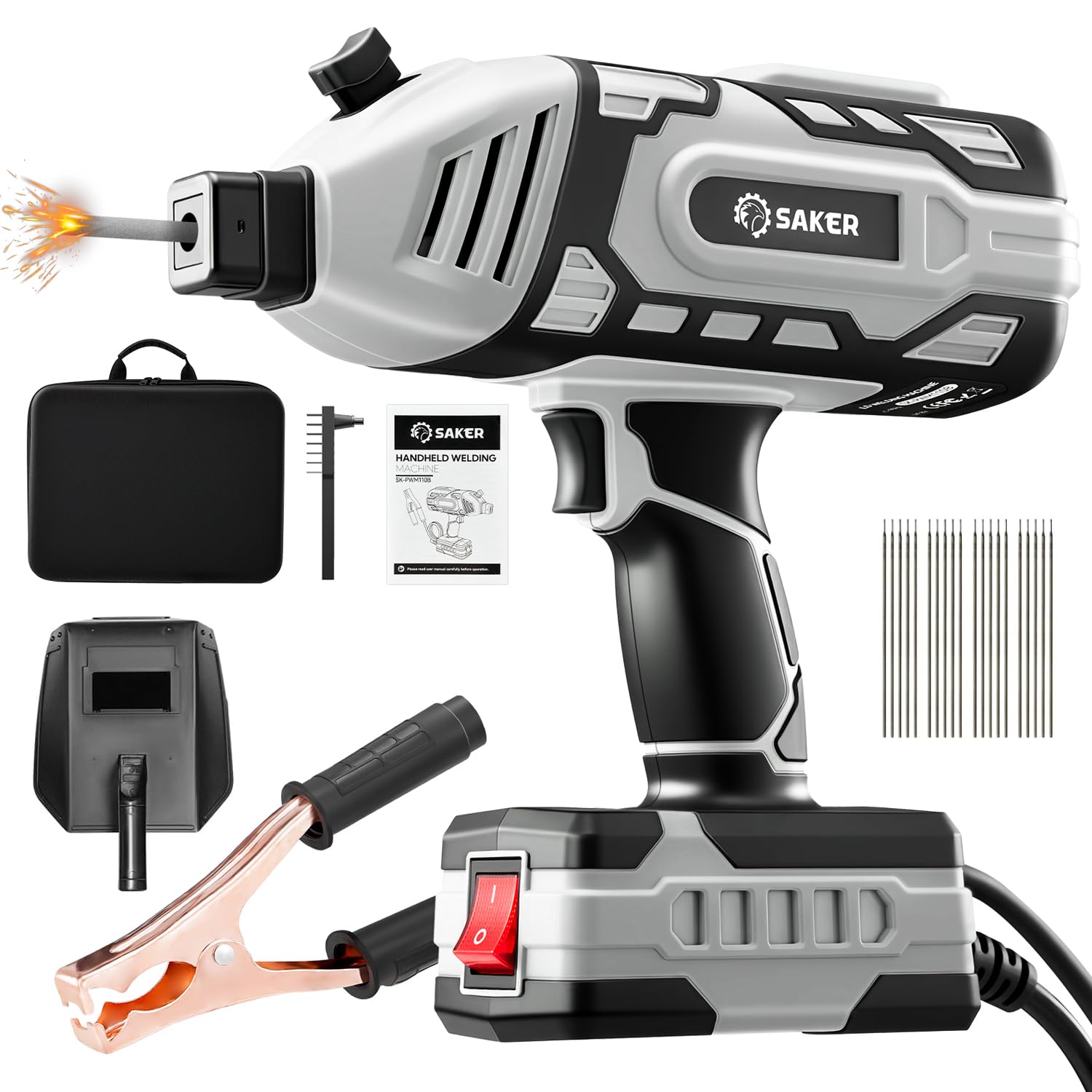
A one-handed 6.82-pound welder that turned skeptics into believers on the first fire-ring repair.
This is the welder you grab for quick fixes where dragging out a full-size unit feels like overkill. At just 6.82 pounds, the Saker is a handheld IGBT inverter that fits in one hand and runs entirely on 110V power. Its adjustable 20-120 amp output works through a 5-speed knob, so you pick the power level and start welding carbon steel and iron within seconds of plugging in.
The portability was the biggest draw across hundreds of owners — it is easy to carry, easy to store, and easy to use even for absolute beginners. One skeptic repaired a fire-ring leg on the first try, calling it plug-and-play with plenty of power. The hot start arc ignition promotes smooth, reliable starts, while a 360-degree cooling system and overheat protection keep it running for longer sessions.
The reality check is the duty cycle. Being this small means it is built for light repairs and small projects, not continuous production. Owners frequently compare it to a 135-amp MIG welder for its performance on small jobs, which tells you exactly where its comfort zone sits. The five-level knob offers less fine-tuning than stepless dials, but for 3/32-inch rod work it is more than enough control.
What makes it special
- One-handed 6.82-pound design stores anywhere
- 20-120 amp range covers home DIY and auto repairs
- Hot start gives smooth arc ignition for beginners
Where it fits less
- Light-duty design means low duty cycle for big jobs
- 5-level knob is coarser than stepless adjustment
- Limited to 3/32-inch rods on 110V
Pick it for: quick fence fixes, automotive touch-ups, and small metal repairs where portability trumps raw power.
Pass it by if: you regularly weld thick steel or run long continuous beads.
9. Faiuot Handheld Welding Kit

A complete beginner kit that pairs a 6.67-pound handheld welder with everything you need to make your first weld tonight.
Most welders ship as just a machine. This one arrives as a full kit: the handheld welder, auto-darkening welding goggles, 20 welding rods, ground clamp, welding brush, gloves, helmet, and a carrying case. For someone who has never welded before, that means zero extra trips to the store — you open the box, put on the gloves, and start practicing immediately.
The welder itself runs 20-120 amps on standard 110V power and supports 3/32-inch to 1/8-inch rods (2.5-3.2mm). IGBT inverter technology with current compensation and anti-stick features keeps the arc smooth and reduces spatter. The adjustable auto-darkening goggles shade from #3 to #11 with UV and infrared protection, shielding your eyes the moment the arc strikes. A 360-degree cooling system with overheat protection lets it handle longer sessions.
A welder with 60 years of experience was genuinely impressed, noting it produces easy, deep welds and is perfect for outdoor jobs. The one consistent buyer warning is the included goggles — they work but feel flimsy, and the suggestion is to invest in a full-face auto-darkening helmet for serious work. The duty cycle is low, and an occasional unit arrives defective, though the 3-year warranty and responsive support cover that.
Everything included
- Full kit — welder, rods, goggles, gloves, helmet, case
- Auto-darkening goggles adjust from shade #3 to #11
- 60-year welding veteran praised its easy, deep welds
Upgrade these first
- Included goggles feel flimsy — a real helmet is better
- Low duty cycle limits continuous welding time
- Quality control varies — check your unit early
Ideal for: a beginner who wants to start welding immediately without buying accessories separately.
Not ideal for: experienced welders who already own gear and want a bare machine they can upgrade.
10. DEKOPRO 160A Stick Welder

A budget dual-voltage welder that survived a 3-foot drop and still beats big-box brands for small jobs.
At 11.44 pounds, the DEKOPRO 160A is a compact machine that runs on both 110V and 220V with automatic compensation for voltage fluctuation. It delivers stable current through an IGBT inverter design, meaning less damage to copper and iron and better energy efficiency. It welds stainless steel, mild steel, and aluminum, making it suitable for DIY users and professionals alike.
Owners consistently praised it as a great value for the money, with one noting the full kit (hood and tools included) saved them versus buying parts separately. It worked great on 120V for appliance repair, and one buyer described welding 1/8-inch steel to 2-3/8-inch pipe without issue. The machine even survived a 3-foot drop and kept working — a real durability test most budget welders would fail.
The catch is the output. It performs noticeably better on 220V than on 110V, where it is fine for light repairs but not heavy work. One owner found it stops at 145 amps in practice, about 15 amps low on 240V. The work clamp that ships with it is cheap — several owners replaced it immediately, though the copper cables themselves are fine. The Lift TIG mode requires buying a torch separately.
Why it overdelivers
- Survived a 3-foot drop and kept working
- Full kit with hood and tools saves vs buying separately
- Welds stainless, mild steel, and aluminum
The honest trade-offs
- Output runs about 15 amps low in practice
- Included work clamp is cheap — replace it
- Lift TIG torch sold separately
Choose it for: budget-minded beginners who want one machine that works on both 110V and 220V while staying affordable.
pass on it if: you need a machine that hits its full rated amperage or do heavy production work.
11. Sunstac SS-200S Stick Welder

The smallest 200-amp stick welder around, proving you do not need a heavy machine for farm repairs.
Buyers describe the Sunstac SS-200S as half the size of a typical 200-amp welder, and at 12.18 pounds it is genuinely compact. The all-new LCD screen is easier to read than older LED displays — digits stay visible even with your helmet down, letting you check voltage and current mid-weld. It is a 2-in-1 machine offering Stick and Lift TIG modes (the TIG torch is not included).
It is built for home maintenance, yard repairs, and fixing farm equipment. The adjustable hot start and arc force make the arc easier to strike and keep it smooth, while the automatic anti-stick function stops rods from fusing to your workpiece. A built-in VRD (Voltage Reduction Device) option adds anti-electric-shock protection — switch it on for safety, off for more welding power. Over-current, over-heat, and overload protection extend its lifespan.
On 110V, owners note it is best for light repairs with 1/16 or 3/32 rods — it is a 200A machine on paper, but household outlets limit real output. On 220V it burns 1/8-inch 7018 rods and successfully welded 3/8 to 1/2-inch steel on an excavator, impressing onlookers. The duty cycle cuts in before a full rod finishes at high amps, and one owner measured it not reaching 100 amps on 110V despite the rating.
What buyers love
- Smallest 200-amp stick welder — half the size of typical units
- LCD screen stays readable with a helmet on
- VRD anti-shock protection switch
What to remember
- On 110V only light repairs with 1/16 or 3/32 rods
- Duty cycle cuts in before a rod finishes at high amps
- Real 110V output measures under 100 amps
Great for: farm and yard repairs where you want a compact machine that stores easily and handles light 110V work.
Not for: heavy 110V welding or anyone expecting true 200A output from a standard outlet.
Understanding the Specs
Amp Output and Duty Cycle
Amp output determines what rods you can burn and how thick the metal can be. Duty cycle is the percentage of a 10-minute window you can weld continuously at a given amperage. At 40% duty cycle on 200A, you get four minutes of welding followed by a six-minute cool-down — fine for hobby work, limiting for marathon fabrication sessions.
IGBT Inverter Technology
IGBT (Insulated Gate Bipolar Transistor) is the modern electronics that replaces heavy copper transformers. It makes machines lighter, more efficient, and more stable at the arc. It is the reason a 12-pound unit can produce a 200-amp-class weld that used to require a 60-pound transformer.
Hot Start and Arc Force
Hot start delivers a brief burst of extra current when the rod touches the metal, which makes the arc easier to strike — the most common beginner frustration. Arc force boosts current if the arc shortens too much, preventing the rod from sticking to the workpiece. Anti-stick automatically cuts power if the rod welds itself to the metal, saving you from wrestling it free.
Dual Voltage vs 110V Only
A dual-voltage machine runs on both standard household 110V outlets and heavier 220V shop circuits. On 110V you get enough power for 3/32-inch rods and light repairs; on 220V the same machine open up its full amp output. A 110V-only unit is simpler but permanently limited by the outlet’s power ceiling.
FAQ
Can a 110V stick welder weld 1/8-inch steel?
What is the difference between 110V and 120V welders?
How thick of metal can a 110V stick welder weld?
What size welding rods should I use on a 110V welder?
How long can I weld continuously on a 110V stick welder?
Is a dual voltage welder worth the extra money?
What does a VRD safety feature do on a stick welder?
Can a 110V welder run on a generator?
What is the difference between TIG and Stick welding on a 110V machine?
How much do I need to spend for a decent 110V stick welder?
Final Thoughts: The Verdict
For most people, the 110 volt stick welder winner is the Weldpro 200A because it covers five welding modes, includes a foot pedal, and earns serious praise for its quality. If you want a precision pulse TIG for stainless work, grab the YESWELDER TIG-205P. And for the professional-grade build that lasts, the ESAB Rogue ES 180i is the one to reach for.
How We Picked
We do not accept paid placement. Every pick is matched to a real buyer and a real use-case; we do not hands-on test units.
Sources & Methodology
Specifications: manufacturer listings and product documentation. Review insights: verified customer reviews, as of August 2026. Pricing: not shown on this page (it changes often); check the current price via the retailer link.
As an Amazon Associate, FitlyFast earns from qualifying purchases. This does not affect which products we feature.