
Our readers keep the lights on and the weekend projects moving. As an Amazon Associate, I earn from qualifying purchases.
Specs are compiled from manufacturer listings and verified buyer reviews and can change over time — please confirm the key details on the product page before buying.
Capturing a fast-moving athlete without blur is the real test of a budget camera. You don’t need a pro body to freeze a sprint or a slide. You need fast autofocus, a decent burst rate, and a lens that lets in enough light — this guide lines up eleven models that deliver.
I’m Rikta — the founder and writer behind FitlyFast. This guide is built by comparing the manufacturers’ published specifications and the patterns across verified customer reviews, so you get each pick’s real strengths and trade-offs instead of marketing spin.
For sideline parents and weekend shooters, the best budget sports photography camera balances fast autofocus, a usable burst rate, and a kit lens that performs in daylight.
Our Picks at a Glance


How To Choose The Best Budget Sports Photography Camera
Sports photography is demanding because the subject never holds still. A portrait-focused camera can feel sluggish on the field. You need a body that locks focus quickly and fires several shots per second to pick the best frame later.
Autofocus is the heart of the matter
More autofocus points usually mean the camera can track a runner or a ball across a wider area of the frame. A 9-point system, common on entry DSLRs, keeps the active area small and centered. A modern mirrorless body with hundreds of points can lock onto a face or eye and follow it as the athlete moves toward you. For action, wider autofocus coverage makes tracking easier.
Burst rate decides what you catch
Burst rate is how many photos the camera takes in one second while you hold the shutter. A 3 fps (frames per second) camera might miss the exact moment of a kick. A body shooting at 11 fps gives you a sequence to choose from. More frames mean a better chance of freezing peak action, outweighing extra megapixels.
Lens light matters in every season
The kit lens aperture (the f-number) controls how much light reaches the sensor. A wider aperture like f/2.8 lets in more light, which helps you freeze motion with a faster shutter speed. On a sunny afternoon, even an f/5.6 kit lens is fine. Under stadium lights or in a dim gym, you will feel the difference quickly.
Quick Comparison
| Model | Best For | Autofocus Points | Burst Rate | Sensor | Amazon |
|---|---|---|---|---|---|
| Canon 2000D Bundle★ Best Overall | Beginners wanting a full kit | 9 | — | 24.1MP APS-C | Amazon |
| Canon Rebel T7 BundleAlso Great | First-time DSLR buyers | 9 | 3 fps | 24.1MP APS-C | Amazon |
| Canon EOS R100 BundleCompact Mirrorless | Mirrorless newcomers | 143 | 6.5 fps | 24.2MP APS-C | Amazon |
| Canon T7 Dual Lens | Reach for far-field sports | 9 | 3 fps | 24.1MP APS-C | Amazon |
| Nikon D5200 | Photography learners growing fast | 39 | 5 fps | 24.1MP DX | Amazon |
| Nikon Z50 | Travel-friendly mirrorless | 209 | — | 20.9MP DX | Amazon |
| Sony A6100 | Fast action and eye tracking | 425 | 11 fps | 24.2MP APS-C | Amazon |
| Canon EOS R50 Bundle | Hybrid photo and video | 99 | — | APS-C | Amazon |
| Sony ZV-E10 II | Content creators wanting 4K | 759 | 11 fps | 26MP APS-C | Amazon |
| Canon EOS RP | Full-frame image quality | — | — | Full-Frame | Amazon |
In‑Depth Reviews
1. Canon EOS 2000D / Rebel T7 DSLR Camera 20pc Bundle (Renewed)
A 20-piece starter kit that beats buying every accessory separately.
Some buyers want one box to solve everything, and this renewed 2000D bundle answers that. It stacks the classic Canon DSLR body with a SanDisk 32GB card, a tripod, a case, and wide-angle lenses into a single 20-piece package. The kit lens opens to a wide f/2.8 at its best, which is a step brighter than many rivals and genuinely helpful when clouds roll in over the field.
Owners describe it as the ideal beginner starter set — “better than buying separately,” as the review pages put it. They call the pictures amazing and the operation simple to understand, which is exactly what you want when you are juggling a camera bag and a screaming halftime crowd. The built-in Wi-Fi with NFC pairs to your phone for quick sharing or remote control through the Camera Connect app.
Acknowledged honestly: it is a renewed unit, so the condition depends on the previous owner, and there is no external microphone input if you ever want to record interviews along with the action. For pure still photography at the fence line, it holds its own against pricier setups.
Why it wins
- Everything included — tripod, case, extra lenses, and memory card
- f/2.8 kit aperture gathers more light than typical entry lenses
- Wi-Fi remote control from your phone is built in
The honest catch
- Renewed condition means inspecting your unit on arrival matters
- No mic input, so vloggers should look elsewhere
Best for: the beginner who wants one complete purchase and would rather upgrade individual pieces later.
Not for: video creators who need to plug in an external microphone.
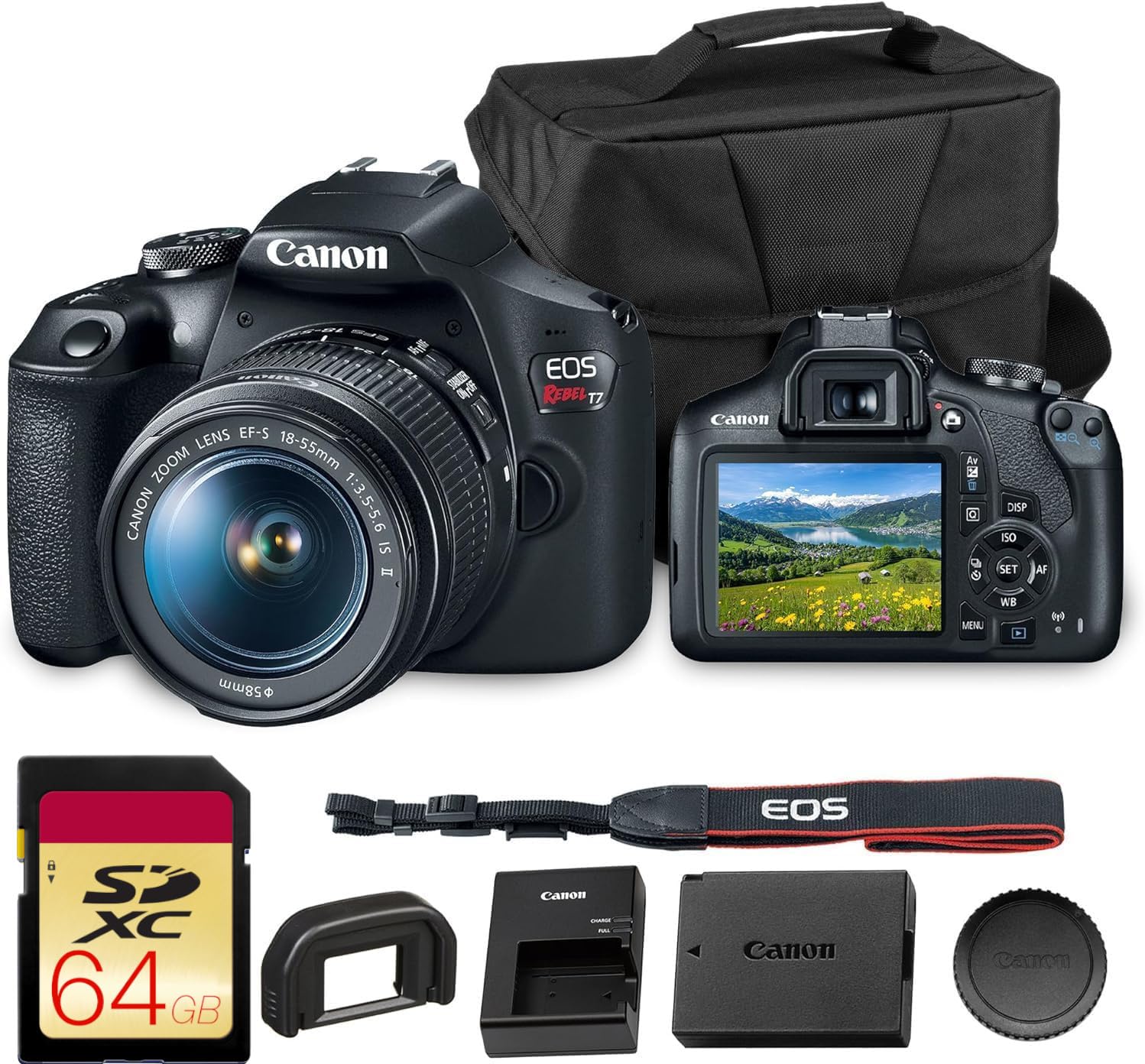
2. Canon EOS Rebel T7 DSLR Camera with 18-55mm Lens Bundle
The sideline workhorse — easy to master and proven on a high school track.
The Rebel T7 is the camera parents buy when they want real DSLR quality without a steep learning curve. Its 24.1MP APS-C CMOS sensor pairs with the DIGIC 4+ processor to deliver sharp, vibrant shots, and the 18-55mm lens covers everything from a wide team huddle to a close-up at the fence line. The crowd favorite here — a 4.7-star reputation across 400+ owners — is built on how often buyers report it “just works” right from the start.
You get dependable autofocus that feels easy, even when you’re tracking a sprinter. Owners mention shooting “very easy to use on auto focus, lightweight, got the job done as I shot photos for my son’s high school track team.” The 9-point autofocus system (the points that lock focus on your subject) is modest on paper but works reliably in daylight. The 3.0-inch LCD screen and simplified menu make it approachable for a first-time photographer, and the built-in Wi-Fi and NFC (a short-range wireless tap-to-connect feature) let you push photos to your phone instantly for posting.
The trade-off is typical for entry DSLRs: a 2-hour battery and a 9-point autofocus grid that struggles with fast, erratic movement. But the bundle arrives with a 64GB memory card and a shoulder bag, so you are ready to shoot the day it lands on your doorstep.
What owners rave about
- Picture quality praised most — customers note both stills and video come out clear
- Wi-Fi transfer to a phone is fast and reliable, great for sharing after a game
- Bundle value stands out — a 64GB card and bag are included
Where it asks patience
- 9 autofocus points lag behind mirrorless rivals for tracking
- Battery averages around a 2-hour session, so pack a spare for all-day tournaments
Reach for this if: you want a proven, beginner-friendly DSLR that comes with everything to start shooting the first day.
Look elsewhere if: your main sport is indoors under poor lights, where a wider lens aperture would help more.
3. Canon EOS R100 Mirrorless Camera Bundle
Canon’s mirrorless entry point that tracks action with 143 autofocus points.
If you want to leave the chunky DSLR body behind, the R100 is a compact mirrorless alternative that still shoots like a real camera. Its 24.2MP APS-C sensor (a larger-than-phone sensor that captures detail) pairs with the DIGIC 8 processor, and the 143 autofocus points are a night-and-day upgrade over the 9 points on Canon’s Rebel DSLRs — a 15.9x gap you feel immediately when a player sprints across your viewfinder. You can fire off 6.5 frames per second with the electronic shutter, enough to catch a jump shot or a goal celebration.
The kit lens runs f/4.5 to f/6.3, which is fine in daylight but asks for a faster prime lens once the sun drops. Owners call it an excellent little camera with easy functions and clear pictures, and the included wide-angle and telephoto attachments, filters, flash, and tripod keep you busy for months. The 3-inch LCD and Wi-Fi plus Bluetooth connectivity round out a genuinely modern starter package.
A few buyers find the body small for large hands, and some wish the included accessories were higher quality — the tripod is basic. But as a lightweight mirrorless that fits in a day bag, it is a smart step up from a smartphone for sideline duty.
What stands out
- 143 AF points track moving subjects far better than entry DSLRs
- 6.5 fps burst catches sequences of fast action
- Compact body slips into any bag for travel to away games
Where it compromises
- Kit lens aperture narrows to f/6.3, limiting low-light work
- Some find the grip small for larger hands
Choose this for: a compact mirrorless that leapfrogs DSLR autofocus without breaking your budget.
Think twice if: your games run under floodlights — the narrow kit lens will strain.
4. Canon T7 EOS Rebel DSLR with 18-55mm and 75-300mm Lenses
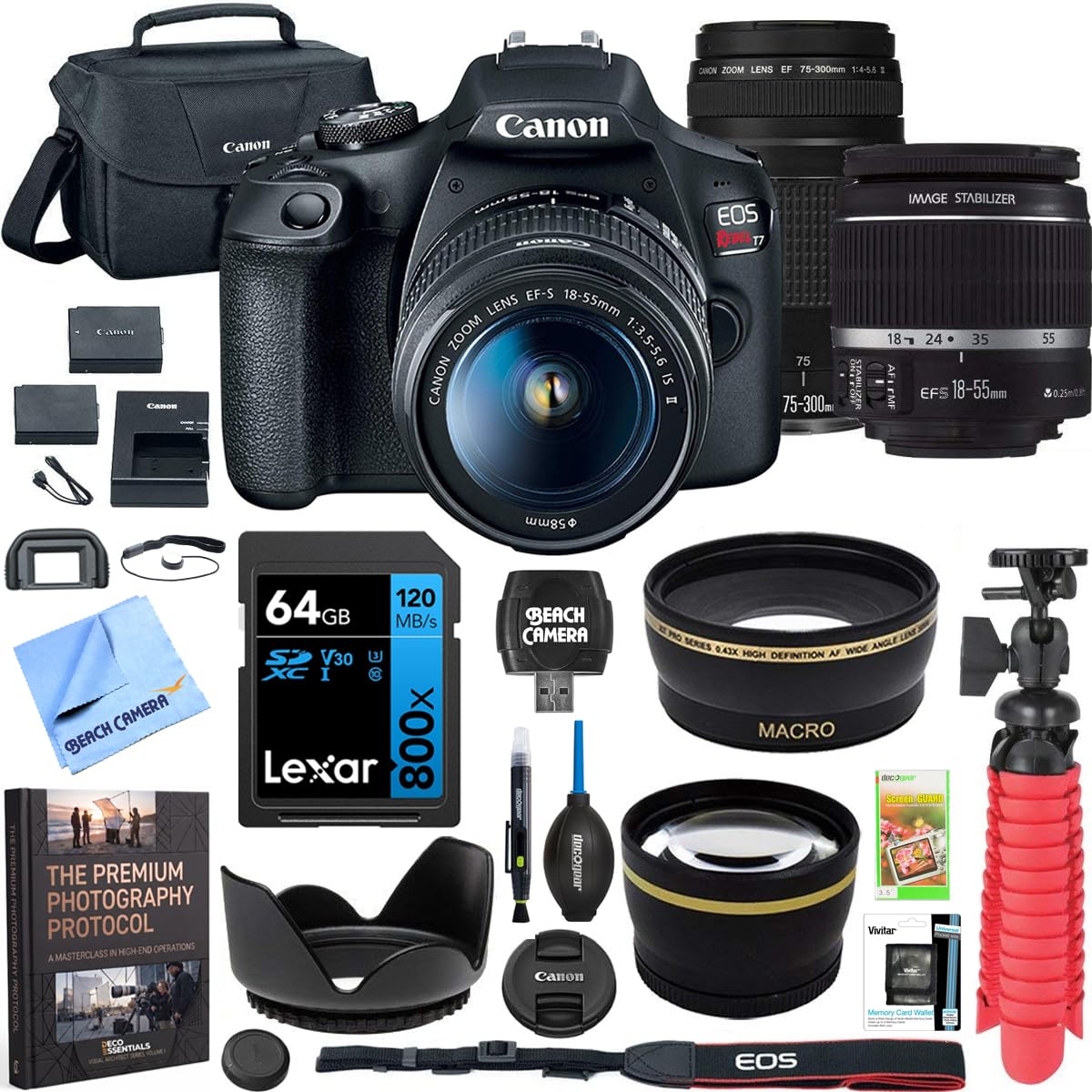
The dual-lens setup that pulls distant players right into your frame.
Far-field sports demand reach, and this T7 bundle delivers it with a second lens. Alongside the standard 18-55mm IS II, you get the EF 75-300mm III telephoto — the lens that turns a distant striker into a crisp portrait. The 24.1MP APS-C sensor with ISO up to 12800 in boosted mode, a 9-point AF system with AI Servo AF for tracking, and 3.0 fps continuous shooting make this a solid, well-rounded action body.
Owners consistently call it great value for the money and praise the picture quality, with one noting good performance in low light. The bundle sweetens the deal with a 12-inch tabletop tripod, a replacement battery, a Lexar 64GB SDXC card, a lens hood, and a cleaning kit — everything but the sideline chair. It is a Canon-authorized kit with a full one-year USA warranty, which adds real confidence.
The 75-300mm lens is a budget telephoto, so expect it to hunt a little in dim conditions, and the 3 fps burst means you must time your shutter well. Some reviewers point out the autofocus can act up over months of heavy use. For daytime sports where reach is everything, nothing in this price tier gets you closer to the action.
Why it earns its spot
- 75-300mm telephoto reaches far-field action the kit lens cannot
- Canon-authorized with a full one-year USA warranty
- Complete bundle with card, tripod, and cleaning kit
What to weigh
- 3 fps burst requires careful timing for peak action
- Telephoto struggles as light fades in the evening
Pick this for: soccer, lacrosse, or track parents who need telephoto reach without a second lens purchase.
skip it if: you mainly shoot indoors where the slower telephoto aperture will frustrate you.
5. Nikon D5200 DSLR with 18-55mm AF-S DX VR Lens

A 39-point autofocus and a 5 fps burst make this the budget pick that actually tracks motion.
Nikon’s D5200 quietly outclasses most entry DSLRs with specs aimed at moving subjects. The 39 autofocus points cover a much wider frame than the 9-point Canon Rebels, and the 5 fps continuous shooting gives you a real sequence of a play unfolding. That combo makes it the strongest pure action value in the DSLR tier — the thing owners say separates it from cheaper bodies.
The 24.1MP DX-format CMOS sensor with the EXPEED 3 processor earns constant praise for image quality, with buyers highlighting sharp focus points and excellent value. The rear 3.0-inch vari-angle monitor flips and tilts, so you can shoot over a crowd or low to the ground for a dramatic angle on a sprint start. It handles 16 scene modes for beginners while offering full manual control as your skills grow.
The honest limits: only AF-S lenses autofocus, so older screw-drive Nikkor lenses will not work in auto mode, and the built-in flash is weak — plan on an external unit for night games. Buyers call it the best entry-level pro camera they have owned, with one noting battery life stretching through a full event day without a charge.
The strengths
- 39 AF points track action across a wider area than entry Canon rivals
- 5 fps burst gives you a sequence to pick from
- Vari-angle monitor enables creative low and high angles
The trade-offs
- Older screw-drive lenses will not autofocus on this body
- Built-in flash is weak for dim stadiums
Best for: the learner who wants autofocus and burst specs that grow with their skills.
Not ideal for: anyone who owns a collection of older manual-focus Nikkor lenses.
6. Nikon Z50 DX-Format Mirrorless Camera with 16-50mm VR Lens

A featherweight mirrorless that a parent called “perfect” for travel and track days.
The Z50 is what happens when Nikon pours its modern mirrorless tech into a compact crop-sensor body. The 209-point hybrid autofocus locks onto subjects with speed, and owners praise its eye detection specifically — a huge plus for framing a runner’s face mid-stride. Its 20.9MP DX-format sensor with native ISO up to 51,200 performs impressively in low light, which is rare at this level.
What wins people over is portability. It is the camera buyers reach for over their heavy full-frame D850 for travel, because it is “so much lighter and smaller” — one owner made the switch in 30 minutes. The 4K Ultra HD video recording and flip-down LCD screen make it equally happy shooting highlight clips as stills. The 16-50mm VR kit lens includes vibration reduction to steady handheld shots.
The catch is battery life, which owners call shorter than DSLR standards, and spare batteries cost more. It also arrives as a manufacturer-refurbished unit with a 90-day warranty, so confirm the condition on arrival. For a compact camera that travels to every away game without weighing you down, it is a standout.
Why owners love it
- 209-point AF with eye detection tracks faces and animals reliably
- Native ISO up to 51,200 handles dim gyms impressively
- Ultra-light and compact — the top reason buyers choose it
What to know
- Battery life trails DSLRs; spares are pricey
- Refurbished unit with a 90-day warranty needs inspection on arrival
Reach for this if: you want a light mirrorless that travels easily and nails eye focus in action.
Look elsewhere if: long tournament days without a charger are your norm.
7. Sony Alpha A6100 Mirrorless Camera with 16-50mm Zoom Lens

Sony’s 425-point autofocus with 11 fps burst — action specs that rival cameras triple the price.
This is the budget camera that stops feeling like a budget camera. The A6100 packs Sony’s “world’s fastest AF at 0.02 sec” claim into a body with 425 phase-detection and 425 contrast-detection points covering 84% of the sensor. It shoots up to 11 frames per second at full 24.2MP resolution with autofocus and exposure tracking locked on — a burst rate that leaves every DSLR on this list behind by a wide margin.
Real-time Eye AF tracks human and animal eyes, so you can lock onto a face and let the camera follow even as the athlete cuts across the field. The 180-degree tiltable 3-inch touchscreen and touch-tracking let you tap a subject on screen and the camera does the rest. Owners call it the best crop-sensor camera for the money, with entry-level buyers thrilled by the framed-quality photos they finally capture.
The recurring gripe is the menu system, which several owners find convoluted until customized — a learning hump, not a wall. The EVF is also modest compared to pricier rivals. For pure action performance per dollar, the A6100 is the undisputed leader of this lineup.
The action specs that matter
- 425 AF points over 84% of the sensor track like a pro body
- 11 fps burst freezes sequences no DSLR here can match
- Real-time Eye AF for humans and animals locks focus reliably
The honest hurdles
- Menu system takes time to learn and customize
- Viewfinder is basic compared to pricier Sony bodies
Best for: anyone who prioritizes autofocus and burst speed above all else for action sports.
Consider otherwise if: menu simplicity matters more to you than raw tracking performance.
8. Canon EOS R50 Mirrorless Camera with 18-45mm Lens Bundle
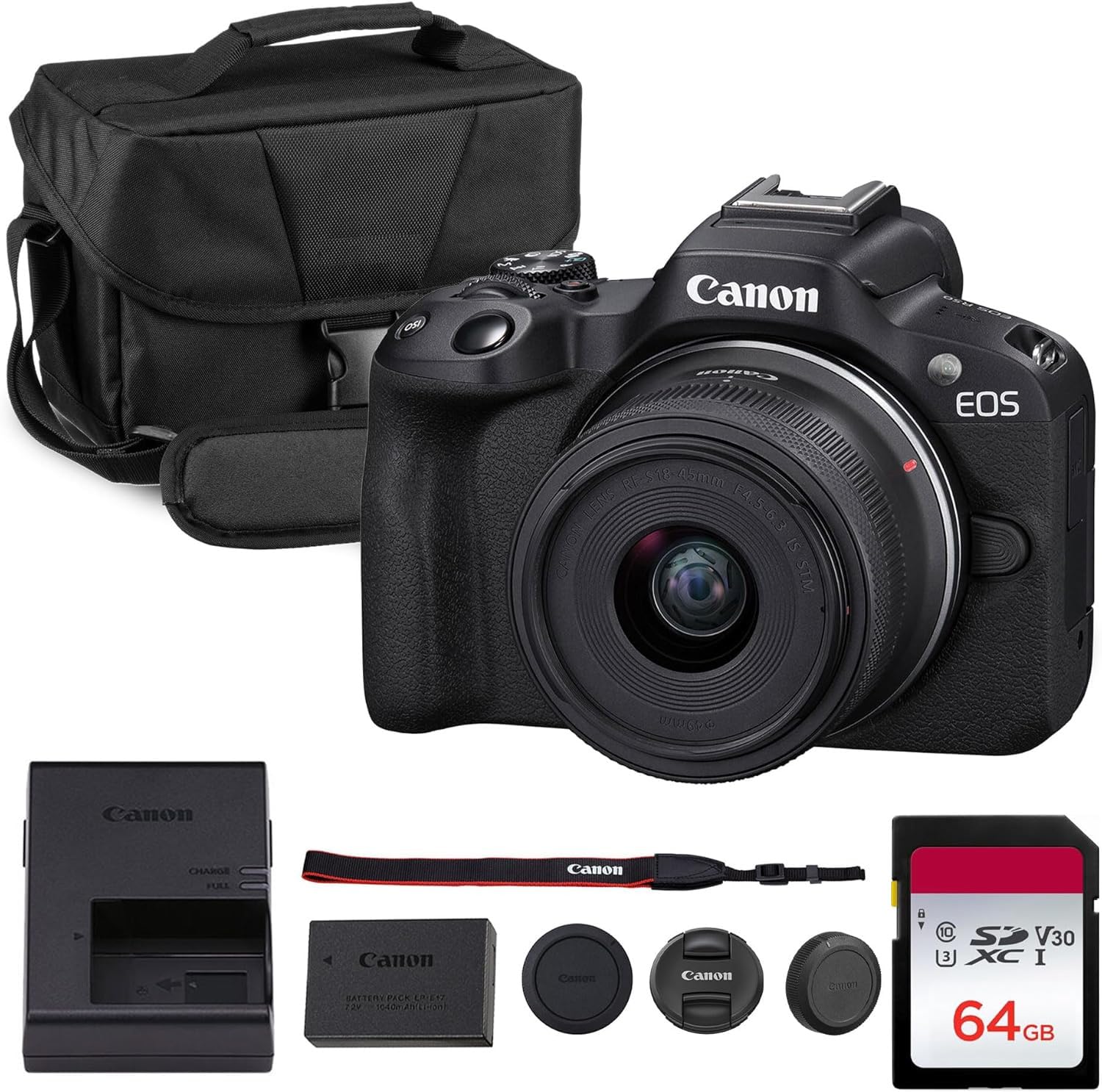
A tiny mirrorless that shoots 4K video and photos with Canon’s Dual Pixel AF II.
The R50 puts Canon’s modern Dual Pixel AF II into a body small enough for small and medium hands, which owners specifically praised. It shoots oversampled 4K video with reliable face and eye detection, plus stills that buyers describe as professional-looking without complex setup. The 18-45mm kit lens covers wide to standard focal lengths, ideal for daily content and sideline portraits alike.
Buyers love how lightweight and portable it is, calling it cute and convenient to take everywhere — one called it a smart replacement for the pricier G7X. The vari-angle touchscreen and vertical video shooting make it social-media ready, while Creative Assist gives in-camera guides that help beginners learn as they shoot. Battery charging is notably quick per owner feedback.
The compromises: there is no in-camera image stabilizer, and the buffer fills quickly during continuous shots, so it is not built for long bursts of rapid-fire action. The listed 99 autofocus points are fewer than Sony’s 425, though Dual Pixel AF is famously reliable. For hybrid photo and video on a budget, this is a serious contender.
What impresses
- Dual Pixel AF II with face and eye detection locks subjects smoothly
- Oversampled 4K video looks sharp for highlight reels
- Ultra-portable body made for small and medium hands
What it lacks
- No in-camera stabilizer — steady hands or a tripod help
- Buffer fills fast in continuous shooting bursts
Choose this for: a light, friendly camera that does photos and 4K video equally well.
Reconsider if: you plan long, rapid-fire sequences of continuous action.
9. Sony ZV-E10 II APS-C Mirrorless Creator Camera with 16-50mm Lens

Sony’s newest creator camera with 759 AF points and 4K/60p video for demanding shooters.
This is the most advanced sensor in Sony’s APS-C lineup, and it shows. The ZV-E10 II’s back-illuminated 26MP Exmor R CMOS sensor is roughly ten times bigger than the average smartphone sensor, delivering high resolution and detail that owners call sharp in 4K. The 759 autofocus points — the highest on this list — use AI-assisted subject recognition with Real-time Eye AF for humans, animals, and birds.
With up to 60 fps in 4K and 120 fps capture in Full HD, you can record slow-motion sequences at 5x, plus 11 fps continuous stills with full AF/AE tracking. The Creative Look function offers 10 in-camera presets for expressive moods without post-processing. Owners who use it as a daily webcam and studio camera report excellent video and photo quality in a body smaller than a DSLR.
This is where the budget road ends, and the trade-offs reflect that: several buyers report dead batteries and charging issues, and the battery life draws the most criticism. It also tends to overheat in 4K during long indoor sessions. There is no electronic viewfinder — you compose on the screen only. For serious creators, the image quality justifies the jump; for casual shooters, it is more than you need.
The advanced specs
- 759 AF points with AI subject recognition — the best on this list
- 4K/60p and Full HD 120p for dramatic slow motion
- 26MP sensor captures intricate detail in stills
What owners flag
- Battery life is the most-discussed downside; spares are recommended
- Overheating can occur in 4K during long sessions
- No electronic viewfinder for composing in bright sun
Best for: serious creators who want class-leading autofocus and 4K/60p capture.
Not for: casual buyers who shoot occasionally and want simple, low-maintenance battery life.
10. Canon EOS RP Full-Frame Mirrorless Camera with RF24-105mm Lens

The gateway to full-frame image quality, praised for stunning photos and solid build.
Every camera above uses a crop sensor; the RP is the budget route to full-frame, and the difference shows in image quality. Owners call the photos stunning, with beautiful color and low-light performance that crop sensors cannot match. The full-frame sensor captures more light and detail, making it a fantastic way to get pro-level stills while staying affordable, as one 20-year Canon user put it.
The bundle pairs the body with the RF24-105mm F4-7.1 IS STM lens, which offers optical image stabilization at up to 5 stops of shake correction. That stabilization is gold for handheld sideline shooting when you cannot brace against a railing. The body weighs approximately 440g alone, keeping the full-frame experience genuinely portable, and it records 4K UHD 2160p video for highlight clips.
Be honest about the limits: owners note this is built for scenic, portrait, and landscape work — not fast sports. The autofocus is mixed, with some finding it takes a moment to lock, and 4K video carries a crop without autofocus. Battery life also draws mixed feedback. If your priority is jaw-dropping stills over rapid action tracking, this full-frame Canon is the pick.
The full-frame rewards
- Full-frame sensor delivers stunning low-light stills
- 5-stop optical image stabilization steadies handheld shots
- Light body at 440g makes full-frame travel-friendly
What it is not
- Autofocus is mixed for fast-moving sports subjects
- 4K video has a crop and no autofocus
- Battery life is short per charge per owner feedback
Choose this for: maximum image quality and low-light stills on a real full-frame sensor.
Look elsewhere if: your priority is tracking fast action, where the Sony bodies lead.
Understanding the Specs
Autofocus Points
Autofocus points are the spots in the frame where the camera can lock focus. More points — and points spread wider across the sensor — mean the camera can track a fast-moving player even when they are not in the center of your shot. Entry DSLRs often have 9 points, while modern mirrorless cameras range from 99 to 759. For sports, more coverage directly translates to keeper shots.
Burst Rate (fps)
Burst rate, measured in frames per second (fps), is how many photos the camera captures in one second while you hold the shutter button. A 3 fps camera catches a moment; an 11 fps camera catches a sequence, letting you pick the single best frame from a play. Higher burst rates are the single biggest advantage for freezing a kick, a dive, or a sprint finish.
FAQ
How many autofocus points do I need for sports photography?
Is 3 fps burst rate enough for sports?
Will a kit lens like the 18-55mm work for sideline sports?
What is the difference between a DSLR and a mirrorless camera for sports?
Does the aperture (f-number) of the lens matter for sports?
Can I use a budget camera to shoot indoor sports like basketball or volleyball?
Is the Canon EOS RP good for sports photography?
How does the Canon R100’s autofocus compare to the Rebel T7?
What is the best lens for a budget sports photography camera?
How long does the battery last on these budget cameras?
Final Thoughts: The Verdict
Across the board, the budget sports photography camera winner is the Canon EOS Rebel T7 Bundle because it pairs a proven 24.1MP DSLR with an easy learning curve and everything you need in the box. If you want the fastest autofocus and burst speed for serious action, grab the Sony A6100 — its 425 points and 11 fps outpace everything else here. And for telephoto reach on big fields, the Canon T7 Dual Lens with its 75-300mm zoom is the one to reach for.
How We Picked
We do not accept paid placement. Every pick is matched to a real buyer and a real use-case; we do not hands-on test units.
Sources & Methodology
Specifications: manufacturer listings and product documentation. Review insights: verified customer reviews, as of August 2026. Pricing: not shown on this page (it changes often); check the current price via the retailer link.
As an Amazon Associate, FitlyFast earns from qualifying purchases. This does not affect which products we feature.