
Our readers keep the lights on and the weekend projects moving. As an Amazon Associate, I earn from qualifying purchases.
Specs are compiled from manufacturer listings and verified buyer reviews and can change over time — please confirm the key details on the product page before buying.
A butcher knife that won’t hold an edge is just a heavy piece of metal, and the right sharpener turns it back into the most valuable tool in your kitchen. Whether you are breaking down a whole ribeye or just slicing Sunday roasts, the goal is the same: get a scary-sharp edge fast and keep it there without wrecking the blade.
I’m Rikta — the founder and writer behind FitlyFast. This guide is built by comparing the manufacturers’ published specifications and the patterns across verified customer reviews, so you get each pick’s real strengths and trade-offs instead of marketing spin.
Manual steels, whetstones, and electric machines all take different skills, so the butcher knife sharpener that fits your workflow depends on how much effort you want to put in.
Our Picks at a Glance


How To Choose The Best Butcher Knife Sharpener
Your butcher knife is long, heavy, and used hard, so the sharpener must grip serious steel without bouncing the blade. You have three main approaches, each balancing speed, edge quality, and the skill required.
Manual Steel vs Stone vs Electric
A round steel like the Victorinox realigns an edge that is already decent; it keeps a knife working between real sharpenings but won’t fix a truly dull blade. A whetstone like the Work Sharp Benchtop cuts new steel and delivers a keener edge, but you control the angle by hand—or with its guides. Electric machines do the angle work for you, trading a little control for serious speed.
Angle Matters More Than You Think
Most kitchen knives sit at 15° or 20° per side. A 15° edge slices with less resistance but wears faster; a 20° edge is tougher and better for heavy butchering work. If a sharpener only offers one fixed angle, check that it matches how you use the knife — this is why adjustable guides and multiple preset guides are worth paying for.
Grit and Abrasive Type
Grit numbers tell you how coarse the abrasive is: a lower number like 400 reshapes a damaged edge, while a high number like 6000 polishes it to a fine finish. Diamond abrasives cut faster and handle very hard steels; ceramic and corundum stones are gentler and cheaper. For a butcher knife that gets used hard, a two-stage system—coarse to reshape, fine to finish—gives the most consistent results.
Quick Comparison
| Model | Best For | Abrasive Type | Sharpening Angle | Power Source | Amazon |
|---|---|---|---|---|---|
| Victorinox Round Finecut Steel★ Best Overall | Fast edge touch-ups | Fine steel | Freehand | Manual | Amazon |
| Narcissus ElectricBest Value | Kitchen convenience | Diamond wheels | Fixed slots | Electric 30W | Amazon |
| Work Sharp BenchtopBest Control | Hands-on edge control | 1000/6000 corundum | 15° / 17° guides | Manual | Amazon |
| Bogoni Rolling | Guided ease | 400 diamond / 3000 ceramic | 15° / 20° guides | Manual | Amazon |
| Presto EverSharp | Fast electric sharpening | Sapphirite wheels | 20° fixed | Electric 120V | Amazon |
| Mercer Double Diamond | Simple manual honing | Diamond abrasives | Fixed guides | Manual | Amazon |
| Work Sharp Ken Onion | Versatile pro-level edges | Flexible belts | Adjustable 15°–30° | Electric variable speed | Amazon |
In‑Depth Reviews
1. Victorinox Round Finecut Butcher Sharpening Steel
Our pick — over 4.5★ from 600+ verified ratings; the strongest balance of quality and price.
The classic round steel that keeps a heavy butcher blade singing all shift long.
This is the tool for keeping an already-sharp blade working, not for resurrecting a chipped one. The 30 cm round steel with a fine cut realigns the edge between heavier sharpenings, so your breaker and boning knives stay responsive through a long prep session.
The full 17.24-inch length provides a longer stroke than most steels, which buyers report is a real advantage on bigger blades. One owner put it simply: “Very nice steel, 2 inches longer than my last works real well.” The long grooves are preferred over diamond-pattern steels because they hone scimitar, breaker, and boning knives exceptionally well.
Sharpening quality is what owners single out most — the edge comes back true with a few passes. It is manual, so it demands a little technique, but the payback is a blade that never sits dull on the board.
Why Butchers Reach for It
- Long steel suits large and heavy blades
- Fine cut keeps edges keen between sharpenings
- Traditional round design is simple and fast
What It Won’t Do
- Only realigns edges — won’t fix truly dull knives
- Requires a steady freehand angle
Stick with this if: you want a dependable daily steel for edge maintenance during heavy cutting.
Look elsewhere if: you need something that grinds a fresh edge onto a neglected blade.
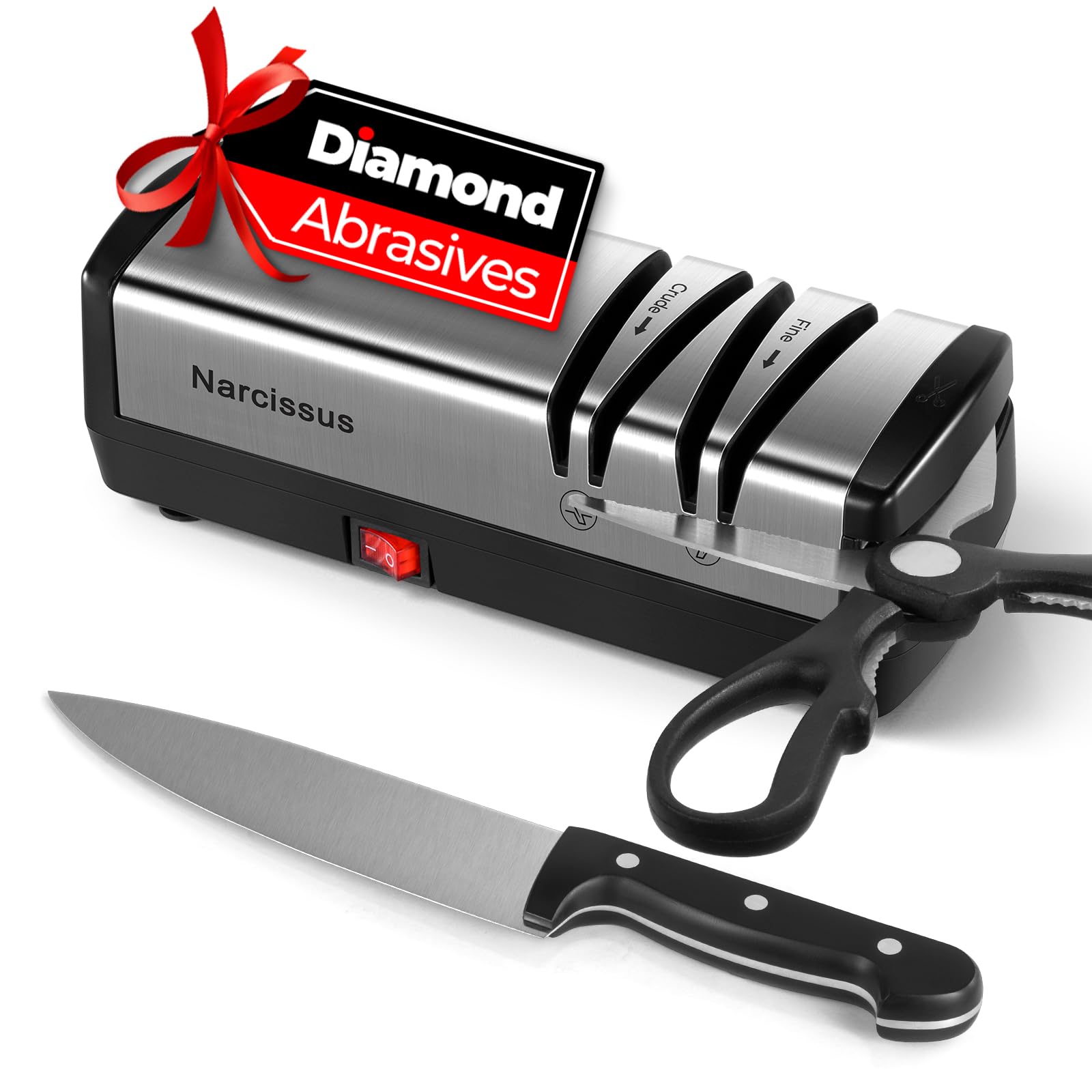
2. Narcissus Diamond Abrasives Electric Knife Sharpener
A compact electric that brings dull knives back to life without any real skill.
Sharpening performance is what wins people over here — it is the most-praised aspect by a wide margin. The diamond abrasive wheels cut fast, and owners mention the edge holds for a long time after sharpening. It handles straight, serrated, and ceramic knives, plus it doubles as a scissors sharpener.
The process is genuinely simple: plug it in and pull the knife through two different slots, then a third slot cleans the newly honed edge.
A metal dust collection box keeps the counter clean, and four anti-slip foot pads cut vibration. Compared to the manual Mercer below, this one trades a bit of edge refinement for serious convenience — you give up control but gain speed.
Everyday pick: the speed and ease make it ideal for a home kitchen where knives get dull fast.
Watch the limits: heavy-duty clipper-style scissors give it trouble, and you may need to force thick blades into the slot.
3. Work Sharp Benchtop Whetstone Knife Sharpener
A guided whetstone that gives you a true hand-sharpened edge without the guesswork.
This sharpener sits between raw stones and simple to use machines. The dual-sided 1000/6000 grit corundum water stone (a stone that uses water instead of oil) sharpens fast on the coarse side, then hones to a keen finish on the fine side — all in one base. Magnetic guides lock in 15° or 17° angles, or you can remove them to sharpen freehand, so you control the edge exactly.
At 2.3 pounds, it is noticeably heavier than the 1.7-pound Narcissus electric, and that weight pays off in stability. The rubber grip keeps it planted while you work, which owners repeatedly praise. It handles 10-inch chef’s knives and carbon or stainless steel with ease.
The water control base holds water to reduce mess and stores the stone when you’re done. Technique still matters — the results depend on how consistently you sweep the blade. Soak the stone for 5 minutes, sweep the knife, and use the 6000 side for the final fine edge.
The Guided Approach
- Magnetic angle guides remove guesswork
- Dual grit sharpens and hones in one stone
- Stable base with rubber grip for control
The Learning Curve
- Results depend on your sweeping technique
- Removable guides can sit awkwardly on the stone
Reach for this if: you want a genuinely keen edge and are willing to practice the motion.
Think twice if: you want set-and-forget sharpening with zero technique required.
4. Bogoni Rolling Knife Sharpener with Diamond & Ceramic Discs
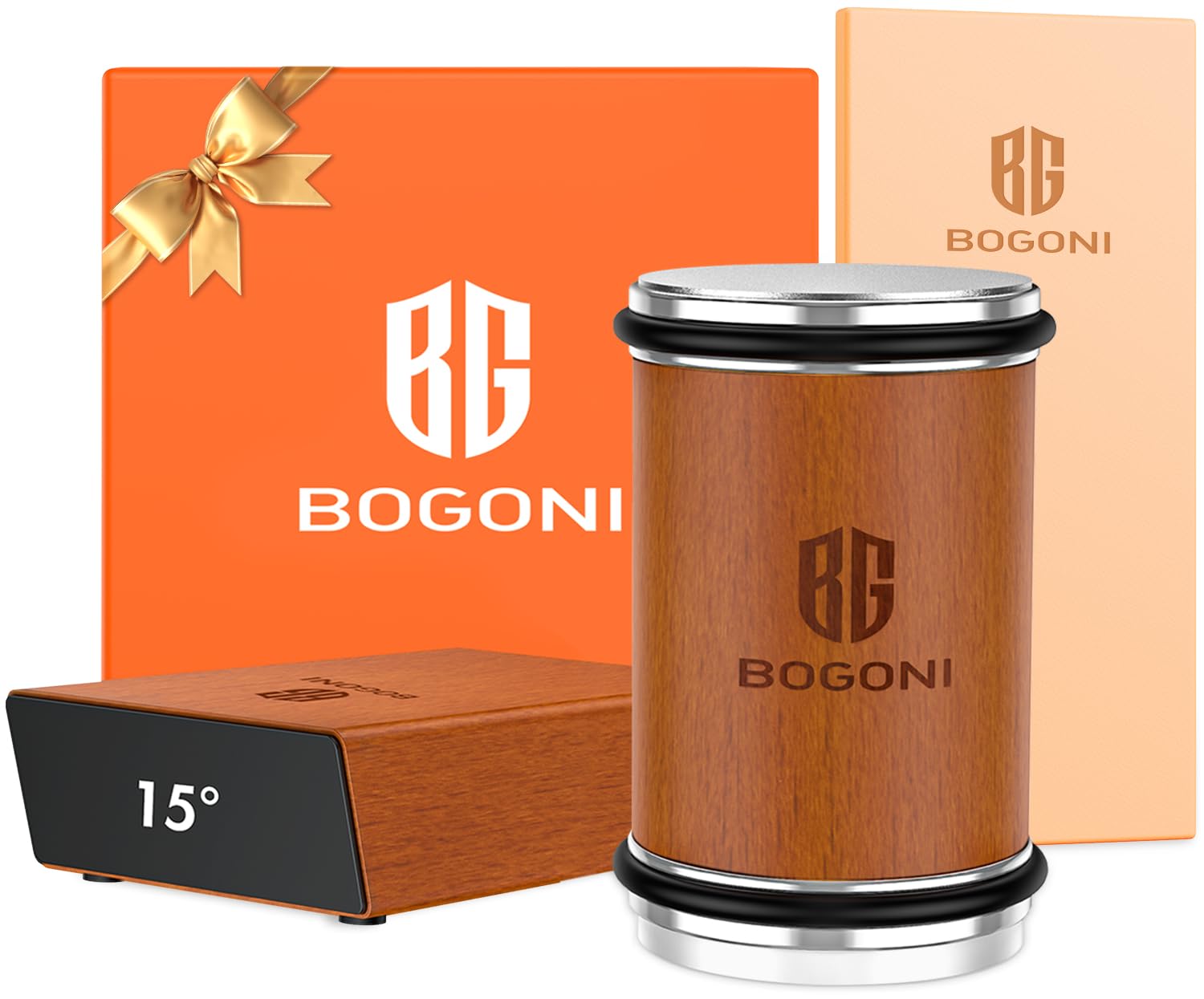
A rolling wood block that makes guided sharpening feel easy, even with tired wrists.
Effectiveness leads the praise here by a long way — it is the thing owners mention most. The 400-grit diamond disc reshapes a damaged edge, then the 3000-grit ceramic disc polishes it ultra-fine. Replaceable discs keep it performing long-term, and a leather strop finishes the job.
A chef with tendonitis found it easy and easier on the wrists than a steel, reaching razor sharp in under four minutes. Six built-in N52 magnets hold the knife firmly in place, so there is no slipping. The preset 15° and 20° magnetic guides remove all guesswork — 15° for high-carbon and Damascus steel, 20° for tougher everyday edges.
The natural wood body and compact design make it a handsome countertop piece. It works on most kitchen and pocket knives, and dull blades come back in as little as 30 passes per side.
Effort-first design: no special skills needed — anyone can reach a razor edge in minutes.
Noted trade-off: the magnetic angle guide draws mixed feedback over magnet strength, so very small blades may need propping.
5. Presto 08800 EverSharp Electric Knife Sharpener

A proven two-stage electric that grinds a razor edge in about a minute per knife.
This is the crowd favorite for speed — easily the most-reviewed sharpener here, with tens of thousands of ratings behind it. The Sapphirite wheels use the same ultra-hard material as professional sharpening shops, grinding a precisely angled edge and then honing it to a razor finish. The two clear slots make it obvious: coarse to grind, fine to polish.
Buyers consistently report reviving decades-dull knives in 3 to 4 passes per side., and one owner sharpened 20-30 knives in 30-40 minutes. The precision blade guides hold the knife at the perfect 20° angle, so there is no guesswork. It runs quietly, stays light, and the suction cups hold it steady.
It handles kitchen and sport knives fast, but only non-serrated steel blades — ceramic is off the table, and 20° is the only angle on offer. The fine wheel can leave a burr, so a quick pass on a honing rod finishes the job.
Speed Demon
- Razor-sharp edge in roughly one minute per knife
- Simple two-slot design needs no skill
- Sapphirite wheels match pro-shop material
Single-Angle Limits
- 20° only — no option for finer 15° edges
- Steel only; not for ceramic blades
Pick this for: quick, repeatable sharpening across a whole knife block without learning technique.
Pass if: you need finer-angle control or own ceramic knives.
6. Mercer Culinary Double Diamond Manual Knife Sharpener

A no-nonsense diamond block that pros trust to bring blades back to dangerous sharpness.
Quality is what owners single out most here, and it is easy to see why. The 100% diamond abrasives work in two stages — sharpening then honing — to create an arch-shaped edge that is strong and durable. It handles straight edge and serrated knives alike.
Professional cooks grab this sharpener when they want to skip wet stones. One working cook revived a dull chef’s knife and impressed the boss with the edge, according to the brand. Precision guides keep the angle controlled for simple to use results, and the textured handle gives a secure, safe grip.
It is fully manual, so you get the control of a stone without the mess or the learning curve. The trade-off is that you are doing the work yourself — no motor to lean on, unlike the Presto above. For a butcher or serious home cook, that control is the whole point.
Chef-approved: fast, effective, and simple — a favorite among working pros who dislike whetstones.
The fine print: read the directions first; getting top results depends on following the technique.
7. Professional Electric Knife Sharpener 3-Stage
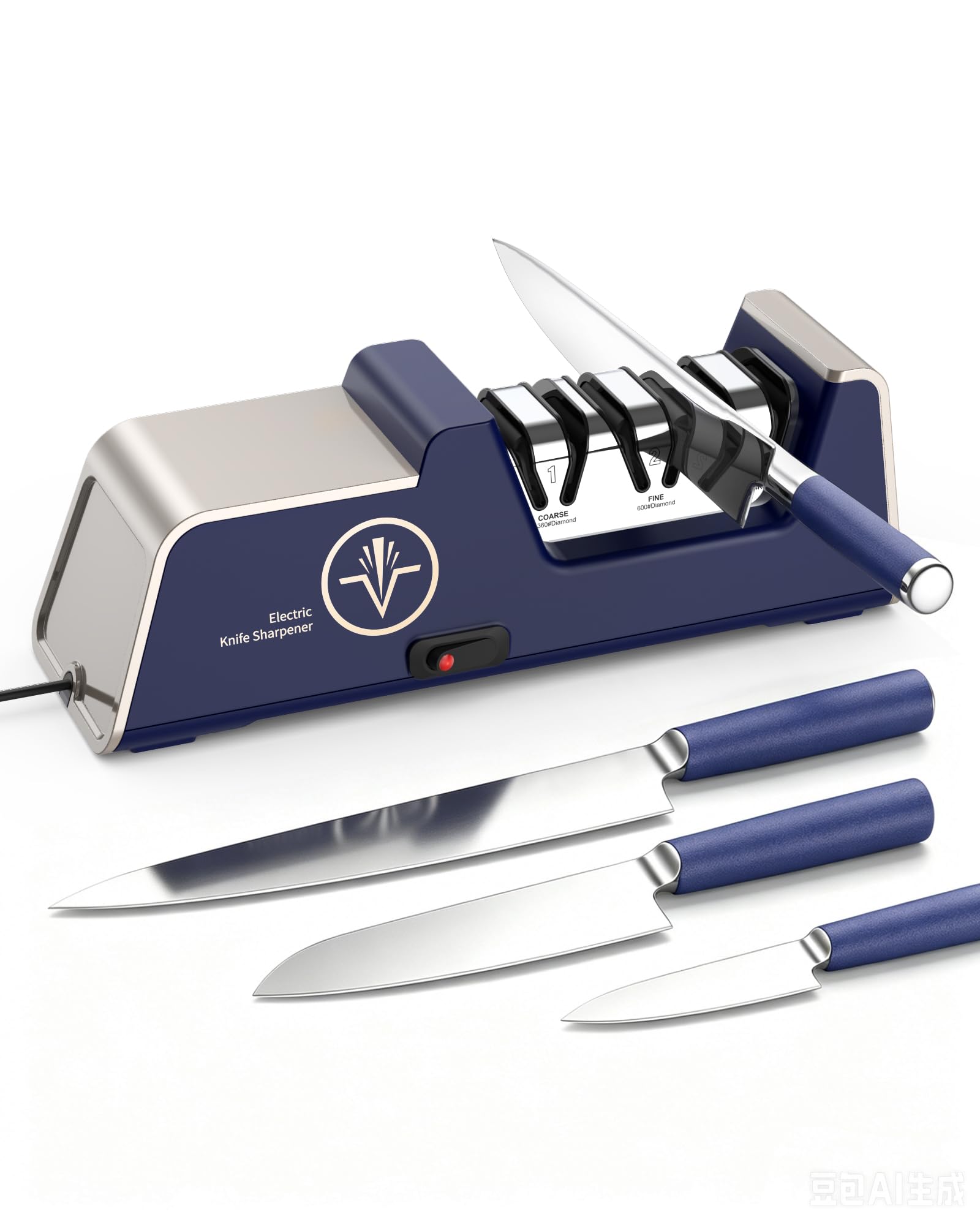
A three-stage electric that restores dull German steel to near-new sharpness in about a minute.
Stages 1 and 2 use 100% diamond abrasives to sharpen and hone, while stage 3 uses stropping disks to polish the blade to a like-new surface. Customers note a dramatic revival of knives that had gone dull for years. — One owner restored a 4-plus-year dull blade after 25 passes per side through all three stages..
The flexible spring guides hold the blade at the right angle and create a longer-lasting arch edge down the full length. It applies an ultra-sharp 15° edge to knives and can convert a 20° edge to a finer 15° for easier cutting. The German imported motor is strong but energy efficient, and It operates between 60dB and 80dB..
First sharpening takes about 30 seconds; resharpening takes about 10 seconds. A magnetic chip collector keeps metal shavings contained for easy cleaning. The champagne gold finish and compact footprint keep it looking sharp on the counter.
The 3-Stage Advantage
- Diamond abrasives for steel and most ceramic knives
- Spring guides hold a consistent angle
- Polishes to a like-new finish
Design Quirks
- Limited room to slide the knife at the handle
- Some ceramic knives can fail to sharpen
Best for: anyone who wants a professional-grade edge without whetstone skill.
Not ideal for: very hard ceramic blades or people who want a razor-level mirror finish.
8. Homly Professional Electric Knife Sharpener

A sturdy electric that handles everything from butcher knives to fish fillet blades.
Performance leads the reviews here — it is the most-mentioned aspect by a wide margin, and the quality follows close behind. The 3-stage system uses 100% diamond abrasives in stages 1 and 2 to sharpen and hone, then a third stage to polish. The flexible spring guide rod keeps the blade at an ideal angle for a durable arch edge down the entire length.
Reviewers point out it sharpens better than a more expensive device they had used before, and a self-described 60-year sharpening veteran was impressed. Fish fillet knives came out exceptionally sharp — better than new. The double-layer shell and noise-reducing design keep it sturdy and relatively quiet, with two swipes often enough for a razor edge.
It is built for serious volume: the heavy-duty build suits a kitchen that processes a lot of meat. The catch is that too much pressure or too slow a movement can leave a blade indent, so practice on an old knife first.
Built to Work Hard
- Handles chef, butcher, fillet, and pocket knives
- Sturdy build that owners call heavy-duty
- Fast results — often two swipes to sharp
Handle With Care
- Excess pressure can indent the blade
- Learner should practice on older knives first
Choose this for: a heavy-use kitchen that processes lots of meat and needs durable electric sharpening.
Skip if: you want a gentle machine that forgives aggressive technique.
9. Work Sharp Ken Onion Knife Sharpener Tool

The belt-driven powerhouse that sharpens anything you own, from kitchen knives to axes.
Designed with knife-making legend Ken Onion, this is the most versatile sharpener in the lineup. It runs on flexible abrasive belts with precision guides and electronic speed control, so it sharpens every knife you own — plus scissors, serrated blades, axes, and garden tools. The adjustable angle guide spans 15° to 30°.
Shoppers say it restores dull everyday-carry knives to razor-sharp, mirror-polished edges without the frustration of manual stones. It is powerful but user-friendly, with many noting it is easy even for inexperienced users. The variable speed motor and quality belts make quick work of even heavily damaged edges.
It is the most expensive pick here, priced firmly at the premium tier, and the belts do wear out over time. It also runs a bit bulky on the counter. But for a serious edge enthusiast who owns multiple blade types, no other pick matches its range.
The All-Rounder
- Adjustable angle from 15° to 30° covers every blade
- Sharpens knives, scissors, serrated, and tools
- Belt-driven speed for fast results
The Commitment
- Premium price tag
- Belts wear out and need replacing
- Bulky footprint on the counter
Worth it for: collectors and enthusiasts who want one machine for every edge in the house.
Overkill if: you just need to keep a single chef’s knife sharp.
Understanding the Specs
Grit Numbers Explained
Grit tells you how coarse the abrasive surface is. A lower number like 400 grit aggressively grinds away metal to reshape a damaged or very dull edge. A high number like 6000 grit polishes the edge to a fine, keen finish. Two-stage systems combine both: coarse to grind, fine to hone, giving you a complete job in one tool.
Sharpening Angle
The angle at which the abrasive meets the blade determines edge geometry. A 15° edge is thinner and slices with less resistance but wears faster, ideal for precision work. A 20° edge is tougher and holds up better under heavy butchering. Fixed-angle sharpeners like the Presto (20° only) are simpler but less flexible than adjustable ones like the Ken Onion (15°–30°).
FAQ
What is the difference between sharpening and honing a butcher knife?
Can an electric sharpener handle a long butcher knife safely?
Is a 15° or 20° edge better for butchering?
Why does my sharpener leave a burr on the blade?
Can I sharpen a ceramic butcher knife with any sharpener?
How often should I sharpen versus hone my butcher knife?
Does a heavier sharpener stay more stable during use?
What does 100% diamond abrasive actually mean for performance?
Final Thoughts: The Verdict
For most buyers, the butcher knife sharpener winner is the Victorinox Round Finecut Steel because it is the fastest, most traditional way to keep a heavy blade working hard all day. If you want a simple to use electric that needs no skill, grab the Narcissus for its diamond-powered speed and ease. And for the serious edge enthusiast who owns multiple blade types, the Work Sharp Ken Onion is the one to reach for — its adjustable angle range and belt-driven power make it the most complete sharpening system here.
How We Picked
We do not accept paid placement. Every pick is matched to a real buyer and a real use-case; we do not hands-on test units.
Sources & Methodology
Specifications: manufacturer listings and product documentation. Review insights: verified customer reviews, as of August 2026. Pricing: not shown on this page (it changes often); check the current price via the retailer link.
As an Amazon Associate, FitlyFast earns from qualifying purchases. This does not affect which products we feature.