
Our readers keep the lights on and the weekend projects moving. As an Amazon Associate, I earn from qualifying purchases.
Specs are compiled from manufacturer listings and verified buyer reviews and can change over time — please confirm the key details on the product page before buying.
When you’re buying your first electric longboard on a tight budget, two numbers matter most: how far it goes on a charge and the steepest hill on your commute. A board rated for 15 mph can feel slow if you weigh 200 lb, but a heavier rider can actually get more range from a smaller motor — so match the board to your weight, not just the sticker specs.
I’m Rikta — the founder and writer behind FitlyFast. This guide is built by comparing the manufacturers’ published specifications and the patterns across verified customer reviews, so you get each pick’s real strengths and trade-offs instead of marketing spin.
The five shortboards below focus on genuine value, rider weight limits, and honest battery claims. Find out which budget electric longboard fits your commute without breaking your back or your bank account.
Our Picks at a Glance


How To Choose The Best Budget Electric Longboard
A budget board is a compromise between speed, range, and weight — and the right balance depends on whether you are a 120 lb teen or a 220 lb commuter. Before you buy, check the board’s weight limit, not just its motor wattage.
Match the Board to Your Weight
The single biggest mistake beginners make is ignoring the rider weight limit. A board rated for 150 lb will feel sluggish and drain its battery fast if you weigh more, so look for a 220 lb or higher limit if you are a bigger adult.
Read the Range Claim with Skepticism
Manufacturers quote range at steady speed on flat ground with a light rider. Real-world range drops with hills, wind, and your weight, so treat a quoted range as the best-case number and expect roughly two-thirds of it in daily riding.
Quick Comparison
| Model | Best For | Top Speed | Range | Weight Limit | Amazon |
|---|---|---|---|---|---|
| EBOSSOM ES6 SE★ Best Overall | Teens and light adults | 10 mph | 6-8 miles | 220 lbs | Amazon |
| DNASKATE M8Best Value | Beginners on flat roads | 15 mph | 9 miles | — | Amazon |
| ASKATE A1 | Longer flat cruises | 25 KPH | 17 miles | 264 lbs | Amazon |
| MEEPO Campus | Smaller riders | 15.5 mph | 8-10 miles | 150 lbs | Amazon |
| MEEPO Mini5 | Speed-focused riders | 28 mph | 11 miles | 330 lbs | Amazon |
In-Depth Reviews
1. EBOSSOM ES6 SE
The safest-feeling first board for teens, with a 220 lb limit that fits light adults too.
The ES6 SE suits riders who want confidence over adrenaline. Its 350W brushless motor (a motor that runs without brushes, so it’s smoother and needs less maintenance) tops out at a gentle 10 mph, and the 4 speed modes let a nervous beginner ease in slowly. Parents get confidence from the UL2272 safety certification (a safety standard covering the battery and electrical system).
Range lands at 6-8 miles per charge, which owners say holds up well in real riding. The 27.6-inch deck is built from 8-ply maple, and the 9.1-inch width gives a stable platform — notably wider than the M8’s 8-inch deck — that helps younger riders find their balance. The catch is the motor: buyers report it feels weak on any incline, so treat this as a flat-ground cruiser.
Owners consistently praise the build quality and battery life, and the board’s durability shines through even when a kid abuses it. One 6’1″, 220 lb rider reported the single rear-wheel drive still moves well, which is impressive for a board aimed at teens.
What wins riders over
- Genuine 6-8 mile battery that holds charge for days
- 220 lb weight limit suits teens and lighter adults
- UL2272 certified battery for low-maintenance charging
Where it holds back
- 10 mph top speed feels slow for experienced riders
- Single motor struggles on hills
- Remote feels flimsy, though it functions fine
The right first board: if you are buying for a 7-12 year old or a lightweight adult who wants a stable, safe intro to electric skating.
Not for thrill-seekers: the weak motor and 10 mph cap mean you will outgrow this board quickly if you ride fast.
2. DNASKATE M8
The crowd favorite that actually out-performs its spec sheet on flat roads.
The M8 is the value king here, and the numbers tell the story: a 400W hub motor (a motor built into the wheel) beats the ES6 SE’s 350W, a 15 mph top speed beats the ES6’s 10 mph, and a 9-mile range that owners routinely exceed. What wins people over is the consistency — owners mention quality is the most-praised aspect of this board, followed closely by speed.
Real owner reports are almost suspiciously good: one rider logged 34 miles in the first week and measured a true 12-mile range against the 9-mile spec, with a top speed of 20 mph versus the rated 15. The 28-inch deck with its practical kicktail makes it easy to carry and flick around, and at 11.5 lb it is light enough to haul onto a bus.
The honest limitation is hills. Owners consistently report it struggles on any incline and performs best as a flat-road commuter for 1-5 mile trips. The LCD remote shows speed, battery, and 4 gear modes, and the battery charge time is a quick 2 hours.
Why it wins: the 400W hub motor delivers real speed and range that beat its price point — “Actual range 12mi (spec 9), top speed 20mph (spec 15)” is the kind of spec-beating owners keep reporting.
The honest trade-off: stick to flat ground; this board needs momentum to start on any uphill.
Reach for this if: you want the most capability per dollar for flat commutes and don’t mind a compact deck.
Look elsewhere if: your route has serious hills or you weigh over 200 lb and need torque.
3. ASKATE A1
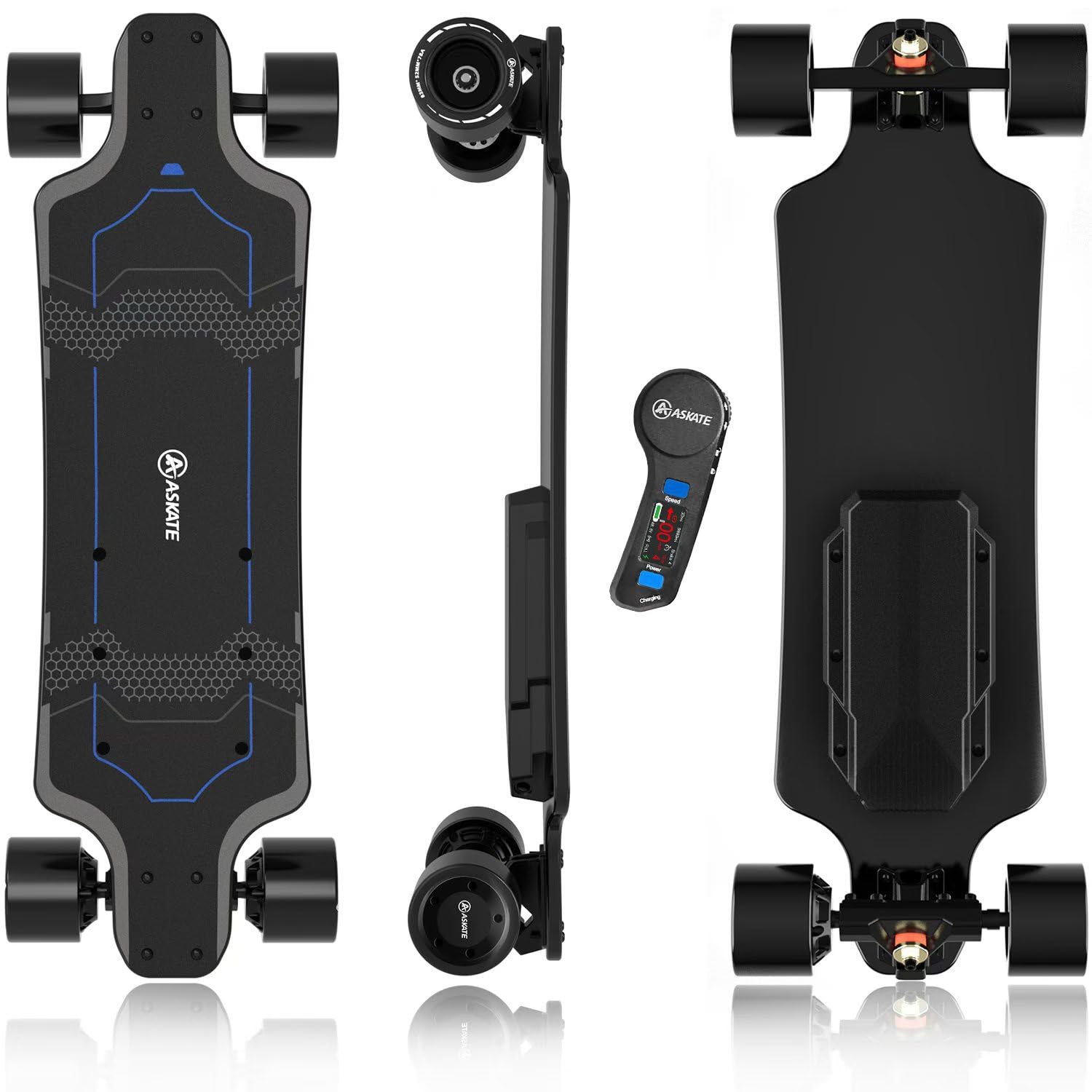
The long-distance champ that keeps going long after the others have stopped.
The A1 goes the distance. With a range of up to 17 miles and a 264 lb weight capacity, it’s the board for bigger riders and longer trips — the highest weight limit here, beating the M8’s unspecified cap and the ES6’s 220 lb. That 31.5-inch deck is also the longest in this lineup, giving a more stable ride for taller riders.
Its single 350W motor reaches 25 KPH, and the MR remote with its LED screen shows battery level, live speed, and mileage while offering 4 speed and brake modes. Customers note the battery lasts about 2 hours at full capacity, and one rider confirmed it handled a 10-hour session of being left on and still had enough power to ride home.
The trade-offs are real but fair: charging takes a slow 3.5 hours, and the flexible deck has a basic build quality that owners say demands avoiding wet conditions. One rider noted a random stall that required a 15-minute wait to reset, an occasional issue rather than a pattern.
Best for distance: the 17-mile range and 264 lb limit make it the only real option here for heavier riders who want to go far.
Mind the hills: it climbs “slowly but surely,” so keep expectations realistic on steep routes.
Choose this if: you are a bigger rider or want maximum range for town cruising.
skip it if: you need fast charging or a board that can handle wet pavement.
4. MEEPO Campus

A tiny 26.7-inch deck that slips into a backpack, built for riders under 150 lb.
The Campus is MEEPO’s entry-level board, and its entire design revolves around portability. The compact 26.75-inch deck with a 7.87-inch width is the smallest here, making it the easiest to carry onto transit or store in a locker. The 4-speed M5 remote is intuitive, with a brake system owners specifically praise as smooth and easy to control.
Here is the honest catch: the weight limit is 150 lb, and the manufacturer itself recommends the V3 Max or V5 series for anyone heavier. A 135 lb rider reported 6-mile round trips on one charge at 11 mph in mode 3, confirming the 8-10 mile range is realistic for lighter riders. But a 220 lb owner noted lower acceleration and top speed, and one 150 lb rider found it “barely moves” and can’t climb a 2% incline.
For teens and small adults, the Campus delivers a dependable, portable ride with instant remote pairing and a 3-hour charge time. The UL2272 certified battery (a safety standard for the battery and electrical system) adds confidence for younger riders.
Small riders love it
- Genuinely portable at 26.75 inches with a carry handle
- Smooth braking and instant remote connection
- UL2272 certified battery with individual cell monitoring
Bigger riders beware
- 150 lb limit means reduced speed and range above that
- Single motor has no hill capability
- Occasional battery issues reported needing replacement
The perfect starter: if you are under 150 lb and want the most portable electric board for short commutes.
Not for heavy riders: over the weight limit, the board feels underpowered and disappoints.
5. MEEPO Mini5

The only dual-motor board here, hitting 28 mph with a 330 lb weight limit.
The Mini5 is a different animal entirely. Its dual 500W hub motors — the only dual-motor setup in this lineup — push a 28 mph top speed and an 11-mile range, while the 330 lb weight capacity dwarfs every other board on this list. This is the board you buy when you have tried a single-motor ride and want real power.
The 33-inch deck with a kicktail (a raised tail for popping the front up) and 8-ply maple construction rides smooth over bumps and curbs, with owners calling the ride quality excellent and the board “super fast.” The detachable PU wheel design (polyurethane wheels you can remove) lets you swap hub motors easily as they age. The M6C LED remote is responsive and shows all vital stats.
The price premium brings real trade-offs. At 17.4 lb, it is the heaviest board here by a wide margin. Reviewers point out real-world range lands around two-thirds of the 11-mile spec unless you stay on the slowest speed, and speed wobbles at 25 mph demand careful truck adjustment. The quality earns the most praise, but stability and reliability get genuinely mixed feedback — some shoppers say issues with the battery and wheels.
Why riders upgrade to it
- Dual 500W hub motors deliver 28 mph — class-leading here
- 330 lb limit fits virtually any rider
- Detachable wheels simplify motor upgrades
The premium price it asks
- 17.4 lb is heavy to carry for long stretches
- Real range drops to ~2/3 of spec at speed
- Speed wobble at 25 mph needs careful setup
Buy this if: you already ride and want dual-motor power and speed that a single-motor board cannot deliver.
Think twice if: you are a beginner who needs a light, easy board — the Mini5’s weight and speed are serious commitments.
Understanding the Specs
Motor Power and Drive Type
A single 350W to 400W motor is enough for flat cruising with a lighter rider, while dual motors like the Mini5’s 500W pair deliver the torque and speed heavier riders need. Hub motors sit inside the wheel, making the board quieter, simpler, and easier to push like a normal skateboard when the battery dies.
Top Speed and Range Realism
Quoted top speed and range assume a light rider on flat, smooth ground. Heavier riders see both numbers drop, and hills cut range further. Expect roughly two-thirds of the advertised range in real daily riding, especially if you use the highest speed mode.
Deck Length and Weight Limit
Longer decks — 31.5 inches and up — offer more stability and room for bigger feet, while shorter decks like the Campus’s 26.75 inches are easier to carry. The weight limit is the number to check first: over it, the board feels sluggish and the battery drains fast.
Battery Safety Certification
Look for UL2272 certification, which covers the electrical system for fire and shock safety. It means the battery is individually monitored and the board meets a recognized safety standard, so you can charge and store it indoors with less worry.
FAQ
What does rider weight actually do to range and speed?
Can a budget electric longboard climb hills?
How long does a budget board battery take to charge?
Is a 10 mph top speed enough for a beginner?
What is the difference between a belt drive and a hub motor?
What does UL2272 certification mean for safety?
Can I push an electric board manually if the battery dies?
How fast is 25 KPH compared to 15 mph?
Should I buy a board with a higher weight limit than my weight?
What safety gear should I use with an electric longboard?
Final Thoughts: The Verdict
For most buyers, the winner for the budget electric longboard spot is the DNASKATE M8, because its 400W motor and spec-beating real-world range give you the most capability per dollar. If you are buying for a younger rider or want maximum safety, grab the EBOSSOM ES6 SE. And if you already ride and want real dual-motor speed, the MEEPO Mini5 is the one to reach for despite its higher price.
How We Picked
We do not accept paid placement. Every pick is matched to a real buyer and a real use-case; we do not hands-on test units.
Sources & Methodology
Specifications: manufacturer listings and product documentation. Review insights: verified customer reviews, as of August 2026. Pricing: not shown on this page (it changes often); check the current price via the retailer link.
As an Amazon Associate, FitlyFast earns from qualifying purchases. This does not affect which products we feature.