
Our readers keep the lights on and the weekend projects moving. As an Amazon Associate, I earn from qualifying purchases.
Specs are compiled from manufacturer listings and verified buyer reviews and can change over time — please confirm the key details on the product page before buying.
Buying a solar generator on a budget usually means one big fear: that you’ll get a weak battery that dies after one phone charge. The truth is, there are now genuinely capable units that run a CPAP machine all night, keep a fridge cold, or power your laptop for a full workday — without costing a fortune. This guide cuts through the marketing noise to show you exactly which budget-friendly models deliver real power you can rely on.
I’m Rikta — the founder and writer behind FitlyFast. This guide is built by comparing the manufacturers’ published specifications and the patterns across verified customer reviews, so you get each pick’s real strengths and trade-offs instead of marketing spin.
Before you scroll, know this: the picks here are matched by solar input capability, not exact wattage, so the nearest same-type size stands in for the one you searched. Every model genuinely accepts solar panels for recharging, and each one holds up when the grid goes down. Here are the best budget solar generators worth your money.
Our Picks at a Glance


How To Choose The Best Budget Solar Generator
Picking a solar generator is really about matching the battery’s capacity and the inverter’s output to the specific devices you plan to power. The most common mistake is buying by wattage alone and ignoring capacity — you can have a 1500W inverter but only enough battery to run it for ten minutes.
Capacity vs. Output: The Two Numbers That Matter
To size a generator, you need two numbers. Capacity, in watt-hours (Wh), is the total energy the battery stores — think of it as the fuel tank. Output, in watts (W), is the power it can deliver at once — the engine size. You need enough output to start your biggest device (like a CPAP or mini fridge) and enough capacity to keep it running for the hours you need. A CPAP user might need a 220Wh unit, while a full-size fridge demands far more.
Solar Panel: What to Expect from “40W” or “100W”
The solar panel wattage in the box is the theoretical maximum under perfect overhead sun. In real conditions, a 40W panel might deliver 30W to the battery, and a 100W panel might net 80W. If you plan to live off-grid for days, budget for a bigger panel than the included one — many buyers report that a 60W or 100W panel is the balance for keeping a station topped up.
Battery Chemistry: The Long Game
LiFePO4 (lithium iron phosphate) cells are the current gold standard because they handle roughly 4× more charge cycles than standard lithium-ion. If you want a generator that lasts a decade instead of a few years, prioritize models with this chemistry even if the upfront capacity is lower.
Quick Comparison
| Model | Best For | Capacity | AC Output | Weight | Amazon |
|---|---|---|---|---|---|
| Apowking HP200L★ Best Overall | Ultra-portable day trips | 220Wh | 300W | 5 lbs | Amazon |
| AFERIY Nomad 1800-ATop Performer | Home backup and heavy loads | 1024Wh | 1800W | 25.6 lbs | Amazon |
| Anker SOLIX C300Compact Pick | Weekend getaways | 288Wh | 300W | 15.5 lbs | Amazon |
| DaranEner NEO | CPAP and overnight use | 288Wh | 350W | 8.2 lbs | Amazon |
| Anker SOLIX C200 | Phone and laptop charging | 192Wh | 200W (DC) | 4.2 lbs | Amazon |
| BLUETTI Elite 30 V2 | Fast wall recharge | 288Wh | 600W | 9.4 lbs | Amazon |
| EBL EB1000 | Small appliances and tools | 999Wh | 1000W | 21 lbs | Amazon |
| GRECELL EB500 | Weekend camping trips | 519.48Wh | 500W | — | Amazon |
| VTOMAN FlashSpeed 1500 | Whole-home emergency power | 1548Wh | 1500W (3000W peak) | 41.5 lbs | Amazon |
In-Depth Reviews
1. Apowking HP200L 300W Solar Generator
The featherweight powerhouse that fits in a daypack and still runs a CPAP all night
At just 5 lbs, this is the lightest unit in the lineup — a full 64% lighter than the DaranEner NEO above it, which matters when you’re hiking to a campsite. The 220Wh battery (60,000mAh) provides roughly 15 phone charges, 3 drone batteries, or 5 hours of laptop backup for real-day use.
The 300W pure sine wave AC output (600W peak) handles sensitive electronics safely — laptops, CPAP machines, and mini-fridges all get clean power without risk. What wins people over is the included 40W solar panel, which uses 24% high-efficiency monocrystalline cells and works even in dawn, dusk, or overcast conditions.
Owners mention that this generator is a lifesaver for power outages, especially in storm-prone areas, and they love that all 7 ports (2 AC, 2 USB-C PD, 3 USB-A, 1 DC carport) work simultaneously without interference. The recurring trade-off is that solar charging is slow — one owner noted the 40W panel charges effectively but a 60W panel would be faster. The integrated LED floodlight (5000K, ~300 lumens) illuminates up to 100 sq. ft and runs 30+ hours per charge for tent reading or dusk cooking.
What wins people over
- The 5 lb weight means you’ll actually bring it along
- All 7 ports work at once, no interference, no fan noise
- 12-month customer support with a warranty that’s honored, per buyers
The trade-offs to know
- Solar recharging is slow with the included 40W panel
- Battery life gets mixed reviews — some report it holds charge well, others say it doesn’t
Reach for this if: you need the lightest possible generator for day trips, camping, and overnight CPAP use while staying affordable.
Think twice if: you plan to live off-grid for multiple days — the solar recharge speed will test your patience.
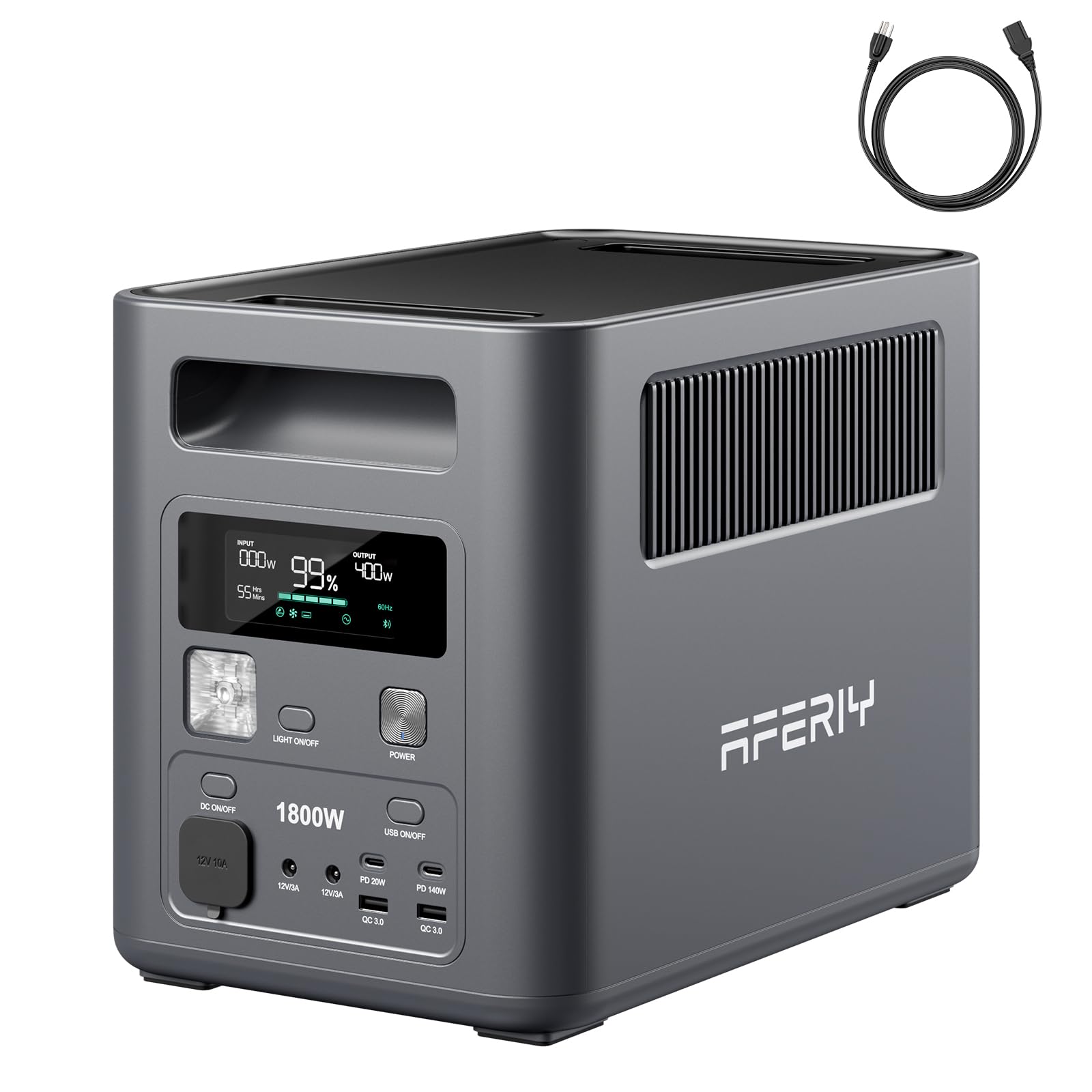
2. AFERIY Nomad 1800-A
The 1800W juggernaut that powers a window AC unit and still switches over in under 10ms
This is the serious home-backup option in the budget range — 1024Wh capacity with a 1800W AC output (3600W peak) that easily runs fridges, coffee makers, and even a portable washing machine. The LiFePO4 battery is rated for over 4000 charge cycles and a 10-year lifespan, making it a long-term investment.
Speed is the standout: the built-in UPS (uninterruptible power supply, a backup that kicks in instantly) switches in under 10ms — twice as fast as standard models — so computers and security cameras never blink during an outage. Customers note that a 200W solar panel at half power can do a full charge in about 2 hours, and the unit stays below 30dB (about as loud as a whisper) in most use, quiet enough for a living room.
The thing everyone raves about is reliability, and the numbers back it up: AC+solar mode can hit 0-80% in just 35 minutes. It’s also 16% smaller and 25% lighter than most models with similar capacity. The 13 ports (4 AC, 1 140W USB-C PD, 2 QC3.0 USB-A, and more) plus smart app control make it a true command center. Some owners find it heavy at 25.6 lbs, but the sturdy handles and one-hand-friendly design help.
Power-lifter’s pick: This is the budget pick that punches far above its price tier — a genuine home-backup workhorse with a 10-year lifespan, UL listed for safety.
Best for: anyone who wants to power real appliances (AC units, fridges, tools) and needs a reliable UPS for home offices.
Looks elsewhere if: you need something you can carry on a long hike — at 25.6 lbs this is a car-camping or home unit.
3. Anker SOLIX C300
The whisper-quiet all-rounder that powers a BiPAP all night and recharges in 50 minutes
This is the premium compact option that delivers 300W (600W surge) and 288Wh from a LiFePO4 battery designed for 3,000 cycles — a decade of use. It’s 15% smaller than similar designs, making it a favorite for spontaneous adventures, and it’s so quiet that it emits just 25dB from 3.3 ft away, invisible to ears in a tent.
You get 8 ports total: 3 AC outlets, 1 car socket at 120W, 2 USB-C at 140W each, plus a 15W USB-C and 12W USB-A. Reviewers point out it powers an Airsense 10 BiPAP all night and charges from zero to 100% in about an hour via wall outlet. The included 60W solar panel (IP68 rated) works in rain, though shoppers say the panel charges slowly on overcast days — the consensus is that a 100W panel is a better match if you rely heavily on solar.
The integrated app connects via WiFi/Bluetooth from 100 ft away, offering temperature monitoring and basic control. The 5-year warranty and smart temperature control add real confidence. One owner summed it up: the solar panel charges well and the power station is “compact, lightweight, and easy to use.”
The quiet strengths
- 25dB noise level means it won’t disturb sleep or conversation
- 140W two-way USB-C fast charging is rare at this price
- 5-year warranty on a battery rated for 3,000 cycles
Where it falls short
- Included 60W solar panel is slow on cloudy days
- The carry strap is sold separately, not included
Grab it for: family camping, CPAP/BiPAP overnight use, and a quiet backup that disappears into your trunk.
skip it if: you demand fast solar recharging from the box — budget extra for a larger panel.
4. GRECELL EB500 Solar Generator
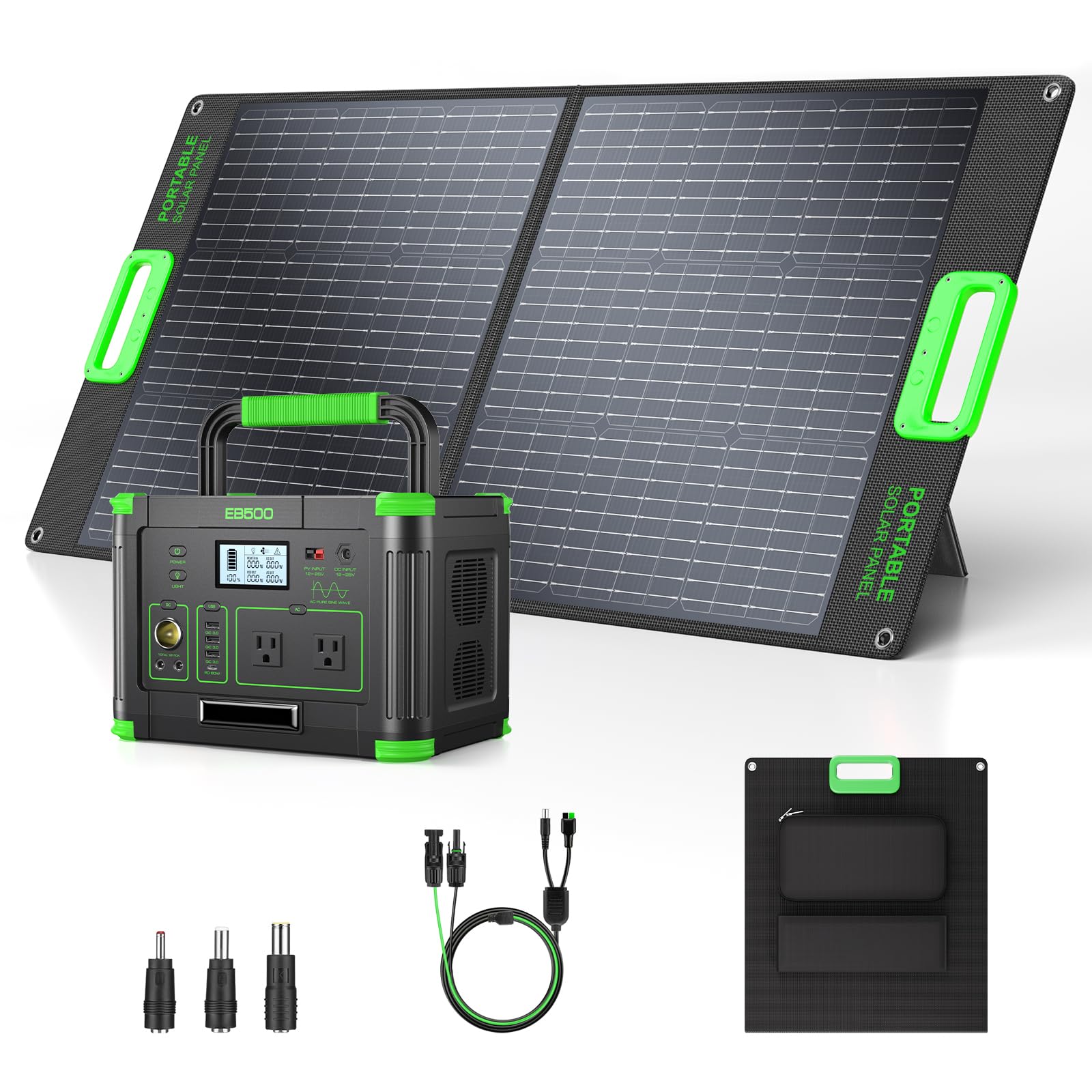
The sweet-spot mid-ranger with a 100W panel that actually keeps up with weekend trips
This is the model that strikes the best balance between price and real-world usefulness. The 519.48Wh capacity and 500W rated power (1000W peak) runs a CPAP with humidifier all night — owners confirm it “lasts all night” on camping trips — and the included 100W solar panel is substantially more capable than the 40W panels bundled with cheaper units.
The panel uses monocrystalline cells with up to 23.5% conversion efficiency and delivers up to 100W at 18V, so it captures more sunlight and charges faster than traditional polycrystalline panels. The station itself has 10 ports total, including 2 pure sine wave AC outlets, a 60W USB-C PD port, and a wireless charger on top.
Buyers who went dry camping for 5 days reported it held a charge well for phones, fans, and headlamps. The built-in smart BMS protects against overvoltage, overcurrent, and short circuits. The real value here is the panel-to-capacity ratio — you get a panel that genuinely replenishes the battery during a day of sun, unlike the token panels on cheaper kits. Pair it with the included carrying case and cable storage bag for a tidy setup.
The balanced buy: With more than double the capacity of entry-level units and a panel that keeps pace, this is the pick for people who want one generator that works for both weekend camping and home outages.
Choose this if: you want a panel that actually keeps up with your battery and a station that runs a CPAP with humidifier all night.
Pass if: you need to power high-draw appliances like a fridge or power tools — step up to the higher-wattage picks.
5. BLUETTI Elite 30 V2
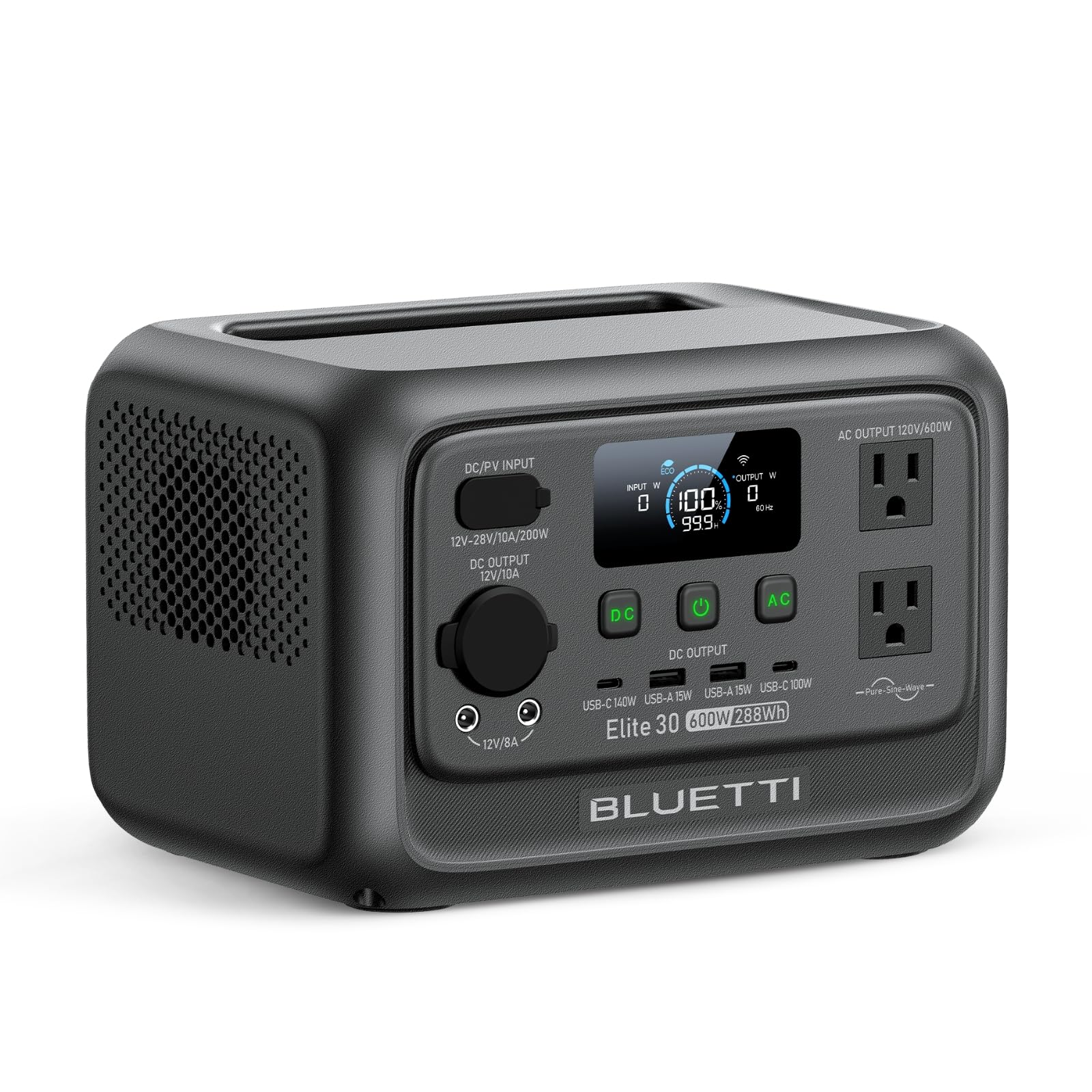
The fast-charging workhorse that jumps from 0 to 80% in 45 minutes flat
This is the unit for people who hate waiting. The BLUETTI Elite 30 V2 charges from 0-80% in just 45 minutes via its 380W wall charger, and 0-100% in 70 minutes — numbers that blow past most competitors. The 288Wh LiFePO4 battery delivers a full 600W continuous output (1500W peak with Power Lifting Mode), which is twice the output of many units in its class.
Owners use it as a genuine UPS replacement, running home servers with “smooth switchover” and no hiccups, thanks to the 10ms ultra-fast UPS switch. The 8 charging modes cover wall (380W/200W adjustable), solar, and car — plus AC+solar for faster top-ups. At 9.4 lbs, it’s carry-friendly for camping, road trips, and beach days.
The thing everyone raves about is the quality of the build and the fast charging — the two most-praised aspects in the data. It’s easy to use, and customer service is responsive. Buyers report 2.4h runtime at 150W load, beating a degraded CyberPower UPS that only managed 1h. The main trade-off: the app needs a few tweaks for advanced UPS modes, and one owner noted the power gauge isn’t perfectly accurate.
The speed advantage
- 0-80% in 45 minutes is class-leading for this capacity
- 600W continuous output, 1500W peak with Power Lifting
- 10ms UPS switch protects critical gear during outages
The small catches
- Power gauge accuracy has been questioned by an owner
- App setup for UPS mode takes some configuration
Ideal for: home offices needing a reliable UPS, campers who want to recharge fast before heading out, and anyone who prioritizes quick turnaround.
Not for: multi-day off-grid solar living — the 288Wh capacity is best for short trips and backup.
6. VTOMAN FlashSpeed 1500
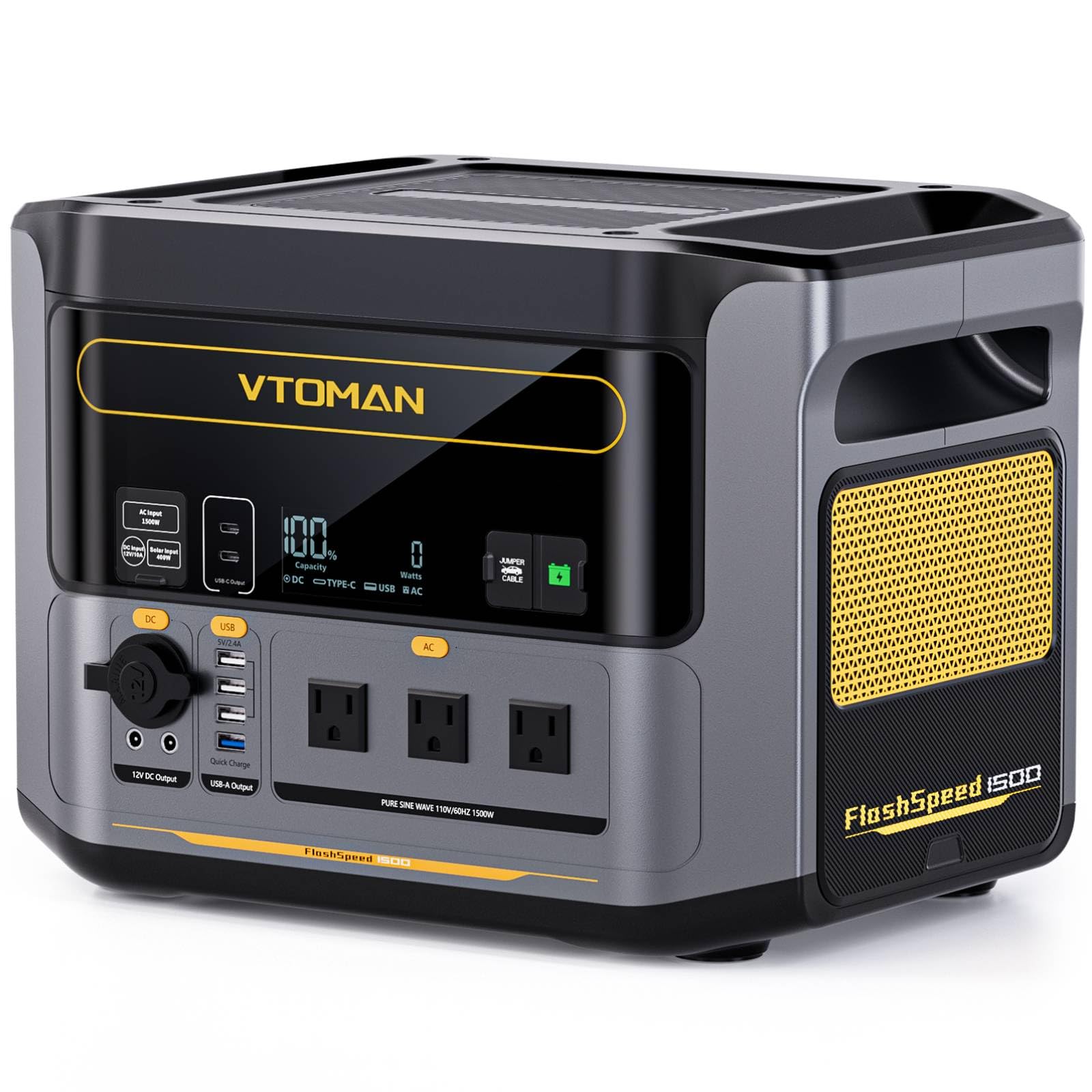
The 1548Wh monster that recharges in one hour and powers a space heater
This is the big one — 1548Wh capacity with 1500W AC output (3000W peak) that can handle a 1500-watt space heater, which most power stations simply refuse to run. The V-Beyond technology lets it output 1500W constant-power even when powering over-1500W appliances, instead of just shutting off like most generators.
The headline feature is the recharge speed: 0-100% in just 1 hour via AC. That’s remarkable for a 1548Wh unit. Owners who have used it daily for three years report zero issues, powering air fryers and running 20W ham radios indefinitely with a 100W solar panel. The 400W solar input (30-60V) means you can hook up serious panel arrays for off-grid living.
The thing everyone raves about is the capacity-to-price ratio, which owners call “great value.” The LiFePO4 battery is rated for 3000+ cycles before degrading to 80% capacity. It charges 12 devices simultaneously across 12 ports, and the passive UPS switches in under 20ms. It’s expandable to 3096Wh with an extra battery (sold separately). The honest catches: a few owners note the DC output auto-off can be an issue with fridges, and the 41.5 lb weight makes it a home-base unit, not a hiking companion.
The heavy hitters
- 1-hour full recharge from wall AC is exceptional at this capacity
- 1500W constant-power output handles over-rated appliances
- Expandable to 3096Wh doubles your runtime
Bear in mind
- At 41.5 lbs, this stays in the trunk or garage
- AC drains battery when idle unless switched off
Best for: whole-home emergency backup, tailgates, RVs, and anyone who needs to power high-draw appliances like space heaters or air fryers.
Overkill if: you only need to charge phones and laptops — a smaller, lighter unit will serve you better.
7. EBL EB1000
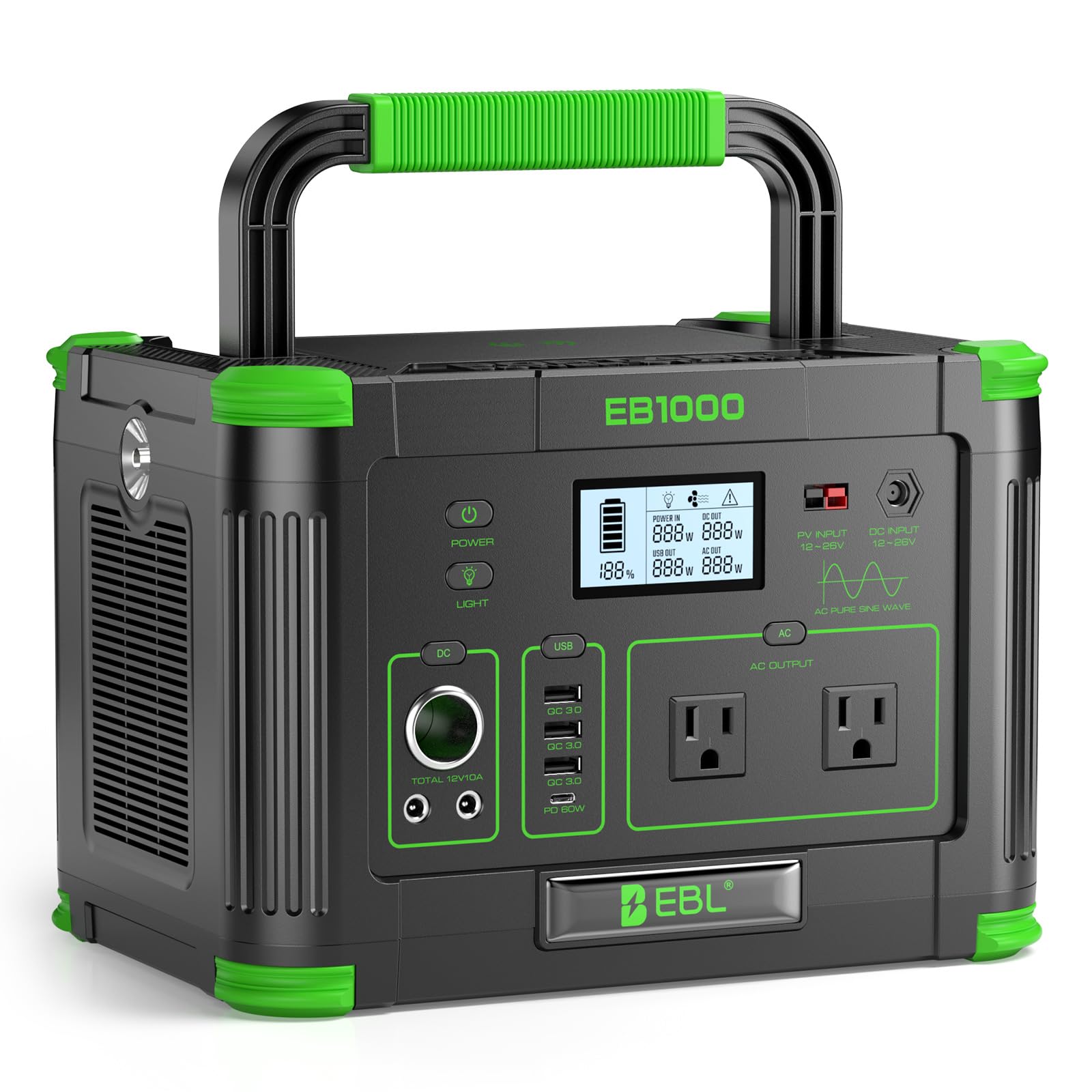
The appliance-friendly unit that runs a corded saw and drill without breaking a sweat
With 999Wh capacity and 1000W continuous output, this is one of the few budget-priced stations that truly bridges the gap between camping gear and home backup. It runs floodlights for 212 hours or a TV for 56 hours, and owners mention it powers corded saws and drills on job sites.
The 21 lb weight with a folding handle makes it easy to move from trunk to campsite. It offers a 60W PD USB-C port, multiple USB-A QC3.0 ports, and a 10W wireless charger on top. The built-in BMS prevents overcharging, overheating, and short circuits, with an automatic cooling fan and LD screen that sleeps after 20 seconds to save energy.
The pure sine wave output keeps sensitive electronics safe, and pass-through charging lets you power devices while the unit itself recharges — convenient in an RV. Charging is slower than the premium picks: AC takes 7-8 hours fully, and car charging 9-11 hours. Solar input accepts 12-26V at 8A max. The honest take from the data: while power quality is praised, the battery life gets mixed feedback, with one owner noting actual runtime fell short of claims.
Real-world power
- 1000W output runs tools, small appliances, and electronics
- 999Wh capacity covers a TV for 56 hours
- 10W wireless charging pad on top is a handy extra
Honest limits
- Slow recharge — 7-8 hours from wall AC, 9-11 from car
- Some customers note runtime below spec
Pick this for: emergency home backup, vendor booths, and campsites where you need real appliance-level power without paying flagship prices.
Look elsewhere if: fast solar recharging is critical — this unit’s charge times test patience.
8. DaranEner NEO 350W
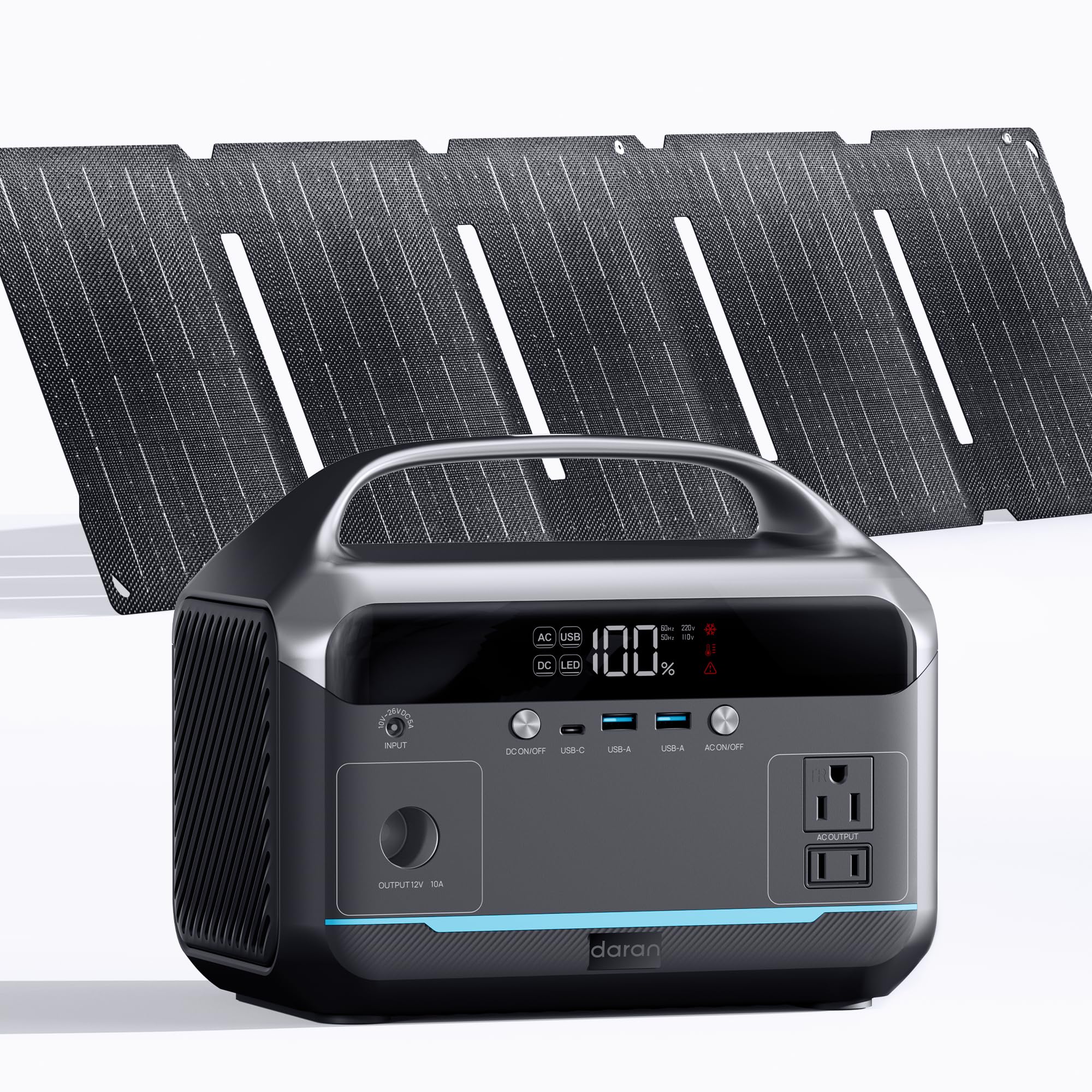
The LiFePO4 balance that runs a CPAP for up to 31 hours on a single charge
This is the CPAP owner’s best friend. Reviewers point out a CPAP test via AC adapter delivered 7-31 hours of runtime depending on breath cycle (without humidifier or heated tube), making it a confident choice for hurricane season. The 288Wh capacity and 350W pure sine wave AC output (600W surge) handle laptops, drones, and mini fridges safely.
The battery chemistry is the big differentiator here: premium LiFePO4 (lithium iron phosphate, a safer, longer-lasting chemistry) cells deliver 4× longer lifespan than standard lithium-ion. It weighs 8.2 lbs, which is 3.2 lbs heavier than the Apowking but still light enough for backpacks and RV storage. The charging speed is among the most-praised aspects — 48 owners single it out — and durability gets strong mentions too.
You get 6 output ports: 2 AC (350W), 1 USB-C PD 60W, 2 QC 18W USB-A, and 1 12V/120W car port. Three recharge methods (solar with MPPT, AC up to 90W, car up to 100W) mean you’re never stuck. The built-in LED light has 4 modes for nighttime emergencies. One owner’s honest note: the power gauge isn’t perfectly accurate, and a unit can arrive fully discharged — the fix is to exercise the battery (charge to 100%, drain to 20%, repeat) before trusting it.
The overnight champion: If CPAP reliability is your #1 priority, this is the budget pick that delivers verifiable all-night runtime with a battery chemistry built to last.
Best for: CPAP users, hurricane-preppers, and RV owners who want a durable LiFePO4 station at a sensible price.
Caution: a freshly shipped unit may need a couple of charge-drain cycles to reach its rated performance.
9. Anker SOLIX C200 DC

The Starlink-slayer that fits in a grocery bag and recharges fast in full sun
This is the unit for the modern digital nomad. The Anker SOLIX C200 delivers 192Wh and 200W DC output with a 140W two-way USB-C port — and shoppers say it runs a Starlink Mini for 5 hours via the OEM DC-to-USB-C cable, which is remarkable for a unit this small. The 1.9 kg (4.2 lb) weight makes it the lightest premium pick here, 39% smaller than similar power stations.
The 60W solar panel in the box recharges the unit to full in a day of good sun — owners note it “charges lickety split” in full sun, with slower but steady gains in clouds. You get 5 charging ports total: 1 USB-C at 100W, 1 USB-C at 140W, 1 USB-C at 15W, and 2 USB-A at 12W each, which covers phones, tablets, cameras, drones, and gaming consoles.
The thing everyone raves about is the charge speed and reliability — it’s one of the few units that can charge 5 devices while solar-charging itself, reaching full by nightfall. The LiFePO4 battery is backed by a 3-year warranty. A US Army owner who used it daily said it never ran out of power even with 2-3 hours of solar charging per day. The honest catch: this is a DC-only unit (no AC outlet), so it can’t run appliances — it’s built for charging, not powering.
The freedom factor
- 140W two-way USB-C fast charging is the best in this weight class
- Runs Starlink Mini 5 hours on one charge
- 39% smaller than similar power stations
Know the limits
- No AC outlet — charging devices only, not appliances
- Only works with specific Anker panels, not generic solar
Perfect for: remote workers, Starlink users, and minimalists who need a featherweight charging hub that vanishes into a backpack.
Pass if: you need to run a CPAP, mini-fridge, or any AC-powered device — this is a charger, not an appliance power source.
Understanding the Specs
Watt-Hours (Wh) — Total Energy Storage
This is the “size of the gas tank.” A 220Wh unit holds enough energy for roughly 15 phone charges, while a 999Wh unit can run a TV for 56 hours. For CPAP use, a 220-288Wh unit typically covers one to two nights. For appliance power, aim for 500Wh or more.
Pure Sine Wave AC Output
This describes the shape of the electricity the inverter produces. Pure sine wave means the power is as clean as what comes from your wall outlet, so sensitive electronics like laptops, CPAP machines, and projectors run safely. Cheaper “modified sine wave” inverters can damage these devices over time.
FAQ
How long will a 220Wh solar generator run a CPAP machine?
What is the difference between LiFePO4 and standard lithium-ion batteries?
Can I run a refrigerator on a budget solar generator?
How long does it take to recharge a solar generator from the included panel?
Will a solar generator run my laptop?
What does the UPS switch do and why does it matter?
Can I expand the battery capacity of these solar generators later?
What is pass-through charging and should I look for it?
Final Thoughts: The Verdict
For most buyers, the best budget solar generator is the Apowking HP200L because it delivers the lightest form factor, genuine CPAP-level power, and a complete solar kit at a price that’s tough to top. If you want a home-backup workhorse that can power real appliances, grab the BLUETTI Elite 30 V2 for its lightning-fast 45-minute recharge. And for the best panel-to-capacity ratio on a weekend budget, the GRECELL EB500 with its 100W solar panel is the one to reach for.
How We Picked
We do not accept paid placement. Every pick is matched to a real buyer and a real use-case; we do not hands-on test units.
Sources & Methodology
Specifications: manufacturer listings and product documentation. Review insights: verified customer reviews, as of August 2026. Pricing: not shown on this page (it changes often); check the current price via the retailer link.
As an Amazon Associate, FitlyFast earns from qualifying purchases. This does not affect which products we feature.