
Our readers keep the lights on and the weekend projects moving. As an Amazon Associate, I earn from qualifying purchases.
Specs are compiled from manufacturer listings and verified buyer reviews and can change over time — please confirm the key details on the product page before buying.
The biggest mistake with a budget mic is assuming “cheap” means your teammates will hear keyboard clacks and your dog barking. This guide finds budget mics that deliver clear, natural voice without the tin-can effect.
I’m Rikta — the founder and writer behind FitlyFast. This guide is built by comparing the manufacturers’ published specifications and the patterns across verified customer reviews, so you get each pick’s real strengths and trade-offs instead of marketing spin.
You’ll find the best budget computer microphone that suits your streaming, gaming, or work-from-home setup without wasting money on features you won’t use.
Our Picks at a Glance


How To Choose The Best Budget Computer Microphone
Before you add anything to your cart, you need to know that not all “noise-canceling” mics are created equal. The capsule and electronics determine whether your voice comes through clear or muffled.
The Pickup Pattern is Everything
Most budget mics use a cardioid pickup pattern, which means they capture sound best from the front and reject it from the sides and rear. This pattern rejects side and rear noise, so your keyboard clacks stay out of the mix. A supercardioid is even tighter, which the Razer Seiren V3 Mini uses to focus purely on you.
Audible Noise: The Spec Nobody Reads
The audible noise figure tells you how much hiss the mic itself adds. Lower numbers mean less hiss and cleaner recordings. The InnoGear sits at 20 db, the FIFINE at 16 db, and the FDUCE at 95 db — so a “budget” label doesn’t mean they all perform the same in a quiet room.
Mount and Stability Matter More Than You Think
A flimsy stand transmits desk vibrations into your audio, so a weighted base or shock mount is essential. Look for a weighted base or a built-in shock mount — like the HyperX SoloCast 2 has — so accidental knocks don’t ruin your recording mid-sentence.
Quick Comparison
| Model | Best For | Pickup Pattern | Audible Noise | Connection | Amazon |
|---|---|---|---|---|---|
| InnoGear Gaming Mic★ Best Overall | RGB gaming setups | Cardioid | 20 dB | USB-C | Amazon |
| FIFINE K669BBest Value | crisp vocals | Cardioid | 16 dB | USB-A/C | Amazon |
| TONOR TC30Top Performer | Longevity & build | Cardioid | 70 dB | USB-C | Amazon |
| ZealSound K66 | ASMR & iPhone use | Cardioid | 40 dB | USB-C/Lightning | Amazon |
| ZealSound A68S | Boom arm flexibility | Cardioid | — | USB-C/Lightning | Amazon |
| Razer Seiren V3 Mini | Compact desk space | Supercardioid | 20 dB | USB-A | Amazon |
| HyperX SoloCast 2 | Studio-quality on a budget | Cardioid | 79 dB | USB-C | Amazon |
| MAONO PD100U | Dynamic noise rejection | Cardioid Dynamic | 75 dB | USB-C | Amazon |
| FDUCE SL40+ | XLR future-proofing | Cardioid Dynamic | 95 dB | USB-C/XLR | Amazon |
In‑Depth Reviews
1. InnoGear Gaming Mic
The RGB-laden starter that makes your voice the star without emptying your wallet.
You get a full streaming setup in one box: a cardioid condenser capsule, a pop filter, a shock mount, and a mic stand. The built-in noise cancellation filters out fan hum and keyboard clatter so your callouts stay clear. It runs at 20 db of audible noise, which means the mic itself stays fairly quiet while you talk.
The controls are built for zero-fuss use: a touch-sensitive mute button on top and a large gain knob at the base for quick volume tweaks. Zero-latency monitoring keeps your voice in your ears instantly, and the 6.56ft (2m) USB cable gives you plenty of slack to route it around your desk. Compatibility covers Windows PCs, Macs, PS4, and PS5, though Xbox owners should look elsewhere.
The 4 RGB modes — solid color, multi-color gradient, breathing, and transitions — add the streamer aesthetic without needing extra software. Durability gets a mixed verdict from the crowd: some say it’s phenomenal, but a few note the stand loosens over time. One long-term user reports owning it for over 2 years with zero issues, and friends say it sounds good. The stand may wobble eventually, but for the price, the sound quality wins people over.
What Wins People Over
- Built-in noise cancellation keeps background clatter out of your stream.
- Touch mute and a large gain knob make on-the-fly adjustments easy.
- Zero-latency monitoring means you hear yourself without delay.
The Honest Trade-Offs
- The stand can loosen over time, which is annoying but not fatal.
- Not compatible with Xbox, so console players on that system are out of luck.
Reach for this if: you are new to streaming and want a complete, good-sounding kit with RGB flair.
Look elsewhere if: you need a rock-solid stand that never loosens after months of daily use.
2. FIFINE K669B
A metal-bodied workhorse that quietly outperforms mics costing twice as much.
This is the quietest mic in the lineup at just 16 db of audible noise — so clean that background chatter stays out of your recordings. The cardioid condenser focuses on your voice and reduces the noise around you, and the dedicated volume knob on the body gives you a louder-or-quieter adjustment without touching software. It even turns to zero to protect your privacy during a call.
The solid metal construction and sturdy tripod stand handle daily use for voice overs, livestreams, and Zoom meetings. It plugs straight into a USB-A port with the included 5.9-Foot cable, so there is no driver installation. Compatibility spans desktops, laptops, PS4, and PS5, but like most budget mics, it won’t work with Xbox or phones. If you use Zoom, you may need to disable the auto-adjust volume feature so your recording level stays put.
The crowd favorite here is the sound quality — loads of owners call it crisp and praise the build. Budget-conscious buyers report it beats a dynamic mic for pure value, and the volume knob gets consistent praise as the standout feature. The mid-range can sound a touch dull for some ears, with one owner describing a slightly “AM radio” tone that needs EQ. For gaming chat, meetings, and singing games, this is the one people keep recommending.
Why It’s a Crowd Pleaser
- crisp voice capture with a very low 16 db noise floor.
- Solid metal housing with a stable tripod stand.
- The volume knob is a standout feature for quick control.
Who Should Skip It
- The sound leans mid-bass heavy; you may want EQ software.
- No XLR output, so it is USB-only for recording.
Grab this if: you want the lowest background hiss possible at this tier for podcasts or voice overs.
Think twice if: you’re an audiophile who wants a brighter, more detailed high-end without tweaking EQ.
3. TONOR TC30
A 4-year livestream veteran that proves budget mics can go the distance.
If you want evidence of durability, consider this: one content creator ran 500+ livestreams and 1,800+ YouTube videos on this mic before it developed any issues. The TC30 keeps it simple — no RGB, no gimmicks, just a cardioid condenser, a concealed shock mount to kill desk vibrations, and a pop filter to tame plosives. The 400g weight and foldable tripod mean it sits steady without taking over your desk.
Setup is genuinely tool-free: attach the pop filter, plug in the USB Type-C cable, and go. It works with Windows, macOS, and Linux from the start, plus PS4 and iPad with an adapter. The USB 2.0 data port needs no extra driver. A 2200 ohm impedance and 48 KHz frequency response keep your voice natural for gaming, podcasting, and online meetings, though there is no gain knob.
The main recurring trade-off is room noise — it picks up fans and background sounds that need cleaning up in editing. The pop filter arm is a bit flimsy, so handle it gently. But the consensus is strong: owners say it looks and feels expensive despite the budget price, and the sound beats pricier peers like the Logitech Yeti Orb. For a beginner wanting a radio-quality voice in Audacity, this is a proven workhorse.
Built to Last: Years of heavy daily use with only minor issues is the standout story here.
The Catch: No gain control means you adjust volume in software, so a noisy room will need post-editing.
4. ZealSound K66 Pink

The pink mic that doubles as an ASMR studio in a box, ready for iPhone or PC.
This one is built for delicate audio. The wide 40Hz–18kHz frequency response captures soft whispers, tapping, and brushing with rich detail, and its sensitivity of –45dB ±3dB keeps micro-sounds clear without distortion. If you create ASMR, podcast, or do voice-overs, the K66’s cardioid pattern focuses on your voice and reduces the hum of fans and keyboard clicks.
The standout feature is a Noise Reduction Mode activated by holding the mute button — you get a blue indicator when it’s on. You also get dedicated knobs for gain, monitoring volume, and echo, so you can shape your sound live without opening software. A 3.5mm headphone jack gives zero-latency monitoring, and the one-touch mute shows a bright red LED so you never accidentally broadcast.
You can plug this mic into iPhones, iPads, PCs, Macs, and PS4/PS5 right away, thanks to the included USB-C and Lightning adapters. The 360° rotatable body and weighted metal base keep it stable during recording, so it won’t tip over mid-session. The 70.87-inch USB cable plus foam windscreen round out the kit. Reviewers call it a great starting point with crisp sound, though a few report it stops working after a few months and some find iPhone compatibility inconsistent.
Creator’s Toolkit: Echo knob, gain knob, and monitoring volume all on the body — built for hands-on sound shaping.
Know the Risk: Some units reportedly fail after a few months, and iPhone compatibility is not guaranteed for every user.
5. ZealSound A68S

A studio-style arm and tripod combo that flexes from TikTok to Twitch.
This is the most flexible mounting setup in the lineup. The scissor boom arm extends up to 30.8 in, rotates 360°, and clamps to desks up to 1.8 in thick, while the foldable tripod lets you switch to quick tabletop recording. The 96 kHz sampling rate keeps your voice detailed, and the built-in noise reduction chip plus detachable pop filter clean up plosives and background hum.
The bottom-mounted gain knob stays out of the way but is easy to reach, reducing accidental bumps. The one-touch mute shows a large red indicator so you always know your status on camera. A 3.5mm headphone jack provides zero-latency monitoring to check your levels mid-stream. RGB lighting with multiple solid colors and gradients matches your setup, and a long-press turns it off for distraction-free recording.
This bundle covers all bases: mic, boom arm, desk clamp, tripod, shock mount, pop filter, 78.7 in USB cable, and both Lightning and USB-C adapters for phones. Buyers rave about the crisp voice quality and flawless Discord compatibility, with one calling it a “standout.” The recurring concern is durability — several owners mention breakage within weeks, so treat the mechanical parts gently.
The Flexibility Win
- Boom arm extends 30.8 in and clamps to desks up to 1.8 in thick.
- 96 kHz sampling delivers crisp, detailed speech.
- Adapts to iPhone, Android, PC, Mac, and PS4/PS5 with included adapters.
Handle With Care
- Some customers note breakdowns within weeks, so durability is a gamble.
- The foam pop filter looks out of place on camera for some users.
Pick this if: you want one mic that mounts on an arm for streaming and a tripod for travel.
skip it if: you need a tank-like build you can toss in a bag without worry.
6. Razer Seiren V3 Mini

The ultra-compact titan that hides on your desk but never hides your voice.
Space is precious on a gaming desk, and this mic respects that. At 8.32 ounces and only 6.38 inches tall, the Seiren V3 Mini tucks neatly beside your keyboard. The supercardioid pickup pattern is tighter than standard cardioid, so it locks onto your voice and suppresses room noise like typing and mouse clicks better than most budget rivals. It runs at 20 db of audible noise, keeping the hiss low.
The signature feature is a tap-to-mute sensor on top. A quick tap silences you instantly, and an LED indicator tells you at a glance whether you’re live. The tiltable stand includes a built-in shock absorber, and it detaches entirely if you want to mount it on a boom arm. Plug-and-play USB works with Discord, OBS Studio, and XSplit with no drivers required.
Razer Synapse opens up advanced customization like studio-level sample rates and separate playback and audience volume mixes. The loudest praise goes to build quality, sound clarity, and the convenience of the mute — it’s described as a “10/10” for work calls. The trade-off is that background noise dampening is a bit weak from the start, though software settings can fix it. The original list price draws some grumbles, but it’s a premium-feeling mini at a reasonable cost.
The Mute is Magic: Tap-to-mute with a clear LED is the feature work-call warriors rave about.
Sound Caveat: Background dampening is mild until you tweak software settings.
7. HyperX SoloCast 2
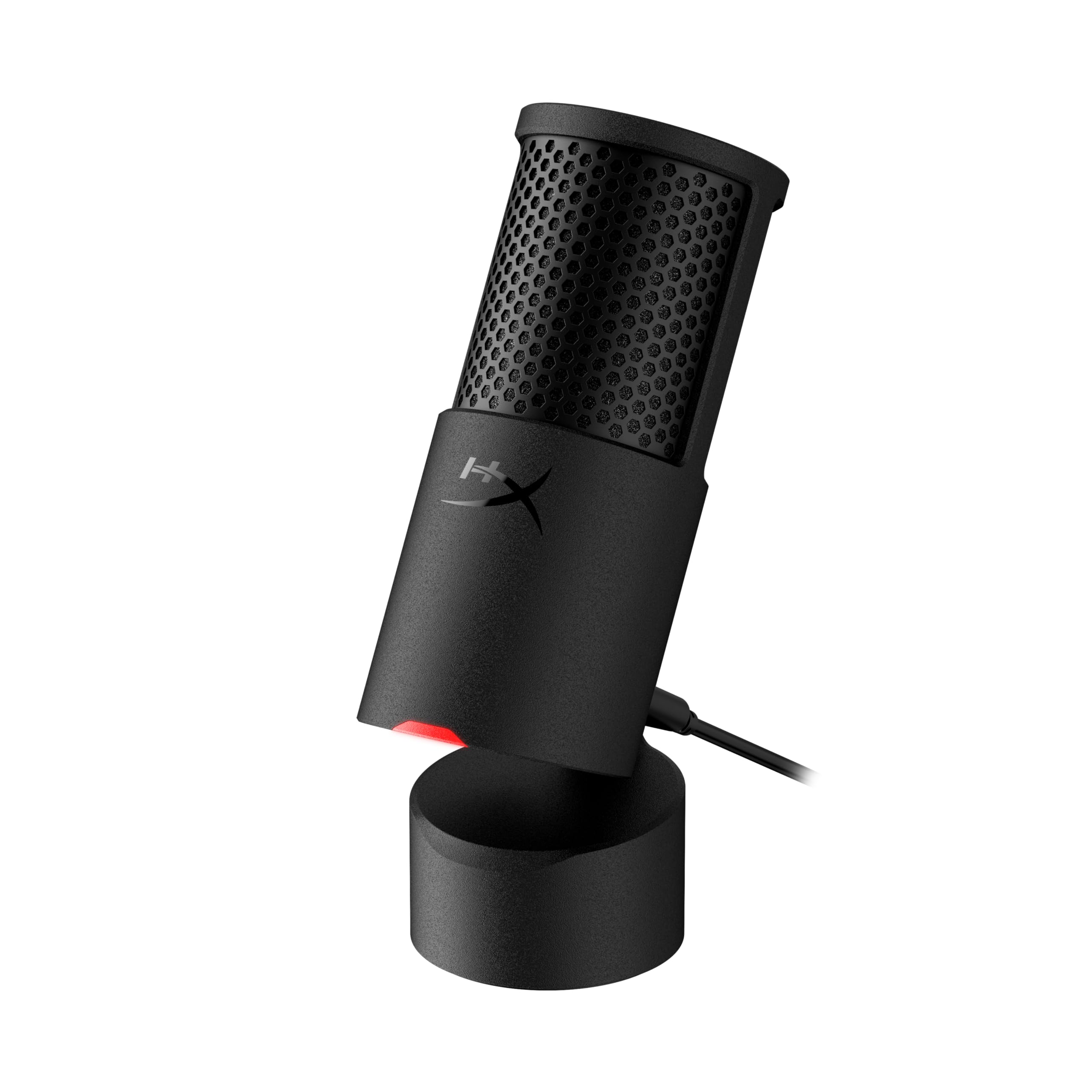
Bundles a pop filter and shock mount inside a body that barely takes up desk space.
This is the “everything built-in” mic. The SoloCast 2 packages a foam pop filter, a tiltable stand, and a suspension system that absorbs vibrations — so you get shock mount benefits without extra parts. The 24-bit/96kHz sampling rate delivers crisp, detailed audio with no setup required. The cardioid polar pattern pulls your voice from the front while ignoring the sides and rear.
The weighted base keeps it stable on a busy desk, and built-in 3/8″ and 5/8″ threads let you attach it to standard mic arms easily. Tap-to-mute works with a red LED when live and off when muted. Plug-and-play USB-C to USB-A connection means you’re recording in seconds. The only minor complaint is the USB-C port can feel slightly insecure, so securing the cable to a boom arm is a smart idea.
Customizable audio filters via HyperX NGENUITY — high-pass, low-pass, and voice enhancement — let you reduce rumble and boost clarity, with settings saved directly to the mic. Reviewers describe the audio as “crisp every time” and note it picks up voice clearly from 25-30 ft away. The trade-off is sensitivity: it catches background noise even with suppression, so a quiet room helps. For a compact all-in-one that rivals pricier mics, this is a top pick.
What Makes It Studio-Grade
- 24-bit/96kHz sampling captures detailed, natural audio.
- Built-in pop filter and shock mount need no extras.
- Audio filters customizable and saved to the mic via NGENUITY.
Watch Out For
- Very sensitive to background noise despite the suppression.
- The USB-C port can feel a bit loose; secure the cable.
Choose this for: pro-level voice clarity in a compact body without buying extra accessories.
Pass if: you record in a noisy room and need aggressive noise cancellation.
8. MAONO PD100U

The dynamic capsule that shrugs off room noise better than any condenser here.
Most budget mics are condensers, but this one is a dynamic microphone — and that makes a real difference. Dynamic mics are naturally less sensitive to ambient noise, so the PD100U picks up your voice from the top (best range 2″-4″) while strongly rejecting sounds from the sides and back. The 192kHz/24bit sampling rate delivers high-resolution audio, and the flat frequency response of 60Hz-14kHz reproduces pure, clear vocals with a strong mid-frequency curve.
The dual-layer noise reduction uses woven nets plus anti-spray sponges to reduce airflow impact. A convenient gain knob lets you dial down sensitivity in a noisy room or crank it up to make your voice more present. The metal construction and thick base with non-slip rubber feet keep it stable. The 2.36″ height adapter extends the mic, and 3/8″ and 5/8″ threads fit standard arm stands. The recording angle adjusts up and down 180°.
Buyers call it a “phenomenal microphone considering price and quality,” with excellent off-axis rejection and a richer tone than some — one owner compared its accuracy favorably against a Shure SM7B while noting a brighter signature. The consensus is that EQ open up its full potential. The bundled boom arm, 6.56ft XLR cable, and pop filter make this a complete starter kit for podcasters and streamers.
Noise Rejection King: The dynamic capsule naturally resists background noise better than condenser rivals.
EQ Helps: Some owners say a little equalization makes the sound shine even more.
9. FDUCE SL40+

The rare budget mic that lets you grow from USB to a full XLR studio setup later.
Here’s the future-proofing angle: the SL40+ offers both USB and XLR outputs, so you can plug it straight into your PC today or into a professional audio interface tomorrow. The dynamic capsule supports up to 96KHz/24bit and uses digital audio processing for equalization and mute functions, minimizing background noise. The cardioid pickup keeps your vocals pure for podcasting, streaming, and gaming.
The minimalist controls let you mute with one key, and in USB mode a long press switches the control between headset volume and microphone gain. The all-metal construction comes with a boom stand that adjusts angle and height smoothly, plus a table mount clamp and cable ties to keep your desk tidy. It’s plug-and-play over USB or via XLR without needing an external preamp for basic gain.
Reviewers call it a “solid, entry level microphone for online chatting and gaming,” with one happy podcast host praising the professional sound quality for the price. A few note a “POP” sound when saying words with the letter P, suggesting the built-in filtering could be better. Some recommend a preamp or software gain since the dynamic output is lower. Getting both USB simplicity and a path to XLR is a rare combo.
The Dual Connection: USB for today, XLR for when you upgrade your interface.
Minor Pop Issue: Plosives on P-words may need extra filtering to tame.
Understanding the Specs
Pickup Pattern
This tells you which direction the mic hears. Cardioid captures from the front and rejects the sides and rear, which is ideal for a solo user at a desk. Supercardioid narrows that focus even further. Dynamic microphones like the MAONO and FDUCE are naturally less sensitive to background noise than condensers, which is why they’re great for noisy rooms.
Audible Noise
This is the hiss the mic itself generates in a silent room. Lower numbers mean cleaner audio: the FIFINE at 16 db and the InnoGear and Razer at 20 db are notably quieter than the TONOR at 70 db or the FDUCE at 95 db. If you record in a quiet space, a lower figure keeps your voice crisp without extra hiss.
Gain Knob
A physical volume control on the mic body. It lets you boost a soft voice or reduce sensitivity in a loud room without opening software. Mics without one, like the TONOR, require you to adjust volume in your operating system or recording app instead.
Shock Mount
A suspension system that absorbs vibrations from desk bumps, typing, and mouse clicks. The TONOR and HyperX SoloCast 2 build this in, while the InnoGear includes it in the box. It keeps accidental knocks from rumbling through your recording.
FAQ
Will a budget USB mic work with my PS5 or Xbox?
Can I use these mics with an iPhone or tablet?
What is the difference between a condenser and a dynamic microphone?
Is a lower audible noise number always better?
Do I need a pop filter with these microphones?
How long do budget USB microphones typically last?
Do these microphones need special drivers or software?
What does the gain knob actually do?
Final Thoughts: The Verdict
Across the board, the budget computer microphone winner is the InnoGear Gaming Mic because it bundles noise cancellation, RGB, and a full kit at a price that’s tough to top. If you want the lowest background hiss for podcasting, grab the FIFINE K669B at just 16 db. And if you need a compact mic that disappears on your desk, the Razer Seiren V3 Mini is the one to reach for.
How We Picked
We do not accept paid placement. Every pick is matched to a real buyer and a real use-case; we do not hands-on test units.
Sources & Methodology
Specifications: manufacturer listings and product documentation. Review insights: verified customer reviews, as of August 2026. Pricing: not shown on this page (it changes often); check the current price via the retailer link.
As an Amazon Associate, FitlyFast earns from qualifying purchases. This does not affect which products we feature.