
Our readers keep the lights on and the weekend projects moving. As an Amazon Associate, I earn from qualifying purchases.
Specs are compiled from manufacturer listings and verified buyer reviews and can change over time — please confirm the key details on the product page before buying.
Behind every clean podcast track and every quiet studio take sits one humble part that gets ignored until it fails: the XLR cable. It is the wire that carries your microphone’s signal to your interface or mixer, and when it is built poorly, you hear it as buzzing, hissing, or hum. The good news is that the eight cables here are the ones worth considering, and this guide sorts them by real-world use so you know exactly which to pick for your desk, your stage, or your travel bag.
I’m Rikta — the founder and writer behind FitlyFast. This guide is built by comparing the manufacturers’ published specifications and the patterns across verified customer reviews, so you get each pick’s real strengths and trade-offs instead of marketing spin.
if you need a long run for a live stage or a flexible cable for a small home recording space, the right cable for xlr keeps your audio clean and your setup dependable. Every pick here earns its place on sound quality and build.
Our Picks at a Glance


How To Choose The Best Cable For XLR
An XLR cable connects your microphone to your mixer, interface, or speaker using three pins inside a locking connector. The locking tab is why XLR cables don’t accidentally unplug mid-recording, and the balanced three-pin design is why they can run long distances without picking up hum. When you shop for one, a few specific details decide whether it serves you for years or frustrates you in weeks.
Length: Match It to Your Space
Think about where your microphone sits and where your mixer or interface lives. A short 5-foot cable keeps things tidy on a small desk, while a 25-foot run lets you roam a stage or route around a full studio. The trade-off is simple: extra length gives you freedom but also more cable to manage on a cluttered desktop, so buy the shortest length that comfortably fits your setup.
Build Quality: Jacket, Shielding, and Connectors
Three physical parts decide how long a cable lasts and how clean it sounds. The outer jacket is the sleeve you touch, with braided nylon feeling premium and tough PVC being easier to wipe clean. The shielding inside blocks electromagnetic interference from power cables and other gear, so look for copper braided shielding or a double-layer shield for noise rejection. Finally, the connectors themselves need strain relief — the reinforced section where the cable meets the plug that stops it from breaking when you yank or step on it, with metal housing and grip treads being the more durable choice.
Conductor Material and Gauge
Inside the cable, the metal that carries your signal matters for long runs. Oxygen-free copper conducts cleanly and resists the oxidation that can degrade audio over time, and it is the standard serious buyers look for. The gauge, or thickness, of the conductors also plays a role — a 20 AWG wire is thicker and more sturdy, which can matter for long stage cables, while thinner wire stays more flexible for a desk setup.
Quick Comparison
| Model | Best For | Length | Pack Size | Key Feature | Amazon |
|---|---|---|---|---|---|
| Elgato XLR Cable★ Best Overall | Desk setups that need flexibility | 10 ft | 1 | Nylon braided jacket | Amazon |
| Hosa HMIC-005Best Value | Budget-minded reliability | 5 ft | 1 | REAN connectors | Amazon |
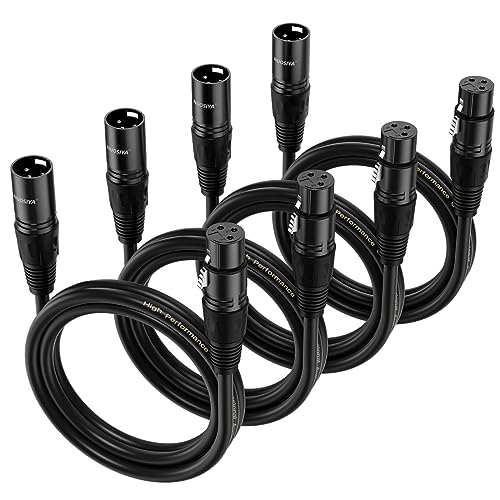
| NUOSIYA 4-PackMulti-Rig Pick | Multi-rig setup value | 6 ft | 4 | PVC braided jacket | Amazon |
| FIFINE L9 | Long desk reach | 9.8 ft | 1 | Tangle-resistant design | Amazon |
| Pig Hog 2-Pack | Stage performance | 25 ft | 2 | Kink-free finish | Amazon |
| AQOOL 4-Pack | Color-coded stage organization | 25 ft | 4 | Dual-layer shielding | Amazon |
| RØDE XLR-3 | Studio-grade signal purity | 10 ft | 1 | Canare cabling | Amazon |
| GEARit 6-Pack | Full-rig outfitting | 20 ft | 6 | 22AWG OFC conductors | Amazon |
In‑Depth Reviews
1. Elgato XLR Cable, Shielded Microphone Cable, 10ft
Our pick — over 4.5★ from 950+ verified ratings; the strongest balance of quality and price.
The desk cable that feels premium in your hands and stays flexible enough to rearrange your whole setup.
Your recordings stay hum-free because this cable targets electromagnetic noise interference (EMI, the buzzing from nearby power lines) with tune shielding. The rugged nylon braided jacket you touch every day is sturdy without being stiff, so routing it around your desk never becomes a fight. The gold-plated pins on the male-to-female connectors resist corrosion over time, which keeps the connection solid as the cable ages.
The 10-foot length gives enough slack to reposition a mic arm or interface without re-cabling, and owners call it a quality braided cable that looks sleek on a desk. The plug-and-play design means no software, no drivers, just connect any XLR microphone and go. Cross-shop this against the FIFINE L9 at 9.8 feet and you are looking at nearly the same reach — a gap of just 0.2 feet — so the choice depends on brand and finish.
Elgato’s braided outer layer gives it the edge in everyday feel, and buyer enthusiasm shows in the crowd favorite rating of 4.8 stars across 900+ owners. If you want one cable that looks as good as it sounds, this is the one. It suits a home studio desk; skip it if you need several cables at once — a multi-pack will stretch your budget further.
What wins people over
- Braided nylon jacket is tough yet flexible for daily desk use
- Gold-plated pins keep the signal clean as the cable ages
- 10-foot length gives solid reach for most mic arm setups
What to weigh
- One single cable means no spare if you run multiple mics
- Premium branding comes with a higher per-cable cost
Reach for this if: you want a premium-feeling desk cable that looks sleek and stays flexible in a home studio.
Look elsewhere if: you need several cables at once — you will get more value from a multi-pack.
2. Hosa HMIC-005 Pro Microphone Cable, REAN XLR3F to XLR3M, 5 Feet
A road-ready workhorse that keeps delivering clean signal long after cheaper cables have given up.
Your signal stays sturdy for years because this cable pairs REAN XLR connectors (the professional-grade plug brand that locks in securely) with a 20 AWG wire inside — thicker than many budget cables. Touring musicians and studio engineers rely on it because it simply gets the job done without drawing attention to itself. Buyers report a well-made cable that lasts for years — one owner’s unit survived six years of use and still works like new.
What stands out in the review data is how consistently owners describe clean, transparent audio with no added noise. Owners consistently praise its quality and reliability, noting clean sound without distortion or noise even after years of use. At 5 feet it is the shortest pick here, which makes it perfect for a tidy desk where your interface sits right next to the mic — but it is also short enough to feel limiting in a larger room, so consider your layout before choosing.
Compared to the Elgato’s 10-foot reach, the Hosa gives you half the length at a lower cost, which is the right trade for a compact, no-fuss setup. The connector quality is a genuine highlight, with buyers noting high-quality plugs that lock in confidently. If you want rock-solid reliability for a small space without spending for extra length you will not use, this is the smart pick; it simply won’t serve you in a big room.
Why it earns its spot
- REAN connectors are built for heavy stage use
- 20 AWG gauge supports a clean, sturdy signal
- Proven to last many years in real-world use
Keep in mind
- 5-foot length is best for compact, close setups only
- No braided jacket for extra surface protection
Grab it if: your interface sits within arm’s reach and you want a proven, durable cable without the premium price.
Pass if: you need the freedom of a longer run — the 5-foot reach will box you in.
3. XLR Cable 6 Ft 4 Packs, Premium Balanced Microphone Cable
Four solid cables for less than you would pay for two elsewhere — a value play for anyone wiring multiple inputs.
If you are setting up a small home studio with several microphones, or you run a podcast desk with two hosts, this pack solves the “I need more than one cable” problem in one order. Each cable uses oxygen-free copper conductors (a purer form of copper that resists corrosion and carries the signal cleanly) wrapped in polyethylene insulation, with a copper braided shield to cancel hum and improve high-frequency response. The soft PVC jacket is easy to wipe clean and tougher than standard mic cables.
What makes this pack genuinely versatile is that the same cable works for both audio and DMX data — meaning you can use it for a microphone or for stage lighting control without buying a second set. The double spring-style strain relief (the reinforced zone at each plug) stops the cable from pulling out of the connector when stretched, while the heavy-duty metal housing with grip treads keeps connections secure. Owners note the soldering is well done and the XLR ends are good quality, which speaks to the build care at this price.
Each cable runs 6 feet, which is 63% shorter than the FIFINE L9’s 9.8-foot reach, so this pack suits setups where your gear stays close together. That is part of why buyers mention the length is perfect for looping several cables together across a compact board. Compared to buying single premium cables, this pack delivers four reliable lines for about the same money as one or two, making it the practical choice when you need volume over a single flagship wire — but a large room will leave you short.
Why it stands out
- Four cables outfit a multi-mic setup in one purchase
- Works for both XLR audio and DMX lighting signals
- Copper braided shielding cuts hum and noise
Consider this
- 6-foot length limits reach for larger rooms
- Less premium feel than a single high-end braided cable
Best for: podcasters and home studios wiring several inputs at once and wanting four solid cables in one box.
Think twice if: you need the flexibility of a 9- or 25-foot run for a big space.
4. FIFINE L9 XLR Microphone Audio Cable for Podcast Recording

The extra-long desk cable that lets you stretch your recording setup without tripping over tight routing.
For podcasters who like their mixer or interface on the far side of the desk, the FIFINE L9 solves the constant “cable too short” frustration with a 9.8-foot reach. That extra run, 63% longer than the NUOSIYA pack’s 6-foot cables, gives you the freedom to position your mic arm where you want it and still reach your gear without an awkward tug. The flexible, tangle-resistant design keeps the cable from knotting up when you pack it away, which owners describe as easy to latch and detach.
The build targets exactly what a podcaster worries about: a secure connection that does not introduce noise. Sturdy connectors and reliable shielding minimize signal loss and unwanted interference, and the balanced 3-pin design means clean, clear sound reproduction when you hit record. Owners note the cable feels solid with premium materials and sounds great even before fine-tuning mixer settings, proving it is not the weak link in the chain.
The L9 is also a strong choice for mic-to-camera setups, since 9.8 feet lets you separate the camera from your recording subject without crowding the shot. Where it falls short of the Elgato is the outer jacket — the FIFINE uses a more standard finish rather than a braided sleeve, so it does not feel as premium when you handle it. But for the reach alone, it is a standout value for anyone whose desk layout demands a longer run; the Elgato wins on texture if that matters more to you.
The highlights
- 9.8-foot reach handles larger desk layouts easily
- Tangle-resistant design coils and uncoils cleanly
- Secure shielding keeps the signal free of noise
The trade-offs
- Standard jacket lacks a premium braided finish
- Single cable purchase means no built-in backup
Choose it when: your interface sits far from your mic and you want 9.8 feet of flexible, clean-sounding reach.
pass on it if: you want the tactile premium feel of a braided nylon sleeve — the Elgato wears that crown.
5. Pig Hog XLR 25 Foot 2 Pack Tour Grade Microphone Cables

The touring staple that rolls up clean, lays flat, and delivers quiet signal night after night.
When a working musician needs a cable that never becomes the problem, this 25-foot 2-pack is the answer. Its defining quality is the silicone-like finish on the jacket, which owners consistently describe as kink-free and easy to roll up after a show — the kind of detail that matters when you are tearing down a rig at 1 a.m. The thick construction helps prevent the cable from kinking or knotting, and the XLR male-to-female connectors are built to take repeated plugging and unplugging.
At 25 feet, this cable is built for movement. The length lets a vocalist roam the stage or a guitarist reach a distant amp without signal loss, and owners mention clean sound with no hissing or crackling even mid-performance. Buyers call it the best cable bargain in the business, with one professional musician of 40 years switching their entire rig over after the first purchase.
The build quality justifies the “tour grade” label, with owners praising its durability and value for money. Compared to the AQOOL 4-pack’s 25-foot cables, the Pig Hog gives you two instead of four, so you pay more per cable — but the silicone-like finish is the differentiator for anyone who has fought a stiff cable on a dark stage. If you need reach, durability, and easy packing in one package, this is the pair to beat; a static desk setup will not use all that mobility.
What makes it shine
- Silicone-like jacket stays kink-free and coils easily
- 25-foot length gives real stage mobility
- Thick construction survives road abuse
What to know
- Two cables per pack, not four — plan your count
- Longer run means more cable to manage on a small stage
Reach for these if: you perform live and want a durable, kink-free 25-foot cable that packs down fast.
Look past them if: you are wiring a static desk — the long run buys mobility you will not use.
6. XLR Cables 25ft 4 Pack, Balanced XLR Male to Female Microphone Cable

Four different connector colors turn cable chaos into instant identification on a busy stage or studio floor.
Anyone who has ever stared at a tangle of identical black cables mid-setup knows the pain this pack solves. Each of the four 25-foot cables comes with a different colored connector, so you know exactly which line runs to which mic without tracing a single wire. The included Velcro ties keep each cable coiled and tidy between uses, and owners find the color coding genuinely helpful for organizing a stage or studio.
Under the hood, this pack is built for clean sound over long distances. The high-purity oxygen-free copper conductors carry your signal without degradation, while the dual-layer shielding — a high-density braided copper shield plus a foil shield — rejects both EMI and RFI (the electromagnetic and radio interference that cause hum and buzz). Customers note clear voice transmission with no feedback, and the hand-feel stands out: one owner calls the cable supple and pliable, noting it is flexible yet thick enough to survive being stepped on.
At 4 pounds for the set and 25 feet per cable, this pack is the serious alternative to the Pig Hog’s 2-pack — you get double the cables for your stage or studio at a comparable cost per line. Buyers consistently praise the sound and build, calling it a pro-grade cable and connector setup even before factoring in the price. The main consideration is the weight when you carry all four, but for a fixed install or studio rack, that is a non-issue — just know your bag will feel heavier.
Why it wins favor
- Color-coded connectors make channel identification instant
- Dual-layer shielding blocks EMI and RFI effectively
- Flexible yet tough jacket stands up to foot traffic
Weigh this
- 4-pound set is heavy to carry as a full loadout
- Multicolored connectors may not suit a strict aesthetic
Pick this if: you manage multiple long mic runs and want color-coded cables to keep channels straight.
Settle for the 2-pack if: you only need two cables and want to carry less weight.
7. RØDE XLR-3 Premium XLR Cable (3m, Black)

The studio purist’s choice — premium internals from Canare and Neutrik deliver ultra-low noise every take.
When your recordings live or die by signal purity, this is the cable that serious engineers reach for. It pairs Canare cabling (a brand known for high-quality pro audio wire) with Neutrik connectors (the industry-standard plug used across professional gear) to deliver extremely low noise for ultra-clear signal transfer. At 10 feet 3 meters, it matches the Elgato’s reach, but the internal pedigree is what separates it for critical listening.
Owners consistently describe the build as solid, thick, and professional, with snug connectors and a flexible, no-tangle design that makes setup easy. The sound is praised as crisp with zero interference, and reviewers point out it outperforms the generic cable it replaced. It also comes with strain relief sleeves at both ends, the reinforced sections that absorb bending force so the wire inside does not fatigue and break after years of use.
among the most pleasant surprises in the review data is the color selection — the cable is available in orange, purple, green, blue, red, pink, and black — and buyers love being able to color-match their setup. Owners lead with praise for quality and color, calling it the most functional XLR cable on the market and advising “buy once” instead of re-buying cheaper alternatives. The RØDE badge carries a premium cost per single cable, but for the internals and the finish, that is the price of admission for a serious signal chain — a multi-pack will serve you better on a tight budget.
What justifies the price
- Canare cabling and Neutrik connectors are pro-grade staples
- Extremely low noise keeps recordings hiss-free
- Seven color options match any studio aesthetic
What to weigh
- Premium cost per single cable is the highest here
- 10-foot length is standard, not long-run territory
Buy it if: you demand ultra-low noise and premium internals for critical studio recordings.
Choose a multipack if: you need several cables on a budget — the RØDE premium is per single cable.
8. GEARit 22AWG OFC XLR Cables 20 FT 6-Pack Male to Female
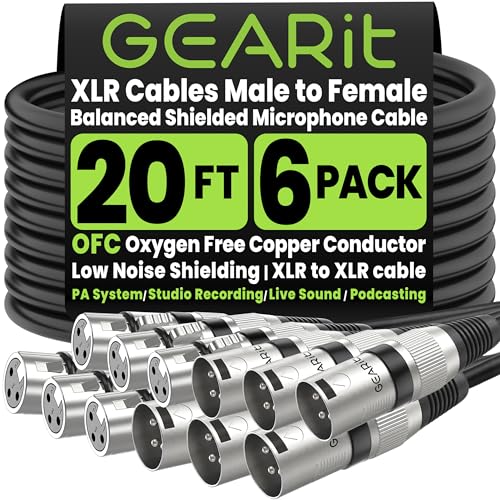
Six 20-foot cables ready in one rigid box — the full-rig outfitter for churches, venues, and multi-input studios.
When you are outfitting an entire stage, a church sound booth, or a multi-input home studio, this 6-pack is the most efficient way to get there. Six 20-foot cables arrive in a rigid box ready to deploy, and each one uses 22AWG oxygen-free copper conductors — a solid gauge for balanced audio that carries the signal cleanly over longer distances. The balanced shielding with EMI/RFI protection keeps static and interference out when you connect microphones to mixers, preamps, or patch bays.
The metal connector housings are built for repeated plug-and-unplug cycles, and owners confirm the cables clip firmly to mics and boards. Buyers use them for everything from on-the-go church events to full studio setups, and the recurring verdict is a sturdy, well-made cable that delivers reliable performance. The versatility is a genuine strength — these work for microphones, mixers, powered speakers, and any gear with a standard 3-pin XLR connection.
A small but honest note: some buyers found the connectors do not lock into every microphone, specifically citing Sennheiser e604 models, while they worked fine with an AUDIX D6 and SM57. That makes this pack a better fit for standard dynamic mics than for specialty clip-on drum mics. For the sheer volume of cable per dollar, though, it is hard to argue with six 20-foot lines — the best value-per-foot in this entire lineup for anyone wiring a full space, as long as your mics use standard recesses.
Why it leads on volume
- Six 20-foot cables outfit a full stage or studio at once
- 22AWG OFC conductors carry clean signal over long runs
- Metal housings survive repeated plugging cycles
Check compatibility
- Connectors may not lock into every mic, like some Sennheiser e604s
- Six long cables create significant bulk to store
Best for: venues, churches, and studios that need many long cables at the best per-foot value.
Test before you commit if: you rely on specific clip-on mics with unusual connector recesses.
Understanding the Specs
Balanced 3-Pin Design
The XLR connector uses three pins to carry your audio as a balanced signal. Two pins carry the same audio in opposite phases, and a third carries the ground. When the signal reaches your mixer, the two phases cancel out any noise picked up along the cable run — this is why XLR cables can stretch 25 feet or more without the hum you would hear in an unbalanced cable. For any serious mic setup, balanced is the standard you want.
Shielding and Materials
The shield is the conductive layer inside the cable that blocks interference from power lines, phones, and other electronics. Budget cables often use a simple foil wrap, while better cables add a braided copper layer or a dual-layer design for stronger noise rejection. The conductor metal matters too — oxygen-free copper (OFC) resists the oxidation that can dull your signal over time, which is why you see it listed on the better cables in this guide.
FAQ
What is the difference between a balanced and unbalanced XLR cable?
How long should my XLR cable be?
Do expensive XLR cables actually sound better than cheap ones?
Can I use an XLR cable for DMX stage lighting?
Why do XLR connectors have a locking mechanism?
What is oxygen-free copper and why does it matter in XLR cables?
How long should an XLR cable last before I need to replace it?
Is a thicker cable gauge always better for XLR?
Will any XLR cable work with any microphone?
Can I connect a long XLR cable without losing audio quality?
Final Thoughts: The Verdict
For the majority of shoppers, the cable for xlr winner is the Elgato XLR Cable because its braided nylon jacket, gold-plated pins, and 10-foot reach combine premium feel with clean, quiet signal in the most common home studio scenario. If you want proven durability on a budget with a shorter reach, the Hosa HMIC-005 is the value pick that has earned owner trust for years. And for stage work or full-rig outfitting, the {“@context”: “https://schema.org”, “@graph”: [{“@type”: “ItemList”, “name”: “8 Best Cable For XLR”, “url”: “https://fitlyfast.com/best-cable-for-xlr/”, “numberOfItems”: 8, “itemListElement”: [{“@type”: “ListItem”, “position”: 1, “name”: “Elgato XLR Cable, Shielded Microphone Cable, 10ft”, “url”: “https://fitlyfast.com/best-cable-for-xlr/#product-1”}, {“@type”: “ListItem”, “position”: 2, “name”: “Hosa HMIC-005 Pro Microphone Cable, REAN XLR3F to XLR3M, 5 Feet”, “url”: “https://fitlyfast.com/best-cable-for-xlr/#product-2”}, {“@type”: “ListItem”, “position”: 3, “name”: “XLR Cable 6 Ft 4 Packs, Premium Balanced Microphone Cable”, “url”: “https://fitlyfast.com/best-cable-for-xlr/#product-3”}, {“@type”: “ListItem”, “position”: 4, “name”: “FIFINE L9 XLR Microphone Audio Cable for Podcast Recording”, “url”: “https://fitlyfast.com/best-cable-for-xlr/#product-4”}, {“@type”: “ListItem”, “position”: 5, “name”: “Pig Hog XLR 25 Foot 2 Pack Tour Grade Microphone Cables”, “url”: “https://fitlyfast.com/best-cable-for-xlr/#product-5”}, {“@type”: “ListItem”, “position”: 6, “name”: “XLR Cables 25ft 4 Pack, Balanced XLR Male to Female Microphone Cable”, “url”: “https://fitlyfast.com/best-cable-for-xlr/#product-6”}, {“@type”: “ListItem”, “position”: 7, “name”: “RØDE XLR-3 Premium XLR Cable (3m, Black)”, “url”: “https://fitlyfast.com/best-cable-for-xlr/#product-7”}, {“@type”: “ListItem”, “position”: 8, “name”: “GEARit 22AWG OFC XLR Cables 20 FT 6-Pack Male to Female”, “url”: “https://fitlyfast.com/best-cable-for-xlr/#product-8”}]}, {“@type”: “Product”, “position”: 1, “name”: “Elgato XLR Cable, Shielded Microphone Cable, 10ft”, “image”: “https://m.media-amazon.com/images/I/61SZhLSmm0L.jpg”, “brand”: {“@type”: “Brand”, “name”: “Elgato”}, “url”: “https://www.amazon.com/dp/B0BBNC2JCH/?tag=fitlyfast00-20”, “offers”: {“@type”: “Offer”, “url”: “https://www.amazon.com/dp/B0BBNC2JCH/?tag=fitlyfast00-20”}}, {“@type”: “Product”, “position”: 2, “name”: “Hosa HMIC-005 Pro Microphone Cable, REAN XLR3F to XLR3M, 5 Feet”, “image”: “https://m.media-amazon.com/images/I/314WKmUznKL.jpg”, “brand”: {“@type”: “Brand”, “name”: “Hosa”}, “url”: “https://www.amazon.com/dp/B004TP4IZU/?tag=fitlyfast00-20”, “offers”: {“@type”: “Offer”, “url”: “https://www.amazon.com/dp/B004TP4IZU/?tag=fitlyfast00-20”}}, {“@type”: “Product”, “position”: 3, “name”: “XLR Cable 6 Ft 4 Packs, Premium Balanced Microphone Cable”, “image”: “https://m.media-amazon.com/images/I/51bgFbHyojL.jpg”, “brand”: {“@type”: “Brand”, “name”: “XLR”}, “url”: “https://www.amazon.com/dp/B0CGR9D854/?tag=fitlyfast00-20”, “offers”: {“@type”: “Offer”, “url”: “https://www.amazon.com/dp/B0CGR9D854/?tag=fitlyfast00-20”}}, {“@type”: “Product”, “position”: 4, “name”: “FIFINE L9 XLR Microphone Audio Cable for Podcast Recording”, “image”: “https://m.media-amazon.com/images/I/31+KlugHREL.jpg”, “brand”: {“@type”: “Brand”, “name”: “FIFINE”}, “url”: “https://www.amazon.com/dp/B0C6MP6KD8/?tag=fitlyfast00-20”, “offers”: {“@type”: “Offer”, “url”: “https://www.amazon.com/dp/B0C6MP6KD8/?tag=fitlyfast00-20”}}, {“@type”: “Product”, “position”: 5, “name”: “Pig Hog XLR 25 Foot 2 Pack Tour Grade Microphone Cables”, “image”: “https://m.media-amazon.com/images/I/514JHBYYfgL.jpg”, “brand”: {“@type”: “Brand”, “name”: “Pig”}, “url”: “https://www.amazon.com/dp/B01MXDYK38/?tag=fitlyfast00-20”, “offers”: {“@type”: “Offer”, “url”: “https://www.amazon.com/dp/B01MXDYK38/?tag=fitlyfast00-20”}}, {“@type”: “Product”, “position”: 6, “name”: “XLR Cables 25ft 4 Pack, Balanced XLR Male to Female Microphone Cable”, “image”: “https://m.media-amazon.com/images/I/51H-WHSMQfL.jpg”, “brand”: {“@type”: “Brand”, “name”: “XLR”}, “url”: “https://www.amazon.com/dp/B099NV8KX3/?tag=fitlyfast00-20”, “offers”: {“@type”: “Offer”, “url”: “https://www.amazon.com/dp/B099NV8KX3/?tag=fitlyfast00-20”}}, {“@type”: “Product”, “position”: 7, “name”: “RØDE XLR-3 Premium XLR Cable (3m, Black)”, “image”: “https://m.media-amazon.com/images/I/312Kt6nKDvL.jpg”, “brand”: {“@type”: “Brand”, “name”: “RØDE”}, “url”: “https://www.amazon.com/dp/B0BTXS965R/?tag=fitlyfast00-20”, “offers”: {“@type”: “Offer”, “url”: “https://www.amazon.com/dp/B0BTXS965R/?tag=fitlyfast00-20”}}, {“@type”: “Product”, “position”: 8, “name”: “GEARit 22AWG OFC XLR Cables 20 FT 6-Pack Male to Female”, “image”: “https://m.media-amazon.com/images/I/519gnMHaejL.jpg”, “brand”: {“@type”: “Brand”, “name”: “GEARit”}, “url”: “https://www.amazon.com/dp/B0855F3L3Z/?tag=fitlyfast00-20”, “offers”: {“@type”: “Offer”, “url”: “https://www.amazon.com/dp/B0855F3L3Z/?tag=fitlyfast00-20”}}, {“@type”: “FAQPage”, “mainEntity”: [{“@type”: “Question”, “name”: “What is the difference between a balanced and unbalanced XLR cable?”, “acceptedAnswer”: {“@type”: “Answer”, “text”: “A balanced XLR cable uses three pins to carry your audio signal in two opposite phases plus a ground, which cancels out interference picked up along the run. This is why XLR cables can travel long distances without hum. An unbalanced cable uses only two conductors and picks up noise more easily, which is why balanced XLR is the standard for professional microphones and mixers.”}}, {“@type”: “Question”, “name”: “How long should my XLR cable be?”, “acceptedAnswer”: {“@type”: “Answer”, “text”: “Measure the distance from your microphone to your mixer or interface and add a little slack. A 5-foot cable suits a compact desk where the interface sits right next to the mic, while a 10-foot cable gives you room to reposition a mic arm. For stage use or larger studio layouts, 20 to 25 feet lets you roam or route around the room. Buying the shortest length that fits avoids a tangle of unused cable.”}}, {“@type”: “Question”, “name”: “Do expensive XLR cables actually sound better than cheap ones?”, “acceptedAnswer”: {“@type”: “Answer”, “text”: “A well-built budget cable can sound perfectly clean over a short run, so you do not always need the most expensive option. Where premium cables earn their cost is in better shielding, higher-quality connectors, and tougher jackets that last longer and resist noise in challenging environments. For a short desk run, a solid mid-range cable works great; for long stage runs or critical studio work, the extra build quality pays off.”}}, {“@type”: “Question”, “name”: “Can I use an XLR cable for DMX stage lighting?”, “acceptedAnswer”: {“@type”: “Answer”, “text”: “Yes — XLR and DMX both use the same 3-pin connector standard, so a 3-pin XLR cable can carry DMX data for stage lighting as well as audio. Some cables, like the NUOSIYA 4-pack in this guide, are explicitly designed for both. If you need one cable type for your whole rig, a 3-pin XLR cable that supports both is the versatile choice.”}}, {“@type”: “Question”, “name”: “Why do XLR connectors have a locking mechanism?”, “acceptedAnswer”: {“@type”: “Answer”, “text”: “The XLR connector has a small latch that clicks into place when you plug it in, locking the cable securely to your mic or mixer. This prevents the cable from being pulled out accidentally during a recording or performance. To disconnect, you press the latch release and pull. This is one reason XLR is the reliability standard for live sound and studio work.”}}, {“@type”: “Question”, “name”: “What is oxygen-free copper and why does it matter in XLR cables?”, “acceptedAnswer”: {“@type”: “Answer”, “text”: “Oxygen-free copper (OFC) is a purer form of copper that has had most of the oxygen removed during refining. It resists corrosion better than standard copper, which helps the cable maintain clear signal transmission over many years. You will see OFC listed on higher-end cables like the GEARit and NUOSIYA picks here because it is a reliable mark of better conductor quality.”}}, {“@type”: “Question”, “name”: “How long should an XLR cable last before I need to replace it?”, “acceptedAnswer”: {“@type”: “Answer”, “text”: “With normal use, a well-built XLR cable should last many years — some shoppers say their Hosa cables still working like new after six years of use. The main failure points are the connector connections and the strain relief where the cable meets the plug, which is why metal housing and reinforced strain relief are worth looking for. Treat the connectors gently when plugging and unplugging, and a quality cable will serve you for a long time.”}}, {“@type”: “Question”, “name”: “Is a thicker cable gauge always better for XLR?”, “acceptedAnswer”: {“@type”: “Answer”, “text”: “A thicker gauge, like 20 AWG or 22 AWG, generally means a more sturdy conductor that carries the signal well over longer runs. However, thicker wire can also make the cable stiffer and harder to route around a desk. For short runs either works, so let your environment decide — a flexible thinner cable is easier for tight desktop routing, while a thicker gauge suits long stage cables that see more abuse.”}}, {“@type”: “Question”, “name”: “Will any XLR cable work with any microphone?”, “acceptedAnswer”: {“@type”: “Answer”, “text”: “Most XLR cables work with any standard microphone that uses a 3-pin XLR output, since the connector standard is universal. One caveat is that some specialty microphones, like certain clip-on drum mics, have recessed connectors that not every cable’s plug will lock into securely. If you use an unusual microphone, it is worth checking the review data for compatibility notes before you buy a large multi-pack.”}}, {“@type”: “Question”, “name”: “Can I connect a long XLR cable without losing audio quality?”, “acceptedAnswer”: {“@type”: “Answer”, “text”: “Yes — this is the main advantage of balanced XLR. The balanced design cancels out interference, so runs of 25 feet and even longer stay clean. The key is to use a cable with good shielding, like the braided copper or dual-layer options in this guide. An unbalanced cable would pick up noise over that same distance, but a shielded balanced XLR cable handles it without loss.”}}]}]}