
Our readers keep the lights on and the weekend projects moving. As an Amazon Associate, I earn from qualifying purchases.
Specs are compiled from manufacturer listings and verified buyer reviews and can change over time — please confirm the key details on the product page before buying.
Dry winter air leaves you zapped by every doorknob, your throat raw by morning, and your wood floors starting to crack. A bypass humidifier fixes this at the source — it rides on your furnace, using the blower to push moisture through every room, not just one. But with manual controls, wiring decisions, and even the claim that “bypass” types are inherently water-wasters, it is hard to tell which unit will actually hold steady, comfortable humidity without turning your utility room into a leaky mess. This guide cuts through the jargon and wires you up with the right pick.
I’m Rikta — the founder and writer behind FitlyFast. This guide is built by comparing the manufacturers’ published specifications and the patterns across verified customer reviews, so you get each pick’s real strengths and trade-offs instead of marketing spin.
Here is how to choose the best bypass humidifier for your home by matching capacity, controls, and installation reality to your furnace setup.
Our Picks at a Glance

How To Choose The Best Bypass Humidifier
A bypass humidifier taps into your furnace’s existing airflow, so its whole job depends on matching it to your home’s size and your heating setup. Get the capacity wrong and you will be either drowning in condensation or stuck at a dry 25%. Get the wiring wrong and you will be pouring water down the drain every day. Start with these three decisions.
Match Daily Output to Your Home’s Size
Most bypass units list a capacity in gallons per day (GPD) and a recommended floor area. A 12-gallon-per-day model handles mid-size homes, while 17 gallons per day steps up to larger, tighter-built houses. If your home’s square footage sits in the middle of two ratings, err upward — an undersized unit runs constantly and still fails to hold your target humidity.
Pick Your Control Style: Manual vs. Digital
Manual humidistats give you a simple dial that reads the air and turns the water on when levels drop. Digital models with an outdoor sensor adjust automatically as the weather shifts, so you do not have to keep tweaking the dial. The trade-off is that digital units can be finicky to wire, while a manual dial pairs easily with most smart thermostats if you want that route.
Check Your Wiring and Water Setup Before You Commit
Every bypass humidifier needs power and a water supply. Some come with a transformer and everything included, others expect you to wire into the furnace’s low-voltage board. You also need a place to send the drain water — or a “drainless” design that evaporates it all. Read the included-components list carefully; the frustrating installations almost always start with a missing relay or valve.
Quick Comparison
| Model | Best For | Daily Capacity | Floor Area | Control | Amazon |
|---|---|---|---|---|---|
| AprilAire 600M★ Best Overall | Large homes, easy wiring | 17 gal | 4,000–5,000 sq ft | Manual | Amazon |
| GeneralAire 1042LHClassic Swap | Classic swaps, durability | 19.2 gal | 2,800 sq ft | Manual | Amazon |
| AprilAire 400M | Water conservation | 17 gal | 4,000–5,000 sq ft | Manual | Amazon |
| Honeywell HE240D | Budget-friendly homes | — | 1,500–3,000 sq ft | Digital | Amazon |
| GeneralAire 3200M | Compact installs | 12 gal | 3,200 sq ft | Manual | Amazon |
In‑Depth Reviews
1. AprilAire 600M
Our pick — over 4.5★ from 950+ verified ratings; the strongest balance of quality and price.
The workhorse that holds steady, comfortable humidity across a big home without babysitting.
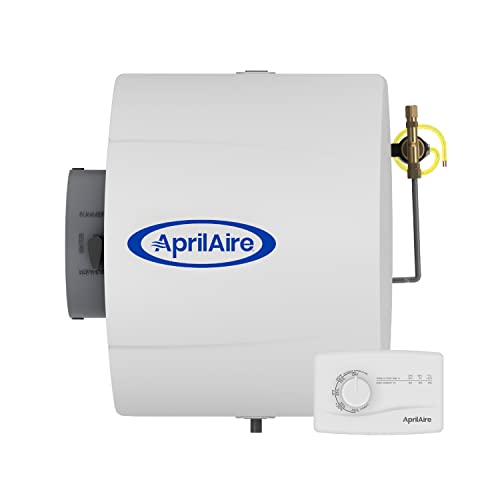
The AprilAire 600M delivers moisture at 17 gallons per day, covering homes up to 5,000 square feet in tightly built construction. That is the same output class as the GeneralAire 1042LH below, but the AprilAire is rated for 4,000 to 5,000 square feet of floor area versus the GeneralAire’s 2,800, so it suits open layouts and two-story tracts that smaller units cannot touch.
What wins people over is the install experience. Owners consistently call it straightforward, and it pairs beautifully with smart thermostats: the unit runs on the same 24-volt furnace wiring, so a Nest can drive the solenoid directly with a * wire. The included transformer and sensor mean you can have automated control without hunting for extra parts. Buyers report it “holds humidity well after initial absorption,” which matches the pattern of several owners holding a rock-steady 38-40% relative humidity across 2,400 square feet.
The trade-off is that the wiring and sensor layout reward a homeowner who reads carefully. A few owners note the humidistat wiring instructions are the hardest part, and one found the integrated solenoid can short if you miswire it to the furnace transformer — the included relay exists to prevent exactly that. Treat the wiring as a half-day project and this is the best all-rounder you can mount on a duct.
Why it wins
- 17-gallon daily capacity for large homes up to 5,000 sq ft
- Measures a light 8.7 pounds, so one person can lift it into place
- Plays perfectly with Nest and other 24V smart thermostats
The honest catch
- Electrical wiring is the trickiest step for DIY installs
- Your furnace must be able to push enough airflow for full coverage
Reach for it if: you have a larger home and want reliable, owner-approved humidity with minimal maintenance.
Think twice if: you are not comfortable with low-voltage wiring or do not have easy duct access for a bypass run.
2. GeneralAire 1042LH
The drop-in replacement that outlived your old furnace and will likely outlive the next one too.
The GeneralAire 1042LH is the unit people buy when their 25- or 30-year-old humidifier finally cracks. It ships with a 24-volt system and its own 120V transformer, and the reversible 6-inch duct connection means it fits either side of your plenum. Owners mention swapping it straight onto the original screws and reusing the old valve and humidistat — no new plumbing, no new wire pulls.
Its real talent is durability and output. The listed capacity is 19.2 gallons, the largest tank rating in this roundup, and it is built for forced-air furnaces up to 2,800 square feet. The AprilAire 600M weighs 8.7 pounds, while this unit weighs a solid 12 pounds — a heavier build that matches the owner reports of decades-long service. In one early-1900s farmhouse, three days after install the humidity climbed from 20% to 35%.
The recurring advice is simply upkeep: use genuine GeneralAire 990-13 pads, replace them once or twice per season, and keep the screen clean. Owners who skip maintenance are the ones who end up buying again — neglect, not the design, is what kills it. This is the pick for anyone who wants the same proven unit back, with zero guessing about fit.
Built to last
- 12-pound body signals serious, long-life construction
- Ships with 120V transformer and 24V control built in
- Reversible RH or LH duct hookup for flexible placement
The honest catch
- Requires regular pad and screen servicing 2-4 times a year with hard water
- Generates 19.2 gallons of output but is rated for only 2,800 sq ft
Best for: anyone replacing an aging GeneralAire who wants the exact same footprint and familiar controls.
Look elsewhere if: you want digital, automatic control — this is a manual-dial unit through and through.
3. AprilAire 400M

Delivers the same big-house output as the 600M but evaporates every drop instead of draining it.
The AprilAire 400M shares the 600M’s 17-gallon-per-day capacity and up-to-5,000-square-foot reach, but its defining feature is a drainless water-saver process that evaporates 100% of the water entering the panel. If your home has no floor drain near the furnace, this removes the biggest installation headache a bypass unit can throw at you — no drain line to plumb, no water wasted down the pipe.
Owners notice the water efficiency immediately, and the unit’s quiet, solid build gets repeated compliments. It uses a wicking evaporative filter and ships with the 24VAC transformer and valves included, so the box is genuinely close to complete for a DIY install. Comfort-wise, customers note the first winter goes by with no dry throat and no static shocks, and the manual dial lets you fine-tune without climbing into the attic.
The catch is consistency. Some reviewers point out rock-steady humidity, while others find output insufficient in very dry or drafty homes, and a recurring note flags water leaking from the back where spray lands on the filter support. If you have a floor drain and want simpler, predictable performance, the 600M is the safer bet — but the 400M is the one to reach for when running a drain line is a dealbreaker.
Why it stands out
- Drainless operation means no floor drain required
- 17-gallon daily output matches the top-tier 600M
- Includes 24VAC transformer, valves, and control in the box
The honest catch
- Output consistency gets mixed reports in very dry climates
- A spray-over-filter-support leak is a known QC issue to watch
Pick this if: you want whole-home moisture but have no place to route a drain line.
skip it if: you need guaranteed output in an extremely dry home and can handle a simple drain instead.
4. Honeywell HE240D

The affordable digital option that automates humidity for smaller homes — if the install cooperates.
The Honeywell HE240D targets homes of 1,500 to 3,000 square feet and brings the one thing the manual-dial units lack: a digital humidistat with an outdoor sensor that automatically maintains your preset as the weather changes. Set it once and the unit turns on and off to hold your level, protecting wood floors and furniture while cutting static electricity.
It mounts on either the warm-air supply or return duct of a forced-air furnace, and the included digital controller is genuinely convenient when it works. Owners who got past the wiring report the unit does distribute moisture through the home, and the responsive support team will send a replacement part if a solenoid arrives faulty.
The honest truth is this model has the most mixed feedback in the group. A recurring complaint is excessive water use — even with flow restrictors and the valve adjusted, moisture struggled to push past 20-25% in one owner’s home — and the installation is more involved than the advertised four steps, with no test mode on the humidistat. You also must supply the water hookup yourself and have a floor drain. This is the right pick for a budget-first buyer who accepts a more hands-on setup for automatic control.
Budget appeal
- Digital humidistat with outdoor sensor automates control
- Fits mid-size homes from 1,500 to 3,000 sq ft
- Pre-filter style keeps moisture distribution even
The honest catch
- Water hookup not included in the box
- Some owners saw poor humidity lift despite flow restrictors
Choose it for: the lowest-cost path to automatic, season-following humidity.
Avoid it if: you want proven, predictable output — the manual units above are more consistent.
5. GeneralAire 3200M

A compact, American-made flow-through unit that sneaks into tight furnace rooms without stealing airflow.
The GeneralAire 3200M earns its place on pure simplicity. It is a compact, evaporative, flow-through bypass humidifier rated at 12 gallons per day for homes up to 3,200 square feet, and it weighs just 7 pounds, compared with the GeneralAire 1042LH at 12 pounds from the same brand. Owners describe it as engineered without the back-pressure that chokes a 6-inch inlet duct.
It ships with the MHX3C manual humidistat and is designed for easy install and easy maintenance, which matches the owner consensus that the hardware itself is high quality and durable. The manual control keeps things predictable: set your dial and the wick filter does the work, with no digital controller to fight.
The practical lesson from owners is about wiring, not the unit. If you power it with a simple transformer and drain into a bucket, the initial startup can run a full bucket of water straight down the drain — the guidance is to wire it to the furnace board so the water only flows when the heat runs. And note the manufacturer expects professional installation to keep the warranty valid. Skip the bucket-drain setup and this compact unit performs beautifully for a mid-size home.
Compact and clean
- 7 pounds and a small profile ease the mounting job
- 12-gallon daily output for homes up to 3,200 sq ft
- Low back-pressure design passes air freely
The honest catch
- Wastes water if not wired into the furnace control board
- Warranty expects professional installation
Best suited to: anyone with a cramped utility space who wants a quality American-made unit and understands furnace wiring.
Not for: first-time DIYers — the professional-install warranty requirement creates real risk for a self-install.
Understanding the Specs
Gallons Per Day (GPD)
This tells you how much moisture the unit can push into the air in a full day of running. It is the single best predictor of whether the humidifier can keep up with your home’s size. A 12-gallon unit suits mid-size homes, while 17 gallons and up covers large, tightly built houses. Undersize this number and you will run the unit constantly and still feel the dry air.
Floor Area Rating
Manufacturers pair each unit with a recommended square footage, usually stated “in tightly built homes.” This matters because a drafty older house loses humidity far faster than a modern sealed one. If your home is older or leaky, buy for the top of the range or one size up — the square footage claim assumes decent insulation and windows.
Manual vs. Digital Humidistat
The humidistat is the brain that reads your air and decides when to release water. A manual dial is simple, reliable, and easy to wire into a smart thermostat — you set a level and adjust it as the season changes. A digital unit with an outdoor sensor tracks weather swings automatically, removing the guessing, but adds wiring complexity and a few more parts that can fail.
Flow-Through vs. Drainless
Most bypass humidifiers are flow-through: water runs over the pad, evaporates into the warm air, and the remainder drains away. A drainless design evaporates 100% of the incoming water, which is vital if your furnace room has no floor drain. Flow-through is simpler and proven; drainless saves water and opens up installation spots but needs a more careful water-control setup.
FAQ
What is a bypass humidifier and how does it work with my furnace?
How many gallons per day do I need for my home size?
Can I install a bypass humidifier myself or do I need a pro?
Will a bypass humidifier work with my Nest or other smart thermostat?
How often do I need to replace the humidifier pad or filter?
Why is my bypass humidifier using so much water?
Does a bypass humidifier need a floor drain nearby?
What is the difference between a bypass and a fan-powered or steam humidifier?
Why does my humidifier not raise humidity above 25-30%?
Final Thoughts: The Verdict
Across the board, the bypass humidifier winner is the AprilAire 600M because its 17-gallon daily capacity, large-home reach, and owner-proven humidistat wiring make it the most reliable all-rounder for the money. If you want to skip the drain line entirely, grab the AprilAire 400M for its water-saving, drainless design. And for the classic drop-in replacement that keeps the same footprint for decades, the GeneralAire 1042LH is the one to reach for. Whichever you choose, match the daily output to your square footage and check your wiring plan before you cut a single duct.
How We Picked
We do not accept paid placement. Every pick is matched to a real buyer and a real use-case; we do not hands-on test units.
Sources & Methodology
Specifications: manufacturer listings and product documentation. Review insights: verified customer reviews, as of August 2026. Pricing: not shown on this page (it changes often); check the current price via the retailer link.
As an Amazon Associate, FitlyFast earns from qualifying purchases. This does not affect which products we feature.