
Our readers keep the lights on and the weekend projects moving. As an Amazon Associate, I earn from qualifying purchases.
Specs are compiled from manufacturer listings and verified buyer reviews and can change over time — please confirm the key details on the product page before buying.
A budget chef’s knife can rival premium blades if you prioritize the right steel, handle, and edge angle. A genuinely sharp 8-inch blade that glides through tomatoes and stays keen for weeks is absolutely within reach if you know which steel, handle, and edge angle to look for. This guide focuses on the budget tier, where the right choice separates a frustrating tool from a reliable daily workhorse.
I’m Rikta — the founder and writer behind FitlyFast. This guide is built by comparing the manufacturers’ published specifications and the patterns across verified customer reviews, so you get each pick’s real strengths and trade-offs instead of marketing spin.
From hand-forged Japanese-style gyutos to the line-cook-favorite Mercer, here are the budget chef knife picks that actually hold an edge, fit your hand, and won’t empty your wallet.
Our Picks at a Glance

How To Choose The Best Budget Chef Knife
Before you dive in, know this: we matched the 8-inch blade length flexibly, so some picks are 7–9 inches—the nearest standard size that serves the same purpose. That way, you won’t mistake a 33-centimeter blade for an 8-inch one when they’re close but not identical.
Steel choice is the top priority, as it determines edge retention and sharpening frequency. High-carbon stainless steel (like AUS-8, 1.4116, or 10Cr15MoV) offers a strong balance: it takes a keen edge yet resists rust far better than pure carbon steel. Look for a hardness rating around HRC 58–60, which tells you the blade will hold that edge through heavy prep without becoming brittle.
Edge angle: sharper isn’t always better
A 12–15 degree edge angle per side allows easy slicing through tomato skins. But that sharpness comes with a catch: a very acute edge can chip if you hack through bones or frozen food. For a budget all-rounder, a 15-degree edge is the balance: sharp enough for precise cuts, sturdy enough for daily use.
The handle: your grip is the real test
The handle is as critical as the blade for comfort during extended prep sessions. Rosewood and Pakkawood (layered resin-impregnated wood) are moisture-resistant and comfortable, while Santoprene rubber offers a sure grip even wet. A full-tang design—where the steel runs the entire length of the handle—adds balance and prevents the blade from snapping under pressure.
Quick Comparison
| Model | Best For | Blade Steel | Edge Angle | Handle | Amazon |
|---|---|---|---|---|---|
| RASSE Gyuto★ Best Overall | Value & forged looks | AUS-8 Stainless | 15° | Rosewood | Amazon |
| Emojoy DamascusGift-Ready Pick | Gifting & flair | 67-Layer Damascus | 15° | Olive Wood | Amazon |
| KEEMAKE 1.4116Top Performer | Everyday versatility | 1.4116 High Carbon | 8°–12° | Pakkawood | Amazon |
| Sunnecko | Heavy-duty prep | High Carbon Stainless | 12–15° | Pakkawood | Amazon |
| Mercer Millennia | Pro-style workhorse | High Carbon Steel | Hollow Ground | Santoprene | Amazon |
| imarku | Balance & sharpness | High Carbon Stainless | 10–15° | Pakkawood | Amazon |
| KEEMAKE 440C | Artisan forged feel | 440C High Carbon | 12–15° | Rosewood | Amazon |
| HOSHANHO Gyuto | 9-layer edge retention | 10Cr15MoV Core | 12–15° | Rosewood | Amazon |
| LEVINCHY Damascus | Mirror-polished premium | 73-Layer Damascus | 8–12° | Pakkawood | Amazon |
In‑Depth Reviews
1. RASSE Japanese Chef Knife Gyuto
A hammered, hand-forged 8-inch gyuto that delivers pro-level sharpness without the pro-level invoice.
At just 9.12 ounces, this knife balances a substantial feel with nimble handling, and the high carbon AUS-8 stainless steel blade takes a 15° ultra-sharp edge that buyers report stays keen for long stretches. The hammered texture isn’t just decorative—it’s hand-pounded, giving the blade a traditional forged look that stands out next to stamped alternatives.
The ergonomic octagonal rosewood handle reduces wrist strain and lets you adjust your cutting angle mid-task.
Quality is the thing everyone raves about—78 owners single it out—with sharpness close behind at 48 mentions. The recurring trade-off is weight and care: some find it slightly blade-heavy, and this knife demands hand-washing and thorough drying to avoid staining or rust, so never let it sit in the sink.
What wins owners over
- Stays sharp for long periods with minimal touch-ups
- Hammered, hand-forged look feels far above its price bracket
- Octagonal rosewood handle gives a secure, balanced grip
What to watch
- Requires hand-washing and immediate drying to prevent rust
- Some find it slightly blade-heavy and large to store
- Likely 8Cr13MoV steel rather than true AUS-8, per savvy owners
Reach for this: home cooks who want a sharp, handsome daily blade that outperforms its budget without babying it.
Look elsewhere if: you hate hand-washing knives or need a compact blade for small drawers.
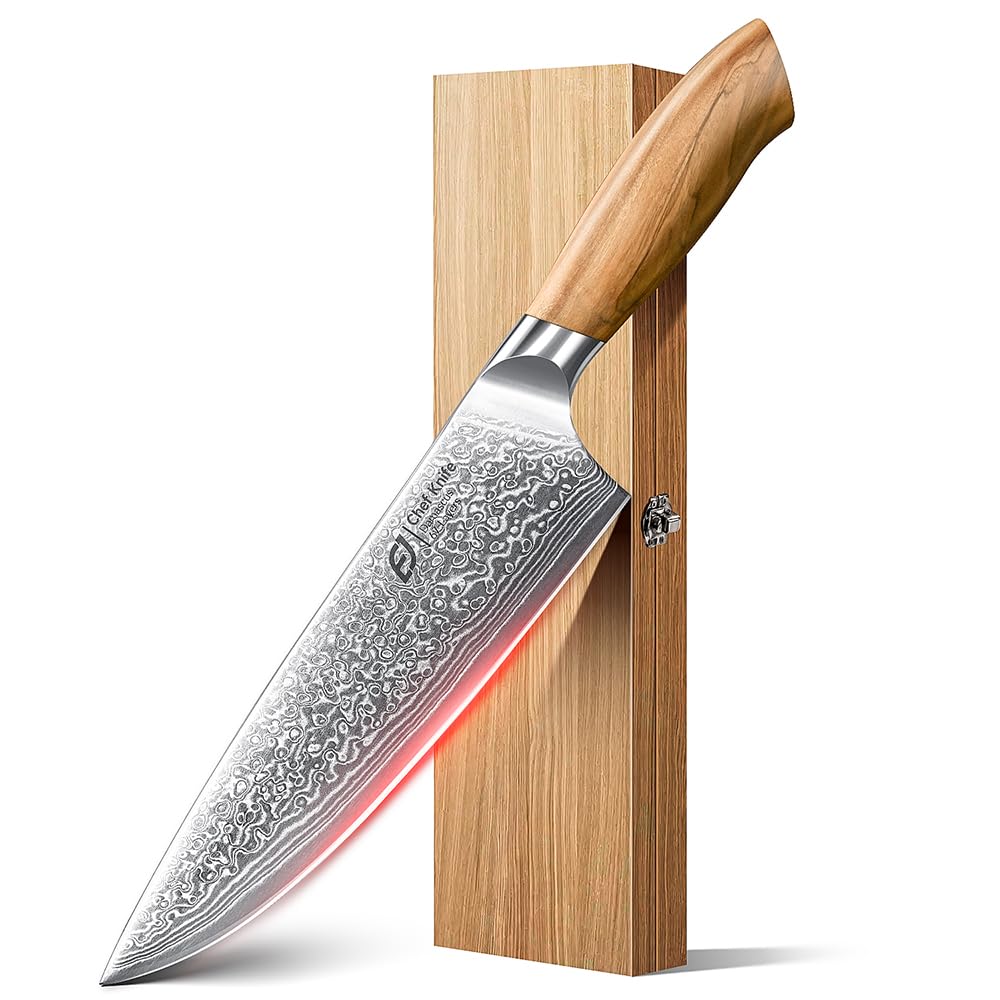
2. Emojoy Damascus Chef Knife
A 67-layer Damascus blade with an olive wood handle that cuts meat like butter and looks like a much pricier present.
This is the knife that wins on wow-factor: hand-forged 67-layer Damascus steel with 0.98% carbon and 18% chromium, hardened to 58 HRC, and laser-calibrated to a 15° cutting bevel. It arrives sharp enough to glide through meat, fish, and vegetables immediately, and buyers describe the cutting experience as “surgical.”
The CALABRIAN olive wood handle is organic-shaped to fit any hand size, and the half-bolster design makes it easy to hold for long prep sessions. Quality leads the conversation here—115 owners praise it—with sharpness trailing at 93 mentions and appearance at 57. Owners recommend mineral oil to keep the olive wood looking its best.
It ships in a premium wooden gift box, making this the rare budget knife you could hand to a newlywed or a housewarming host without a second thought. The catch is that the Damascus pattern needs proper care: hand-wash and dry it every time, since the layered steel won’t forgive neglect.
The raindrop effect: owners specifically call out the beautiful Damascus pattern, and the wooden box improve it into genuine gift territory.
Who it’s for: anyone who wants a conversation-piece blade that performs daily and impresses when the box comes off.
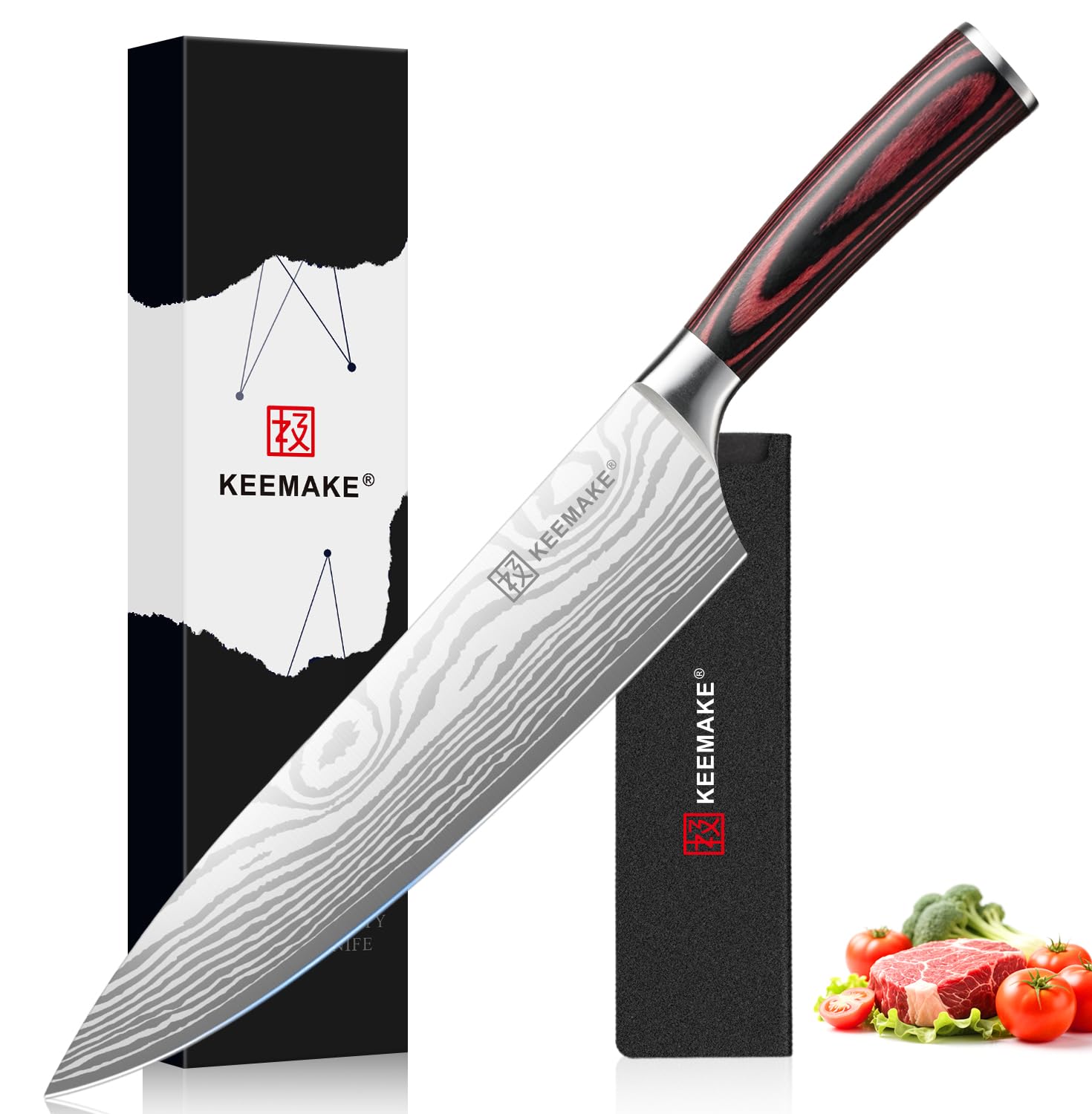
3. KEEMAKE 8″ Chef Knife
Hand-sharpened to a razor 8°–12° edge, this 8-incher crushes butternut squash and ripe tomatoes without a pause.
This is the blade for the cook who’s tired of stopping mid-recipe to resharpen. The 1.4116 high-carbon stainless steel holds a 58±2 HRC hardness, and owners mention it powers through prime rib bone cartilage and dense winter vegetables without losing its bite. It weighs only 8.48 ounces, so it feels lively rather than heavy in the hand.
The curved Pakkawood handle and sloped bolster encourage a secure pinch grip that reduces wrist strain during marathon prep sessions—think holiday feasts or batch-cooking Sundays. Quality is the most-praised trait at 54 mentions, with sharpness close behind at 50. Owners describe switching to this knife and wondering what they used before.
A protective sheath and gift box are included, which keeps the edge safe in a drawer and makes it a practical present for a culinary student or BBQ enthusiast. The trade-off: a thinner 8°–12° edge is supremely sharp but wants a cutting board, not a metal pan or bone, to keep that keenness intact.
Daily-driver strengths
- Edge retention that sails through squash, pineapple, and chickens
- Curved handle with sloped bolster reduces hand fatigue
- Comes with a sheath and gift box for safe storage
The fine print
- Thin acute edge needs a proper cutting board to avoid chipping
- Some may find it lighter than a traditional German-style knife
Grab this if: you do heavy weekly prep and want a knife that keeps going without constant honing.
Think twice if: you prefer a heavyweight blade with more heft behind each chop.
4. Sunnecko 8 Inch Chef Knife
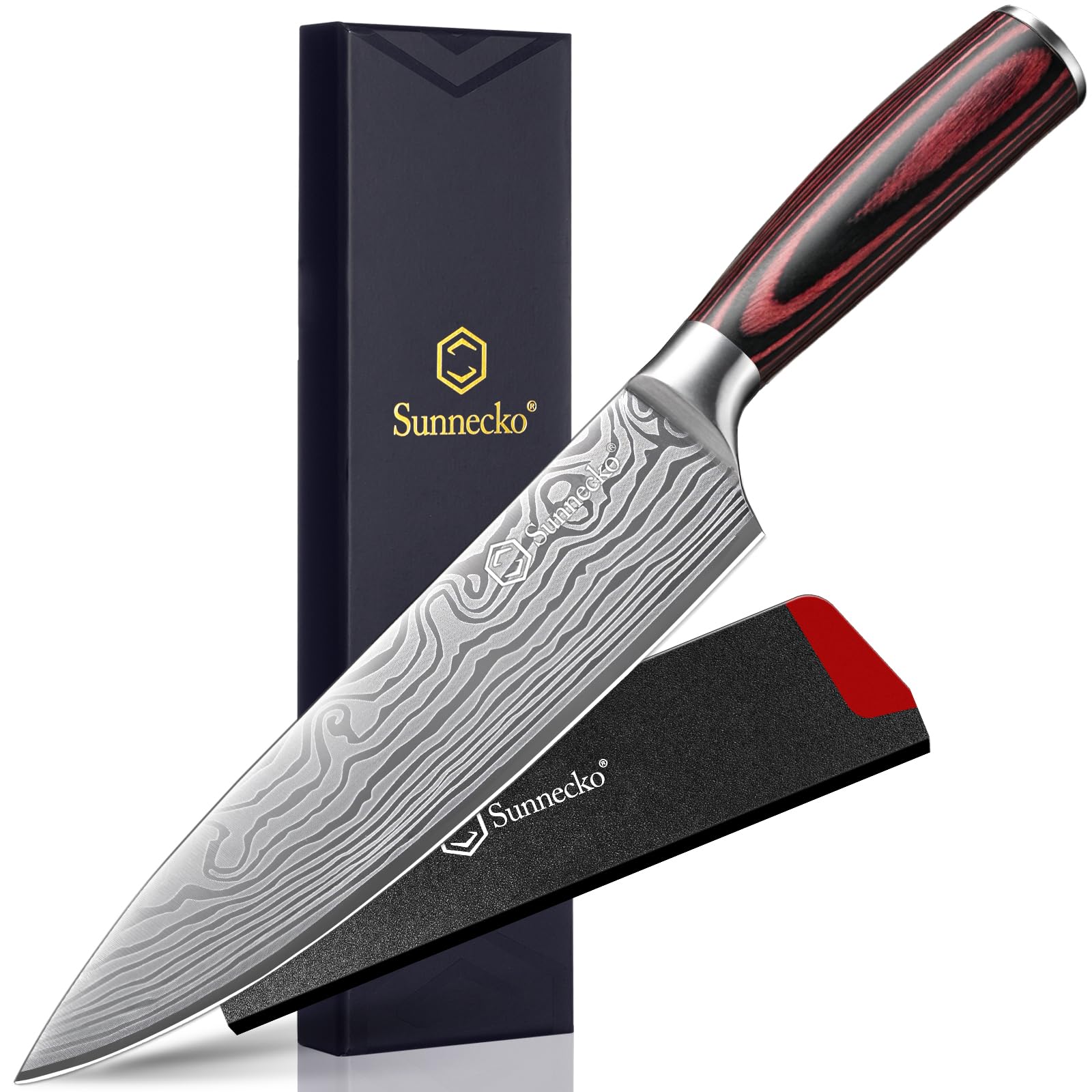
A laser-etched, hand-sharpened 12–15° blade that one owner bought for a 12-year-old and everyone else keeps for themselves.
The Sunnecko is the all-in-one workhorse that claims to handle 90% of prep tasks, and owners largely agree. Its high-carbon stainless steel is hand-sharpened to a 12–15° angle per side, gliding through tomatoes and meats without crushing. It tips the scales at just 0.2 kg, making it nimble for smaller hands—one parent picked it as a starter knife for a 12-year-old son.
The etched laser pattern mimics traditional Japanese grain, giving it a premium look for dinner parties or BBQ sessions. Quality leads the reviews at 62 mentions, with sharpness at 52, and the full-tang design means the blade won’t snap under tough butchering jobs. A custom-fit PVC sheath protects the edge and your fingers in the drawer.
The honest caveat, as multiple owners note, is that the blade requires frequent honing to stay razor-sharp—it arrives very sharp and takes well to sharpening, but it’s not a set-and-forget edge. For anyone upgrading from dull store knives, it’s a clear step up that won’t pretend to be a Japanese blade.
The honest take: “For the price this knife is great,” owners say—it arrives sharp, looks gorgeous, and punches above its weight for everyday slicing.
Fit note: plan to keep a honing steel handy, since the edge fades faster than premium steel.
5. Mercer Culinary Millennia Chef’s Knife

The line cook’s secret: a wide hollow-ground blade that scoops diced veg and holds its edge through a brutal shift.
This is the knife you’ll find in professional kitchens, and there’s a reason. The 8-inch wide hollow-ground blade is made from one-piece high-carbon Japanese steel that customers note is razor-sharp, holds its edge well, and sharpens back up easily. It weighs just 4.64 ounces, yet feels heavy-duty and substantial in use.
The textured finger points on the Santoprene-and-polypropylene handle provide slip resistance even when wet, and the protective finger guard is a safety plus. Sharpness is the most-praised trait at 39 mentions, with quality at 31. A line cook compared it directly to a Henckels and found it better for chopping, scooping, and angle control at about a third of the price.
The hollow-ground edge reduces sticking, so food doesn’t cling to the blade as you slice. Some find the wide blade size a bit much for smaller hands, and one owner called the finger guard “ugly”—but the consensus is clear: it’s an inexpensive, heavy-duty all-purpose knife that outworks knives costing far more.
Why pros keep it
- Wide hollow-ground edge prevents food from sticking
- Textured, non-slip grip performs well when wet
- Rapidly sharpens back to a razor edge
Trade-offs
- Wide blade can feel large for smaller hands
- Less sharp from the start than premium Japanese options
Choose it for: serious home cooks and pros who want a dependable, easy-to-maintain blade for long sessions.
Pass on it if: you want a pretty knife for display rather than a durable workhorse.
6. imarku Chef Knife 8 Inch
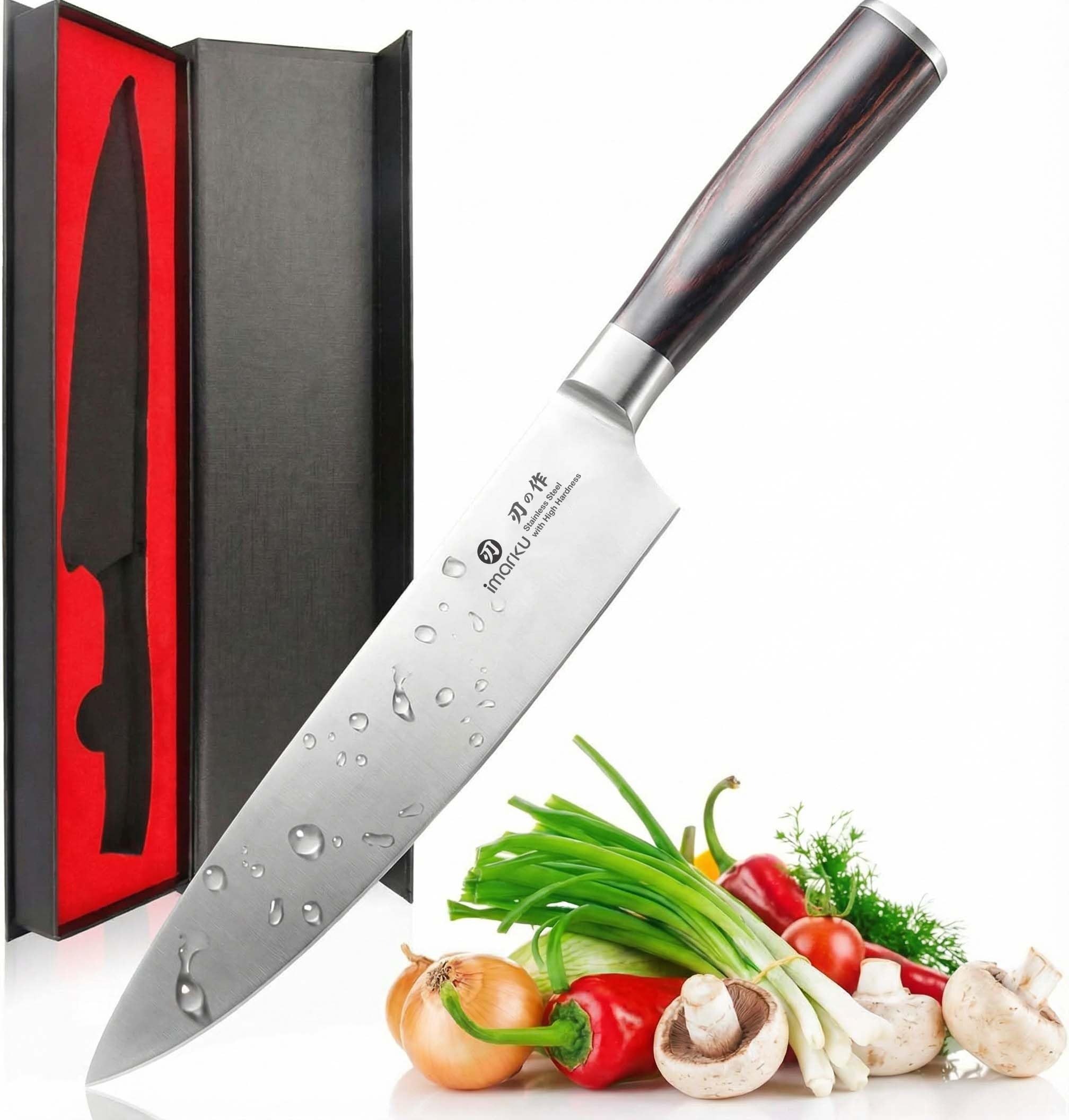
A hand-forged V-shaped blade so sharp owners nicknamed it “the finger guillotine” — handle with respect.
This 8-inch chef’s knife is crafted from hand-forged high-carbon stainless steel with a V-shaped edge ground to 10–15° per side, designed to minimize cutting resistance and retain sharpness through heavy daily use. Weighing 10.88 ounces, it has a nice, solid heft that owners appreciate for everyday chopping, slicing, and mincing of everything from meat to sushi.
Sharpness is the dominant theme, earning 66 mentions—the most of any trait here—followed by quality at 49. One owner nicknamed it “the finger guillotine” for its extreme sharpness, and another kept using it daily for five years. The Pakkawood handle is ergonomically curved for an ambidextrous hold that stays comfortable over long sessions.
Durability feedback is mixed: many find it very durable, but a few report the handle can crack within a couple of months. It arrives in a fancy gift box and includes a one-year replacement policy, so it’s a low-risk pick for parents, culinary students, or anyone who wants a knife that looks as sharp as it cuts.
The edge story: owners consistently call it extremely sharp and note it retains the edge well, but the blade-guard bolster can dig into some grips during prolonged use.
Balance point: it cuts meat like butter and fits the hand nicely—just mind your fingertips.
7. KEEMAKE 440C Chef Knife
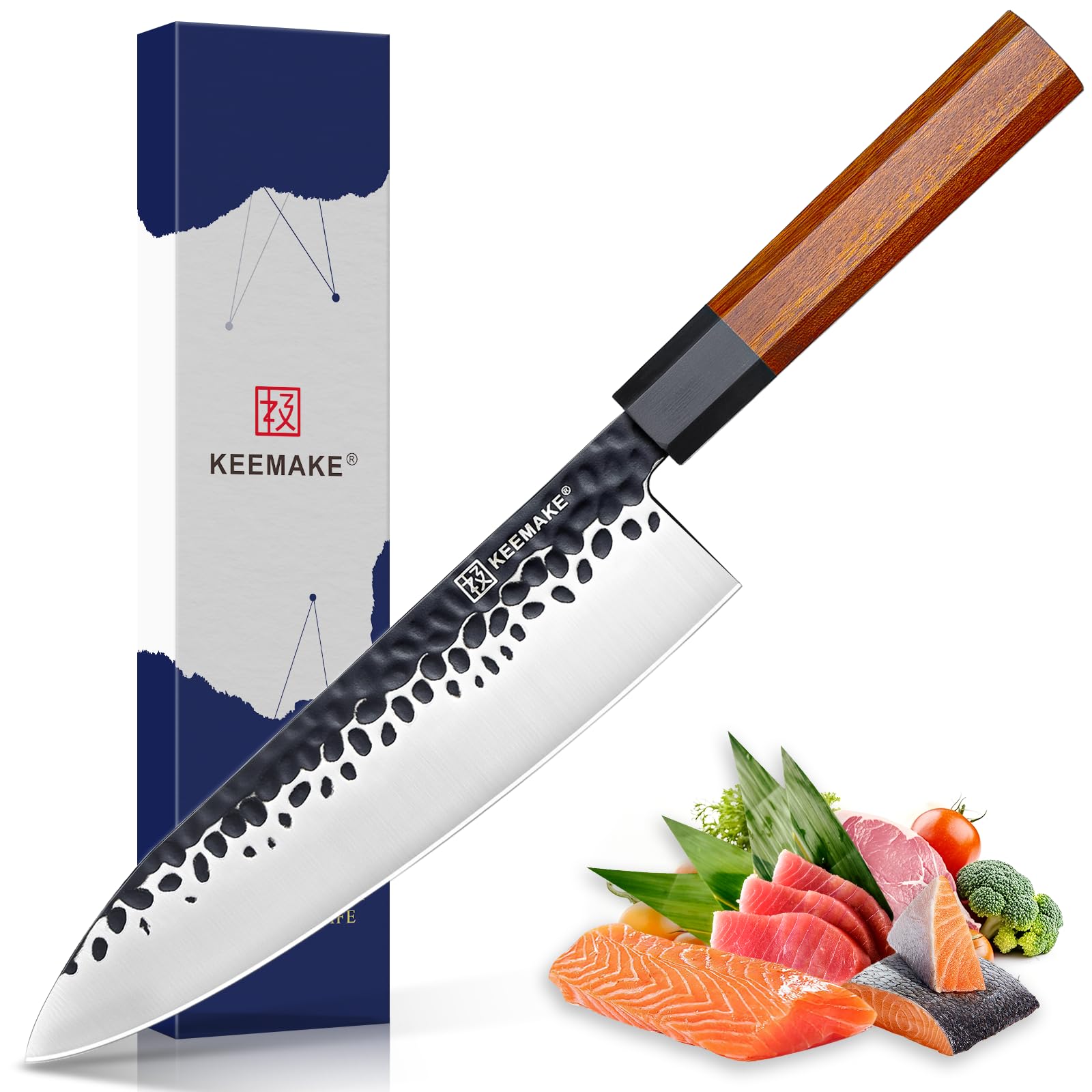
A hand-forged 440C blade with a hammered 5-layer pattern that slices tomatoes without smashing a single one.
This is the knife for cooks who want the aesthetic of a hand-forged Japanese blade without the collector price. It’s forged from high-carbon 440C steel through a rigorous 60-day process involving precise quenching and nitrogen vacuum cryogenic tempering, hitting a Rockwell Hardness of HRC 58. The result is a blade that owners say cuts clean through tomatoes without smashing them—and they didn’t realize how dull their old knives were until this arrived.
The hand-sanded edge is acute at 12–15° per side, gliding through tomato skins, boneless meats, and dense vegetables while preserving natural juices. Sharpness leads at 37 mentions, with quality at 32. The non-slip octagonal rosewood handle is moisture-resistant and fits naturally in both right and left hands, reducing wrist tension during extended prep.
The 2.3mm thick blade features a tsuchime hammer texture that prevents food from sticking, adding artisan beauty to its function. Reviewers point out it needs whetstone sharpening every other week to a month depending on use—a sushi chef called it “a great beginner knife” but noted it’s not for skinning whole loins. It arrives gift-ready in elegant packaging, perfect for a milestone birthday or housewarming.
What stands out
- Hand-hammered texture prevents food from sticking
- HRC 58 hardness holds a sharp, corrosion-resistant edge
- Octagonal rosewood handle fits both hands comfortably
Keep in mind
- Will need regular whetstone maintenance to stay razor-sharp
- Not built for heavy bone-breaking tasks
Pick this for: home cooks upgrading from dull knives who want artisan looks with genuine cutting performance.
Skip if: you want a low-maintenance blade you never have to sharpen.
8. HOSHANHO 8 Inch Gyuto Chef Knife

A 9-layer sandwich of high-carbon steel with a 10Cr15MoV core that holds its edge for weeks on end.
This gyuto is engineered around a high-hardness Japanese 10Cr15CoMoV super steel core, wrapped in 8 layers of corrosion-resistant composite steel to form a stable sandwich structure for longer service life. It’s sharpened using wet V-shaped technology with both sides hand-polished to 12–15 degrees, and shoppers say the edge stays sharp for weeks—even after regular chicken prep and produce peeling.
The blade measures 8.11 inches with a 6.1-inch handle, a near-golden-ratio balance that makes every cut, chop, and slice feel easy. The traditional Japanese octagonal rosewood handle, accented with two copper wires, fits the hand securely. Weighing just 221 g, it’s lightweight enough for delicate work yet substantial enough for daily prep.
Buyers call the craftsmanship “stunning” and say the quality exceeds the price, though they emphasize it’s a hand-wash-only blade to prevent rust and oxidation. One owner mentioned a minor issue with the butt of the blade near the hand needing a quick grind-down. It’s a professional-grade all-rounder that excels at slicing and dicing produce and chicken, with excellent value for money.
The sharpness story: owners describe a blade that holds its edge for weeks and handles chicken, fruit, and vegetable prep with ease.
Care warning: the high-carbon steel is chip-prone if neglected, so hand-wash and dry it every time.
9. LEVINCHY Damascus Chef’s Knife

A 73-layer Damascus blade with a mirror-polished 8–12° edge that owners say cuts “like a lightsaber.”
This is the top-shelf pick for budget shoppers who want a true premium feel. The blade is forged from 73-layer Damascus stainless steel at HRC 60±2, hand-finished with a mirror polish at 8–12° per side for exceptional sharpness. Buyers consistently describe it as razor-sharp and well-balanced, slicing through meat like butter and holding its edge longer than the Henckels and Zwilling knives they previously owned.
The ergonomic Pakkawood handle is comfortable and doesn’t slip, even during long use, and feels good regardless of hand size or grip position. Quality is the most-praised aspect at 43 mentions, with sharpness at 37. At just 7.84 ounces, it feels lightweight in hand despite its premium construction.
The honest caveat echoes across reviews: while the Damascus pattern looks beautiful, several sharp-eyed owners note it may not be true Damascus steel, and the thin blade can lose its edge faster than expected without proper sharpening skill. It arrives in a high-quality black gift box, making it a serious contender for anyone who wants the look and feel of a luxury knife without the luxury invoice.
The premium feel
- Mirror-polished 8–12° edge cuts with surgical precision
- 73-layer steel resists rust and stains
- Lightweight at 7.84 oz with a comfortable Pakkawood grip
The honest limits
- Some owners question whether it’s genuine Damascus steel
- Thin edge requires sharpening skill to maintain
Reach for it if: you want a stunning, razor-sharp blade that outperforms bigger brands and looks the part on your counter.
Be realistic if: you expect a Japanese collectible—this is a beautiful budget blade, not an heirloom.
Understanding the Specs
Steel type and HRC hardness
Steel type dictates initial sharpness and how long the edge lasts. High-carbon stainless steels like AUS-8, 1.4116, and 10Cr15MoV (all common knife alloys) balance edge retention with rust resistance. Hardness, measured in HRC (Rockwell scale), tells you how the blade behaves: around HRC 58–60 is ideal for a budget knife—hard enough to hold an edge, tough enough not to chip.
Edge angle per side
Edge angle per side determines the cutting feel and durability. A 12–15° angle is the sharp, precise range that glides through tomato skins and fish without crushing. A more acute 8–12° edge is even sharper but more fragile, while a wider 15°+ edge is sturdier for heavy chopping. For most home cooks, 12–15° is the practical zone.
The handle material
Handle material directly influences grip comfort and moisture resistance. Rosewood feels traditional and warm, resists moisture, but needs occasional oiling. Pakkawood (resin-stabilized wood) resists moisture and fatigue with less upkeep. Santoprene rubber offers a non-slip, durable grip that works well when wet—a favorite in professional kitchens.
Forged vs. stamped construction
Forged knives are heated and shaped from a single piece of steel, giving them a denser, heavier feel and better balance. Stamped knives are cut from a rolled steel sheet, making them lighter and cheaper while still performing well. For a budget pick, a forged blade often delivers a more substantial, premium feel, but a good stamped blade like the Mercer remains a pro favorite.
FAQ
Is a budget chef knife actually sharp enough for daily cooking?
What is the difference between AUS-8 and 1.4116 steel?
What does the HRC hardness number mean for a chef knife?
Why is a 15-degree edge angle better than a wider one?
Can I put a budget chef knife in the dishwasher?
Will a budget knife need sharpening right away?
What is the difference between a forged and a stamped knife?
Is Damascus steel worth it on a budget knife?
What does full tang mean and why does it matter?
How do I choose the right handle material for my grip?
Final Thoughts: The Verdict
For most cooks, the budget chef knife winner is the RASSE Gyuto: it offers hand-forged looks, a sharp 15° AUS-8 edge, and a comfortable rosewood handle at a price that undercuts rivals—plus the highest owner praise in its tier. If you want a gift that impresses, pick the Emojoy Damascus with its 67-layer blade and olive wood handle. For a low-maintenance pro workhorse, the Mercer Millennia is your best bet. Whichever you choose, hand-wash it, and it’ll serve you for years of easy prep.
How We Picked
We do not accept paid placement. Every pick is matched to a real buyer and a real use-case; we do not hands-on test units.
Sources & Methodology
Specifications: manufacturer listings and product documentation. Review insights: verified customer reviews, as of August 2026. Pricing: not shown on this page (it changes often); check the current price via the retailer link.
As an Amazon Associate, FitlyFast earns from qualifying purchases. This does not affect which products we feature.