
Our readers keep the lights on and the weekend projects moving. As an Amazon Associate, I earn from qualifying purchases.
Specs are compiled from manufacturer listings and verified buyer reviews and can change over time — please confirm the key details on the product page before buying.
Your fingers will hit 10,000 keystrokes in a single debugging session, and the right board turns that grind into a rhythm instead of a chore. The best coding mechanical keyboard pairs responsive switches with a quiet, comfortable build for all-day use. — quiet enough for late-night commits, responsive enough for rapid refactoring, and built to endure years of heavy daily use.. This guide breaks down the switch feel, layout, and connectivity choices that actually matter for programmers.
I’m Rikta — the founder and writer behind FitlyFast. This guide is built by comparing the manufacturers’ published specifications and the patterns across verified customer reviews, so you get each pick’s real strengths and trade-offs instead of marketing spin.
We’ve matched nine top boards to coding workflows., from hot-swappable switches to silent gasket mounts, so you can pick your next daily driver with confidence. in your coding mechanical keyboard.
Our Picks at a Glance


How To Choose The Best Coding Mechanical Keyboard
For a coder, the keyboard is the most-used tool. A mushy or hollow-sounding board will annoy you by lunch., while the right switches and sound profile make long sessions feel easy.. Here’s what separates a great coding board from a merely loud one.
Switch Type: The Heart of the Feel
Linear switches (like the ones in most of these picks) move straight up and down with no bump, which makes them fast and smooth. Tactile switches give a small bump at the actuation point so you feel each keystroke. For heavy typing, many coders prefer a lighter actuation force (measured in grams, such as the 45gf in the top pick) so your fingers don’t tire out.
Layout and Ergonomics
Full-size boards keep the number pad, while 75% boards (about 79-81 keys) cut the pad to free up mouse space and shorten reach. A 96% layout (around 98 keys) keeps the numpad but tightens the gap between keys. What matters is whether the layout puts arrow keys, Home/End, and Page Up/Down where your muscle memory expects them.
Quick Comparison
| Model | Best For | Layout & Keys | Switch Type | Connectivity | Amazon |
|---|---|---|---|---|---|
| GravaStar Mercury K1 Pro★ Best Overall | Premium durability & sound | 75% / 79 Keys | Linear (Kailh Speedy Mint) | Tri-Mode (2.4G / BT / USB-C) | Amazon |
| RK ROYAL KLUDGE R75Best Value | Portable wireless value | 75% / 68 Keys | Linear (Cream) | Tri-Mode (2.4G / BT / USB-C) | Amazon |
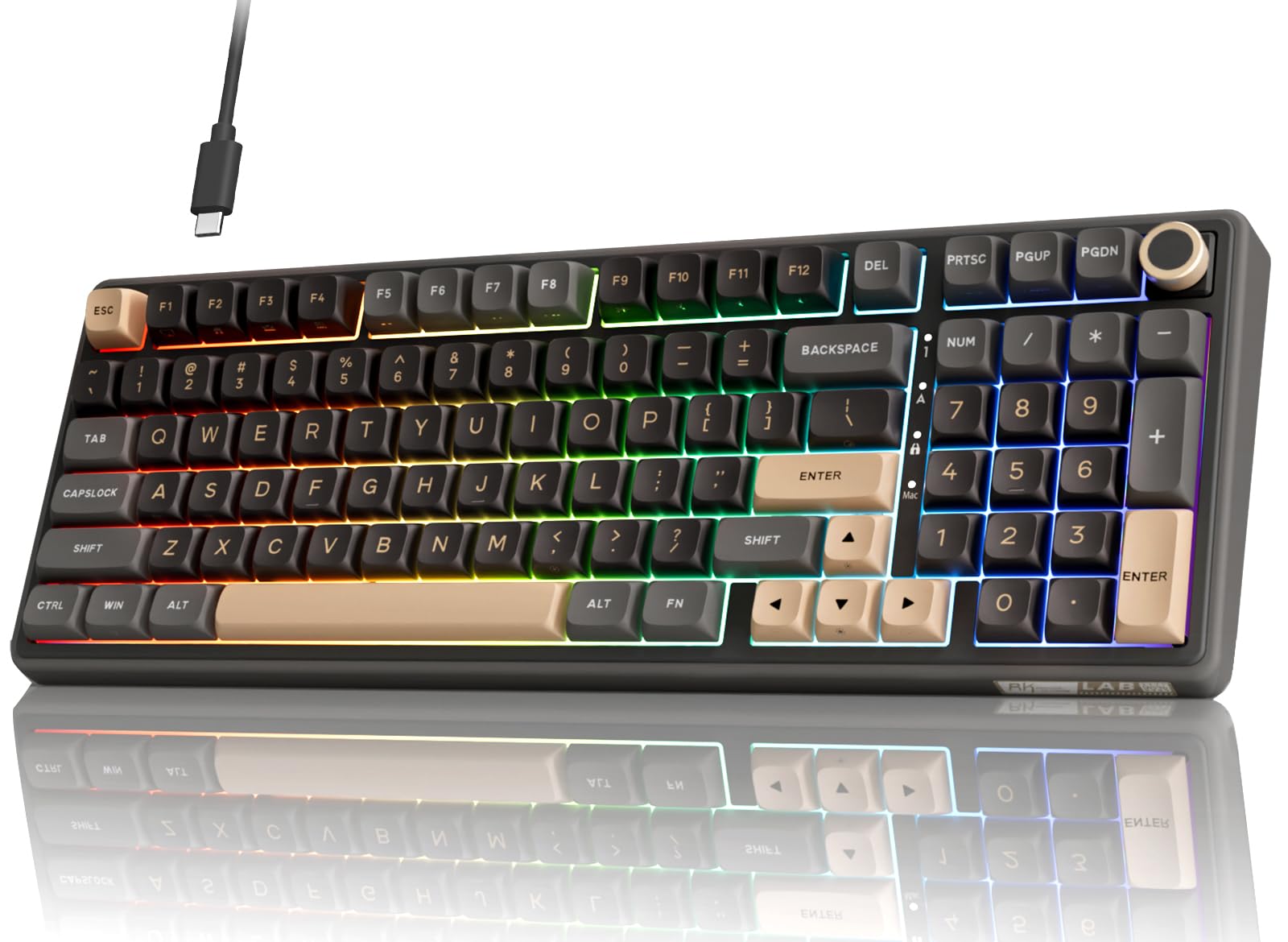
| RK ROYAL KLUDGE R98 ProNumpad Pro | Numpad in compact size | 96% / 98 Keys | Linear (Cream) | Wired (USB-C) | Amazon |
| SOLAKAKA A75 | Ratchety smooth feel | 75% / 81 Keys | Linear (LEOBOG Reaper) | Tri-Mode (2.4G / BT / USB-C) | Amazon |
| Redragon K580 PRO | Macro keys & media wheel | Full / 104 Keys | Linear (Red) | Tri-Mode (2.4G / BT / USB-C) | Amazon |
| AULA S75 Pro | LCD screen & thocky feel | 75% / 80 Keys | Linear (Pre-lubed) | Tri-Mode (2.4G / BT / USB-C) | Amazon |
| AULA S98 Pro | Big battery + numpad | 96% / 96 Keys | Linear (LEOBOG Star Vector) | Tri-Mode (2.4G / BT / USB-C) | Amazon |
| Corsair K70 CORE | Full-size wired reliability | Full / Wired | Linear (MLX Red) | Wired (USB-A) | Amazon |
| ASUS ROG Azoth | Customization & OLED | 75% / 81 Keys | Linear (ROG NX Snow) | Tri-Mode (2.4G / BT / USB-C) | Amazon |
In-Depth Reviews
1. GravaStar Mercury K1 Pro 75%
Our pick — over 4.5★ from 750+ verified ratings; the strongest balance of quality and price.
The cyberpunk-aluminum heavyweight that turns every coding session into a premium, satisfying ritual.
If you’re a programmer who treats your desk as a sanctuary, the K1 Pro is the one that makes you want to keep typing. Its aluminum alloy frame gives it a solid, rigid feel that most boards lack, and the gasket-mounted FR4 plate (a flexible circuit board layer) with a 5-layer foam structure produces that deep, creamy “thock” — a sound owners consistently rave about, calling it supremely satisfying and buttery smooth.
Under the hood, the GravaStar x Kailh Speedy Mint linear switches need only a light 45gf actuation force (the pressure to press a key) with 1.2mm pre-travel, so your fingers barely press to register a keystroke — a big win for long coding sessions. They’re rated for 70,000,000 keystrokes, so this board is built to outlast your career. It connects via 2.4GHz wireless, Bluetooth, or wired USB-C, and with lighting off, it sips power for up to 470 hours — you can leave it on the desk for weeks without reaching for a cable. The 79-key layout is compact yet complete, and the dedicated control knob lets you adjust volume or mute quickly during a focus sprint.
The trade-off is its cyberpunk aesthetic — this is a statement piece that loves flashy RGB setups, not a wallflower. Owners also note the linear switches lack a tactile bump, so if you live for that physical feedback, you might find it too smooth. It’s a crowd favorite with a 4.8-star average across over 700 ratings, a rare score for any peripheral.
Why Coders Adore It
- Premium aluminum build with dense, stable heft
- Thocky, creamy sound from the FR4 gasket mount and foam layers
- Blistering long battery life at 470 hours with lighting off
- Hot-swappable and programmable for full customization
Reality Checks
- Linear switches lack a tactile bump for touch typists
- Compact layout means no dedicated Home/End keys
- Sci-fi styling won’t blend into a minimalist office
Ideal for: The coder who wants a durable, great-sounding daily driver that feels like an end-game purchase.
Keep in mind: If you need tactile feedback or row of Home/End keys, a more traditional layout might suit you better.
2. RK ROYAL KLUDGE R75
The travel-ready 75% board that delivers a creamy, quiet typing experience without the premium price tag.
If your coding happens in coffee shops, co-working spaces, or anywhere you need to pack up quickly, the RK R75 is a natural fit. Its compact 68-key, 75% layout is smaller than the GravaStar’s, and owners specifically praise its solid construction and beautiful tactile feel. The pre-lubed Cream switches give a smooth, creamy sound — one owner calls it “creamy clacky” — that’s noticeably quieter than your average mechanical board, so you won’t annoy the whole office with your refactoring.
It switches between Bluetooth, 2.4GHz, and USB-C, and can pair with up to 3 devices — handy for hopping between a work laptop and a personal desktop. The 4000mAh battery inside is rated for at least 7 days of use, and it stretches even further with the RGB off. Buyers report getting 25-30 hours in practice, which means charging once or twice a week for full-time work-from-home duty. The gasket mount and five layers of sound-absorbing material keep the noise down and the feel stable, and the south-facing RGB offers more than 20 built-in lighting modes.
Like most budget boards, the keycaps let RGB shine through around the letters rather than through them, so legends don’t light up themselves — fine in daylight, less ideal in a dark room. It’s a small trade for a board that one long-term owner says feels durable after a year of heavy use. If you want the best balance of price, portability, and everyday comfort, this is the one that wins on value.
Smart buy for: The developer who switches desks often and wants a quieter, lighter board that still feels premium on a budget. It’s a serious upgrade over the Redragon K580 below for pure typing feel, though it trades away the dedicated macro keys.
3. RK ROYAL KLUDGE R98 Pro
A 96% layout that keeps your numpad and adds a buttery-smooth typing experience for data-heavy work.
For developers who crunch numbers, enter IP addresses, or work in spreadsheets as much as code, the R98 Pro is a godsend. It packs a full 98-key layout with the numpad, arrow keys, and most functions into a slightly tighter footprint than a full-size board, so you get all the keys without losing the whole desk. The 96% layout actually saves space compared to a full-size board while keeping everything you need.
Typing on it feels genuinely premium thanks to the five layers of sound-absorbing foam and pre-lubed Cream switches — reviewers describe the experience as “buttery smooth” and note the sound is a quiet, beautiful thunk-click. The MDA profile PBT keycaps sit differently than standard ones, providing a stronger sense of wrapping for your fingers, which can reduce fatigue on long days. Interestingly, this is a wired-only board (USB-C), which removes any wireless worry and makes it a rock-solid, zero-latency workhorse; owners note zero lag in gaming and appreciate the heavy, secure feel.
It’s not the best board for your neighbors, though — the knob sits close to the Page Down key and is a bit hard to grip, and some find the arrow and Shift/Enter layout cramped. One owner notes the “end” key is included to replace the knob if you prefer. This is the pick for the desktop-bound dev who types a lot of numbers and wants a quiet, solid board without paying for wireless.
Built for Productivity
- Full numpad in a space-saving 96% layout
- Buttery smooth pre-lubed linear switches
- MDA profile PBT keycaps that fit fingers better
- Zero-latency wired connection for work and gaming
Minor Quirks
- Volume knob sits too close to Page Down for easy grabbing
- Some keys feel slightly cramped for wide hands
- Wired-only, so you’re tethered to your desk
Reach for this if: Your daily work involves a numpad and you want that creamy, quiet mechanical feel on a wired desk setup.
Look elsewhere if: You need wireless flexibility or have very large hands that need more key spacing.
4. SOLAKAKA A75 75%
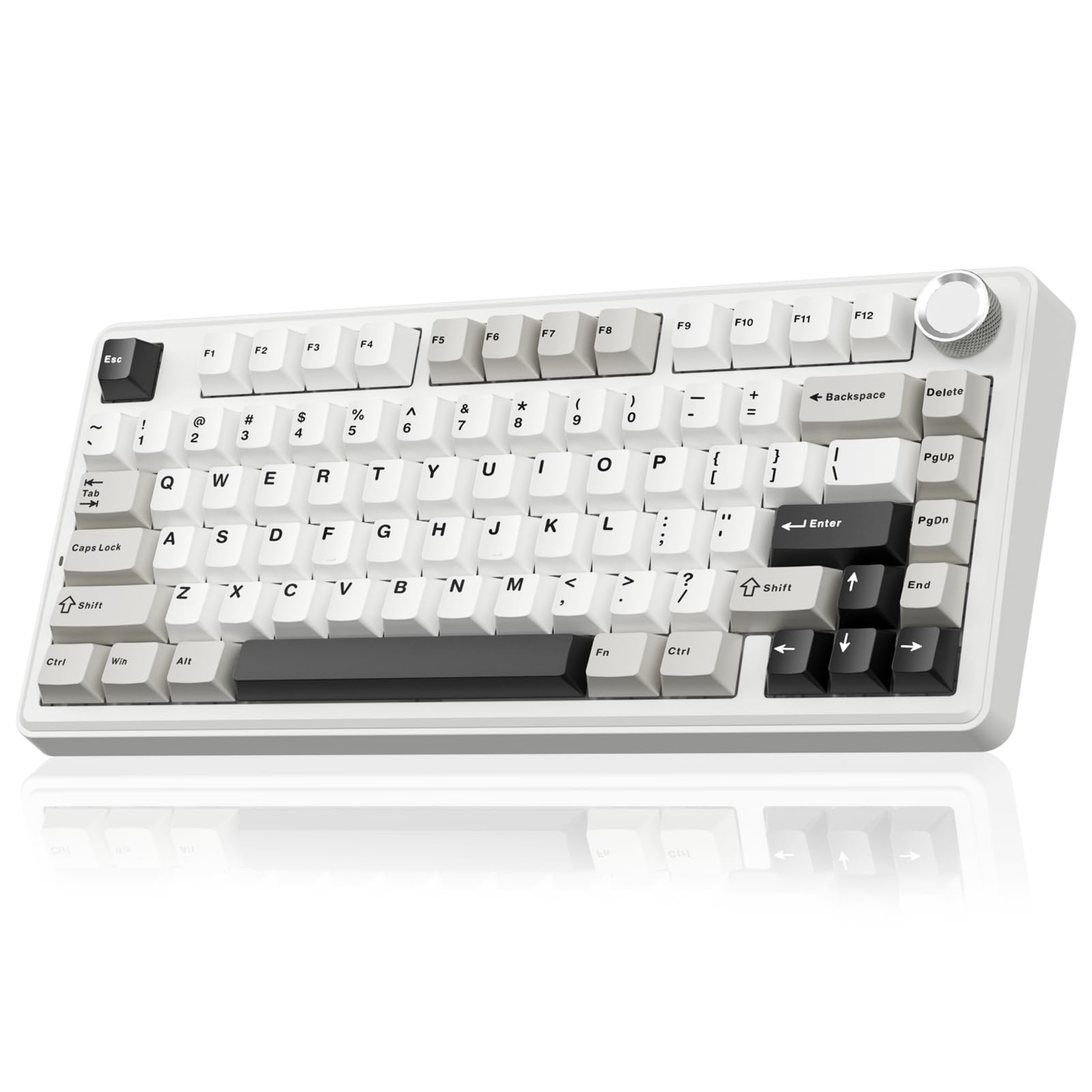
The silent, silky 75% board that feels heavenly to type on — without the premium sticker shock.
SOLAKAKA’s A75 is the sleeper hit of this list, a board owners describe as “heavenly to type on” and “the best keyboard under.” With 81 keys in a 75% layout (a compact size that keeps arrow keys), it’s a touch larger than the RK R75 but keeps the arrow keys intact. The LEOBOG reaper switches come pre-lubricated from the factory, so they feel precise and smooth right from the start — no switch-swapping needed, per multiple owners.
The creamy sound profile comes from a serious internal build: a gasket mount with PCB single-key slotting, IXPE shaft bottom pad, PET voice actor pad, silicone base mat, and PO sound-absorbing cotton. This means you get a soft, thocky sound that’s quiet enough for a shared office — one owner specifically noted it’s office-friendly. It also connects to up to five devices via three modes (2.4GHz, BT 5.0, USB-C) and works with Windows, Mac, and iOS.
The catch is mostly about RGB: the keycaps are opaque, so the 17 lighting modes are a subtle underglow rather than a light show, and the custom software only runs on Windows in wired mode. But the battery life is a big win — the 4000mAh cell handles a full work week easily, with owners calling the battery life “amazingly long.” For the coder who cares more about feel than flash, this is a genuinely lovely pick that punches far above its price class.
Feel-first choice: If you compared this head-to-head with the pricier GravaStar at the top, the typing feel is in the same league — owners say it’s comparable to the much more expensive Mercury K1. You lose the aluminum body and the battery runway, but you save a lot for a board that feels this good.
5. Redragon K580 PRO

The full-size workhorse with five dedicated macro keys and a media wheel for serious automation.
If your workflow is full of repetitive key sequences — launching builds, toggling servers, inserting boilerplate — the Redragon K580 PRO’s five dedicated macro keys (G1-G5) are a genuine productivity hack. You can record combos directly on the keyboard with no software required, which matters if your IT department locks down installs. This is the only board on this list with dedicated macro keys, making it a favorite for coders and gamers who want that extra edge.
It’s also a full-size, 104-key layout, so you get the numpad plus a media wheel for volume and playback. The hot-swappable socket accepts almost any 3-pin or 5-pin switch, so you can experiment with different feels over time — one owner swapped in Kailh White Pro switches and was thrilled. Connectivity is tri-mode (USB-C, Bluetooth, 2.4GHz) with near-wired responsiveness in the wireless modes, and the 104 keys support full anti-ghosting for rapid multi-key combos.
Opinions split on two things, though. Battery life and connectivity draw mixed feedback across the review base — some owners mention flawless wireless, while others hit re-pairing headaches. The stock Red linear switches are noticeably quieter than most, which is a plus for shared spaces, but the plastic shell lacks the reassuring heft of the aluminum boards on this list. It’s still a value-driven choice for keyboard users who want macros without paying for a high-end gamer brand.
Automation Edge
- 5 dedicated macro keys for on-the-fly combos
- Full-size 104-key layout with numpad
- Hot-swappable 3/5-pin switch socket
- Media wheel for quick volume control
Mixed Bag
- Connectivity and battery life draw mixed owner reports
- Plastic build feels less premium than metal boards
- RGB is nice but not as vibrant as top picks
Grab it for: The macro-hungry developer or gamer who wants a full-size layout and on-the-fly automation without spending big.
skip it if: You need flawless wireless stability or a denser, more premium aluminum feel.
6. AULA S75 Pro
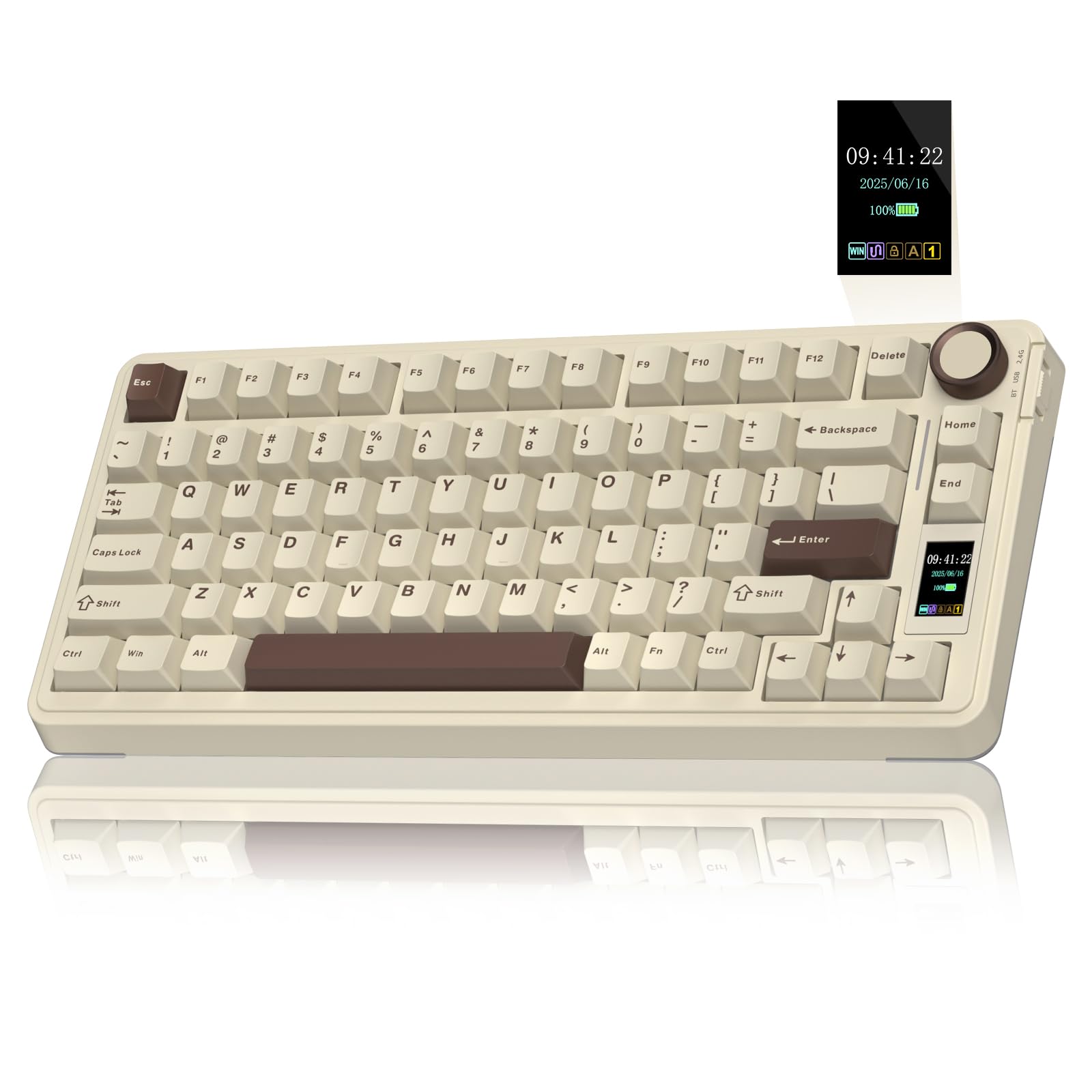
The thocky 75% board with a GIF-happy LCD screen that makes desk customization genuinely fun.
The AULA S75 Pro wins the attention game with a built-in LCD screen that shows battery status, date, time, operating system, and even custom GIFs — a small delight that makes your keyboard feel personal. Owners love this feature, calling the screen a highlight and the keyboard overall a “surprisingly good” budget-friendly custom experience. The creamy tactile feel is the other big praise point, with reviewers describing the typing as super responsive and creamy.
It’s a compact 80-key, 75% layout with a multi-function knob for controlling volume, RGB modes, and more. The tri-mode connectivity (BT 5.0, 2.4GHz, USB-C) supports up to five devices, and it’s compatible with Windows, Mac, iOS, and Android. The 19 RGB effects plus side lighting create a strong gaming atmosphere, and the hot-swappable base accepts 3-pin or 5-pin switches, so you can DIY your own feel. The battery sips power, too — customers note roughly 20 hours with full RGB, stretching to a week with sleep enabled.
The caveat: owners note the switches are a bit clacky rather than the “caramel latte” deep thock some expected, and the screen only activates fully on Windows in wired mode — Mac users get a default date display without customization. One owner adored it so much they called it a great gaming board even on an old PC. For the developer who wants a bit of desk personality and a great-feeling board, this is a delightful middle-ground pick.
Personality pick: If you’re torn between this and the SOLAKAKA A75 above, the difference is the screen and knob — the AULA gives you a customizable LCD and side lighting for a little more money, while the SOLAKAKA is a touch quieter and cheaper. Both deliver that creamy sound.
7. AULA S98 Pro
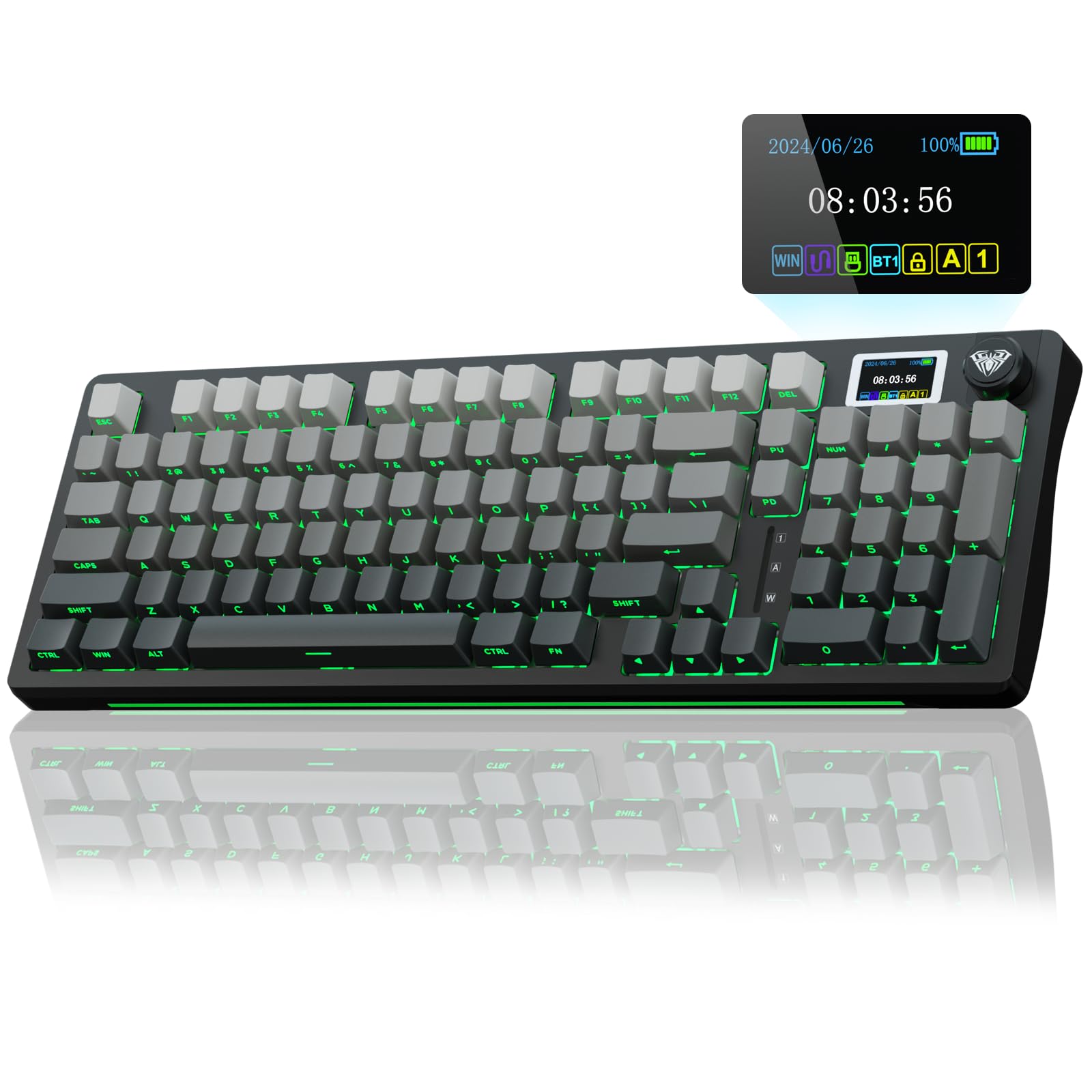
A 96-key board with the biggest battery here, built for weeks of wireless work without anxiety.
Battery anxiety is real, and the AULA S98 Pro is the cure. Its built-in 5000mAh battery is the largest in this lineup — owners routinely report it lasting weeks on a single charge, with one noting 70% remaining after three full workdays. If you’re a laptop-toting dev who hates carrying chargers, this board’s endurance is its superpower, letting you go wire-free for extended stretches.
The 96-key layout (with numpad) makes it a productivity machine, and the creamy sound is backed by five layers of sound deadening material plus an integrated silicone pad. The pre-lubed LEOBOG Star Vector switches are smooth and quiet from the start. It also has a smart LCD screen and multi-function knob for adjusting volume, RGB, and system mode, plus 19 RGB effects and over 16.8 million colors. The side-engraved PBT keycaps (with south-facing LEDs) keep legends readable in the dark, which matters for late-night debugging.
The main quirks are minor: the screen customization requires Windows in wired mode, and one owner found the USB dongle wasn’t recognized, though Bluetooth and cable worked fine. The knob has a slight play in it, and the side-printed legends take a moment to get used to. That said, it’s a huge amount of keyboard for the money — owners call it “the gold standard for out-of-the-box thock.” For coders who want a numpad, wireless freedom, and a battery that just won’t quit, this is the pick.
Why It Stands Out
- Massive 5000mAh battery lasts weeks on a charge
- 96-key layout includes the essential numpad
- Deep, creamy thock from 5-layer dampening
- LCD screen for GIFs, battery, and system status
The Trade-Offs
- Screen customization only on Windows in wired mode
- Knob has a slight play; dongle occasional issue
- Side-printed keycaps take getting used to
Best for: The developer who wants numpad + wireless + a battery that lasts for weeks, without paying premium prices.
Think twice if: You rely entirely on the USB dongle and want a simpler, more conventional layout.
8. CORSAIR K70 CORE RGB
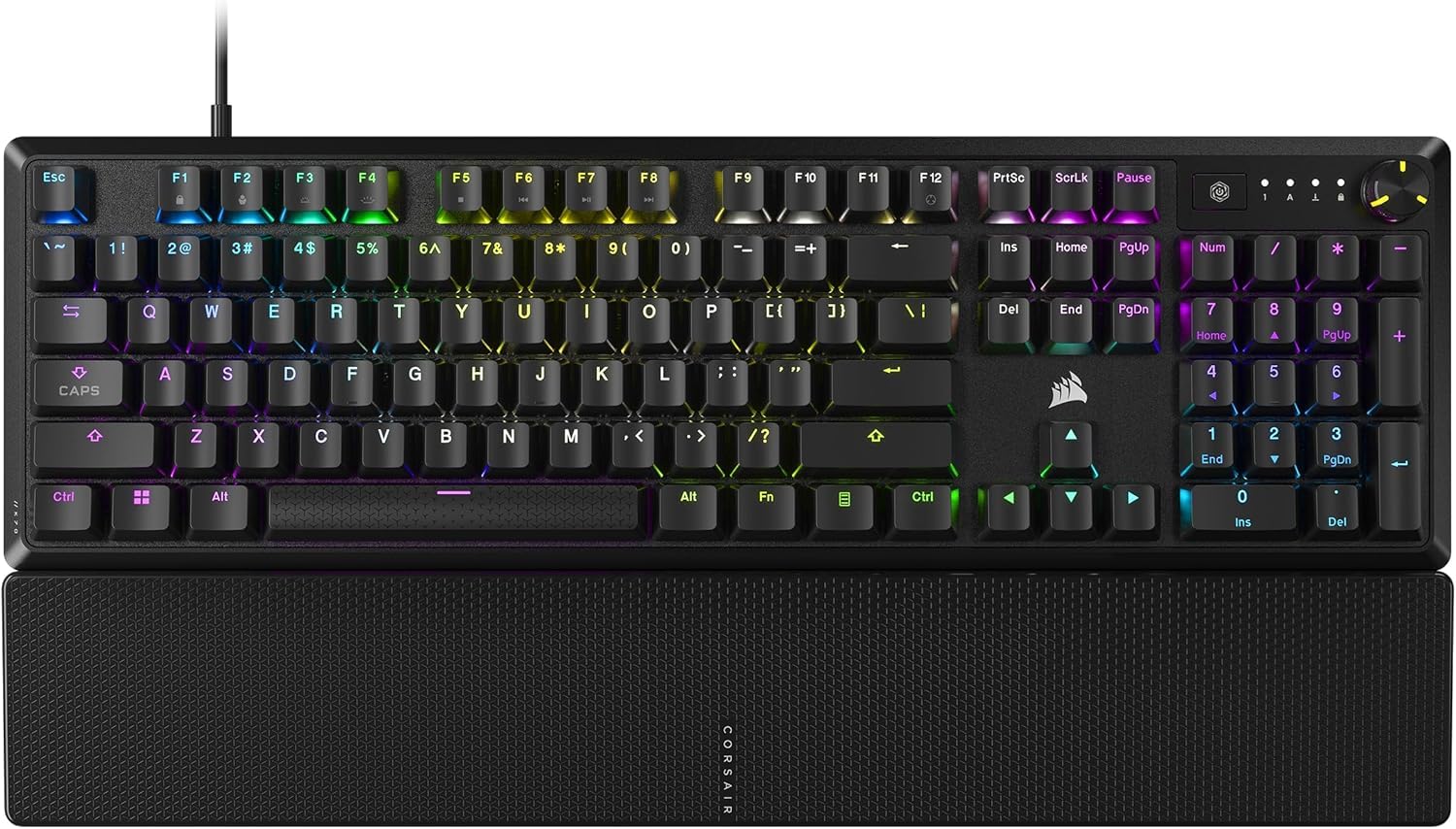
The full-size, wired favorite from a trusted brand — smooth, quiet, and instantly familiar for desktop workers.
Sometimes you just want a trusted name, and Corsair’s K70 CORE delivers that reliability in a full-size, wired format. It’s built around pre-lubricated MLX Red linear switches, and the two layers of sound dampening make it notably quieter than typical mechanical boards — owners call the typing “lovely mechanical feel without a ton of noise,” making it a great option for an open office, and one owner specifically said it’s great for work.
The aluminum top plate adds a layer of stability and a premium feel, while the magnetic, detachable soft-touch palm rest is a genuinely thoughtful addition for long days of typing — a feature most boards here lack entirely. The ABS double-shot keycaps are tough and won’t crack under pressure, and the multi-function rotary dial plus programmable media button give you quick volume and playback control, customizable through Corsair’s iCUE software. Plus, it saves your lighting settings directly to the board, so your custom RGB follows you even to a locked-down work PC.
The honest caveat is durability: while many owners have zero issues and love the feel, a meaningful portion report reliability problems — repeated keystrokes on specific keys (F1-F3 and 1-3) after a few months, or occasional freezes where the RGB stops and the function buttons stop working until you unplug and re-plug. The product listing itself flags function keys failing half the time. It’s a great-feeling, great-looking board when it works, and the brand support is there, but the longevity is more of a gamble than the budget favorites above.
Instant classic: This is the pick for the coder who wants a full-size, wired board with a comfortable palm rest and zero wireless setup fuss — you just plug in via USB-A and go. Just be aware the reliability reports are more mixed here than on the value picks.
9. ASUS ROG Azoth

The fully-loaded DIY dream for keyboard enthusiasts — complete with OLED screen and a professional lube kit.
The ROG Azoth is the enthusiast’s choice, a board as much for tinkerers as for typists. It comes as a complete DIY kit with Krytox GPL-205-GD0 lubricant, a switch opener, pullers, a lube station, and a brush — everything you need to build your own perfect switch feel, right in the box. The 81-key 75% layout is paired with pre-lubed ROG NX Snow linear switches that owners describe as “buttery smooth and thocky out-of-the-box,” with a typing experience that’s “incredibly satisfying.”
The 2-inch OLED screen is a genuine differentiator — it monitors CPU/GPU stats, media playback, and keyboard settings in real-time, and the multi-function control knob gives tactile adjustment for volume and lighting. For wireless, the ROG SpeedNova technology in 2.4GHz mode delivers ultra-low latency and an astonishing 2000+ hours of battery life with the OLED and RGB off — owners confirm the battery lasts roughly two weeks at 75% brightness, with flawless wireless performance even at 6-8 feet. It’s fully hot-swappable for 3-pin switches, and the PBT doubleshot keycaps feel premium.
The big ask is the price — it’s the most expensive board here by a wide margin, and owners openly say it’s pricey but that “quality justifies” it. The OLED customization is a bit limited, and GIFs can distort if changed wirelessly (you need to plug in). One owner calls it “unbeatable” with battery life they’ve never seen before. If you’re the kind of coder who loves to mod, tweak, and personalize every detail, this is the board that will keep you happy for years.
Enthusiast’s Dream
- Complete DIY kit with Krytox lube, opener, and pullers
- 2-inch OLED screen for real-time system stats
- 2000+ hours battery life in 2.4GHz mode
- Buttery smooth pre-lubed NX Snow switches
The Premium Cost
- Easily the most expensive board on this list
- OLED customization is somewhat limited
- GIFs distort if changed wirelessly — must use cable
Buy it for: The keyboard enthusiast who wants an end-game wireless board with OLED flair and a full modding kit included.
Pass if: You’re on a budget or just want a plug-and-play board without the DIY learning curve.
Understanding the Specs
Switch Types & Actuation
Mechanical switches come in three main types: linear (smooth, no bump), tactile (a bump at the press point), and clicky (bump plus an audible click). For coding, the key metric is actuation force, measured in grams (like the 45gf on the GravaStar) — lower force means lighter, faster keystrokes that are easier on your fingers over long sessions. Many boards are hot-swappable, letting you change switches without soldering to find your perfect feel.
Layouts & Key Counts
You’ll see three layouts: full-size (104 keys with numpad), 96% (around 96-98 keys with numpad in a tighter space), and 75% (around 68-81 keys with no numpad but arrow keys intact). The trade-off is desk space versus key availability. Coders who use a numpad for data entry tend to prefer 96% or full-size; those prioritizing mouse room and a shorter reach often choose 75%. Also check for a dedicated knob — great for quick volume control during focus sessions.
FAQ
What’s the best switch type for coding?
Should I get a 75% or full-size keyboard for programming?
What is a gasket mount and why does it matter?
How much battery life can I expect from a wireless mechanical keyboard?
What does “hot-swappable” mean and do I need it?
Will these keyboards work with macOS?
What’s the difference between linear and tactile switches for typing?
Is the RK R75 or the AULA S98 Pro better value for a programmer?
Final Thoughts: The Verdict
For most people, the coding mechanical keyboard winner is the GravaStar Mercury K1 Pro because it pairs a dreamy 470-hour battery and a durable aluminum body with the thocky, satisfying sound every reviewer raves about. If you want portability and a quieter, lighter feel on a budget, grab the RK ROYAL KLUDGE R75. And for the number-crunching dev who refuses to charge weekly, the AULA S98 Pro brings a numpad and a 5000mAh battery that simply won’t quit. Every board here is worth your desk — the only question is which layout and feel match the way you work.
How We Picked
We do not accept paid placement. Every pick is matched to a real buyer and a real use-case; we do not hands-on test units.
Sources & Methodology
Specifications: manufacturer listings and product documentation. Review insights: verified customer reviews, as of August 2026. Pricing: not shown on this page (it changes often); check the current price via the retailer link.
As an Amazon Associate, FitlyFast earns from qualifying purchases. This does not affect which products we feature.