
Our readers keep the lights on and the weekend projects moving. As an Amazon Associate, I earn from qualifying purchases.
Specs are compiled from manufacturer listings and verified buyer reviews and can change over time — please confirm the key details on the product page before buying.
A commercial toaster is the difference between a breakfast line that crawls and one that clears. The two styles you will meet are pop-up toasters with four slots for counter service, and conveyor toasters that feed bread through a heated tunnel continuously. This guide sorts the seven strongest performers by what actually matters in a busy kitchen — speed, even browning, and how long the heating elements survive daily abuse.
I’m Rikta — the founder and writer behind FitlyFast. This guide is built by comparing the manufacturers’ published specifications and the patterns across verified customer reviews, so you get each pick’s real strengths and trade-offs instead of marketing spin.
Find out which heavy-duty machine can handle your morning rush without burning the edges or stalling the line — this rundown of the best commercial toaster options is built on real owner experience, not spec-sheet promises.
Our Picks at a Glance

How To Choose The Best Commercial Toaster
Your daily output decides your toaster style before anything else. A 4-slice pop-up fits a small diner counter, while a conveyor unit keeps a buffet line moving non-stop. Match the machine to the volume, not the other way around.
Match the speed to your rush
Count the busiest hour of your day. Pop-up models handle a few slices at a time and need staff attention. Conveyor toasters run continuously, so you drop bread in one end and it emerges toasted at the other. If your breakfast service peaks hard, a conveyor’s steady throughput beats a pop-up’s batch cycle.
Check the heating element’s longevity
Heating elements are the first thing to fail under heavy use. Look for elements rated for long hours and check whether the manufacturer sells replacement parts. A toaster that dies after a few months stalls your line and costs far more than the purchase price.
Weigh stainless steel build against counter space
Stainless steel resists corrosion and wipes clean, but heavier machines need sturdy counter support. A 37-pound conveyor unit is a permanent fixture, while a 5-pound pop-up can move between stations. Measure your counter depth before committing to a large footprint.
Quick Comparison
| Model | Best For | Output | Weight | Heating Range | Amazon |
|---|---|---|---|---|---|
| Proctor Silex 24850R★ Best Overall | Hotels needing 450ºF heat | 4 slices | 6 pounds | 7 settings, 450ºF | Amazon |
| PYY Conveyor ToasterAlso Great | High-volume restaurants on a budget | 150 slices/hour | 37 pounds | 7 speeds | Amazon |
| Waring WCT704 Pop-Up | Diners needing wide-slot flexibility | 4 slices | 5.2 pounds | Rotary dial + 2 programs | Amazon |
| SUCISENI Conveyor Toaster | Cafes wanting 3 heating patterns | 300 slices/hour | 30.2 pounds | 7 speeds, 3 modes | Amazon |
| Waring CTS1000 Conveyor | Peak breakfast bars needing max output | 450 slices/hour | 27.9 pounds | 9 programs | Amazon |
| VEVOR TT-300 Conveyor | Large family breakfasts on a budget | 300 slices/hour | 30.6 pounds | 7 settings, 3 modes | Amazon |
| DIYAREA Conveyor Toaster | Compact counters with big output | 300-350 slices/hour | — | 7 colors, 3 modes | Amazon |
In-Depth Reviews
1. Proctor Silex Commercial 4 Slot Toaster 24850R
A 4-slot pop-up that hits a searing 450ºF for hotels and restaurants needing fast, even browning.
The Proctor Silex 24850R earns its place on raw heat output — it adjusts up to 450ºF, which is hotter than most pop-up toasters ever get. That temperature headroom means it recovers quickly between batches, a real advantage in a hotel breakfast room where guests queue up for toast. The extra-wide 1 3/8-inch slots swallow bagels, waffles, and artisan breads, while the self-centering guides hold each slice in the middle of the heat for even browning on both faces.
Practical touches make it kitchen-friendly: a front crumb tray slides out for quick cleanup, and the toast-boost feature lifts slices high enough to grab without burning your fingers. At 11.5″D x 13″W x 8.8″H, it is a compact footprint compared with conveyor units — about 81% more compact than the PYY conveyor in depth and width — so it fits on a tight counter where a conveyor would not. The brushed stainless finish keeps it looking sharp in a front-of-house setup.
The reliability record is the honest concern here. Customers note the 24850R failing after 2 years with one of two control boards dead, leaving half the unit unusable, and warranty claims have been denied for units sold by third-party retailers. Another unit failed on one side after 8 months with the same warranty dead-end. Some owners also note the lever does not always look engaged and there is no visible indicator that heating has started — quiet enough that staff miss the finish beep and forget orders. It is a powerful toaster when it works, but the durability and support questions are real.
Heat when you need it: the 450ºF ceiling and self-centering guides deliver fast, even browning in a compact 4-slot body.
Plan for the worst: the warranty path is rocky for third-party purchases and some units fail on one side within a year.
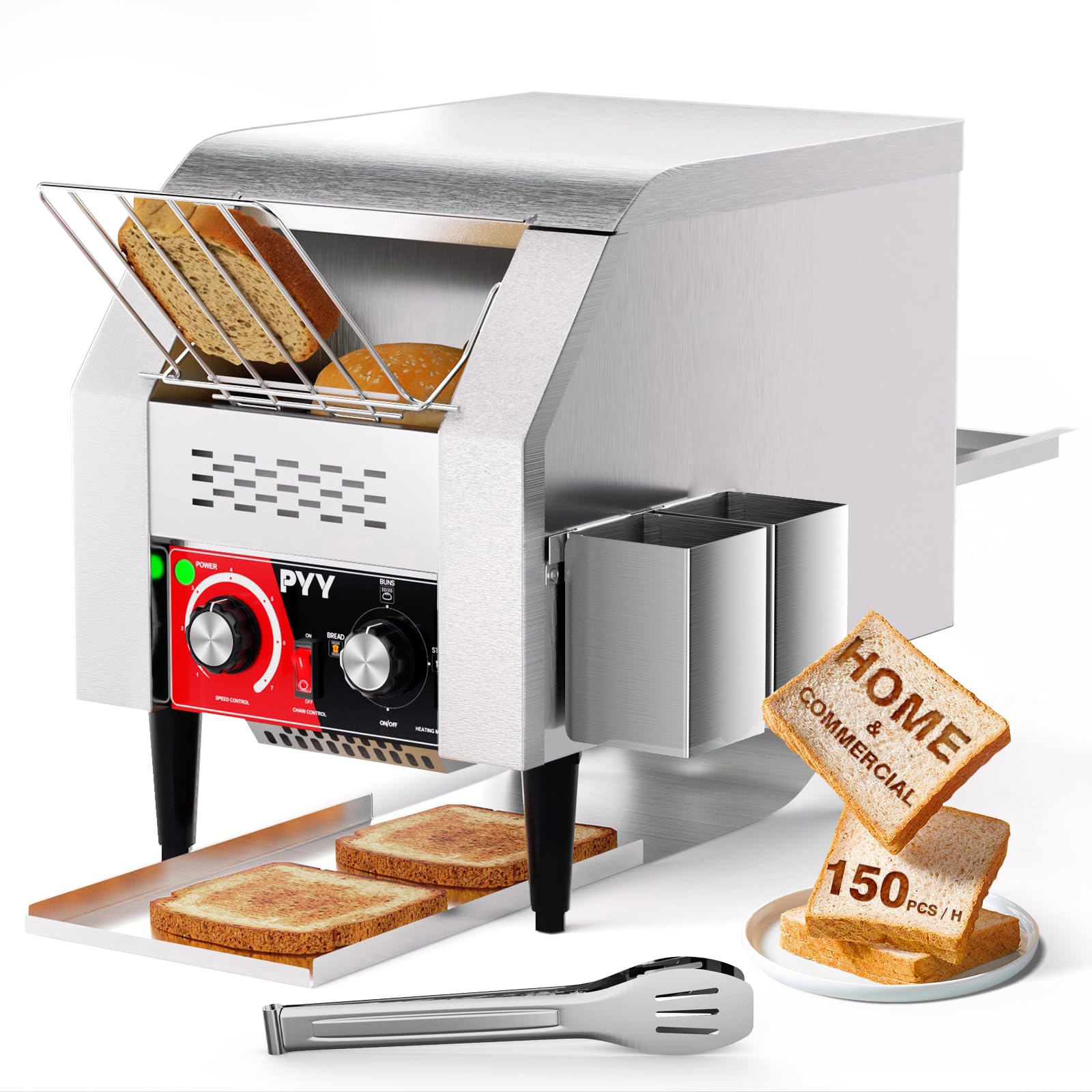
2. PYY Commercial Conveyor Toaster 150pcs/h
The conveyor workhorse that keeps a busy breakfast line moving without breaking the budget.
The PYY conveyor toaster earns the top spot because it nails the two things a commercial kitchen needs most: steady throughput and honest reliability. It pumps out 150 slices of toast per hour, and the 7-speed knob lets you dial the browning level by slowing or speeding the belt. The 37-pound stainless steel build gives it a planted, heavy feel on the counter, and four non-slip feet keep it stable during the rush.
What wins people over is the build quality — it is the most-praised trait in the owner feedback, and the functionality draws nearly the same level of enthusiasm. One high-volume restaurant owner reports it “works well after constant use daily,” which is the exact scenario this machine is designed for. The front-or-rear output switch is a thoughtful touch, letting you route finished toast to whichever side fits your service flow. The removable crumb tray and food-grade chain net make the end-of-shift cleanup a quick wipe-down instead of a project.
The honest trade-off shows up in the toasting consistency. Owners note the toast level needs occasional adjusting on the conveyor, so it is not a low-maintenance machine — expect to nudge the knob as different breads come through. Durability gets mixed feedback too, with a couple of units failing within a year. That said, one owner who had heating elements fail at the 9-month mark got same-day repair instructions from support and fixed it with two screws — a much better outcome than being stuck with a paperweight.
What Wins Owners Over
- Fast, continuous 150-slice-per-hour throughput keeps lines moving
- Quality build is the most-praised trait in the feedback
- Prompt, effective customer support for repair guidance
Where It Trips Up
- Toast level needs regular adjustment between batches
- A few units have failed before the one-year mark
Reach for this if: you run a busy restaurant or buffet and want a capable conveyor toaster that won’t break the bank.
Keep your hand on the knob: the browning consistency needs occasional tweaking as you switch bread types.
3. Waring 4-Slice 2-Slot Toaster with Extra-Long Slots
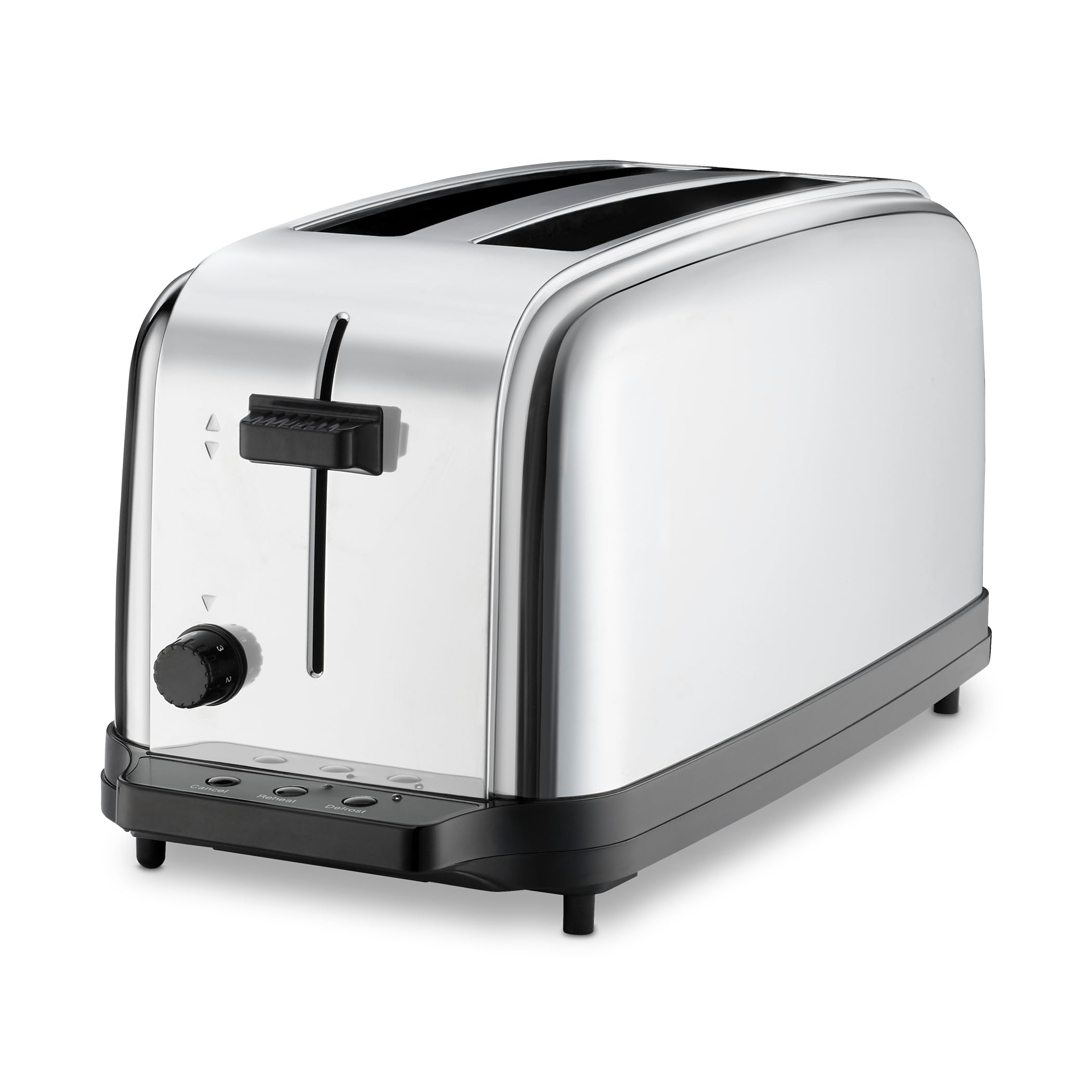
The 5.2-pound pop-up with extra-long slots that handles odd-shaped artisan breads without a fight.
When your menu runs thick-sliced artisan loaves or homemade bread, the Waring WCT704 earns its spot with two extra-long, extra-wide 1-3/8-inch slots. The self-centering bread rack grips the thinnest slices so both faces brown evenly, and the chrome plated steel shell keeps the 5.2-pound body feeling solid on the counter. A rotary dial handles browning level, while push-button controls cover defrost, reheat, and cancel with clear LED indicators.
You get even toasting that owners trust for decades — one buyer compared it directly to a 23-year-old Cuisinart model, calling the Waring its identical successor and noting it toasts more evenly than anything else they have used in 42 years. The long slots are the recurring highlight, fitting wide loaves that smaller toasters reject, and the sides reportedly stay cool even mid-cycle. That track record explains why it is a frequent replacement for older units in the same kitchen.
The catch is batch consistency. When toasting 4 slices versus 2, you need to add about 1.5 to the browning knob — a quirk that takes a shift or two to learn. Reviewers also report defective units that toasted one side only and burned edges, enough that buyers returned replacements. And the thin metal shell feels lighter than the price tag suggests to some hands. For a diner counter that serves mostly standard bread, though, the even toasting and wide-slot flexibility are genuinely tough to top.
Decade-grade reputation: owners measure this toaster’s life in years, not months, and the extra-long slots handle breads other pop-ups reject.
The learning curve: expect to adjust the knob about 1.5 notches when doubling from 2 to 4 slices.
4. SUCISENI Commercial Toaster 300 Slices/Hour

A 30.2-pound conveyor with three heating patterns and a 1-year warranty backing its 300-slice output.
The SUCISENI conveyor toaster stands out because it splits its heating elements into patterns most competitors skip. The STBY function runs both upper and lower tubes at low temperature, BUNS fires only the upper tube for high heat, and BREAD engages both tubes for full-power toasting. That flexibility matters when your menu mixes buns, croissants, and sliced bread across the same shift. The 7 heat settings control the conveyor speed — darker toast means a slower belt — so color stays consistent batch after batch.
Owners running food trailers and diners describe it as a workhorse that toasts buns “all day long,” and the 1900W heating element gets up to temperature fast. The smooth stainless surface resists oil and dust buildup, and the removable chrome crumb tray pops out for quick cleaning — a real upgrade over machines that force you to flip the whole unit. The brand backs it with a one-year warranty and a 24-hour response service, which matters when your line depends on the machine.
The honest caveat is that toasting consistency earns mixed reviews — some units drop out cold or miss even browning, so it is not a guaranteed slam dunk. One owner who had an upper heating element fail at 5 months got replacement parts from the seller quickly and fixed it in five minutes, which speaks well of the support. The rear heat vents keep the chassis cool during long runs, and four adjustable-height non-slip feet let you level it on uneven countertops.
Pattern flexibility: the three heating modes — low for both tubes, upper-only for buns, full for bread — set it apart from single-mode conveyors.
Support you can count on: a one-year warranty and responsive parts service soften the mixed consistency reports.
5. Waring Heavy-Duty Conveyor Toaster with 450 Slices per Hour
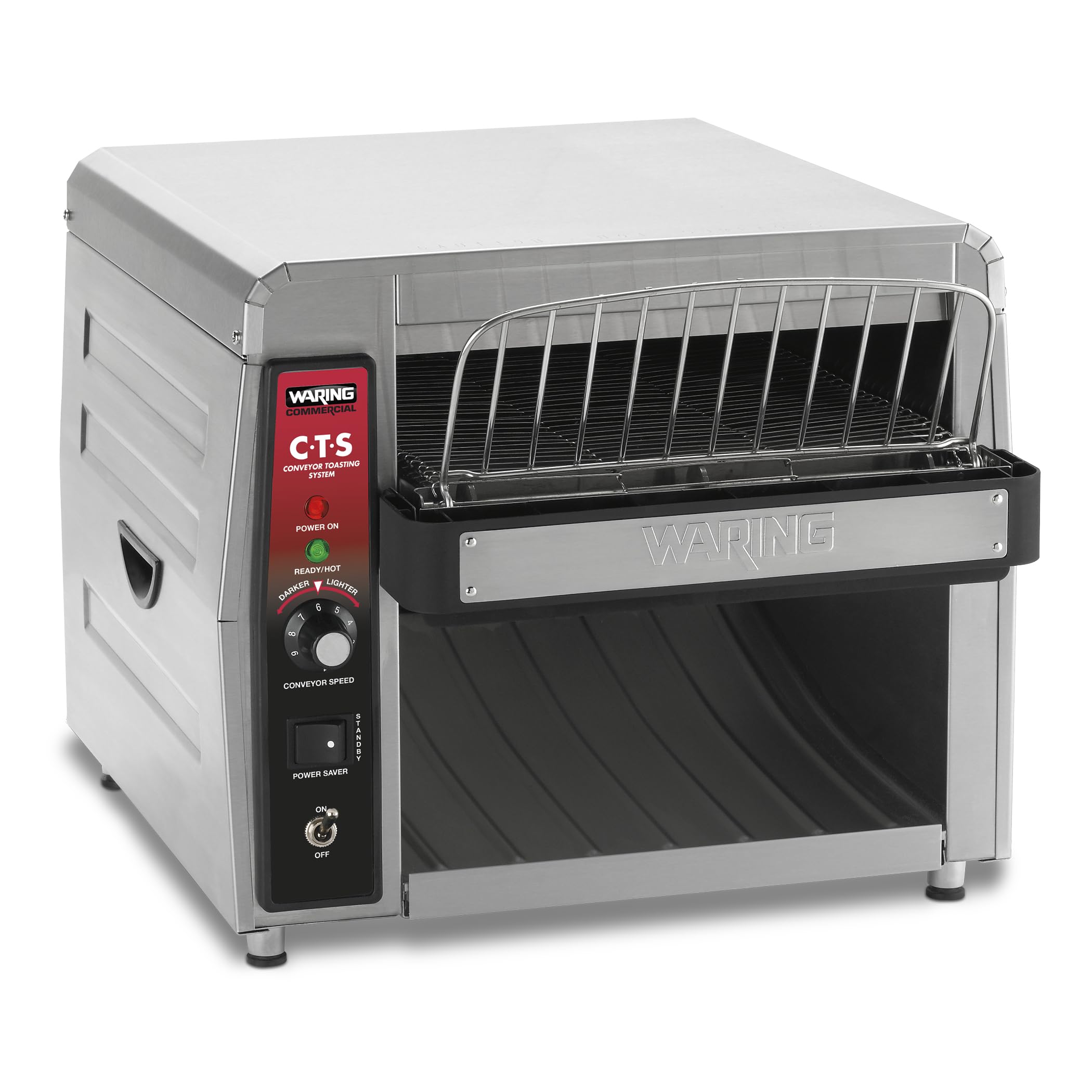
The 27.9-pound conveyor that chews through 450 slices an hour for the busiest breakfast bars.
The Waring CTS1000 is the output king of this lineup, processing up to 450 slices per hour — enough to keep a peak-service breakfast bar stocked without a single gap in the line. The 2-inch-wide slot takes artisan breads and thick bagels without jamming, which owners say took real searching to confirm before buying. The 1800W heating element drives serious throughput, and it runs on standard 120V so it drops into most commercial kitchen circuits without special wiring.
The durability story here is split, and honesty demands both sides. One owner reports using the toaster daily for 4 years, switching it on at 6 a.m. and off at 2 p.m., and it still works perfectly — the kind of longevity every kitchen hopes for. Others describe it as dependable and consistent, with the only complaint that the numbers on the browning knob wear off with heavy use. The brushed stainless steel shell wipes down easily and carries the professional look a front-of-house buffet needs.
The flip side is that some units fail early — one stopped working after two months, and the reliability feedback overall is genuinely mixed. The POWER ON and READY indicator lights help you know when it is actually up to temperature, which removes some guesswork. At 15.5 x 13.5 x 19.5 inches, it is compact enough for countertop placement despite its commercial-grade output. Buyers report the mouth is wide enough to pass artisan-size slices without sticking, which is the detail that separates this from tighter-throated conveyors.
The Long-Haul Credentials
- 450-slice-per-hour output clears the busiest rushes
- Owners mention 4 years of daily use without failure
- 2-inch-wide slot swallows artisan breads and thick bagels
The Reliability Gamble
- Some units stop working within two months
- Knob numbers wear off with heavy daily use
Pick it for: breakfast bars and diners that need maximum throughput and have a track record of maintaining equipment.
Think twice if: you cannot afford a failure in the first months — the reliability reports are too split to guarantee.
6. VEVOR Commercial Conveyor Toaster, 300 Slices/Hour

A 30.6-pound budget conveyor that promises 300 slices an hour with dual-knob precision control.
The VEVOR TT-300 enters the list as the value-oriented conveyor, offering a 300-slice-per-hour rating at a price that undercuts most of the competition. It brings a food-grade 304 stainless steel chain mesh to move bread smoothly, and the 840 stainless steel heating element is built for even heat across long hours. The 28.9″D x 14.4″W x 17.1″H footprint is sizable, so it is a permanent counter fixture rather than a tuck-away appliance.
Control comes from two knobs: one sets your toastiness across 7 levels — the darker the setting, the slower the belt — and the other switches between 3 heating modes. The upper and lower elements work separately, which lets you adjust for buns versus bread. The removable crumb tray catches the fallout, and the smooth stainless surface resists oil buildup, so the end-of-shift cleanup is a quick wipe and rinse.
The owner reports here are the weakest in this lineup, and they deserve a straight read. Units have arrived with a conveyor that would not turn, others failed to toast even on the darkest setting, and one restaurant owner went through two units that both refused to work. The brand’s support has been slow to respond, which compounds the frustration. A low-noise operation is claimed, but the reliability questions make this a gamble — you may get a workhorse or you may get a return label. For the price, it is the entry point into conveyor toasting, but budget buyers should expect to roll the dice.
The price-to-output story: 300 slices per hour for a budget-tier buy is the appeal, with dual-knob control over 7 settings and 3 modes.
The reliability risk: too many units arrive dead or fail to toast — support has not consistently made it right.
7. DIYAREA Commercial Conveyor Toaster 300 Slices/H

A compact 14.4-inch-deep conveyor that packs 300-350 slices an hour into a small counter footprint.
The DIYAREA conveyor toaster is the space-saver of the group, with a 14.4″D x 16.5″W x 15.2″H body that fits where larger conveyors will not. Despite the small footprint, it rates 300-350 slices per hour — a serious throughput for a machine this size. The 304 food-grade stainless steel frame and stainless-aluminum chain are built for food-safe, corrosion-resistant service, and owners running BBQ restaurants use it daily for frozen garlic toast and burger buns.
It offers 7 baking colors and 3 heating modes, so you can tune the crispness level for different breads. The front-or-rear output lets you route finished toast to whichever side suits your service counter, and the setup is simple enough that staff pick it up within a shift. One owner sums up the appeal perfectly: “This thing is so fun! Even frozen garlic toast from the store after a few passes is just perfect!” For a small restaurant or cafe, the combination of compact size and high output is genuinely useful.
The lifespan is the concern that keeps it near the bottom of the list. One unit lasted only four months, another quit after three months with no return or repair path available. The brand does warn that new machines emit odor and smoke for the first 30 minutes as lubricating oil burns off — a normal break-in, but surprising if you are not told. When they run, reviewers point out they work excellently day after day. When they fail, the support options look thin. It is a fun, capable machine for the right setup, but durability is a real question mark.
Big output, small footprint: 300-350 slices per hour in a 14.4-inch-deep body is the standout combination here.
The lifespan gamble: too many units have died inside four months with no easy fix path.
Understanding the Specs
Output Rate (Slices Per Hour)
This is the single most important number for a commercial toaster. It tells you how many slices the machine can finish in 60 minutes of continuous running. A 150-slice conveyor suits a small cafe, while a 450-slice unit handles a peak breakfast bar. Match the rate to your busiest hour — not your average one — or the line backs up exactly when you need speed most.
Heating Patterns and Speeds
Conveyor toasters control browning by adjusting belt speed and heat. More settings mean more precision — 7 heat levels is the common standard, letting you slow the belt for darker toast. Some machines split upper and lower heating elements so you can toast buns differently from bread. More patterns give you flexibility, but they also add controls your staff must learn.
Build Material and Weight
Stainless steel resists corrosion and wipes clean, making it the standard for commercial kitchens. Weight signals stability and build density — a 37-pound conveyor feels planted, while a 5.2-pound pop-up is portable. Heavier machines need sturdy counter support and are hard to move between stations. Choose based on whether the toaster will live in one spot or travel.
Slot Width and Self-Centering
Slot width decides which breads fit. Extra-wide 1 3/8-inch slots accept bagels, waffles, and artisan breads that standard slots reject. Self-centering guides hold slices in the middle of the heat so both faces brown evenly. If your menu runs thick-cut or odd-shaped breads, these two features matter more than raw output.
FAQ
What is the difference between a conveyor and a pop-up commercial toaster?
How many slices per hour do I actually need?
How long does a commercial toaster last?
Can a commercial toaster handle bagels and artisan breads?
What voltage do commercial toasters need?
Why does my new conveyor toaster smell or smoke at first?
How do I clean a commercial toaster?
Is a commercial toaster worth it for a small business?
What is a self-centering bread guide?
Why do some toasters have separate upper and lower heating elements?
Final Thoughts: The Verdict
For most buyers, the best commercial toaster is the PYY Conveyor Toaster because it delivers honest 150-slice throughput, a quality stainless build, and responsive support at a budget-friendly price. If you want max output for a peak breakfast bar, grab the Waring CTS1000 for its 450-slice capacity. And for wide-slot flexibility with artisan breads, the Waring WCT704 is the one to reach for.
How We Picked
We do not accept paid placement. Every pick is matched to a real buyer and a real use-case; we do not hands-on test units.
Sources & Methodology
Specifications: manufacturer listings and product documentation. Review insights: verified customer reviews, as of August 2026. Pricing: not shown on this page (it changes often); check the current price via the retailer link.
As an Amazon Associate, FitlyFast earns from qualifying purchases. This does not affect which products we feature.