
Our readers keep the lights on and the weekend projects moving. As an Amazon Associate, I earn from qualifying purchases.
Specs are compiled from manufacturer listings and verified buyer reviews and can change over time — please confirm the key details on the product page before buying.
You keep reaching for the remote to rewind because the actors mumble, the explosions roar, and the voices get buried. That is exactly what a dedicated center channel speaker fixes — it is the one speaker in a home theater built solely to carry dialogue, vocals, and the midrange where human speech lives. The right one makes voices crisp and clear without you having to crank the volume, and this guide sorts through the real choices so you can stop guessing and start hearing.
I’m Rikta — the founder and writer behind FitlyFast. This guide is built by comparing the manufacturers’ published specifications and the patterns across verified customer reviews, so you get each pick’s real strengths and trade-offs instead of marketing spin.
Find a top-tier center channel speaker for dialogue that turns muffled movie talk into clear, natural voices you can actually enjoy.
Our Picks at a Glance


How To Choose The Best Center Channel Speaker For Dialogue
Buying a center channel is not about picking the loudest box. It is about picking the one that makes voices sound natural, cuts through action scenes, and fits the space you actually have. Before you compare wattage or looks, lock in the three things that truly decide dialogue performance.
The drivers do the talking
The woofers and tweeter are what shape vocal sound. A larger woofer, like a 5.25-inch driver, moves more air and delivers fuller, more natural voices than a smaller one. The tweeter handles the crisp high notes that give speech its clarity, so a quality dome tweeter — silk, titanium, or aluminum — matters just as much as the woofer size.
How the speaker is built decides how it sounds
A 2-way speaker splits the audio between a woofer and a tweeter, which is the most common and affordable design. A 3-way speaker adds a dedicated midrange driver, which often means smoother transitions between frequencies and more natural voices. Pay attention to the crossover, the component that splits the sound, because a well-designed crossover keeps the drivers working together instead of fighting each other.
Size is a real decision, not an afterthought
Center channels range from slim bars that slide under a TV to large cabinets that need a dedicated stand. A bigger cabinet usually means deeper bass and more presence, but it also demands physical space. Measure your entertainment center before you buy, and remember that a speaker that does not fit is a speaker you will not enjoy.
Quick Comparison
| Model | Best For | Design | Woofer Size | Tweeter | Amazon |
|---|---|---|---|---|---|
| Klipsch RP-504C★ Best Overall | Large rooms & loud, clear dialogue | 2.5-Way | 5.25 in | Titanium | Amazon |
| Micca MB42X-CBudget Champion | Budget-friendly compact setups | 2-Way | 4 in | Silk Dome | Amazon |
| Yamaha NS-C210Compact Pick | Compact spaces & small rooms | 2-Way | — | Balanced Dome | Amazon |
| Polk Monitor XT30 | Hi-res audio & budget Atmos | 2-Way | 5.25 in | 1 in | Amazon |
| Fluance Signature | Warm, natural vocals | 2-Way | 5 in | Neodymium | Amazon |
| ELAC Debut 2.0 C5.2 | Near-wall placement | 2-Way | 5.25 in | Cloth Dome | Amazon |
| Sony SS-CS8M2 | Small spaces & Sony receivers | 2-Way | 3.94 in | High-Precision | Amazon |
| Klipsch RP-404C | Movies & music bass punch | 2-Way | 4 in | Titanium | Amazon |
| Polk ES35 | Slim spaces under a TV | 2-Way | 3 in (x6) | Terylene | Amazon |
| ELAC Uni-Fi 2.0 UC52 | Reference-level 3-way clarity | 3-Way | 5.25 in | Wide-Roll Dome | Amazon |
| SVS Prime Center | High-output home theaters | 3-Way | 5.25 in | Aluminum Dome | Amazon |
In‑Depth Reviews
1. Klipsch RP-504C Reference Premiere Center Channel Speaker
Our pick — over 4.5★ from 950+ verified ratings; the strongest balance of quality and price.
The crowd-favorite heavyweight that turns a mumbling soundtrack into clear, room-filling dialogue.
This is the speaker owners point to when they talk about voices, midrange, and bass all standing out in TV and movies. The secret is a 2.5-way design with dual crossovers, meaning the two 5.25-inch Cerametallic woofers split the work so the dialogue band gets dedicated attention instead of being stretched thin. A vented titanium tweeter adds the crisp high end that makes speech sound alive rather than boxy.
The horn-loaded front is engineered for wide dispersion, which is a fancy way of saying the sound stays clear even when you are sitting off to the side rather than dead center. At roughly 90dB real efficiency, it plays loud without demanding a huge amplifier. Buyers report it pairs beautifully with other Klipsch RP components, and several note the 504C is the smarter buy over the newer 504C II because the performance is comparable at a lower price.
There is a catch, and it is physical: this is a very large, heavy speaker. A few owners had to buy a new TV stand to fit it, and one had to wall-mount the TV entirely. The good news is Klipsch says a TV up to 75 lbs can sit on top, so it doubles as a sturdy platform. One first unit arrived damaged in a single delivery, which happens with heavy gear, but the replacement was perfect.
What wins people over
- Dialogue clarity that owners call vastly better than any soundbar they tried
- Furniture-grade wood cabinet that looks and feels premium
- Wide off-axis sound keeps voices clear from side seats
- Efficient design plays loud from a modest receiver
What to plan around
- Massive footprint demands a big stand or a wall-mounted TV
- Heavy enough that you will want a second pair of hands
- Needs a break-in period before it sounds its best
Reach for it if: you have the space and want the highest-rated dialogue performance for a large room.
Measure twice first: this footprint is bigger than most owners expect, so check your stand before ordering.
2. Micca MB42X-C Advanced 2-Way Passive Center Channel Speaker
The compact budget pick that handles dialogue beautifully at low volumes while staying affordable.
At this size and price, the twin 4-inch woven carbon fiber woofers look far more expensive than they are, and owners say the balanced design handles dialogue better at lower volumes than pricier centers. The silk dome tweeter delivers smooth treble and accurate imaging, so voices sound natural rather than harsh. It pairs exceptionally well with Micca bookshelf speakers, and one owner reported it fills a 20 x 15 room effectively.
There is a real caveat baked into the reviews: the sound starts out hollow and needs a 30-40+ hour break-in before the bass opens up and becomes exceptional. That means you should not judge it on day one. Owners who stuck with it describe a near-audiophile speaker that outperforms its price, with one noting it is exceptional for hearing-impaired listeners because vocals and mids stay crisp and clear after receiver tuning.
It is noticeably compact, so do check the dimensions before you buy. A couple of owners note the tweeter runs slightly bright and can add a faint hiss to “s” sounds, which is a minor trade-off at this level. For a small or mid-sized home theater with a subwoofer handling the deepest bass, this is the value king.
Compact workhorse: impressive dynamic range for its size, and the carbon fiber woofers keep the low and midrange tight without muddying the highs.
Buy it if: you want the most dialogue clarity per dollar in a small room.
Be patient: budget 30-40+ hours of break-in before the bass truly arrives.
3. Yamaha Audio NS-C210BL Center Channel Speaker
The small speaker that projects dialogue far beyond its size, ideal for cramped apartments.
As owners put it, this little box “projects sound at a far greater distance than I anticipated with plenty of bass.” The light aluminum cone woofers give extra-fast response, and the 7/8-inch balanced dome tweeter keeps dialogue crisp. In a cramped apartment paired with tower speakers, owners mention dialogue is now much clearer without needing the volume cranked.
You can place this speaker on a fireplace mantle without overhang thanks to its thin depth, and its compact height fits under a 75-inch TV, as several owners confirmed. The Yamaha Piano Black finish looks elegant, and the build quality is solid, with screw terminals that accept banana plugs. Its six-ohm design worked smoothly with five 8-ohm JBL speakers in one 5.1 setup, so it pairs well with mixed brands.
The honest limit is output: it is not loud enough for large rooms, so treat it as a desktop or small living room center. Bass is limited given the size, which is expected, but for dialogue clarity in a tight space, owners consistently call it a great value.
Space-saver with punch: the best fit for anyone whose TV sits low or whose shelf is shallow, delivering clear dialogue without dominating the room.
Choose it if: you need a slim, attractive center that disappears into a small setup.
skip it if: you have a large open living room that needs serious volume.
4. Polk Audio Monitor XT30 Compact Center Channel Speaker

A compact center that promises hi-res dialogue and blends smoothly with Polk’s newer towers.
Polk designed this to deliver crisp dialogue using a 1-inch tweeter and two 5.25-inch Dynamically Balanced woofers (a design that smooths mid-range bass). It works with 4- and 8-ohm receivers, and it supports Dolby Atmos and DTS:X surround sound — formats that keep dialogue locked to the screen. As the entry point to Polk’s timbre-matched Monitor XT series, it blends smoothly with MXT60 towers and the MXT12 sub, so your front speakers sound like one unit.
Owners describe the sound as genuinely good, with clear dialogue and strong value, especially when paired with Polk bookshelf speakers and a Yamaha Atmos receiver. The build is solid, and one owner using 12-gauge wire noted the terminals handled the thick cable without bunching.
Two honest notes: the speaker is bigger than the photos suggest, and one owner had to raise the TV to fit it under the screen. Also, a careful owner measured the woofer at 4.5 inches rather than the advertised 5.25 inches, so expect a compact sound rather than a bass monster. The fabric cover does not come in black to match darker setups.
Strong value: a well-reviewed, affordable step into a hi-res home theater with dialogue clarity that owners call a great deal on sale.
Best for: building a Polk Monitor XT system on a budget without sacrificing modern audio formats.
Check the fit: it is taller than expected, so measure your TV clearance first.
5. Fluance Signature HiFi 2-Way Center Channel Speaker

The timbre-focused center that makes voices sound warm, full, and natural rather than thin.
Fluance built this specifically around vocals, and the reviews confirm it: clear voicing and warm, full vocal reproduction are the recurring themes. The ultra high-end Neodymium tweeters deliver high frequencies with clarity, while the dual 5-inch midrange drivers use a pointed dome design that sends sound waves straight from the center of the woven glass fiber cone. The result is an enhanced soundstage where voices sound like they are in the room.
The cabinet is acoustically inert, precision-crafted from engineered wood to reduce resonance, and it tips the scales at a sturdy 16 lbs. A 92dB sensitivity rating means it plays efficiently without demanding a powerhouse receiver. Owners who upgraded from tinny ceiling speakers reported a dramatic improvement in TV and movie dialogue, with several noting it rivals speakers that cost several times more.
It needs power to shine, so pair it with a real receiver rather than a weak amp. The build has minor quirks — the terminals are hard to turn, banana plugs do not sit flush, and the magnetic grille feels flimsy to some. Volume output gets mixed feedback, so it suits medium rooms better than cavernous ones.
Natural voices: owners consistently describe the vocal reproduction as warm and full, a clear upgrade over brighter, thinner centers.
Reach for it if: vocals are your top priority and you have a decent receiver to feed it.
Look elsewhere if: you need a speaker that dominates a very large room without help.
6. ELAC Debut 2.0 C5.2 Center Channel Speaker
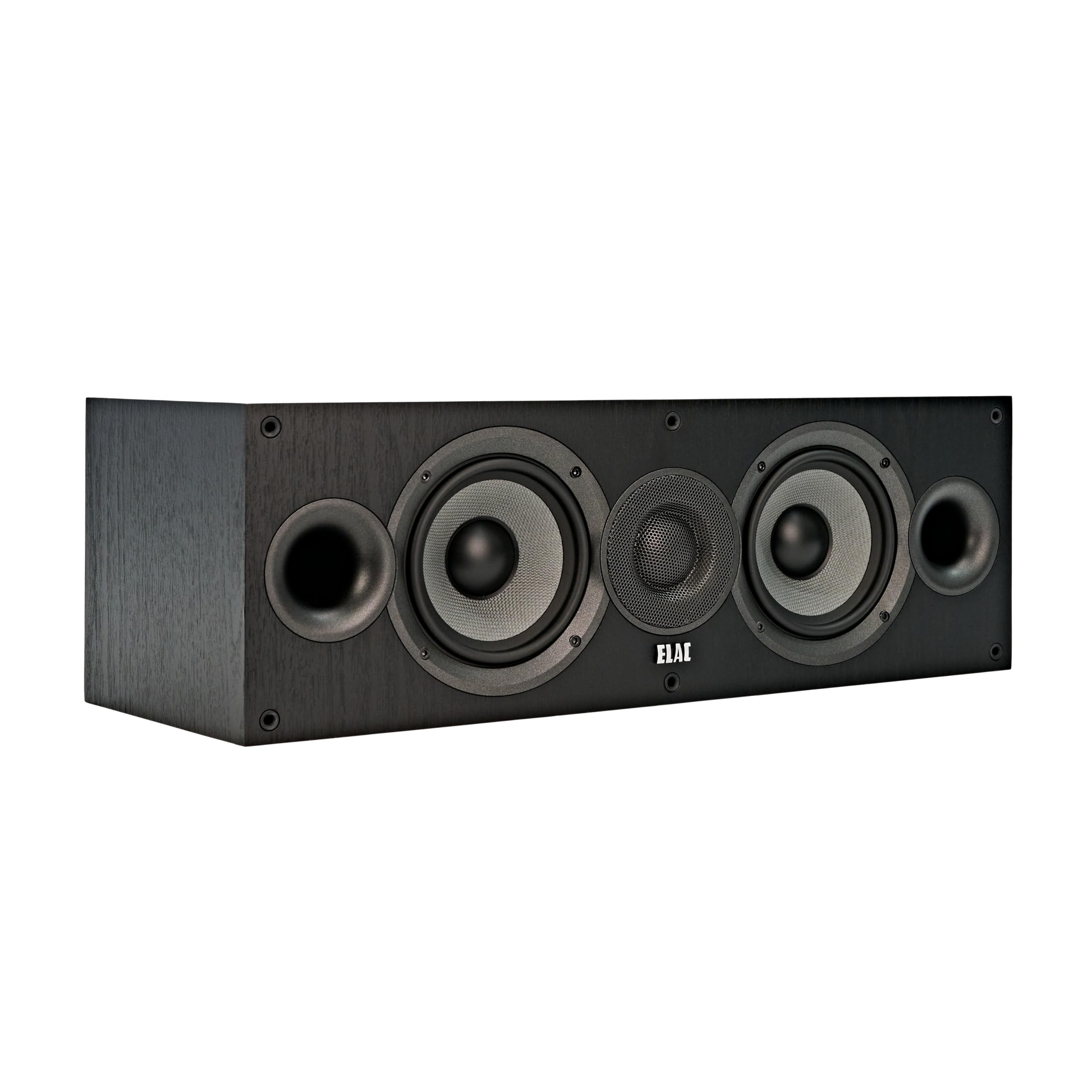
The Andrew Jones-designed sleeper that owners call the best dialogue clarity they have heard.
ELAC’s Debut 2.0 series got a full redesign, and the C5.2 is the center that owners describe as crisp for voices. The soft-dome cloth tweeter takes response up to 35,000 Hz — beyond the range of human hearing — which translates to life-like high frequencies and airy vocals. The woven aramid-fiber woofers offer stiffness and damping far beyond polypropylene, giving a smoother, extended low-frequency response.
The smartest practical feature is the front-firing port. Because the port faces forward, you can place this speaker against a wall or inside a bookshelf without choking the bass, which is a real advantage if your entertainment center is tight. It pairs beautifully with the B6.2 bookshelf speakers, and one owner running it with an Onkyo TX-NR 686 called the sound outstanding. An A/B test against the larger C6.2 found the sound identical — only the size differs.
It is a large, heavy cabinet, and owners note the size seriously. One reviewer even called it the “Holy Grail” center for its rich, vibrant vocal projection. A single owner found it caused listening fatigue with concert documentaries, but that is an outlier among praise for clarity and value.
Sleeper center: the front-firing design plus aramid woofers make this a flexible, high-value pick that beats pricier rivals on dialogue clarity.
Buy it if: you want reference-level clarity and need to place the speaker near a wall.
Prepare for size: it is noticeably large and heavy, so verify your stand can handle it.
7. Sony SS-CS8M2 2-Way 3-Driver Center Channel Speaker

The compact Sony that brings vocals to life without demanding a whole shelf of space.
Sony built this 2-way, 3-driver center specifically for faithful vocal reproduction, with two 3.94-inch woofers boosting the low end and a high-precision tweeter handling the highs. The bass reflex enclosure keeps low frequencies distortion-free, and the reinforced cellular cone prevents the muddying that plagues cheaper drivers. At 12.3 lbs and roughly 17 inches wide, it is genuinely compact — small enough for tight spaces where bigger centers will not fit.
Owners describe the dialogue as clear, articulate, and natural, with no sibilance, boominess, or metallic tone. One owner who upgraded from a Deftech center reported better clarity and bass response, while another moving up from the Micca MB42-C heard an instant improvement in clarity and extra punch. It is a perfect match for Sony AV receivers, and it pairs well with Yamaha receivers too.
A placement tip from an owner: put it on its own stand in front of the cabinet with a slight upward tilt for the best vocals. Its 6-ohm impedance is flexible across receivers. This is an entry-level pick, so it will not shake a large room, but for small spaces and mid-tier systems, it is a clear upgrade.
Vocal clarity, minimal footprint: the compact design plus natural dialogue make it ideal for apartments and smaller entertainment centers.
Choose it if: you want a Sony-matched center that fits tight spaces without sacrificing clear voices.
pass on it if: you need deep, room-shaking bass from the center itself.
8. Klipsch RP-404C Reference Premiere Center Channel Speaker
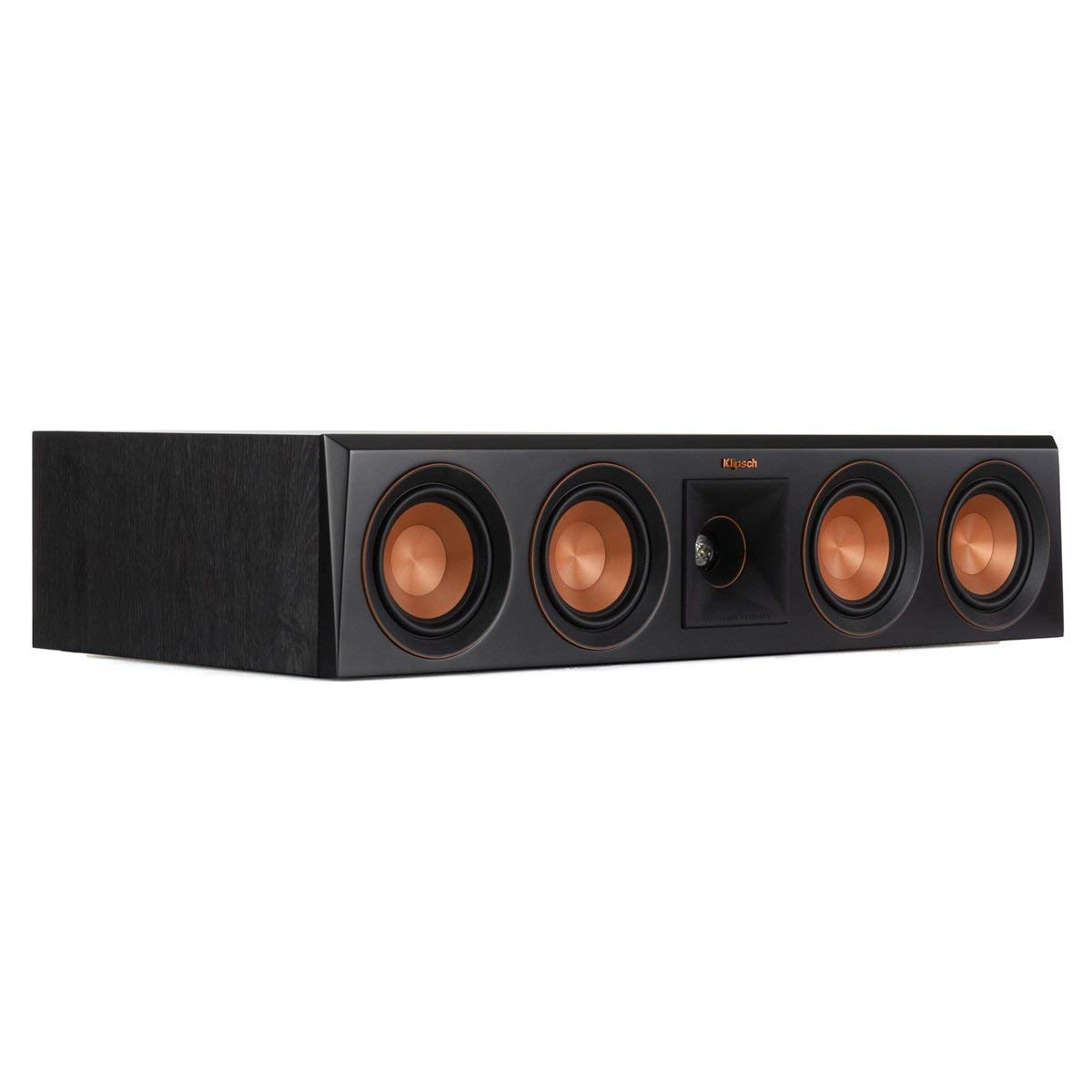
The four-woofer Klipsch that delivers crisp gunshots, clear vocals, and rich resonance in one box.
This is the more compact sibling in the Reference Premiere line, using four 4-inch spun copper woofers and a 1-inch titanium vented tweeter mounted in a hybrid Tractrix horn. Owners consistently praise the crisp, sharp vocals, and several note they can use it at lower volumes while keeping great sound quality — a key trait for late-night movie watching. It blends beautifully with Klipsch tower speakers, making it a natural centerpiece for a full Klipsch setup.
Customers note better dialogue clarity and a richer, more resonant, “meatier” sound than the cheaper R-52C. The deep cabinet design lets a TV sit on top, saving floor space. One owner driving it with a Denon receiver at 100 watts per channel called the sound great with good volume, while another described crisp gunshots and booms in rich Dolby Atmos as amazing for the price.
The caveat is identical to its bigger sibling: it is heavy and tall, and owners emphasize checking the measurements and weight before buying. The single 5-way screw terminals accept banana plugs or bare wire up to 12-gauge, and the color coding makes connection easy. The magnetic grille removes cleanly for a more formal look.
Where it shines
- Clear, sharp vocals that hold up at lower volumes
- Richer, more resonant sound than Klipsch’s R-52C
- Deep cabinet lets a TV sit on top
- Modern premium look with copper accents
What to know
- Heavy and tall, so measure carefully
- Rear-firing port needs some breathing room behind it
Best for: Klipsch fans who want the signature horn sound in a slightly more manageable size.
Think twice if: your cabinet is shallow or your TV is already low — this one is tall.
9. Polk Audio Signature Elite ES35 Slim Center Channel Speaker

The slim speaker that fits under a TV without blocking it, yet still fills the room with clear audio.
If your TV sits low or your console is shallow, this is the design that solves the problem. The ES35 is a high-performance slim center with a 1-inch Terylene tweeter and six 3-inch woofers arranged in a Dynamically Balanced Acoustic Array. Polk’s patented Power Port Technology delivers dramatic frontal impact, and the brand notes this center carries almost 75 percent of your audio — meaning it does the heavy lifting for dialogue.
Owners call it the best slim center channel in its price range, praising its clear, natural dialogue at low volumes and its ability to fill a room despite the compact size. The rear port comes with a cage, which allows flush wall placement without choking the bass. It fits easily in entertainment centers, and its classy style makes a statement in any decor.
It needs a 20-30 hour break-in before the bass opens up and voices gain more range. The build is plastic but well-constructed, and owners note wall hardware is not included, so budget for that if you plan to mount it. One owner replaced a tinny soundbar with this in a 3.1 setup and called it a major upgrade.
Space-saving clarity: the rare slim center that does not compromise on vocal clarity, ideal for wall-mounting below a TV without blocking the IR sensor.
Pick it if: you need a low-profile center that still delivers clear, room-filling dialogue.
Set expectations: give it 20-30 hours of break-in and buy your own wall hardware.
10. ELAC Uni-Fi 2.0 UC52 Center Speaker

The true 3-way coaxial design that owners say brings an immediate, audible step up in clarity.
This is the big step up from ELAC’s Debut line. The UC52 uses a true 3-way design with a newly developed concentric driver — a 1-inch wide-roll surround tweeter mounted in the center of a 4-inch aluminum midrange — plus a triple single-piece aluminum cone 5.25-inch bass driver. That coaxial layout puts the tweeter and midrange on the same axis, which owners say makes dialogue crisp from more seats in the room, especially off-center.
Owners who upgraded from the Debut 2.0 C5.2 noticed an immediate improvement in sound quality, crediting the dedicated midrange driver. Another called it a major step up from the debut line, with voices having a more defined and substantive presence at higher volumes. One owner who A/B tested it against pricier B&W and Paradigm centers found it outperformed them on clarity and wide dispersion.
The honest downsides: it is a large, unattractive black box that is hard to hide, and one owner hit intermittent connection dropouts that were not cable-related. Dialogue clarity gets mixed feedback in the summary, though individual reviewers point out crisp dialogue. At this level, front-firing ports allow flexible placement, and the 6-ohm nominal impedance works with virtually all receivers.
Why it is a step up
- True 3-way coaxial design for smoother, more natural voices
- Improved off-center clarity compared to 2-way designs
- Front-firing ports allow placement near walls
- Outperformed pricier B&W and Paradigm centers for some owners
What holds it back
- Large and visually plain, hard to hide in a living room
- Quality control is praised, but one owner hit connection dropouts
Step up if: you already own ELAC Debut speakers and want noticeably better vocal presence.
Hide it if: looks matter — this one is a big black box that takes commitment to place.
11. SVS Prime Center Speaker

The high-output 3-way center that anchors a serious home theater with easy power.
SVS built the Prime Center around a true 3-way crossover design, and it shows in the reviews: owners praise its accurate sound quality and performance in home theater systems. The 1-inch aluminum dome tweeter plays crisp at high volumes, delivering an “airy” presentation with unveiled highs so vocals and dialogue always sound crisp. The two 5.25-inch woofers sit in cast ABS-fiberglass composite baskets for precise alignment and an inert frame without resonances.
Owners say it distributes sound excellently beyond a 90-degree axis, meaning your side seats still get clear dialogue. One owner paired it with Cerwin-Vega L-9 floor-standing fronts and called it a beautiful match. Another said it dramatically improved dialogue clarity for a hearing-impaired user, elevating the entire surround setup. The proprietary SVS SoundMatch 3-way crossover ensures accurate frequency response and smooth transitions between drivers.
A couple of honest notes: the midrange runs very bright and may need a level reduction through the receiver, and it needs about 15 movies of break-in to warm up. The rear ported cabinet demands a little space behind it, but the heavy, compact build feels premium. Audioholics praised it for offering composed, high-output performance at its price.
easy power: the aluminum tweeter and 3-way crossover make this the pick for clear dialogue at high volumes in larger theaters.
Choose it if: you want a premium 3-way center that plays loud without strain in a dedicated theater room.
Tune it: the bright midrange rewards a quick level adjustment on your receiver.
Understanding the Specs
2-Way vs 3-Way Design
A 2-way speaker splits audio between a woofer and a tweeter, which is the most common and affordable design. A 3-way speaker adds a dedicated midrange driver, which often means smoother transitions and more natural voices. If dialogue clarity is your top priority, a 3-way design is worth the upgrade.
Woofer Size and Material
Larger woofers, like 5.25-inch drivers, move more air and deliver fuller, more natural voices. The cone material also matters — carbon fiber, aramid fiber, and aluminum cones are stiffer and resist distortion better than paper or polypropylene. This translates to tighter, cleaner vocals.
FAQ
Why is my dialogue muffled without a center channel speaker?
Does a bigger woofer always mean better dialogue clarity?
What is the difference between a 2-way and a 3-way center channel speaker?
How long does a center channel speaker need to break in?
Can I place a center channel speaker inside a cabinet or against a wall?
What does off-axis sound mean and why does it matter for dialogue?
Do I need a receiver to power a passive center channel speaker?
Will any center channel speaker match my existing front speakers?
Final Thoughts: The Verdict
For most people, the center channel speaker for dialogue winner is the Klipsch RP-504C because its 2.5-way design and horn-loaded titanium tweeter deliver the clearest voices across the widest seating area, backed by the strongest owner consensus in this lineup. If you want a slim speaker that fits under a low TV, grab the Polk ES35. And for a budget-friendly compact room, the Micca MB42X-C is the one to reach for.
How We Picked
We do not accept paid placement. Every pick is matched to a real buyer and a real use-case; we do not hands-on test units.
Sources & Methodology
Specifications: manufacturer listings and product documentation. Review insights: verified customer reviews, as of August 2026. Pricing: not shown on this page (it changes often); check the current price via the retailer link.
As an Amazon Associate, FitlyFast earns from qualifying purchases. This does not affect which products we feature.