
Our readers keep the lights on and the weekend projects moving. As an Amazon Associate, I earn from qualifying purchases.
Specs are compiled from manufacturer listings and verified buyer reviews and can change over time — please confirm the key details on the product page before buying.
The bouldering wall is a puzzle of tiny edges, glassy smears, and aggressive overhangs, and the shoe on your foot decides whether you solve it or slide off. You need rubber that bites, a toe that can hook, and a heel that stays locked on a desperate heel-hook. This guide breaks down the best climbing shoes for bouldering by comparing the specs that actually matter — downturn, rubber compound, and fit — so you can pick the pair that matches your foot and your climbing style.
I’m Rikta — the founder and writer behind FitlyFast. This guide is built by comparing the manufacturers’ published specifications and the patterns across verified customer reviews, so you get each pick’s real strengths and trade-offs instead of marketing spin.
Whether you’re projecting V5s in the gym or eyeing your first outdoor boulder problem, the right aggressive shoe makes every foothold feel bigger and every heel hook feel secure, without sacrificing the comfort your sessions demand.
Our Picks at a Glance


How To Choose The Best Climbing Shoes For Bouldering
Bouldering is short, powerful, and technical — you fall a lot, and you need a shoe that turns your foot into a precise tool. The right pair balances a downturned toe for hooking, a sticky sole for smearing, and a snug fit that transfers every ounce of power to the rock.
Downturn and Asymmetry: The Aggressive Profile
The downturn (the banana-like curve that pulls your toe downward) is what lets you stand on tiny holds and hook over edges on steep terrain. A large downturn like the La Sportiva Skwama’s PD75 profile is built for overhanging boulders where you’re pulling hard. A moderate downturn, like the Ocun Striker QC’s, is more forgiving and works across vertical walls and slabs without cramping your toes as fast.
Rubber Compound: Grip vs. Durability
Sticky rubber is what keeps your foot on a smear (a foothold with no edge). Softer compounds like Vibram XS Grip2 and Evolv’s Trax SAS bite hard into the rock, so you can trust them on tiny edges, but they wear down faster on rough rock and gym holds. Harder compounds like Vibram XS Edge last longer and edge better, yet they feel slicker on flat smears. Your choice depends on if you want maximum friction or a longer lifespan.
Fit and Closure System: Velcro vs. Slip-On
Bouldering shoes should fit snug with no dead space — the tighter the fit, the better the power transfer to your toes. Velcro straps (like the Ocun Striker QC and EVOLV Kronos) let you dial in the tightness quickly between attempts. Slip-ons like the Skwama offer maximum sensitivity but rely on a precise fit. Most bouldering shoes run small, so expect to size down 0.5 to 1 full size from your street shoe.
Quick Comparison
| Model | Best For | Rubber | Closure | Weight | Amazon |
|---|---|---|---|---|---|
| La Sportiva Skwama★ Best Overall | Aggressive all-round bouldering | Vibram XS Grip2 | Slip-On | N/A | Amazon |
| Ocun Striker QCBest Value | Comfortable entry-to-mid bouldering | CAT rubber 1.1 (4mm) | Hook and Loop | 418 g | Amazon |
| Ocun JETT QCLightest Pick | Lightweight all-round wall work | CAT rubber 1.5 (4mm) | Hook and Loop | 376 g | Amazon |
| EVOLV Defy | Wide-foot beginners | Traction rubber | Hook and Loop | N/A | Amazon |
| EVOLV Kronos | Stepping up from rentals | Trax SAS | Dual-Strap | N/A | Amazon |
| La Sportiva Kubo | Narrow heels with progressive support | Vibram XS Edge (4mm) | Hook and Loop | N/A | Amazon |
| SCARPA Instinct VS | Precise power on edges and heel hooks | Vibram XS Edge (4mm) | Hook and Loop | 7.8 oz (1/2 pair size 40) | Amazon |
| La Sportiva Solution | Maximum performance on steep projects | Vibram XS Grip2 (3.5mm) | Slipper/Lock Harness | N/A | Amazon |
In‑Depth Reviews
1. La Sportiva Skwama Performance Rock Climbing Shoes
Our pick — over 4.5★ from 250+ verified ratings; the strongest balance of quality and price.
The gold standard for gym rats who want one shoe that smears, hooks, and edges without compromise.
The Skwama is the pick that keeps coming up when climbers talk about a shoe that does everything. Its defining feature is a pointed toe with a large downturn and high asymmetry (the PD75 last), which means your foot is pre-cranked into a powerful hooking position. That profile, paired with a soft 4mm Vibram XS Grip2 sole (rated 5 out of 5 for surface sensitivity), lets you feel every grain of the hold while the sticky rubber does the gripping.
The fit is where the Skwama shines for medium-width feet. Reviewers repeatedly praise the wide toe box and pointed toe for tucking into pockets, while the S-heel and shallow heel cup keep narrow heels locked in on heel hooks. The trade-off is a notorious break-in period — buyers report it took 4-5 sessions of hard digging into the skin around the ankle before the shoe settled in. Once broken in, it stretches roughly half a size and becomes glove-like, but expect some pain before the payoff.
The crowd favorite — 4.6 stars across 200+ owners — and the most-praised feature is comfort, with owners noting the heel design and the secure fit that keeps them confident on overhangs and technical smears. It’s genuinely the most versatile aggressive shoe on this list, equally at home on gym volumes and outdoor gritstone.
What Wins Owners Over
- Generous toe box that fits wider forefeet without losing precision
- Exceptional smearing and edging performance on varied terrain
- Secure S-heel holds well on aggressive heel hooks
The Cost of Greatness
- Painful break-in that can dig into the ankle for several sessions
- Sticky rubber wears faster at the toe than harder compounds
- Sizing runs large — most owners downsize 0.5 to a full size
Reach for it if: you want a single aggressive slip-on that handles everything from tiny pockets to slopey smears.
Think twice if: you have very wide feet (the fit is medium width) or zero patience for a painful break-in period.
2. Ocun Striker QC Bouldering Shoe
A velcro-slipper hybrid that punches far above its price on comfort and moderate grip.
The Striker QC is the budget-conscious climber’s dream: a proper bouldering shoe with a modest downturn that won’t punish your toes on a long session. At 418 grams, it’s noticeably heavier than Ocun’s own JETT QC (376 g) — an 11% gap you’ll feel on big walls but rarely notice on 12-foot boulder problems. The microfiber upper and hook-and-loop closure make it easy to slip on and off between attempts, which is exactly what you want in a gym setting.
What sets the Striker apart is its fit. Buyers describe it as comfortable for extended wear, with a secure Velcro closure and no pressure points, and the medium-stiffness midsole (2D Fit Middle) gives it enough support for vertical and slightly overhung problems. The 4mm CAT rubber offers moderate, grippy performance — not as sticky as a Vibram XS Grip2, but more than enough for gym holds and juggy outdoor rock.
The durability question is real. While most owners mention the shoes holding up well over months of use, at least one reviewer noted the shoes began pulling apart after not even 2 months of use. It’s not a widespread pattern, but it’s worth knowing you’re getting a value-tier shoe, not an indestructible one. Sizing runs small and tight, so plan to order up 0.5 from your normal climbing shoe size.
Who it’s for: entry-to-mid climbers who want a comfortable, secure, moderate shoe for gym bouldering without spending premium dollars.
The honest limit: the rubber is grippy but not elite, and a rare unit has shown premature wear — inspect yours early.
3. Ocun JETT QC Bouldering Shoe
Ocun’s featherweight all-rounder that grips hard and disappears on your foot.
The JETT QC is the lighter sibling in Ocun’s lineup, tipping the scales at just 376 g — the lightest shoe in this comparison and 42 g lighter than the Striker QC above. That featherweight feel translates to less fatigue on long sessions and a more sensitive connection to the wall. The slightly stiffer midsole (2D Fit Hard) gives it more support on edges than the Striker, making it a touch more versatile for vertical terrain and multipitch work.
Buyers love the grip and stability, calling out the high-quality materials that grip surfaces very well and provide stability while climbing. The 4mm CAT rubber 1.5 compound is the same family as the Advancer but tuned for a slightly different feel. What you sacrifice is the aggressive downturn — the JETT’s last is an all-round profile, so it’s not the shoe for desperate overhangs, but it excels on slabs, vertical walls, and moderate bouldering.
The one consistent warning from owners: the sizing runs tight, so order up if you’re between sizes. For a climber who wants one lightweight, comfortable shoe that works across indoor gym and outdoor rock while staying affordable, the JETT QC is a quietly excellent choice.
Best for: all-day sessions on slabs and vertical walls where lightweight sensitivity beats aggressive power.
skip it if: your projects are steep overhangs that demand a heavily downturned toe.
4. EVOLV Defy Rock Climbing Shoes
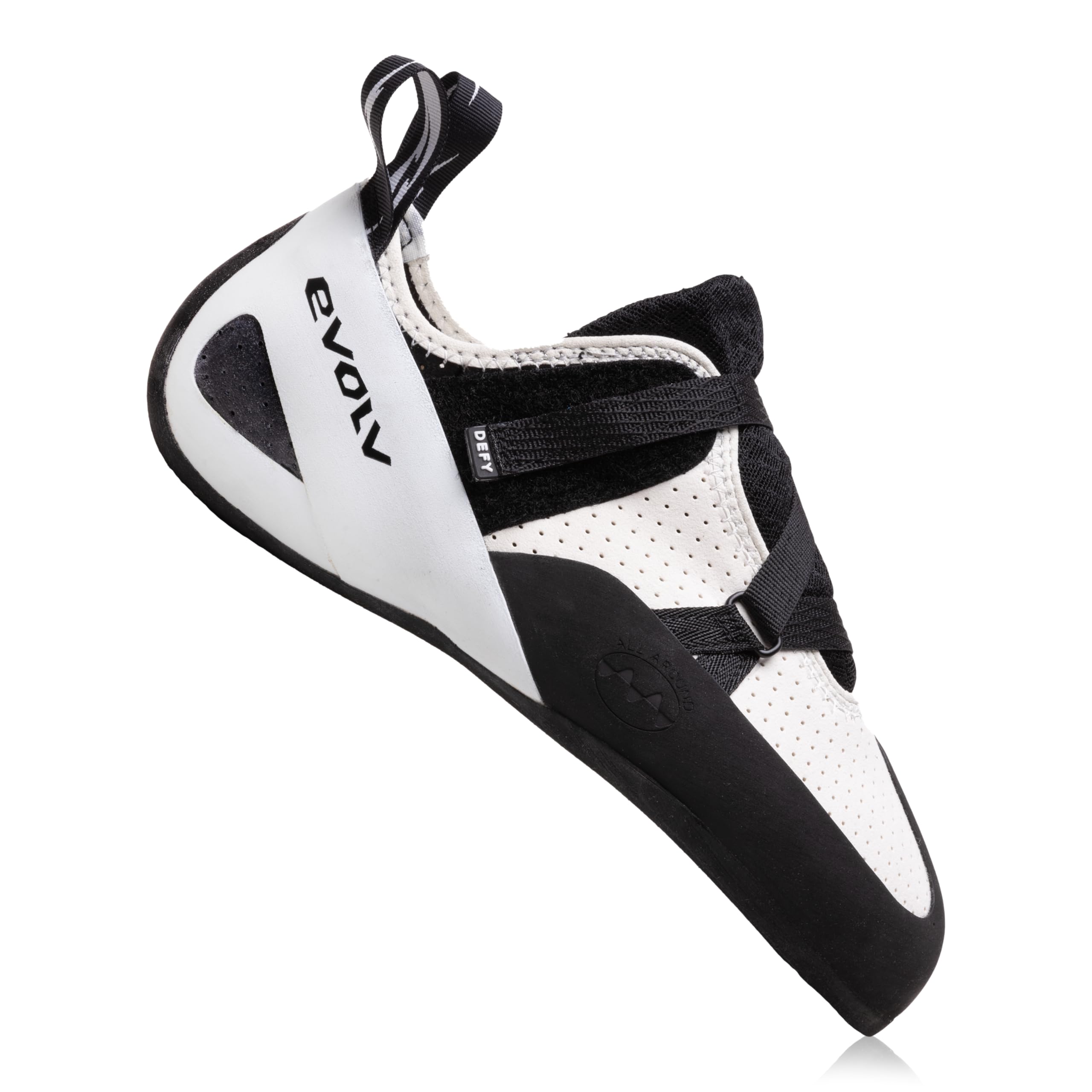
The beginner’s best friend, built for wide feet and all-day comfort on the mats.
The Defy is EVOLV’s answer for climbers who are done with rentals but not ready for an aggressive downturn that cramps their toes. It features a downturned toe for hooking and power transfer, giving you a taste of performance features without the extreme discomfort of a high-performance shoe. The flat-ish profile and soft sole make it among the most comfortable shoes you can wear for hours, so you can keep climbing without your feet screaming.
What makes the Defy stand out is its fit for wide feet. Buyers consistently note the wide forefoot and short length — the shoe runs both wider and shorter than other brands, so you’ll likely need to size up about 2 full sizes from your street shoe. Once you find that size, it’s described as supremely comfortable, with solid build quality and a great beginner-friendly toe. The same fit that suits wide feet is the one caveat: for normal-width feet, the short length can feel cramped unless you size up significantly.
The build quality earns the most praise from owners, who note the shoe lasts for months even with 3-4 sessions per week. It’s not an aggressive performer — soft sole and not downturned enough for hard overhangs — but for a beginner tackling V2-V4 problems, it’s a forgiving, comfortable companion that won’t hold you back.
Reach for it if: you have wide feet and want a comfortable, durable first shoe that won’t crush your toes.
Look elsewhere if: you have narrow feet or you’re already projecting steep overhangs that need a stiffer, more aggressive sole.
5. EVOLV Kronos Rock Climbing Shoes

The perfect bridge for climbers sick of rentals who aren’t ready for an aggressive downturn.
The Kronos is explicitly designed as an intermediary-friendly option for climbers advancing from beginner shoes. It features a slight camber design with a downturned toe that assists on steeper sport routes and boulder problems, while staying comfortable enough for long slab routes (rated PSR 4). That versatility makes it an ideal first purchase for someone who wants one shoe that works across the whole gym.
The standout spec is the Trax SAS sole — EVOLV’s stickiest rubber compound. Owners consistently praise the outstanding rubber for its grip on slabs and vertical terrain, with one climber noting it performs well on slabs and other vertical terrain but isn’t aggressive enough for hardcore overhangs. The synthetic upper keeps the shoe from stretching much, and the dual-strap closure system ensures a snug fit for the life of the shoe.
The catch is sizing inconsistency. Multiple customers note the sizing is “all over the place” — some find it true to size, others need to go up 0.5 or even a full size. The general guidance is to stay close to your street size (don’t downsize more than 0.5) and be prepared to exchange if needed. It’s durable too, with owners reporting about a year of bi-weekly gym use before needing replacement.
Grab it if: you’re transitioning from rentals and want a comfortable, grippy, durable shoe for all-around gym climbing.
Pass if: your focus is steep overhangs where a heavily downturned aggressive shoe performs better.
6. La Sportiva Womens Kubo Rock Climbing Shoes
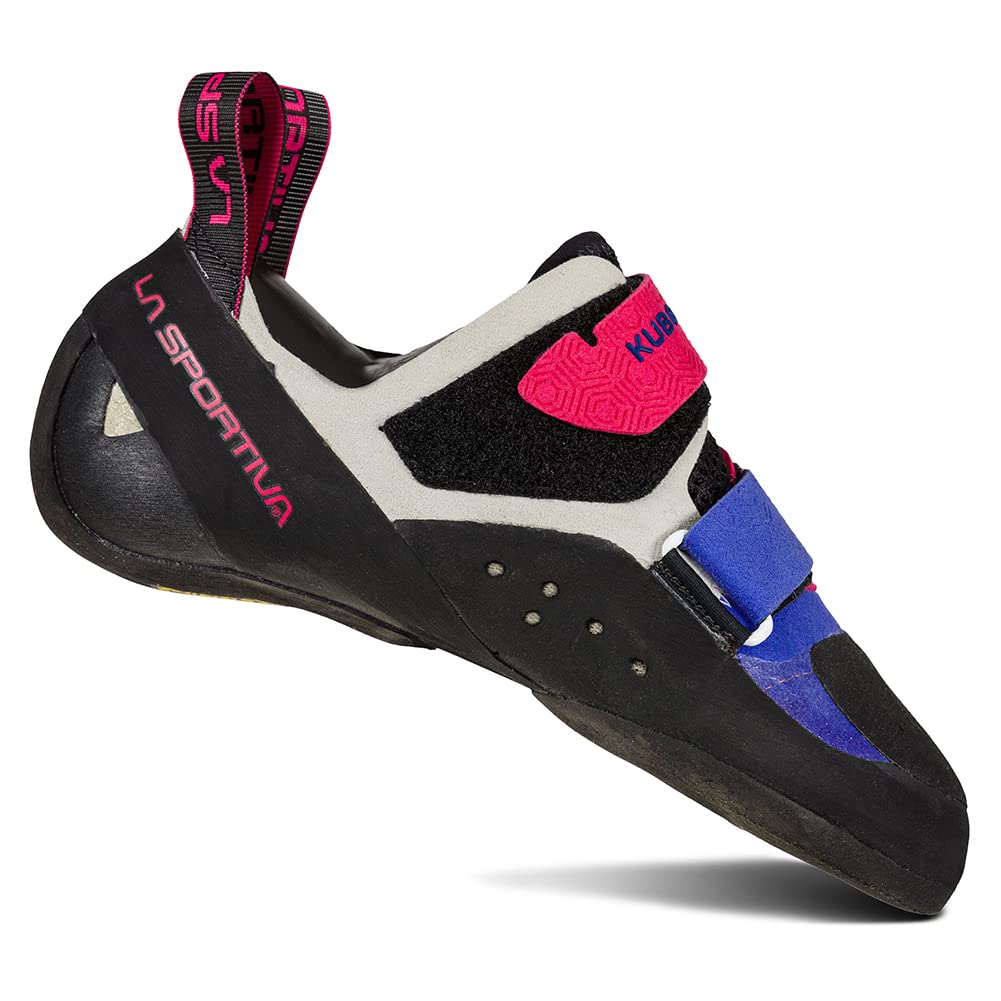
A progressive-support shoe that loves narrow heels and rewards improving technique.
The Kubo is La Sportiva’s progressive shoe, designed for climbers who are actively improving their technique. Its pointed toe with a medium downturn and low asymmetry (the PD 55 last) gives you a hint of aggression without the extreme pre-cranking of a performance shoe. The 4mm Vibram XS Edge sole (rated 3 out of 5 for stiffness) provides solid edging support while staying comfortable for long sessions.
What earns the Kubo its loyal following is the fit, especially for narrow heels. The adjustable Velcro closure lets you dial in a perfect snug fit, and reviewers point out it works brilliantly for narrow feet and narrow heels — a common fit nightmare in climbing shoes. One V5 climber reports it’s more comfortable and durable than a Scarpa Arpia, while another notes the heel pocket is secure and the rubber is sticky on small holds and overhangs.
There’s a caveat on sizing that comes up often: the fit can be bizarre. Some owners get their exact Euro size and it fits perfectly, while others report a size 9.5 being too small for a size 8 foot. The rubber doesn’t stretch much, so ordering up is safer than down. It’s not the best for smearing — one owner found the rubber slippery on smears — but for edging, heel hooks, and overhangs, it’s a powerful, comfortable intermediate shoe.
Perfect for: women with narrow heels who want a comfortable, supportive shoe that edges well and holds on overhangs.
Be aware: the sizing inconsistency means buying from a place with a good return policy, and it’s not ideal for smearing-heavy slabs.
7. SCARPA Instinct VS Rock Climbing Shoes

A moderately downturned powerhouse that turns your foot into a precision instrument on edges.
The Instinct VS is SCARPA’s legendary bouldering shoe, a moderately downturned, moderately asymmetric profile that’s been a favorite of hard climbers for years. It features a 4mm Vibram XS Edge outsole paired with a 1.0mm Flexan midsole, which gives it a stiff, precise platform for standing on tiny edges while retaining enough sensitivity to feel the rock. This combination makes it a superb edging shoe that also hooks and smears with confidence.
The comfort is the surprise. Despite the aggressive downturn, the generous toe box fits wide forefeet and even a Morton’s toe (where the second toe is longer) comfortably, and the heel is designed to grip without causing Achilles pain. Shoppers say wearing them for up to 2 hours without discomfort after a short break-in. The upper mixes microsuede and leather with heat-welded reinforcements for a durable, precise fit that molds to your foot over time.
The versatility across bouldering and sport climbing is what makes this a standout. It’s superior on edges and heel hooks compared to the La Sportiva Solution, though the XS Edge rubber is less sticky on smears than a softer compound. Sizing is the recurring challenge — most buyers size up a full size from their street shoe, and the newer version runs slightly larger than older models. It’s a shoe that rewards getting the fit right with incredible power transfer.
Its Superpowers
- Excellent edging precision with the stiff 4mm Vibram XS Edge sole
- Comfortable for an aggressive shoe — fits wide forefeet and Morton’s toe
- Grippy, sensitive heel that locks in on heel hooks
Its Quirks
- Hard to size — runs small and the newer version fits larger than the old
- Edge rubber is less sticky on smooth smears than softer compounds
- Poor breathability in hot weather
Get it if: you’re a hard bouldering project who needs precise edging power and a comfortable heel hook.
Be warned: plan for sizing exchanges and expect smears to feel slightly precarious compared to a softer rubber.
8. La Sportiva Mens Solution Rock Climbing Shoe
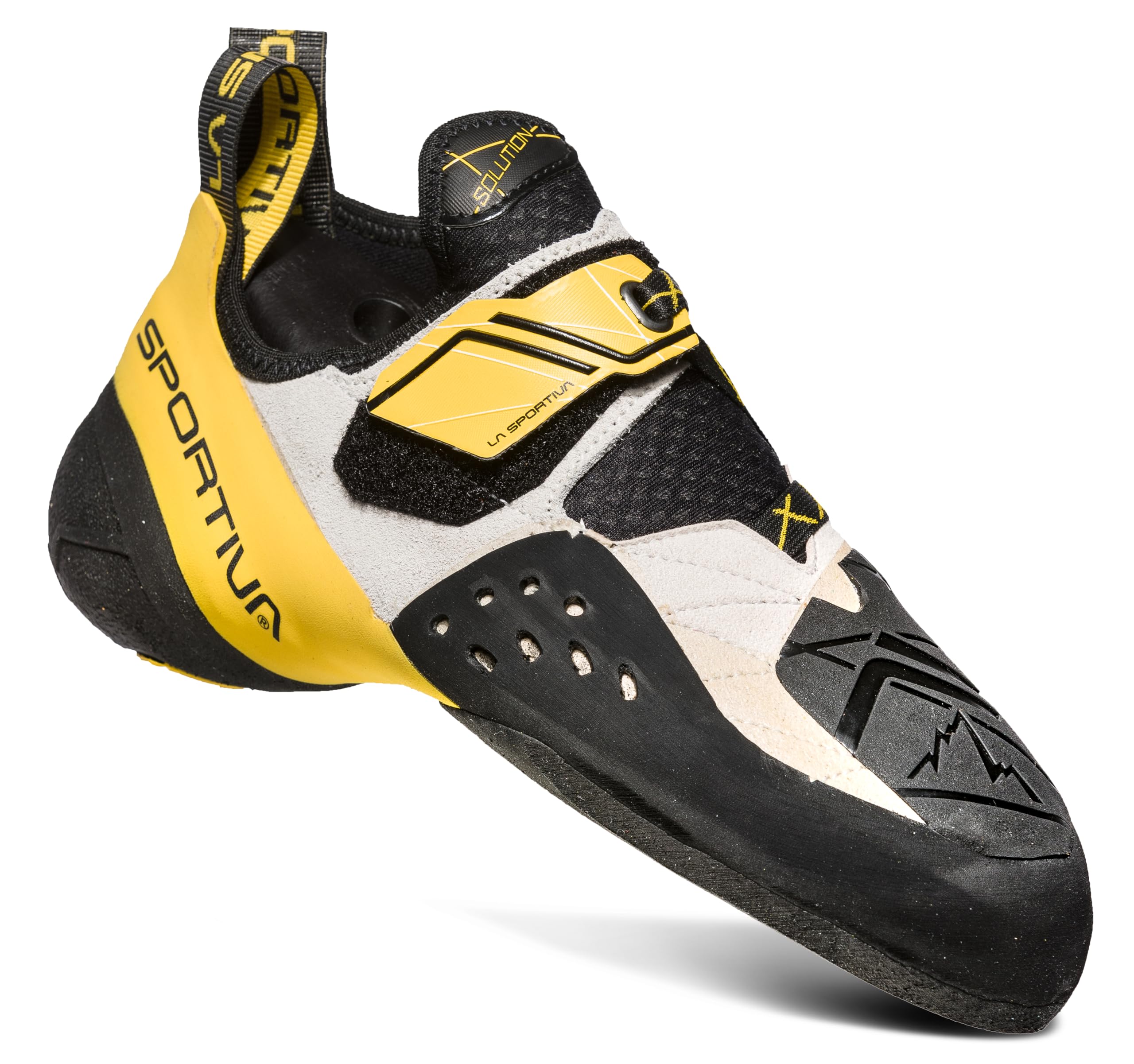
The iconic climbing shoe for well-trained feet that demand maximum performance on steep terrain.
The Solution is La Sportiva’s flagship performance shoe, aimed at the most experienced climbers with well-trained feet. It features a pointed toe with a large downturn and higher asymmetry (the PD75 last), making it among the most aggressive profiles in this lineup — built to maintain an intense and continuous climb on steep overhangs. The 3.5mm Vibram XS Grip2 sole (rated 4 out of 5 for sensitivity) delivers exceptional stickiness on smears and slopers, so you can trust your foot placement on tricky, rounded holds.
The slipper-style closure with a Lock Harness System is what sets the Solution apart. It cinches the heel and midfoot securely, creating a powerful, sensitive fit that excels at toe hooks and heel hooks on desperate boulder problems. The medium volume fits a wide range of feet, and the soft-stiff balance (rated 3 out of 5 for stiffness) flexes enough for smearing while staying supportive under load on edges.
Owners confirm the performance pedigree, with one noting the quality is excellent and meets expectations. The sizing guidance is consistent: go one full size below your EU street shoe size (44 to 43 works for most). It is not a comfortable all-day shoe — it’s a weapon for sending your project. One buyer mentioned their pair lasted only 2 1/2 weeks on indoor boulders before coming apart, and others note the high sides can cut into ankle bones, so treat it as the high-performance tool it is.
For the projectors: if you climb hard and want the iconic aggressive slipper for steep boulders, this is the benchmark.
Know before you buy: it’s demanding on the feet, and an occasional unit has shown premature wear — buy from a source with a solid return policy.
Understanding the Specs
Rubber Compounds Decoded
Sticky rubber is what keeps you on a smear, but not all rubber is equal. Vibram XS Grip2 (found on the Skwama and Solution) is the softest and stickiest — it bites aggressively on smooth holds but wears fast on rough rock. Vibram XS Edge (on the Kubo and Instinct VS) is harder; it edges beautifully and lasts longer but feels slicker on flat smears. EVOLV’s Trax SAS is their stickiest compound, tuned for the Kronos.
Downturn and Asymmetry
The downturn is the curve that pulls your toe down toward the rock. A large downturn (like the Solution’s PD75) is built for steep overhangs where you hook your toe over edges — it’s powerful but uncomfortable for long periods. A medium downturn (like the Kubo’s PD55) offers a middle ground, with enough aggression for bouldering and enough flatness for vertical walls. Asymmetry refers to how much the shoe curves inward toward your big toe; more asymmetry means more power on your big toe but a tighter fit.
FAQ
How much should I size down for bouldering shoes?
What is the difference between Velcro straps and a slip-on closure?
Will the shoes stretch after break-in?
Are aggressive downturned shoes bad for beginners?
How long do bouldering shoes typically last?
What does “asymmetry” mean in climbing shoes?
Can I climb slabs and vertical walls in an aggressive bouldering shoe?
What is the best shoe for wide feet?
Why do bouldering shoes cost more than regular climbing shoes?
Is it better to buy climbing shoes online or in a store?
Final Thoughts: The Verdict
For most climbers, the climbing shoes for bouldering winner is the La Sportiva Skwama because it combines an aggressive pointed toe with the wide toe box and secure S-heel that climbers crave, making it the single most versatile performance shoe on this list. If you want precision edging power, grab the SCARPA Instinct VS. And for comfortable all-day gym sessions on a budget, the Ocun Striker QC is the one to reach for.
How We Picked
We do not accept paid placement. Every pick is matched to a real buyer and a real use-case; we do not hands-on test units.
Sources & Methodology
Specifications: manufacturer listings and product documentation. Review insights: verified customer reviews, as of August 2026. Pricing: not shown on this page (it changes often); check the current price via the retailer link.
As an Amazon Associate, FitlyFast earns from qualifying purchases. This does not affect which products we feature.