
Our readers keep the lights on and the weekend projects moving. As an Amazon Associate, I earn from qualifying purchases.
Specs are compiled from manufacturer listings and verified buyer reviews and can change over time — please confirm the key details on the product page before buying.
Picking your first serious camera for a photography course shapes how you learn exposure, focus, and composition. You need a body with room to grow, a lens system you can expand, and controls that teach rather than frustrate. A student camera must balance image quality, manual control, and a beginner-friendly price.
I’m Rikta — the founder and writer behind FitlyFast. This guide is built by comparing the manufacturers’ published specifications and the patterns across verified customer reviews, so you get each pick’s real strengths and trade-offs instead of marketing spin.
The right camera for photography student turns classroom theory into muscle memory, so every dial and button becomes an instinct.
Our Picks at a Glance

How To Choose The Best Camera For Photography Student
Your first camera is a learning tool, not a status symbol. The best student camera makes you master exposure, focus, and composition without fighting the interface. Here’s what actually matters for a course, not just for social media.
Lens mount is your long-term commitment
The lens mount locks you into a system for years, so choose wisely. Canon’s EF and EF-S mounts, Nikon’s F mount, and Sony’s E mount each have huge libraries of affordable glass. Before you buy, check whether the camera brand you like has the specific primes and zooms you’ll want in your second and third years of study.
Manual control layout beats megapixel count
A photography course demands aperture priority, shutter priority, and full manual modes. Look for a camera with dedicated dials for shutter speed and aperture, plus easy access to ISO. A 24-megapixel sensor is plenty for learning — the interface and the feel of the buttons matter far more than extra resolution that just fills up your memory cards.
Autofocus performance for real-world assignments
You will shoot moving subjects eventually, whether it’s a street scene or a friend’s sports game. More autofocus points and a higher burst rate mean you can track motion and capture the decisive moment. A camera with 51 focus points and 8 frames per second will serve you better for action than one that only manages 9 points and 3 frames per second.
Quick Comparison
| Model | Best For | Autofocus Points | Max Burst Speed | Megapixels | Amazon |
|---|---|---|---|---|---|
| Nikon D850★ Best Overall | High-resolution stills mastery | 153 | 9 fps | 45.7 MP | Amazon |
| Canon EOS Rebel T7 BundleBest Starter Bundle | Beginners needing a full kit | 9 | 3.0 fps | 24.1 MP | Amazon |
| Canon EOS Rebel T7 Renewed BundleBudget Champion | Value seekers wanting extra lenses | 9 | 3 fps | 24.1 MP | Amazon |
| Canon EOS RP Kit | First full-frame mirrorless | — | — | — | Amazon |
| Nikon D7500 | Action and low-light shooting | 51 | 8 fps | 20.9 MP | Amazon |
| Canon EOS R8 | Hybrid photo and video work | 1,053 zones | 40 fps | 24.2 MP | Amazon |
| Sony Alpha a7 III | All-round full-frame performance | 693 | 10 fps | 24.2 MP | Amazon |
| Fujifilm X-T5 Kit | Classic controls with modern tech | 425 | 15 fps | 40.2 MP | Amazon |
| Sony Alpha 7R V | Maximum resolution for fine art | 693 | 10 fps | 61.0 MP | Amazon |
In‑Depth Reviews
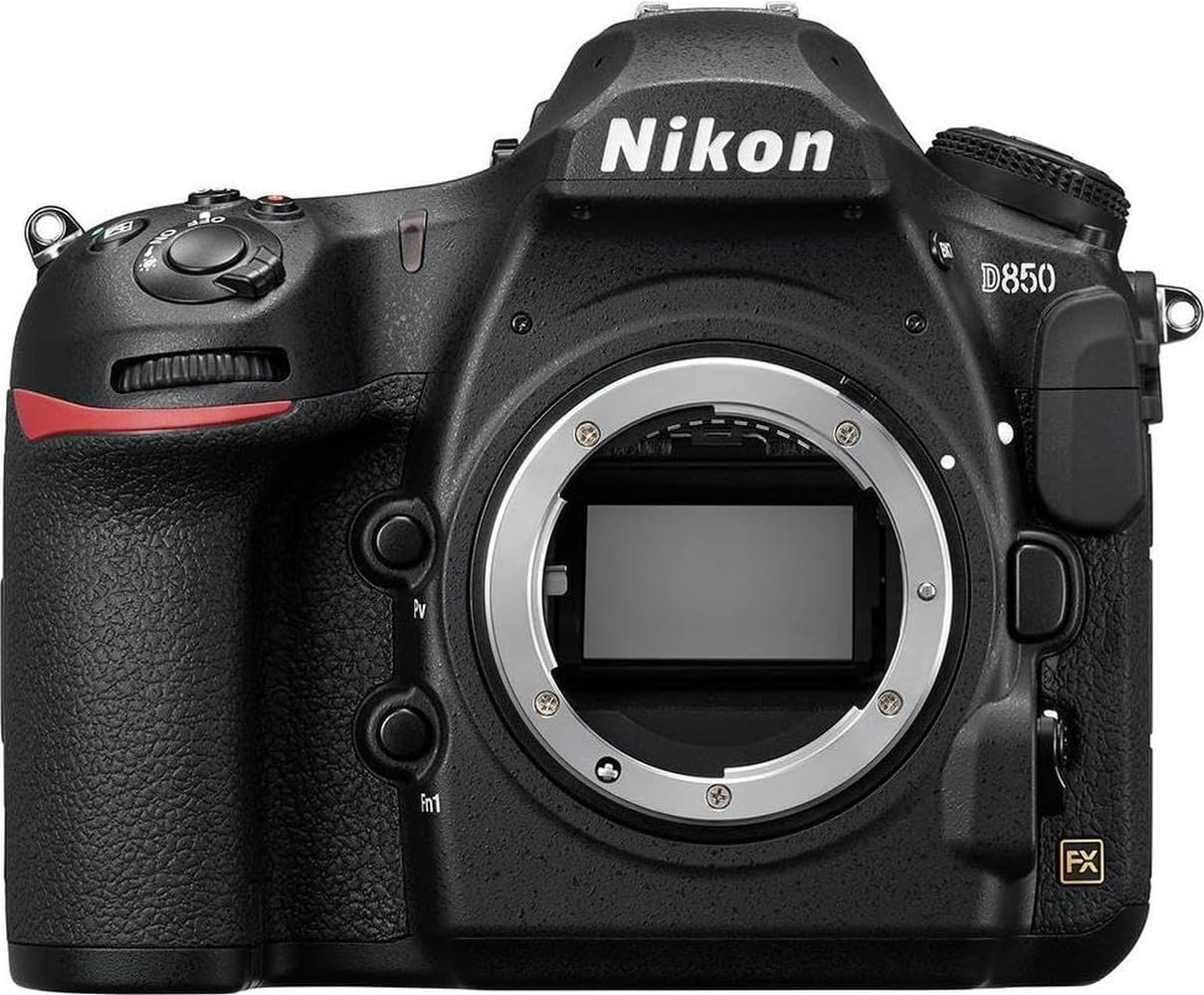
1. Nikon D850 FX-Format Digital SLR Camera Body
Our pick — over 4.5★ from 800+ verified ratings; the strongest balance of quality and price.
The full-frame heavyweight that turns classroom theory into gallery-grade prints.
The D850 is the camera serious photography students grow into, and the crowd favorite — 4.7 stars across 800+ owners. Its 45.7-megapixel back side illuminated (BSI) sensor (a chip design that captures more light) delivers resolution that buyers report “rivals medium format” when paired with premium glass. That is 90% more resolution than a typical 24.1 MP starter DSLR, which means you can crop deeply and still print large.
For action assignments, the 153 autofocus points and 9 frames per second continuous shooting give you a 17.0x advantage in focus points and a 3.0x advantage in speed over an entry-level Canon. A 4K Ultra HD time-lapse mode and slow motion up to 120 FPS at 1080p cover your video coursework. The tilting touchscreen and focus shift shooting mode (which automatically racks focus for macro stacks) make studio work far less tedious.
What wins people over is the build quality — it is weather-sealed, has illuminated buttons, and feels like a professional tool. The trade-offs are real for a student: it is heavy, the menus are complex, and the giant RAW files will fill a 32GB card fast. Buyers also note the video autofocus is weak and there is only one XQD card slot, so you will want a backup card strategy.
high-res workhorse
- Outstanding dynamic range with virtually no risk of moiré (the wavy pattern artifacts you see on fine fabrics)
- Weather-sealed body and intuitive illuminated controls for low-light shooting
- Focus stacking and focus peaking tools that simplify macro and landscape work
bulky and heavy
- Large RAW files demand big, fast memory cards
- Complex menu system with a learning curve for beginners
- Heavy build that is tiring on long walks
pro shooter’s pick: If your course demands high-resolution stills and you plan to print or work commercially, this is the body that will carry you for years.
overkill for most: you want a lightweight everyday carry or shoot mostly video, where the autofocus and bulk work against you.
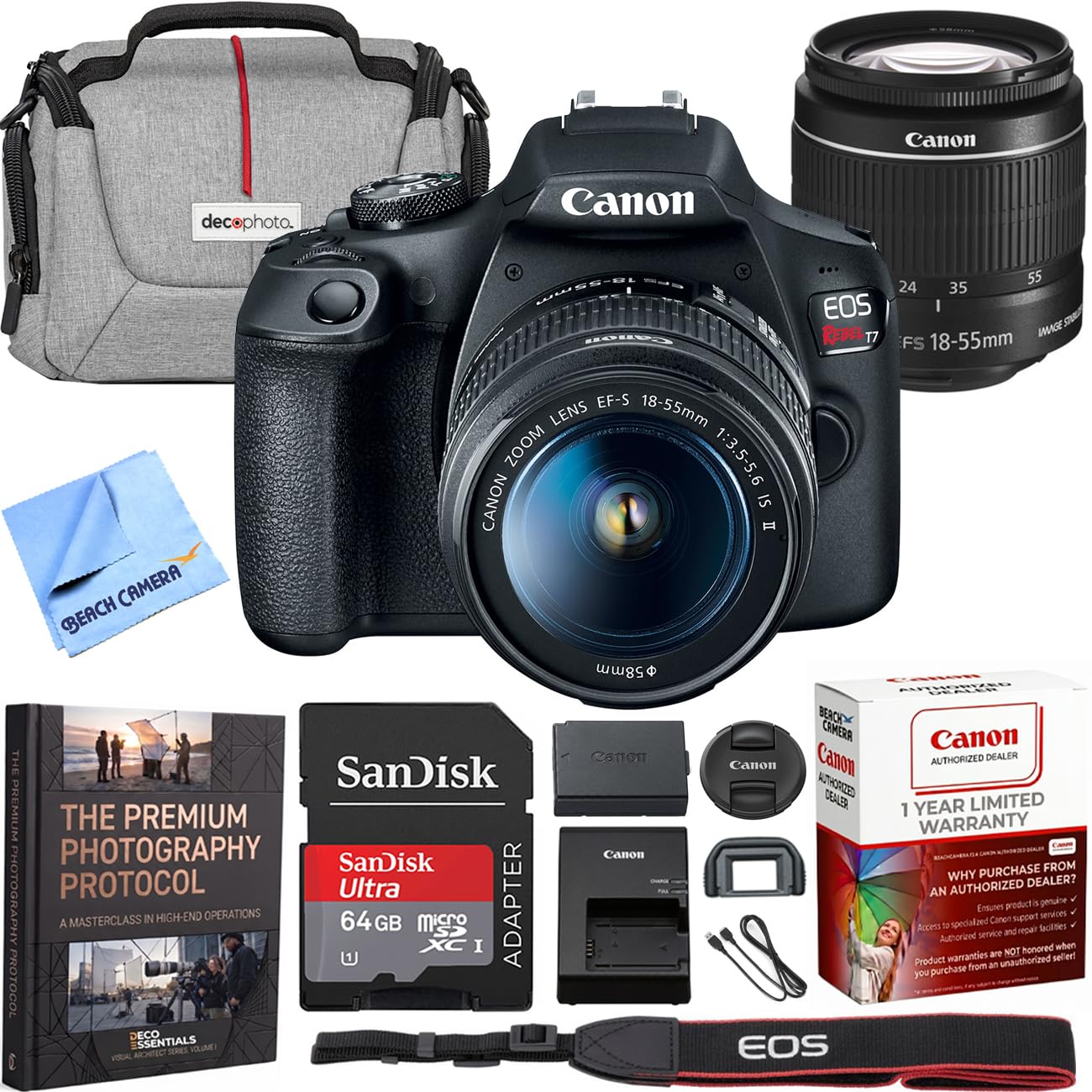
2. Canon EOS Rebel T7 DSLR Camera Bundle
The complete beginner’s kit that arrives ready to shoot your first semester.
If you want everything in one box, this Canon EOS Rebel T7 bundle is the classic starting point. The 24.1 Megapixel CMOS (APS-C) sensor (a smaller-than-full-frame chip that keeps costs down) with ISO 100-6400 (expandable to H: 12800) handles your first low-light assignments. The 18-55mm f/3.5-5.6 IS II lens covers wide-angle to portrait lengths, and the lens’s image stabilization (IS) reduces the blur from shaky hands.
The kit adds a Deco Gear camera bag, a SanDisk 64GB microSD card, a microfiber cloth, and a digital photography guide ebook. Built-in Wi-Fi and NFC let you transfer images to your phone and shoot remotely — a feature that makes critiquing sessions easier. The 9-point AF system and 3.0 fps continuous shooting are entry-level numbers, so you will feel the limit on fast action.
You get real Canon quality at a budget price — one retired photographer who treated himself calls it “Canon quality through and through.” The accessory lenses in the bundle are decent but not Canon-grade, and the included slave flash (a separate off-camera flash unit) has compatibility issues with the camera for some users. The camera’s on-board Feature Guide explains settings on screen, which is a genuine help for your first weeks.
beginner friendly kit
- Full starter kit with bag, 64GB card, and cleaning cloth
- Scene Intelligent Auto mode for confident first shots
- Remote shooting and wireless printing via built-in Wi-Fi
dated sensor tech
- 9-point AF limits action and sports photography
- Slave flash may not fire with the camera
- Entry-level build lacks weather sealing
entry-level value: you are a complete beginner who wants one box with everything needed for a first photography class trip.
serious shooters: you already know you want to shoot fast-moving subjects or need a weather-sealed body for outdoor work.
3. Canon EOS Rebel T7 Renewed Bundle with Telephoto Lenses
Three lenses in one box open up wildlife and portrait practice on a student budget.
This renewed (refurbished) Canon EOS Rebel T7 bundle trades a bit of new-box polish for a massive range of focal lengths. You get the 18-55mm IS II lens for everyday shots, the EF 75-300mm III for sports and wildlife reach, and a 500mm f/8 preset telephoto lens for distant subjects. The 24.1MP APS-C CMOS sensor and DIGIC 4+ processor deliver the same image quality as a brand-new T7.
The bundle adds two SanDisk 32GB SDHC cards, a camera shoulder case, a slave flash, HD UV filters, a monopod, a flexible spider tripod, and a T-mount for the 500mm lens. Owners describe the camera as a “great starting camera” that takes “amazing pictures.” The 9-point AF system with a center cross-type point and 3 fps shooting are basic, but the kit makes up for it with versatility.
The honest trade-off is the autofocus speed — owners find it “very slow” on the long zoom, so manual focus is often faster. The 500mm lens is fully manual and needs a tripod at full reach to avoid blur. The included slave flash is weak, and you will want to budget for a stronger flash for indoor low-light work. One year seller warranty covers the renewed body.
telephoto bargain
- Three-lens range from 18mm wide-angle to 500mm telephoto
- Full HD 1080/30p video recording for video assignments
- Monopod, tripod, and filters included for stability
renewed condition risk
- Long telephoto lenses are manual focus only
- Slow autofocus overall in the 9-point system
- Renewed condition means possible cosmetic wear
budget zoom hunter: a student who wants to try wildlife, sports, and portrait photography without buying separate lenses later.
warranty worriers: you need fast, reliable autofocus for action shots or prefer brand-new gear with no refurbishment history.
4. Canon EOS RP Full-Frame Mirrorless with RF24-105mm Lens Kit

A compact full-frame mirrorless that opens up low-light and portrait depth on a student’s budget.
The Canon EOS RP is the affordable door into full-frame photography — buyers call it “a fantastic way to get into Full Frame while staying affordable.” Full-frame means the sensor is the same size as classic 35mm film, which gives you better low-light performance and that creamy background blur known as bokeh. The kit lens is the RF24-105mm F4-7.1 IS STM with a versatile zoom range and Optical Image Stabilization (IS) that corrects up to 5 stops of camera shake (so you can shoot at slower shutter speeds without blur).
This mirrorless body (a camera without the mirror box of a DSLR, making it smaller and quieter) is described as compact and lightweight for travel and vlogging. It records 4K UHD 2160p video, and you can use Canon’s EOS Utility Webcam Beta Software to turn it into a high-quality webcam for online classes. The maximum magnification of 0.4x and minimum focusing distance of 0.66 feet in autofocus let you get close for detail shots.
Owners say it takes “professional looking pictures” and note the high ISO performance has “minimal grain.” The recurring negatives are that the 4K video has a crop and a 30-minute limit, and the kit lens lacks an AF/MF switch (you change it in the menu). The battery life draws the most criticism, so a spare battery is wise for a full day of shooting.
full-frame hybrid
- Full-frame sensor for superior low-light and depth of field
- 5 stops of image stabilization in the kit lens
- Compact body that travels and vlogs easily
kit lens limits
- 4K video uses a crop and caps at 30 minutes
- Kit lens edge sharpness is soft until f/8
- Battery life is the most common complaint
travel all-rounder: you want the look of full-frame portraits and landscape shots without carrying a heavy DSLR.
low-light pros: you shoot a lot of sports or need long battery life for all-day fieldwork.
5. Nikon D7500 20.9MP DSLR with 18-140mm VR Lens

The 51-point autofocus and 8 fps burst make this the action-photography student’s tool.
If your photography course includes sports, wildlife, or street candids, the Nikon D7500 is built for a fast-moving scene. The 20.9MP sensor delivers “class leading image quality” with an ISO range and metering system that Nikon owners say matches the award-winning D500. The 51-point AF system with 15 cross-type sensors and group-area AF tracks subjects with speed, and the up to 8 fps continuous shooting capability captures the peak of a jump or a swing.
The 18-140mm f/3.5-5.6G ED VR lens is a standout all-in-one walk-around zoom, covering wide to telephoto reach with Vibration Reduction (Nikon’s name for image stabilization) to steady your handheld shots. The large 3.2-inch 922K dot tilting LCD screen with touch functionality makes composing from high or low angles easy, and the 4K Ultra HD video with stereo sound, power aperture control, and auto ISO covers your video assignments.
What wins people over is the sharp, low-noise image quality even in low light, and owners mention the fast autofocus and the “outstanding” 18-140mm lens. The camera is an older 2017 model, so it lacks the latest mirrorless tech, and it is “sturdy but heavy” — a definite carry weight on a long walk. One buyer called it “not for beginners” simply because the feature set is deep, but the buttons and layout are straightforward once you learn them.
fast action shooter
- 51-point AF and 8 fps burst for action shots
- 20.9MP sensor with strong low-light performance
- Versatile 18-140mm VR lens covers most subjects
cropped sensor
- Heavier than modern mirrorless alternatives
- 2017 model lacks the latest autofocus tech
- Setup menu has a learning curve
sports enthusiast: students whose assignments mix fast-moving subjects, low-light indoor sports, and all-day versatility.
landscape purists: you want the lightest possible kit or the newest AI-powered autofocus.
6. Canon EOS R8 Mirrorless Camera Body

Canon’s lightest full-frame RF mirrorless is a hybrid powerhouse for photo and video coursework.
The Canon EOS R8 is the current balance for students who want full-frame quality without carrying a heavy DSLR. It is Canon’s lightest full-frame RF Mount mirrorless camera, built around a 24.2 megapixel CMOS image sensor and the DIGIC X Image Processor. The Dual Pixel CMOS AF II system covers up to 100% x 100% of the frame with 1,053 AF zones, and it uses deep learning to detect people, animals, vehicles, and even aircraft, trains, and horses.
For a student doing both stills and video, this is the most versatile body here: uncropped 4K at up to 60 fps (oversampled from 6K), Full HD high-frame-rate recording at up to 180 fps2 for slow motion, Canon Log 3 or HDR PQ for professional color grading, and a max movie record time of 2 hours3. The 40 frames per second continuous shooting with electronic shutter means you will not miss a decisive moment, and the 0.39-inch OLED EVF (electronic viewfinder) refreshes at up to 120 fps.
Buyers describe the R8 as “R6 Mark II without the price,” noting it shares the same sensor, autofocus, and video capability as that pricier model. The low-light performance is called “magic in your hands.” The honest trade-offs are a single SD card slot, a smaller battery, and no in-body image stabilization (IBIS) — so you will want stabilized RF lenses. The battery life is the most common complaint, so pack a spare.
compact full-frame
- Deep-learning autofocus tracks people, animals, and vehicles
- 4K 60p video and 180 fps slow motion for video projects
- Lightest full-frame RF Canon, ideal for travel
small battery life
- Single SD card slot with no backup
- No in-body image stabilization
- Smaller battery that drains faster
street photography: your course blends photography and videography and you want a light full-frame with professional autofocus.
long video shoots: you need IBIS for handheld video or want dual card slots for professional reliability.
7. Sony Alpha a7 III Mirrorless with 28-70mm Lens

The 693-point autofocus and 10 fps burst make this a pro-level step up for ambitious students.
The Sony Alpha a7 III has been the default recommendation for serious enthusiasts, and it still earns that reputation. Its advanced 24.2MP back-illuminated (BSI) full-frame sensor has a 1.8X readout speed, 15-stop dynamic range (the span between the darkest and brightest details a sensor can capture), and 14-bit uncompressed RAW. The ISO range from 50 to 204,800 means you can shoot in near darkness and still get usable images.
The autofocus is the headline: 693 phase-detection and 425 contrast AF points cover 93% of the image area, and owners say the AF speed and accuracy beat Canon DSLRs. It shoots up to 10 fps with either silent or mechanical shutter while maintaining AE/AF tracking, so you can capture a decisive moment without the camera hunting. The included 28-70mm f/3.5-5.6 lens is a solid everyday zoom, and 4K video is “stunning” per owners.
What wins people over is the overall package — one owner says it “outperforms a Canon Rebel T7 with prime lenses,” and another shoots roughly 710 photos per charge. The battery life is genuinely excellent for a mirrorless. The honest trade-offs are the menu system, which buyers call complex, and weather sealing that is insufficient for harsh environments. The kit lens is fine but not exceptional, so you will eventually want better glass.
versatile all-rounder
- 693-point AF with 93% frame coverage for reliable tracking
- Excellent battery life, roughly 710 shots per charge
- 4K video with S&Q slow-motion mode
menu complexity
- Complex menu system takes time to learn
- Weather sealing is not for harsh conditions
- Kit lens is decent but not exceptional
hybrid creator: students who want a do-everything full-frame body that handles photos, video, low light, and action with equal skill.
menu haters: you want the newest AI autofocus tricks or prefer a simpler menu layout.
8. Fujifilm X-T5 Mirrorless with XF16-50mm Kit

A 40.2-megapixel APS-C camera with vintage dials that teach you exposure the old-school way.
The Fujifilm X-T5 is the camera for students who love the tactile feel of photography. Its 40.2 Megapixel X-Trans CMOS 5 HR BSI sensor delivers image quality that one owner calls “as good as it gets on APSC” (the smaller-than-full-frame format). The dual dials on top for shutter speed and ISO force you to learn manual exposure the way your instructor wants — no menu digging required.
The XF16-50mmF2.8-4.8 R LM WR lens kit covers wide to standard portrait lengths, and the up to 7 stops of Internal Body Image Stabilization (IBIS) (the sensor itself compensates for shake) means you can shoot handheld in low light. It hits 15 frames per second in mechanical shutter, and the 1/180,000 max shutter speed in electronic shutter freezes even the fastest action. The 160MP pixel shift multi-shot mode creates ultra-high-resolution files for fine art work.
What owners rave about is the “vintage aesthetic” and the film simulation modes (Fujifilm’s in-camera color profiles that mimic classic film stocks), which make your JPEGs look beautiful straight out of camera. The learning curve is real — one owner said there was “initial confusion but easy to learn” — and the body is heavier and bulkier than some rivals, though still shoulder-carryable. It is a 4.5-star camera with a smaller rating base, so it is more of a niche pick.
classic dials: If you love dials, film aesthetics, and want a camera that feels like an instrument rather than a computer, the X-T5 is deeply satisfying. Buyers consistently call it “the best camera I have ever owned.” The catch is that the layout has a steeper initial learning curve than a typical mirrorless, and the body is not the lightest in its class.
9. Sony Alpha 7R V Full-Frame Mirrorless Camera Body

A 61-megapixel body with AI autofocus that delivers detail for fine-art and commercial ambitions.
The Sony Alpha 7R V is the camera for students whose final projects demand maximum resolution. Its 61.0 MP full-frame back-illuminated Exmor R CMOS sensor captures an astonishing level of detail, and the Advanced BIONZ XR engine boosts overall processing speed by up to 8x. Customers note the images are “sharp” with incredible dynamic range, capturing detail in both highlights and shadows.
The next-generation AF uses a new AI processing unit for Real-time Recognition autofocus with deep learning. It tracks not just people and animals, but also birds, insects, cars, and planes — which is exactly what you need for nature or sports assignments. It shoots 8K 24p/25p and 4K 60p (50p) video, so your filmmaking coursework is covered too. The dual SD/CFexpress Type A slots give you the redundant storage professionals rely on.
What wins people over is the autofocus that “tracks even during chaotic moments” and the resolution that lets you crop aggressively. The honest trade-offs are that it is “larger, heavier, technical,” and expensive — this is a serious investment. Owners note it is “not for sports/video” as a primary role, and battery drain runs about 25% higher than the previous model. It is the camera you buy when you are committing to photography as a career.
ultimate resolution
- 61MP sensor for massive prints and heavy cropping
- AI autofocus with eye detection for humans, animals, birds, insects, cars, and planes
- 8K and 4K video plus dual card slots
pricey investment
- High price point that is a major student investment
- Heavier and more technical than compact rivals
- Higher battery drain than the A7R III
pixel peeper: your track is fine art, commercial, or editorial where maximum resolution and AI focus tracking justify the cost.
casual snapper: you are on a tight budget or want a lightweight carry for everyday classwork.
Understanding the Specs
Megapixels and Sensor Size
The megapixel count (MP) tells you how many millions of pixels the sensor captures. More pixels mean you can print larger and crop more aggressively, but a bigger sensor is what truly improves low-light performance and background blur. Full-frame sensors (like the ones in the Canon EOS RP or Sony a7 III) are the same size as 35mm film, while APS-C sensors (like the Canon Rebel T7) are smaller and more budget-friendly. For a student, 24MP is plenty — the difference between 24MP and 45.7MP only matters when you print huge or need to crop heavily.
Autofocus Points and Burst Speed
Autofocus (AF) points are the spots where the camera can lock focus in the frame. More points mean better tracking of moving subjects across the whole image. The Nikon D850 has 153 AF points and 9 fps continuous shooting, while the Canon Rebel T7 has 9 points and 3.0 fps — a 17.0x gap in points and a 3.0x gap in speed. For sports and wildlife, you want at least 51 points and 5 fps. For portraits and landscapes, 9 points is workable but frustrating on moving subjects.
FAQ
Should a photography student start with a DSLR or a mirrorless camera?
Do I need a full-frame sensor as a beginner?
Is the Canon EOS Rebel T7 good enough for a university photography course?
What does the lens kit matter for a student?
How many megapixels do I actually need for assignments?
Is buying a renewed or refurbished camera a good idea?
Does a camera for a photography student need 4K video?
Why do autofocus points matter when I shoot portraits?
Final Thoughts: The Verdict
If you want one dependable pick, the camera for photography student winner is the Nikon D850 because it is the highest-rated body here and delivers 45.7MP resolution, 153 autofocus points, and 9 fps burst speed that will carry you from beginner to professional. If you want an entry-level kit with everything included, grab the Canon EOS Rebel T7 Bundle. And for a light full-frame with modern AI autofocus, the Canon EOS R8 is the one to reach for.
How We Picked
We do not accept paid placement. Every pick is matched to a real buyer and a real use-case; we do not hands-on test units.
Sources & Methodology
Specifications: manufacturer listings and product documentation. Review insights: verified customer reviews, as of August 2026. Pricing: not shown on this page (it changes often); check the current price via the retailer link.
As an Amazon Associate, FitlyFast earns from qualifying purchases. This does not affect which products we feature.