
Our readers keep the lights on and the weekend projects moving. As an Amazon Associate, I earn from qualifying purchases.
A slow hard drive or a nearly full disk is the single biggest bottleneck in any modern PC, laptop, or gaming console. Upgrading to a solid-state drive eliminates that drag, but the choice between a blistering NVMe Gen 4 drive and a proven SATA SSD comes down to your motherboard, your budget, and your workload.
I’m Rikta — the co-founder and writer behind FitlyFast. I’ve spent hundreds of hours analyzing controller chipsets, NAND types, and real-world transfer benchmarks to separate marketing promises from genuine performance gains in the 1 TB SSD market.
Whether you are a gamer demanding sub-second load times, a creative professional moving massive project files, or simply reviving an older laptop, this guide examines the top contenders to help you find the right 1 tb ssd for your setup.
How To Choose The Best 1 TB SSD
Choosing a 1 TB SSD today is not just about capacity; it is about interface compatibility, real-world speed, and thermal management. A drive that runs too hot can throttle and lose performance during long file transfers or intense gaming sessions.
Interface: NVMe PCIe Gen 4 vs. SATA III
NVMe Gen 4 drives deliver sequential reads up to 7,100 MB/s — over ten times faster than a SATA III drive’s 560 MB/s cap. If your motherboard has an M.2 slot supporting Gen 4, an NVMe drive is the obvious choice for a boot drive or game library. SATA III drives, however, remain the best upgrade for older laptops and desktops that lack an M.2 slot, providing a massive speed boost over a mechanical hard drive without requiring a new motherboard.
Form Factor: M.2 2280 vs. 2.5-Inch
M.2 2280 drives are small sticks that plug directly into the motherboard, keeping your build clean and cable-free. 2.5-inch SATA drives are larger and require a power cable from the PSU and a SATA data cable. For ultrabooks and compact builds, an M.2 drive is the only practical option. For a desktop with spare drive bays, a 2.5-inch SATA SSD is a simpler, often more budget-friendly choice.
Real-World Performance: Sustained Writes and SLC Cache
A drive’s peak speed is only part of the story. Many SSDs use a portion of the NAND as a dynamic SLC cache to boost burst performance. Once the cache fills, write speeds drop to the native TLC or QLC NAND speed. For tasks like moving large video files, look for drives with a large variable buffer or DRAM cache to maintain consistent performance. This spec is often more impactful than the advertised peak sequential read.
Thermal Management
High-performance NVMe drives generate significant heat under sustained loads. If your motherboard does not have a built-in heatsink over the M.2 slot, you should consider a drive with a graphene heat spreader or a copper foil sticker. Without proper cooling, the controller may throttle speeds to protect itself, negating the advantage of a high-end drive.
Quick Comparison
On smaller screens, swipe sideways to see the full table.
| Model | Category | Best For | Key Spec | Amazon |
|---|---|---|---|---|
| Samsung 870 EVO | Premium SATA | Ultimate reliability for legacy systems | 560 MB/s Sequential Read | Amazon |
| WD Blue SN5100 | Premium NVMe | Pro workflow speeds | 7,100 MB/s Sequential Read | Amazon |
| SanDisk Extreme Portable | External | Rugged on-the-go backup | 1,050 MB/s Read / IP65 | Amazon |
| Fanxiang S880E | NVMe Gaming | PS5 expansion at high speed | 7,000 MB/s Sequential Read | Amazon |
| Fikwot FX660 | Mid-Range NVMe | Balanced speed and value | 4,800 MB/s Sequential Read | Amazon |
| Patriot P400 Lite | Gen 4 Entry | Budget Gen 4 for desktops | 3,500 MB/s Sequential Read | Amazon |
| Crucial BX500 | Entry-Level SATA | Affordable system revive | 540 MB/s Sequential Read | Amazon |
In‑Depth Reviews
1. Samsung 870 EVO 1TB

The Samsung 870 EVO is the benchmark for SATA SSDs, maximizing the interface’s limits to 560 MB/s sequential reads and 530 MB/s writes. It leverages Samsung’s in-house V-NAND and a DRAM-based cache to maintain consistent performance over long periods, unlike many budget SATA drives that rely on slower QLC NAND. This drive is the gold standard for anyone reviving an older laptop or desktop that only has SATA ports.
Samsung rates the 870 EVO for up to 600 TBW (Terabytes Written) for the 1TB model, backed by a 5-year limited warranty. This endurance rating is among the highest in the SATA category, making it suitable not just for a boot drive but for heavy write workloads like video recording or surveillance systems. The included Samsung Magician software provides easy firmware updates and drive health monitoring.
The trade-off is that you are paying a premium for the SATA form factor. Users report that the drive runs noticeably cooler than competing SATA SSDs, and it is compatible with a vast range of systems from PCs to Macs and NAS devices. For a pure drop-in upgrade that prioritizes rock-solid reliability, this is the top choice.
Why it’s great
- Maximum SATA III speeds with DRAM cache for sustained writes.
- Industry-leading 600 TBW endurance rating.
- Runs cooler than most SATA competitors.
Good to know
- Higher price per gigabyte than budget SATA options.
- No performance benefit over mid-range SATA drives on most tasks.
2. WD Blue SN5100 1TB NVMe SSD
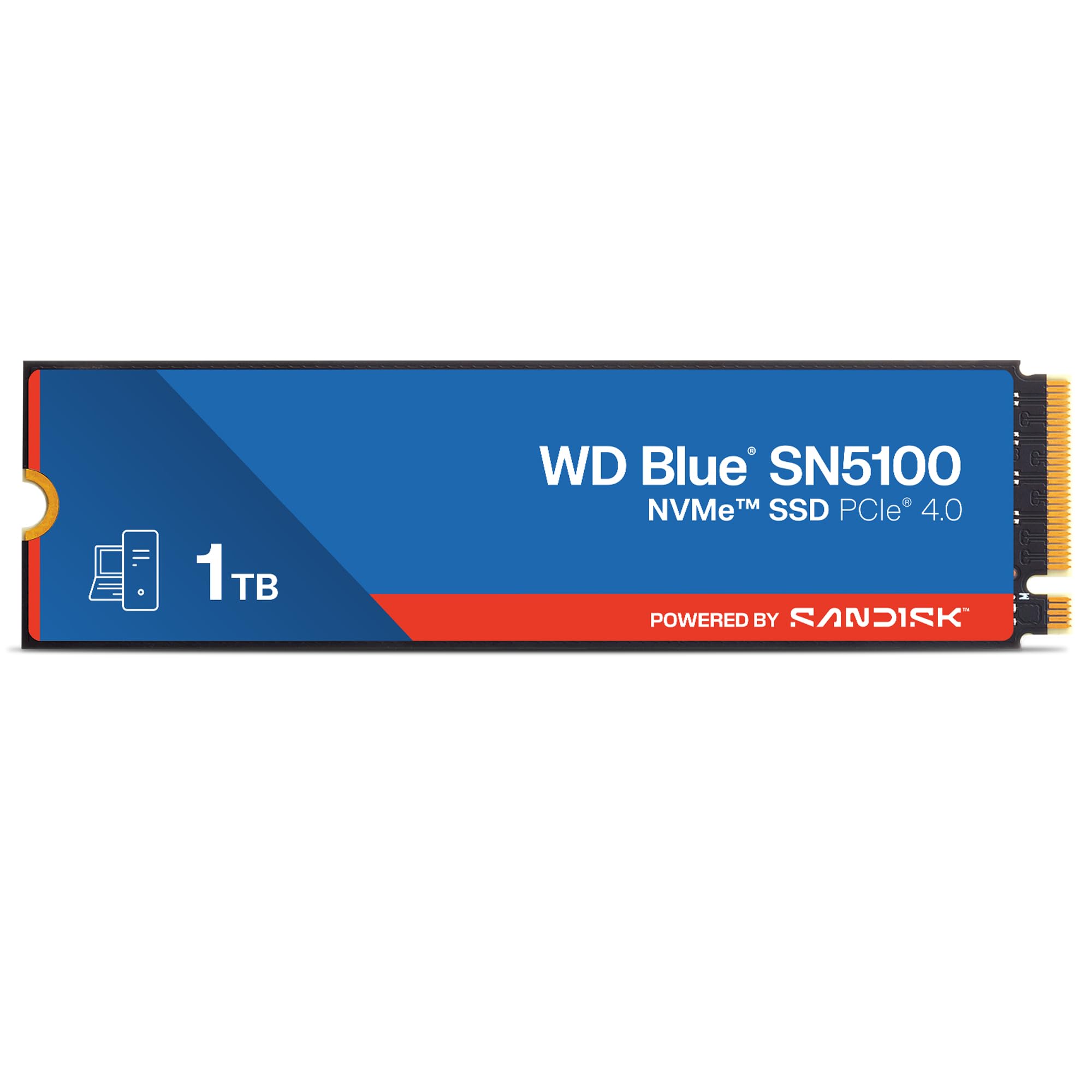
The WD Blue SN5100 delivers a massive performance leap over previous generations, hitting sequential read speeds up to 7,100 MB/s via the PCIe Gen 4 interface. It utilizes SanDisk nCache 4.0 technology, which creates a large dynamic SLC write cache to sustain high transfer rates for large files. This drive is designed to accelerate AI-enabled workflows, 4K video editing, and data-heavy creative tasks.
Western Digital backs this drive with a 5-year limited warranty and offers a free download of Acronis True Image for easy data migration. The M.2 2280 form factor makes it compatible with most modern motherboards and high-end laptops. Users consistently note the “no nonsense” installation and the immediate, noticeable speed improvement over older SATA or Gen 3 drives.
One consideration is that while the peak speeds are elite, the SN5100 uses DRAM-less design, relying on Host Memory Buffer (HMB) to access system RAM. This can slightly impact performance in random write workloads compared to drives with dedicated DRAM. However, for the vast majority of users, the combination of speed, brand reliability, and warranty makes this a top-tier Gen 4 choice.
Why it’s great
- Class-leading 7,100 MB/s sequential read speed.
- 5-year warranty from a trusted brand.
- nCache 4.0 technology for sustained file transfers.
Good to know
- DRAM-less design; uses HMB for caching.
- Best performance requires a PCIe Gen 4 slot.
3. SanDisk Extreme Portable 1TB SSD

The SanDisk Extreme Portable SSD is a rugged external drive built for photographers, videographers, and anyone who needs fast, durable storage on the go. It delivers NVMe-level performance via a USB 3.2 Gen 2 interface, with read speeds up to 1,050 MB/s and write speeds up to 1,000 MB/s. This is fast enough to edit video directly from the drive or quickly back up an entire system.
Its construction is a standout feature: it offers IP65 water and dust resistance and can survive drops from up to 3 meters, with a built-in carabiner loop for securing it to a bag. For security, it includes 256-bit AES hardware encryption with password protection. The drive comes with both a USB-C cable and a USB-A adapter, ensuring broad compatibility.
Users have praised its compact, palm-sized form factor and its reliable performance over extended use. It is an ideal solution for traveling creatives who need a fast, worry-free drive that can handle the elements. The main limitation is that it is an external drive, so it will not reach the internal NVMe speeds of a direct M.2 connection, but its combination of speed and ruggedness is unmatched in the portable category.
Why it’s great
- Fast 1,050 MB/s reads for on-the-go editing.
- IP65 water/dust resistance and 3-meter drop protection.
- Hardware encryption for data security.
Good to know
- External drive; slower than internal NVMe.
- May get warm during long continuous transfers.
4. Fanxiang S880E 1TB NVMe SSD

The Fanxiang S880E brings Gen 4 speeds to a competitive price point, offering sequential reads up to 7,000 MB/s and writes up to 3,000 MB/s. It supports the NVMe 2.0 protocol and is fully compatible with DirectStorage and the PS5, making it a strong contender for gamers who want near-instant load times. The drive features a graphite-coated copper foil sticker for thermal management.
Fanxiang backs this drive with a 5-year service and lifetime technical support. It uses 3D NAND flash and is marketed directly at gamers and content creators. Users have installed it in everything from a Ugreen NAS to a secondary gaming PC, consistently reporting that it performs admirably in real-world scenarios without overheating. One user noted it recognized immediately on a PS5 and provided ample storage.
The main consideration is the brand’s relative newness in the global market. While user reviews are overwhelmingly positive, some users express caution about the less established name. The drive performs very close to the top-tier WD Blue SN5100 at a more approachable cost, but for those who prioritize a household name, the Western Digital option might be more reassuring. Its maximum sequential speeds are advertised in Megabits per second in the specs, but in real-world usage, it delivers on its promises.
Why it’s great
- High-speed 7,000 MB/s reads for gaming and PS5.
- 5-year warranty with lifetime tech support.
- Effective graphite-coated copper foil heat spreader.
Good to know
- Brand is less established than Samsung or WD.
- Not compatible with macOS.
5. Fikwot FX660 1TB M.2 SSD

The Fikwot FX660 strikes a solid balance between speed and cost with PCIe Gen 4 x4 connectivity and read speeds up to 4,800 MB/s. It uses dynamic SLC cache technology to boost burst performance and includes a graphene heat dissipation sticker to manage thermals. This drive is well-suited for upgrading a PS5 or a modern laptop that supports Gen 4.
Its intelligent management system for temperature and power efficiency is a notable feature, helping to extend battery life in laptops. Users have successfully deployed it in external USB enclosures for NAS builds and report it works flawlessly on PS5. It comes with a 5-year warranty and includes necessary mounting hardware. The drive is backward compatible with PCIe Gen 3 slots.
On the downside, users note that the drive does not include a physical heatsink, just the graphene sticker. For sustained heavy workloads, a third-party heatsink might be necessary. Also, some users have mistakenly bought it for systems with a Key E M.2 slot instead of a Key M slot, so checking motherboard compatibility is essential. For a general performance boost without paying for the top-tier speeds, it is a very capable choice.
Why it’s great
- 4,800 MB/s reads are a great upgrade from SATA.
- PS5 compatible and backward compatible with Gen 3.
- 5-year warranty and includes screwdriver.
Good to know
- No dedicated DRAM; uses HMB.
- No physical heatsink; only graphene sticker.
6. Patriot P400 Lite 1TB SSD

The Patriot P400 Lite is an entry-level PCIe Gen 4 SSD that delivers sequential read speeds up to 3,500 MB/s and writes up to 2,700 MB/s. It uses a graphene heat shield to keep temperatures in check without requiring a bulky heatsink. For users building a new system on a Gen 4 platform but coming from a tight budget, this drive offers a significant speed advantage over Gen 3.
User reviews are surprisingly strong, with many comparing it favorably to premium drives like the Samsung 980 Pro in real-world tasks. One user noted that their unit outperformed the rated speeds, reading faster than a Samsung 980 PRO in sequential tests. It has been praised as a high-value drive for selling computers or as a secondary gaming drive. The drive supports end-to-end data path protection.
The key limitation is its relatively modest speed for a Gen 4 drive. While 3,500 MB/s is a massive upgrade over SATA, it is about half the speed of high-end Gen 4 drives. Some users note that component specifications may change between batches, potentially affecting long-term performance. As a cost-effective way to access the Gen 4 interface, it remains a very compelling option.
Why it’s great
- Gen 4 speeds at a very low price point.
- Graphene heat shield keeps it cool.
- Users report it often outperforms its rated specs.
Good to know
- Slower than other Gen 4 drives (capped at 3,500 MB/s).
- Component changes between batches may occur.
7. Crucial BX500 1TB SSD

The Crucial BX500 is a budget-friendly SATA III SSD that provides a massive performance upgrade over a traditional hard drive. With sequential reads up to 540 MB/s, it is over 300% faster than a typical HDD and is 45 times more energy efficient, directly improving battery life in laptops. It uses Micron 3D NAND, drawing on decades of memory manufacturing expertise.
This drive is the quintessential choice for reviving older computers that lack an M.2 slot. Its 2.5-inch, 7mm form factor fits almost any standard laptop or desktop drive bay. Users with 2018-era laptops report boot times dropping from minutes to under 15 seconds. The installation is straightforward, and the Crucial Executive Software allows for monitoring and optimization. It comes with a 3-year limited warranty.
The main trade-off is that it is an entry-level SATA drive, meaning it uses DRAM-less architecture and likely QLC NAND. Sustained write speeds after the SLC cache is exhausted will be lower than a DRAM-based SATA drive like the Samsung 870 EVO. For basic office work, web browsing, and media consumption, however, the BX500 delivers a transformative experience for a very low cost. It is the perfect budget solution for extending the life of an old system.
Why it’s great
- Dramatic speed upgrade for old HDD-based PCs.
- Extremely low power consumption improves laptop battery life.
- Simple drop-in installation for any 2.5-inch bay.
Good to know
- DRAM-less design with QLC NAND.
- Sustained write speeds drop after SLC cache is full.
FAQ
Can I use a PCIe Gen 4 SSD in a Gen 3 slot?
Will an NVMe SSD work with my PlayStation 5?
What is the difference between TLC and QLC NAND?
Final Thoughts: The Verdict
For most users, the best 1 tb ssd winner is the WD Blue SN5100 because it delivers flagship Gen 4 speeds and a 5-year warranty from a top-tier brand. If you want a rugged external drive for travel, grab the SanDisk Extreme Portable. And for reviving an older laptop without an M.2 slot, nothing beats the reliable Samsung 870 EVO.