
Our readers keep the lights on and the weekend projects moving. As an Amazon Associate, I earn from qualifying purchases.
A 10-inch Dobsonian telescope is the sweet spot of amateur astronomy—large enough to resolve delicate nebula dust lanes and Saturn’s subtle ring divisions, yet compact enough that one person can manage setup in under an hour. Unlike smaller apertures that leave deep-sky objects as faint smudges, a 10-inch mirror gathers enough light to turn galaxies into tangible shapes with visible spiral structure under dark skies.
I’m Rikta — the co-founder and writer behind FitlyFast. I’ve spent hundreds of hours analyzing mirror quality, mount stability, eyepiece train design, and real-world collimation behavior across the Dobsonian market to build this guide around pure optical performance and long-term value.
Whether you are upgrading from a tabletop scope or starting with a serious instrument, this breakdown of the best 10 inch dobsonian telescope options will help you match your observing goals to the right aperture, focal ratio, and feature set without wasting money on unnecessary complexity.
How To Choose The Best 10 Inch Dobsonian Telescope
Dobsonian telescopes are simple Newtonian reflectors on a rocker-box mount—no tripod, no complex gears, just pure aperture per dollar. Once you commit to a 10-inch mirror, the key distinctions come down to focal ratio, tube design, mount bearings, focuser quality, and whether you want automated GoTo tracking or the classic manual star-hop experience.
Focal Ratio: f/4.8 vs f/5 vs f/6
Most 10-inch Dobsonians sit around f/4.8 to f/5, giving a focal length near 1200mm. Faster ratios (f/4) are designed for astrophotography but demand precise collimation and expensive coma correctors. Slower ratios (f/6) deliver easier collimation and work better with budget eyepieces, but the tube becomes physically longer and heavier. For visual-only use, f/5 is the Goldilocks zone—bright wide-field views at low power and enough focal length for planetary magnification with a quality Barlow.
Solid Tube vs Collapsible/Flextube
Traditional solid tubes are lighter per inch of aperture and need no light shroud, but they take up more trunk space. Collapsible designs—like Sky-Watcher’s Flextube—collapse the truss poles so the tube fits across a back seat, trading a few minutes of setup and the need for an optional light shroud for dramatically better portability. If you plan to take your scope to dark sites, collapsible is worth the minor inconvenience.
Mount Bearings and Motion Smoothness
Dobsonian mounts rely on Teflon or steel-needle bearings for altitude and azimuth movement. At 10 inches, the rocker box must handle roughly 35–45 pounds with zero stick-slip. Teflon pads are standard and work well in dry conditions; steel-needle bearings offer smoother motion in humid environments. Tension control handles let you adjust friction without tools—a feature worth seeking out if you use heavy eyepieces or a finder scope that throws off balance.
Focuser Quality and Upgradability
A 2-inch Crayford-style dual-speed focuser is non-negotiable at this aperture. Single-speed focusers make fine-tuning at high magnification frustrating. Dual-speed gives a 10:1 reduction for precise focus on planetary detail. Check whether the focuser is metal-bodied (preferred) and has standard 2-inch/1.25-inch compatibility so you can upgrade to wide-field eyepieces later.
GoTo vs Manual: Which Tracking System Suits Your Style?
Manual Dobsonians force you to learn the sky through star-hopping, which builds deep familiarity with constellations and deep-sky object locations. Computerized GoTo systems—like SynScan or Celestron StarSense—automatically slew to any target in a database of over 40,000 objects, perfect for maximizing observing time under light-polluted skies or for beginners who want instant gratification. Decide whether you value the journey of discovery or the destination itself.
Quick Comparison
On smaller screens, swipe sideways to see the full table.
| Model | Category | Best For | Key Spec | Amazon |
|---|---|---|---|---|
| Celestron StarSense Explorer 10-inch | Premium App-Enabled | Beginners wanting guided sky tours | 254mm f/6.4 Newtonian, XLT coatings | Amazon |
| Sky-Watcher Flextube 250 Dobsonian | Collapsible Classic | Visual observers who transport often | 10-inch f/4.9, 94% reflective mirrors | Amazon |
| Sky-Watcher Quattro 250P | Astrophotography OTA | DSLR deep-sky imaging | 10-inch f/4, oversized secondary mirror | Amazon |
| Sky-Watcher Virtuoso GTi 150P | Tabletop GoTo | Portable grab-and-go sessions | 150mm f/5, built-in Wi-Fi GoTo | Amazon |
| Celestron StarSense Explorer 150AZ | Tabletop Smartphone | Beginners on a budget | 150mm f/4.3, StarSense app dock | Amazon |
| DWARFLAB Dwarf 3 Smart Telescope | Ultra-Portable Smart | Astrophotography on the go | Dual-lens, 3 lb, 4K auto-tracking | Amazon |
| DWARFLAB Dwarf Mini | Pocket-Sized Smart | Travel-friendly smart scope | 1.85 lb, Sony IMX662 sensor | Amazon |
| MEEZAA 150EQ Reflector | Beginner Equatorial | Learning equatorial tracking | 150mm f/4.3, German EQ mount | Amazon |
| Dianfan 150EQ | Entry-Level Kit | Family stargazing starter | 150mm f/4.3, carry bag included | Amazon |
| Sky-Watcher Flextube 300 SynScan | 12″ GoTo Premium | Serious observers wanting automation | 12-inch f/4.9, 42,000-object database | Amazon |
In‑Depth Reviews
1. Celestron StarSense Explorer 10-inch Dobsonian

This 10-inch f/6.4 Dobsonian combines Celestron’s proprietary StarSense sky-recognition technology with a massive 254mm parabolic mirror coated with StarBright XLT multi-layer coatings. The result is an instrument that guides you through the night sky via your smartphone dock while delivering crisp, high-contrast views of everything from Jupiter’s banding to the dust lanes of the Andromeda Galaxy. The dual-speed 2-inch Crayford focuser provides the fine control needed for planetary work at high magnification.
The manual altazimuth base uses Teflon bearings that move smoothly even when balancing heavy 2-inch eyepieces such as the included 32mm unit. Owners consistently report that the StarSense app works reliably after enabling location services, pinpointing targets within the field of view of the included 25mm Plossl. The tension control handle lets you adjust friction without tools, a major convenience when swapping between a 2-inch wide-field and a 1.25-inch high-power eyepiece.
The Dawes limit of 0.46 arc-seconds means this scope can theoretically split tight double stars under steady seeing. Some users note that the supplied 25mm eyepiece is serviceable but recommend upgrading to a 8-12mm eyepiece and a 2x Barlow for lunar and planetary detail at over 200x magnification. The overall package at this aperture level is unmatched for a beginner who wants professional-level light grasp without a steep learning curve.
Why it’s great
- StarSense app eliminates the frustration of learning the sky alone
- 10-inch f/6.4 mirror delivers bright, contrast-rich views with manageable tube length
- Dual-speed Crayford focuser allows precise high-magnification adjustments
- Stable Dobsonian base with Teflon bearings and tension control
Good to know
- StarSense app may not work on some budget Android phones
- Included 25mm Plossl is decent but not premium
- Tube and base are heavy—each piece requires separate trips to a dark site
2. Sky-Watcher Flextube 250 Dobsonian 10-inch Collapsible

The Sky-Watcher Flextube 250 is the benchmark for a 10-inch collapsible Dobsonian. Its strut-based Flextube design collapses the optical tube from 48 inches to roughly 30 inches, fitting across the back seat of most sedans while keeping the primary and secondary mirrors permanently aligned. The 94% reflective multi-coated borosilicate mirrors pull in faint detail from nebulae and galaxies that standard 88% coatings would leave invisible.
At f/4.9 with a 1200mm focal length, this scope pairs naturally with 2-inch wide-field eyepieces for sweeping views of the Milky Way star clouds. The proprietary tension control handles compensate for heavy eyepieces without needing counterweights, and the 2-inch Crayford-style dual-speed focuser handles both 2-inch and 1.25-inch accessories smoothly. Users report that the Plossl eyepieces—25mm and 10mm—perform better than their price suggests, though upgrading to a quality 2-inch wide-angle is the first recommended modification.
Collimation out of the box is usually close, but the included 8×50 right-angle finder (RACI) makes star-hopping much more comfortable than straight-through finders. The most common owner modification is adding a simple lazy-Susan bearing for smoother azimuth rotation and a light shroud for stray-light control. At 42 pounds fully assembled, it is manageable for one person to roll on wheels but not to carry long distances without break down.
Why it’s great
- Collapsible strut design stows into a car-friendly package
- 94% reflective mirrors maximize light throughput for deep-sky objects
- Dual-speed 2-inch Crayford focuser handles all eyepiece sizes
- RACI finder allows comfortable star-hopping without neck strain
Good to know
- Collimation can shift during transport—expect to check before each session
- Azimuth bearings may stick initially; some users add a lazy-Susan mod
- No light shroud included—stray light can reduce contrast in suburban settings
3. Sky-Watcher Quattro 250P Imaging Newtonian

The Quattro 250P is an optical tube assembly designed purely for deep-sky astrophotography. Its f/4 focal ratio (1000mm focal length) captures four times the light per unit time compared to an f/8 system—critical for revealing faint hydrogen-alpha emission from nebulae in short sub-exposures. The oversized secondary mirror fully illuminates APS-C and full-frame camera sensors without vignetting, a non-negotiable feature for DSLR and dedicated astro-camera users.
The 2-inch dual-speed Crayford focuser includes a 10:1 micro-focus reduction for dialing in perfect focus with Bahtinov masks. Multiple knife-edge baffles inside the tube block stray light from degrading contrast on dim nebulae. Owners recommend pairing this tube with a mount like the EQ6-R Pro or an AM5 strain-wave mount, as the OTA alone weighs 33 pounds and demands precise guiding at f/4.
Experienced imagers note that coma correctors—such as the Starizona Nexus 0.75x or Apertura 0.95x—are essential at f/4 to produce sharp stars across the frame. Some units may require primary mirror masking or replacement of the stock focuser for truly flat fields. This is not a beginner’s plug-and-play scope; it is a tool for imagers ready to invest in guiding, field flatteners, and dew heaters to extract its full potential.
Why it’s great
- Fast f/4 optics drastically reduce exposure times for deep-sky imaging
- Oversized secondary mirror covers full-frame sensors without vignetting
- Internal knife-edge baffles minimize stray light during long exposures
- Dual-speed 2-inch focuser allows precise focusing with high-magnification setups
Good to know
- Requires a heavy-duty equatorial mount—adds significant cost
- Coma corrector is mandatory for corner-to-corner sharp stars
- Stock focuser may need replacement for astrophotography-grade performance
4. Sky-Watcher Virtuoso GTi 150P Tabletop GoTo Dobsonian

The Virtuoso GTi 150P delivers 150mm of aperture in a tabletop package that weighs only 25.8 pounds total. Its built-in Wi-Fi connects directly to the SynScan Pro app, turning your smartphone or tablet into a full GoTo hand controller with a 42,000-object database. At a focal ratio of f/5 (750mm focal length), paired with Super Plossl eyepieces at 25mm and 10mm, the scope offers bright, sharp views of lunar craters, Jupiter’s cloud bands, Saturn’s rings, and the Orion Nebula from a moderately dark backyard.
The patented Freedom Find technology uses dual encoders so you can push the scope manually to a new target and then resume GoTo control without losing alignment—not a standard feature on budget GoTo mounts. The collapsible truss-tube design means the optical tube collapses into a compact unit that stores easily in a closet or car trunk. Users generally rate the optics as excellent for the price class, but caution that the stock focuser feels plastic and benefits from a Teflon-tape mod for smoother travel.
Owners note two consistent pain points: the GoTo pointing accuracy can drift 2–5 degrees in light-polluted suburbs, requiring manual intervention at high magnification, and the stock eyepieces are entry-level Kellners rather than Plossls. Upgrading to a 2x Barlow and a medium-power eyepiece in the 15–18mm range dramatically improves planetary viewing. For a grab-and-go scope that fits on a sturdy picnic table, this is a compelling choice.
Why it’s great
- Built-in Wi-Fi GoTo works directly with smartphone app—no hand controller needed
- Freedom Find encoders let you push manually without losing alignment
- Collapsible design stores in a compact footprint
- 150mm aperture gathers enough light for deep-sky favorites
Good to know
- GoTo pointing accuracy degrades under light-polluted skies—expect 2-5 degree offsets
- Stock focuser can feel loose; a simple Teflon tape mod is recommended
- Tabletop design requires a sturdy surface—not usable without a table
5. Celestron StarSense Explorer 150AZ Tabletop Dobsonian
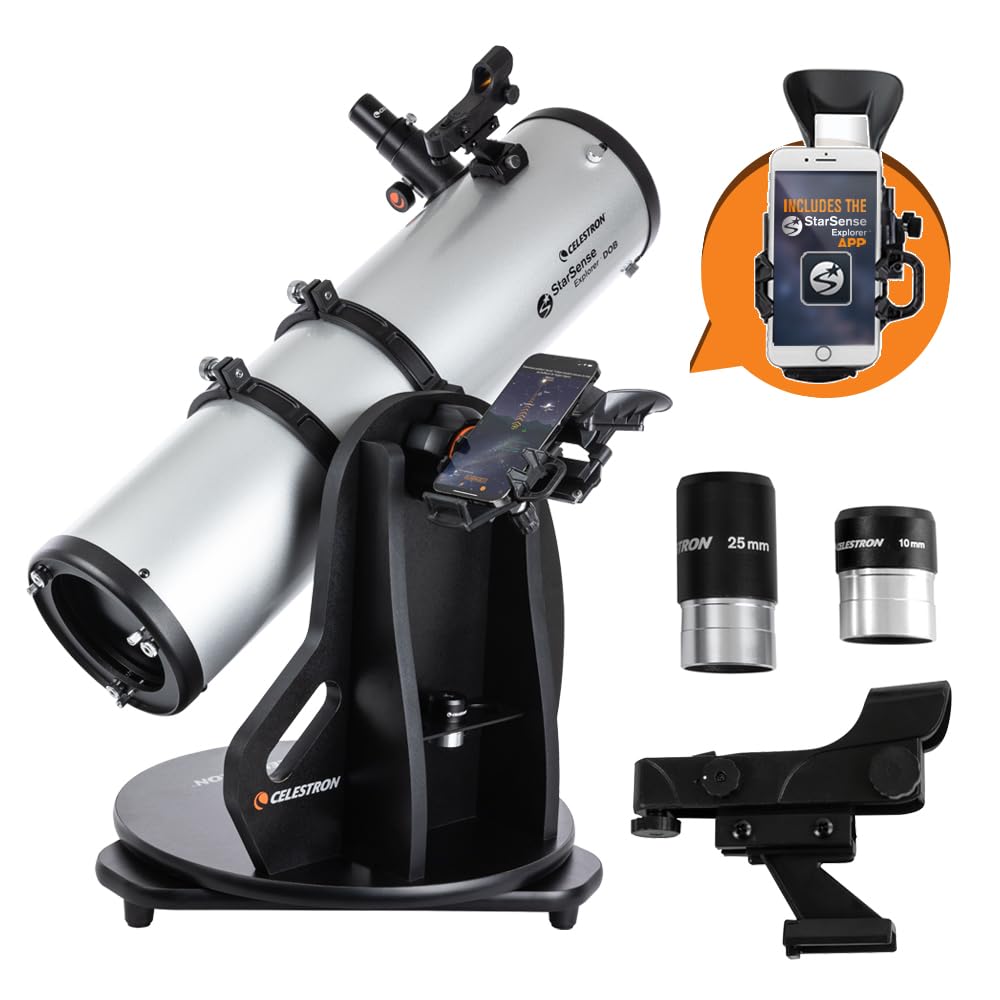
The StarSense Explorer 150AZ is a 6-inch tabletop Dobsonian that uses the same smartphone-powered sky recognition technology as Celestron’s larger models. By docking your phone into the included StarSense dock, the app analyzes overhead star patterns and guides you to planets, bright nebulae, and galaxies using on-screen arrows—no star chart knowledge required. This is the lowest-cost entry point into Celestron’s app-enabled Dobsonian ecosystem.
The f/4.3 focal ratio (650mm focal length) provides wide-field views ideal for scanning large objects like the Andromeda Galaxy and the Pleiades. The Altazimuth manual base is smooth and stable, with a StarPointer red-dot finder for quick alignment before engaging the app. Users praise the solid feel of the base compared to wobbly tripod-mounted alternatives in the same price bracket. The supplied 25mm and 10mm Kellner eyepieces produce decent images but lack the contrast and eye relief of Plossl or eyepieces.
One practical limitation: the pressboard base is heavy enough that the scope is best kept assembled near a dark-sky viewing spot—transporting it frequently is a chore. Some users also report that the StarSense app has trouble on inexpensive Android phones with insufficient camera hardware. For a beginner who will mostly observe from home and wants a guided introduction to the night sky, this scope offers a low-friction path to real astronomical discovery.
Why it’s great
- StarSense app eliminates the need to learn constellations manually
- Solid tabletop Dobsonian base eliminates tripod wobble
- Wide f/4.3 field of view is excellent for large deep-sky objects
- Sturdy construction at an approachable overall value
Good to know
- Pressboard base is heavy and not ideal for frequent transport to dark sites
- StarSense app may not work reliably on lower-end Android smartphones
- Kellner eyepieces are functional but upgrading to Plossls improves contrast
6. DWARFLAB Dwarf 3 Smart Telescope
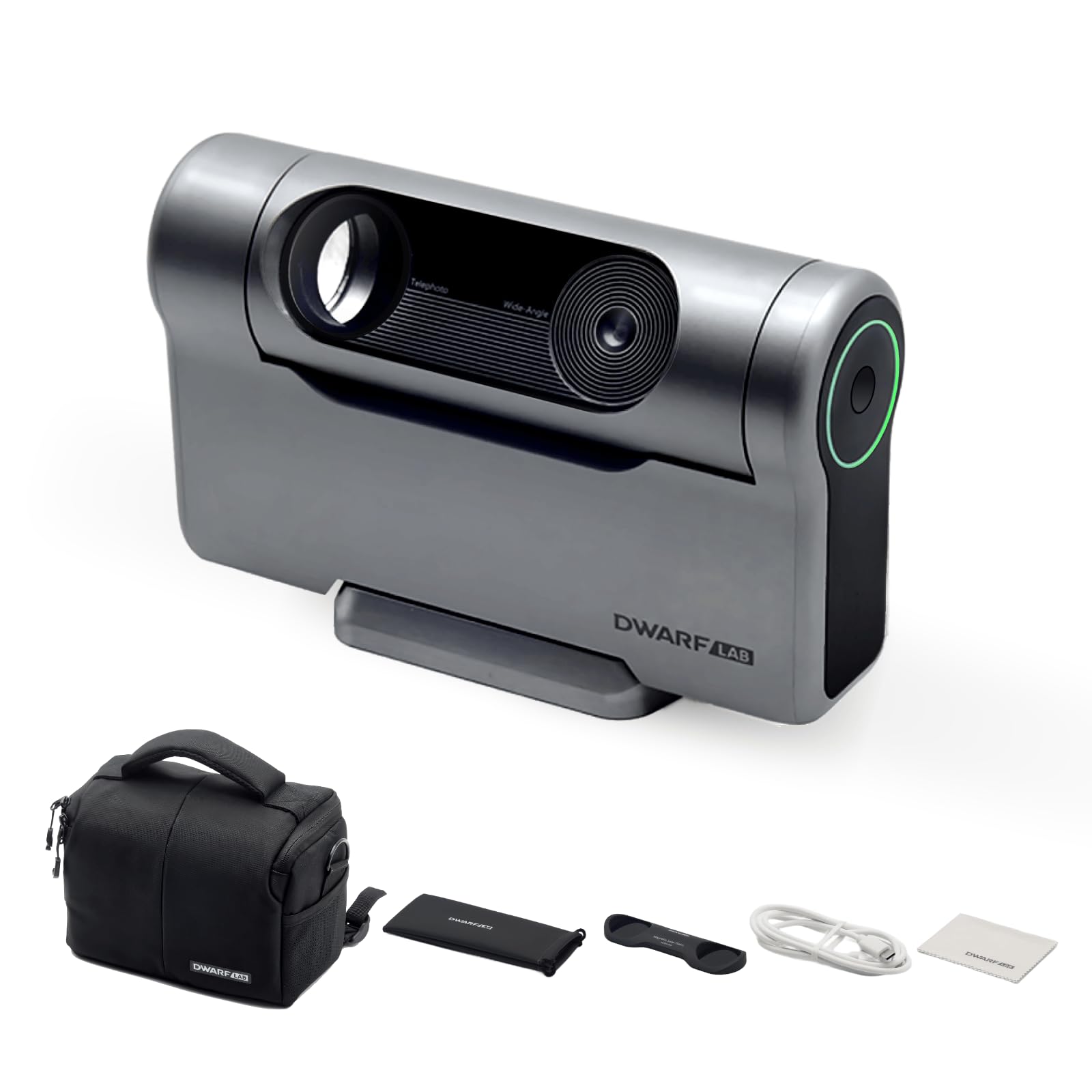
The Dwarf 3 is not a classic Dobsonian—it is a fully self-contained smart telescope with dual imaging lenses: a telephoto for deep-sky objects and a wide-angle for star trails and Milky Way panoramas. Weighing only 3 pounds, it replaces the concept of heavy mirror and mount with a digital camera system that auto-tracks celestial targets in 4K resolution and processes images directly in the companion app via cloud stacking.
The Altazimuth mount supports both AZ and EQ modes for tracking, with single-frame exposures up to 90 seconds in EQ mode. Users consistently report excellent results on bright deep-sky targets like the Orion Nebula, Andromeda Galaxy, and even the Pinwheel Galaxy under Bortle 5 skies. The app-based control means you can operate the scope from inside your home while it sits outside, and the built-in battery plus external power bank allows all-night imaging sessions.
The trade-off is that this is an imaging-only device—there is no eyepiece for visual observation. Chromatic aberration is present on bright stars, and the fixed dual-lens system cannot be upgraded. For an astrophotography beginner who wants instant, shareable results without learning mount guiding, collimation, or image processing, the Dwarf 3 is a transformational product. For those who want to look through an eyepiece, this is not the right path.
Why it’s great
- 3-pound all-in-one design fits in any backpack
- Dual imaging system captures both wide-field and deep-sky targets
- Cloud-based processing produces finished images without a computer
- Auto-tracking in 4K removes guiding complexity
Good to know
- No eyepiece viewer—imaging only
- Chromatic aberration visible on bright stars
- Fixed lens design cannot be upgraded or swapped
7. DWARFLAB Dwarf Mini Smart Telescope
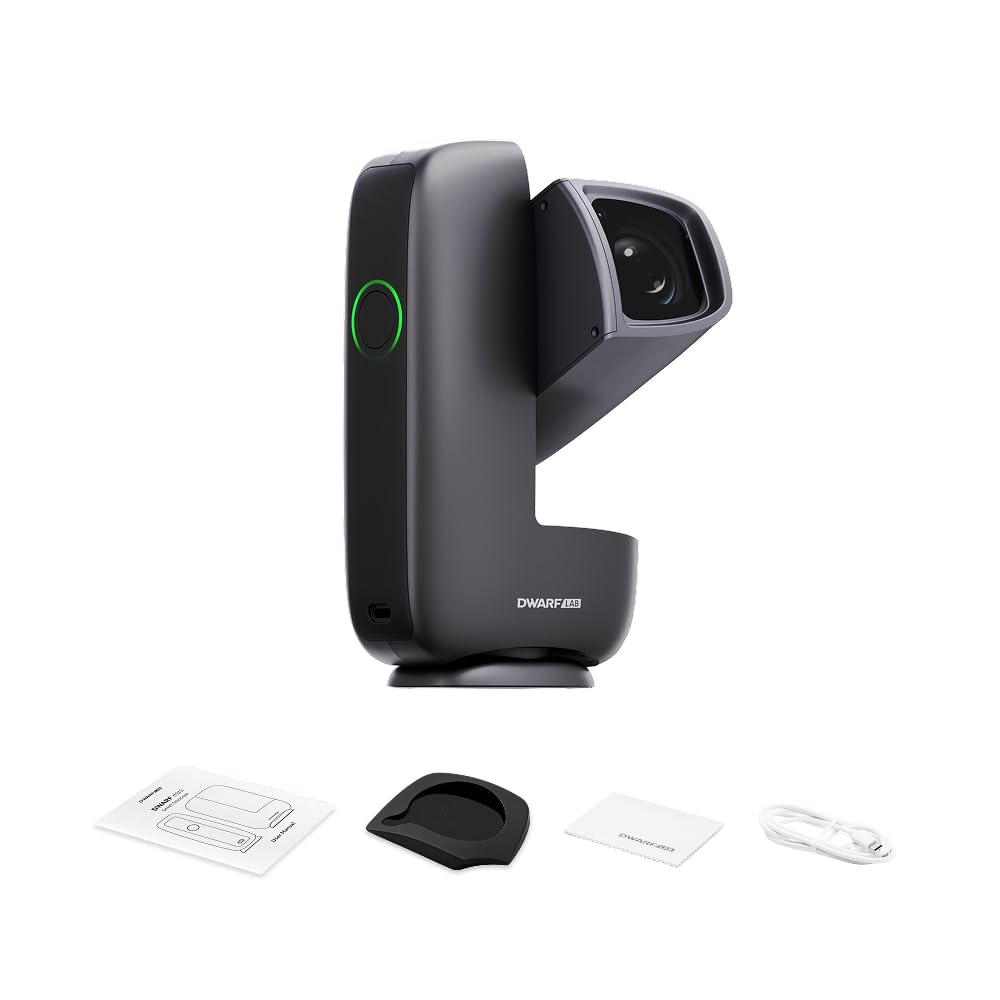
At just 1.85 pounds, the Dwarf Mini is the most portable telescope in this review—small enough to slide into a large coat pocket or backpack side pouch. Its compact form houses a Sony IMX662 sensor with 2.9μm pixels that capture clean, low-noise images of brighter deep-sky targets, the moon, and even sunspots when paired with the built-in solar filter.
The app-based control system includes a built-in sky atlas and auto-GOTO functionality with full 360-degree azimuth rotation. In EQ mode, the Mini supports single-frame exposures up to 90 seconds, enough to resolve structure in nebulas like M42 and M27 from suburban skies. The built-in light pollution filter helps cut through city glow, making this a viable option for urban users who cannot easily drive to dark sites.
Users highlight the incredibly short learning curve—most are capturing recognizable deep-sky images within ten minutes of unboxing. The wide field of view (2.45 degrees) is great for framing large objects but means the Mini struggles with small planets, which appear as featureless dots. The integrated Wi-Fi connects directly to your phone without needing a network. For anyone who prioritizes portability over raw aperture, this is the current state of the art.
Why it’s great
- Extremely portable 1.85-pound design fits in any bag
- Built-in light pollution filter helps urban astrophotography
- Auto-GOTO and EQ mode enable long-exposure imaging
- Very short setup time—images within minutes of unboxing
Good to know
- Not suitable for planetary detail—small planets appear as dots
- Wide 2.45-degree field limits effective focal length for small targets
- Requires a stable tripod for long exposures
8. MEEZAA 150EQ Newtonian Reflector
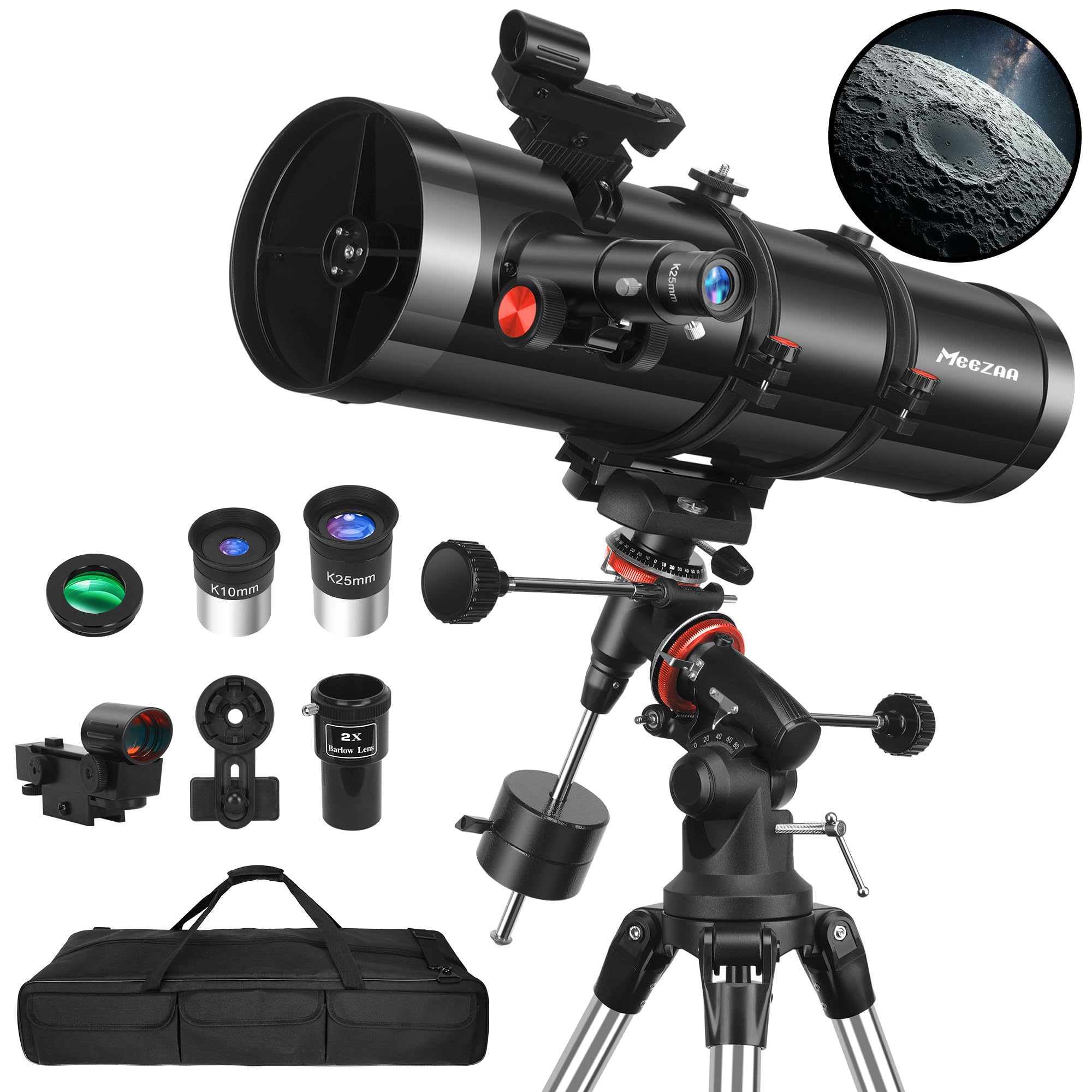
The MEEZAA 150EQ pairs a 150mm f/4.3 Newtonian reflector with a German equatorial mount, giving beginners a hands-on introduction to equatorial tracking. The mount features slow-motion control cables and setting circles, allowing users to manually track targets by rotating only one axis after polar alignment. The stainless steel tripod and built-in accessory tray create a stable platform for lunar and planetary observation.
The accessories include two Kellner eyepieces at 25mm and 10mm, a 2x Barlow lens, a moon filter, and a phone adapter for afocal photography. At 26x to 130x magnification, the scope delivers detailed views of lunar craters, Jupiter’s bands and moons, and Saturn’s rings. Users consistently mention that the optics are surprisingly sharp for the price bracket, though the stock eyepieces are entry-level and benefit from replacement.
The equatorial mount has a learning curve—it takes a few sessions to master polar alignment and coordinate rotation—but the included instructions and color-coded assembly help. Some users note that the slow-motion cables feel imprecise at high magnification, and the phone adapter can be finicky to align with the eyepiece. For a budget-conscious astronomy enthusiast who wants to learn equatorial tracking without a GoTo system, this is a functional and well-reviewed starting point.
Why it’s great
- German equatorial mount teaches proper tracking technique
- Sharp 150mm parabolic mirror at an accessible price point
- Includes moon filter and phone adapter for afocal imaging
- Sturdy tripod with accessory tray reduces setup frustration
Good to know
- Equatorial mount has a steep learning curve for absolute beginners
- Stock Kellner eyepieces are low-quality—budget for replacements
- Phone adapter alignment can be fiddly
9. Dianfan 150EQ Reflector
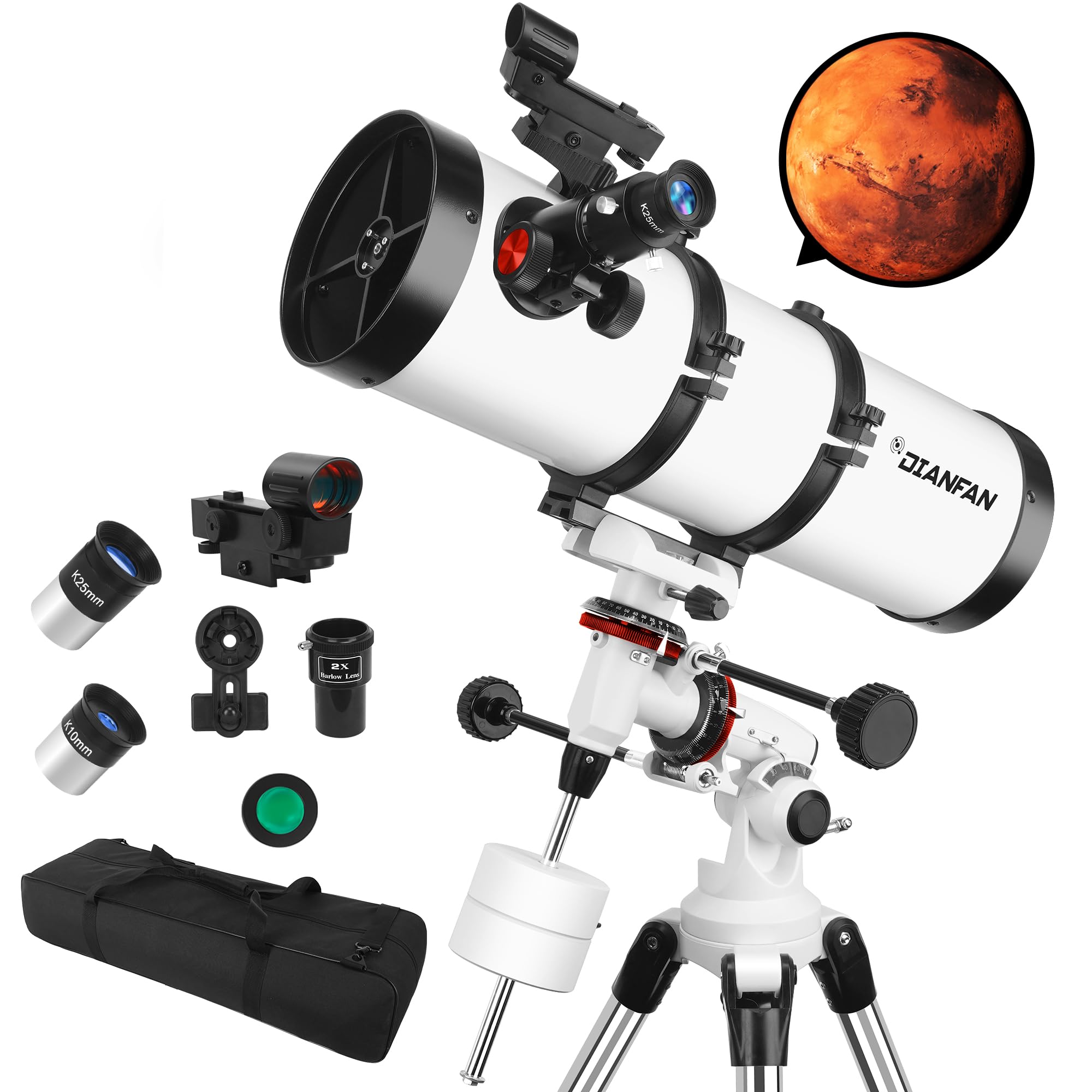
The Dianfan 150EQ is a complete family observing kit built around a 150mm f/4.3 Newtonian reflector on a German equatorial mount. The set includes a custom-fit carry bag that holds the entire telescope—tube, mount head, tripod, and accessories—making this one of the few sub-aperture kits that can realistically be transported to a dark site in a single trip.
With supplied 25mm and 10mm Kellner eyepieces plus a 2x Barlow lens, the available magnification range of 26x to 130x covers lunar surface studies, Jupiter’s major cloud bands and the Galilean moons, and Saturn’s rings at modest detail. The pre-assembled equatorial mount has intuitive dials and slow-motion control cables that help beginners understand manual sky tracking. Users praise the overbuilt stainless steel tripod for its stability, which reduces vibration at high power.
Several owners report that the red-dot finder may arrive slightly misaligned—an easy fix with a daytime adjustment session. The phone adapter attaches securely but can slip if not tightened properly. The carry bag is padded and zippered, measuring 35.4 inches long, which fits across the back seat of most vehicles. For a family looking for an affordable, portable introduction to equatorial astronomy that can grow with their skills, this kit covers the essentials without cutting corners on the tripod or the mirror.
Why it’s great
- Full kit includes a padded carry bag for easy dark-site transport
- Overbuilt stainless steel tripod provides vibration-free viewing
- Pre-assembled equatorial mount with slow-motion controls simplifies setup
- 150mm aperture delivers bright lunar and planetary views
Good to know
- Red-dot finder may require re-alignment out of the box
- Phone adapter can slip if not tightened securely
- Stock eyepieces are basic Kellner design—functional but not exceptional
10. Sky-Watcher Flextube 300 SynScan 12-inch GoTo Dobsonian

The Flextube 300 SynScan represents the ultimate marriage of Dobsonian aperture and GoTo automation. Its 12-inch (305mm) f/4.9 mirror collects 44% more light than a 10-inch, resolving globular clusters into individual stars and pulling spiral structure from galaxies that are invisible in smaller apertures. The collapsible truss-tube design keeps the assembly manageable, with the OTA and base splitting into two pieces that fit in a compact car.
The built-in Wi-Fi connects directly to the SynScan app, controlling the all-metal-geared DC servo motors that drive the 42,000-object GoTo system. Users report that alignment takes 2–4 minutes and that tracking remains accurate enough for 30-second unguided exposures on bright deep-sky targets. The 2-inch Crayford dual-speed focuser handles heavy 2-inch wide-field eyepieces without flex, and the RACI finder makes manual star-hopping comfortable alongside the automated system.
The total weight of 99 pounds fully assembled is prohibitive for frequent solo transport—this is a semi-permanent backyard instrument for serious observers. Some owners note that the particle board base feels less premium than the optics deserve, and that the collapsible light shroud is essential for contrast in suburban settings. For the experienced amateur who wants 12-inch light-grasp with push-button navigation, the SynScan system is unmatched at its price level.
Why it’s great
- 12-inch mirror delivers massive light-gathering power for faint deep-sky objects
- Built-in Wi-Fi GoTo with 42,000-object database and phone control
- All-metal gearing on DC servo motors for precise tracking
- Collapsible Flextube design fits in a compact car
Good to know
- Very heavy at 99 pounds—semi-permanent backyard setup for one person
- Particle board base may not feel as durable as the optics
- Light shroud required for optimal contrast in lit environments
FAQ
What can I actually see with a 10-inch Dobsonian telescope from a suburban backyard?
How often do I need to collimate a 10-inch Dobsonian?
Do I need a light shroud for a collapsible Dobsonian?
Can I use a 10-inch Dobsonian for astrophotography?
What accessories should I buy first for a 10-inch Dobsonian?
Final Thoughts: The Verdict
For most users, the best 10 inch dobsonian telescope winner is the Celestron StarSense Explorer 10-inch because its smartphone-guided navigation removes the intimidation of learning the sky while the 10-inch StarBright XLT mirror delivers exceptional deep-sight performance. If you want the most portable collapsible design for dark-site trips, grab the Sky-Watcher Flextube 250 Dobsonian. And for dedicated astrophotographers who need a fast f/4 imaging platform, nothing beats the Sky-Watcher Quattro 250P.