
Our readers keep the lights on and the weekend projects moving. As an Amazon Associate, I earn from qualifying purchases.
Choosing the right 10-inch miter saw blade is the single factor that determines whether your cuts look like they came from a factory floor or a hand saw. The wrong tooth count or grind geometry leads to melted plastic edges, chipped plywood veneers, and burnt hardwood faces that ruin hours of work.
I’m Rikta — the co-founder and writer behind FitlyFast. I’ve spent countless hours combing through real-world user reports and head-to-head durability tests to isolate which 10-inch blades actually deliver on their tooth-count promises for wood, aluminum, and plastic cutting.
This guide breaks down seven top contenders across wood ripping, fine finishing, and non-ferrous metal cutting so you can confidently buy a 10 inch miter saw blade that matches your material stack and budget level.
How To Choose The Best 10 Inch Miter Saw Blade
Matching blade geometry to your material is the difference between a glue-ready edge and a sanding disaster. Tooth grind type, count, and kerf thickness form the triad you must evaluate before any purchase.
Tooth Count Determines Cut Quality
A 24-tooth blade rips through dimensional lumber fast but leaves a rougher face. A 40-tooth general-purpose blade balances speed and finish for crosscuts. An 80-tooth or higher blade excels at ultra-fine crosscuts in plywood, melamine, and non-ferrous metals — but feeds slower to avoid burning.
Grind Geometry: ATB vs TCG vs Flat
Alternate Top Bevel (ATB) teeth shear wood fibers cleanly for crosscutting and trim work. Triple-Chip Grind (TCG) teeth chamfer and square off, making them the only choice for aluminum, brass, copper, and abrasive plastics. Flat-top grind (FTG) is reserved for ripping where you need a flat-bottom kerf for dadoes and tenons.
Kerf Thickness and Motor Load
Thin-kerf blades (.090–.100 inch) cut faster with less waste and work well on lower-horsepower miter saws. Full-kerf blades (.125 inch or more) resist deflection better on sliding miter saws but demand more torque and create wider waste channels.
Quick Comparison
On smaller screens, swipe sideways to see the full table.
| Model | Category | Best For | Key Spec | Amazon |
|---|---|---|---|---|
| Makita B-66977 | Premium Wood | Fine crosscuts on hard maple and plywood | 80 teeth, ATAFR grind | Amazon |
| Freud LM72M010 | Premium Ripping | Ripping hardwoods and tenon cuts | 24 teeth, flat-top grind, 20° hook | Amazon |
| Diablo D1080N | Non-Ferrous Metal | Aluminum, brass, copper, and plastic | 80 teeth, TCG grind, Perma-Shield | Amazon |
| BOSCH DCB1080 | Fine Finish Wood | Melamine and finished plywood crosscuts | 80 teeth, ATB grind, Speed Coat | Amazon |
| Diablo D1040X | General Purpose | Everyday rip and crosscut in wood | 40 teeth, ATB, thin kerf | Amazon |
| TOMAX TMA10801 | Metal Cutting | Aluminum extrusions and PVC conduit | 80 teeth, TCG grind | Amazon |
| IVY Classic 35056 | Plastic Cutting | Plexiglass, vinyl siding, thin aluminum | 200 teeth, no-set carbon steel | Amazon |
In‑Depth Reviews
1. Makita B-66977 10″ 80T Carbide-Tipped Miter Saw Blade
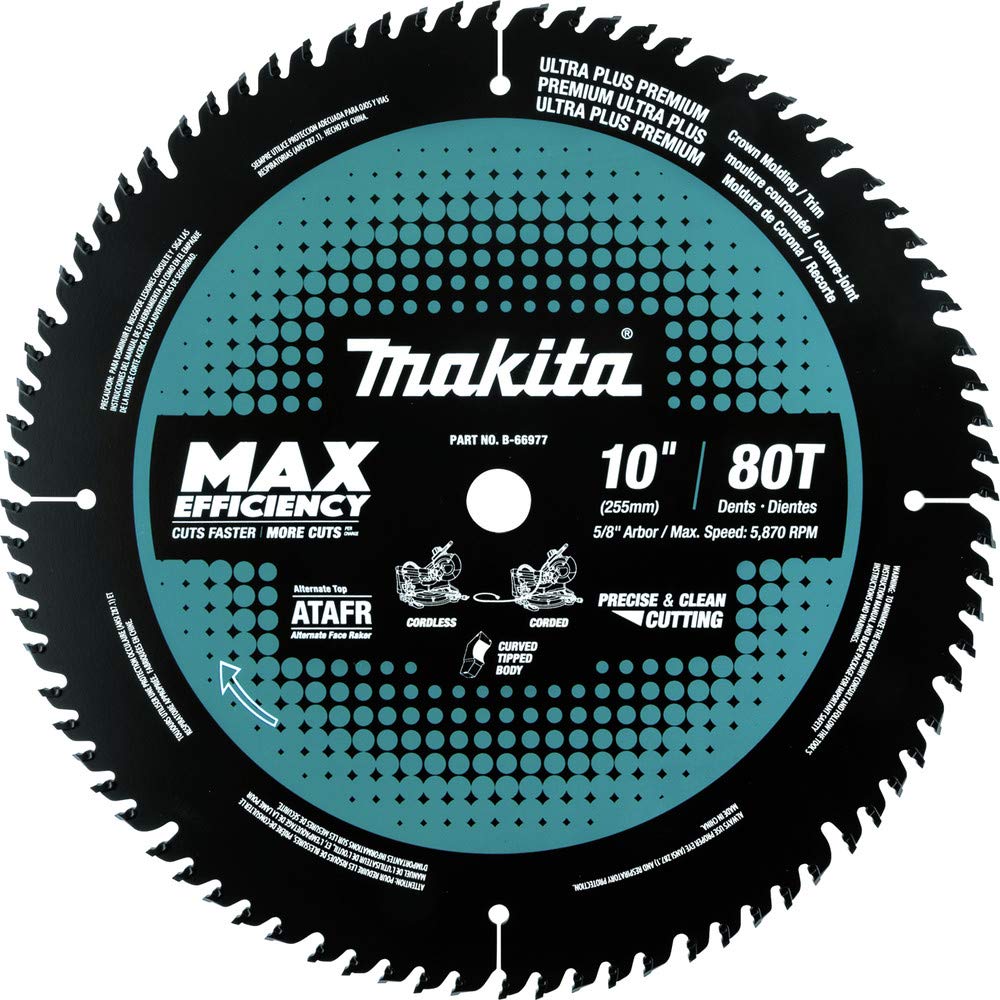
The Makita B-66977 uses an ATAFR (alternate top alternate face with raker) geometry that professional cabinet installers rank above the Diablo 90-tooth for its significantly reduced gumming on hard maple and cherry. The 80-tooth count combined with a thin kerf design produces glass-smooth crosscuts on plywood veneers without painter’s tape or sacrificial backing boards. Users report zero chipping on 8/4 cherry and 1.75-inch butcher block on the first pass.
The blade’s Max Efficiency engineering prioritizes motor load reduction, which translates to cleaner cuts on cordless miter saws where battery conservation matters. Carbide tip retention on this model withstands heavy daily use on job sites, with one pro carpenter noting it outperformed both Bosch and Diablo on hard maple rips over 25 years of field work.
Pre-treated with T-9 corrosion protection out of the box, this blade arrives ready for immediate use without pitch buildup on the first several cuts. The 5/8-inch arbor fits virtually all standard 10-inch sliding and compound miter saws, making it a direct drop-in upgrade for the factory Milwaukee and DeWalt blades.
Why it’s great
- ATAFR grind delivers chip-free crosscuts on veneer plywood without tape
- Thin kerf reduces motor drag and battery drain on cordless saws
- Professional-grade carbide tips resist gumming on resinous hardwoods
Good to know
- Not intended for heavy ripping of thick lumber
- Thin kerf can deflect on aggressive sliding miter cuts
2. Freud LM72M010 10″ Heavy-Duty Rip Blade
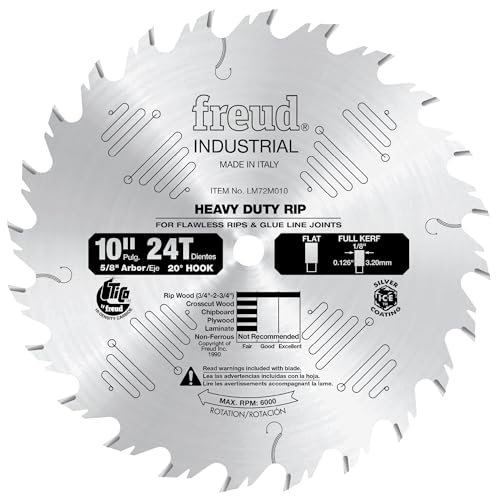
The Freud LM72M010 is purpose-built for ripping thick hardwoods where a full-kerf flat-tooth design produces glue-ready edges straight off the saw. The 24-tooth count with a 20-degree hook angle aggressively pulls material through, making short work of 8/4 cherry and walnut without burning, even on a 1.75-horsepower cabinet saw. The flat-top grind leaves a perfectly square bottom ideal for dadoes and through-tenons.
Laser-cut anti-vibration slots on the steel body dramatically reduce sideways deflection during deep rips, producing a kerf that stays true without wandering. The Silver Ice coating resists pitch accumulation and corrosion across hundreds of linear feet of cut lumber, extending resharpening intervals well beyond standard uncoated blades. The plate thickness measures 0.087 inch, providing rigidity that thin-kerf blades cannot match.
While this blade excels at ripping, its flat grind creates more tear-out on crosscuts of plywood and melamine compared to an ATB or TCG geometry. Users running it on low-torque saws may notice increased noise due to the thick plate displacing air, but the trade-off in cut quality and longevity justifies the step up from general-purpose blades.
Why it’s great
- Flat-top grind leaves square kerf bottoms for joinery without sanding
- Thick plate and anti-vibration slots resist deflection on deep rips
- Silver Ice coating prevents corrosion and pitch buildup
Good to know
- Noisier than thin-kerf blades on some saws
- Not suitable for clean crosscuts on plywood or melamine
3. Diablo D1080N 10″ 80T Non-Ferrous & Plastic Blade
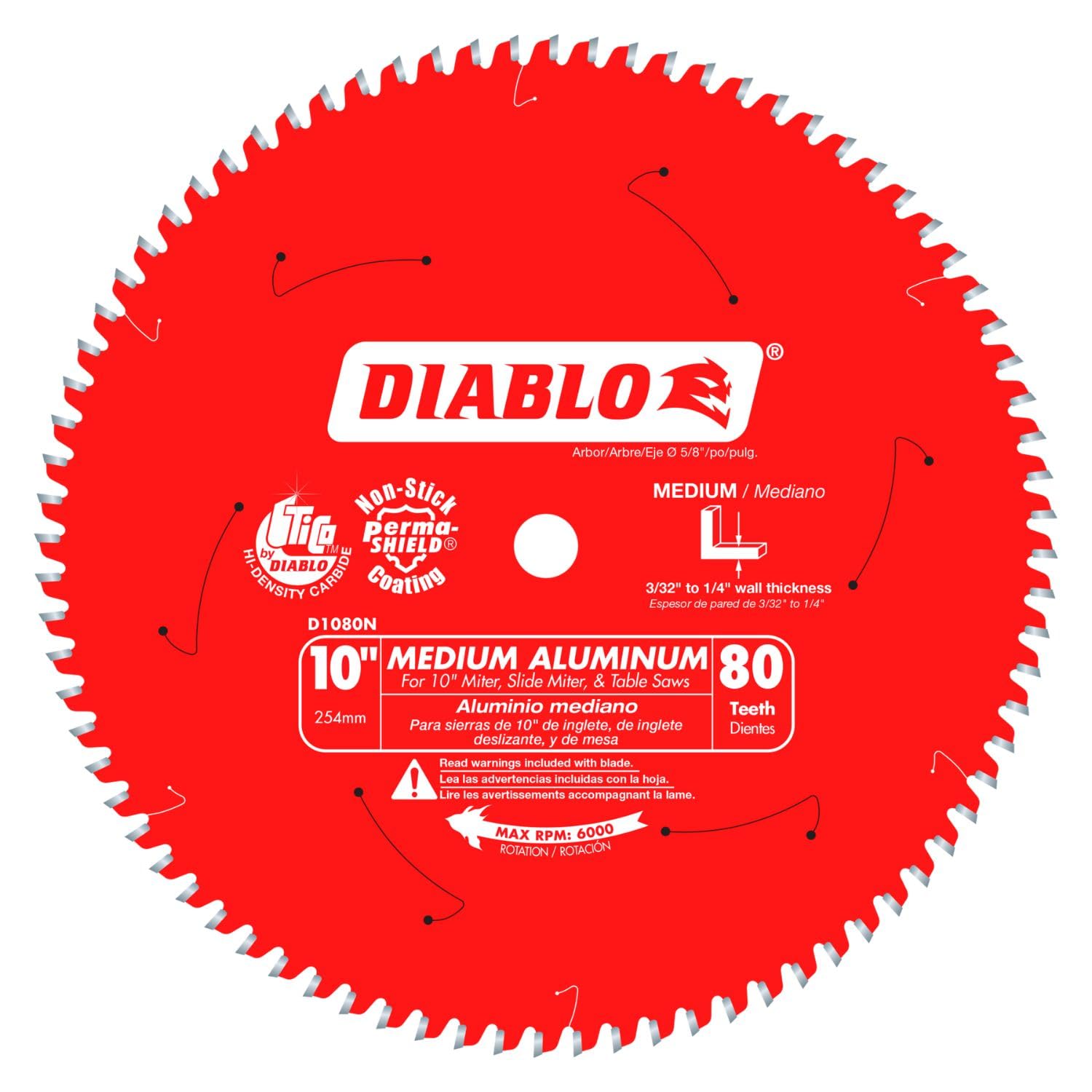
The Diablo D1080N uses a Triple-Chip Grind (TCG) tooth profile that handles the abrasive nature of aluminum, brass, copper, and fiberglass without chipping or melting. The 80-tooth configuration, combined with a negative 5-degree hook angle, slows feed rate intentionally to prevent grabbing in thin-walled extrusions. Users report burr-free cuts on 0.093-inch ABS sheet, 1/16-inch aluminum plate, and 3060 T-slot extrusions when paired with a rigid table saw.
Tri-Metal shock-resistant brazing anchors each TiCo super-density micro-grain carbide tip to withstand the intermittent impact loads inherent in metal cutting. The Perma-SHIELD non-stick coating protects the blade body from the heat generated during extended aluminum runs, preventing gumming and corrosion that would degrade cut quality. Laser-cut stabilizer vents trap vibration noise, keeping operation quieter than unvented metal-cutting blades.
A consistent learning curve exists for newcomers: clamping stock firmly, applying cutting wax regularly, and maintaining a consistent bite width are necessary to achieve square cuts on T-slot extrusions. The blade also performs admirably on splintery plywood and melamine, effectively serving as a dual-purpose blade for job sites that switch between wood and metal materials.
Why it’s great
- TCG grind produces burr-free cuts on aluminum and brass extrusions
- Tri-Metal brazing withstands impact loads from metal cutting
- Perma-SHIELD coating prevents heat gumming during extended runs
Good to know
- Requires cutting wax and clamped stock for best results
- Negative hook angle slows feed rate noticeably
4. BOSCH DCB1080 10″ 80 Tooth Edge Circular Saw Blade

The BOSCH DCB1080 uses a Brute Carbide C3/C4 micro-grain formulation on an ATB tooth geometry to produce extra-fine finishes on melamine, finished plywood, and hardwoods. The 80-tooth density delivers crosscuts that require no secondary sanding, making it a direct competitor to Freud and Diablo finish blades. Users switching from factory stock blades on Bosch and other miter saws describe the cut improvement as immediate and dramatic.
Speed Coat antifriction finish reduces heat buildup during continuous cutting, preventing the burning that plagues lower-tooth-count blades on dense materials. The extra-hard steel body resists bending and deflection, maintaining true kerf alignment through cuts on 3/4-inch plywood and hardwood trim. The thinner kerf design also reduces material waste while keeping feed speed high enough for production trim work.
Some weekend handymen note that the blade is overkill for rough framing cuts, but its performance on crosscuts of melamine and pre-finished plywood eliminates the need for sacrificial tape and scoring passes. The 5/8-inch arbor fits standard miter saws, and the blade arrives balanced and ready for immediate use straight out of the box.
Why it’s great
- Brute Carbide C3/C4 micro-grain formulation resists impact damage
- Speed Coat prevents burning on dense hardwoods and melamine
- Extra-hard steel body resists deflection for true kerf alignment
Good to know
- Overkill for rough framing and ripping operations
- Thin kerf may not suit sliding miter saws with deflection issues
5. Diablo D1040X 10″ 40-Tooth ATB General Purpose Blade

The Diablo D1040X is the benchmark 40-tooth ATB general-purpose blade that amateur and professional woodworkers alike consistently recommend as a first upgrade from stock saw blades. TiCo high-density carbide tips maintain a sharp cutting edge through pressure-treated lumber, with one user reporting zero degradation across 192 pressure-treated 5/4-by-6-inch boards and 72 1-by-4-inch boards cut twice each. The Perma-SHIELD non-stick coating prevents gumming during extended use in resinous woods.
The super-thin laser-cut kerf design cuts faster and with less motor strain than full-kerf alternatives, producing near 180-grit finish quality on crosscuts that eliminates the need for sanding on most projects. Tri-Metal shock-resistant brazing anchors carbide tips firmly enough to withstand demolition conditions, making this blade suitable for both finish carpentry and remodeling tear-out work. Users describe cut smoothness and noise reduction as immediately noticeable upgrades over factory 24-tooth blades.
The red non-stick coating can transfer to stock material during the first few cuts, though this is a cosmetic issue that disappears after break-in. This blade balances rip and crosscut performance so effectively that many woodworkers stop buying specialized blades for general shop use, storing the D1040X as their everyday go-to.
Why it’s great
- TiCo carbide holds edge through hundreds of pressure-treated lumber cuts
- Perma-SHIELD coating prevents resin buildup during prolonged use
- Thin kerf produces near sanding-free finish on crosscuts
Good to know
- Red coating may transfer to stock material initially
- Not optimized for ultra-fine finish work or non-ferrous metals
6. TOMAX TMA10801 10″ 80 Tooth TCG Aluminum Blade

The TOMAX TMA10801 brings a construction-grade TCG grind to budget-conscious buyers who need clean cuts on aluminum extrusions, copper tubing, and schedule 80 PVC conduit without paying premium blade prices. The 80-tooth count with a TCG profile produces burr-free edges on 1.5-inch aluminum angle and 2-inch PVC pipe when mounted on a miter saw, with users describing the cut quality on extrusions as “like butter” for light DIY work.
Electrophoretic coating reduces rust and corrosion during storage, preserving the blade body between intermittent metal-cutting sessions. The 5/8-inch arbor fits standard miter saws, and the blade installs without modifications. PVC cutting generates a massive volume of static-charged debris — users recommend cutting outdoors or connecting a high-volume dust collector to avoid cleanup headaches.
Longevity data on this blade is limited compared to premium offerings, with early-stage reviewers noting consistent performance across eight test cuts but unable to verify edge life over hundreds of operations. On older table saws the blade can exhibit vibration and noise that detract from cut finish, making a rigid saw setup important for optimal results. It is best suited for hobbyists and light commercial use rather than continuous production runs.
Why it’s great
- TCG grind produces clean burr-free edges on aluminum extrusions
- Electrophoretic coating prevents rust between intermittent use sessions
- Budget-friendly entry point for non-ferrous metal cutting
Good to know
- Longevity unverified beyond early test cuts
- PVC debris output is very high — plan for dust containment
7. IVY Classic 35056 Swift Cut 10″ 200 Tooth Plastic Blade
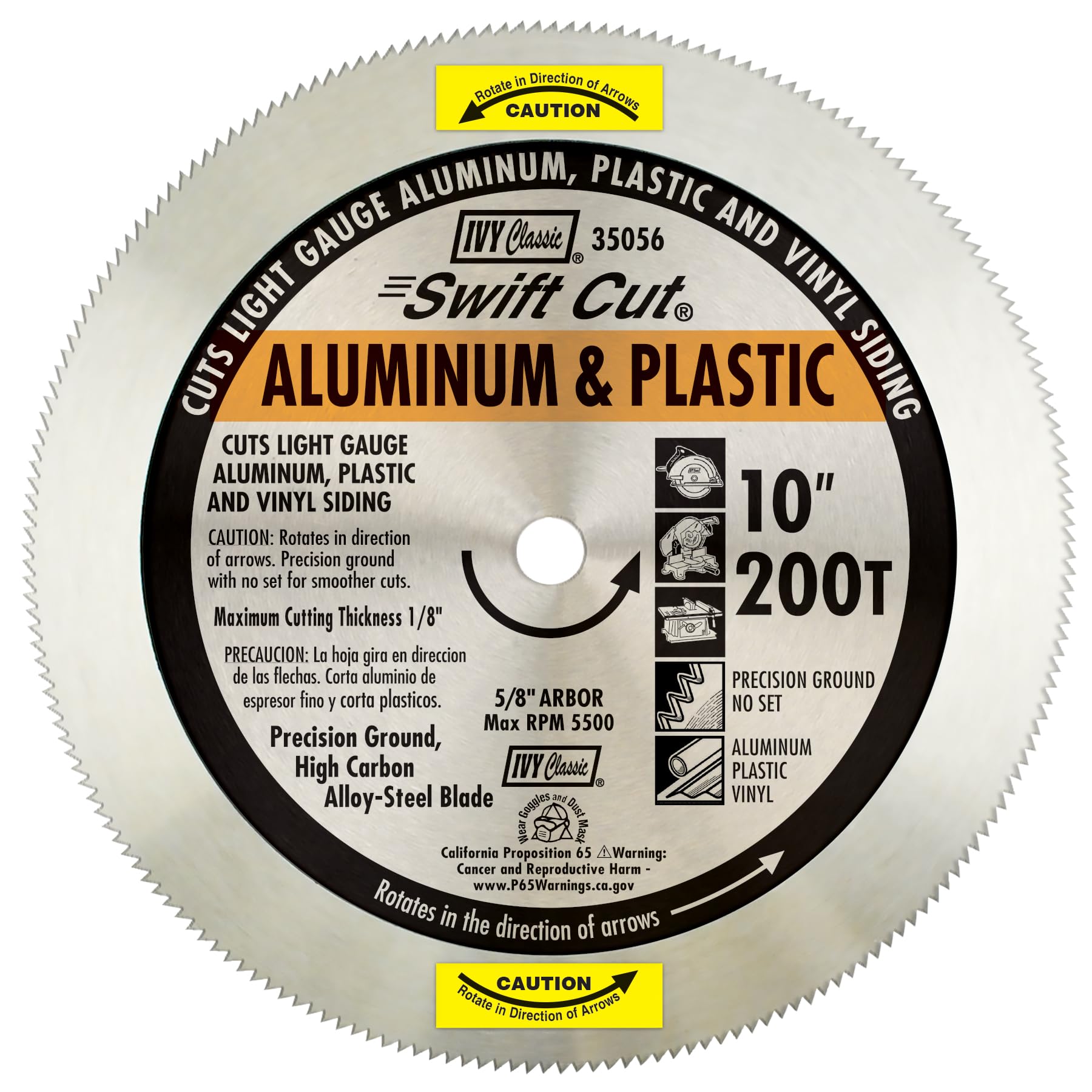
The IVY Classic 35056 Swift Cut is a high-carbon alloy steel blade with 200 precision-ground teeth that have zero set angle, producing chip-free cuts in acrylic, polycarbonate, vinyl siding, and thin aluminum up to 1/8-inch thickness. The extreme tooth density distributes cutting pressure across many contact points, preventing the melting and chipping that occurs when standard wood blades encounter plastic materials. Users report clean, accurate cuts through 1/8-inch plexiglass on table saws with no melting at consistent feed rates.
The no-set tooth design means each tooth cuts a kerf exactly its own width, eliminating the tendency for plastic chips to bind between tooth sets and cause heat buildup. The blade is explicitly rated for light-gauge aluminum and vinyl siding, with a separate IVY Classic 36366 10-inch 80-tooth model recommended for materials exceeding 1/8-inch thickness. Arbor size is standard 5/8-inch, fitting most miter and table saws without adapters.
A factory labeling error has been reported where the rotation direction arrow is printed opposite to the blade’s actual cutting direction — users should verify rotation by tooth angle before installation rather than trusting silkscreen markings. The blade is unsuitable for wood cutting due to the no-set grind geometry and high tooth count that would clog immediately in fibrous materials. It is a dedicated tool for the plastics workflow only.
Why it’s great
- 200 no-set teeth prevent melting and chipping on acrylic and plexi
- Zero-set design eliminates heat buildup from chip binding
- Budget-friendly option for occasional plastic cutting projects
Good to know
- Rotation arrow may be reversed — verify tooth angle before mounting
- Not rated for wood cutting or materials over 1/8-inch thick aluminum
FAQ
Can I use an 80-tooth ATB blade to cut aluminum on my miter saw?
Why does my 10-inch blade burn the wood on my sliding miter saw?
How many cuts can I expect from a carbide-tipped 10-inch miter saw blade before resharpening?
Final Thoughts: The Verdict
For most users, the 10 inch miter saw blade winner is the Makita B-66977 because its ATAFR grind delivers cabinet-grade crosscuts on hardwoods and plywood without gumming, outperforming premium competitors at a decisive value advantage. If you need a dedicated ripping blade for thick hardwoods and flat-bottom joinery, grab the Freud LM72M010. And for cutting aluminum, brass, or plastics on a job site, nothing beats the Diablo D1080N for its burr-free TCG cuts and industrial carbide retention.