
Our readers keep the lights on and the weekend projects moving. As an Amazon Associate, I earn from qualifying purchases.
A miter saw that wobbles on the slide rails or fails to square up a crown molding cut is worse than no saw at all — it wastes material and patience. The difference between a frustrating afternoon and a production-ready setup comes down to rail stability, motor torque, and how well the saw holds its calibration across a full shift of bevel and miter adjustments.
I’m Rikta — the co-founder and writer behind FitlyFast. I have spent hundreds of hours analyzing 10-inch sliding compound miter saw specifications, comparing motor amperage, rail bearing systems, bevel detent precision, and dust collection effectiveness to separate genuine workshop tools from undersized compromises.
This guide covers nine models that span compact job-site portability, dual-bevel production saws, and multi-material cutting platforms. Whether you need a saw for fine trim work, metal framing, or deep crosscuts on 4×4 lumber, the 10 inch sliding compound miter saw that fits your shop depends on blade control, slide play, and bevel range above all else.
How To Choose The Best 10 Inch Sliding Compound Miter Saw
Choosing the right sliding miter saw means looking past the brand name and understanding the specific weaknesses that make a saw useless for fine joinery. Three factors dominate real-world performance: slide rail stability, bevel detent precision, and the motor’s ability to maintain RPM under load.
Slide Rail Design and Vertical Play
Traditional sliding rails extend rearward and require clearance behind the saw. They also introduce lateral and vertical play over time. The best designs, like Bosch’s Axial-Glide or Makita’s linear ball bearing system, eliminate rail extension and reduce deflection. When testing a saw, pull the head to full extension and feel for any rocking motion — that rocking translates directly to uneven cuts on wide stock.
Bevel and Miter Detent Quality
Not all detent plates lock with the same authority. Budget saws often use thin stamped steel detents that bend or skip after a few dozen cuts. Look for machined aluminum bases and positive-stop levers that engage with a solid click. Dual bevel saves significant time on compound cuts because you do not have to flip the workpiece or rotate the saw head 180 degrees to cut the opposite direction.
Multi-Material Capability vs. Dedicated Wood Saw
Saws that include a TCT blade for cutting steel, aluminum, and embedded nails, such as the Evolution models, trade some blade sharpness for versatility. If you cut only hardwoods and softwoods, a saw with a dedicated 60-tooth carbide blade and higher RPM produces cleaner edges with less tear-out. The decision hinges on whether your job site includes metal studs, rebar, or pressure-treated lumber with fasteners.
Quick Comparison
On smaller screens, swipe sideways to see the full table.
| Model | Category | Best For | Key Spec | Amazon |
|---|---|---|---|---|
| Bosch CM10GD | Premium Glide | Fine trim in tight spaces | Axial-Glide no-rail system | Amazon |
| Makita LS1019L | Compact Slider | Crown molding & large crosscuts | Linear ball bearing rails | Amazon |
| Delta 26-2241 | Shadow Line Saw | Wide crosscuts under 18″ | LED shadow line guide | Amazon |
| SKIL MS6305-00 | Budget Dual Bevel | DIY renovation projects | LED shadow line 2×12 capacity | Amazon |
| Evolution R255SMS+ | Multi-Material | Cutting steel & wood with nails | TCT blade, no sparks steel cut | Amazon |
| DOVAMAN DMS01A | Dual Speed | Entry-level value with laser | 5000/3200RPM + 3 TCT blades | Amazon |
| MarvTool JS-1013C3 | Lightweight | Portable garage workshop | 25.6 lb with extension tables | Amazon |
| Evolution R185SMS+ | 7-1/4″ Compact | Multi-material light duty | 1500W motor, 7-1/4″ blade | Amazon |
| Makita LS1040 | Non-Sliding Saw | Precision trim work lightweight | Fixed arm 27 lb compact | Amazon |
In‑Depth Reviews
1. Bosch CM10GD Compact Miter Saw

The Bosch CM10GD removes the sliding rail system entirely with the Axial-Glide mechanism, which uses articulated arms to pull the saw head forward without any rear clearance requirement. This eliminates the vertical and lateral play inherent in traditional rail designs, making it one of the most accurate 10-inch sliding compound miter saws for trim carpenters who set up against a wall. The dual-bevel controls sit up front, allowing quick angle changes from 45 degrees left to 45 degrees right without reaching behind the saw.
The 15-amp motor drives a 60-tooth carbide blade at 4,000 RPM, producing clean crosscuts on hardwood, softwood, and laminates. Users consistently report that the saw arrives square and holds calibration through extended use. The ambidextrous trigger handle with soft grip reduces fatigue during repetitive cuts, and the clear lower guard provides unobstructed line of sight to the blade contact point.
Dust collection with the included bag is mediocre, but connecting a shop vacuum to the dust chute improves containment significantly. The saw lacks a soft-start feature, and the trigger safety slide can feel stiff depending on hand position. For compact workspaces where every inch behind the saw matters, the Bosch CM10GD delivers production-level accuracy in a footprint that fits in a van shelf.
Why it’s great
- Axial-Glide system eliminates rail slop completely
- Compact footprint fits flush against walls
- Front-mounted bevel control saves time on compound cuts
- Large fence supports long workpieces with stop blocks
Good to know
- No soft start — motor jerks on startup
- Dust collection bag is weak; needs vacuum adapter
- Heavy at 64 pounds for job-site portability
2. Makita LS1019L 10″ Dual-Bevel Sliding Compound Miter Saw

The Makita LS1019L uses a 2-steel rail system with linear ball bearings that glide smoothly and reduce the saw’s footprint so it can sit flush against a wall while delivering a 6-5/8-inch nested crown molding capacity — typically found only on 12-inch saws. The direct drive gearbox increases vertical cutting capacity to 5-1/4 inches, making it possible to cut dimensional lumber standing on edge. The 15-amp motor runs quietly with a soft start that prevents breaker trips on shared circuits.
The laser guide projects a cut line, though some users report the laser is dim in bright workshop lighting and shows multiple lines when the blade is raised. The dual-bevel knob is positioned up front, allowing quick bevel adjustments without reaching behind the saw. The fence includes two independent pieces that can be adjusted for clearance, and the dust collection achieves over 80 percent containment when connected to a vacuum.
Work clamp operation is slower than competing models because the clamp requires multiple turns to tighten. Some units have arrived with blade-carriage alignment issues that require replacement under warranty. For woodworkers who cut large crown profiles and need a compact sliding saw with premium bearing construction, the LS1019L performs at the top of its class.
Why it’s great
- Crown molding capacity rivals 12-inch saws
- Soft start prevents circuit breaker trips
- Linear ball bearing rails reduce vertical play
- Dust collection exceeds 80% with shop vacuum
Good to know
- Laser guide too dim for bright conditions
- Work clamp requires slow rotation
- Check blade/rail alignment immediately upon arrival
3. Delta 26-2241 10″ Sliding Compound Miter Saw

The Delta 26-2241 stands out with a shadow line guide that projects an accurate cut line onto the workpiece using an LED, eliminating the calibration drift common with laser guides. The dual-bevel design offers 45 degrees left and 45 degrees right with seven positive bevel stops, while the miter range spans 50 degrees left to 60 degrees right with ten detents. The 15-amp motor delivers 4,000 RPM with a belt-driven soft stop that slows the blade gradually rather than slamming a brake.
The sliding mechanism uses smooth arms that extend without binding, and the saw arrives square from the factory for most users. Cuts up to 17.5 inches wide are achievable when the workpiece is elevated on a 2×4, making this one of the few compact saws that can handle wide shelving panels. The front miter controls include a push-button detent override for fine adjustments between stops.
Dust collection is the clear weak point — the included bag barely catches anything, and even with a vacuum, substantial sawdust accumulates on the bench and floor. Some users report slight vertical arm flex when cutting material wider than 6 inches, though careful feed speed minimizes the effect. For the price and cutting capacity, the Delta offers solid value for serious DIY renovation work.
Why it’s great
- LED shadow line guide stays accurate without recalibration
- Belt-driven soft stop improves safety
- Wide 17.5-inch crosscut capacity with elevation
- Front miter release with detent override
Good to know
- Dust collection is poor — expect bench cleanup after every session
- Minor arm flex on cuts over 6 inches wide
- Shadow line hard to see in direct sunlight
4. SKIL MS6305-00 10″ Dual Bevel Sliding Compound Miter Saw

The SKIL MS6305-00 punches well above its price tier by including dual-bevel capability, an LED shadow line, and a 15-amp motor that spins at 4,800 RPM. The shadow line outperforms lasers in precision because it does not need calibration and remains visible on dark materials. The saw cuts through 2×12 lumber at 90 degrees and 2×8 at 45 degrees, making it suitable for deck framing and baseboard installation without requiring a larger 12-inch blade.
The miter range reaches 50 degrees left and right with 11 positive stops at the most common angles. The bevel locks at four positive positions: 48 and 45 degrees left, 0 degrees, and 45 degrees right. The hold-down clamp secures material firmly against the fence and prevents kickback during sliding cuts. The saw weighs under 40 pounds, light enough for a single person to move between work locations.
The sliding fence extensions have a slight gap that can catch small offcuts, and the miter detent mechanism uses a thin stamped plate that may bend if subjected to heavy abuse. Homeowner renovators and weekend woodworkers will appreciate the accuracy and power at this price point, but a pro framing crew should expect the detent to require periodic realignment.
Why it’s great
- LED shadow line is more accurate than a laser
- Dual bevel saves time on compound cuts
- Powerful 4,800 RPM motor handles hardwoods confidently
- Lightweight at 39.4 pounds
Good to know
- Miter detent mechanism can slip under heavy use
- Sliding fence gap catches small offcuts
- Not designed for continuous professional use
5. Evolution Power Tools R255SMS+ 10-Inch Sliding Miter Saw

The Evolution R255SMS+ is engineered for cutting mild steel, aluminum, wood with embedded nails, plastic, and composite decking using a single premium TCT blade. The patented multi-material cutting technology generates virtually no sparks and leaves the blade cool to the touch after cutting steel, which is a major safety advantage over abrasive chop saws. The 15-amp motor powers through 4×4 lumber and 1/4-inch steel plate without bogging down.
Bevel range covers 0 to 45 degrees left, and miter reaches 50 degrees left and right. The saw includes dual quick-release clamps, a dust bag, taller fences, a slide rail protector, and an integrated carry handle. Users report that the soft-start feature prevents the saw from tripping breakers on older wiring. The laser guide provides a cut reference, though it loses accuracy beyond the first few inches of blade travel.
The included clamp is adequate for wood but less effective on thin metal, and the fence requires careful adjustment out of the box to ensure square cuts. The saw throws chips rearward, so a vacuum or dust collection bag is essential for indoor use. For shops that switch between steel studs and dimensional lumber daily, the Evolution R255SMS+ eliminates the need for a dedicated metal-cutting saw.
Why it’s great
- Cuts steel, aluminum, and wood without changing blades
- No sparks or heat during metal cuts
- Soft start protects workshop circuits
- 3-year manufacturer warranty included
Good to know
- Laser only accurate for the first few inches of cut
- Throws chips rearward — vacuum recommended
- Fence requires assembly adjustment for square
6. DOVAMAN DMS01A Updated 10-Inch Sliding Miter Saw

The DOVAMAN DMS01A brings a dual-speed motor (5,000 RPM for wood, 3,200 RPM for metal) and three TCT blades to the entry-level market, making it a versatile package for DIYers who cut different materials. The 13-inch sliding rail extends with smooth action, and the extendable side tables support material up to 4×13 inches. The ambidextrous design includes dual lock switches for both left- and right-handed operators, a thoughtful touch for shared workshop spaces.
The built-in laser guide projects a cut line that improves accuracy for beginners, though the included blades are the weakest point in the package — several users report immediate upgrades to a Diablo blade for noticeably cleaner cuts. The 15-amp motor delivers sufficient power for softwoods, PVC, aluminum, and thin steel without stalling. Setup is straightforward with clear instructions, and the saw includes two extra carbon brushes for future motor maintenance.
The blade guard is made of metal rather than plastic, a durability advantage over some budget competitors. One common complaint involves the saw arriving with minor damage from shipping, though seller responsiveness reportedly resolves issues quickly. For the price, the DOVAMAN offers an impressive feature set, but serious woodworkers should budget for a higher-quality blade replacement out of the gate.
Why it’s great
- Dual-speed motor adapts to wood and metal cutting
- Includes three TCT blades for multi-material use
- Ambidextrous design with dual lock switches
- Metal blade guard outlasts plastic alternatives
Good to know
- Included blades need immediate upgrade for fine cuts
- Possible shipping damage upon arrival
- Not suited for heavy professional daily use
7. MarvTool JS-1013C3 10-Inch Sliding Compound Miter Saw
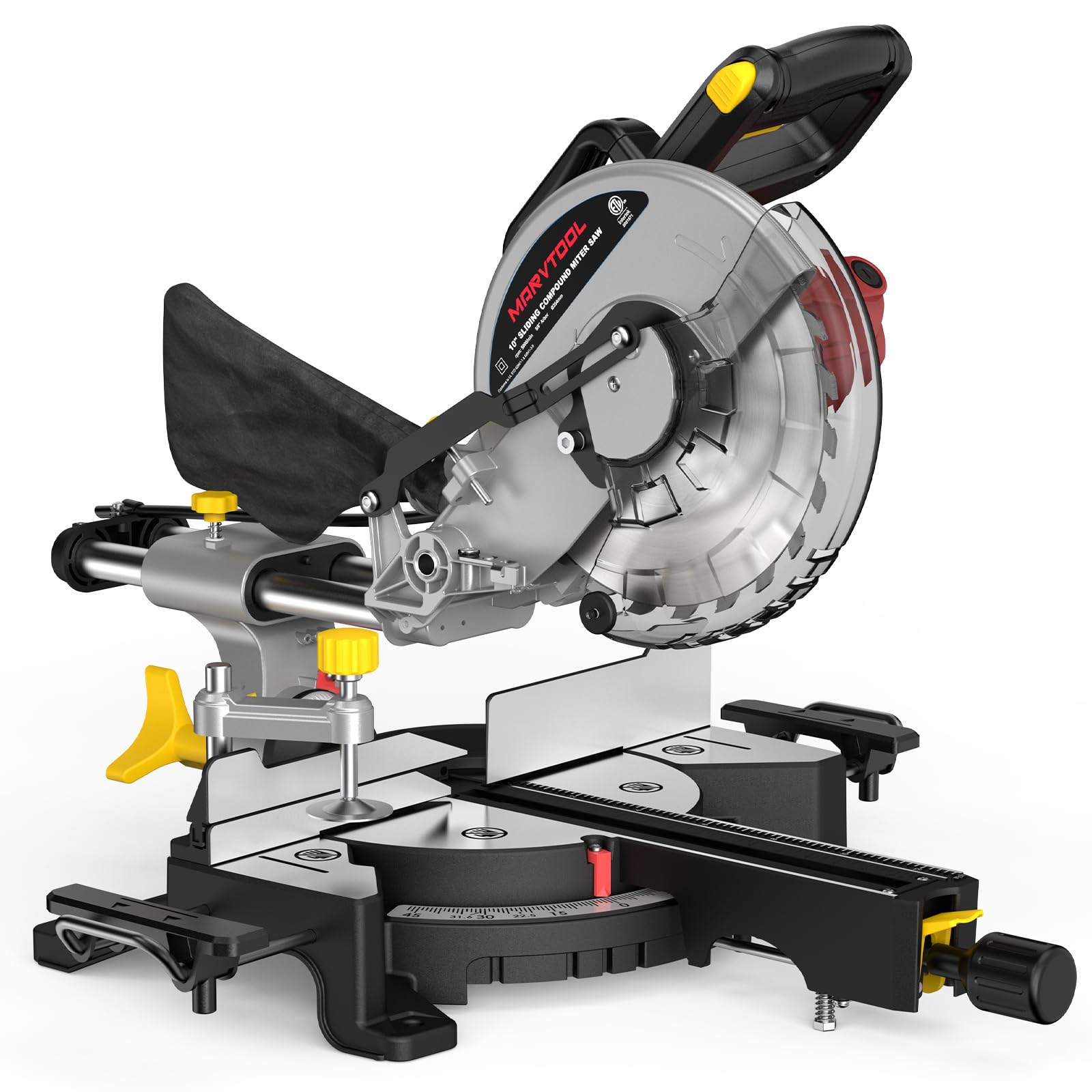
The MarvTool JS-1013C3 weighs only 25.6 pounds, making it one of the lightest sliding compound miter saws on the market. The 15-amp motor delivers 5,000 RPM, and the saw includes two extension tables that support longer workpieces for crosscuts up to 4×13 inches. The single-bevel design allows bevel cuts from 0 to 45 degrees left, while the miter base adjusts left and right for compound angle cuts. The compact head locks into the base using a release knob for compact storage.
The saw includes a 36-tooth TCT blade that arrives pre-installed, saving setup time. Users report that the saw cuts square out of the box and produces clean edges on softwoods, laminates, and thin aluminum. The transparent blade guard provides visibility during cuts while protecting against debris. The dust collection bag captures a reasonable portion of sawdust, though a vacuum connection would improve containment for indoor use.
There is no laser guide included, so operators relying on a projected cut line will need to develop a kerf-alignment technique. The plastic handle is adequate but does not inspire long-term confidence under heavy pulling force. The MarvTool is ideal for a small garage workshop or a DIYer who needs a portable saw that can be stored on a shelf between weekend projects.
Why it’s great
- Ultra-light 25.6 pounds for easy portability
- Included extension tables support long boards
- Powerful 5,000 RPM motor with smooth slide action
- Compact storage with head lock mechanism
Good to know
- No laser guide for cut alignment
- Plastic handle may wear under heavy use
- Dust collection bag captures only moderate debris
8. Evolution Power Tools R185SMS+ 7-1/4″ Sliding Miter Saw

The Evolution R185SMS+ uses a 7-1/4-inch blade but earns a spot in this guide because it extends the multi-material cutting capability to an extremely portable form factor — the saw weighs so little it can be carried one-handed. The 1,500-watt motor with an optimized gearbox cuts steel, aluminum, wood with embedded nails, and plastic using the same premium TCT blade. The laser cutting guide assists alignment, and the dust collection bag keeps the immediate work area relatively clean.
Bevel capacity spans 0 to 45 degrees, and miter settings cover 50 degrees left and 50 degrees right. The sliding mechanism uses ball bearings for smooth travel, and users report minimal blade wander during normal finish work. The saw is not designed for heavy framing — it pulls approximately 760 watts under load — but it handles trim, baseboards, and thin metal with surprising authority.
The carry handle, premium clamp, and 3-year warranty add to the package. Some users note that the included laser only aligns accurately for the first few inches of a cut. For a handyman who needs one saw that fits in a car trunk and cuts both a 2×4 and a steel angle bracket, the R185SMS+ delivers unmatched versatility in a tiny footprint.
Why it’s great
- Extremely compact and lightweight for transport
- Cuts wood, metal, and plastic with one blade
- Smooth ball bearing slide with no play
- 3-year manufacturer warranty
Good to know
- 7-1/4″ blade limits maximum cut depth
- Laser only accurate near the start of the cut
- Not suitable for heavy framing applications
9. Makita LS1040 10″ Compound Miter Saw

The Makita LS1040 is a non-sliding compound miter saw that prioritizes absolute rigidity over crosscut width. Without sliding rails or articulation, the saw has zero lateral or vertical play, making it the most accurate option in this list for trim carpenters who cut baseboards, crown molding, and door casing all day. The 15-amp direct drive motor delivers 4,600 RPM with noticeable torque, and the dual-posts maintain the cutting head in perfect alignment throughout the blade’s descent.
Miter cuts range from 45 degrees left to 52 degrees right with nine positive stops at 15, 22.5, 30, 45, and 0 degrees. Bevel cuts reach 45 degrees to the left. The machined aluminum base and dual slide rails provide a stable platform, and the included 40-tooth micro-polished blade produces clean edges on hardwoods without burning. The saw weighs only 27 pounds, which makes it easy to carry to the third floor of a renovation project.
The non-sliding design limits crosscut capacity to roughly 4 inches at 90 degrees, so this saw cannot rip 2×12 lumber in a single pass. The blade bolt can be extremely tight from the factory, requiring a rubber mallet to loosen. For professionals who value dead-on accuracy over wide capacity and already own a separate sliding saw, the LS1040 remains a benchmark for trim work.
Why it’s great
- Zero side-to-side play for absolute cutting precision
- Lightweight 27 pounds for job-site portability
- Powerful motor with high torque output
- Machined aluminum base and durable build
Good to know
- Non-sliding design limits crosscut capacity to ~4 inches
- Blade bolt can be extremely difficult to remove
- Base not compatible with standard portable stands
FAQ
How much rear clearance does a sliding miter saw need?
Can a 10-inch sliding saw cut a 4×4 in one pass?
Why does my miter saw blade wobble when sliding?
Can I use a 12-inch blade on a 10-inch miter saw?
Is a dual-bevel saw worth the extra money for a DIYer?
Final Thoughts: The Verdict
For most users, the best 10 inch sliding compound miter saw overall is the Bosch CM10GD because its Axial-Glide system delivers zero-rail-play accuracy in a compact footprint that fits against walls. If you cut crown molding and oversized trim, the Makita LS1019L offers a larger nested crown capacity than any other 10-inch saw on the market. And for multi-material job sites where you cut steel studs, aluminum, and nail-embedded lumber daily, the Evolution R255SMS+ eliminates the need for a separate metal-cutting saw with its no-sparks TCT blade system.