
Our readers keep the lights on and the weekend projects moving. As an Amazon Associate, I earn from qualifying purchases.
A 10x binocular is a precision tool that brings distant details into your hands, but the wrong one will leave you with a headache, a blurry image, and a wasted afternoon. The real difference between a model and a model isn’t just build quality — it’s how the optical system handles chromatic aberration, light transmission, and edge-to-edge sharpness at the moment you’re trying to track a fast-moving bird in twilight.
I’m Rikta — the co-founder and writer behind FitlyFast. After analyzing hundreds of optical specifications and cross-referencing real-world user data across seven different price tiers, I know exactly which specs actually deliver a clear field of view and which are just marketing noise.
Whether you’re scanning a ridgeline for deer or trying to spot a warbler in dense canopy, the right pair changes what you can see. This guide breaks down the seven best 10x binoculars on the market right now, ranked by optical clarity, build durability, and real-world performance across every lighting condition.
How To Choose The Best 10x Binoculars
A 10×42 configuration is the standard sweet spot for wildlife observation: enough magnification to resolve detail without the hand-shake issues of 12x or 15x, and a 42mm objective lens that gathers sufficient light for dawn and dusk use. But the real dividing lines between good and great come down to the optical coatings, prism quality, and weather sealing — not just the magnification number.
Optical Coatings: The Brightness Multiplier
Fully multi-coated (FMC) lenses apply anti-reflective layers to every air-to-glass surface, boosting light transmission through the entire optical path. Without this, a 10x binocular loses up to 15% of available light at each lens surface. Products using “coated” (single-layer) optics will appear dimmer and more prone to flare. Dielectric mirror coatings on the prism surfaces are a step further, reflecting over 99% of incoming light for the crispest low-light performance.
Prism Glass: Why BaK-4 and Phase Coatings Matter
BaK-4 (Barium Crown) glass has a higher refractive index than BK-7, which means you get a perfectly round exit pupil with no dark edges. Pair that with phase-correction coatings on roof-prism binoculars — essential for resolving fine detail such as feather texture or leaf veins — and you eliminate the washed-out look common in entry-level roof-prism designs. Skip phase coating, and a 10x binocular will struggle to hold sharpness beyond the centre 60% of the field.
Build and Weather Sealing
A nitrogen-purged, O-ring-sealed body is non-negotiable if you glass in rain, snow, or high humidity. Fogging occurs when internal moisture condenses on cold glass — nitrogen purging replaces that moist air with dry gas. Rubber-armoured polycarbonate or magnesium alloy housings protect against drops, while twist-up eyecups with multiple click stops ensure proper eye relief for glasses wearers. A 10x binocular with poor eye relief (under 15mm) will force you to hold the unit away from your eyes, collapsing the field of view.
Quick Comparison
On smaller screens, swipe sideways to see the full table.
| Model | Category | Best For | Key Spec | Amazon |
|---|---|---|---|---|
| Nikon Monarch M5 10×42 | Premium | All-day wildlife glassing | ED Glass + Dielectric Coatings | Amazon |
| Leupold BX-4 Pro Guide HD | Premium | Low-light hunting/scouting | Guard-ion + DiamondCoat 2 | Amazon |
| ZEISS Terra ED 10×42 | Premium | Birding with high color accuracy | Schmidt-Pechan ED glass | Amazon |
| Celestron Nature DX ED 10×42 | Mid-Range | Budget-conscious birders | ED Glass + Phase Coated BaK-4 | Amazon |
| Bushnell H2O Xtreme 10×42 | Mid-Range | Wet/coastal environments | IPX7 Waterproof + FMC | Amazon |
| Vortex Copperhead HD 10×42 | Mid-Range | Hunting with VIP warranty | HD Optical System + FMC | Amazon |
| Celestron Outland X 10×25 | Budget | Compact carry / kids | BaK-4 Prisms + 6.2° FOV | Amazon |
In‑Depth Reviews
1. Nikon Monarch M5 10×42
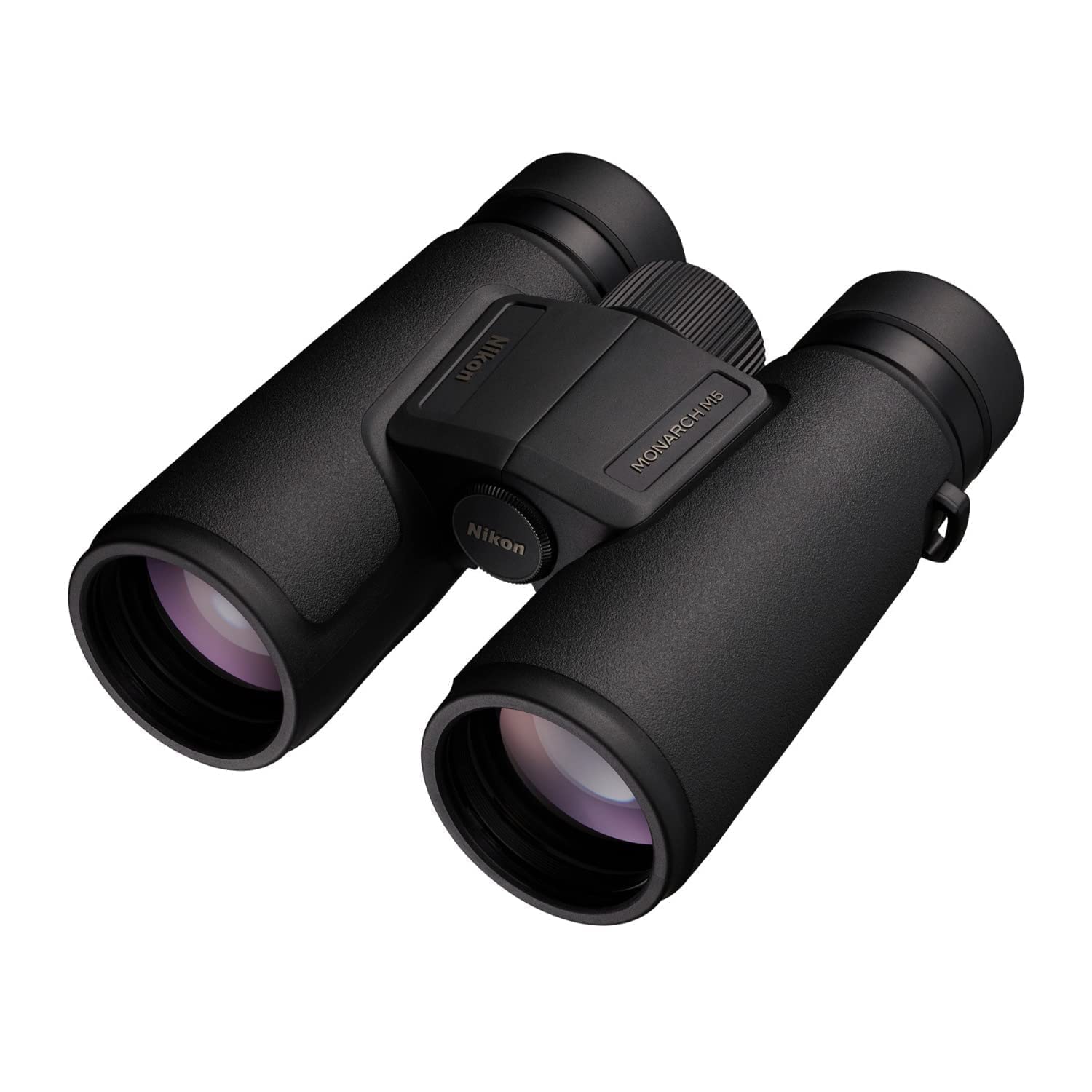
The Nikon Monarch M5 is the benchmark for a serious mid-premium 10×42. It uses Extra-low Dispersion (ED) glass to crush chromatic aberration — that purple-green fringing you see on the edges of cheap optics — and pairs it with dielectric high-reflective multilayer prism coatings that push light transmission well above 90%. The result is a view that feels almost clinical in its sharpness, with colour accuracy that holds across the entire 293-foot field of view at 1,000 yards.
The 18.4mm of eye relief is generous enough for glasses wearers to see the full field without vignetting, and the turn-and-slide eyecups lock in place with positive clicks. The focus knob is large and smooth, with close-focus down to 8.2 feet — useful for butterflies or flowers between big glassing sessions. The only notable omission is a tripod adapter socket, which limits steady long-range viewing.
Build quality is typical Nikon: a nitrogen-purged, O-ring-sealed polycarbonate body wrapped in thick rubber armour. It’s waterproof and fogproof across temperature extremes, and the included neoprene strap and semi-rigid case offer adequate carry protection. For the hunter or birder who wants true premium clarity without stepping into the + range, the Monarch M5 delivers the clearest picture in its price bracket.
Why it’s great
- ED glass eliminates color fringing almost entirely
- Dielectric coatings produce bright, natural color in low light
- Excellent 18.4mm eye relief for glasses wearers
Good to know
- No built-in tripod adapter socket
- Eyepiece cap fits loosely and falls off easily
2. Leupold BX-4 Pro Guide HD 10×42
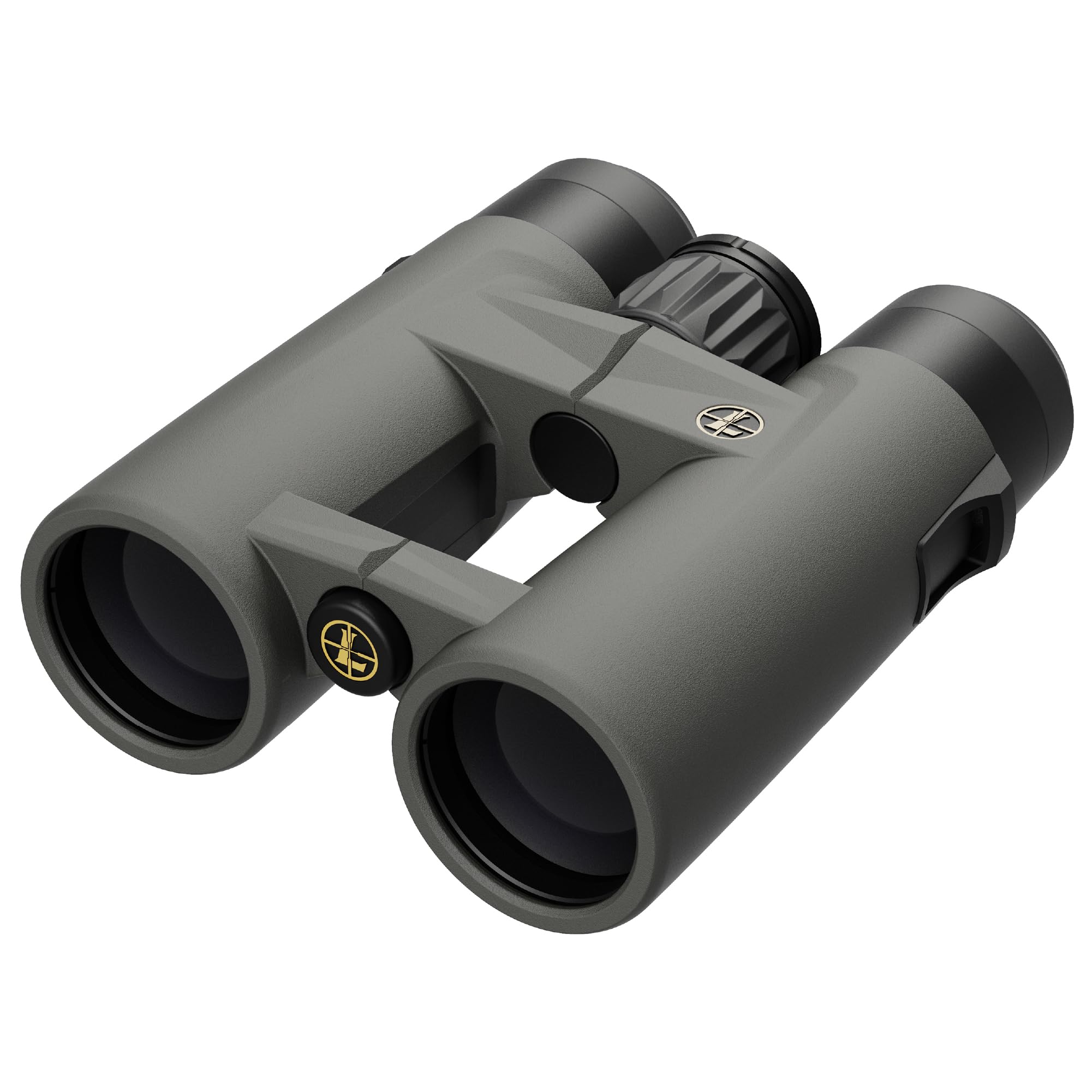
Leupold’s BX-4 Pro Guide HD Gen 2 is an open-bridge, dual-hinge design that cuts weight to just 25 ounces — noticeable on long hikes where every gram counts. What sets it apart is the Guard-ion lens coating that beads water and sheds dirt on contact, combined with DiamondCoat 2 for abrasion resistance. In wet weather, you’ll spend less time wiping lenses and more time scanning the horizon.
The 7.2-degree field of view (378 feet at 1,000 yards) is the widest of any 10×42 in this review, which is a major advantage when following running game or fast-flying birds. The Leupold Elite Optical System delivers excellent glare reduction, and the generous diopter range accommodates large prescription differences between eyes. The image is bright and neutral, with no noticeable warm or cool bias across the field.
The rubber-armoured aluminium body feels more premium than polycarbonate shells, and the open-bridge design provides a natural hand grip that reduces fatigue. This is a dedicated low-light performer — for dusk deer hunts or dawn bird surveys, the BX-4 edges out almost everything below . The main sacrifice is a slightly narrower focus range compared to the Nikon Monarch M5.
Why it’s great
- Widest field of view in class at 378 feet
- Guard-ion and DiamondCoat 2 repel water and scratches
- Lightweight 25-ounce open-bridge design reduces hand fatigue
Good to know
- Focus wheel is slightly slower than competitors
- Diopter adjustment lacks locking mechanism
3. ZEISS Terra ED 10×42

ZEISS is a name that carries weight in optics, and the Terra ED delivers the brand’s signature colour fidelity and contrast at a more accessible price than the Conquest or Victory lines. The Schmidt-Pechan ED prism system with a hydrophobic multi-coating achieves 88% light transmission — not industry-leading, but enough to produce vivid, true-to-life colours with no visible chromatic aberration even against high-contrast backdrops like snow against dark branches.
The large focus wheel is positioned so your index finger lands naturally on it when raising the binoculars to your eyes. The movement is smooth with no play, and the 7.2-degree apparent field of view (60 degrees apparent) feels immersive — almost like you’re looking through a much larger optic. The fiberglass-reinforced polycarbonate casing is lightweight at roughly 25.6 ounces but still feels rigid. The hard-shell case and neoprene strap included are premium extras not always found at this level.
Where the Terra ED falls short is edge sharpness. The centre 70% of the field is crisp and contrasty, but the outer edges show softness compared to the Leupold BX-4 or the Nikon Monarch M5. For a dedicated birder who values centre-field detail and color accuracy above all, this is a stellar pick. For the hunter needing edge-to-edge sharpness across a wide field, the Leupold is the stronger choice.
Why it’s great
- Excellent colour fidelity and contrast with zero chromatic aberration
- Hydrophobic multi-coating sheds water effectively
- Large, ergonomic focus wheel with natural finger placement
Good to know
- Edge sharpness drops noticeably outside the centre field
- Field of view is average for the price bracket
4. Celestron Nature DX ED 10×42

The Celestron Nature DX ED is the first genuine value proposition in this list — it packs Extra-low Dispersion (ED) glass into a mid-range price that most birder budgets can handle. The phase-coated BaK-4 prisms deliver a round exit pupil with no dark edges, and the fully multi-coated lenses produce a bright image that rivals optics costing twice as much in full daylight. Chromatic aberration control is excellent for the price, with only faint colour fringing visible on extreme high-contrast edges.
The 309-foot field of view at 1,000 yards is adequate but not class-leading. Eye relief sits at 14.3mm, which is snug for glasses wearers — you’ll need to press the eyecups down firmly to see the full field. The centre focus knob is smooth and responsive, and the built-in tripod adapter socket is a welcome inclusion for long sessions. The rubber-armoured polycarbonate body is weather-sealed and nitrogen-purged, so fogging is not a concern.
Ergonomics are the main trade-off here. The focus wheel is positioned slightly forward, requiring a small hand shift, and the grip texture is functional but not as secure as the Vortex Copperhead. For the birder on a strict budget who refuses to compromise on optical clarity, the Nature DX ED offers 90% of the optical performance of the Nikon Monarch M5 for roughly two-thirds the investment.
Why it’s great
- ED glass at a mid-range price point
- Phase-coated BaK-4 prisms for sharp central detail
- Built-in tripod adapter socket
Good to know
- Eye relief is tight at 14.3mm for glasses
- Ergonomics feel slightly less natural than competitors
5. Bushnell H2O Xtreme 10×42

The Bushnell H2O Xtreme is built for the worst weather you’ll glass in. Its IPX7 rating means it can be submerged in 1 metre of water for 30 minutes — overkill for rain, but reassuring if you’re on a boat or crossing streams. The fully multi-coated lenses and BaK-4 prisms produce a bright image with good contrast, though the lack of phase coating means fine detail resolution is a step behind the fully coated competition in this list.
The 6.8-degree field of view (357 feet at 1,000 yards) is broader than the Celestron Nature DX ED, which makes tracking moving wildlife easier. The rubber armouring is thick with a soft-touch texture that gives a secure grip even in wet hands. The included strap is functional but the neck strap is notably uncomfortable for long sessions — replace it with a harness if you glass for hours.
The main optical compromise is chromatic aberration control. Without ED glass, green and purple fringing is noticeable on high-contrast edges, particularly in bright sunlight. For a dedicated boat binocular or a rugged spare that you don’t mind getting muddy, the Bushnell H2O is a durable choice. But for the birder who needs razor-sharp feather detail, the Celestron Nature DX ED is the better investment.
Why it’s great
- IPX7 waterproof rating — can survive submersion
- Broad 357-foot field of view for tracking
- Excellent wet grip with thick rubber armour
Good to know
- Noticeable chromatic aberration on high-contrast edges
- No tripod adapter socket on the FRP model
6. Vortex Copperhead HD 10×42

The Vortex Copperhead HD is the gateway into Vortex’s HD optical line, offering a fully multi-coated lens system paired with their HD glass for improved color fidelity. The 334-foot field of view at 1,000 yards is generous, and the 17mm of eye relief works well for glasses. The center focus knob is large and easy to operate with gloves on — a practical detail for cold-weather hunting.
What truly sets the Copperhead apart is the Vortex VIP Warranty. It’s unconditional, unlimited, and fully transferable — if you damage these binoculars for any reason, Vortex repairs or replaces them for free, no receipt needed. For a hard-use hunting binocular that will get knocked around, this warranty alone changes the value calculation, effectively making the Copperhead a lifetime investment.
Optically, the Copperhead is not as sharp as the Celestron Nature DX ED at the edges. The HD glass improves contrast over standard glass, but edge softness is still present past the centre 60% of the field. Low-light performance is better than the Bushnell H2O but trails the Nikon Monarch M5 by a noticeable margin. The copper HD model is a solid mid-range choice for the hunter who values rugged durability and a no-questions-asked warranty over absolute optical purity.
Why it’s great
- VIP Warranty is unconditional and fully transferable
- Large focus knob works well with gloves
- Good 17mm eye relief for glasses wearers
Good to know
- Edge sharpness is noticeably soft past centre field
- Low-light brightness trails ED-glass competitors
7. Celestron Outland X 10×25
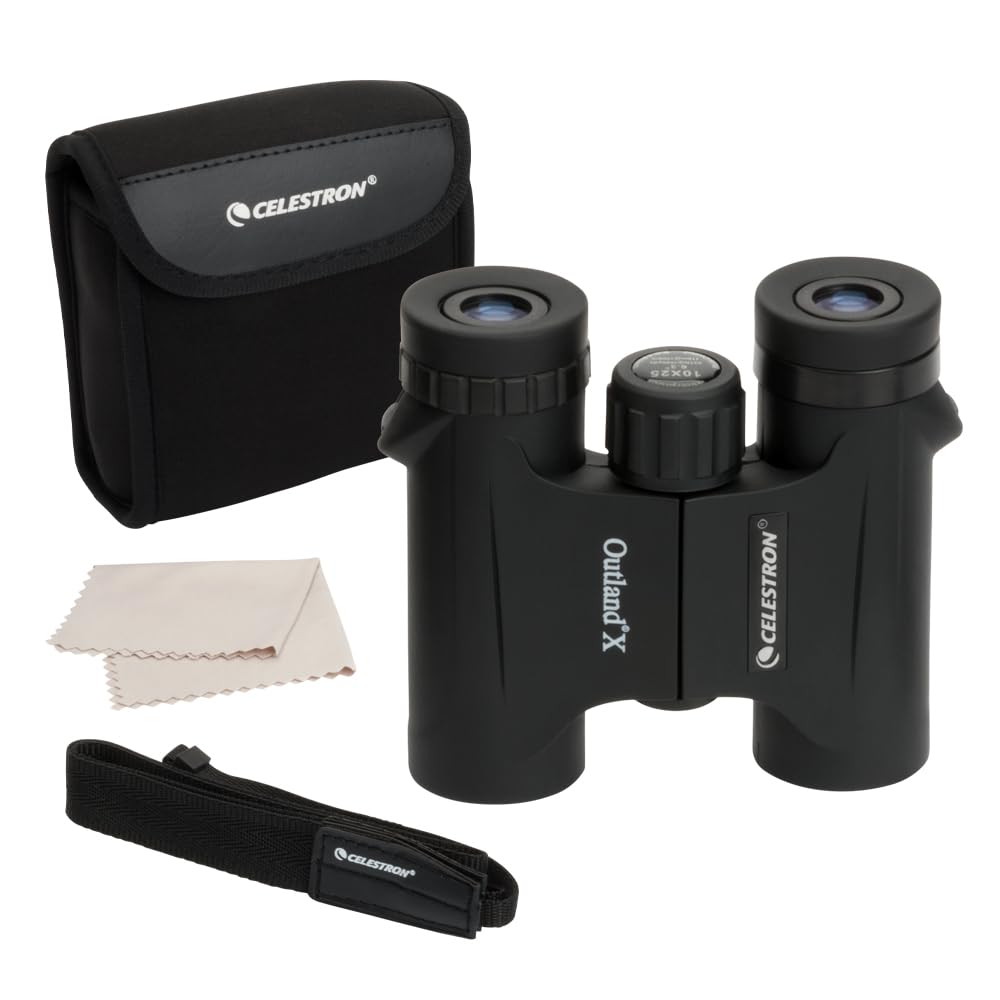
The Celestron Outland X 10×25 is a true pocket binocular — small enough to slip into a jacket pocket or daypack without weighing you down. The 25mm objective lenses are the smallest in this review, which directly limits low-light performance. The exit pupil is just 2.5mm, meaning you need bright daylight conditions to get a usable image. In shaded woods or twilight, the view dims significantly.
What the Outland X lacks in brightness, it partially makes up for in convenience and build quality. The BaK-4 prisms produce a clean, round exit pupil, and the multi-coated lenses deliver reasonable contrast for the format. The 6.2-degree field of view (100.6 feet at 1,000 yards) is narrow — expect to sweep more to find your subject. The focus mechanism is smooth, and the waterproof, nitrogen-purged body is genuinely weatherproof, uncommon at this size and investment level.
This is not a primary glassing tool for serious birders or hunters. The 10×25 format demands steady hands to hold the image stable, and the small exit pupil makes eye placement critical — any misalignment and the image blacks out. For the day hiker who wants a lightweight backup, or for introducing a child to binocular use without a large investment, the Outland X offers reliable performance in a truly compact package.
Why it’s great
- Extremely compact and pocketable design
- Waterproof and fogproof despite small size
- BaK-4 prisms for a clean exit pupil
Good to know
- 2.5mm exit pupil is dim in low light
- Narrow field of view requires constant repositioning
FAQ
Is 10x magnification too shaky for handheld use?
What does the 10×42 number actually mean?
Why do some 10x binoculars cost ten times more than others?
Can I use a 10x binocular for stargazing?
Final Thoughts: The Verdict
For most users, the best 10x binoculars to buy right now is the Nikon Monarch M5 10×42 because it combines ED glass, dielectric coatings, and generous eye relief at a price that undercuts true high-end rivals while outperforming almost everything in its tier. If you spend most of your glassing time in low light and need the widest possible field of view, the Leupold BX-4 Pro Guide HD is your pick with its 378-foot FOV and exceptional water-shedding coatings. And for the budget-conscious birder who refuses to sacrifice optical clarity, nothing beats the Celestron Nature DX ED 10×42, which brings ED glass and phase-coated BaK-4 prisms into the mid-range with zero chromatic aberration compromise.