
Our readers keep the lights on and the weekend projects moving. As an Amazon Associate, I earn from qualifying purchases.
A true 11.2 AV receiver is the command center of a dedicated home theater, built for those who refuse to compromise on channel count or raw power. This tier demands careful selection, as the wrong choice can mean limited upgrade paths or insufficient amplification for a multi-subwoofer, multi-speaker layout.
I’m Rikta — the co-founder and writer behind FitlyFast. This guide was built from hundreds of hours of comparative analysis of 11.2-channel flagship hardware, decoding room correction systems, amplifier topologies, and HDMI 2.1 implementation to separate genuine performance from marketing specifications.
Whether you are building a 7.2.4 Dolby Atmos cinema or a reference-level two-channel music system, choosing the right 11.2 av receiver determines whether your investment delivers clarity or becomes a bottleneck for your speakers.
How To Choose The Best 11.2 AV Receiver
Selecting an 11.2 AV receiver means balancing amplifier channel count, room correction sophistication, and HDMI 2.1 readiness. Below are the three factors that separate a long-term flagship from a short-lived stopgap.
Native Amplifier Channels vs. Processing Channels
An “11.2” label can mean 11 channels of built-in amplification or 11.2 processing with fewer internal amps. Models like the Onkyo TX-RZ70 deliver 11 amplified channels at 140W each, while the Marantz AV7706 is a pre-amplifier only, requiring external power amps. Know which configuration fits your existing amplifier inventory and budget for external amplification.
Room Correction: Dirac Live vs. Audyssey vs. YPAO
Dirac Live (Onkyo TX-RZ50, TX-RZ70) offers full-bandwidth, phase-aware correction with optional bass control for multi-subwoofer timing. Audyssey MultEQ XT32 (Marantz SR8015) provides excellent subwoofer EQ and dynamic volume. YPAO R.S.C. with 3D (Yamaha RX-A8A) focuses on reflection control and low-frequency mode. Each system has distinct strengths in taming room modes and speaker integration.
HDMI 2.1 Bandwidth and Gaming Features
With 4K/120Hz and 8K/60Hz passthrough, HDMI 2.1 ports must support full 40 Gbps bandwidth for uncompressed signals. Look for VRR, ALLM, and QFT if you connect a PlayStation 5 or Xbox Series X. Flagship models like the Denon AVR-S970H (7.2 channels) may lack the channel count but offer the gaming features, whereas premium 11.2 units like the Sony STR-AZ5000ES include them natively.
Quick Comparison
On smaller screens, swipe sideways to see the full table.
| Model | Category | Best For | Key Spec | Amazon |
|---|---|---|---|---|
| Onkyo TX-RZ70 | Flagship AVR | Reference 7.2.4 systems | 140W x 11, ESS Sabre DAC | Amazon |
| Yamaha RX-A8A | Flagship AVR | Surround:AI processing | YPAO R.S.C. 3D, 11.2 ch | Amazon |
| Sony STR-AZ5000ES | Flagship AVR | 360 Spatial Sound Mapping | 130W x 11, 7-in HDMI 2.1 | Amazon |
| Marantz SR8015 | Flagship AVR | High-current 11-channel amp | 140W x 11, Audyssey XT32 | Amazon |
| Marantz AV7706 | Pre-amplifier | External amp setups | 11.2 pre-out, HEOS built-in | Amazon |
| NAD T 758 V3i | Mid-range AVR | BluOS streaming + Dirac | 7x60W, Dirac Live, MQA | Amazon |
| Onkyo TX-RZ50 | Mid-range AVR | Best-value Dirac Live AVR | 120W x 9, THX Certified | Amazon |
| Yamaha RX-A4A | Mid-range AVR | MusicCast multi-room | 7.2 ch, YPAO R.S.C. 3D | Amazon |
| Sony STR-AN1000 | Mid-range AVR | Sonos integration + 8K | 7.2 ch, 165W 6 ohms | Amazon |
| Denon AVR-S970H | Entry AVR | Budget 7.2 with 8K | 90W x 7, HEOS, phono in | Amazon |
| Denon PMA-1700NE | Integrated Amp | Pure 2-channel stereo | 140W x 2, AL32 Processing | Amazon |
In‑Depth Reviews
1. Onkyo TX-RZ70 11.2-Channel AV Receiver
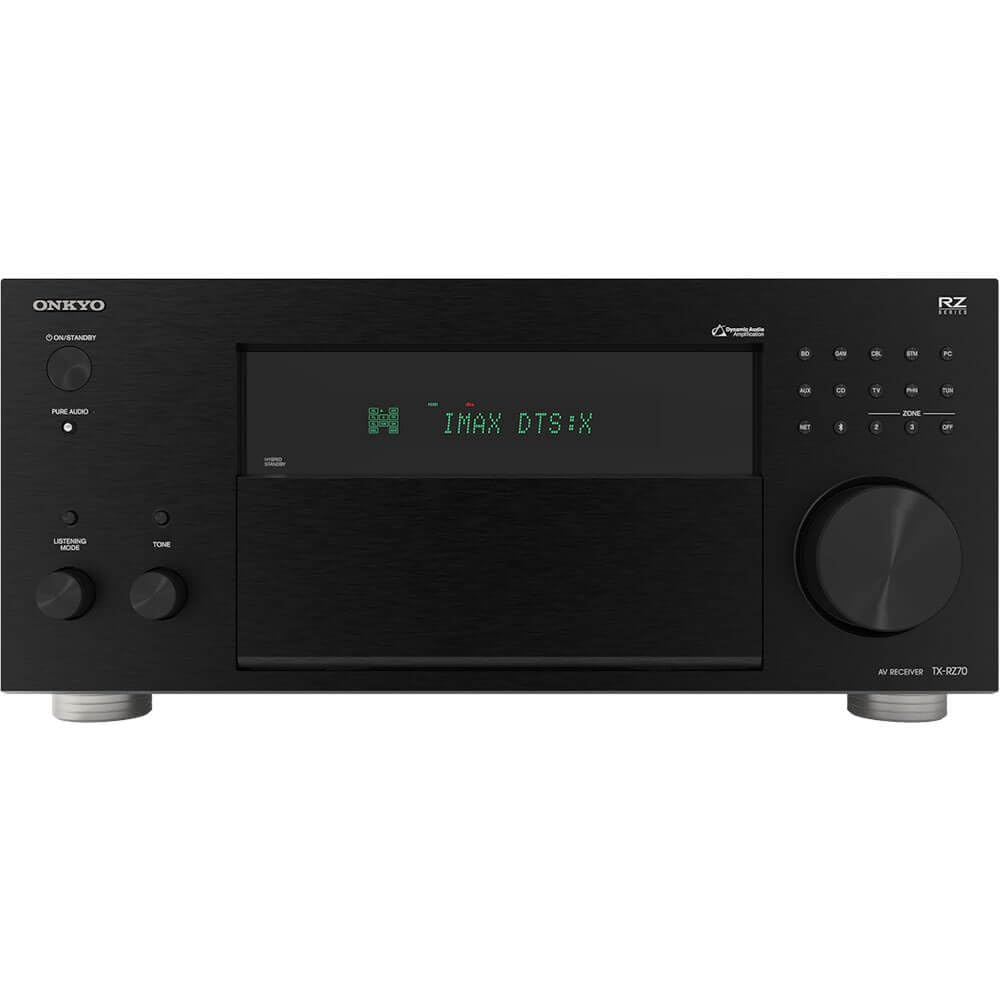
The Onkyo TX-RZ70 is the most compelling 11.2 AV receiver for demanding home theater builders, combining 140W per channel across all 11 amplified outputs with ESS Sabre DACs that deliver studio-grade digital-to-analog conversion. The inclusion of Dirac Live Full Bandwidth room correction out of the box — with optional Dirac Live Bass Control for multi-subwoofer timing — means this receiver can correct phase and frequency response with precision typically found in separate processors costing significantly more.
User reports confirm the TX-RZ70 runs cooler than previous Onkyo generations even at high listening levels, and independent bench testing shows the amplifier section exceeds its rated 140W per channel, peaking around 170W. The THX Certification across four listening modes (cinema, gaming, music, surround EX) ensures consistent signal integrity. The unit is physically large and heavy at nearly 58 pounds, requiring a sturdy AV rack or dedicated shelf.
RCA pre-outs integrate seamlessly with external amplifiers for those expanding to 7.2.4 or beyond. The remote feels less premium than the receiver itself, but the web-based setup interface and Roon Ready certification make this a versatile hub for both movie and high-resolution music streaming. For anyone building a reference-grade 7.2.4 system, this receiver offers the best ratio of amplifier power to room correction sophistication in its tier.
Why it’s great
- ESS Sabre DACs elevate stereo and multi-channel clarity
- Dirac Live Full Bandwidth included at no extra cost
- Rated 140W, tested higher with excellent thermal management
Good to know
- Extremely heavy and requires deep cabinetry
- Remote feels cheap relative to flagship price
- Zone 2 control interface is non-intuitive
2. Yamaha RX-A8A AVENTAGE 11.2-Channel AV Receiver

The Yamaha RX-A8A anchors the AVENTAGE flagship line with 11.2 channels of amplification, Surround:AI real-time audio optimization, and YPAO R.S.C. with 3D multipoint measurement. The Surround:AI engine analyzes audio content frame-by-frame and adjusts dialogue clarity, surround effects, and bass response dynamically, which translates to noticeably improved vocal intelligibility during complex movie passages without manual tweaking.
All seven HDMI inputs support 8K60 and 4K120 at 40 Gbps with HDCP 2.3, ALLM, and VRR for gaming. The inclusion of a phono input and XLR pre-outs for the front left/right channels gives audiophiles a balanced connection path to external amplification. User reports highlight that the backlit remote lights on pickup and the receiver passes HDMI signals even when in standby, simplifying system integration.
The YPAO calibration requires careful microphone positioning — using a tripod and measuring points spaced two to three feet apart delivers the best results. Owners upgrading from 7.2-channel receivers note the independent subwoofer adjustment greatly improves bass balance in 5.2.4 configurations. The full-screen on-screen display and MusicCast app interface are functional but less refined than Dirac Live’s desktop software.
Why it’s great
- Surround:AI enhances dialogue and soundstage in real-time
- XLR pre-outs for front channels enable balanced connection
- Backlit remote and HDMI pass-through in standby
Good to know
- YPAO requires careful setup for optimal results
- Some users report HDCP handshake issues after firmware updates
- Full-screen OSD cannot be used simultaneously with video
3. Sony STR-AZ5000ES 11.2 CH 8K A/V Receiver

The Sony STR-AZ5000ES delivers 130W per channel across 11.2 channels with Sony’s 360 Spatial Sound Mapping, a technology that creates phantom height and surround speakers from a smaller physical array. The Digital Cinema Auto Calibration IX (DCAC IX) system measures speaker positions and adjusts phase alignment meticulously, and user feedback confirms this calibration dramatically improves the coherence of 5.1.2 setups simulating 7.1.4.
Seven HDMI 2.1 inputs support 8K and 4K/120 with Dolby Vision and IMAX Enhanced, though HDR10+ is absent. The “Works with Sonos” certification allows seamless integration into an existing Sonos ecosystem. The front panel design includes a magnetic cover plate for a clean look, and the remote is illuminated. Several users note this receiver runs hot during extended use and recommend active cooling or generous ventilation space.
The Neural X upmixing function works well for stereo music, and dialogue clarity is noticeably improved over previous Sony generations. Auto calibration can fail if speakers are connected to the wrong binding posts, so careful wiring checks are necessary. For those who prioritize Sony’s spatial sound processing and want a fully equipped 11.2 channel receiver with premium build quality, this unit justifies its position.
Why it’s great
- 360 Spatial Sound Mapping creates convincing phantom height channels
- Illuminated remote and magnetic front cover plate
- Excellent Dolby Atmos and dialogue clarity performance
Good to know
- Runs hot; requires active cooling or generous ventilation
- No HDR10+ support
- Auto calibration can misconfigure if speaker assignment is wrong
4. Marantz SR8015 11.2 Channel AV Receiver

The Marantz SR8015 is a high-current 11.2-channel receiver that delivers 140W per channel with a robust toroidal transformer and custom capacitors for stable power delivery. The Audyssey MultEQ XT32 room correction system, combined with Sub EQ HT for independent subwoofer calibration, provides deep control over multi-subwoofer timing and frequency response.
Bi-amping capable speakers can be driven directly, but the receiver lacks a high-pass filter for the bi-amped high-frequency channels, which means full-range content reaches tweeters unless external crossovers are used. The unit runs cooler than many competitors according to user reports, requiring at least 8 inches of clearance to prevent overheating. The front USB port and eight HDMI inputs (including one 8K) provide ample connectivity.
The remote control is widely criticized for its cheap feel and occasional unresponsiveness, which feels incongruent with the receiver’s tier. HEOS built-in enables multi-room audio streaming, and the advanced GUI setup guides users through configuration. For those seeking the Marantz sound signature with Audyssey calibration and 11 channels of onboard amplification, this receiver is a strong contender despite the subpar remote.
Why it’s great
- Toroidal transformer delivers stable high-current output
- Audyssey Sub EQ HT provides independent subwoofer calibration
- Runs cooler than many 11-channel competitors
Good to know
- Remote control feels cheap and can be unresponsive
- Bi-amping lacks high-frequency crossover
- Subwoofers default to off in some configurations
5. Marantz AV7706 11.2Ch AV Surround Pre-Amplifier

The Marantz AV7706 is a dedicated 11.2-channel pre-amplifier/processor designed for users who already own or plan to purchase external multichannel power amplifiers. By eliminating the amplifier section, this unit reduces heat generation and allows complete separation of preamp and amp stages, which is a core tenet of high-end audio system design.
It features the full Audyssey Platinum Suite including MultEQ XT32 for room correction, Sub EQ HT, Dynamic Volume, and LFC. Eight HDMI inputs support 8K upscaling and 4K/120Hz passthrough with Dolby Vision, HDR10+, and HLG. The HEOS multi-room streaming platform integrates with Spotify, TIDAL, and TuneIn, and voice control works with Amazon Alexa and Google Assistant.
Users upgrading from older pre-processors like the AV7701 note significant picture quality improvements and cleaner audio presentation. The setup process benefits from the advanced GUI, but the remote lacks backlit keys. For system builders who want to pair this with a separate multi-channel amplifier for dedicated 7.2.4 or 5.2.4 setups, the AV7706 offers a clean signal path and future-proof HDMI 2.1 connectivity.
Why it’s great
- Separate preamp design minimizes heat and noise
- Audyssey MultEQ XT32 with Sub EQ HT included
- 8 HDMI inputs with full 8K/4K120 support
Good to know
- Requires separate power amplifiers for each channel
- Remote lacks backlit keys
- Smart Select feature is locked to input set
6. NAD T 758 V3i 7.1-Channel Network A/V Receiver

The NAD T 758 V3i is a 7.1-channel receiver that punches above its power rating through Dirac Live room correction and BluOS wireless multi-room streaming. At 60W per channel, the power is modest compared to dedicated 11.2 flagships, but the high-current Hypex UcD amplifier modules deliver clean, controlled output that drives difficult speaker loads with surprising authority.
Dirac Live is built-in and calibrates for both timing and coloration across the full frequency range. BluOS support enables Master Quality Authenticated (MQA) playback and synchronization with other BluOS devices for whole-home audio. The modular MDC design allows future upgrades to new HDMI or audio processing standards, extending the product’s lifespan.
User feedback is mixed on reliability — some report wireless connectivity drops and unresponsive support tickets. The on-screen setup menus are dated, and the BluOS app has an archaic interface. However, the sound quality is praised for its lack of coloration compared to competitors. For buyers who prioritize Dirac Live and streaming versatility over raw amplifier power, this receiver offers a unique value proposition.
Why it’s great
- Dirac Live built-in at a competitive tier
- BluOS supports MQA and multi-room synchronization
- Modular MDC design enables future upgrades
Good to know
- Only 7 channels of amplification, requires external amps for 11.2
- Software interface and support are dated
- Some reliability concerns with wireless connectivity
7. Onkyo TX-RZ50 9.2-Channel AV Receiver

The Onkyo TX-RZ50 provides 9.2 channels of amplification at 120W per channel with Dirac Live included out of the box, making it one of the most accessible entry points into premium room correction. The receiver can process up to 11.2 channels, allowing users to add an external two-channel amplifier for a full 7.2.4 configuration.
THX Certification guarantees no added noise or distortion across all signal paths, and the Klipsch Optimize Mode automatically sets crossover values for compatible Klipsch speakers. HDMI 2.1 inputs support 8K60 and 4K120 with VRR, QFT, and ALLM for gaming. The Works with Sonos certification enables integration into Sonos systems via a Sonos Port.
Users consistently report that Dirac Live calibration significantly improves sound quality over standard AccuEQ, with tighter bass and more precise imaging. The receiver runs quietly and stays cool during operation. Some users note HDMI switching takes 12–15 seconds, and the dual subwoofer outputs are not independently adjustable. For a first step into Dirac Live–corrected 9.2-channel systems, the TX-RZ50 sets a high benchmark.
Why it’s great
- Dirac Live included without extra cost
- THX Certified with Klipsch Optimize Mode
- Quiet and cool operation under load
Good to know
- Only 9 channels amplified; needs external amp for 11.2
- HDMI switching delay of 12–15 seconds
- Dual sub outputs not independently controllable
8. Yamaha RX-A4A AVENTAGE 7.2-Channel AV Receiver

The Yamaha RX-A4A is a 7.2-channel AVENTAGE receiver that brings Surround:AI and YPAO R.S.C. with 3D room calibration into a mid-range tier. While not a full 11.2 amplifier, its processing capabilities and pre-outs support expansion to larger systems with external amplification.
All seven HDMI inputs handle 8K60 and 4K120 at 40 Gbps with Dolby Vision, HDR10+, and HLG. The MusicCast platform enables multi-room audio streaming, and the unit is Roon Tested for high-resolution music playback. The phono input accommodates turntable enthusiasts without an external preamp.
Users appreciate the straightforward YPAO calibration for 5.1 systems, though Atmos configurations require more manual involvement. Surround:AI mode automatically adjusts audio parameters based on content type, and the “All-Channel Stereo” mode works well for music parties. The lack of a front HDMI input and the need for a USB drive for major firmware updates are minor inconveniences. For those building a 7.2-channel system with room to grow, the RX-A4A offers excellent build quality and processing features.
Why it’s great
- Surround:AI enhances real-time audio adaptation
- Phono input and Roon Tested certification
- MusicCast enables seamless multi-room streaming
Good to know
- Only 7.2 channels amplified natively
- No front HDMI input for quick device connection
- Firmware updates require USB drive
9. Sony STR-AN1000 7.2 CH Surround Sound Receiver

The Sony STR-AN1000 is a 7.2-channel receiver with 8K HDMI 2.1 support and Digital Cinema Auto Calibration IX. It delivers 165W per channel at 6 ohms, sufficient for medium-sized rooms. The receiver includes 360 Spatial Sound Mapping and Dolby Atmos Height Virtualizer for creating immersive audio from traditional speaker layouts.
Works with Sonos certification allows integration with existing Sonos systems, and built-in Chromecast, Spotify Connect, and Apple AirPlay 2 cover most streaming preferences. The graphical setup interface walks users through initial configuration, and the Zone 2 and Zone 3 outputs enable multi-room audio distribution.
Users upgrading from older Sony receivers report markedly improved sound quality and dialogue clarity. Some note the default subwoofer distance measurement in DCAC IX can be inaccurate, requiring manual correction. A known issue with Apple TV 4K Dolby Vision passthrough requires direct connection to the TV. The front panel display is small and difficult to read from a distance. For Sony loyalists wanting 8K readiness and Sonos compatibility in a 7.2-channel package, this receiver delivers strong performance.
Why it’s great
- Works with Sonos certification built-in
- 360 Spatial Sound Mapping creates immersive soundfield
- 6 HDMI 2.1 inputs with 8K/4K120 support
Good to know
- DCAC IX subwoofer distance measurement may need manual override
- Apple TV Dolby Vision passthrough requires direct TV connection
- No phono input for turntable users
10. Denon AVR-S970H 8K Ultra HD 7.2 Channel Receiver

The Denon AVR-S970H is a 7.2-channel receiver that delivers 90W per channel with 8K/60Hz passthrough and HDMI 2.1 gaming features including VRR, QFT, and ALLM. It is designed for budget-conscious builders who want the latest HDMI standards without investing in a full 11.2-channel flagship.
HEOS built-in enables multi-room music streaming from Spotify, TIDAL, and Pandora. The receiver includes a phono input for turntables, six HDMI inputs (three 8K), and analog/digital inputs for legacy devices. The on-screen setup guide and Audyssey MultEQ calibration make initial configuration accessible to first-time users.
Users consistently praise the sound quality, noting the Denon runs cooler than comparable Onkyo models. Zone 2 powered output reduces the main zone to 5.2 channels, which limits flexibility for those wanting simultaneous multi-room audio. The remote lacks a programmable TV power button, and the HEOS app cannot stream Bluetooth sources. For a cost-effective entry point into 8K gaming and 7.2-channel home theater, this receiver offers solid fundamentals.
Why it’s great
- 8K/60Hz passthrough with VRR, QFT, ALLM for gaming
- Phono input and HEOS multi-room streaming included
- Runs cooler than similarly priced competitors
Good to know
- Only 7.2 channels; Zone 2 reduces main to 5.2
- No programmable TV power button on remote
- Bluetooth cannot stream HEOS sources
11. Denon PMA-1700NE Integrated Amplifier

The Denon PMA-1700NE is a two-channel integrated amplifier focused on pure stereo music reproduction, not multichannel home theater. With 140W per channel and Advanced AL32 Processing Plus, it upsamples digital audio to 384 kHz/32-bit resolution, delivering detailed and distortion-free sound.
The built-in phono equalizer supports both MM and MC cartridges, catering to vinyl enthusiasts. Digital inputs include USB-DAC for computer audio, optical, and coaxial connections. The Analog Mode shuts off digital circuitry for the cleanest possible analog signal path. The amplifier weighs nearly 39 pounds, with a solid aluminum chassis and heirloom-quality construction.
Users report the sound is smooth, non-fatiguing, with tight bass and spacious imaging. The USB DAC is excellent once proper drivers are installed. Some note the lack of a subwoofer output and Wi-Fi/Bluetooth limits its versatility compared to AVRs. The remote does not include tone control adjustment. For dedicated two-channel listeners who value build quality and analog purity, this amplifier excels in its domain.
Why it’s great
- AL32 Processing Plus for high-resolution upsampling
- MM/MC phono input for turntable users
- Heirloom-quality build with solid aluminum chassis
Good to know
- Only two-channel output, no multichannel capability
- No subwoofer pre-out
- Uses older Burr-Brown DAC; external DAC may improve further
FAQ
Do I need external amplifiers for an 11.2 AV receiver?
What is the difference between 7.2.4 and 5.2.4 speaker layouts?
Final Thoughts: The Verdict
For most users, the 11.2 av receiver winner is the Onkyo TX-RZ70 because it combines 140W of clean amplification across all 11 channels with ESS Sabre DACs and Dirac Live room correction at a price point that undercuts similarly specced competitors. If your system already includes external amplifiers, the Marantz AV7706 pre-amplifier offers the cleanest signal path and Audyssey XT32 calibration. And for the ultimate in real-time audio adaptation, nothing beats the Yamaha RX-A8A with its Surround:AI engine and XLR front-channel outputs.