
Our readers keep the lights on and the weekend projects moving. As an Amazon Associate, I earn from qualifying purchases.
An 11-channel receiver isn’t a casual upgrade—it’s the backbone of a dedicated home theater where you demand object-based audio from Dolby Atmos, DTS:X, and Auro-3D without channel shortfall. Whether you’re building a 7.2.4 or a 9.2.2 layout, the processor and amplifier section must handle independent crossover points, Dirac or YPAO calibration, and enough clean wattage to drive a full speaker array at reference levels without strain.
I’m Rikta — the co-founder and writer behind FitlyFast. I specialize in analyzing home theater hardware specifications, comparing room-correction suites, HDMI 2.1 implementation, and real-world amplifier headroom across receivers that serious buyers consider multi-year investments.
After combing through lab-grade specs, user-verified reliability reports, and real calibration performance across eleven models priced between entry-level and flagship territory, the clear winner for most enthusiasts building a future-proof system is the best 11 channel receiver that balances processor power, clean amplification, and premium room correction without demanding separates-level spending.
How To Choose The Best 11 Channel Receiver
An 11-channel receiver is a serious investment. It must power up to eleven speakers simultaneously while processing complex object-based audio formats, managing multiple HDMI 2.1 signals, and applying advanced room correction. Skipping the wrong spec means degraded sound or compatibility issues with your speaker layout.
Channel Count vs. Amplifier Topology
Not all 11-channel receivers process and amplify eleven discrete channels internally. Some models, like the Denon AVR-S970H, are 7.2 channel amplifiers with 11.2 processing—meaning you need an external two-channel amp to achieve a full 7.2.4 layout. Always check whether the receiver has 11 onboard amplifier channels or only 11 processing channels. True 11-channel amplification is found on the Onkyo TX-RZ70, Yamaha RX-A8A, Sony STR-AZ5000ES, and Marantz SR8015.
Room Correction Maturity
Room correction is the biggest differentiator between mid-range and premium receivers. Dirac Live Full Bandwidth, found on the Onkyo TX-RZ50 and TX-RZ70, uses machine learning to flatten frequency response and improve impulse response across all listening positions. Yamaha’s YPAO R.S.C. with 3D and multipoint measurement excels at precision EQ and subwoofer integration. Sony’s 360 Spatial Sound Mapping creates phantom height channels that make a 5.1.2 setup sound like 7.1.4. Audyssey MultEQ XT32 on Denon and Marantz models is reliable but less flexible than Dirac.
HDMI 2.1 and Gaming Features
If you pair the receiver with a PS5, Xbox Series X, or a high-end PC, look for full 48Gbps HDMI 2.1 inputs supporting 4K/120Hz, VRR, ALLM, and QFT. The Onkyo TX-RZ70, Denon AVR-S970H, and Sony STR-AN1000 all deliver these gaming features. The Yamaha RX-A4A and RX-A8A support 40Gbps HDMI 2.1 (sufficient for 4K/120 but not 8K/60 at full bandwidth). The Marantz SR8015 lacks VRR and ALLM natively, though it passes 4K/60 HDR fine.
Power Rating and Speaker Sensitivity
Wattage matters less than clean power across all channels driven simultaneously. Premium models like the Onkyo TX-RZ70 (140W per channel) and Marantz SR8015 (140W per channel) use robust power supplies and large toroidal transformers. The OSD Audio XMAX11, a dedicated amplifier rather than a receiver, delivers 3x310W + 8x135W into 4 ohms—ideal for power-hungry speakers. For efficient speakers (90dB+ sensitivity), 100W per channel is generally sufficient. For low-sensitivity bookshelf speakers (86dB), aim for at least 120W to avoid clipping during dynamic peaks.
Quick Comparison
On smaller screens, swipe sideways to see the full table.
| Model | Category | Best For | Key Spec | Amazon |
|---|---|---|---|---|
| Onkyo TX-RZ70 | Premium 11CH AVR | True 7.2.4 with Dirac Live | 140W x 11, ESS Sabre DAC | Amazon |
| Yamaha RX-A8A | Flagship AVENTAGE | Auro-3D + Surround:AI | 11.2 processing, XLR pre-outs | Amazon |
| Sony STR-AZ5000ES | Premium ES Series | 360 Spatial Sound Mapping | 11.2 CH, 130W x 2 | Amazon |
| Marantz SR8015 | Flagship Marantz | Warm signature + HEOS | 140W x 11, 8K HDMI | Amazon |
| OSD Audio XMAX11 | Power Amplifier | High-power external amp | 3x310W + 8x135W (4 ohm) | Amazon |
| Onkyo TX-RZ50 | Mid-Range 9.2 | Dirac Live + 7.2.4 capable | 120W x 9, 11.2 processing | Amazon |
| Yamaha RX-A4A | Mid-Range AVENTAGE | Surround:AI + phono input | 7.2 CH, 8K/60 HDMI | Amazon |
| Sony STR-AN1000 | Mid-Range 7.2 | Sonos integration + DCAC IX | 7.2 CH, 165W (6 ohm) | Amazon |
| Denon AVR-S970H | Mid-Range 7.2 | 8K gaming + HEOS multi-room | 90W x 7, 11.2 processing | Amazon |
| Denon AVR-S770H | Entry Mid-Range | Budget 8K + HEOS | 75W x 7, 4K/120 gaming | Amazon |
| Pioneer VSX-935 | Value 7.2 | Basic 8K + RF remote | 7.2 CH, HDMI 2.1 | Amazon |
In‑Depth Reviews
1. Onkyo TX-RZ70
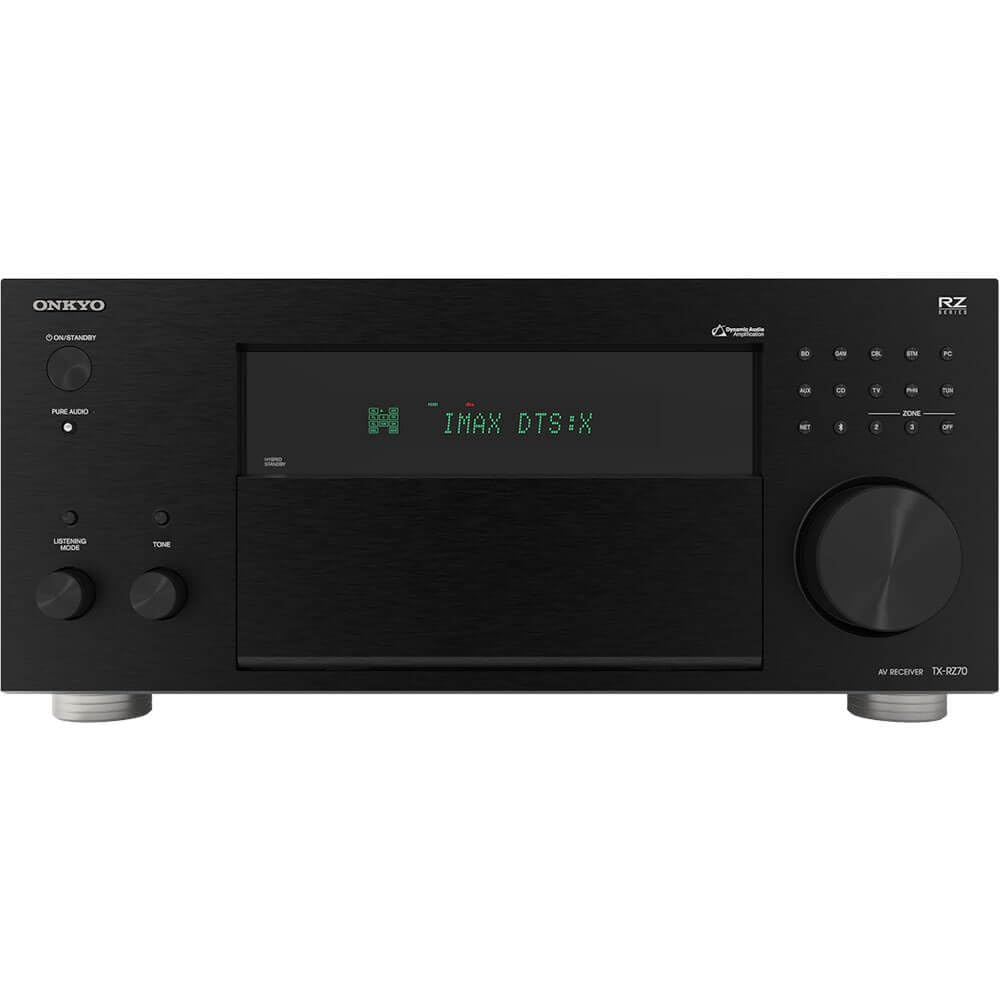
The Onkyo TX-RZ70 is the most complete 11-channel receiver you can buy without jumping to separates. It amplifies eleven channels natively at 140W per channel with ESS Sabre DACs delivering distortion-free dynamics. Dirac Live Full Bandwidth room correction comes included—no paid upgrade required—and the IMAX Enhanced certification ensures stretched-aspect-ratio cinema playback.
HDMI 2.1 ports handle 4K/120, VRR, ALLM, and QFT flawlessly, making it equally suited for high-refresh-rate gaming. Roon Ready certification and Works with Sonos add streaming flexibility. The THX Select certification guarantees no signal alteration across any input or listening mode. Users consistently report clean, punchy bass and excellent dialogue clarity after Dirac calibration.
The remote feels inexpensive for a flagship unit, and the chassis is exceptionally large—measure your rack before buying. Zone 2 control via the app lacks volume numbering. Still, at roughly half the cost of a comparable separates system, the TX-RZ70 delivers reference-grade power and processing that rivals receivers double its price.
Why it’s great
- True 11-channel amplification, no external amp needed for 7.2.4
- Dirac Live Full Bandwidth included, tightens bass and flattens response
- ESS Sabre DACs provide clarity rivaling dedicated streamers
Good to know
- Chassis is very deep and heavy at 57.9 lbs
- Remote control lacks premium feel for this price tier
2. Yamaha RX-A8A

The Yamaha RX-A8A is the flagship AVENTAGE receiver with 11.2-channel processing, XLR pre-outs, and Surround:AI technology that automatically optimizes sound fields in real time. It supports Dolby Atmos, DTS:X, and Auro-3D immersive formats, giving you the widest format compatibility in this list. YPAO R.S.C. with 3D multipoint measurement provides precise EQ and subwoofer low-frequency mode calibration.
HDMI 2.1 inputs run at 40Gbps—enough for 4K/120 but not full 48Gbps 8K/60. It supports ALLM and VRR for gaming. The MusicCast app handles multi-room streaming with Spotify Connect, TIDAL, and Qobuz. Roon Tested certification ensures high-quality network audio playback. Users praise its dynamic, engaging soundstage, deep mid-bass punch, and room-shaking lower frequencies with capable subs.
Some users report HDCP 2.2 handshake issues requiring a reboot after firmware updates. The on-screen OSD is full-screen and intrusive during adjustments. Surround:AI can push vocals aggressively to the center channel on older stereo content. Despite these quirks, the RX-A8A outperforms the Marantz Cinema 50, Denon X4800H, and Sony 7000ES in blind listening tests according to user reports.
Why it’s great
- Auro-3D support alongside Atmos and DTS:X
- XLR pre-outs enable painless integration of external amplifiers
- Backlit remote that lights up when picked up
Good to know
- HDMI inputs are 40Gbps, not full 48Gbps for highest 8K bandwidth
- Firmware updates require a USB drive and manual steps
3. Sony STR-AZ5000ES

The Sony STR-AZ5000ES is the most processor-forward 11-channel receiver available. Its 360 Spatial Sound Mapping technology creates phantom height channels that make a 5.1.2 system sound convincingly like 7.1.4. Digital Cinema Auto Calibration IX with manual distance and screen-position offsets significantly improves soundstage precision. It outputs 130W per channel into 8 ohms (2ch driven) and supports Dolby Atmos and DTS:X decoding.
HDMI 2.1 ports deliver 4K/120, VRR, ALLM, and QFT, though HDR10+ and QMS are absent. The unit integrates with Sonos via Works with Sonos certification and supports Chromecast built-in and Apple AirPlay. IP control is available for custom integration systems. Users report immediately noticeable clarity improvements over older Sony receivers, with cleaner dialogue and wider soundstage even in smaller rooms.
The receiver runs hot during extended use—adding a cooling fan is recommended. HDR10+ support is missing, which may matter if your projector supports that format. The calibration algorithm occasionally mis-measures subwoofer distance. Setup is straightforward via the GUI, web interface, or remote app. For users who value phantom height channel processing, the AZ5000ES is uniquely powerful.
Why it’s great
- 360SSM creates phantom height channels for smaller Atmos setups
- DCAC IX with manual distance adjustment fine-tunes positioning
- Sonos integration, Chromecast, AirPlay, and IP control
Good to know
- No HDR10+ support
- Runs very hot; cooling fan recommended for rack installations
4. Marantz SR8015

The Marantz SR8015 was the flagship 11-channel receiver in 2020 and remains a strong contender at now-discounted pricing. It delivers 140W per channel across eleven amplified channels with a toroidal transformer and Marantz’s warm, musical sound signature. Audyssey MultEQ XT32 handles room correction, and the HEOS networking platform streams from Spotify, TIDAL, and Pandora.
It supports Dolby Atmos and DTS:X but lacks Auro-3D. HDMI connectivity is 4K/60 and 8K/60 on the front input, though it lacks VRR and ALLM for high-refresh-rate gaming. Users pair it with Klipsch, Bowers & Wilkins, and Polk speakers for rich, clear highs and controlled bass. The sheer number of HDMI inputs and pre-outs makes it ideal for complex systems with multiple sources.
The remote feels cheap and unresponsive given the price bracket. It runs hot—8 inches of clearance above are mandatory, not optional. Subwoofer outputs default to off and must be enabled manually in the menu. Bi-amping sends a full-range signal to both HF and LF inputs, which defeats the purpose of proper bi-amplification. If you value Marantz’s warm tonality and need HEOS multi-room, the SR8015 is an excellent value at its current price point.
Why it’s great
- Warm, musical sound signature with toroidal power supply
- HEOS handles multi-room streaming natively
- Massive pre-out section for external amp expansion
Good to know
- No VRR or ALLM for next-gen gaming
- Runs hot; minimum 8 inches clearance required
5. OSD Audio XMAX11

The OSD Audio XMAX11 is not a receiver—it’s a dedicated 11-channel power amplifier meant to pair with a separate AV processor or pre-amplifier. It delivers 3x310W for front channels and 8x135W for surrounds and heights into 4 ohms with less than 1% THD. Two 2.3kVA toroidal transformers and a massive capacitor bank (3×4000µF + 8×2000µF) provide immense current reserves for dynamic peaks.
Frequency response extends from 5Hz to 50kHz, capturing subsonic LFE content and ultra-high-frequency detail. Balanced XLR and RCA inputs give flexibility with any processor. Users report zero distortion even at sustained high output, driving speakers 9dB louder than a typical mid-range AVR without thermal shutdown. The Class A/B topology keeps distortion low at the cost of higher weight—64.2 pounds.
You need a separate processor—this amp has no HDMI, no room correction, no streaming. It is ideal for users who already own a processor like a Yamaha CX-A5200 or Emotiva RMC-1L. The trigger input requires a toggle switch ON to work properly with automation systems. For sheer headroom and clean power, the XMAX11 outperforms every receiver on this list in amplifier performance but requires a separate processor investment.
Why it’s great
- Massive 2×2.3kVA toroidal transformers for instant current delivery
- Balanced XLR inputs and RCA inputs for integration flexibility
- 5Hz to 50kHz bandwidth captures full content range
Good to know
- Requires separate AV processor—no HDMI or streaming built-in
- Heavy at 64.2 lbs; may require reinforced rack shelving
6. Onkyo TX-RZ50

The Onkyo TX-RZ50 offers 9.2 channels of amplification with 11.2 processing, making it a cost-effective entry into Dirac Live room correction. It powers a 7.2.4 setup when paired with an external two-channel amplifier on the rear surround or front height channels. The 120W per channel (8 ohms, 2ch driven) is sufficient for most medium-sized rooms with moderately efficient speakers. THX Select certification ensures accurate signal reproduction.
HDMI 2.1 with 4K/120 and eARC is fully supported. The Works with Sonos certification allows seamless integration with a Sonos Port for multi-room control. Dirac Live calibration via the included wired microphone significantly improves sound clarity and bass integration compared to older Audyssey generations. Users report warm, detailed sound with excellent crossover adjustability per channel.
The WiFi card has been a failure point in early units—ensure you have warranty coverage. HDMI switching takes 12 to 15 seconds, which feels slow compared to competitors. Dual subwoofer outputs are not independently adjustable. For its price, the TX-RZ50 is the best way to access Dirac Live room correction without paying flagship prices.
Why it’s great
- Dirac Live Full Bandwidth included at no extra cost
- THX Select certification guarantees accurate sound reproduction
- Works with Sonos via Sonos Port integration
Good to know
- Only 9 amplifier channels; requires external amp for 7.2.4
- WiFi card reliability issues reported in early production
7. Yamaha RX-A4A

The Yamaha RX-A4A is a 7.2-channel receiver but provides 11.2 processing and pre-outs for zone 2 and external amplifier expansion. Its Surround:AI technology analyzes audio scenes in real time and automatically optimizes dialog, effects, and surround balance—particularly impressive for action movies and concert footage. YPAO R.S.C. with 3D multipoint measurement achieves precise speaker EQ and subwoofer integration.
HDMI 2.1 inputs support 8K60 and 4K120 at 40Gbps. The MusicCast app enables multi-room streaming with Spotify Connect, TIDAL, and Qobuz. A built-in phono input accommodates turntables without an external preamp. Users report a spacious, accurate soundstage with the ability to drive a set of external pre-outs for additional amplification on the front channels.
Firmware updates require a USB flash drive—no direct network update option exists. The setup menu is extensive and may overwhelm new users. HDMI switching lacks the front-panel convenience found on Denon models. For users who prefer the Yamaha AVENTAGE build quality and phono input, the RX-A4A is a strong mid-range option that can grow with external amplifiers.
Why it’s great
- Surround:AI real-time optimization for movies and concerts
- Built-in phono input for vinyl playback
- Pre-outs for external amplifier expansion
Good to know
- Firmware updates require USB drive, not network
- Only 7 amplifier channels; needs external amp for height expansion
8. Sony STR-AN1000

The Sony STR-AN1000 is a 7.2-channel receiver with 11.2 processing that emphasizes streaming flexibility and Sony’s Digital Cinema Auto Calibration IX. Works with Sonos certification allows seamless integration into existing Sonos systems. Chromecast built-in and Apple AirPlay provide additional streaming options. It decodes Dolby Atmos, DTS:X, and supports Dolby Vision and IMAX Enhanced HDR formats.
HDMI 2.1 ports support 8K and 4K/120 with VRR and ALLM for gaming. Zone 2 and Zone 3 distribution allow multi-room audio. Users report crisp, detailed sound with excellent dialog clarity after calibration. The S-Center speaker function improves vocal synchronization when paired with compatible Sony TVs. The remote and front-panel display are less informative than competitive models.
The calibration algorithm has been reported to mis-measure subwoofer distance and lacks a small surround speaker setting. Dolby Vision passthrough from Apple TV 4K has experienced intermittent failures for some users. The front display is small and hard to read from a seating position. For Sonos households prioritizing streaming and solid 7.2 performance, the STR-AN1000 is a logical choice.
Why it’s great
- Sonos integration, Chromecast, AirPlay all built-in
- DCAC IX calibration with 360 Spatial Sound Mapping
- Full HDMI 2.1 gaming features including VRR and ALLM
Good to know
- No phono input for turntables
- Calibration can mis-measure subwoofer distance
9. Denon AVR-S970H

The Denon AVR-S970H is a 7.2-channel receiver with 11.2 processing, allowing future expansion to a 7.2.4 layout with an external two-channel amplifier. It delivers 90W per channel into 8 ohms—clean power for medium-efficiency speakers. Full HDMI 2.1 support with 8K/60 pass-through, VRR, ALLM, and QFT makes it one of the most gaming-friendly receivers in the mid-range. The HEOS platform streams to multi-room speakers.
The on-screen guided setup walks you through speaker configuration and input assignment. The Audyssey MultEQ room correction handles basic EQ but lacks the advanced customization of Dirac Live. Users report clear, rich sound for both movies and vinyl playback via the built-in phono input. The graphical interface is responsive and easy to navigate. The unit runs cooler than comparable Onkyo and Yamaha models.
Powered Zone 2 uses the rear surround channels, reducing the main zone to 5.2. The HEOS platform cannot act as a Bluetooth source while streaming from the receiver—a notable limitation. The remote lacks a programmable TV power button. For gamers who want full HDMI 2.1 features in a reliable mid-range package with HEOS multi-room, the S970H is a strong pick.
Why it’s great
- Full HDMI 2.1 gaming features: VRR, ALLM, QFT, 4K/120
- 11.2 processing enables upgrade path to 7.2.4
- Phono input for turntables, HEOS for streaming
Good to know
- Only 7 amplifier channels; needs external amp for Atmos heights
- HEOS Bluetooth streaming has limitations
10. Denon AVR-S770H

The Denon AVR-S770H is the most affordable receiver in this roundup that still offers 8K/60 and 4K/120 HDMI 2.1 passthrough. It outputs 75W per channel across 7 channels—sufficient for small to medium rooms with efficient speakers. HEOS built-in streams from Spotify, TIDAL, and Pandora to the receiver and optional HEOS speakers. Dolby Height Virtualization and DTS Virtual:X create a sense of overhead sound without physical height speakers.
The guided setup interface walks you through speaker configuration, input naming, and network setup. Audyssey MultEQ room correction provides basic EQ. Users upgrading from soundbars report dramatic improvements in soundstage and dialog clarity. The Direct dB volume control allows precise level adjustment. Voice control via Amazon Alexa lets you adjust volume and switch inputs hands-free.
Some users report random volume drops to zero and frequent HDMI handshake failures requiring power cycling. Firmware updates take over 10 minutes and can be prone to error. The lack of multi-channel analog inputs limits compatibility with older sources. For budget-conscious buyers who need 8K HDMI 2.1 and HEOS streaming, the S770H works—but reliability concerns warrant extended warranty coverage.
Why it’s great
- 8K/60 and 4K/120 HDMI 2.1 at the lowest price point
- HEOS streaming with Spotify, TIDAL, and Pandora
- Dolby Height Virtualization for a virtual Atmos effect
Good to know
- Firmware reliability issues reported by multiple users
- 75W per channel limits headroom with low-sensitivity speakers
11. Pioneer VSX-935
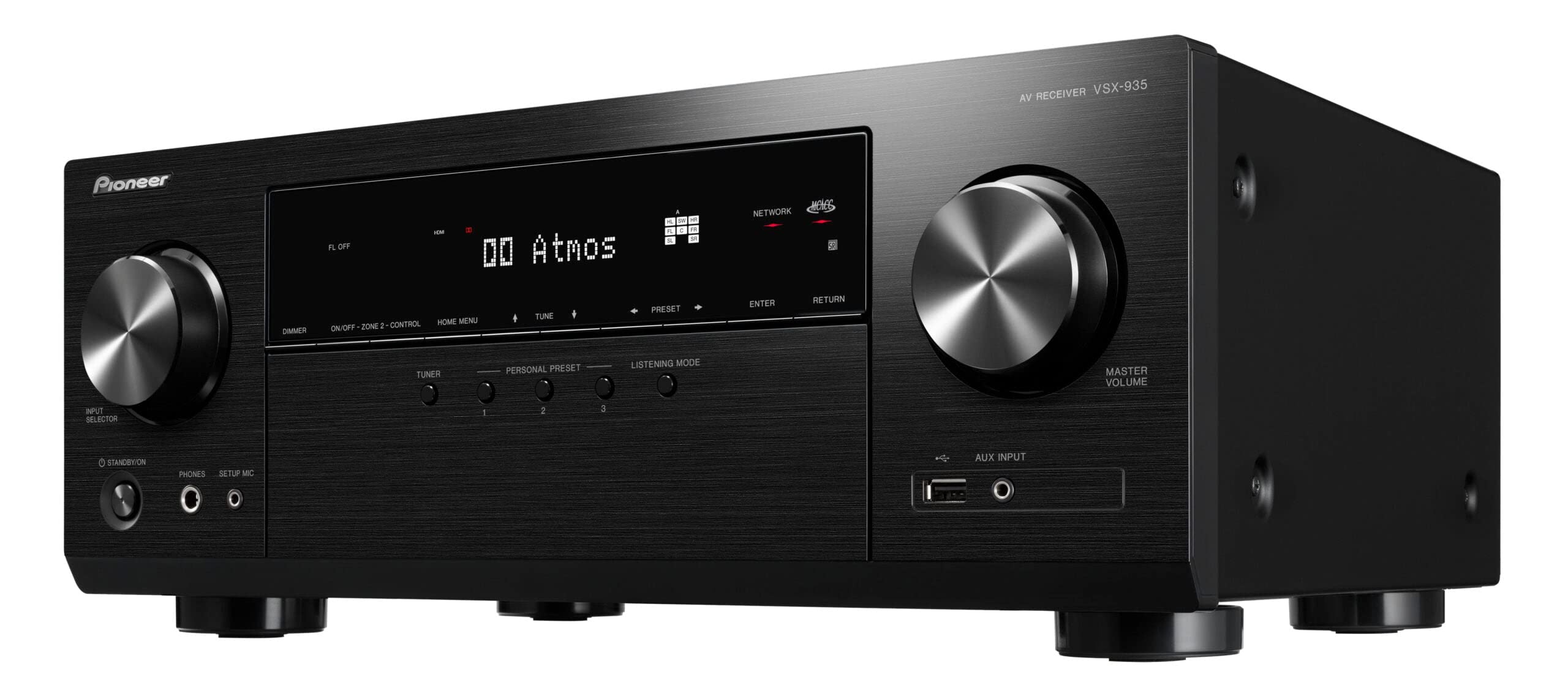
The Pioneer VSX-935 is a 7.2-channel receiver that includes HDMI 2.1 with 8K/60 passthrough and Dolby Atmos Height Virtualization. It is the most budget-friendly option in this roundup, targeting users transitioning from a soundbar or older 1080p receiver. The RF remote operates reliably from long distances and through obstacles. The dimmable front display is clear and includes a display-off mode for dark rooms.
Users praise the crisp, loud audio performance when speakers are properly placed. Dual-zone output allows a second audio zone for patio or kitchen speakers. The receiver works with Audirvana and can handle DSD128 streaming for high-resolution audio. Dialog control improves clarity without raising the overall volume.
Multiple users report persistent HDMI video issues when connecting a computer, including snow, black screens, and refresh rate failures. Rear and side surround channels sometimes fail to output sound even after correct configuration. Firmware updates are USB-only and have been reported to fail with error codes. For the price, it delivers basic HDMI 2.1 functionality, but reliability for complex setups is questionable. Consider it only for very simple stereo or 5.1 use cases.
Why it’s great
- HDMI 2.1 with 8K/60 at the lowest price in this list
- RF remote works through walls and cabinets effectively
- Dual-zone output allows simultaneous speaker and outdoor audio
Good to know
- HDMI video failures with computer sources reported repeatedly
- Surround channels may not function correctly with all setups
FAQ
What is the difference between 7.2.4 and 9.2.2 speaker layouts with an 11-channel receiver?
Do I need an external amplifier if my receiver has 11 channels built-in?
Can an 11-channel receiver improve the sound from a 5.1 speaker system?
What HDMI 2.1 features matter most for gaming on an 11-channel receiver?
How important is Dirac Live compared to Audyssey or YPAO?
Final Thoughts: The Verdict
For most users, the best 11 channel receiver winner is the Onkyo TX-RZ70 because it delivers true 11-channel amplification, Dirac Live Full Bandwidth included, ESS Sabre DACs, full HDMI 2.1 gaming features, and THX certification at a price that undercuts competing separates by thousands of dollars. If you want Auro-3D support and XLR pre-outs for future amplifier expansion, grab the Yamaha RX-A8A. And for a budget-conscious path to Dirac Live room correction with upgrade potential to 7.2.4, nothing beats the Onkyo TX-RZ50.