
Our readers keep the lights on and the weekend projects moving. As an Amazon Associate, I earn from qualifying purchases.
A dedicated 12-volt heater taps directly into your engine’s coolant to deliver real, engine-heated warmth to your cab, defrosting windows and keeping your feet comfortable without draining your battery. Whether you’re restoring a classic car, working a tractor in sub-zero temps, or adding heat to a UTV, the right unit changes the way you face the cold.
I’m Rikta — the founder and writer behind FitlyFast. Over several years of analyzing automotive climate hardware, I’ve focused on how BTU ratings, CFM airflow, and hydronic loop compatibility separate effective heaters from disappointing ones in real-world installs.
This guide breaks down the best options for adding serious warmth to your vehicle, from compact under-dash units to high-output UTV heaters. Here is your complete resource for finding the right 12 volt car heater to match your specific cab, budget, and installation skills.
How To Choose The Best 12 Volt Car Heater
Choosing the right heater starts with understanding your vehicle’s existing cooling system and how you intend to route the coolant. The best heater on paper will fail if it doesn’t fit your available space or if its hose connections don’t align with your engine block. Focus on three areas: heat output, physical dimensions, and included installation parts.
Heat Output: BTU and CFM
BTU (British Thermal Units) measures raw heat energy, while CFM (Cubic Feet per Minute) measures how quickly that heat is moved into the cab. A unit with high BTUs but low CFM will create a hotspot near the heater without distributing warmth across the cabin. For a standard truck cab, look for at least 8,000 BTUs and 200+ CFM to feel a noticeable difference on cold mornings. For larger cabs or vans, you’ll want to push those numbers higher or combine multiple units.
Installation: Coolant Hoses and Brackets
Almost all true 12-volt coolant heaters require connecting to your vehicle’s heater hoses—typically a 5/8-inch inner diameter line. The heater itself acts as a secondary core. You need to T into the existing loop, run hoses to the unit, and mount it securely under the dash. Check if the kit includes T-fittings, hose clamps, and a mounting bracket. Missing hardware can turn a simple weekend job into a parts hunt.
Durability: Fan Motor and Switch Quality
Customer reviews consistently point to two failure points: the fan speed switch and the blower motor. Look for units with metal-shaft switches and sealed motors that resist vibration. A plastic knob that spins on the shaft is a red flag—some units require immediate modification with an adhesive to keep the controls functional. Units with copper or copper-tube cores also tend to transfer heat more efficiently than all-aluminum alternatives.
Quick Comparison
On smaller screens, swipe sideways to see the full table.
| Model | Category | Best For | Key Spec | Amazon |
|---|---|---|---|---|
| JEGS Auxiliary UTV Heater | Premium Forced Air | Max Heat Output for UTVs & Trucks | 28,000 BTU / 260 CFM | Amazon |
| American Cooling Solutions Cab Heater | Premium Hydronic | Tractors & Classic Vehicles | 13,000 BTU / 2-Speed Fan | Amazon |
| TURBRO 9kW Diesel Heater | Standalone Diesel | RVs, Garages & Boats | 9,000 Watts / Smart LCD | Amazon |
| Caframo True North Heater | 120V Electric | Quiet Cabin & Anti-Freeze | 5,200 BTU / 3 Heat Settings | Amazon |
| Evargc Compact Hydronic | Mid-Range Hydronic | Buses & Large Cabs | 8,500 BTU / 3-Speed Fan | Amazon |
| Saihisday Auxiliary Heater | Budget Hydronic | Budget-Friendly Install | 8A Draw / 4 Ports | Amazon |
| XuSha Universal Heater | Budget Hydronic | Entry-Level Heating | 8,000 BTU / 4 Ports | Amazon |
In‑Depth Reviews
1. JEGS Auxiliary UTV Heater 12V Assembly
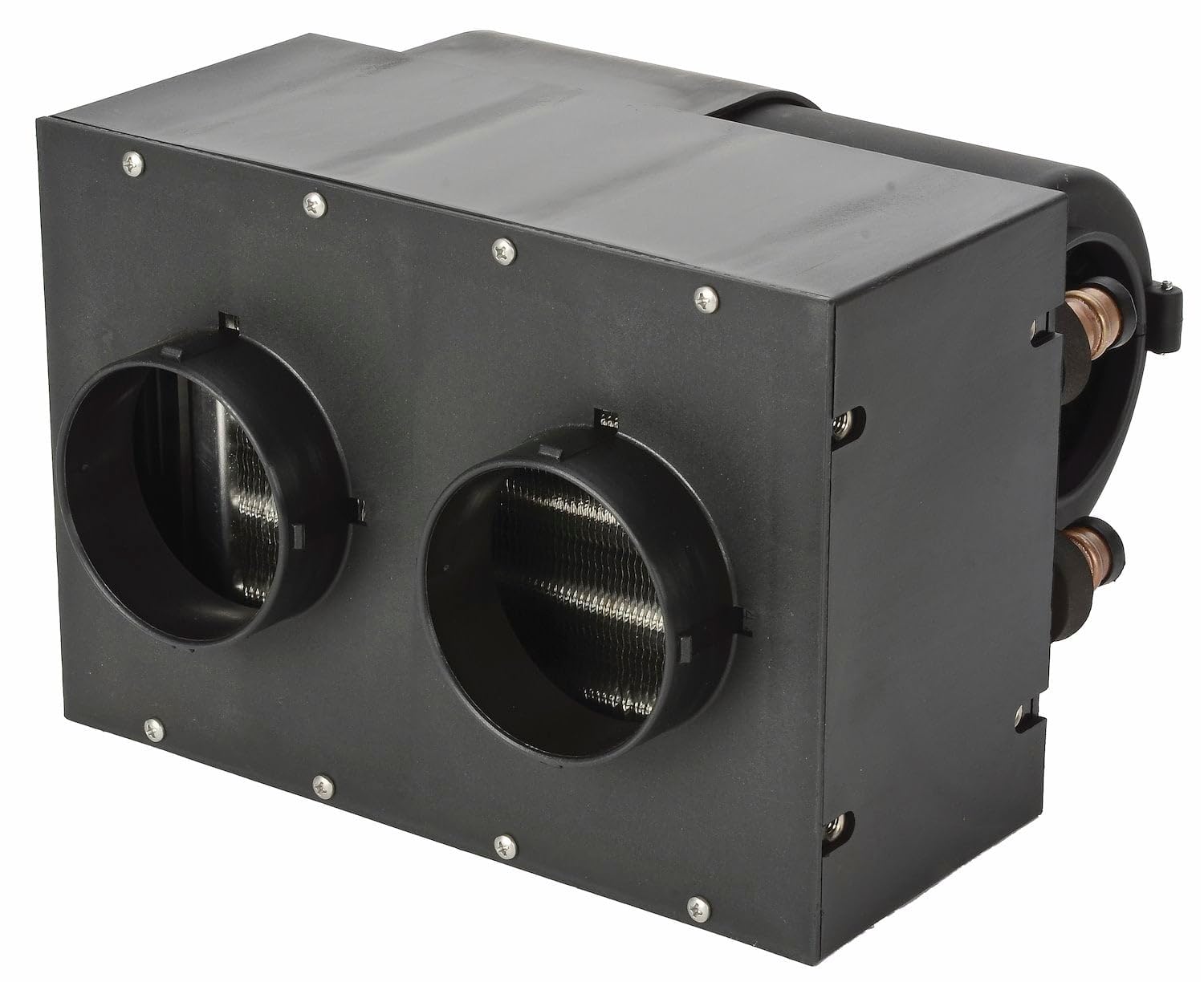
The JEGS heater is the benchmark for raw power in this category, delivering a massive 28,000 BTUs with 260 CFM of airflow—enough to heat a full-sized truck cab or a skid steer loader in minutes. Its heavy-duty injection-molded and glass-filled nylon construction is designed to survive the vibrations of off-road use, a step up from the thin sheet metal found on budget units. The three-speed motor gives you control over noise versus output, with many users reporting that the low setting alone is sufficient for a typical cab.
Installation requires some fabrication—this is not a plug-and-play unit. The heater core needs to be spliced into your vehicle’s coolant loop, and the mounting bracket may need slight modification for tight under-dash spaces. Several users noted that wiring it correctly is crucial for achieving full heat output, and some experienced missing parts from the kit. The glass-filled nylon housing holds up well, but the unit is loud on the high setting, and it recirculates cabin air, which can cause window fogging if you don’t crack a window.
For anyone restoring a classic car, retrofitting a UTV, or adding serious heat to a work vehicle, the JEGS offers unmatched BTU-per-dollar value. The key trade-off is that you’ll need mechanical confidence to install it properly, and the noise level on high is significant. If you have the space and the skills, this is the heater that will actually make you forget it’s winter.
Why it’s great
- Highest heat output in the roundup at 28,000 BTU.
- Glass-filled nylon housing resists cracking from vibration.
- Low fan setting often provides more than enough warmth.
Good to know
- Loud on high speed; window fogging can occur without fresh air.
- Installation requires fabrication skills and correct wiring.
- Some units arrive missing parts; customer support may be inconsistent.
2. American Cooling Solutions Cab Heater

The American Cooling Solutions heater sits in a premium tier for a reason: it includes a complete installation kit with Y-connectors, hose clamps, a fuse holder, and a fuse—saving you a trip to the auto parts store. Its copper tube core provides superior thermal conductivity compared to cheaper aluminum units, transferring more heat from the coolant into the air. The low-profile design (just 8.25 by 8 by 4.63 inches) fits into tight spaces in tractors, classic cars, and UTVs without crowding the footwell.
User reports highlight its ability to heat a John Deere cab or a classic 46’ Chevy truck quickly, but the two-speed fan is a weak point—some owners feel the fan lacks the air volume for high-speed defrosting. The mounting brackets are adequate but not heavy-duty; vibrations can loosen them over time, especially in off-road equipment. A few units have arrived with stripped screws or loud fan noise, indicating quality control inconsistency.
If you want a near-complete install kit and the durability of a copper core, this is a strong choice for a classic car project or a tractor. The trade-off is that the fan performance is merely average for the price, and you may need to reinforce the mounting to prevent vibration. For a clean, compact install with good heat, it delivers, but the fan could be more powerful.
Why it’s great
- Includes Y-connectors, clamps, and fuse kit for easier install.
- Copper tube core offers better heat transfer than aluminum.
- Compact low-profile design fits many tight applications.
Good to know
- Two-speed fan lacks high air volume for rapid heating.
- Mounting brackets can vibrate loose in rough environments.
- Quality control varies—some units have stripped screws or noisy fans.
3. TURBRO 9kW Diesel Heater
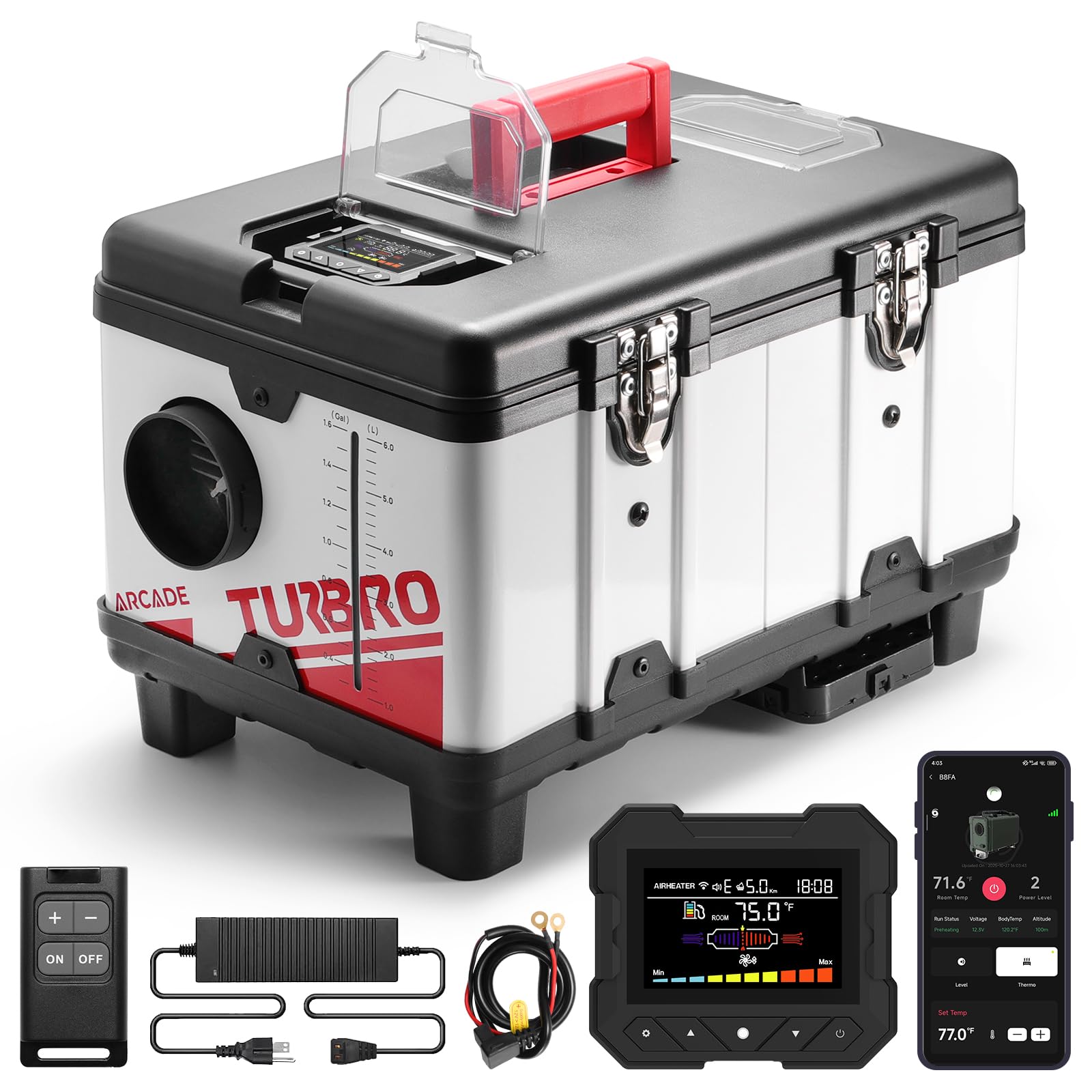
The TURBRO is not a coolant-based heater—it’s a standalone diesel-fired unit that draws from its own 1.6-gallon fuel tank, making it ideal for vehicles without accessible coolant lines, such as RVs, boats, tents, and garages. It operates on 12V or 24V DC and 110V AC, giving you flexibility across multiple power sources. The smart LCD and Bluetooth app control let you set a target temperature, program timers, and switch between manual gear modes without reaching for the unit.
In real-world use, the heater starts reliably even at -40°F and produces consistent heat over long periods, with a low fuel consumption rate of 0.16 to 0.4 liters per hour. The built-in tank runs for about 8 hours on high, which is enough for an overnight stay but not for extended off-grid trips. A significant minority of users report failures within the first 6 hours of use, with error codes the manual does not clearly explain. The company’s support is email-only, which can be frustrating if the unit fails.
This heater is best for those who need heat without engine coolant, such as camper van owners or workshop users who want a programmable, remote-controlled system. The potential for early failure and the reliance on email support are real risks. If you get a good unit, the combination of smart controls and standalone operation is excellent, but the failure rate is higher than traditional hydronic heaters.
Why it’s great
- Standalone operation with built-in fuel tank—no coolant hookup needed.
- Bluetooth app and LCD controller allow full temperature scheduling.
- Runs on 12V, 24V, and 110V for broad vehicle compatibility.
Good to know
- Some units fail within a few hours; customer support is email-only.
- Fuel tank size limits runtime to about 8 hours on high.
- Exhaust must be vented outside, requiring a permanent installation.
4. Caframo True North Heater

The Caframo True North is a 120V AC electric heater, not a 12V DC unit, but it earns a spot here as a premium solution for campers, boats, and workshops where shore power is available. Its hallmark is ultra-quiet operation—the forced-air fan is barely audible, making it ideal for a bedroom or a quiet office. The solid steel housing and low-profile block design prevent tip-overs, and the anti-freeze mode automatically turns the heater on when the temperature drops to 38°F, protecting your space from freezing pipes or equipment.
Users consistently praise its build quality: it is manufactured in Canada with a five-year warranty, and the mechanical controls (three heat levels and two fan settings) are durable. The internal thermostat is somewhat unreliable, so using an external thermostat is recommended for precise temperature control. A small number of units have experienced an over-temperature switch failure after prolonged use, though this is not common.
If you need quiet, safe, and reliable heat in a space with 120V power, the Caframo is the gold standard. It is expensive relative to its BTU output, but the build quality and safety features justify the cost. It is not a replacement for a 12V heater in a vehicle without shore power, but for a cabin, boat, or workshop, it is a long-term investment in comfort.
Why it’s great
- Extremely quiet operation; barely audible on low fan.
- Solid steel housing with anti-freeze auto-start at 38°F.
- Five-year warranty and Canadian manufacturing quality.
Good to know
- 120V only—not suitable for vehicles without shore power.
- Internal thermostat is less accurate; external control recommended.
- Expensive for the 5,200 BTU output compared to coolant heaters.
5. Evargc Compact Hydronic Heater
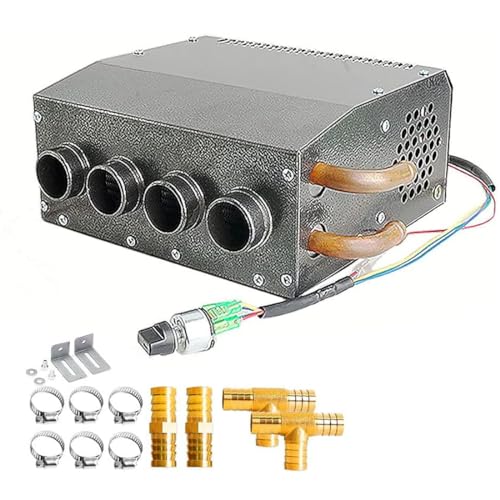
The Evargc heater hits a sweet spot with 8,500 BTUs and a copper and iron core that transfers heat efficiently. Its three-speed fan and four adjustable vent ports give you good control over air distribution, and the 96-watt power draw means minimal strain on your electrical system. It is designed as a direct hydronic hookup, requiring a 5/8-inch coolant line and a heat source from your engine.
Users report that it works wonderfully in larger spaces like a 12-seater bus, producing more heat than needed for mild winter conditions. The installation is straightforward for those comfortable with cutting and splicing heater hoses. The main complaint is the fan speed control switch—the plastic knob is poorly fitted and often spins on the shaft, requiring a drop of super glue to stay functional. This is a minor annoyance but speaks to a cheap component in an otherwise solid unit.
For anyone with a van, bus, or large cab who wants reliable heat without breaking the bank, the Evargc is a strong mid-range contender. The switch issue is fixable, and the copper core ensures good thermal performance. It does not include T-fittings or mounting hardware, so budget for those separately.
Why it’s great
- Copper and iron core provides efficient heat transfer.
- Three-speed fan with four adjustable vents for airflow control.
- Works well in large vans and buses, even in cold climates.
Good to know
- Plastic fan knob is loose and may require glue to stay on shaft.
- No T-fittings or installation hardware included in the box.
- Mounting brackets may place coolant lines on the wrong side for some applications.
6. Saihisday 12V Car Auxiliary Heater

The Saihisday unit is a budget-friendly hydronic heater that offers the basic functionality of a four-port under-dash heater at an accessible price point. It draws 8 amps from your 12V system and requires a 5/8-inch coolant line connection. The unit is designed for defrosting and demisting, with a powerful blower motor that can push warm air across a windshield or into the footwell.
Customer reviews reveal a split experience. Many users found it easy to install in a 1998 Chevy S10 or a Polaris Ranger, noting that the noise level is acceptable and the heat output is adequate for the price. However, a significant number reported defective switches that only work when wires are wiggled, and hose clamps that strip easily. The included plastic air hoses are widely considered useless, so you will likely need to source your own flexible ducting. The fan motor is also described as a little weak by some, adequate for close-range heating but not for circulating air throughout a large cab.
If you are on a tight budget and you have basic wiring and plumbing skills, the Saihisday can get you warm—but be prepared to replace the switch and the hoses. It is a reliable core with cheap accessories. For a project vehicle where you can work around these flaws, it is a functional entry point, but it lacks the refinement and reliability of mid-range units.
Why it’s great
- Low entry cost for adding heat to a project vehicle.
- Includes a switch and wiring for basic installation.
- Provides adequate heat for small cabs and UTVs.
Good to know
- Defective switches and stripped hose clamps reported frequently.
- Included plastic air hoses are low quality and often replaced.
- Fan motor is weak; not ideal for circulating heat in larger spaces.
7. XuSha 8000 BTU Universal Heater

The XuSha heater is the most affordable option in this guide, offering 8,000 BTUs of heat output in a compact package that weighs 7 pounds. It operates purely as a coolant-to-air heat exchanger—there is no internal heating element, so its performance is entirely dependent on your engine’s water temperature. Users have successfully installed it in classic hot rods (like a 1957 Dodge pickup), UTVs, and RZRs, where it provides enough warmth to defrost windows and keep feet comfortable in temperatures around 16°F.
The primary issue is that the unit does not come with mounting screws or detailed installation instructions. The hose clamps provided are basic, and the fan switch has a history of burning out after just a couple of uses. Several users reported that the switch failed quickly, and the fan motor can produce a noticeable vibration that causes acoustic noise in the cab. The instructions are poor, so this is strictly for those who understand how to route and clamp 5/8-inch coolant hoses.
For an absolute budget build where you need just a little extra heat, the XuSha works—if you are lucky with the switch. The heat output is genuine when the engine is warm, but the electrical components are the weakest link. If you are comfortable replacing a switch and using your own hose clamps, this can be a functional solution. If you want a trouble-free install, spending a bit more on a mid-range unit will save you frustration.
Why it’s great
- Very low cost to add basic auxiliary heat to any vehicle.
- Produces decent heat when coolant is up to temperature.
- Works well for vintage car projects and basic UTV builds.
Good to know
- Fan switch is prone to burning out after a few uses.
- No mounting hardware or clear instructions included.
- Fan motor can vibrate and create noise inside the cab.
FAQ
How do I install a 12 volt coolant heater in my vehicle?
Can I use a 12 volt car heater without engine coolant?
Why does my auxiliary heater blow cold air until the engine warms up?
How much battery drain will a 12 volt car heater cause?
Will a 12 volt coolant heater work in an electric vehicle?
Final Thoughts: The Verdict
For most users, the 12 volt car heater winner is the JEGS Auxiliary UTV Heater because it delivers the highest BTU output and CFM airflow in a durable package, making it the most effective for a wide range of truck and UTV applications. If you want a complete kit with better mounting hardware and a copper core for easier installation, grab the American Cooling Solutions Cab Heater. And for stand-alone, engine-independent heat with smart control features, nothing beats the TURBRO 9kW Diesel Heater.