
Our readers keep the lights on and the weekend projects moving. As an Amazon Associate, I earn from qualifying purchases.
A deep cycle battery is the backbone of any off-grid power system, whether you are powering a trolling motor on a kayak, running lights and a fridge in an RV, or storing solar energy for a cabin. Choosing the wrong chemistry or capacity can leave you stranded with dead electronics and a heavy, useless brick. This guide breaks down the nine best options on the market, focusing on the specs that actually matter for long-term reliability.
I’m Rikta — the co-founder and writer behind FitlyFast. I’ve spent countless hours analyzing battery specifications, comparing cycle life claims against real-world reviews, and investigating the trade-offs between sealed lead-acid, AGM, and lithium iron phosphate chemistries to compile this definitive resource.
After evaluating over a dozen models across multiple chemistries and price tiers, this review of the best 12 volt deep cycle battery will help you match the right technology to your specific power demands and budget.
How To Choose The Best 12 Volt Deep Cycle Battery
Selecting the right deep cycle battery requires understanding your energy consumption and the environment in which the battery will operate. The wrong choice can lead to premature failure or insufficient runtime.
Chemistry: The Core Decision
Your first move is to choose between Flooded Lead-Acid (FLA), Absorbent Glass Mat (AGM) sealed lead-acid, and Lithium Iron Phosphate (LiFePO4). FLA batteries are the cheapest but require regular maintenance and off-gassing. AGM batteries are spill-proof, maintenance-free, and offer better vibration resistance, making them a solid mid-range pick. LiFePO4 batteries are the premium choice: they are significantly lighter, provide consistent voltage until nearly depleted, and deliver thousands of cycles vs. a few hundred for lead-acid. The higher initial cost is often offset by a much longer lifespan.
Capacity and Amp-Hours (Ah)
Capacity, measured in amp-hours (Ah), determines how long a battery can deliver a specific current. To estimate your needs, total the amp draw of all devices you plan to run and multiply by the desired run time in hours. Add a 20% buffer to avoid fully discharging the battery, which can damage lead-acid types. A 100Ah battery is a common sweet spot for medium-draw applications like a trolling motor or small RV setup, while 150Ah units are better for solar storage or larger systems.
Quick Comparison
On smaller screens, swipe sideways to see the full table.
| Model | Category | Best For | Key Spec | Amazon |
|---|---|---|---|---|
| Battle Born 100Ah | Premium LiFePO4 | Full-time RV/Long-term Reliability | 3000-5000 cycles @ 100% DoD | Amazon |
| DUMFUME 150Ah | High-Capacity LiFePO4 | Solar & Off-Grid Storage | 1920Wh energy / 22.05 lbs | Amazon |
| Power Queen 100Ah | Mid-Range LiFePO4 | Trolling Motor & Golf Cart | 15000 deep cycles / 24 lbs | Amazon |
| Litime 100Ah TM | Marine LiFePO4 | Saltwater & Bass Boats | ABYC E-13 / TVS spike protection | Amazon |
| HRBEENERGY 100Ah | Value LiFePO4 | Budget-Minded Upgrade | IP67 waterproof / 19.4 lbs | Amazon |
| HumsiENK 100Ah | Feature-Rich LiFePO4 | 2-Hour Fast Charging | 15000+ cycles / App-ready BMS | Amazon |
| Mighty Max ML100-12 | Sealed AGM Lead-Acid | UPS & Budget Solar/Kayaks | 100Ah SLA / 28 lbs | Amazon |
| WEIZE 100Ah | Heavy-Duty AGM | Off-Grid Backups & RVs | 63 lbs / 1150A max discharge | Amazon |
| Newport Vessels 50Ah | Light AGM Marine | Kayak & Light Trolling | 50Ah AGM / 32 lbs | Amazon |
In‑Depth Reviews
1. Battle Born Batteries 100Ah LiFePO4
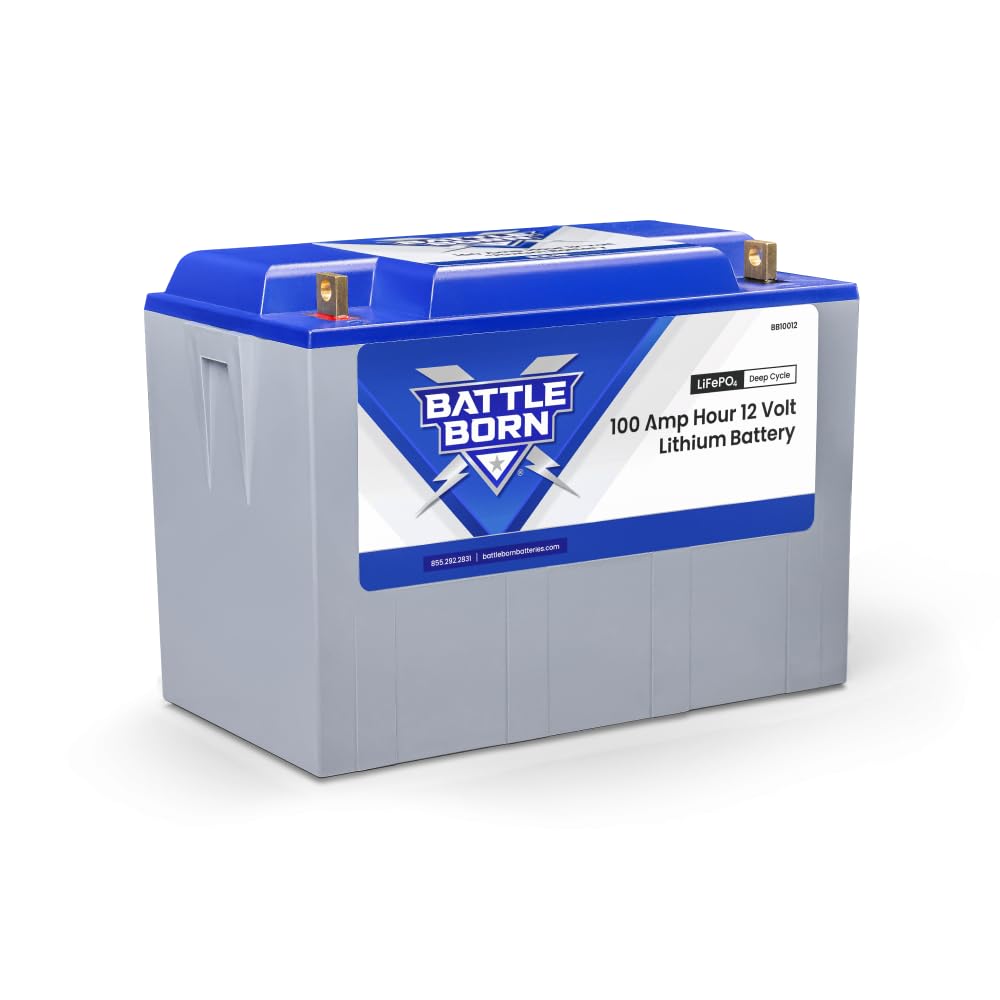
The Battle Born BB10012 has become the benchmark for premium drop-in replacement in the RV and marine world, and for good reason. It uses proven LiFePO4 chemistry with a robust internal BMS that handles low-temperature protection, high and low voltage, and short circuits automatically. At 31 pounds, it is less than one-third the weight of a comparable lead-acid battery, freeing up payload and making installation a one-person job.
Real-world users consistently report fast charging from solar arrays and drastically longer runtimes. One vanlife owner documented running a 450W heater for 90 minutes and powering all cabin loads on a 3,000-mile trip with no issues. Another customer replaced two 6V lead-acid golf cart batteries with two BB10012s and saw their fridge running time jump from 8 hours to 28 hours. The 10-year warranty and reputation for stellar customer service add confidence that this investment will pay off over the long haul.
The primary barrier is the high upfront cost per amp-hour compared to AGM or other lithium brands. Also, because the BMS is fully internal, there is no external display or Bluetooth connection for monitoring state of charge. You will need a separate battery monitor or shunt to get precise readouts. For serious full-time users who want maximum reliability and lifespan, the premium is justified.
Why it’s great
- Industry-leading 10-year warranty with verified support
- 3000-5000 deep cycles at 100% depth of discharge
- Lightweight build frees up payload in RVs and boats
Good to know
- Highest per-amp-hour cost on this list
- No built-in Bluetooth or state-of-charge display
- Requires lithium-compatible charger for optimal charging
2. DUMFUME 12V 150Ah LiFePO4
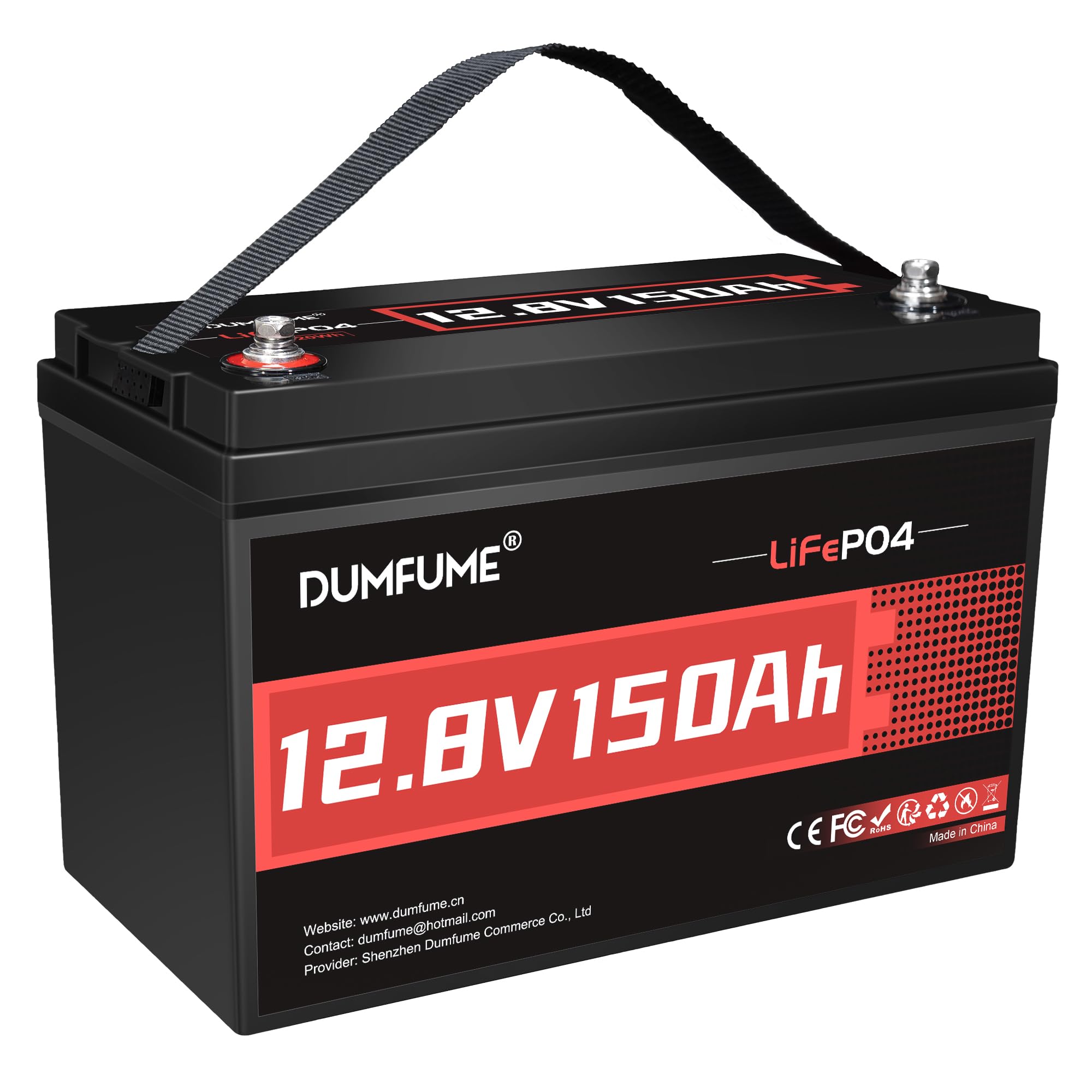
The DUMFUME 150Ah LiFePO4 battery delivers serious capacity at a weight of just over 22 pounds, making it a strong contender for home solar or large campervan builds. With 1920Wh of total energy and support for up to 4S4P configurations, you can scale from a single unit to a 7680Wh (6 x 150Ah) bank. The 100A BMS provides solid protection against overcharge and short circuits, and the unit maintains a stable voltage well below freezing (with the caveat that charging is blocked at low temps).
Buyers using this battery in solar arrays report steady performance and accurate capacity ratings. One reviewer saw four units exceed their rated capacity by about 7Ah each, and after a year of twice-weekly charging, the batteries still tested above spec. Another ran a 24V 100Ah setup for a complete home backup and described it as a “great investment.” The weight advantage is real—at 11 kg, it is easily carried and positioned in confined compartments.
A notable warning from the field: several users received units that required a parallel jump charge to wake the BMS from sleep. This is manageable with a second battery but can be a frustrating first experience. Additionally, the 5-year warranty is only honored for direct purchases from the manufacturer, not Amazon, which may complicate returns. If you are comfortable with these nuances, the capacity-per-dollar ratio is outstanding.
Why it’s great
- Highest raw capacity on this list at 150Ah
- Very light for its capacity, easy to handle
- Excellent value for large solar or off-grid installations
Good to know
- Some units may ship in BMS sleep mode requiring a jump start
- 5-year warranty not valid for Amazon purchases per manufacturer
- Not recommended as a drop-in starter battery
3. Power Queen 12V 100Ah LiFePO4
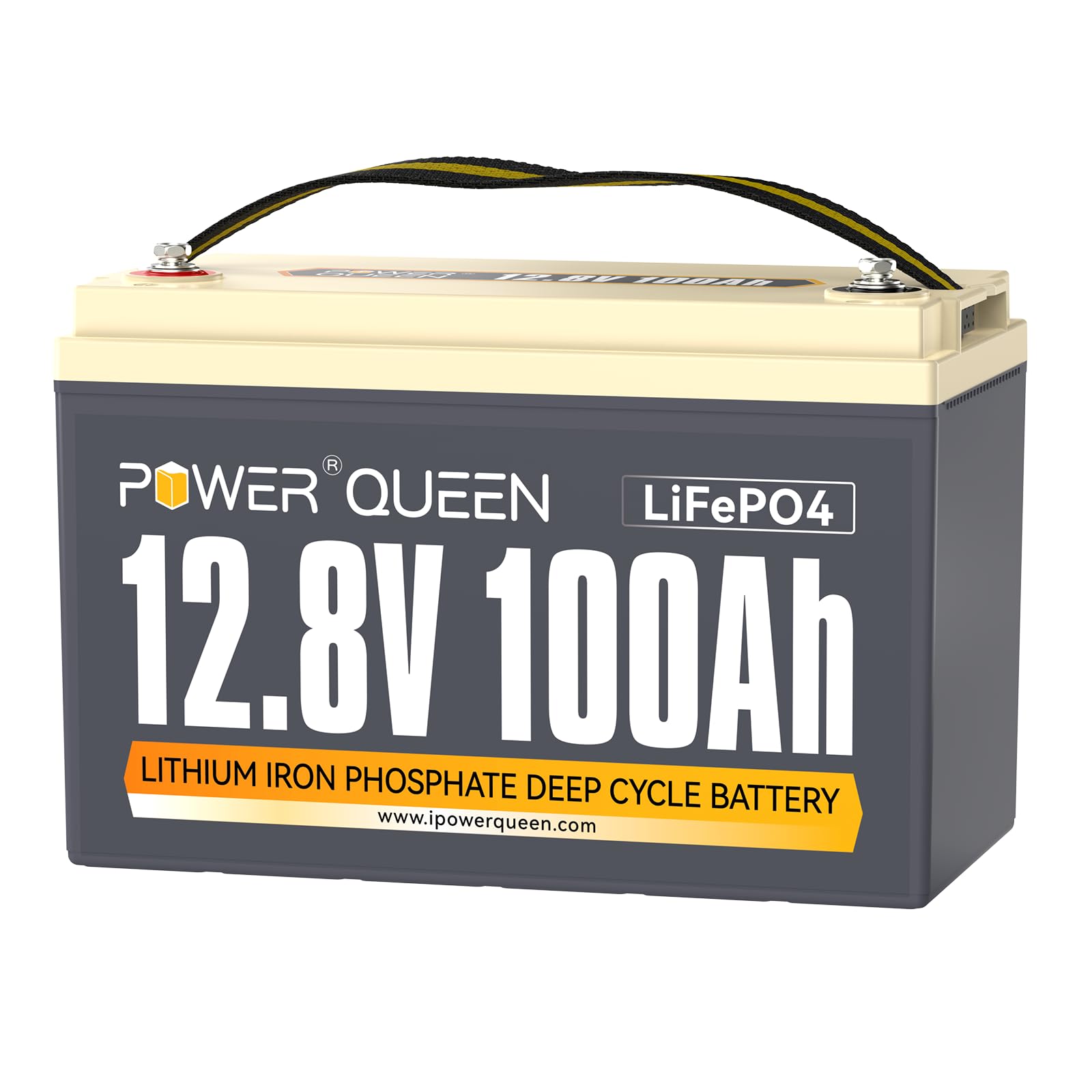
Power Queen has carved out a solid reputation in the mid-range LiFePO4 space, and this 100Ah Group 31 battery is a prime example. It uses genuine Grade-A cells and a 100A BMS to deliver stable voltage over a massive claimed lifespan of 15,000 cycles. The unit weighs just 24 pounds—about one-third the weight of an equivalent AGM unit—and fits into standard Group 31 trays, making it a true drop-in upgrade for many golf carts and RVs.
Users are particularly impressed with its performance on trolling motors. One owner reported running a 36V trolling motor on three of these batteries in series, and the kids drove the golf cart for four days without needing a recharge—a dramatic improvement over the old daily charging routine. Sailboat owners have also stacked multiple units in parallel to power cabin electronics and found build quality to be excellent, with one testing 102Ah from a single 100Ah-rated unit.
The main caveat concerns the physical terminals. A few owners noted that the 6mm bolts with a 13mm head can be prone to cross-threading when connecting multiple lugs. Also, while the battery supports expansion up to 4S4P, some users found the overall length slightly longer than standard Group 31 brackets, requiring a minor mod. For the price, the cycle life claim is generous, but real-world longevity is still being proven.
Why it’s great
- Very competitive price per amp-hour for LiFePO4
- Lightweight at 24 lbs, easy to install
- Excellent feedback from trolling motor and golf cart users
Good to know
- Terminal bolts may cross-thread with multiple lugs
- Slightly longer than standard Group 31 tray in some cases
- Lacks built-in Bluetooth for live monitoring
4. Litime 12V 100Ah Trolling Motor LiFePO4

The Litime 100Ah Trolling Motor battery was designed from the ground up for wet, demanding marine environments. It meets the ABYC E-13 standard, which means its BMS has extra protection against dust, water ingress, and salt spray. More importantly, it features built-in TVS (Transient Voltage Suppression) to shield sensitive 12V-36V trolling motors from damaging voltage spikes that can ruin electronics. Weighing 22 pounds, it shaves over 40 pounds off an equivalent lead-acid battery.
Anglers on bass boats and jon boats alike report exceptional results. One user with a 36V Minn Kota Ultrex on a 16-foot jonboat ran the motor for hours against a headwind and barely registered a discharge on the battery monitor. Another switched from AGM and saw the solar panels still reading 100% the next day after a full day of fishing. The weight reduction also measurably improved boat handling and increased top speed by several mph.
The main downside is that the BMS does not include active cell balancing, which some users have found can lead to minor voltage drift between cells over time. A workaround using a multibank charger and manual disconnects is workable but not ideal for a plug-and-play experience. Also, some batteries arrived with the BMS in sleep mode, requiring a force-charge from a lead-acid charger to wake them up. For serious boaters, the marine-specific protections make it a compelling choice.
Why it’s great
- ABYC E-13 certified with triple weather protection
- TVS suppression protects trolling motor electronics
- Lightweight dramatically improves boat performance
Good to know
- BMS lacks active cell balancing
- May require wake-up charge if BMS is in sleep mode
- Applications like security systems may need a monitoring device
5. HRBEENERGY 12.8V 100Ah LiFePO4

The HRBEENERGY 100Ah LiFePO4 battery hits a sweet spot for entry-level lithium adopters who want a lightweight upgrade without breaking the bank. At 19.4 pounds, it is one of the lightest 100Ah units on the market, making it ideal for weight-sensitive applications like kayaks and small scooters. The IP67 waterproof rating adds confidence for marine or outdoor use, and the Group 24 size fits standard trays without modification.
Users have successfully deployed this battery across a range of applications. A kayak fisherman reported that the battery powered his 30lb Minn Kota for three hours and barely drained the charge. One reviewer used three units in series to power a 36V golf cart for ten hours, while another ran three in parallel for a 12V RV setup that lasted 3-4 days. The included 100A BMS offers standard protections, and the 10-year manufacturer warranty is a generous promise for a battery in this price tier.
The primary concern raised in reviews is that the low-voltage cutoff kicks in at roughly 9.5V, which is lower than the 10-10.5V that most LiFePO4 batteries use. This can cause a sudden cut-off that may take a few minutes to re-enable. Additionally, the auto-recovery function cycles between cut-off and re-connect instead of staying locked out, which could be problematic for sensitive electronics. It is a minor quirk but worth noting for gear that requires a hard shutdown to prevent damage.
Why it’s great
- Very lightweight at 19.4 lbs for easy transport
- IP67 waterproof rating for wet environments
- Competitive price for a feature-rich LiFePO4
Good to know
- Low-voltage cutoff is lower than many competitors
- BMS auto-recovery cycle may not suit all applications
- No built-in Bluetooth or app connectivity
6. HumsiENK 12V 100Ah LiFePO4

HumsiENK brings a premium feature set to a mid-range price with this 100Ah LiFePO4. The headline feature is an app-connected BMS that provides real-time data on voltage, current, and capacity directly to your phone—a rare find at this price point. The battery also supports fast charging, claiming a full charge in just two hours, which is a massive time-saver compared to the 14-hour slog of traditional lead-acid. A nylon carry handle and IP67 waterproofing make it practical for regular handling and outdoor exposure.
Users upgrading from 6V golf cart batteries to three 12V HumsiENK units report a dramatic weight reduction and much longer runtime. One owner replaced his golf cart’s six 6V batteries and saw significant weight savings with consistent power delivery until the very end of the charge. In a solar backup context, a single unit running a 2kW inverter kept an 8000 BTU A/C and kitchen appliances running for 11 hours down to 50% drain. The Bluetooth app offers visibility that most competitors lack.
A few users noted that the BMS low-voltage cutoff can be tricky to reset after a deep discharge. The manual recommends using a 12V 1A lead-acid charger to wake the battery slowly up to 9V before switching to a LiFePO4 charger, which adds an extra step. Additionally, the 5-year warranty is only valid for the original buyer and is not transferable. For anyone who values monitoring and speed, this is a standout option.
Why it’s great
- Bluetooth app provides real-time battery data
- Fast charging reaches full capacity in about 2 hours
- Lightweight with integrated carry handle
Good to know
- BMS reset after deep discharge requires extra steps
- 5-year warranty is non-transferable
- App connectivity can be finicky on initial setup
7. Mighty Max 100Ah SLA/AGM

The Mighty Max ML100-12 is a no-frills sealed lead-acid battery that has been a staple in the budget deep cycle category for years. It uses absorbent glass mat technology to be spill-proof and maintenance-free, with a UL certification that gives some peace of mind. At 28 pounds, it is lighter than a standard flooded battery but still about 50% heavier than a comparable LiFePO4. For applications where weight is not the primary concern, this is a cost-effective way to get 100Ah of reliable power.
Real-world tests show it performs well for trolling motors and small solar systems. One kayak angler paired it with a 44lb trolling motor and got over eight hours of runtime with 35% charge remaining. Another user ran a 32-inch TV and Roku on a 500W inverter for four hours and only consumed 1% of the battery’s capacity—a surprisingly high efficiency. For backup sump pump or alarm systems, the battery’s deep discharge recovery is a notable advantage.
The biggest negative is the return process in the rare case of a defect. The battery weighs 28 pounds and is classified as hazardous material, so return shipping can be expensive if the unit is DOA. While many buyers report years of trouble-free service, there are occasional reports of batteries arriving with low voltage. For a true budget solution, it is hard to beat—just be prepared to handle potential returns directly with the manufacturer.
Why it’s great
- Very low upfront cost for 100Ah of capacity
- Maintenance-free and spill-proof AGM design
- UL certified with solid real-world reliability
Good to know
- Heavy and costly to return if defective
- Limited to about 500 cycles compared to LiFePO4
- No BMS or built-in protection features
8. WEIZE 12V 100Ah Deep Cycle AGM

The WEIZE 100Ah AGM battery is built for stationary applications where raw capacity and high discharge current matter more than weight. With a massive 63-pound casing and a max discharge current of 1150A, it is designed to handle heavy inverter loads and surge demands from appliances like refrigerators and furnace fans. The sealed design is maintenance-free, and the self-discharge rate is just 3% per month, making it an excellent choice for backup power systems that sit idle for long periods.
Users in off-grid cabins and RVs praise its consistent performance. One system uses four WEIZE batteries in parallel to feed a 2000W inverter, providing 4.8 kWh of backup power for ceiling fans, garage doors, and general 120V outlets. Another off-grid RV owner paired two units with 300W of solar panels and ran a 700W inverter without a hitch for nearly two years. The AGM chemistry handles deep discharges better than standard flooded lead-acid and does not require a BMS for basic operation.
The elephant in the room is the weight. At nearly 60 pounds per unit, transporting and installing these is a two-person job. The price has also crept up compared to entry-level LiFePO4 options that offer longer cycle life and a fraction of the weight. For permanently installed backup systems where weight is irrelevant, this is a solid, reliable choice—but for mobile applications like boats and RVs, the extra weight is a significant drawback.
Why it’s great
- High 1150A max discharge for inverter loads
- Very low 3% monthly self-discharge rate
- Reliable AGM build with no maintenance needed
Good to know
- Extremely heavy at ~63 lbs
- Cycle life limited compared to LiFePO4
- No BMS or lithium-level protection features
9. Newport Vessels 12V 50Ah AGM
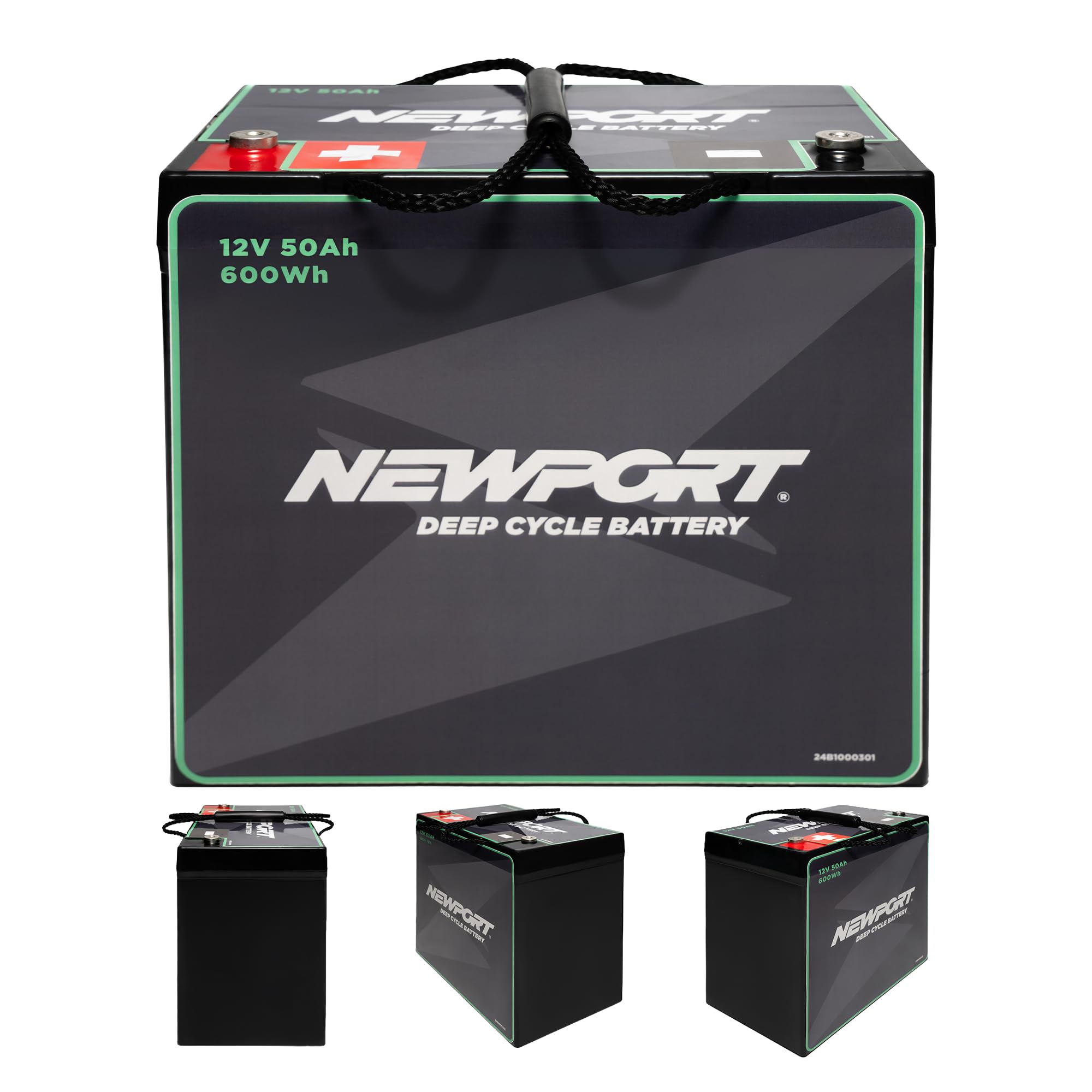
Newport Vessels targets a specific niche with this 50Ah AGM battery: the lightweight marine market for kayaks and small jonboats where every pound counts. At 32 pounds, it is the lightest sealed lead-acid battery in this roundup, and it is designed to work directly with trolling motors. The sealed AGM construction means it is leak-proof and can be mounted in any orientation, a crucial feature for cramped boat compartments.
Kayak anglers report that this battery provides steady power for 4+ hours on a 55lb thrust motor at moderate speeds without voltage sag. One user survived a 20-mph tumble from a truck bed onto asphalt with only cosmetic damage—a testament to the sturdy casing. It also works as a sump pump backup battery, with one homeowner praising its reliability after replacing a failed unit. The price-to-capacity ratio is reasonable for a marine-specific AGM.
The obvious limitation is the 50Ah capacity, which is half of what most deep-cycle applications require. For a full day of heavy trolling, you will likely need to recharge or swap batteries. There is no built-in charge indicator, so an external battery meter is recommended to avoid draining it below safe levels. For light-duty marine use or as a compact backup, it is a fine choice; for anything larger, look to the 100Ah options above.
Why it’s great
- Light and compact for easy kayak transport
- Durable case survived a roll from a truck bed
- Straightforward plug-and-play with trolling motors
Good to know
- Lower 50Ah capacity limits total runtime
- No built-in charge indicator
- Less cost-effective per Ah compared to larger batteries
FAQ
What is the difference between a deep cycle battery and a starting battery?
How many hours will a 100Ah deep cycle battery power my trolling motor?
Is a LiFePO4 battery worth the extra cost over AGM?
Final Thoughts: The Verdict
For most users, the best 12 volt deep cycle battery winner is the Battle Born 100Ah LiFePO4 because of its unmatched balance of reliability, 10-year warranty, and proven real-world performance in RVs and boats. If you want the highest capacity for the money, grab the DUMFUME 150Ah. And for a value-driven upgrade to lithium with app monitoring, nothing beats the HumsiENK 100Ah LiFePO4.