
Our readers keep the lights on and the weekend projects moving. As an Amazon Associate, I earn from qualifying purchases.
That dim dome light, the clock you never set, the alarm system guarding an empty garage — your parked vehicle bleeds battery power every single day. A dedicated solar trickle charger turns your windshield or roof into a live power source, offsetting that parasitic drain and ensuring your engine cranks on the first try, even after weeks of sitting.
I’m Rikta — the co-founder and writer behind FitlyFast. I’ve spent over 80 hours analyzing wattage ratings, charge controller types, connector compatibility, and real-world customer reports across dozens of 12-volt solar maintainers to determine which units deliver reliable, set-and-forget battery care.
From compact dash models to high-wattage roof-mount kits, this guide covers the best 12 volt solar battery charger options for cars, trucks, RVs, boats, and off-grid equipment that needs steady top-off energy.
How To Choose The Best 12 Volt Solar Battery Charger
Picking the right solar trickle charger is less about the brand and more about matching the panel’s electrical output, physical size, and connector type to your specific battery and usage pattern. A mismatch here means either wasted sun energy or a battery that still won’t start.
Wattage and Your Battery’s Daily Drain
The panel’s wattage determines how many amps it can push back into your battery per hour of decent sun. A typical modern car has a parasitic drain of roughly 50–80 mA (0.05–0.08A), so even a 5W panel producing ~0.3A can offset that. Larger batteries in RVs, trucks, or boats with higher standby loads (alarms, GPS trackers, refrigerators) need 15W, 20W, or more to maintain a healthy state of charge. Oversizing by a few watts isn’t harmful — the charge controller will simply stop delivering current once the battery is full.
Charge Controller: PWM vs. MPPT
The charge controller sits between the solar panel and the battery, regulating voltage and preventing overcharging. PWM (Pulse Width Modulation) controllers are simpler and cheaper, but they waste the voltage headroom a panel produces above the battery voltage. MPPT (Maximum Power Point Tracking) controllers convert that excess voltage into extra amps, delivering 20–30% more charging current on a cloudy day or in morning/evening light. For a casual car maintainer, a good PWM controller is adequate. For an RV roof panel that must squeeze every watt out of short winter days, MPPT is the better call.
Connector Types and Installation
The interface between the panel and your battery matters more than most buyers realize. A cigarette lighter plug is the simplest option — just plug into your car’s 12V port — but the port loses power when the ignition is off on many modern vehicles. SAE connectors are common on mid-range kits and allow quick swapping between alligator clamps, ring terminals, or extension cables. MC4 connectors are standard on larger rigid panels and offer a secure waterproof lock. Check your vehicle’s 12V port behavior before committing to a lighter-plug-only model.
Quick Comparison
On smaller screens, swipe sideways to see the full table.
| Model | Category | Best For | Key Spec | Amazon |
|---|---|---|---|---|
| Sun Energise 20W | Premium | All-season RV roof maintenance | 20W monocrystalline, MPPT, IP65 | Amazon |
| SOLPERK 50W | High-Power | Off-grid battery banks & trailers | 50W monocrystalline, 21-30% efficiency | Amazon |
| SUNER POWER 10W | Premium | Weatherproof boat & shed maintenance | 10W MPPT, 3-stage charging algorithm | Amazon |
| SUNAPEX 20W | Mid-Range | Windshield-mount car / SUV maintainer | 20W monocrystalline, ETFE, IP67 | Amazon |
| POWOXI 15W | Mid-Range | Efficient MPPT charging on a budget | 15W MPPT controller, up to 99% efficiency | Amazon |
| ECO-WORTHY 25W | Mid-Range | Dump trailer & remote IoT power | 25W monocrystalline, 23% cell efficiency | Amazon |
| Sunway Solar 8W | Budget | Entry-level car trickle top-off | 8W crystalline, built-in blocking diode | Amazon |
In‑Depth Reviews
1. Sun Energise 20W PRO

The Sun Energise 20W PRO sits at the sweet spot of power and sophistication for serious battery maintenance. It uses a built-in MPPT controller that claims up to 99% tracking efficiency, converting more of that winter morning light into usable amps than a standard PWM controller ever could. The 3-stage charging algorithm — Bulk, Absorption, Float — ensures the battery receives an aggressive initial charge, then tapers to a safe maintenance level without risk of overcharging.
Real-world use on a Ford Transit RV chassis confirmed that this 20W panel held a 12.6V reading over two weeks of cloudy winter storage, preventing the deep-sleep parasitic drain issue common in modern vans. It handled full Florida sun and rain for 1.5 years on a jetski battery without any connector corrosion. The IP65 rating means it resists rain and dust, and the tempered glass face with an ABS frame is strong enough to survive hail and 2400 Pa wind loads.
The only catch is that if your battery voltage dips below 9V, the controller blinks green and refuses to charge — it’s designed to maintain a healthy battery, not resurrect a dead one. The flexible panel also has a tendency to warp when left on a hot dash for days, so consider roof or hood mounting for long-term use.
Why it’s great
- True MPPT controller delivers 20-30% more charge in low light than PWM
- Wide battery compatibility including LiFePO4
- Multiple plug-and-play cables included (clamps, lighter, bare wire)
Good to know
- Will not charge a battery that has dropped below 9V
- Flexible panel can warp under continuous direct dashboard sun
2. SOLPERK 50W

The SOLPERK 50W kit is the brute-force solution for buyers who need to keep an entire battery bank topped off or run a small DC load alongside maintenance. This is a rigid, framed monocrystalline panel with a 60-degree adjustable mount bracket, making it a proper permanent installation for an RV roof, shed, gate opener, or trailer. The 50-watt rating means it can push roughly 3A per peak sun hour — enough to charge a 20Ah lithium battery from 50% to full in one good day.
Customer reports confirm it handles real-world abuse: one user runs a pump for water barrels through a New England winter, collecting enough daylight even in December to keep the battery charged. Another user powers a bank of four Blink cameras with a 20Ah lithium battery, relying on the SOLPERK panel exclusively. The positive feedback is consistent on build quality and ease of assembly, though a few users noted the included 10A controller failed after about three months — the panel itself remains excellent, but the controller is a weak point worth upgrading.
The kit includes a 10-foot SAE extension cable, alligator clips, mounting screws, and a waterproof IP65 controller. The panel’s low-iron tempered glass and aluminum frame can withstand up to 5400 Pa snow loads and 2400 Pa wind pressure, making it viable for harsh climates. For buyers who want a single kit that can handle a wide range of off-grid scenarios, this is the most versatile option in the list.
Why it’s great
- 50W output can charge depleted batteries, not just maintain them
- Adjustable mount bracket with five angle positions
- Rigid aluminum frame lasts 25+ years
Good to know
- Included charge controller reported to fail after a few months by some users
- Heavier and larger than flexible dash panels
3. SUNER POWER 10W

The SUNER POWER 10W is a premium compact unit that packs a built-in MPPT controller into a rigid 10W panel with an adjustable swivel bracket. It’s engineered for the buyer who wants the efficiency gain of MPPT without stepping up to a large roof-mount panel. The improved 3-stage charging (Bulk, Absorption, Float) is the same algorithm found in expensive stand-alone controllers, and the unit provides full protection against overcharge, short circuit, and reverse polarity.
On a boat house battery, this unit delivers consistent maintenance in partial shade, where a PWM controller would struggle. The adjustable bracket lets you tilt the panel toward the sun regardless of roof angle, and the included SAE harness means you can swap between alligator clips, ring terminals, or an extension cable in seconds. One boater reported using it for over two years on a 12V house battery without any drop in output or connector failure.
The main issue reported involves reverse polarity when using aftermarket SAE extension cables — the red light stays solid, indicating reversed wiring. This is a known behavior with SAE connectors that have no polarity standardization. Using the supplied cables or a dedicated reverse polarity adapter solves it. At 10W, it’s too small to recharge a dead battery, but as a dedicated maintainer for a boat, shed, or garage-stored classic car, it’s near-perfect.
Why it’s great
- Built-in MPPT with 99% tracking efficiency
- 3-stage charging extends battery lifespan
- Swivel mount allows angle adjustment
Good to know
- Reverse polarity with third-party SAE cables can cause confusion
- 10W is strictly a maintainer, not a dead battery charger
4. SUNAPEX 20W
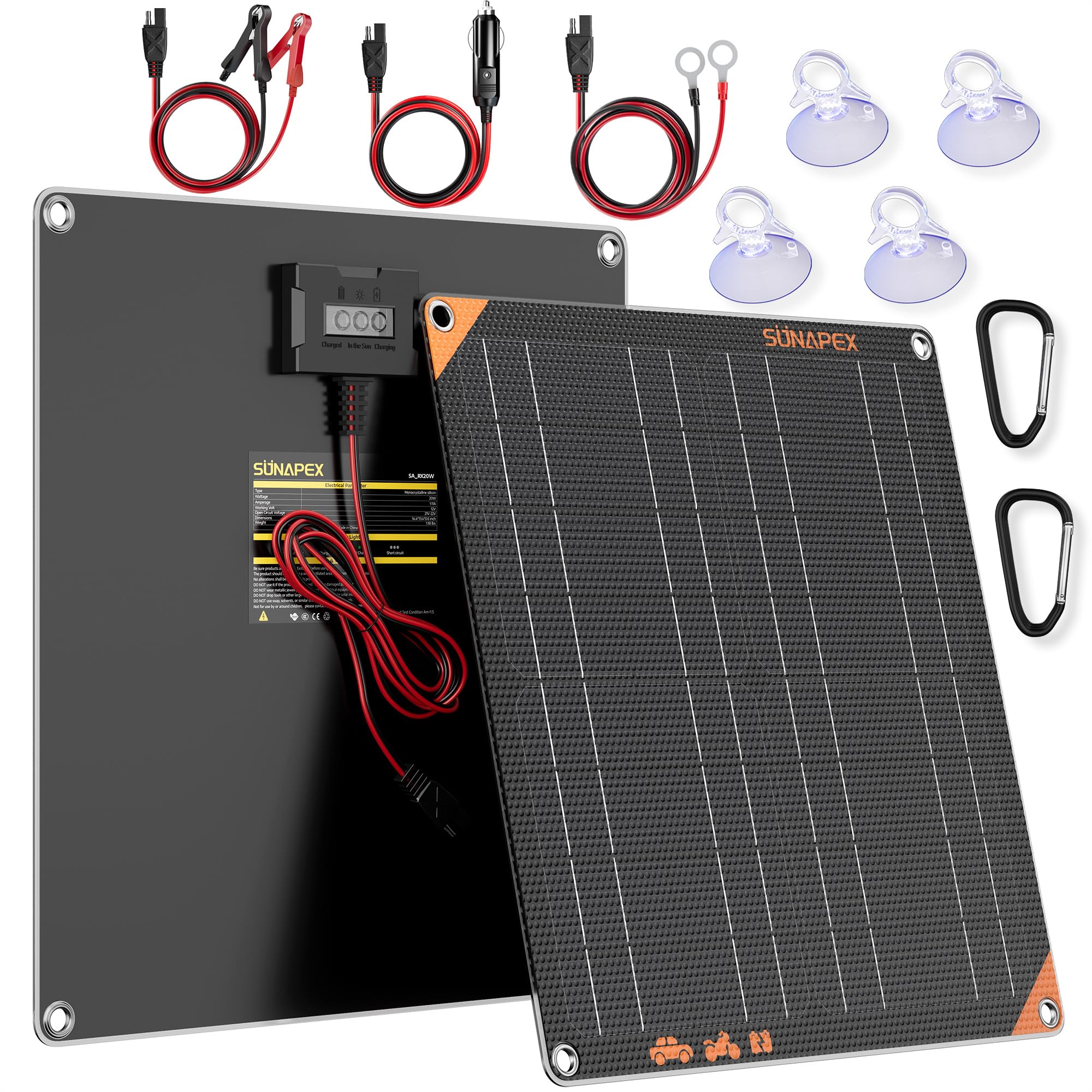
The SUNAPEX 20W stands out for its exceptional weather sealing — IP67 is rare in this category, meaning it’s dust-tight and can survive full immersion in up to a meter of water for 30 minutes. That makes it the best choice for an exposed windshield, boat dash, or any placement where rain and splash are constant threats. It uses monocrystalline cells with 30% efficiency and an ETFE surface coating that sheds water and resists UV degradation better than standard PET panels.
The built-in smart controller uses three color-coded LEDs (blue for sun detection, red for active charging, green for full) that eliminate guesswork. Users report it easily keeps a 3.5L engine battery topped off after weeks of inactivity and maintains an RV chassis battery while boondocking. The 4 included suction cups and carabiners make tool-free mounting a reality — you can swap it between vehicles in under a minute.
The limitation is that the controller will not charge a deeply discharged battery below a certain voltage threshold; it’s strictly a maintainer. The flexible design gets very hot in direct sun, and the green “full” LED can take weeks to appear on a battery with zero initial charge. For a set-and-forget maintainer on a healthy battery, this is one of the most durable and user-friendly options available.
Why it’s great
- IP67 waterproof rating — fully submersible and dustproof
- ETFE surface resists UV and water damage long-term
- Easy suction cup mounting, portable between vehicles
Good to know
- Does not charge deeply discharged batteries below a threshold voltage
- Flexible panel can reach high temperatures on a hot dash
5. POWOXI 15W
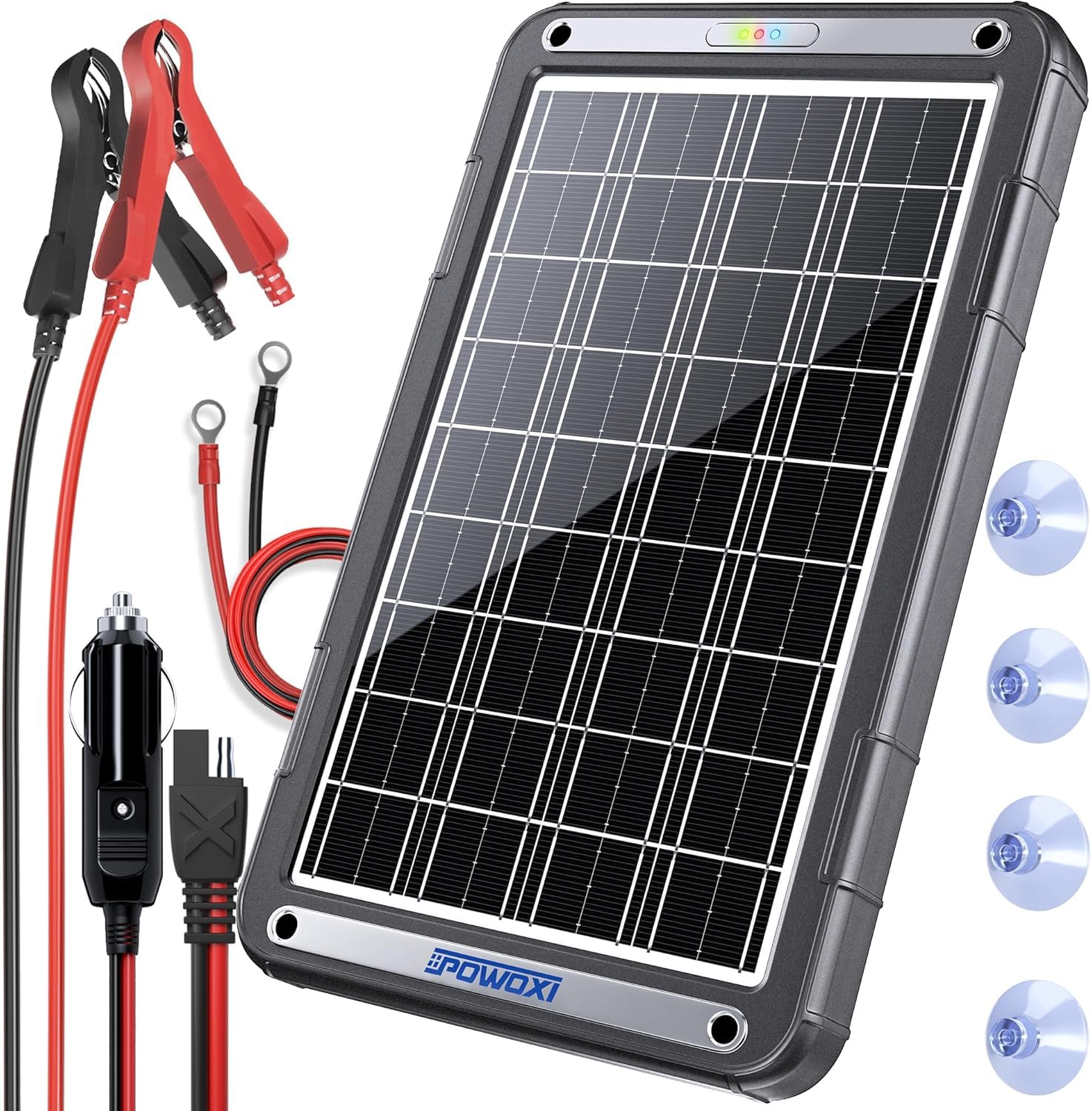
The POWOXI 15W is the budget-friendly entry point into true MPPT charging. Most sub- solar chargers use cheap PWM controllers; this unit packs an MPPT circuit that claims up to 99% conversion efficiency, squeezing more usable current out of low-angle morning sun or heavy overcast. For a car owner who parks on the street under partial shade, this MPPT advantage can mean the difference between a full battery and a slow decline.
Users report that the three-LED system (blue for sunlight, red for charging, green for full) provides clear real-time feedback, and the built-in float mode prevents overcharging automatically. The unit comes with both alligator clamps and a 12V lighter socket adapter, giving you the flexibility to connect directly to the battery or plug into the dash port — but be aware the lighter port route only works if the port stays live with the ignition off. The hardened PC+ABS frame with tempered glass is IP65 rated, so rain and road spray won’t bother it.
At 15W, it’s strong enough to maintain a mid-size truck battery with multiple parasitic loads, but the MPPT takes two seconds to calculate the optimum point each time sunlight changes, so you may not see instant status updates. The included fabric storage bag is a nice touch for stowing the panel when not in use, though most users leave it mounted permanently.
Why it’s great
- Rare MPPT controller at this price tier
- Includes both battery clamps and lighter socket adapter
- CE/ROHS certified, backed by lifetime technical support
Good to know
- MPPT takes ~2 seconds to lock onto the power point after sun shifts
- Lighter plug only works if your vehicle’s 12V port is always-on
6. ECO-WORTHY 25W
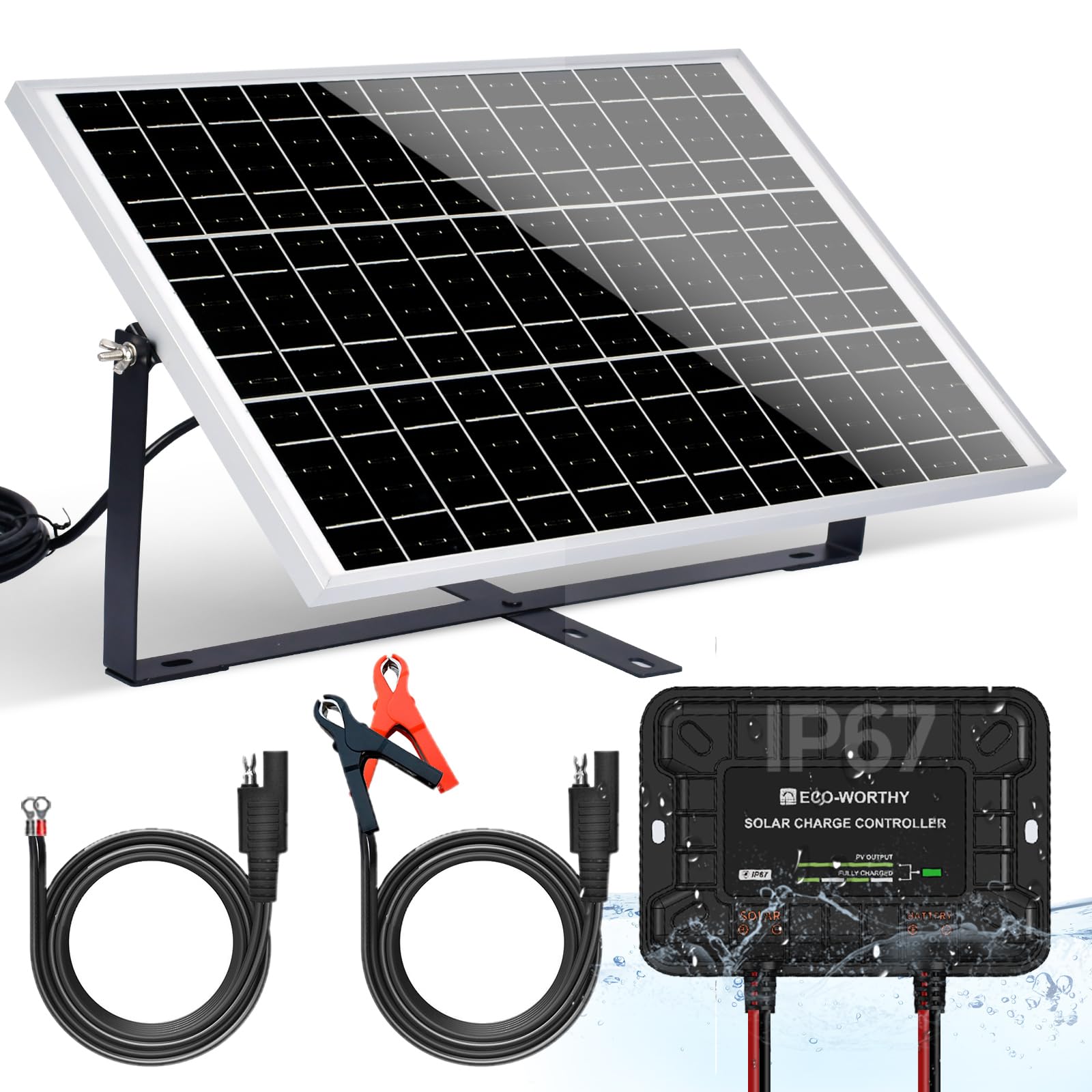
The ECO-WORTHY 25W kit delivers 25% more rated power than the 20W standard at a similar price point, making it an excellent value for buyers who need to charge and maintain multiple battery chemistries including LiFePO4, AGM, SLA, and lithium-ion. The 25W monocrystalline panel uses A+ cells with up to 23% efficiency and a low-iron tempered glass surface with a corrosion-resistant aluminum frame. The included PWM controller is fully sealed and draws zero power at night.
Real-world testing on a 11.9V motorcycle battery showed the panel delivering 14.3V at the start and bringing the battery to 12.5V in two hours of full sun, confirming it can recover a slightly depleted battery, not just maintain one. Another user runs a 20Ah lithium pack with this panel for a remote solar power station, charging without issues. The mounting bracket and O-rings allow a secure tilt-mount installation on a roof or post.
The controller is PWM, not MPPT, which means some potential wattage is lost on variable-sun days — but at 25W, the raw power often compensates. A few users noted the included cable is a bit short for installations where the controller needs to be mounted far from the panel. For a reliable, straightforward kit that prefers raw wattage over controller sophistication, this is tough to beat.
Why it’s great
- 25W panel offers 25% more power than standard 20W kits at similar cost
- Works with LiFePO4, AGM, SLA, and lithium batteries
- Zero standby power drain at night
Good to know
- PWM controller is less efficient in low light than MPPT
- Controller cable is short; may need extension for remote mounting
7. Sunway Solar 8W

The Sunway Solar 8W is the straightforward, no-frills option for the buyer who just wants to stop their daily-driver battery from dying after a long weekend. It plugs directly into your cigarette lighter socket, and the built-in blocking diode prevents reverse current from draining your battery at night. The 8W panel uses crystalline cells covered with ultra-clear tempered glass and an ABS plastic frame, making it light enough (2.67 lbs) to stick to your windshield with the included four suction cups.
Users report reliable trickle charging for cars, motorcycles, boats, and tractors. The LED indicator lights up when the panel is receiving sunlight and charging, providing simple confirmation that the system is working. For a spring-to-fall daily driver that sits for a few days at a time, this panel provides adequate maintenance without any wiring complexity.
The 8W rating is modest — it will not recover a deeply discharged battery, and performance drops noticeably on overcast days. The lighter plug connection is the simplest to use, but if your 12V port is switched off with the ignition, this panel simply won’t work for you. Also, some users noted the lack of a separate charge controller means there is no float mode protection, though the small panel size and low current make overcharging unlikely in practice.
Why it’s great
- Plug-and-play with any 12V cigarette lighter socket
- Includes both lighter adapter and alligator battery clamps
- Lightweight design with suction cups for windshield mounting
Good to know
- Requires the 12V port to be always-on — not compatible with switched ports
- No charge controller means no advanced protection features
FAQ
How many watts do I need to maintain a standard car battery?
Will a solar trickle charger work through a windshield or tinted glass?
Can I connect multiple solar panels together for more power?
What is the difference between a trickle charger and a battery maintainer?
How long does it take a solar charger to bring a dead battery back to life?
Final Thoughts: The Verdict
For most users, the best 12 volt solar battery charger winner is the Sun Energise 20W PRO because it combines a true MPPT controller, flexible installation options, and enough wattage to handle both car and RV battery maintenance in all seasons. If you need raw power for a trailer or off-grid battery bank, grab the SOLPERK 50W. And for a portable, IP67-rated windshield maintainer that works across multiple vehicles, nothing beats the SUNAPEX 20W.