
Our readers keep the lights on and the weekend projects moving. As an Amazon Associate, I earn from qualifying purchases.
The moment the lights cut out, the clock starts ticking on your freezer, your well pump, and your family’s comfort. A generator in this class needs to deliver real starting surge for heavy loads like central AC compressors and deep-well pumps without voltage sag that damages electronics. That 12,000-watt peak rating isn’t just a number—it’s the difference between keeping your home fully operational and wrestling with extension cords in the dark.
I’m Rikta — the co-founder and writer behind FitlyFast. I’ve spent countless hours analyzing engine displacement, copper winding quality, fuel system designs, and real-world voltage stability across the full range of portable generators in this power tier.
The right 12,000 watt generator balances raw starting power with fuel flexibility, runtime efficiency, and noise control, so your backup solution works as reliably on day five of an outage as it does on day one.
How To Choose The Best 12,000 Watt Generator
Choosing a generator in this power class means understanding what 12,000 peak watts actually powers in your home. The wrong choice leaves you with a machine that can’t start your AC compressor or a model that burns through fuel so fast you’re making supply runs every six hours. Focus on three pillars: starting surge capacity, fuel type flexibility, and runtime at realistic loads.
Real-World Starting Surge vs. Running Watts
Every motor-driven appliance—well pump, HVAC compressor, refrigerator compressor—draws 3-7 times its running wattage for a split second on startup. A generator with 12,000 peak watts might deliver only 9,500 running watts, which determines what you can run continuously. Check the locked-rotor amps of your well pump and the LRA of your AC unit; if the generator’s surge can’t handle that brief spike, the voltage collapses and the motor stalls. Engines around 459-500cc with cast iron sleeves tend to handle surge events more consistently than smaller-displacement units.
Fuel Architecture: Dual-Fuel vs. Tri-Fuel vs. Inverter
Dual-fuel generators burn gasoline and propane, offering a backup fuel source when gas stations lose power or supply chains tighten. Tri-fuel adds natural gas, which means an unlimited fuel supply if your gas meter is functional, but peak watts on natural gas are typically 15-20% lower than on gasoline due to the lower BTU content. Inverter generators in the 12,000-watt class use variable engine speed to match load, cutting fuel consumption by up to 50% and producing cleaner power (under 3% THD) safe for sensitive electronics, but they usually carry a higher upfront investment.
Noise, CO Safety, and Portability
A 12,000-watt open-frame generator at full load is loud—expect 75-82 dBA from a distance of 23 feet. Inverter models can drop to 64 dBA, making them neighborhood-friendly during overnight operation. CO shield technology has become standard on most new models; it automatically shuts down the generator if carbon monoxide reaches a dangerous concentration inside an enclosure. For portability, look for a fold-down handle and never-flat wheels, as these units weigh between 210 and 230 pounds when fully fueled.
Quick Comparison
On smaller screens, swipe sideways to see the full table.
| Model | Category | Best For | Key Spec | Amazon |
|---|---|---|---|---|
| Generac GP9500 Tri-Fuel | Tri-Fuel | Whole-home backup on natural gas | 500cc OHV / 10.5 hr runtime | Amazon |
| Westinghouse iGen12000TFc | Inverter/Tri-Fuel | Quiet, electronic-safe power | 457cc inverter / ≤3% THD | Amazon |
| Champion 12,500 Tri-Fuel | Tri-Fuel | Tri-fuel with strong warranty | 500cc / 10,000W running | Amazon |
| GENMAX GM10500iETC | Inverter/Tri-Fuel | Silent operation, remote start | 458cc inverter / 64 dBA | Amazon |
| DuroMax XP12000HX | Dual-Fuel | All-copper windings durability | 457cc / CO Alert safety | Amazon |
| DuroStar DS13000MX | Dual-Fuel | High output at a competitive price | 500cc / 13,000W peak | Amazon |
| Westinghouse 12,500W Dual-Fuel | Dual-Fuel | Remote key fob convenience | 457cc / 12 hr runtime | Amazon |
| Pulsar G12KBN-SG | Dual-Fuel | 8-gallon tank for long runs | 457cc / 12 hr half-load | Amazon |
| Generac 12,500W Tri-Fuel | Tri-Fuel | Rugged build, covered outlets | 500cc / 10.5 hr runtime | Amazon |
| A-iPower AP10700E | Gasoline | Budget-friendly whole-home surge | 459cc / CO sensor | Amazon |
| EcoFlow Smart Generator 4000 | Inverter/Dual-Fuel | Battery charging & smart control | 3200W DC / 70 dBA | Amazon |
| EcoFlow DELTA Pro 3600Wh | Solar/Battery | Zero-emission indoor backup | 3600W AC / 2.7 hr fast charge | Amazon |
| Jackery Solar Generator 5000 Plus | Solar/Battery | Maximum home battery backup | 7200W surge / 5040Wh | Amazon |
In‑Depth Reviews
1. Generac GP9500 Tri-Fuel
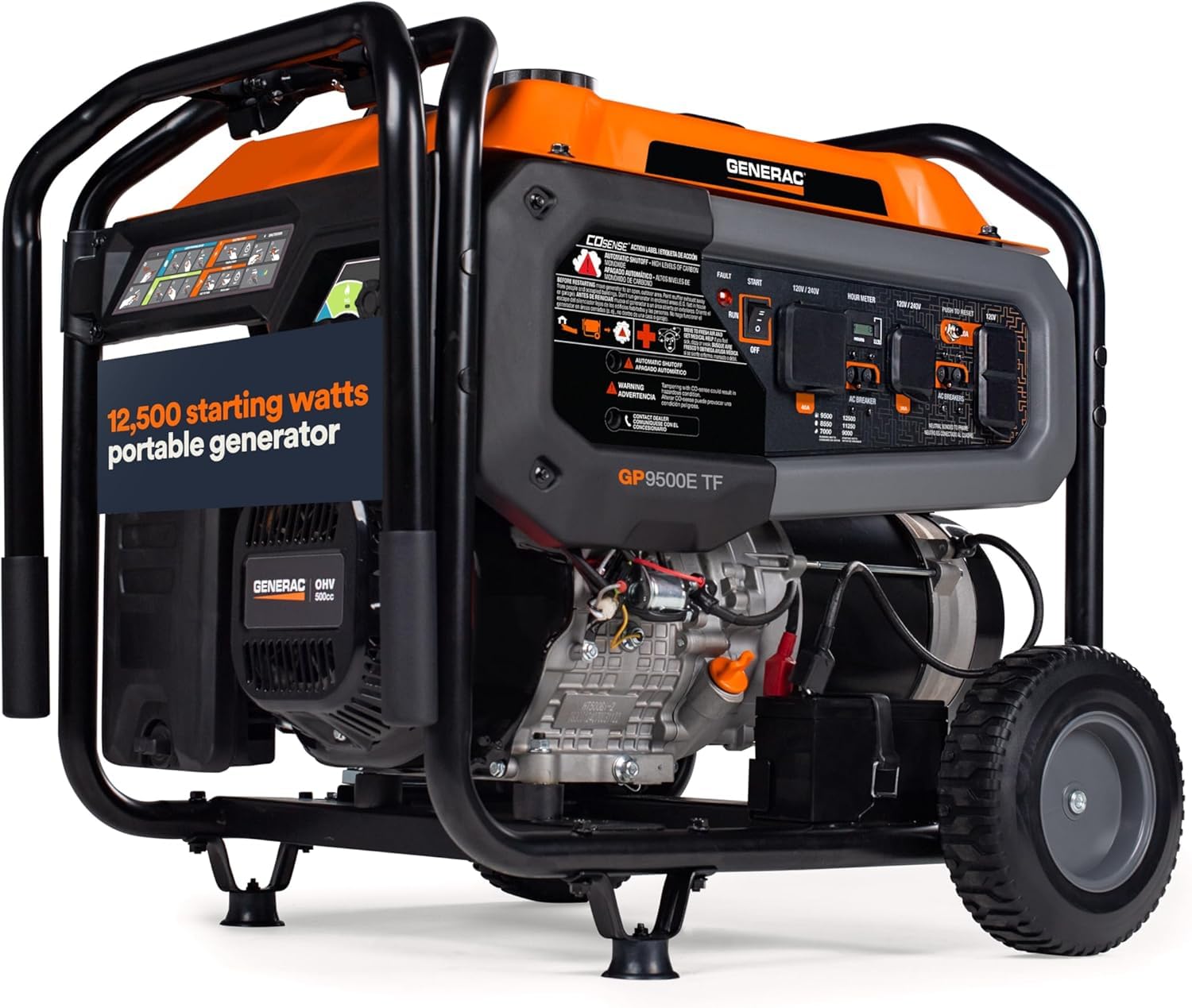
Generac’s GP9500 packs a 500cc OHV engine into a tri-fuel platform that seamlessly switches between gasoline, propane, and natural gas via a simple fuel selector dial. The 12,500 starting watts and 9,500 running watts provide ample surge capacity for a 3.5-ton AC unit and a well pump simultaneously, and the 7.5-gallon steel tank delivers up to 9.5 hours of runtime at 50% load on gasoline.
What sets this apart is the COsense carbon monoxide detection technology—it continuously monitors ambient CO levels and automatically shuts the generator down if a dangerous concentration builds up, which is critical when operating near a garage or enclosed porch. The electric push-button start with included rechargeable battery eliminates pull-cord hassle during cold-weather outages, and the covered weather-resistant outlets protect connections in rain or snow.
Real-world users report powering a 2,600+ square foot house including refrigerator, stove, microwave, fans, water pump, and boiler for three-day outages on just ten gallons of gas. The natural gas conversion kit and propane hose are included out of the box, so you don’t need to source separate parts for the tri-fuel setup. The rugged steel tube cradle and never-flat wheels make it transportable across rough terrain despite the 219-pound dry weight.
Why it’s great
- Tri-fuel runs on natural gas for indefinite runtime
- COsense auto-shutdown for family safety
- 500cc engine provides strong starting surge
Good to know
- Natural gas hookup may require a certified plumber
- Runs at open-frame noise levels (not inverter-quiet)
2. Westinghouse iGen12000TFc
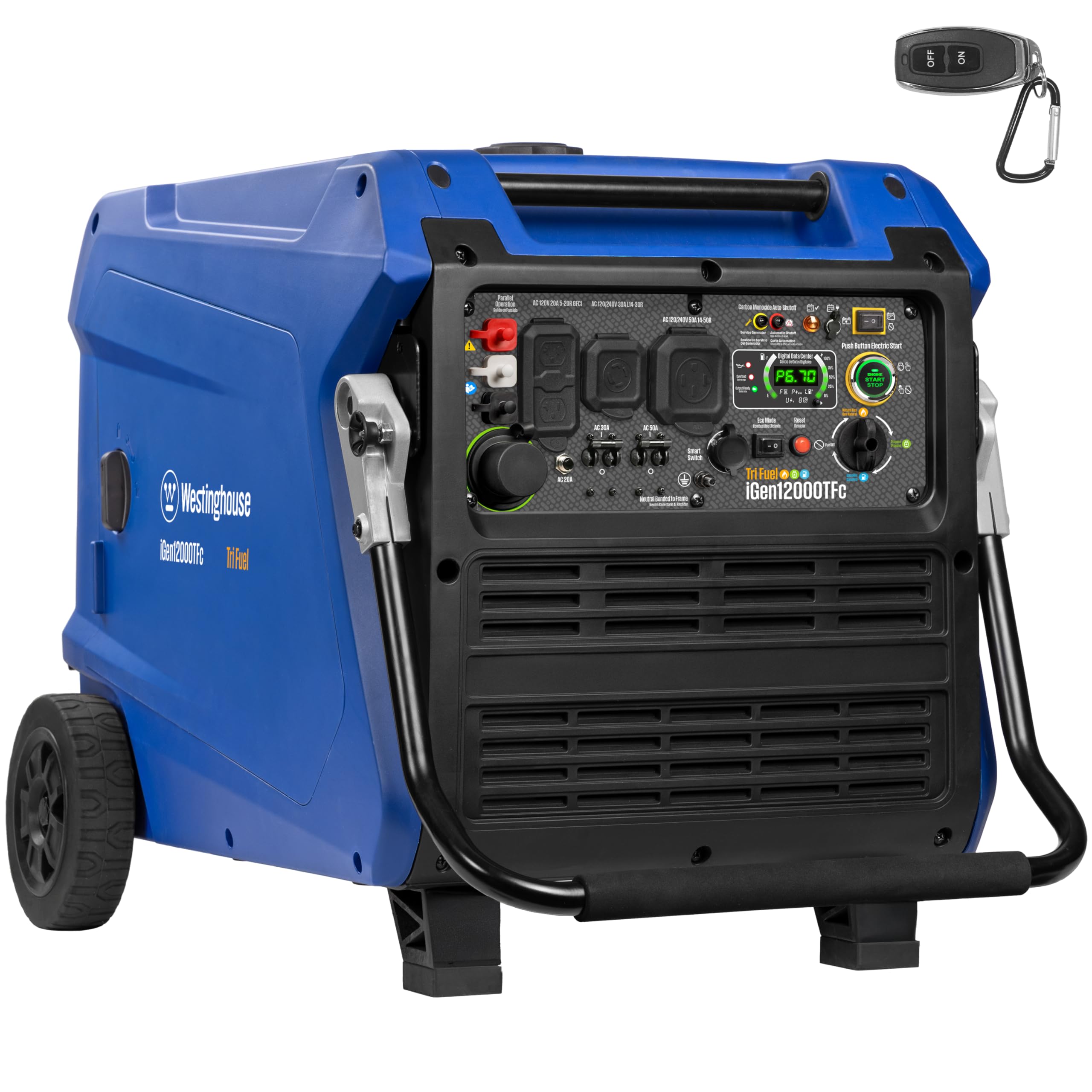
The iGen12000TFc is a tri-fuel inverter generator that delivers 12,000 peak watts (9,000 running) on gasoline, with equivalent propane and natural gas ratings, while maintaining under 3% total harmonic distortion. This low THD makes it safe for sensitive electronics like home theater systems, computer servers, and variable-speed well pump controllers that can be damaged by dirty power from standard generators.
Its inverter technology automatically adjusts engine speed to match the load, cutting fuel consumption by up to 50% compared to a conventional open-frame generator running at full RPM constantly. The 7.9-gallon fuel tank yields up to 19 hours of runtime at 25% load, and the noise level drops to as low as 64 dBA—quiet enough for overnight operation in a suburban neighborhood. The remote start key fob, push-button, and recoil start give you three ways to fire up the 457cc engine.
Users report charging a Tesla Model Y at 32A/220V on propane and running the entire house while maintaining conversation-level noise. The digital data center shows fuel level, power output, remaining run time, and lifetime hours in real time. It’s parallel-capable if you need to double output, and the 50A outlet is transfer-switch ready. At 191 pounds, it’s lighter than many open-frame competitors despite the fully enclosed inverter housing.
Why it’s great
- Under 3% THD protects sensitive electronics
- 64 dBA quiet enough for overnight neighborhood use
- Tri-fuel with up to 19-hour runtime
Good to know
- Peak watts lower on natural gas (9,800W)
- Premium investment for inverter technology
3. Champion 12,500 Tri-Fuel

Champion’s 12,500-watt tri-fuel generator runs on gasoline, propane, or natural gas straight out of the box—both the LPG and natural gas hoses are included along with the battery and engine oil. The 500cc engine delivers 10,000 running watts on gasoline, 9,000 on propane, and 8,000 on natural gas, with an electric rocker switch start that fires reliably even after months of storage.
The Intelligauge display tracks voltage, frequency, session run time, and total run time, helping you schedule oil changes and monitor load balance. The CO Shield carbon monoxide auto-shutoff system adds an essential safety layer for anyone operating the generator near living spaces. At 231 pounds, it’s one of the heavier units in this class, but the wheel kit and fold-down handle make it movable for its intended stationary backup role.
Customer feedback highlights easy setup, push-button convenience, and the ability to run an entire home AC system without strain. Some units have experienced oil leaks from the shipping process or after initial setup, which Champion’s three-year limited warranty covers. The natural gas option is especially valuable for homeowners with existing gas lines who want to eliminate fuel storage entirely.
Why it’s great
- Includes both LPG and natural gas hoses
- Intelligauge tracks key operating data
- Three-year warranty with lifetime support
Good to know
- Some reports of oil leaks from shipping
- On the heavier side at 231 pounds
4. GENMAX GM10500iETC

The GENMAX GM10500iETC is a tri-fuel inverter generator that produces 10,500 starting watts (8,500 running) on gasoline, 9,500/8,000 on LPG, and 8,400/6,800 on natural gas, with total harmonic distortion under 3% for protecting sensitive electronics. Its 458cc single-cylinder engine runs inside a fully enclosed, sound-dampened housing that keeps noise levels low enough for conversation nearby—a major advantage over open-frame units that dominate this power class.
It features remote start via key fob in addition to electric and recoil start, an ATS (automatic transfer switch) control port for standby automation, and a neutral floating design that can be bonded for portable use with a separate bonding plug. The control panel includes a 50A 14-50R outlet, a 30A L14-30R twist-lock, four 120V GFCI 20A outlets, and a 12V DC cigarette outlet. GENMAX includes a rain cover, LPG hose, NG hose with quick connector, and a leave-in battery charger.
Users running on natural gas report very quiet operation—a noticeable step down from traditional generators—and successful simultaneous load handling of a 3-ton central AC and a well pump with proper sequencing. Some early units shipped without a paper manual (digital-only), and a few users experienced surging under light load that required the low-idle switch adjustment. The magnetic dipstick is a thoughtful touch for monitoring oil condition during break-in.
Why it’s great
- Tri-fuel inverter with quiet enclosed design
- ATS port for automatic standby mode
- Includes NG and LPG hoses plus rain cover
Good to know
- Some units need low-idle adjustment for light loads
- No paper manual included; email required
5. DuroMax XP12000HX

DuroMax’s XP12000HX uses a 457cc OHV engine with all-copper windings in the alternator—a construction detail that improves heat dissipation and extends the generator’s lifespan under sustained high-load use. It delivers 12,000 peak watts and 9,500 running watts on gasoline, with slightly lower figures on propane, and includes CO Alert automatic shutdown for carbon monoxide safety.
The power panel includes four 120V GFCI household outlets, one 120V 30A outlet, one 120/240V 30A twist-lock, and a heavy-duty 120/240V 50A outlet, making it transfer-switch ready. The front-facing interface lets you switch fuel types in seconds without tools. Owners report running lights, two refrigerators, a hot tub, and various electronics through an interlock system without voltage complaints.
Some users note the XP12000HX is loud and heavy (222 pounds), but the foldable handle and never-flat wheels help with positioning. A common tip from the community is to replace the factory spark plug with an NGK BPR6RES before extended use, as a few units experienced backfiring after months of propane storage due to spark plug degradation. DuroMax’s CO Alert safety system adds critical protection for operating in partially enclosed spaces.
Why it’s great
- All-copper windings for long-term durability
- 50A outlet ready for transfer switch
- Fast fuel type switching on front panel
Good to know
- Spark plug may need early replacement
- Noise level is typical for open-frame
6. DuroStar DS13000MX

The DuroStar DS13000MX packs a 500cc engine that produces 13,000 peak watts and 9,500 running watts on gasoline, with dual-fuel capability for propane operation. This engine is one of the largest displacements in its price tier, giving it strong starting torque for demanding loads like a well pump or central AC with a high locked-rotor amp rating.
It features push-button electric start, a CO alert automatic shutoff, and a transfer-switch ready 50A outlet. The all-metal construction with reinforced power panel is designed to withstand harsh weather, and the included wheel and handle kit makes it manageable despite the 220-pound weight. Users report powering entire homes with ease, running a titanium 225 stick welder on the 240V setting without strain.
Gasoline economy is reasonable for the class—users note 12-13 hours on seven gallons at moderate load. The propane regulator and hose are included, and the dual-fuel selector is simple to operate. Some units may arrive requiring minor assembly adjustments to the handle, and the open-frame design produces standard noise levels for this power class.
Why it’s great
- 500cc engine delivers strong starting torque
- 13,000W peak provides headroom for surge loads
- Durable all-metal construction
Good to know
- No natural gas option—dual-fuel only
- Minor assembly may be required
7. Westinghouse 12,500W Dual-Fuel

Westinghouse’s 12,500W dual-fuel generator uses a 457cc cast-iron sleeve engine and comes with a remote start key fob in addition to electric and recoil start—a convenience that lets you start the generator from inside your home during a storm. It provides 9,500 running watts on gasoline and 8,500 on propane, with a 6.6-gallon fuel tank delivering up to 12 hours of runtime.
The power panel includes two GFCI 120V 20A household outlets, one transfer-switch ready 120V L14-30R 30A outlet, and one RV-ready 120/240V 14-50R 50A outlet, all with rubber covers for weather protection. Automatic low-oil shutdown and CO sensor provide essential safety, and the digital hour meter helps track maintenance intervals.
Users consistently praise the remote start reliability (works on the third button cycle), the thorough included tool kit and oil, and the overall build quality that earned it recommendations from Consumer Reports and Popular Mechanics. The unit loses some efficiency at high altitude, but a separate high-altitude carburetor kit is available from Westinghouse. At 212 pounds, it’s lighter than many competitors in this wattage class.
Why it’s great
- Remote key fob start for storm convenience
- Cast iron sleeve engine for longevity
- Thorough accessory kit includes oil and tools
Good to know
- High-altitude operation requires separate kit
- No natural gas option—dual-fuel only
8. Pulsar G12KBN-SG

The Pulsar G12KBN-SG features an 8-gallon fuel tank—one of the largest in this class—providing up to 12 hours of continuous operation at half load on gasoline. Its 457cc single-cylinder OHV engine produces 12,000 peak watts and 9,500 running watts on gasoline, with 10,800 peak and 8,550 running on LPG.
The control panel is laid out with four 120V 20A AC outlets, one 120/240V 30A twist-lock, one 120/240V 50A outlet, and one 12V DC output. Electric start with included battery makes startup simple, and the dual-fuel capability means you can switch to propane if gasoline supplies run low. The powder-coated steel frame and mobility kit (wheels and handles) are included.
Real-world feedback shows this unit can run a 2,600-square-foot home including AC, freezer, fridge, TVs, and microwave for 16 hours without refueling. Some users report DOA units or warranty claim delays, particularly during high-demand hurricane seasons, and the engine requires a break-in period with early oil changes to remove metal shavings from manufacturing. It runs quieter than expected for its size, according to many owners.
Why it’s great
- 8-gallon tank provides extended runtime
- 50A outlet for transfer switch hookup
- Quieter than typical open-frame models
Good to know
- Some units arrive DOA or with shipping damage
- Break-in oil changes critical for longevity
9. Generac 12,500W Tri-Fuel
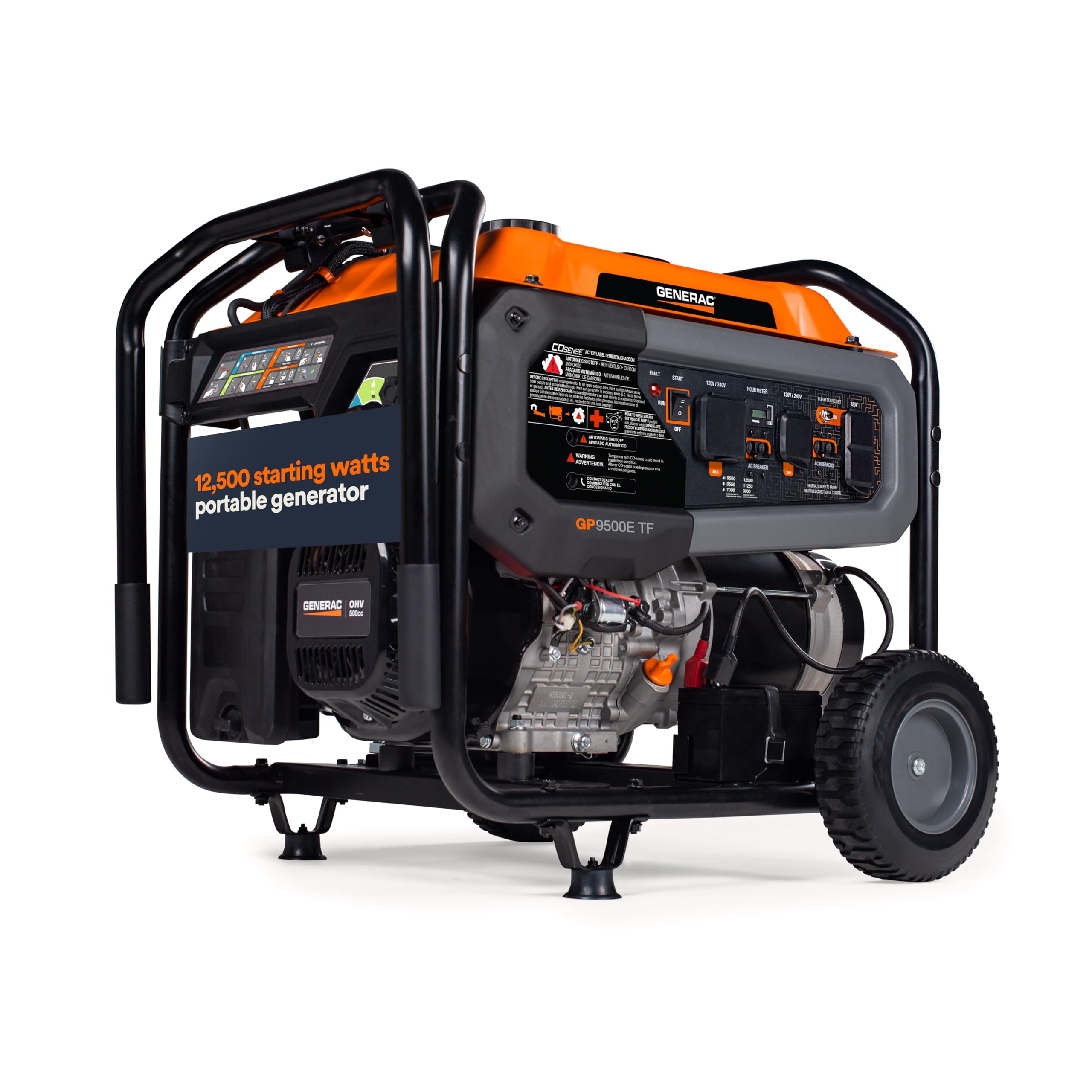
This Generac GP9500 variant prioritizes rugged durability with covered weather-resistant outlets, a steel-tube cradle frame, and heavy-duty never-flat wheels that handle rough terrain. The 500cc OHV engine provides 12,500 starting watts and 9,500 running watts, with tri-fuel capability across gasoline, propane, and natural gas through a fuel source selector that prevents shutdown during fuel switching.
The large-capacity steel fuel tank with built-in gauge delivers up to 10.5 hours of runtime at 50% load on gasoline. The electric start with included battery eliminates manual cranking, and COsense technology monitors ambient carbon monoxide levels for automatic shutdown. Users highlight the straightforward assembly, high-quality construction, and the ability to run critical household loads for 36 continuous hours during an outage.
At 227 pounds, this is a heavy unit that benefits from the included wheel kit for positioning. Some customers note that the natural gas conversion process requires a certified plumber for proper installation, and a small number of units have experienced issues that required a return. The three-fuel flexibility makes it a strong candidate for homeowners with existing natural gas lines who want to avoid fuel storage.
Why it’s great
- Weather-resistant covered outlets for harsh conditions
- Tri-fuel with seamless fuel switching
- Rugged steel-tube cradle frame
Good to know
- Natural gas hookup may require professional plumber
- Heavier than many competitors at 227 pounds
10. A-iPower AP10700E
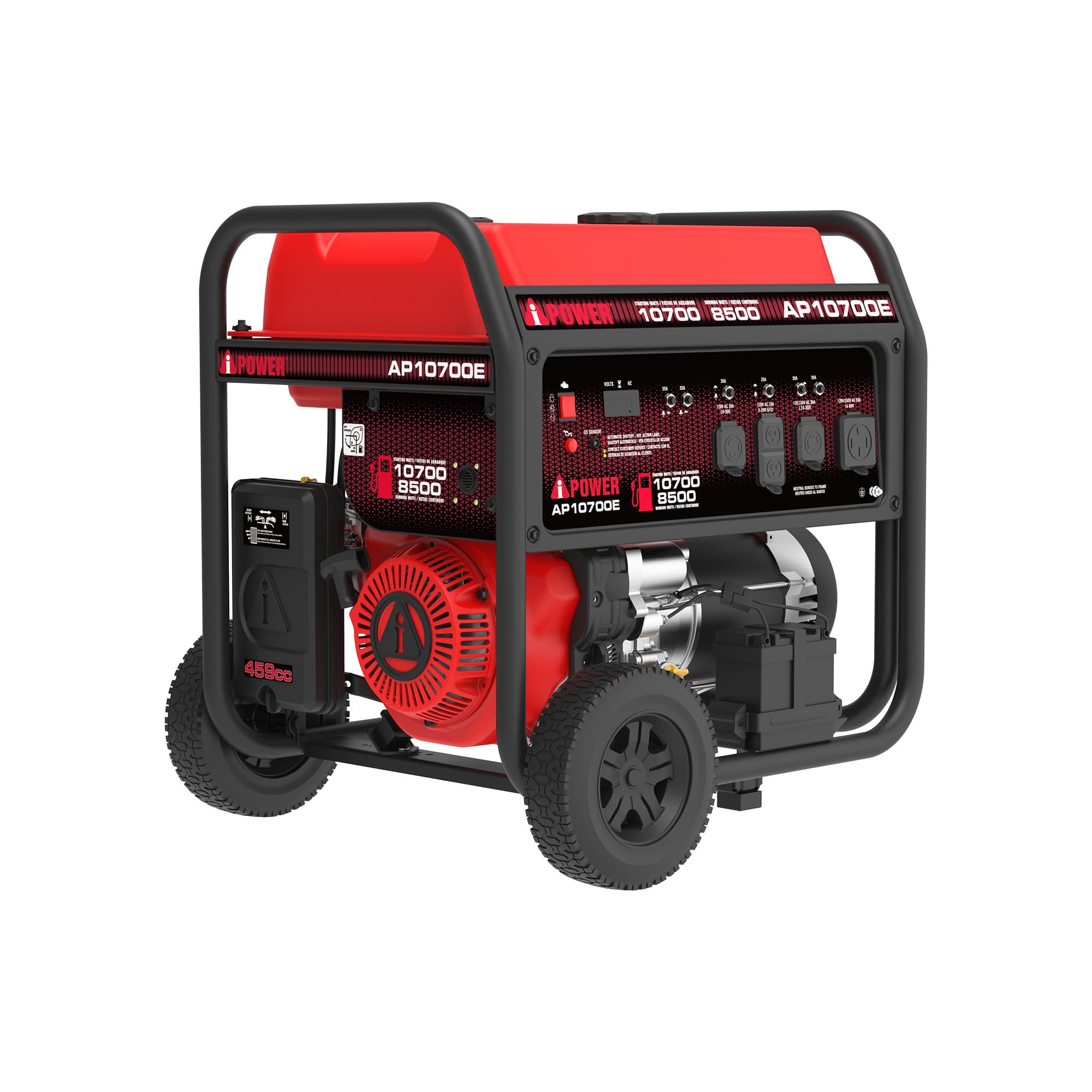
The A-iPower AP10700E offers a budget-friendly entry point to the 10,000+ watt surge class, with a 459cc OHV cast-iron sleeve engine producing 10,700 starting watts and 8,500 running watts on gasoline. It includes both electric push-button start and recoil backup, plus automatic idle control that reduces engine speed when loads drop—saving fuel and reducing noise during light-demand periods.
The control panel features a CO sensor with indicator light, digital data center, two 120V GFCI outlets, one 120V 30A twist-lock, one 120/240V 30A twist-lock, and a 50A 120/240V outlet for transfer switch readiness. Users report handling a 6kW load including a 3.5-ton AC and 2HP well pump with only brief voltage sag on startup, and the 7-gallon tank delivers 12-13 hours of runtime under moderate load.
Some customers note the frequency runs slightly high (60.5-62.5 Hz), which can cause some APC UPS units to cycle unnecessarily. Others report that the GFI outlets may trip after extended storage, requiring a reset before power returns. The unit weighs 220.5 pounds and moves on an included wheel kit, and A-iPower backs it with a 2-year limited warranty.
Why it’s great
- Automatic idle control saves fuel and cuts noise
- Cast iron sleeve engine for longevity
- 50A outlet for transfer switch readiness
Good to know
- Frequency may be high for sensitive UPS units
- GFI outlets may trip after storage
11. EcoFlow Smart Generator 4000

The EcoFlow Smart Generator 4000 is a fundamentally different approach to backup power—it’s a dual-fuel inverter generator designed primarily to charge EcoFlow DELTA Pro power stations via 3200W DC fast charging, achieving 40% better fuel efficiency than running a traditional generator directly. It produces 1900W of AC output on its own, but its real value is as a battery-charging companion for whole-home solar battery systems.
It offers seven quick-start and six quick-shutdown methods, including auto-start/stop based on the connected power station’s battery level, night-care mode, and PV-priority mode. The EcoFlow app provides real-time monitoring of CO concentration, temperature, oil level, and overload alerts with automatic shutdown. At 83 pounds with wheels, it’s far more portable than any conventional 12,000W class generator.
Users with DELTA Pro or DELTA Pro 3 setups report virtually limitless backup power when pairing the smart generator with a propane tank and solar panels—the generator only runs when the battery drops to a set threshold, dramatically reducing fuel consumption and noise. Some users experienced FedEx delivery issues, and the unit is not CARB-approved so it cannot be sold in California. The 3-year warranty and responsive customer support are positives.
Why it’s great
- 40% better fuel efficiency charging batteries vs. direct AC
- App-based auto start/stop for hands-off operation
- Compact and portable at 83 pounds
Good to know
- Requires EcoFlow power station for full benefit
- Not CARB approved—sold in 49 states only
12. EcoFlow DELTA Pro 3600Wh
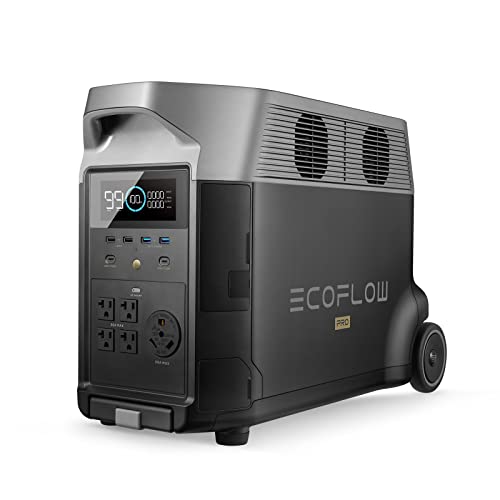
The EcoFlow DELTA Pro is a 3600Wh LiFePO₄ battery power station with 3600W continuous AC output (7200W surge with X-Boost), suitable for powering most household circuits without the noise, fumes, or fuel storage of a gasoline generator. It can be expanded from 3.6kWh up to 25kWh with extra batteries, and two units can be paired for 7200W of output—enough to handle a 5-ton AC unit or a well pump.
X-Stream fast charging fills the battery from a wall outlet in 2.7 hours (1800W) or 1.8 hours with a 240V outlet (3000W). Solar charging at up to 23% efficiency allows off-grid recharging with up to four 400W panels. The EcoFlow app provides full remote monitoring of charge level, temperature, input/output power, and energy consumption history. It features 15 output ports including five 120V AC outlets, USB-C (100W), and a car outlet.
Users appreciate the pass-through mode that automatically switches to battery during outages, keeping refrigerators, freezers, and medical equipment running without interruption. The 99-pound unit is heavy but usable indoors—a major advantage during winter storms or extreme heat when running a gas generator outside in dangerous conditions isn’t practical. It qualifies for the 30% Residential Clean Energy Tax Credit on qualified solar equipment.
Why it’s great
- Zero emissions, safe for indoor use
- Expandable to 25kWh for extended outages
- Fast AC and solar charging with app control
Good to know
- Premium investment compared to gas generators
- Heavy at 99 pounds; not truly portable daily
13. Jackery Solar Generator 5000 Plus

The Jackery Solar Generator 5000 Plus bundles a 5040Wh LiFePO₄ power station with six 85W solar panels (500W total) for a complete solar backup system that can run major home appliances with 7200W of surge capacity (3600W continuous). It supports both 120V and 240V output, which means it can power a 5-ton central AC unit or a water heater—loads that most portable power stations cannot handle.
The system is expandable up to 60kWh with additional batteries, good for 13+ days of essential backup. Solar recharging takes about 2 hours at up to 4000W input using high-voltage panels, and ChargeShield 2.0 technology extends battery cycle life to an estimated 11 years of daily use. The Jackery 60A Smart Transfer Switch enables connection to up to 12 circuits at 120V or 6 circuits at 240V for whole-home integration.
Users highlight the peace of mind from having a deep, expandable battery reserve without fuel storage concerns. Some units have experienced pass-through charging issues (F6 error codes) when connected to a transfer switch, requiring firmware updates from Jackery. At 190.5 pounds, this is a stationary system—not something you move between locations—but it provides true whole-home backup without combustion. Delivery coordination can be an issue due to the weight.
Why it’s great
- 7200W surge powers large appliances including 5-ton AC
- Expandable to 60kWh for extended outages
- Solar recharges in ~2 hours for off-grid use
Good to know
- Very heavy; not intended for frequent relocation
- Pass-through charging may need firmware updates
FAQ
Can a 12,000 watt generator run my central air conditioner and well pump simultaneously?
What is the runtime difference between gasoline, propane, and natural gas on a tri-fuel generator?
How close to my house can I safely operate a 12,000 watt generator?
Is a 12,000 watt inverter generator worth the premium over a conventional open-frame model?
Do I need a transfer switch or can I use extension cords with a 12,000 watt generator?
Final Thoughts: The Verdict
For most users, the 12,000 watt generator winner is the Generac GP9500 Tri-Fuel because it offers the rare combination of a 500cc engine, seamless tri-fuel switching including natural gas, COsense safety technology, and a price that undercuts many dual-fuel competitors while delivering whole-home surge capacity. If you want ultra-quiet operation and clean power for sensitive electronics, grab the Westinghouse iGen12000TFc. And for zero-emission, battery-solar backup that powers large appliances without fuel, nothing beats the Jackery Solar Generator 5000 Plus.